| 规格 | 价格 | 库存 | 数量 |
|---|---|---|---|
| 5mg |
|
||
| 10mg |
|
||
| 25mg |
|
||
| 50mg |
|
||
| 100mg |
|
||
| 250mg |
|
||
| 500mg |
|
||
| 1g |
|
||
| Other Sizes |
|
| 靶点 |
Lesinurad (RDEA594) is a selective urate reabsorption inhibitor that primarily targets urate transporter 1 (URAT1, SLC22A12) with an IC50 of 1.7 μM for inhibiting urate uptake in URAT1-expressing cells; it also inhibits organic anion transporter 1 (OAT1, SLC22A6, IC50 = 6.4 μM) and OAT3 (SLC22A8, IC50 = 2.8 μM), and shows weak inhibition of OATP1B1 (SLCO1B1, IC50 > 100 μM), OATP1B3 (SLCO1B3, IC50 > 100 μM), MRP2 (ABCC2, IC50 > 100 μM), and BCRP (ABCG2, IC50 = 45 μM) [1]
Lesinurad targets URAT1 as the primary molecular target for urate-lowering activity [2] Lesinurad (RDEA594) is a potent inhibitor of URAT1-mediated urate reabsorption (IC50 not specified in the abstract), and its prodrug RDEA806 is metabolized to RDEA594 in vivo [3] |
|---|---|
| 体外研究 (In Vitro) |
Lesinurad是一种全新的选择性尿酸重吸收(SURI)试剂。发现肾转运蛋白 OAT1 和 OAT3 利用 lesinurad 作为底物;发现它们的 Km 值分别为 0.85 和 2 μM [1]。一种可提高近端肾小管尿酸盐排泄的 URAT1 和 OAT 染料称为 lesinurad (RDEA594) [2]。 Lesinurad (RDEA594) 是一种潜在有效的降尿酸药物,可抑制 CYP2C9 和 CYP2C8,IC50 值分别为 14.4 μM 和 16.2 μM,并通过防止尿酸再浓缩而显示出强大的 p450 特性。 Lesinurad 对 CYP1A2、CYP2C19 和 CYP2D6 的 IC50 为 100 μM[3]。
雷西纳德以剂量依赖方式抑制稳定表达人URAT1的HEK293细胞对[¹⁴C]尿酸的摄取,IC50为1.7 μM;同时抑制表达OAT1的细胞对[³H]对氨基马尿酸(PAH)的摄取(IC50=6.4 μM),以及表达OAT3的细胞对[³H]雌酮-3-硫酸盐(E3S)的摄取(IC50=2.8 μM)。浓度高达100 μM时,对OATP1B1或OATP1B3介导的[³H]普伐他汀摄取无显著抑制作用,仅微弱抑制BCRP介导的[³H]米托蒽醌外排(IC50=45 μM)和MRP2介导的[³H]甲氨蝶呤外排(IC50>100 μM)。在人肾近端小管细胞(HRPTC)中,10 μM的雷西纳德可使尿酸重吸收减少约40%,且不影响其他有机阴离子(如PAH、E3S)的摄取 [1] 雷西纳德作为选择性URAT1抑制剂阻断肾脏尿酸重吸收,进而增加尿酸排泄;在人肾组织制备物的体外实验中,其对URAT1的选择性高于其他尿酸转运体(如GLUT9),对肾脏电解质转运体无显著脱靶效应 [2] 雷西纳德(RDEA594)的体外降尿酸活性优于其前药RDEA806:RDEA594在纳摩尔至低微摩尔浓度下即可抑制URAT1介导的尿酸摄取,而RDEA806对URAT1无直接抑制活性,需代谢激活为RDEA594后才具有生物活性 [3] |
| 体内研究 (In Vivo) |
与其前药 RDEA806 相比,lesinurad (RDEA594) 表现出更优异的药代动力学。单剂量 300-800 mg RDEA806 的药理作用与 100 mg 剂量 Lesinurad 所表现出的药理作用相当[3]。
大鼠口服雷西纳德(10、30、100 mg/kg)可剂量依赖性增加尿尿酸排泄,分别提升25%、60%和110%,给药后4小时血清尿酸水平分别降低15%、35%和55%。在氧酸钾诱导的大鼠高尿酸血症模型中,口服30 mg/kg雷西纳德可在2小时内使血清尿酸水平降低40%,且该效应持续8小时。雷西纳德(30 mg/kg)与丙磺舒(50 mg/kg)联用,可协同增加尿尿酸排泄(较雷西纳德单药的60%提升至180%) [1] 在II/III期临床试验中,雷西纳德(200 mg或400 mg每日一次)联合黄嘌呤氧化酶抑制剂(XOIs,如别嘌醇、非布司他),可显著降低单用XOIs未达目标血尿酸的痛风高尿酸血症患者的血尿酸(sUA)水平:200 mg剂量可额外降低sUA 1.8 mg/dL,400 mg剂量在12周时可额外降低sUA 2.3 mg/dL。III期试验(CLEAR 1)显示,雷西纳德200 mg+别嘌醇组有56%的患者sUA<6 mg/dL,而别嘌醇单药组仅27%(P<0.001) [2] 比格犬口服雷西纳德(RDEA594,5 mg/kg)后,血药峰浓度(Cmax)为2.1 μg/mL,药时曲线下面积(AUC0-24h)为8.6 μg·h/mL,终末半衰期(t1/2)为3.2小时;而其前药RDEA806(5 mg/kg)的Cmax为1.5 μg/mL,AUC0-24h为5.2 μg·h/mL,t1/2为1.8小时,且仅30%转化为RDEA594。小鼠口服雷西纳德(10 mg/kg)后3小时血清尿酸水平降低45%,而RDEA806(10 mg/kg)因代谢不完全仅使sUA降低15% [3] |
| 酶活实验 |
1. URAT1抑制实验:将表达人URAT1的HEK293细胞膜制备物与[¹⁴C]尿酸(0.1 μM)及系列浓度的雷西纳德(0.1-100 μM)在转运缓冲液中37℃孵育10分钟;在1 mM丙磺舒存在下测定非特异性摄取,通过液体闪烁计数检测放射性,利用剂量-反应曲线计算尿酸摄取抑制的IC50(N=3次独立实验,每次设3个复孔) [1]
2. OAT1/OAT3抑制实验:将表达OAT1或OAT3的HEK293细胞膜与[³H]PAH(OAT1底物,0.5 μM)或[³H]E3S(OAT3底物,0.1 μM)及雷西纳德(0.1-100 μM)按URAT1实验方法孵育,通过非线性回归分析确定OAT1和OAT3抑制的IC50值 [1] 3. BCRP/MRP2外排实验:将负载[³H]米托蒽醌(BCRP底物)或[³H]甲氨蝶呤(MRP2底物)的BCRP/MRP2表达细胞内翻膜囊泡,与雷西纳德(0.1-100 μM)37℃孵育20分钟,检测外排的放射性并计算转运体抑制的IC50 [1] |
| 细胞实验 |
1. 表达URAT1的HEK293细胞摄取实验:将稳定转染人URAT1的HEK293细胞接种于24孔板,血清饥饿2小时后,与[¹⁴C]尿酸(0.1 μM)及系列浓度的雷西纳德(0.1-100 μM)在HBSS缓冲液中37℃孵育10分钟;用冰浴HBSS终止反应,通过液体闪烁计数检测细胞内放射性,按蛋白含量归一化摄取量并计算相对对照组的抑制百分比 [1]
2. 人肾近端小管细胞(HRPTC)实验:将原代HRPTC接种于胶原包被板,用雷西纳德(1、10、50 μM)处理1小时后加入[¹⁴C]尿酸(0.5 μM),15分钟后检测尿酸摄取;同时评估其他有机阴离子(PAH、E3S)的摄取,以分析雷西纳德的选择性 [1] 3. 转运体介导的药物相互作用实验:将表达OATP1B1/OATP1B3的HEK293细胞与雷西纳德(0.1-100 μM)及[³H]普伐他汀(0.5 μM)孵育30分钟,检测普伐他汀摄取量,判断雷西纳德是否干扰肝脏摄取转运体 [1] |
| 动物实验 |
1. 大鼠高尿酸血症模型:雄性Sprague-Dawley大鼠(200-250 g)随机分为溶剂对照组和雷西纳德治疗组(10、30、100 mg/kg)。在给予雷西纳德前1小时,腹腔注射氧酸钾(250 mg/kg)诱导高尿酸血症。雷西纳德溶于0.5%甲基纤维素溶液中,采用灌胃法给药。分别于给药后0、2、4、6和8小时从尾静脉采集血样,使用尿酸检测试剂盒测定血清尿酸水平。收集8小时尿液以定量尿酸排泄量[1]
2. 大鼠药物相互作用模型:通过灌胃法同时给予大鼠雷西纳德(30 mg/kg)和丙磺舒(50 mg/kg)。给药后4小时收集尿液和血液样本,以测量尿酸水平并评估对尿酸排泄的协同作用[1] 3. 比格犬药代动力学研究:雄性比格犬(8-10 kg)单次口服雷西纳德(RDEA594,5 mg/kg)或RDEA806(5 mg/kg),均配制于10%乙醇/PEG400溶液中。分别于给药后 0、0.5、1、2、4、6、8、12 和 24 小时从头静脉采集血样。采用液相色谱-串联质谱法 (LC-MS/MS) 测定血浆中 RDEA594 和 RDEA806 的浓度,并使用非房室模型分析计算药代动力学参数(Cmax、AUC、t1/2)[3]。 4. 小鼠降尿酸疗效研究:雄性 C57BL/6 小鼠(20-25 g)经口灌胃给予雷西那德 (10 mg/kg) 或 RDEA806 (10 mg/kg)。采用比色法测定给药后 1、3、6 和 12 小时的血清尿酸水平[3]。 |
| 药代性质 (ADME/PK) |
吸收、分布和排泄
口服雷西纳德吸收迅速,单次服用200 mg(空腹或餐后)后1-4小时内即可达到最大血浆浓度(Cmax)。 单次服用放射性标记的雷西纳德后7天内,63%的给药剂量从尿液中排出,32%的给药剂量从粪便中排出。尿液中回收的大部分放射性(>60%的剂量)发生在给药后的前24小时内。尿液中未代谢的雷西纳德约占给药剂量的30%。 静脉给药后,雷西纳德的平均稳态分布容积约为20升。 代谢/代谢物 雷西纳德主要通过多态性细胞色素P450 CYP2C9酶进行氧化代谢。 雷西纳德在大鼠口服给药后迅速吸收,1小时达到血药浓度峰值(Cmax),口服生物利用度约为85%。它广泛分布于各种组织中,肾脏、肝脏和小肠中的浓度最高,脑组织中的浓度较低(脑血浆比<0.1)。 雷西纳德主要在肝脏中通过CYP3A4和UGT2B7代谢,约70%的剂量经尿液排泄(其中15%为原药),25%经粪便排泄,48小时内完成。其在大鼠体内的终末半衰期为2.5小时,在人体中,单次口服200 mg后,半衰期约为5-8小时[1]。 在人体中,雷西纳德口服200 mg后的生物利用度约为90%,Cmax为1.2 μg/mL,AUC0-24h为6.8 μg·h/mL。它与人血浆蛋白高度结合(99%),主要与白蛋白结合。主要代谢途径为氧化(CYP3A4)和葡萄糖醛酸化(UGT2B7),除母体化合物外,无其他活性代谢物。大约 60% 的剂量在 72 小时内经尿液排出,其中 20% 为原药 [2]。 雷西纳德 (RDEA594) 在犬体内的药代动力学特性优于其前药 RDEA806:RDEA594 的 Cmax 比 RDEA806 高 40%,AUC 高 65%,t1/2 长 78%。RDEA806 在体内快速但不完全代谢为 RDEA594,在犬体内的生物活化效率仅为 30%,在人体内仅为 25% [3]。 |
| 毒性/毒理 (Toxicokinetics/TK) |
肝毒性
在大型临床试验中,雷西纳德治疗期间血清酶升高罕见,且与安慰剂组相比无显著差异,也未报告任何由雷西纳德引起的临床明显肝损伤病例。雷西纳德治疗的临床经验有限,但目前尚未有由其使用引起的临床明显肝损伤的报告。 可能性评分:E(不太可能是临床明显肝损伤的原因)。 蛋白结合 雷西纳德与血浆中的蛋白质广泛结合(大于98%),主要与白蛋白结合。 在体外细胞毒性试验中,雷西纳德在浓度高达500 μM时对HRPTC或HEK293细胞未显示出显著毒性(CC50 > 500 μM)。在一项为期28天的大鼠亚慢性毒性研究中,口服Lesinurad(50、100、200 mg/kg/天)未引起体重、食物摄入量或血液学参数的显著变化。肾脏组织学检查显示,200 mg/kg剂量组出现轻度肾小管空泡化,经14天恢复期后可逆。未观察到肝毒性,血清ALT/AST水平保持正常[1]。 在临床试验中,Lesinurad在200 mg/天的剂量下耐受性良好;最常见的不良事件(AE)为头痛(12%)、疲乏(8%)和尿路感染(6%)。在 400 mg/天的剂量下,肾脏相关不良事件(例如血清肌酐升高、急性肾损伤)的发生率增加至 9%(200 mg/天剂量组为 3%)。雷西纳德 的药物相互作用风险较低:体外实验表明,它不会抑制或诱导 CYP450 酶(CYP1A2、CYP2C9、CYP2C19、CYP2D6、CYP3A4),且与别嘌醇/非布司他合用不会改变其血浆浓度 [2]。 在急性毒性研究中,小鼠口服 雷西纳德 的半数致死量 (LD50) >2000 mg/kg,腹腔注射后 >500 mg/kg。 RDEA806 的 LD50 值与 RDEA594 相似,且毒性并未增加。在一项为期 14 天的犬毒性研究中,雷西纳德(100 mg/kg/天)导致血清尿素和肌酐轻度升高,停药后恢复正常[3] |
| 参考文献 |
|
| 其他信息 |
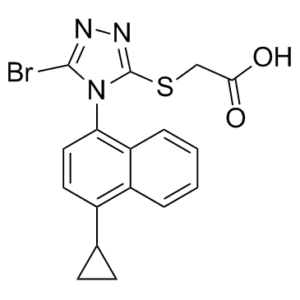
雷西纳德(Lesinurad)是一种三唑类化合物,其结构为[(3-溴-1,2,4-三唑-5-基)硫基]乙酸,在三唑环的1位被4-环丙基萘-1-基取代。用于治疗痛风。它是一种促尿酸排泄药物。它属于三唑类、萘类、环丙烷类、有机溴化合物、芳基硫醚类和单羧酸类化合物。
雷西纳德是一种口服尿酸转运蛋白1 (URAT1) 抑制剂,适用于治疗痛风相关的高尿酸血症。它通过抑制URAT1(一种负责从肾小管重吸收尿酸的酶)和OAT4(另一种与利尿剂引起的高尿酸血症相关的尿酸转运蛋白)来降低血清尿酸浓度。该药物以商品名Zurampic上市,适用于与黄嘌呤氧化酶抑制剂联合使用,治疗单用黄嘌呤氧化酶抑制剂治疗后血清尿酸水平未达标的痛风相关高尿酸血症患者。2017年8月,由雷西纳德和[DB00437]组成的复方口服疗法以商品名Duzallo获得FDA批准,用于治疗未控制痛风患者的痛风相关高尿酸血症。 雷西纳德是一种尿酸转运蛋白1抑制剂。雷西纳德的作用机制是作为尿酸转运蛋白1抑制剂和细胞色素P450 3A诱导剂。 雷西纳德是一种选择性尿酸重吸收抑制剂,与其他药物联合用于痛风治疗。雷西纳德的临床应用有限,但尚未发现其在治疗期间引起血清酶升高或出现临床上明显的肝损伤。 另见:别嘌醇;雷西纳德(成分)。 药物适应症 与黄嘌呤氧化酶抑制剂联合使用,用于治疗痛风相关高尿酸血症,适用于单独使用黄嘌呤氧化酶抑制剂治疗后血清尿酸水平未达标的患者。 FDA标签 Zurampic与黄嘌呤氧化酶抑制剂联合使用,适用于成人痛风患者(伴或不伴痛风石)高尿酸血症的辅助治疗,适用于单独使用足量黄嘌呤氧化酶抑制剂治疗后血清尿酸水平未达标的患者。 预防高尿酸血症,治疗高尿酸血症 作用机制 雷西纳德抑制尿酸转运蛋白1 (URAT1) 和有机阴离子转运蛋白4 (OAT4) 的活性。URAT1 是一种主要的转运酶,负责从肾小管重吸收尿酸;抑制 URAT1 的功能即可增加尿酸的排泄。 药效学 单次和多次口服雷西纳德后,均观察到血清尿酸水平呈剂量依赖性降低,尿尿酸排泄量增加。 雷西纳德是一种首创的选择性尿酸重吸收抑制剂 (SURI),用于治疗痛风患者的高尿酸血症。其作用机制是阻断近端肾小管中 URAT1 介导的尿酸重吸收,从而增加尿酸排泄并降低血清尿酸水平。它获准与黄嘌呤氧化酶抑制剂 (XOI) 联合用于单用 XOI 治疗无法达到目标血清尿酸水平的患者 [1]。 雷西纳德 适用于治疗成人痛风相关高尿酸血症,需与 XOI(别嘌醇或非布司他)联合使用。由于疗效有限且高剂量时肾脏风险增加,不建议单独使用。推荐临床剂量为每日一次,每次 200 mg,与食物同服以减少胃肠道刺激 [2]。 雷西纳德 (RDEA594) 是 RDEA806 的活性代谢物,RDEA806 是一种旨在提高口服生物利用度的前药。 RDEA806 在肝脏中经羧酸酯酶迅速水解为 RDEA594,但其生物活化不完全,因此 RDEA594 被开发为临床候选药物。雷西纳德 已在多项 III 期临床试验(CLEAR 1、CLEAR 2、CRYSTAL)中进行评估,并于 2015 年获得 FDA 批准 [3] |
| 分子式 |
C17H14BRN3O2S
|
|
|---|---|---|
| 分子量 |
404.28
|
|
| 精确质量 |
402.998
|
|
| CAS号 |
878672-00-5
|
|
| 相关CAS号 |
Lesinurad sodium;1151516-14-1
|
|
| PubChem CID |
53465279
|
|
| 外观&性状 |
White to off-white solid powder
|
|
| 密度 |
1.72±0.1 g/cm3
|
|
| 沸点 |
643.7±65.0 °C at 760 mmHg
|
|
| 闪点 |
343.1±34.3 °C
|
|
| 蒸汽压 |
0.0±2.0 mmHg at 25°C
|
|
| 折射率 |
1.776
|
|
| LogP |
5.96
|
|
| tPSA |
93.31
|
|
| 氢键供体(HBD)数目 |
1
|
|
| 氢键受体(HBA)数目 |
5
|
|
| 可旋转键数目(RBC) |
5
|
|
| 重原子数目 |
24
|
|
| 分子复杂度/Complexity |
479
|
|
| 定义原子立体中心数目 |
0
|
|
| InChi Key |
FGQFOYHRJSUHMR-UHFFFAOYSA-N
|
|
| InChi Code |
InChI=1S/C17H14BrN3O2S/c18-16-19-20-17(24-9-15(22)23)21(16)14-8-7-11(10-5-6-10)12-3-1-2-4-13(12)14/h1-4,7-8,10H,5-6,9H2,(H,22,23)
|
|
| 化学名 |
|
|
| 别名 |
|
|
| HS Tariff Code |
2934.99.9001
|
|
| 存储方式 |
Powder -20°C 3 years 4°C 2 years In solvent -80°C 6 months -20°C 1 month |
|
| 运输条件 |
Room temperature (This product is stable at ambient temperature for a few days during ordinary shipping and time spent in Customs)
|
| 溶解度 (体外实验) |
|
|||
|---|---|---|---|---|
| 溶解度 (体内实验) |
配方 1 中的溶解度: ≥ 2.5 mg/mL (6.18 mM) (饱和度未知) in 10% DMSO + 40% PEG300 + 5% Tween80 + 45% Saline (这些助溶剂从左到右依次添加,逐一添加), 澄清溶液。
例如,若需制备1 mL的工作液,可将100 μL 25.0 mg/mL澄清DMSO储备液加入到400 μL PEG300中,混匀;然后向上述溶液中加入50 μL Tween-80,混匀;加入450 μL生理盐水定容至1 mL。 *生理盐水的制备:将 0.9 g 氯化钠溶解在 100 mL ddH₂O中,得到澄清溶液。 配方 2 中的溶解度: ≥ 2.5 mg/mL (6.18 mM) (饱和度未知) in 10% DMSO + 90% (20% SBE-β-CD in Saline) (这些助溶剂从左到右依次添加,逐一添加), 澄清溶液。 例如,若需制备1 mL的工作液,可将 100 μL 25.0 mg/mL澄清DMSO储备液加入900 μL 20% SBE-β-CD生理盐水溶液中,混匀。 *20% SBE-β-CD 生理盐水溶液的制备(4°C,1 周):将 2 g SBE-β-CD 溶解于 10 mL 生理盐水中,得到澄清溶液。 View More
配方 3 中的溶解度: ≥ 2.5 mg/mL (6.18 mM) (饱和度未知) in 10% DMSO + 90% Corn Oil (这些助溶剂从左到右依次添加,逐一添加), 澄清溶液。 1、请先配制澄清的储备液(如:用DMSO配置50 或 100 mg/mL母液(储备液)); 2、取适量母液,按从左到右的顺序依次添加助溶剂,澄清后再加入下一助溶剂。以 下列配方为例说明 (注意此配方只用于说明,并不一定代表此产品 的实际溶解配方): 10% DMSO → 40% PEG300 → 5% Tween-80 → 45% ddH2O (或 saline); 假设最终工作液的体积为 1 mL, 浓度为5 mg/mL: 取 100 μL 50 mg/mL 的澄清 DMSO 储备液加到 400 μL PEG300 中,混合均匀/澄清;向上述体系中加入50 μL Tween-80,混合均匀/澄清;然后继续加入450 μL ddH2O (或 saline)定容至 1 mL; 3、溶剂前显示的百分比是指该溶剂在最终溶液/工作液中的体积所占比例; 4、 如产品在配制过程中出现沉淀/析出,可通过加热(≤50℃)或超声的方式助溶; 5、为保证最佳实验结果,工作液请现配现用! 6、如不确定怎么将母液配置成体内动物实验的工作液,请查看说明书或联系我们; 7、 以上所有助溶剂都可在 Invivochem.cn网站购买。 |
| 制备储备液 | 1 mg | 5 mg | 10 mg | |
| 1 mM | 2.4735 mL | 12.3677 mL | 24.7353 mL | |
| 5 mM | 0.4947 mL | 2.4735 mL | 4.9471 mL | |
| 10 mM | 0.2474 mL | 1.2368 mL | 2.4735 mL |
1、根据实验需要选择合适的溶剂配制储备液 (母液):对于大多数产品,InvivoChem推荐用DMSO配置母液 (比如:5、10、20mM或者10、20、50 mg/mL浓度),个别水溶性高的产品可直接溶于水。产品在DMSO 、水或其他溶剂中的具体溶解度详见上”溶解度 (体外)”部分;
2、如果您找不到您想要的溶解度信息,或者很难将产品溶解在溶液中,请联系我们;
3、建议使用下列计算器进行相关计算(摩尔浓度计算器、稀释计算器、分子量计算器、重组计算器等);
4、母液配好之后,将其分装到常规用量,并储存在-20°C或-80°C,尽量减少反复冻融循环。
计算结果:
工作液浓度: mg/mL;
DMSO母液配制方法: mg 药物溶于 μL DMSO溶液(母液浓度 mg/mL)。如该浓度超过该批次药物DMSO溶解度,请首先与我们联系。
体内配方配制方法:取 μL DMSO母液,加入 μL PEG300,混匀澄清后加入μL Tween 80,混匀澄清后加入 μL ddH2O,混匀澄清。
(1) 请确保溶液澄清之后,再加入下一种溶剂 (助溶剂) 。可利用涡旋、超声或水浴加热等方法助溶;
(2) 一定要按顺序加入溶剂 (助溶剂) 。
Lesinurad and Allopurinol Combination Extension Study in Gout
CTID: NCT01808131
Phase: Phase 3 Status: Completed
Date: 2017-01-24
Median plasma concentration profiles for total atorvastatin (including metabolites) following a single oral dose of atorvastatin 40mg in the absence or presence of a single dose of lesinurad 200mg (a) or 400mg (b), and plasma concentration profile of metformin following a single dose of metformin 850mg (c) or plasma concentration profile of furosemide following a single dose of furosemide 40mg (d) in the absence or presence of a single dose of lesinurad 400mg.Clin Drug Investig.2016 Jun;36(6):443-52. |
|---|
 Uric acid pathway and action site of urate-lowering therapies. *Drugs in italics are agents still under development or still not approved. **Dashed arrow representing lack of metabolic step in humans, due to evolutionary loss of uricase enzyme. |
 enal anion transporters involved in urate reabsorption in the proximal tubule and action sites of existing and novel uricosuric agents. *Drugs in italics are agents still under development or still not approved. |
 URAT1-IN-14
 HYJ-2
HYJ-2
 hURAT1 inhibitor 2
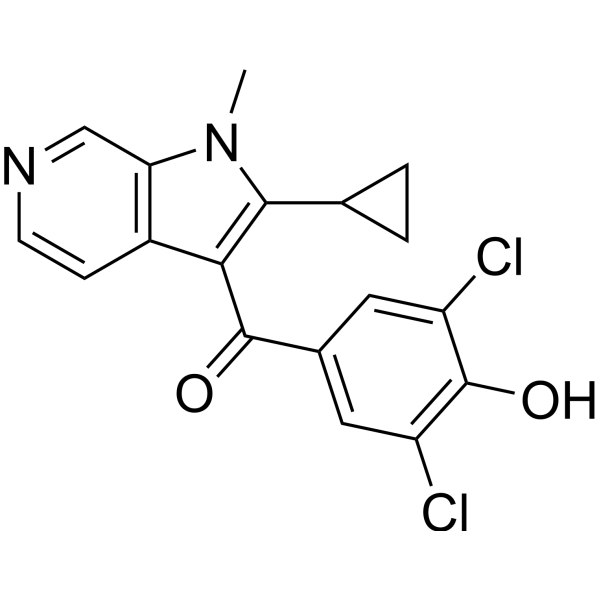 URAT1 inhibitor 13
InvivoChem的所有产品仅用于作科学研究,不面向患者销售
Copyright 2020 InvivoChem LLC | All Rights Reserved 粤ICP备20063088号-1


 COA
COA

 粤公网安备 44011102003439号
 463611831
