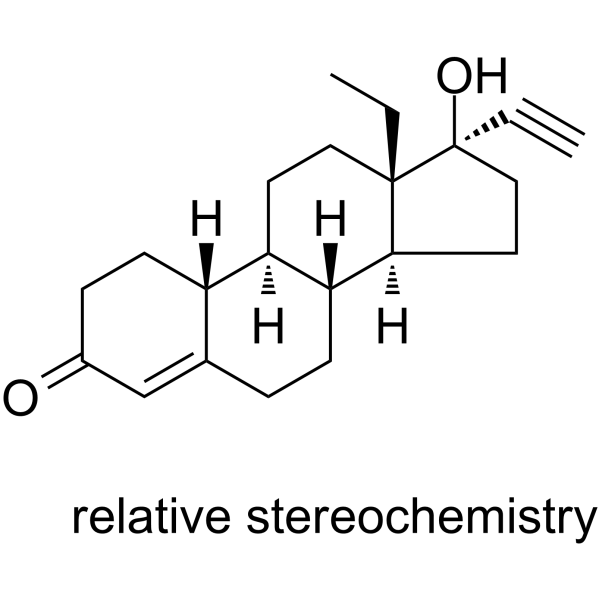
Norgestrel

别名: Norgestrel SH 850 SH 70850 炔诺孕酮;18-甲基炔诺酮;DL-甲基炔诺酮;高诺酮;药典标准品;左炔孕酮;甲基炔诺酮,18-甲炔诺酮;甲基炔诺酮;炔诺酮;炔诺酮-D6;炔诺孕酮 USP标准品;炔诺孕酮标准品(JP)
目录号: V7837 纯度: ≥98%
Norgestrel 是黄体酮的合成类似物,黄体酮是口服避孕药中常见的化合物,也是一种有效的神经保护(神经保护)抗氧化剂,可防止光诱导的 ROS 生成和感光细胞中的细胞死亡。
Norgestrel CAS号: 6533-00-2
产品类别: New1
产品仅用于科学研究,不针对患者销售
规格 价格 库存 数量
50mg
100mg
250mg
Other Sizes
点击了解更多
  • 与全球5000+客户建立关系
  • 覆盖全球主要大学、医院、科研院所、生物/制药公司等
  • 产品被大量CNS顶刊文章引用
InvivoChem产品被CNS等顶刊论文引用
产品描述
炔诺酮是孕酮的合成类似物,孕酮是口服避孕药中常见的化合物,炔诺酮是一种强效的神经保护性抗氧化剂,可防止光诱导的活性氧(ROS)生成和感光细胞死亡。炔诺酮是一种点击化学试剂。它含有炔基,可以与含有叠氮基的化合物发生CuAAc(铜催化叠氮-炔环加成反应)。
生物活性&实验参考方法
靶点
Nrf2 (NF-E2-related factor 2): Norgestrel modulates Nrf2 signaling by increasing its phosphorylation at serine 40, promoting nuclear translocation, and enhancing expression of its target antioxidant proteins. No direct binding IC50/Ki values are provided. [2]
SOD2 (Superoxide Dismutase 2): Norgestrel increases expression of SOD2, a mitochondrial antioxidant enzyme regulated by Nrf2. [2]
Progesterone Receptor Membrane Component 1 (PGRMC1): Norgestrel is known to act through this non-classical receptor, though this study focuses on antioxidant effects. [2]
体外研究 (In Vitro)
用炔诺酮(20 µM;24 小时;661W 细胞)处理后,血清剥夺后的细胞存活率显著提高,表明炔诺酮对受损的 661W 细胞具有神经保护作用 [1]。炔诺酮(20 µM;24 小时;661W 细胞)处理可降低细胞凋亡产生的 caspase-3 和 PARP 裂解 [1]。当感光细胞用炔诺酮(20 µM)处理 6 小时后,661W 细胞中 bFGF mRNA 的表达显著增加 [1]。
体内研究 (In Vivo)
用炔诺酮(100 mg/kg;腹腔注射;6、24 或 48 小时;Balb/c 小鼠)治疗可抑制光照引起的活性氧(ROS)生成,进而阻止感光细胞死亡。主要的抗氧化转录因子 Nrf2 受炔诺酮的翻译后调控,导致其磷酸化、核转位,并提高其效应蛋白超氧化物歧化酶 2 (SOD2) 的水平 [2]。
光诱导视网膜变性模型(Balb/c 小鼠):小鼠在光照损伤(5000 lx 冷白荧光灯照射 2 小时)前 1 小时腹腔注射炔诺酮(100 mg/kg)或溶剂(50 μL DMSO/花生油)。然后将小鼠置于黑暗中,并在光照损伤后 6、24 或 48 小时处死,用于分析。 [2]
抑制活性氧(ROS)生成:二氢乙锭染色显示,与载体对照组小鼠相比,炔诺酮在光损伤后6、24和48小时可抑制感光细胞层和外核层中光诱导的ROS生成。[2]
抑制感光细胞死亡:TUNEL检测显示,炔诺酮在光损伤后24和48小时可抑制感光细胞的光诱导凋亡。炔诺酮治疗组小鼠的外核层厚度得以维持。[2]
保护感光细胞形态:抗视紫红质(用于视杆细胞)和花生凝集素(用于视锥细胞)免疫荧光染色显示,炔诺酮可预防光诱导的形态损伤,包括视紫红质移位、视锥细胞碎裂和突触小泡丢失。 [2]
线粒体ROS减少:使用MitoSox对视网膜单细胞悬液进行流式细胞术分析显示,与对照组相比,炔诺酮在光损伤后6小时(p < 0.001)、24小时(p < 0.01)和48小时(p < 0.01)均显著降低了线粒体ROS水平。[2]
Nrf2表达诱导:免疫荧光染色显示,炔诺酮在光损伤后所有时间点(6、24、48小时)均显著增加了感光细胞层中Nrf2的表达。定量分析显示,所有时间点的Nrf2表达均显著增加。[2]
SOD2表达诱导:免疫荧光染色显示,炔诺酮在光损伤后所有时间点均增加了感光细胞内节(线粒体所在位置)中SOD2的表达。定量分析显示,所有时间点的SOD2表达均显著增加。 [2]
对SOD1表达无影响:在光损伤后的任何时间点,炔诺酮均未增加SOD1的表达。[2]
Nrf2磷酸化和核转位:亚细胞组分的Western blot分析显示,在光损伤后6、24和48小时,炔诺酮增加了核组分中磷酸化Nrf2(Ser40)的水平。免疫荧光染色证实,炔诺酮处理的小鼠光感受器细胞核中pNrf2增加。[2]
Nrf2无转录调控:qRT-PCR结果显示,在任何时间点,载体组和炔诺酮处理组小鼠的nrf2 mRNA表达均无变化,表明存在翻译后调控。[2]
细胞实验
细胞活力检测[1]
细胞类型: 661W 细胞
测试浓度: 20 µM
孵育时间: 24 小时
实验结果: 血清剥夺后细胞活力显著增加。

蛋白质印迹分析[1]
细胞类型: 661W 细胞
测试浓度: 20 µM
孵育时间: 24 小时
实验结果: 凋亡诱导的 PARP 和 caspase-3 裂解减少。

RT-PCR[1]
细胞类型: 661W 细胞
测试浓度: 20 µM
孵育时间: 6 小时
实验结果: bFGF mRNA 在 1 小时内显著上调。
视网膜单细胞悬液制备:将视网膜置于冰冷的 DMEM 培养基中解剖,加入 2.5 mL 含 50 μL DNase II 的 0.25% 胰蛋白酶-EDTA 溶液,于 37°C 消化 15 分钟。弃去消化液后,加入 2.5 mL 含 50 μL DNase II 的 DMEM 培养基,用移液器吹打匀浆。待大块细胞碎片沉淀后,收集 2 mL 单细胞悬液。细胞活力通过台盼蓝排除法评估(活力约为 80%)。[2]
线粒体 ROS 的 MitoSox 染色:将单细胞悬液与 5 μM MitoSox 在 37°C 下孵育 15 分钟。使用 FACScan 流式细胞仪测量荧光(激发波长 488 nm,发射光在 670LP 通道收集)。在设门的光感受器区域计数 10,000 个事件。使用 FlowJo 软件分析结果。[2]
细胞涂片制备:为验证细胞完整性,取 200 μL 单细胞悬液,使用细胞离心机制备细胞涂片。用视紫红质抗体和 Hoechst 染色细胞涂片,以确认光感受器细胞保持完整。[2]
动物实验
动物/疾病模型: balb/c(Bagg ALBino)小鼠出生后在昏暗循环光照下饲养[2]
剂量: 100 mg/kg;
给药途径: 腹腔注射;6、24 或 48 小时(小时)
实验结果: 通过丝氨酸 40 位点磷酸化和激活,增加 Nrf2 的表达,进而增加其靶标抗氧化剂超氧化物歧化酶 2 (SOD2) 的表达,并降低线粒体氧化应激。
光损伤模型:** Balb/c 小鼠出生后在昏暗循环光照(<10 lx,12 小时开/12 小时关)下饲养。4-7 周龄时,小鼠在光照前进行 18 小时的暗适应。小鼠在光照损伤前1小时腹腔注射50 μL溶剂(25 μL DMSO/25 μL花生油)或50 μL炔诺酮(100 mg/kg)。光照前,在红光照射下用0.5%环戊通散瞳。视网膜光损伤通过冷白荧光灯(5000 lx)照射2小时诱导。光照后,小鼠在黑暗中分别饲养6、24或48小时,然后通过颈椎脱臼处死。[2] * **DHE给药用于ROS检测:** 光照损伤后,小鼠在弱光条件下处死前3.5-4小时,腹腔注射两次20 mg/kg二氢乙锭(DHE),两次注射间隔30分钟。之后将小鼠放回黑暗中直至处死。 [2]
* **组织采集:** 将摘除的眼球固定于 4% 多聚甲醛溶液中 1.5 小时,在 4°C 下用 30% 蔗糖溶液进行过夜低温保护,然后冷冻于 Shandon Cryomatrix 冷冻膜中,并使用低温恒温切片机切成 7 μm 厚的切片。切片保存于 -80°C。[2]
* **亚细胞组分分离:** 使用含有 Halt 蛋白酶和磷酸酶抑制剂混合物的组织特异性试剂盒,对速冻视网膜(每个时间点每组约 4 个视网膜,混合)进行亚细胞组分分离。根据试剂盒说明书制备胞质和核组分。[2]

光损伤模型:Balb/c 小鼠出生后饲养于弱光循环光照(<10 lx,12 小时开/12 小时关)环境中。小鼠在4-7周龄时,于光照前进行18小时的暗适应。光照损伤前1小时,小鼠腹腔注射50 μL溶剂(25 μL DMSO/25 μL花生油)或50 μL炔诺酮(100 mg/kg)。光照前,在红光照射下用0.5%环戊通散瞳。视网膜光损伤通过冷白荧光灯(5000 lx)照射2小时诱导。光照后,小鼠在黑暗中分别饲养6、24或48小时,然后通过颈椎脱臼处死。[2]
DHE给药用于ROS检测:光照损伤后,小鼠在弱光条件下处死前3.5-4小时,腹腔注射两次20 mg/kg二氢乙锭(DHE),两次注射间隔30分钟。小鼠被放回黑暗处死。[2]
组织采集:摘除眼球后,用4%多聚甲醛固定1.5小时,在4℃下用30%蔗糖溶液进行过夜低温保护,然后冷冻于Shandon Cryomatrix冷冻保护剂中,并使用低温恒温切片机切成7 μm厚的切片。切片保存于-80℃。[2]
亚细胞组分分离:使用含有Halt蛋白酶和磷酸酶抑制剂混合物的组织特异性试剂盒,对速冻视网膜(每个时间点每组约4个视网膜,混合)进行亚细胞组分分离。根据试剂盒说明书制备胞质和核组分。[2]
药代性质 (ADME/PK)
吸收、分布和排泄
炔诺酮经胃肠道吸收,在肝脏代谢,并以葡萄糖醛酸苷和硫酸盐结合物的形式经尿液和粪便排出。在7名服用14C-炔诺酮的受试者中,5天内有43%的剂量经尿液排出;放射性生物半衰期为24小时。酶水解仅释放了32%的尿放射性,另有25%以硫酸盐结合物的形式排出。尿液中排出的代谢物极性显著低于服用相关化合物炔诺酮或乙炔后排出的代谢物。从尿液中分离出四氢炔诺酮(13β-乙基-17α-乙炔基-5β-gonan-3α,17β-二醇)的3αOH,5β和3βOH,5β异构体,并采用质谱、薄层色谱和气液色谱法进行鉴定。与乙炔或乙炔相比,服用炔诺酮后血浆放射性下降更快。约2%的给药剂量转化为酸性化合物。口服或静脉注射炔诺酮后,放射性排泄率或代谢物无显著差异。通过竞争性蛋白结合系统测定不同合成类固醇(用于激素避孕)从性激素结合球蛋白(SHBG)上置换氚标记睾酮的能力,研究了这些类固醇与SHBG的结合情况。仅有 19-去甲睾酮衍生物表现出显著的从性激素结合球蛋白 (SHBG) 中置换睾酮的能力,其中右炔诺酮 (d-Ng) 的置换能力最强。在既往血浆 d-Ng 水平稳定的女性中,SHBG 水平升高导致 SHBG 水平升高 2 至 6 倍。由此得出结论,SHBG 是 d-Ng 的主要载体蛋白。d-Ng 强大的睾酮置换活性也可能解释了含 d-Ng 的口服避孕药中观察到的雄激素副作用。
代谢/代谢物
(14) 对 7 名受试者给予 C-去甲炔诺酮,5 天内 43% 的剂量经尿液排出……酶水解仅释放出 32% 的尿放射性,另有 25% 以硫酸盐结合物的形式排出。尿液中排泄的代谢物极性远低于服用相关化合物炔诺酮或其代谢物后产生的代谢物。从尿液中分离出四氢炔诺酮(13β-乙基-17α-乙炔基-5β-gonan-3α,17β-二醇)的3αOH,5β和3βOH,5β异构体,并通过质谱、薄层色谱和气液色谱法进行了鉴定。服用炔诺酮后,血浆放射性下降速度比服用炔诺酮或其代谢物后更快。约2%的给药剂量转化为酸性化合物。口服或静脉注射炔诺酮后,放射性排泄速率或代谢物含量无显著差异。在非洲绿猴(Cercopithecus aethiops)中研究了dl-、d-和l-炔诺酮的代谢。单次口服14C-dl-炔诺酮(1 mg/kg)后,14C的总尿排泄量(51.4 ± 5.0%)显著高于服用d-对映体后的排泄量(37.5 ± 5.4%),但与服用l-对映体后的排泄量(44.2 ± 8.9%)无显著差异。在所有情况下,尿液中大部分放射性物质以游离形式存在(48–62%),另有13–27%由β-葡萄糖醛酸酶制剂释放。未检测到硫酸盐结合物。至少有一条主要代谢途径(16β-羟基化)和一条次要代谢途径(16α-羟基化)表现出立体选择性,这意味着它们对14I-对映体有效,但对d-对映体无效。三种代谢物,即16β-羟基炔诺酮、16α-羟基炔诺酮和16-羟基四氢炔诺酮(推测为16β),仅在服用14Cdl-炔诺酮的动物尿液样本中检测到。服用14Cd-炔诺酮后,发现3α,5β-四氢炔诺酮是主要的尿液代谢物。这些观察结果与先前报道的关于dl-炔诺酮在女性尿液中代谢的结果进行了比较。研究了兔肝微粒体组分对炔诺酮立体异构体(d、l和dl的消旋混合物)的体外代谢。具有生物活性的1-炔诺酮的代谢速度比无活性的d-炔诺酮更快。这主要是因为左炔诺孕酮更容易转化为其A环还原代谢物。两种异构体的羟基化程度没有差异;孵育30分钟后,每种异构体约有40%转化为其羟基化代谢物。然而,两种异构体之间存在差异:左炔诺孕酮主要转化为16β-羟基类固醇,而右炔诺孕酮则转化为16α-羟基类固醇。两种异构体在C-6位的羟基化程度相似。外消旋混合物的代谢介于左炔诺孕酮和右炔诺孕酮异构体之间。比较了兔肝组织中19-去甲睾酮衍生的合成孕激素的体外代谢速率。1小时内,炔诺酮的代谢速率与19-去甲睾酮相当,而右炔诺孕酮和炔诺酮的代谢速率略低。左炔诺孕酮的代谢速率低于5%。在所有情况下,反应产物均为四氢类固醇。炔诺酮经左炔诺孕酮代谢。骨骼肌、肺和小肠也能代谢炔诺酮和右孕酮,但速度比肝组织慢。脂肪组织能代谢少量炔诺酮,但心脏和脾脏不能。在所研究的任何肝外组织中,炔诺酮和左炔诺孕酮均未被代谢。
一项体外研究使用少量人空肠黏膜,研究了三种用于口服避孕药(OC)的类固醇的代谢。进行这项研究的原因是已知人胃肠道黏膜能代谢多种药物。孵育后,约40%的炔雌醇、9.8%的左炔诺孕酮和7%的炔雌醇被代谢。所有这些代谢反应均与对照组存在显著差异。结果表明,炔雌醇的代谢与所用组织的重量相关。这些结果与已知的炔雌醇显著首过效应相符。已知首过效应较小或无首过效应的炔诺酮,其肠道代谢率也较低。在所用的实验条件下,未观察到炔雌醇或左炔诺孕酮的I期代谢。
肝脏代谢。
排泄途径:约45%的左炔诺孕酮及其代谢物经尿液排泄,约32%经粪便排泄,主要以葡萄糖醛酸苷结合物的形式存在。
生物半衰期
(14) 向7名受试者服用C-炔诺酮,5天内43%的剂量经尿液排泄;该放射性物质的生物半衰期为24小时。
毒性/毒理 (Toxicokinetics/TK)
毒性概述
与孕激素和雌激素受体结合。靶细胞包括女性生殖道、乳腺、下丘脑和垂体。一旦孕激素(例如左炔诺孕酮)与其受体结合,它们就会减缓下丘脑促性腺激素释放激素 (GnRH) 的释放频率,并抑制排卵前黄体生成素 (LH) 的激增。 毒性数据
LD50 >5000 mg/kg(大鼠口服) 相互作用 与已知可诱导药物代谢酶(尤其是细胞色素P450酶)的物质合用,例如抗惊厥药(如苯巴比妥、苯妥英、卡马西平)和抗感染药(如利福平、利福布汀、奈韦拉平、依非韦伦),可能会增加雌激素和孕激素的代谢。利托那韦和奈非那韦虽然是已知的强效抑制剂,但与这些药物合用时也会出现诱导作用。当与类固醇激素合用时,含有贯叶连翘的草药制剂可能会诱导雌激素和孕激素的代谢。苯妥英和利福平会增加血清中性激素结合球蛋白 (SHBG) 的浓度;这会显著降低某些孕激素的游离药物血清浓度,对于使用孕激素避孕的患者来说,这尤其值得关注。/孕激素/ 目前尚无利福布汀与孕激素相互作用的数据,但由于其结构与利福平相似,因此在与孕激素合用时可能需要采取类似的预防措施。……/孕激素/
非人类毒性值
大鼠口服 LD50 5010 mg/kg
大鼠腹腔注射 LD50 11,200 mg/kg
小鼠腹腔注射 LD50 7300 mg/kg
小鼠口服 LD50 5010 mg/kg
参考文献

[1]. The synthetic progesterone Norgestrel is neuroprotective in stressed photoreceptor-like cellsand retinal explants, mediating its effects via basic fibroblast growth factor, protein kinase A and glycogen synthase kinase 3β signalling. Eur J Neurosci. 2016 Apr;43(7):899-911.

[2]. The synthetic progestin norgestrel modulates Nrf2 signaling and acts as an antioxidant in a model of retinal degeneration. Redox Biol. 2016 Dec;10:128-139.

其他信息
治疗用途

口服合成避孕药;合成孕激素
低剂量炔诺酮(炔诺酮和炔雌醇片)适用于选择使用本产品作为避孕方法以防止怀孕的女性。/美国产品标签包含/
/环丙孕酮适用于/围绝经期和绝经后妇女雌激素缺乏症状的激素替代疗法 (HRT)。
/环丙孕酮适用于/预防绝经后妇女骨质疏松症,适用于未来骨折风险高且无法耐受或不宜使用其他已批准的骨质疏松症预防药物的妇女。
炔诺酮…/适用于/预防怀孕。仅含孕激素的口服避孕药也称为迷你避孕药或仅含孕激素的口服避孕药 (POP)。 /服用前/
药物警告
服用口服避孕药后,吸烟会增加发生严重心血管副作用的风险。这种风险会随着年龄的增长和吸烟量的增加(每天15支或以上)而增加,尤其在35岁以上的女性中更为显著。强烈建议服用口服避孕药的女性不要吸烟。
服用口服避孕药会增加多种严重疾病的风险,包括心肌梗死、血栓栓塞、中风、肝肿瘤和胆囊疾病。但是,对于没有潜在危险因素的健康女性来说,发生严重疾病或死亡的风险非常小。如果存在其他潜在危险因素,例如高血压、高脂血症、高胆固醇血症、肥胖和糖尿病,则发病率和死亡率会显著增加。
如果女性患有以下疾病,则不应服用口服避孕药:血栓性静脉炎或血栓栓塞性疾病;有深静脉血栓形成或血栓栓塞性疾病史;脑血管或冠状动脉疾病;已知或疑似乳腺癌;子宫内膜癌或其他已知或疑似雌激素依赖性肿瘤;不明原因的异常生殖器出血;妊娠期胆汁淤积性黄疸或既往服用口服避孕药后出现的黄疸;肝腺瘤、肝癌或良性肝肿瘤;或已知或疑似妊娠。
口服避孕药最常见的不良反应是恶心。使用阴道或经皮雌孕激素避孕药的女性也有恶心的报道。目前推荐的高剂量性交后雌孕激素联合用药方案的主要风险似乎是中度至重度胃肠道不良反应,包括严重呕吐和恶心,分别在接受短期疗程的女性中发生率为12-22%和30-66%,这可能会限制患者的依从性和治疗效果。在两项前瞻性随机研究中,与高剂量雌激素-孕激素联合用药方案(100微克炔雌醇和0.5毫克左炔诺孕酮,每12小时两次)相比,高剂量性交后孕激素单药治疗方案(0.75毫克左炔诺孕酮,每12小时两次)的恶心和呕吐发生率较低。其他胃肠道不良反应包括呕吐、腹部绞痛、腹痛、腹胀、腹泻和便秘。也有牙龈炎和干槽症的报道。食欲和体重也可能发生变化。/雌激素-孕激素联合制剂/
有关诺孕酮(52项)药物警告的更完整数据,请访问HSDB记录页面。
背景:诺孕酮是FDA批准的合成孕激素类似物。此前研究表明,炔诺酮在视网膜色素变性模型中具有神经保护作用,可通过上调神经营养因子bFGF和LIF来挽救感光细胞免于死亡。[2]
作用机制(抗氧化):本研究表明,炔诺酮通过调节Nrf2信号通路在视网膜中发挥强效抗氧化作用。它可增加Nrf2在丝氨酸40位的磷酸化(可能通过PKC途径),从而导致Nrf2核转位并增加线粒体抗氧化酶SOD2的表达。这可减少线粒体活性氧(ROS),并保护感光细胞免受氧化应激诱导的细胞死亡和形态损伤。[2]
翻译后调控:炔诺酮不影响nrf2 mRNA水平,而是通过翻译后修饰来提高Nrf2蛋白的稳定性和活性。该研究还指出,炔诺酮抑制GSK3β,这可能通过阻止Nrf2的核输出而促进其持续激活。[2]
对SOD2而非SOD1的选择性:炔诺酮可增加SOD2(线粒体)而非SOD1(胞质)的水平,这与其对线粒体活性氧(ROS)的影响以及SOD2对感光细胞存活的重要性相一致。[2]
治疗潜力:研究结果表明,炔诺酮可能成为治疗视网膜色素变性和其他视网膜退行性疾病的潜在选择,因为其抗氧化作用不区分不同的遗传病因。[2]
资金支持:本研究由爱尔兰科学基金会和对抗失明协会资助。[2]
*注: 文献方法仅供参考, InvivoChem并未独立验证这些方法的准确性
化学信息 & 存储运输条件
分子式
C21H28O2
分子量
312.453
精确质量
312.208
CAS号
6533-00-2
PubChem CID
13109
外观&性状
White to off-white solid powder
密度
1.1±0.1 g/cm3
沸点
459.1±45.0 °C at 760 mmHg
熔点
205-207 °C
闪点
195.4±21.3 °C
蒸汽压
0.0±2.6 mmHg at 25°C
折射率
1.571
LogP
3.92
tPSA
37.3
氢键供体(HBD)数目
1
氢键受体(HBA)数目
2
可旋转键数目(RBC)
2
重原子数目
23
分子复杂度/Complexity
609
定义原子立体中心数目
6
SMILES
CC[C@@]12CC[C@@H]3C4CCC(=O)C=C4CC[C@H]3[C@@H]2CC[C@]1(C#C)O
InChi Key
WWYNJERNGUHSAO-XUDSTZEESA-N
InChi Code
InChI=1S/C21H28O2/c1-3-20-11-9-17-16-8-6-15(22)13-14(16)5-7-18(17)19(20)10-12-21(20,23)4-2/h2,13,16-19,23H,3,5-12H2,1H3/t16-,17+,18+,19-,20-,21-/m0/s1
化学名
(8R,9S,10R,13S,14S,17R)-13-ethyl-17-ethynyl-17-hydroxy-1,2,6,7,8,9,10,11,12,14,15,16-dodecahydrocyclopenta[a]phenanthren-3-one
别名
Norgestrel SH 850 SH 70850
HS Tariff Code
2934.99.9001
存储方式

Powder      -20°C    3 years

                     4°C     2 years

In solvent   -80°C    6 months

                  -20°C    1 month

运输条件
Room temperature (This product is stable at ambient temperature for a few days during ordinary shipping and time spent in Customs)
溶解度数据
溶解度 (体外实验)
DMSO : ~100 mg/mL (~320.05 mM)
溶解度 (体内实验)
配方 1 中的溶解度: ≥ 2.5 mg/mL (8.00 mM) (饱和度未知) in 10% DMSO + 40% PEG300 + 5% Tween80 + 45% Saline (这些助溶剂从左到右依次添加,逐一添加), 澄清溶液。
例如,若需制备1 mL的工作液,可将100 μL 25.0 mg/mL澄清DMSO储备液加入到400 μL PEG300中,混匀;然后向上述溶液中加入50 μL Tween-80,混匀;加入450 μL生理盐水定容至1 mL。
*生理盐水的制备:将 0.9 g 氯化钠溶解在 100 mL ddH₂O中,得到澄清溶液。

配方 2 中的溶解度: ≥ 2.5 mg/mL (8.00 mM) (饱和度未知) in 10% DMSO + 90% (20% SBE-β-CD in Saline) (这些助溶剂从左到右依次添加,逐一添加), 澄清溶液。
例如,若需制备1 mL的工作液,可将 100 μL 25.0 mg/mL澄清DMSO储备液加入900 μL 20% SBE-β-CD生理盐水溶液中,混匀。
*20% SBE-β-CD 生理盐水溶液的制备(4°C,1 周):将 2 g SBE-β-CD 溶解于 10 mL 生理盐水中,得到澄清溶液。

View More

配方 3 中的溶解度: ≥ 2.5 mg/mL (8.00 mM) (饱和度未知) in 10% DMSO + 90% Corn Oil (这些助溶剂从左到右依次添加,逐一添加), 澄清溶液。
例如,若需制备1 mL的工作液,可将 100 μL 25.0 mg/mL 澄清 DMSO 储备液加入到 900 μL 玉米油中并混合均匀。


请根据您的实验动物和给药方式选择适当的溶解配方/方案:
1、请先配制澄清的储备液(如:用DMSO配置50 或 100 mg/mL母液(储备液));
2、取适量母液,按从左到右的顺序依次添加助溶剂,澄清后再加入下一助溶剂。以 下列配方为例说明 (注意此配方只用于说明,并不一定代表此产品 的实际溶解配方):
10% DMSO → 40% PEG300 → 5% Tween-80 → 45% ddH2O (或 saline);
假设最终工作液的体积为 1 mL, 浓度为5 mg/mL: 取 100 μL 50 mg/mL 的澄清 DMSO 储备液加到 400 μL PEG300 中,混合均匀/澄清;向上述体系中加入50 μL Tween-80,混合均匀/澄清;然后继续加入450 μL ddH2O (或 saline)定容至 1 mL;

3、溶剂前显示的百分比是指该溶剂在最终溶液/工作液中的体积所占比例;
4、 如产品在配制过程中出现沉淀/析出,可通过加热(≤50℃)或超声的方式助溶;
5、为保证最佳实验结果,工作液请现配现用!
6、如不确定怎么将母液配置成体内动物实验的工作液,请查看说明书或联系我们;
7、 以上所有助溶剂都可在 Invivochem.cn网站购买。
制备储备液 1 mg 5 mg 10 mg
1 mM 3.2005 mL 16.0026 mL 32.0051 mL
5 mM 0.6401 mL 3.2005 mL 6.4010 mL
10 mM 0.3201 mL 1.6003 mL 3.2005 mL

1、根据实验需要选择合适的溶剂配制储备液 (母液):对于大多数产品,InvivoChem推荐用DMSO配置母液 (比如:5、10、20mM或者10、20、50 mg/mL浓度),个别水溶性高的产品可直接溶于水。产品在DMSO 、水或其他溶剂中的具体溶解度详见上”溶解度 (体外)”部分;

2、如果您找不到您想要的溶解度信息,或者很难将产品溶解在溶液中,请联系我们;

3、建议使用下列计算器进行相关计算(摩尔浓度计算器、稀释计算器、分子量计算器、重组计算器等);

4、母液配好之后,将其分装到常规用量,并储存在-20°C或-80°C,尽量减少反复冻融循环。

计算器

摩尔浓度计算器可计算特定溶液所需的质量、体积/浓度,具体如下:

  • 计算制备已知体积和浓度的溶液所需的化合物的质量
  • 计算将已知质量的化合物溶解到所需浓度所需的溶液体积
  • 计算特定体积中已知质量的化合物产生的溶液的浓度
使用摩尔浓度计算器计算摩尔浓度的示例如下所示:
假如化合物的分子量为350.26 g/mol,在5mL DMSO中制备10mM储备液所需的化合物的质量是多少?
  • 在分子量(MW)框中输入350.26
  • 在“浓度”框中输入10,然后选择正确的单位(mM)
  • 在“体积”框中输入5,然后选择正确的单位(mL)
  • 单击“计算”按钮
  • 答案17.513 mg出现在“质量”框中。以类似的方式,您可以计算体积和浓度。

稀释计算器可计算如何稀释已知浓度的储备液。例如,可以输入C1、C2和V2来计算V1,具体如下:

制备25毫升25μM溶液需要多少体积的10 mM储备溶液?
使用方程式C1V1=C2V2,其中C1=10mM,C2=25μM,V2=25 ml,V1未知:
  • 在C1框中输入10,然后选择正确的单位(mM)
  • 在C2框中输入25,然后选择正确的单位(μM)
  • 在V2框中输入25,然后选择正确的单位(mL)
  • 单击“计算”按钮
  • 答案62.5μL(0.1 ml)出现在V1框中
g/mol

分子量计算器可计算化合物的分子量 (摩尔质量)和元素组成,具体如下:

注:化学分子式大小写敏感:C12H18N3O4  c12h18n3o4
计算化合物摩尔质量(分子量)的说明:
  • 要计算化合物的分子量 (摩尔质量),请输入化学/分子式,然后单击“计算”按钮。
分子质量、分子量、摩尔质量和摩尔量的定义:
  • 分子质量(或分子量)是一种物质的一个分子的质量,用统一的原子质量单位(u)表示。(1u等于碳-12中一个原子质量的1/12)
  • 摩尔质量(摩尔重量)是一摩尔物质的质量,以g/mol表示。
/

配液计算器可计算将特定质量的产品配成特定浓度所需的溶剂体积 (配液体积)

  • 输入试剂的质量、所需的配液浓度以及正确的单位
  • 单击“计算”按钮
  • 答案显示在体积框中
动物体内实验配方计算器(澄清溶液)
第一步:请输入基本实验信息(考虑到实验过程中的损耗,建议多配一只动物的药量)
第二步:请输入动物体内配方组成(配方适用于不溶/难溶于水的化合物),不同的产品和批次配方组成不同,如对配方有疑问,可先联系我们提供正确的体内实验配方。此外,请注意这只是一个配方计算器,而不是特定产品的确切配方。
+
+
+

计算结果:

工作液浓度 mg/mL;

DMSO母液配制方法 mg 药物溶于 μL DMSO溶液(母液浓度 mg/mL)。如该浓度超过该批次药物DMSO溶解度,请首先与我们联系。

体内配方配制方法μL DMSO母液,加入 μL PEG300,混匀澄清后加入μL Tween 80,混匀澄清后加入 μL ddH2O,混匀澄清。

(1) 请确保溶液澄清之后,再加入下一种溶剂 (助溶剂) 。可利用涡旋、超声或水浴加热等方法助溶;
            (2) 一定要按顺序加入溶剂 (助溶剂) 。

临床试验信息
Pharmacologic Strategies to Use the Levonorgestrel Implant in HIV-infected Women
CTID: NCT02722421
Phase: Phase 2    Status: Completed
Date: 2024-10-03
Improving the Treatment for Women With Early Stage Cancer of the Uterus
CTID: NCT01686126
Phase: Phase 2    Status: Active, not recruiting
Date: 2024-08-28
A Study of a Levonorgestrel-Releasing Intrauterine System for Long-Term, Reversible Contraception
CTID: NCT00995150
Phase: Phase 3    Status: Terminated
Date: 2024-08-14
A Research Study Looking Into the Effect of NNC0519-0130 on Blood Levels of a Birth Control Pill and Emptying of the Stomach in Women After Menopause
CTID: NCT06513104
Phase: Phase 1    Status: Recruiting
Date: 2024-08-07
Assessing the Efficacy and Acceptability of Two Missed Period Pills Regimens
CTID: NCT06492889
Phase: Phase 2/Phase 3    Status: Not yet recruiting
Date: 2024-07-18
View More

Piroxicam and Levonorgestrel Co-treatment for Emergency Contraception
CTID: NCT03614494
Phase: Phase 2/Phase 3    Status: Completed
Date: 2024-05-06


Kuwa Free! - Live Free!
CTID: NCT05044962
Phase: N/A    Status: Recruiting
Date: 2024-04-10
Weight-loss Drug for Fertility-Sparing Treatment of Atypical Hyperplasia and Grade 1 Cancer of the Endometrium
CTID: NCT06073184
Phase: Phase 2    Status: Not yet recruiting
Date: 2024-03-19
Oral Levonorgestrel Plus Meloxicam, IG-002 Delays Ovulation in Normal Menstruating Women by Seven Days
CTID: NCT05695352
Phase: Phase 2    Status: Recruiting
Date: 2024-03-12
Effects of St. John's Wort on the Oral Contraceptive Hormone Levonorgestrel
CTID: NCT00131885
Phase: Phase 4    Status: Completed
Date: 2023-11-13
Bay98-7196, Dose Finding / POC Study
CTID: NCT02203331
Phase: Phase 2    Status: Completed
Date: 2023-11-07
A Pharmacokinetic Evaluation of Levonorgestrel Implant and Antiretroviral Therapy
CTID: NCT01789879
Phase: Phase 2    Status: Completed
Date: 2023-09-01
Investigating the Interaction Between Two Long-acting Reversible Methods of Contraception and Dolutegravir, a Treatment for HIV
CTID: NCT04910711
Phase: Phase 4    Status: Active, not recruiting
Date: 2023-07-27
Levonorgestrel-Releasing Intrauterine System (LNG-IUS) in the Management of Atypical Endometrial Hyperplasia
CTID: NCT04897217
Phase: Phase 3    Status: Withdrawn
Date: 2023-07-05
LCS16 vs. COC User Satisfaction and Tolerability Study
CTID: NCT03074045
Phase: Phase 3    Status: Completed
Date: 2023-06-18
JAYDESS Drug Utilization Study in Sweden
CTID: NCT02349815
Phase:    Status: Completed
Date: 2023-01-31
A Pilot Study on Fertility Conservative Treatment of Atypical Endometrial Hyperplasia in Singapore
CTID: NCT05492487
Phase: Phase 2    Status: Unknown status
Date: 2022-08-08
Bioavailability of Levonorgestrel and Ethinyl Estradiol Tablets 15.0 mg/0.03 mg With Regards to Reference Product
CTID: NCT05282940
Phase: Phase 1    Status: Completed
Date: 2022-06-02
Adherence With Continuous-dose Oral Contraceptive: Evaluation of Self-Selection and Use
CTID: NCT04112095
Phase: Phase 3    Status: Completed
Date: 2022-05-20
Safety and Efficacy of CDB-2914 in Comparison to Levonorgestrel for Emergency Contraception
CTID: NCT00551616
Phase: Phase 3    Status: Completed
Date: 2022-05-03
A Study of Oral Contraception Under Simulated OTC Conditions
CTID: NCT03559010
Phase: Phase 3    Status: Terminated
Date: 2022-04-04
Pharmacokinetics Study to Evaluate Drug-Drug Interactions and Safety of Elpida® in Co-Administration With Other Drugs
CTID: NCT03709355
Phase: Phase 1    Status: Completed
Date: 2022-01-26
Pharmacokinetic Study to Evaluate Double-Dose Levonorgestrel Emergency Contraception in Combination With Efavirenz-Based Antiretroviral Therapy or Rifampicin-Containing Anti-Tuberculosis Therapy
CTID: NCT03819114
Phase: Phase 2    Status: Completed
Date: 2021-12-27
A Study on the Feasibility and Acceptability of Pericoital Levonorgestrel 1.5mg
CTID: NCT04058873
Phase:    Status: Completed
Date: 2021-11-05
Assessing Use Of Mifepristone After Progestin Priming For Use As 'Missed Period Pills'
CTID: NCT04676776
Phase: Phase 2    Status: Unknown status
Date: 2021-08-12
Effect of Norgestrel 75 mcg on Cervical Mucus and Ovarian Activity During Perfect Use, After One Delayed Intake and After a Missed Pill
CTID: NCT03585712
Phase: Phase 2    Status: Completed
Date: 2021-06-03
Safety and Contraceptive Efficacy of an Intravaginal Ring With LNG (Levonorgestrel) Over One Year in Healthy Women
CTID: NCT02403401
Phase: Phase 3    Status: Completed
Date: 2021-04-08
KYleena Satisfaction Study / Observational Study on User Satisfaction With the Levonorgestrel Intrauterine Delivery System Kyleena (LNG-IUS 12) in New Contraceptive Users and After Switching From Another Contraceptive Method
CTID: NCT03182140
Phase:    Status: Completed
Date: 2021-03-29
Comparison of Estrogen-progestin Therapy in Continuous Regimen Versus Combination Estrogen-progestin Therapy in Continuous Regimen Plus Levonorgestrel-releasing Intrauterine System (LNG-IUS)
CTID: NCT02556411
Phase: N/A    Status: Unknown status
Date: 2021-02-04
Adenomyosis: Genomic Mechanisms and Biological Response
CTID: NCT03428854
Phase:    Status: Withdrawn
Date: 2021-02-02
Levonorgestrel in Preventing Ovarian Cancer in Patients at High Risk for Ovarian Cancer
CTID: NCT00445887
Phase: Phase 2    Status: Completed
Date: 2019-11-19
PK Study of 90-Day Use of Vaginal Rings Containing Dapivirine and Levonorgestrel
CTID: NCT03467347
Phase: Phase 1    Status: Completed
Date: 2019-10-09
Study Comparing Emergency Contraception Effectiveness in Women Who Weight ≥ 80 kg
CTID: NCT03537768
Phase: Phase 4    Status: Unknown status
Date: 2019-10-08
The Evidence for Contraceptive Options and HIV Outcomes Trial
CTID: NCT02550067
Phase: N/A    Status: Completed
Date: 2019-08-20
Study of Spermatogenesis Suppression With DMAU Alone or With LNG Versus Placebo Alone in Normal Men
CTID: NCT03455075
Phase: Phase 2    Status: Unknown status
Date: 2019-08-12
Acceptability & Tolerance of Immediate Versus Delayed Postpartum Contraceptive Implant
CTID: NCT03353012
Phase: Phase 4    Status: Completed
Date: 2019-07-26
Comparison of the Levonorgestrel IUD and the Copper IUD Placed in the Immediate Postplacental Period: A Prospective Cohort Study
CTID: NCT02067663
Phase:    Status: Completed
Date: 2019-07-05
To Investigate the Pharmacological Effects, Drug Blood Levels and Safety of an Intrauterine System Releasing the Study Drug BAY1007626 in Comparison to Mirena and Jaydess in Healthy Young Women Treated for 90 Days to Determine the Drug Dose for Further Development
CTID: NCT02490774
Phase: Phase 2    Status: Terminated
Date: 2019-06-04
PK and Safety Study of Vaginal Rings Containing Dapivirine and Levonorgestrel
CTID: NCT02855346
Phase: Phase 1    Status: Completed
Date: 2018-05-22
Study to Evaluate Pharmacokinetics Profile, Wearability, and Safety of 2 Progestin-Only Patches
CTID: NCT01623466
Phase: Phase 1/Phase 2    Status: Completed
Date: 2018-01-23
A Cross-sectional, Observational Multicenter Study to Assess the Reasons for Choosing the 3-year Hormonal IUD and Level of IUDs Knowledge Among Women Aged 18 to 29 Years
CTID: NCT02903888
Phase:    Status: Completed
Date: 2018-01-12
A Study to Evaluate the Effect of Multiple Oral Doses of JNJ-42847922 on the Steady-state Pharmacokinetics of an Oral Contraceptive Containing Ethinyl Estradiol and Levonorgestrel in Healthy Female Adult Participants
CTID: NCT03249402
Phase: Phase 1    Status: Completed
Date: 2017-12-11
Trial Evaluating Folic Acid Supplementation by Concomitant Administration of Ethinyl Estradiol + Levonorgestrel
CTID: NCT03359057
Phase: Phase 3    Status: Completed
Date: 2017-12-04
Safety,Effectiveness and Acceptability of Sino-implant II in DR
CTID: NCT01594632
Phase: N/A    Status: Completed
Date: 2017-09-21
Advance Supply of Emergency Contraception Compared to Routine Postpartum Care in Teens
CTID: NCT00433004
Phase: Phase 4    Status: Completed
Date: 2017-09-15
Clinical Trial the Use of Levonorgestrel-releasing Intrauterine System Versus Etonogestrel Implant in Endometriosis
CTID: NCT02480647
Phase: Phase 4    Status: Completed
Date: 2017-08-14
An Observational Study to Assess Quality of Life and Satisfaction of Young Women (Aged 18-29) Following 6 (±1) Months Using Jaydess as Their Contraceptive Method
CTID: NCT02574715
Phase:    Status: Completed
Date: 2017-06-29
Effectiveness of Levonorgestrel-intrauterine System (LNG-IUS) Versus Depot Medroxyprogesterone Acetate (DMPA) in Treatment of Pelvic Pain in Clinically Diagnosed Endometriotic Patients
CTID: NCT02534688
Phase: Phase 4    Status: Completed
Date: 2017-03-17
Duration of Use of Highly Effective Reversible Contraception
CTID: NCT02414919
Phase:    Status: Completed
Date: 2017-03-16
The Copper T380A IUD vs. Oral Levonorgestrel for Emergency Contraception
CTID: NCT00966771
Phase:    Status: Completed
Date: 2017-02-06
Impact vs. Dienogest: A Combined Oral Contraceptive in the Size of Endometriomas
CTID: NCT02599077
Phase: Phase 2/Phase 3    Status: Suspended
Date: 2016-11-22
Mirena Observational Program
CTID: NCT00883662
Phase:    Status: Completed
Date: 2016-09-30
LCS12 vs. ENG Subdermal Implant (Nexplanon) Discontinuation Rate Study
CTID: NCT01397097
Phase: Phase 3    Status: Completed
Date: 2016-07-25
Evaluation of Ciclo 21® Effect (Levonorgestrel + Ethinyl Estradiol) Compared to Nordette®.
CTID: NCT01480778
Phase: Phase 3    Status: Completed
Date: 2016-03-03
Mirena and Estrogen for Control of Perimenopause Symptoms and Ovulation Suppression
CTID: NCT01613131
Phase: N/A    Status: Completed
Date: 2015-12-02
Non-interventional Study of Long-term Intrauterine Contraceptives Acceptability and User Satisfaction
CTID: NCT01590537
Phase:    Status: Completed
Date: 2015-10-16
Drug-drug Interaction of BI 201335 and Microgynon
CTID: NCT01570244
Phase: Phase 1    Status: Completed
Date: 2015-08-03
LCS12 Adolescent Study
CTID: NCT01434160
Phase: Phase 3    Status: Completed
Date: 2015-07-27
Study to Evaluate the Pharmacokinetics of an Oral Contraceptive Containing Levonorgestrel and Ethinyl Estradiol When Co-administered With GSK1265744 in Healthy Adult Female Subjects
CTID: NCT02159131
Phase: Phase 1    Status: Completed
Date: 2015-07-07
Mirena or Conventional
Immediate versus delayed insertion of intrauterine contraception at the time of medical abortion
CTID: null
Phase: Phase 3    Status: Trial now transitioned
Date: 2018-03-23
Immediate post partum LNG-IUS insertion or standard insertion procedure after childbirth
CTID: null
Phase: Phase 3    Status: Completed
Date: 2017-09-20
A prospective, randomized, parallel-group study to assess the effects on ovarian activity of ellaOne (ulipristal acetate 30 mg single dose) taken after three consecutive days of missed combined oral contraceptive pills
CTID: null
Phase: Phase 4    Status: Completed
Date: 2017-09-11
Ulipristal acetate versus conventional management of heavy menstrual bleeding (HMB; including uterine fibroids): a randomised controlled trial and exploration of mechanism of action (UCON trial)
CTID: null
Phase: Phase 3    Status: GB - no longer in EU/EEA
Date: 2016-08-26
COLIBRI STUDY, Cooper and Levonorgestrel Intrauterine Device (IUD) Barcelona Research Initiative.
CTID: null
Phase: Phase 4    Status: Ongoing
Date: 2016-02-25
A prospective, open-label, randomized, two-armed clinical trial to evaluate the efficacy and safety of a combination of ethinyl-estradiol and levonorgestrel versus a low-dose combination of pioglitazone + spironolactone + metformin in adolescents with ovarian hyperandrogenism and hyperinsulinemia: Effects on ovulatory function, parameters of chronic inflammation, treatment markers of pronostic and effectiveness and the development of type 2 diabetes
CTID: null
Phase: Phase 3    Status: Completed
Date: 2016-01-22
A Phase 3, randomized, active-comparator controlled clinical trial to study the contraceptive efficacy and safety of the MK-8342B (etonogestrel + 17β-estradiol) vaginal ring and the levonorgestrel-ethinylestradiol (LNG-EE) 150/30 µg combined oral contraceptive (COC) in healthy women 18 years of age and older, at risk for pregnancy.
CTID: null
Phase: Phase 3    Status: Prematurely Ended, Completed
Date: 2015-10-23
Scheduling of GnRH antagonist FIV-ICSI cycles with estrogen or contraceptive oral pills in previous luteal phase. Comparison of results against no treatment.
CTID: null
Phase: Phase 3    Status: Ongoing
Date: 2015-09-10
Multi-center, randomized, comparator-controlled, single-blind, parallel-group study to investigate the pharmacodynamics, pharmacokinetics and safety of an intrauterine system releasing BAY 1007626, as compared with Mirena and Jaydess, in a combined proof-of-concept and dose-finding study in healthy pre menopausal women treated for 90 days
CTID: null
Phase: Phase 2    Status: Prematurely Ended, Completed
Date: 2015-06-17
PROgesterone Therapy for Endometrial Cancer prevention in obese women (PROTEC)
CTID: null
Phase: Phase 2    Status: Completed
Date: 2015-05-07
A randomized, double-blind, double-dummy, parallel- group, multi-center phase IIb study to assess the efficacy and safety of different dose combinations of an aromatase inhibitor and a progestin in an intravaginal ring versus placebo and leuprorelin / leuprolide acetate in women with symptomatic endometriosis over a 12-week treatment period
CTID: null
Phase: Phase 2    Status: Completed
Date: 2014-09-02
PRE-EMPT: Preventing Recurrence of Endometriosis by Means of long acting Protestogen Therapy
CTID: null
Phase: Phase 4    Status: GB - no longer in EU/EEA
Date: 2013-09-11
A prospective, open-label, randomized, two-armed clinical trial to evaluate the efficacy and safety of a combination of ethinyl-estradiol and levonorgestrel versus a low-dose combination of pioglitazone + spironolactone + metformin in adolescents with ovarian hyperandrogenism and hyperinsulinemia: Effects on ovulatory function, parameters of chronic inflammation, on cardiovascular risk factors and on risk factors for the development of type 2 diabetes
CTID: null
Phase: Phase 3    Status: Completed
Date: 2012-12-20
A single centre open-label randomised controlled trial of long term pituitary down-regulation before in vitro fertilisation for women with endometriosis: a pilot study
CTID: null
Phase: Phase 4    Status: Prematurely Ended
Date: 2012-12-07
A prospective, randomized, double-blind parallel-arm, placebo-controlled study to assess the effects on ovarian activity of a combined oral contraceptive pill when preceded by the intake of ellaOne® (ulipristal acetate 30 mg) or placebo
CTID: null
Phase: Phase 4    Status: Completed
Date: 2012-02-20
Multi-center, single-arm study to assess the safety, efficacy, discontinuation rate and pharmacokinetics of the low-dose levonorgestrel intrauterine contraceptive system (LCS12) in post-menarcheal female adolescents under 18 years of age for 1 year, and an optional 2-year extension phase
CTID: null
Phase: Phase 3    Status: Completed
Date: 2011-09-12
Multicenter, open-label, randomized, controlled parallel-group study to assess discontinuation rates, bleeding patterns, user satisfaction and adverse event profile of LCS12 in comparison to etonogestrel subdermal implant over 12 months of use in women 18 to 35 years of age
CTID: null
Phase: Phase 3    Status: Completed
Date: 2011-05-04
Multicenter, randomized, open-label, parallel-group study to evaluate user satisfaction with and tolerability of the low-dose levonorgestrel (LNG) intrauterine delivery system (IUS) with 12 µg LNG/day initial in vitro release rate (LCS12) in comparison to a combined oral contraceptive containing 30 µg ethinyl estradiol and 3 mg drospirenone (Yasmin®) in young nulliparous and parous women (18-29 years) over 18 months of use
CTID: null
Phase: Phase 3    Status: Completed
Date: 2011-01-13
Raskauden ehkäisyn vaikutukset kohdun ja munasarjojen verenkiertoon
CTID: null
Phase: Phase 4    Status: Prematurely Ended
Date: 2010-09-21
A randomised, open-label, multi-centre, dose-finding study to evaluate cycle control of 15 mg or 20 mg estetrol combined with either 150 μg levonorgestrel or 3 mg drospirenone, compared to a combined oral contraceptive containing estradiol valerate and dienogest.
CTID: null
Phase: Phase 2    Status: Completed
Date: 2010-07-15
The thrombogenicity of the dienogest/estradiol valerate containing oral contraceptive (Qlaira)
CTID: null
Phase: Phase 4    Status: Ongoing
Date: 2010-04-14
A Randomized, Open-Label, Comparative, Multicenter Trial to Compare the Effects on Metabolic Parameters of Two NOMAC-E2 Batches (Pivotal Phase III and Commercial Batch) and a Monophasic COC Containing 150 μg LNG and 30 μg EE (Protocol No. P06447)
CTID: null
Phase: Phase 3    Status: Prematurely Ended
Date: 2010-02-03
Multi-center, double-blind, randomized study to investigate the impact of a sequential oral contraceptive containing estradiol valerate and dienogest (SH T00658ID) compared to a monophasic contraceptive containing ethinylestradiol and levonorgestrel (Microgynon) over 6 treatment cycles on alleviating complaints of reduced libido in women with acquired female sexual dysfunction (FSD) associated with oral contraceptive use
CTID: null
Phase: Phase 3    Status: Completed
Date: 2009-03-13
A prospective open randomised controlled trial of women diagnosed with premature ovarian failure (POF) to investigate the effects of active treatment with HRT (hormone replacement therapy) or COCP (combined oral contraceptive pill), and observation of patients who choose to have no treatment, on bone density, markers of cardiovascular disease, markers of bone metabolism, menopausal symptoms, quality of life, depression score, sexual function and ovarian function over 2 years.
CTID: null
Phase: Phase 4    Status: Completed
Date: 2009-03-03
A multicenter, randomized, double-blind, active-controlled, parallel group, 2-arm study to investigate the effect of estradiol valerate/dienogest compared to Microgynon on hormone withdrawal associated symptoms in otherwise healthy women after 6 cycles of treatment
CTID: null
Phase: Phase 3    Status: Completed
Date: 2008-12-10
INHIBIDORES DE LA AROMATASA (ANASTROZOL) ASOCIADOS A DISPOSITIVO INTRAUTERINO LIBERADOR DE LEVONORGESTREL (DIU-LNG) EN EL TRATAMIENTO DE LA ENDOMETRIOSIS MODERADA/SEVERA
CTID: null
Phase: Phase 3    Status: Ongoing
Date: 2008-11-10
Effectiveness and Cost-effectiveness of Levonorgestrel containing Intrauterine system in Primary care against Standard Treatment for menorrhagia
CTID: null
Phase: Phase 4    Status: Completed
Date: 2008-07-25
Effect of continuous versus cyclic dosing regimen of hormonal contraception on bleeding pattern, cardivascular risk marker, sexual function and satisfaction
CTID: null
Phase: Phase 4    Status: Ongoing
Date: 2008-04-16
' A Prospective, Randomized, Double Blind, Multicenter Study to Compare the Efficacy, Safety and Tolerability of CDB-2914 with Levonorgestrel as Emergency Contraception Within 120 Hours Unprotected Intercourse ” (Phase III).
CTID: null
Phase: Phase 3    Status: Completed
Date: 2007-11-15
Multi-center, open-label, randomized study to assess the safety and contraceptive efficacy of two doses (in vitro 12 µg/24 h and 16 µg/24 h) of the ultra low dose levonorgestrel contraceptive intrauterine systems (LCS) for a maximum of 3 years in women 18 to 35 years of age
CTID: null
Phase: Phase 3    Status: Completed
Date: 2007-08-08
A randomized, open-label, comparative, multi-center trial to evaluate the effects on hemostasis, lipids and carbohydrate metabolism, and on adrenal and thyroid function of a monophasic COC containing 2.5 mg NOMAC and 1.5 mg E2, compared to a monophasic COC containing 150 µg LNG and 30 µg EE
CTID: null
Phase: Phase 3    Status: Completed
Date: 2006-09-14
Multicenter study to investigate the bleeding profile and the insertion easiness in women inserted with a second consecutive MIRENA for contraception or menorrhagia
CTID: null
Phase: Phase 4    Status: Completed
Date: 2006-08-31
Prevention Of Endometrial Tumours (POET)
CTID: null
Phase: Phase 3    Status: Prematurely Ended
Date: 2006-06-05
A dose-finding randomized clinical trial to evaluate the differential impact of four progestins for their use as male contraceptives in healthy men.
CTID: null
Phase: Phase 1, Phase 2    Status: Completed
Date: 2005-11-09
A MULTICENTER, RANDOMIZED, DOUBLE-BLIND, PLACEBO-CONTROLLED STUDY OF A COMBINATION OF LEVONORGESTREL AND ETHINYL ESTRADIOL IN A CONTINUOUS DAILY REGIMEN IN SUBJECTS WITH PREMENSTRUAL DYSPHORIC DISORDER
CTID: null
Phase: Phase 3    Status: Completed
Date: 2005-10-21
Multi-center, open, randomized, dose finding phase II study to investigate for a maximum of three years ultra low dose levonorgestrel contraceptive intrauterine systems (LCS) releasing in vitro 12 µg/24 h and 16 µg/24 h of levonorgestrel compared to MIRENA in nulliparous and parous women in need of contraception
CTID: null
Phase: Phase 2    Status: Completed
Date: 2005-03-17

生物数据图片
  • Norgestrel prevents light-induced ROS production and subsequent cell death. Balb/c mice were given intraperitoneal injections of vehicle (veh) or vehicle containing 100 mg/kg norgestrel (norg) 1 h prior to light damage (LD) and were euthanized at 6 h, 24 h or 48 h post-LD. Approximately 4 h before euthanasia, mice received two intraperitoneal injections of 20 mg/kg dihydroethidine (DHE), 30 min apart. Ocular sections were prepared and assessed by microscopy as described in Methods. A; DHE fluorescence (red), indicative of ROS production, and TUNEL staining (green), indicative of cell death, were assessed in the retinas of mice treated with vehicle (veh) or norgestrel (norg) at 6 h (Ai), 24 h (Aii) and 48 h (Aiii) post-LD. Hoechst staining of retinal nuclei allows orientation of retinal layers, and shows changes in the thickness of the ONL following LD. B; graphical representation of ONL thickness at 24 and 48 h post-LD in vehicle (veh) or norgestrel (norg) treated mice. RPE; retinal pigment epithelium, PRL; Photoreceptor layer, ONL; outer nuclear layer, INL; inner nuclear layer, RGL; retinal ganglion cell layer. Images are representative of at least n=3. Error bars denote ±SEM from three independent experiments Scale bar=50 µm. *p=<0.05. (For interpretation of the references to color in this figure legend, the reader is referred to the web version of this article.).[2]. Byrne AM, et al. The synthetic progestin norgestrel modulates Nrf2 signaling and acts as an antioxidant in a model of retinal degeneration. Redox Biol. 2016 Dec;10:128-139.
  • Norgestrel rescues photoreceptors from light-induced structural damage. Balb/c mice were given intraperitoneal injections of vehicle (veh) or vehicle containing 100 mg/kg norgestrel (norg) 1 h prior to light damage (LD) and were euthanized at 24 h or 48 h post-LD. Approximately 4 h before being euthanasia, mice received two intraperitoneal injections of 20 mg/kg dihydroethidine (DHE), 30 min apart. Ocular sections were obtained and assessed by microscopy as described in Methods. A, B; the effect of LD on photoreceptor morphology was assessed in retinas of mice treated with vehicle (veh) or norgestrel (norg) and euthanized 24 (A) or 48 h (B) post-LD. Cone morphology was assessed by peanut agglutinin (PNA) binding (Ai, Bi). Rod morphology was assessed by rhodopsin staining (Aii, Bii). DHE counter-fluorescence (red) is also shown. PRL; Photoreceptor layer, ONL; outer nuclear layer, OPL; outer plexiform layer, INL; inner nuclear layer. Images are representative of at least n=3. Scale bar=50 µm. (For interpretation of the references to color in this figure legend, the reader is referred to the web version of this article.).[2]. Byrne AM, et al. The synthetic progestin norgestrel modulates Nrf2 signaling and acts as an antioxidant in a model of retinal degeneration. Redox Biol. 2016 Dec;10:128-139.
  • Norgestrel decreases light-induced mitochondrial ROS. Balb/c mice were given intraperitoneal injections of vehicle (veh) or vehicle containing 100 mg/kg norgestrel (norg) 1 h prior to light damage (LD) and were euthanized at 6 h, 24 h or 48 h post-LD. Retinas were removed from the eyes, digested and homogenized into single-cell suspensions (SCSs) and loaded with MitoSox, as described in Methods. MitoSox fluorescence was assessed by flow cytometry. A; initially, the photoreceptor population was identified by counting 10,000 events in SCSs from un-treated healthy mice (i) or un-treated mice 48 h after being subjected to LD (ii). Forward scatter (FSC) plotted against side scatter (SSC) shows the photoreceptor (PR) cell population in healthy mice (78.8%) (Ai) is dramatically reduced (16.6%) in the retinas of LD mice (Aii). B (6 h); C (24 h); D (48 h); representative histogram overlays show MitoSox fluorescence in norgestrel (norg) treated mice compared to vehicle (veh) (i). Graphical representations of the median fluorescence intensity (MFI) of MitoSox in vehicle (veh) or norgestrel (norg) treated mice (ii).[2]. Byrne AM, et al. The synthetic progestin norgestrel modulates Nrf2 signaling and acts as an antioxidant in a model of retinal degeneration. Redox Biol. 2016 Dec;10:128-139.
相关产品
联系我们