| 规格 | 价格 | 库存 | 数量 |
|---|---|---|---|
| 10mg |
|
||
| 25mg |
|
||
| 50mg |
|
||
| 100mg |
|
||
| 250mg |
|
||
| 500mg |
|
||
| Other Sizes |
|
| 靶点 |
p110α (IC50 = 3 nM); p110β (IC50 = 33 nM); p110δ (IC50 = 3 nM); p110γ (IC50 = 75 nM); p110α-H1047R (IC50 = 3 nM); p110α-E545K (IC50 = 3 nM); DNA-PK (IC50 = 1.23 μM); mTOR (Ki = 0.58 μM); Autophagy
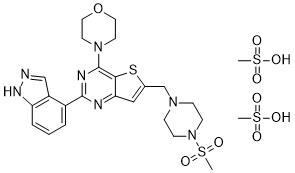
Pictilisib (GDC-0941) dimesylate (CAS#: 957054-33-0) targets class I PI3K isoforms: PI3Kα (IC50 = 3 nM), PI3Kβ (IC50 = 33 nM), PI3Kδ (IC50 = 3 nM), PI3Kγ (IC50 = 75 nM). It does not significantly inhibit mTOR or other lipid/protein kinases. [4] In cell growth inhibition studies, GI50 values in colorectal cancer cell lines: HCT116 = 1081 nM, DLD1 = 1070 nM, HT29 = 157 nM (72 h, SRB assay). [3] |
|---|---|
| 体外研究 (In Vitro) |
GDC-0941 对 PI3Kα 和 PI3Kδ 以及 PI3Kα 突变体 E545-K 和 H1047-R 均具有同等效力,对 PI3Kβ(选择性高 10 倍)和 PI3Kγ(选择性高 25 倍)表现出中等程度的选择性,而对 PI3K II、III 和 IV 类成员(包括 C2β、Vps34、DNA-PK 和 mTOR)则表现出更高的选择性。其 IC50 值分别为 46 nM、37 nM 和 28 nM。[1] GDC-0941 的 IC50 值为 149-944 nM,可有效抑制 HER2 扩增细胞的增殖,无论这些细胞对曲妥珠单抗是否敏感。 GDC-0941 的 IC50 为 500 nM 或更低,可有效抑制具有 PIK3CA 突变的 HER2 扩增细胞的增殖,以及缺乏 PTEN 且对曲妥珠单抗耐药的 HER2 扩增乳腺癌细胞的活力。[2] GDC-0941 可显著抑制 HCT116、DLD1 和 HT29 细胞的生长,其 GI50 值分别为 1081 nM、1070 nM 和 157 nM。 [3] GDC-0941 抑制中心母细胞的数量,诱导细胞凋亡,并抑制肿瘤细胞的增殖。[4]
Pictilisib (GDC-0941) 二甲磺酸盐 (CAS#: 957054-33-0) 作为单一药物,在 HCT116、DLD1 和 HT29 细胞中显示出生长抑制作用,GI50 值分别为 1081 nM、1070 nM 和 157 nM。 [3] 与 MEK 抑制剂(AZD6244 或 PD0325901)联用时,GDC-0941 在 HCT116 和 HT29 细胞中表现出显著的协同生长抑制作用(HCT116 细胞中 GDC-0941/PD0325901 在 1×GI50 浓度下的联合指数值为 0.045;HT29 细胞中为 0.097)。[3] HCT116 和 HT29 细胞的蛋白质印迹分析显示,GDC-0941(1× 和 10× GI50 浓度)抑制 S6 磷酸化,但对 4EBP1 磷酸化的影响甚微。除 HCT116 细胞中 10× GI50 浓度外,GDC-0941 对 AKT 磷酸化的抑制作用并不稳定。与 PD0325901 联用时,GDC-0941 对 S6 磷酸化的抑制作用增强。 [3]在患有自发性B细胞滤泡性淋巴瘤的PTEN⁺/⁻ LKB1⁺/hypo小鼠中,口服Pictilisib (GDC-0941)二甲磺酸盐 (CAS#: 957054-33-0)(75 mg/kg,每日一次),连续5天,可显著抑制Akt活性和磷酸化(Thr308和Ser473),抑制SGK1活性和磷酸化(Thr229和Thr389),抑制S6K活性(p-S6),增加4E-BP1的电泳迁移率,并导致Thr37/Thr46和Ser65位点去磷酸化,以及抑制NDRG1磷酸化(SGK1底物)。[4]治疗14天后,肿瘤缩小至原大小的约40%; 42天后,肿瘤缩小至原体积的约50%。[4] 14天后的免疫组化结果显示,Ki67反应性降低(<5%,而对照组为10-15%),caspase-3阳性凋亡细胞增多,中心母细胞中p-S6染色减弱。[4] 42天后,Ki67仍<5%,p-S6染色降低。[4] 流式细胞术显示,GDC-0941治疗显著减少了肿瘤内的中心母细胞数量。[4] 停止药物治疗(42天后)后,肿瘤在约16天内恢复至原体积,且生长速度加快(29 ± 6.5 mm³/周,而未治疗组为11.8 ± 9.0 mm³/周)。[4] |
| 体内研究 (In Vivo) |
由于微粒体代谢有限,GDC-0941 的口服生物利用度为 78% [5]。在已建立的雌性 NCr 无胸腺小鼠人源 U87MG 胶质母细胞瘤异种移植模型中,以 75 mg/kg/天的剂量给予 GDC-0941 可产生显著的抑制作用,肿瘤生长抑制率达 83% [1]。在携带 HER2 扩增、曲妥珠单抗耐药的 MDA-MB-361.1 异种移植瘤的小鼠中,以 150 mg/kg/天的剂量口服 GDC-0941 可显著减缓肿瘤进展并诱导强效的肿瘤细胞凋亡 [2]。在 PTEN+/-LKB1+/hypo 小鼠中,以 75 mg/kg/天的剂量给予 GDC-0941 治疗两周后,自发性 B 细胞滤泡性淋巴瘤的肿瘤体积缩小了 40%。肿瘤体积缩小的同时,Akt、S6K 和 SGK(血清和糖皮质激素蛋白激酶)的蛋白磷酸化水平也降低。[4]
采用标准方法进行 PI3K 同工酶活性测定。Pictilisib (GDC-0941) 二甲磺酸盐 (CAS#: 957054-33-0) 对 PI3Kα 的 IC50 为 3 nM,对 PI3Kβ 为 33 nM,对 PI3Kδ 为 3 nM,对 PI3Kγ 为 75 nM。它对其他任何受试的脂质或蛋白激酶(包括 mTOR)均无显著抑制作用。[4] 在结直肠癌研究中,使用磺基罗丹明 B (SRB) 法测定暴露 72 小时后的生长抑制情况。将细胞用化合物进行系列稀释处理,固定后用 SRB 染色,并测量吸光度。计算了GI50值。[3] |
| 酶活实验 |
闪烁邻近分析;重组人PI3Kα、PI3Kβ和PI3Kδ与p85α调节亚基在Sf9杆状病毒系统中共表达,并使用谷胱甘肽-琼脂糖亲和层析纯化为GST融合蛋白。闪烁邻近分析。重组人PI3Kγ以类似方式表达并纯化为单体GST融合蛋白。将GDC-0941溶解于DMSO中,并注入50 μL混合溶液中,该混合溶液包含20 mM Tris-HCl(pH 7.5)、4 mM MgCl2、1 mM DTT、1 μM ATP、0.125 μCi [γ-33P]-ATP和4% (v/v) DMSO。为启动激酶反应,将反应混合物与重组 GST 融合蛋白 PI3Kα (5 ng)、PI3Kβ (5 ng)、PI3Kδ (5 ng) 或 PI3Kγ (5 ng) 混合。
细胞生长抑制(SRB 法):将细胞接种于 96 孔板中,用化合物处理 72 小时,然后用三氯乙酸固定,用 SRB 染色,并在 540 nm 处读取吸光度。[3] 细胞系蛋白质印迹分析:将细胞用化合物处理 24 小时,裂解细胞,并通过 SDS-PAGE 分离蛋白质。使用针对 p-ERK、p-AKT、p-S6、p-4EBP1 和总蛋白的抗体。 [3] 小鼠肿瘤流式细胞术分析:从肿瘤中提取的细胞用针对 B220、TCRβ、κ 和 λ 轻链的抗体进行染色,并通过流式细胞术进行分析。前向散射/侧向散射用于鉴定中心母细胞群。[4] 免疫组织化学分析:福尔马林固定石蜡包埋切片用针对 B220、CD79a、CD3、Ki67、cleaved caspase-3、p-S6 (Ser235/236) 和 p-AKT (Ser473) 的抗体进行染色。[4] |
| 细胞实验 |
将 BT474-M1、SKBR-3、AU-565、HCC-1419、ZR75-30、JIMT-1、BT474-EEI、HCC-1954、MCF-7、CALU-3、SKOV-3 和 MKN-7 细胞暴露于不同浓度的 GDC-0941 中 48 小时和 72 小时。采用 CellTiter-Glo 发光细胞活力检测法检测细胞活力和增殖情况。通过蛋白质印迹法检测 pAkt (Ser473)、cleaved caspase-3 和 cleaved PARP 的表达水平。细胞凋亡和 caspase 3/7 活性分别使用 Cell Death Detection ELISAplus 检测和 Caspase-Glo 3/7 检测进行检测。
在结直肠癌细胞的联合用药研究(文献 3)中,未进行 GDC-0941 单独使用的动物实验;仅进行了体外研究。[3] 在 PTEN⁺/⁻ LKB1⁺/hypo 小鼠的自发性淋巴瘤研究(文献 4)中:使用了 6-8 月龄、颈部淋巴结可见肿瘤的小鼠。Pictilisib (GDC-0941) 二甲磺酸盐(CAS#: 957054-33-0) 溶解于 30% 卡普替索 (w/v) 溶液中,每日一次灌胃给药,剂量为 75 mg/kg,持续 42 天。溶剂对照组为 30% 卡普替索溶液。分别于第 0、14、28、42 天以及停药后第 63、77 天,采用 MRI(3D RARE-4)监测肿瘤体积。治疗 5 天后,于末次给药后 2 小时处死小鼠进行生化分析。14 天或 42 天后,收集肿瘤组织进行组织学和免疫印迹分析。[4] |
| 动物实验 |
将MCF7-neo/HER2或MX-1乳腺癌细胞皮下注射到雌性裸鼠(nu/nu小鼠)体内。当肿瘤平均体积达到200至250 mm³时,将小鼠分成每组10只的组。组间大小根据肿瘤大小进行匹配。每周静脉注射一次RP-56976(3%乙醇和97%生理盐水的混合液)。同时,每日口服Pictilisib(GDC-0941,MCT为0.5%甲基纤维素和0.2%吐温-80)。通过将患者来源的肿瘤直接植入NMRI裸鼠(nu/nu小鼠)皮下,构建了MAXF1162 HER2+/ER+/PR+患者来源乳腺癌肿瘤异种移植模型。计算肿瘤体积。在整个研究过程中,每周测量两次肿瘤大小。
临床前动物研究:携带皮下U87MG或IGROV-1异种移植瘤的雌性BALB/c小鼠或NCr无胸腺小鼠(6-8周龄)。Pictilisib(二甲磺酸盐)配制于10% DMSO、5% Tween 20和85%生理盐水中,每日一次口服(po),剂量分别为25、50、100和150 mg/kg,持续19天。每两周测量一次肿瘤体积,并在研究结束时称量肿瘤重量。药代动力学研究采用静脉注射(10 mg/kg)和口服(10 mg/kg)给药,在BALB/c小鼠中测定生物利用度[5]。 临床试验:首次人体I期剂量递增研究,受试者为晚期实体瘤患者。 Pictilisib 最初每28天为一个周期,于第1-21天每日口服一次(21/28方案),之后改为每日连续给药(28/28方案)。起始剂量为15 mg,逐渐增加至450 mg。采用改良的3+3设计确定剂量限制性毒性(DLT)和最大耐受剂量(MTD)。推荐II期剂量(RP2D)为每日一次,每次330 mg,连续给药。在第1天和第15天于多个时间点(给药前、0.5、1、2、3、4、8、24、48、72小时)进行药代动力学采样。药效学评估包括富血小板血浆中的pAKT、肿瘤活检中的pS6和pAKT、血浆胰岛素/葡萄糖水平以及18F-FDG-PET扫描[6]。 |
| 药代性质 (ADME/PK) |
药代动力学[6]
所有剂量组的匹替西利(Pitticilib)药代动力学参数均已估算,并汇总于表3和补充表1中。空腹状态下,口服匹替西利后吸收迅速(中位Tmax为2小时[范围0.5-8小时]);这与剂量无关,且多次给药后保持不变。第1天的末端血浆消除半衰期(T1/2)为13.1至24.1小时。在研究的剂量范围内,药物暴露量(Cmax和AUC0-24)随剂量呈比例增加(图1)。第15天观察到类似的药代动力学特征。累积指数(AUCDay15/AUCDay1)为1.2至2.2,表明多次给药后药物蓄积极少。 本研究对大鼠、犬和人分别单次口服30 mg/kg、5 mg/kg和60 mg目标剂量的[14C]匹替西利(一种选择性1A类磷脂酰肌醇3-激酶(PI3K)小分子抑制剂)后的吸收、代谢和排泄情况进行了表征。匹替西利在所有动物体内均被迅速吸收,达峰时间(Tmax)小于2小时。在所有动物体内,匹替西利均占总放射性的主要成分,超过86.6%。在大鼠、犬和人体内,分别有98%、80%和95%的匹替西利及其相关放射性物质从尿液和粪便中排出,其中不到2%经尿液排出,其余部分经粪便排出。在大鼠和犬中,超过40%的药物相关放射性物质经胆汁排泄,表明胆汁排泄是主要的排泄途径。未代谢的匹替西利(Pitticilib)在大鼠和犬的胆汁中浓度较低。在大鼠中,胆汁中的主要代谢物是部分氧化的吲唑的O-葡萄糖醛酸苷(M20,占剂量的21%),而在犬中则是氧化哌嗪的开环代谢物M7(占剂量的10.8%)。在大鼠胆汁中检测到的新代谢物是氧化的谷胱甘肽(GSH)结合物(M18、M19),提示匹替西利可能生成活性中间体。核磁共振(NMR)进一步证实M18的结构是吲唑环的N-羟基化和GSH结合的代谢物。Xenobiotica. 2021 Jul;51(7):796-810. https://pubmed.ncbi.nlm.nih.gov/33938357/ 临床前小鼠药代动力学:雌性BALB/c小鼠口服Pictilisib(10 mg/kg游离碱)后,口服生物利用度为78%。U87MG荷瘤小鼠口服50 mg/kg后,血浆和肿瘤中的Cmax均在0.5 h达到,肿瘤/血浆比值约为0.8。肿瘤浓度在8 h以上仍高于GI50。血浆半衰期约为4.5 h。分布容积(Vdss)为1.9 L/kg,清除率为33 mL/min/kg [5]。 人体临床药代动力学:Pictilisib吸收迅速,中位Tmax为2 h(范围0.5-8 h)。第1天的末端半衰期为13.1至24.1 h。在 15-450 mg 剂量范围内,观察到 Cmax 和 AUC0-24 呈剂量比例增加。累积指数(第 15 天 AUC/第 1 天)范围为 1.2 至 2.2。对于 RP2D 330 mg,第 15 天的几何平均 Cmax = 2.07 μM,AUC0-24 = 22.8 hr·μM [6]。 |
| 毒性/毒理 (Toxicokinetics/TK) |
安全性和耐受性[6] 匹替西利布在330 mg剂量(21/28给药方案)下耐受性良好;大多数不良事件为轻度至中度,且无治疗相关死亡(表2)。在所评估的剂量水平下,21/28和28/28给药方案的毒性特征似乎无显著差异。发生率≥10%的治疗相关不良事件包括恶心、腹泻、呕吐、疲乏、味觉障碍、食欲下降和皮疹。除450 mg剂量组中出现两例3级皮疹的剂量限制性毒性(DLT)外,该剂量组的第三例患者也出现了2级皮疹;尽管如此,该患者仍接受了8个月的匹替西利布治疗,同时服用口服抗组胺药和润肤剂。在接受每日一次 330 mg 治疗的 10 例患者(28/28 方案)中,2 例出现 1 级或 2 级皮疹,2 例出现 3 级皮疹(在剂量限制性毒性定义窗口期之后);所有这些皮疹在停药并给予支持治疗(包括润肤剂和皮质类固醇)后均消退。[6] 其他具有临床意义的 ≥3 级药物相关不良事件包括 4 级高血糖(n=1,130 mg)和 3 级肺炎(n=1,340 mg)。4 级高血糖为短暂性,无临床意义的症状、体征或酸中毒,发生于一名胆管癌患者,该患者曾接受胰十二指肠切除术,并在事件发生前 2 天开始服用小剂量泼尼松龙。一名曾接受胸部放疗的乳腺癌患者在第一个治疗周期结束时出现3级肺炎,伴有1级呼吸困难、一氧化碳弥散量(DLCO)下降以及高分辨率CT(HRCT)显示磨玻璃样阴影;停药2周并同时服用泼尼松龙后,这些症状缓解。当重新开始服用匹替西利(Pitticilib)240 mg时,呼吸困难和HRCT改变复发;由于疾病进展,永久停用匹替西利后,这些症状再次缓解。
剂量限制性毒性(DLT)和最大耐受剂量(MTD)[6] 每日一次450 mg(21/28方案)的MTD已超过,两名患者出现3级皮疹,属于DLT。这是一种覆盖体表面积 70-80% 的斑丘疹,大约在每日服用 Pitticilib 后 2 周出现,并在停药 2 周后自行消退。在每日一次 330 mg(21/28 给药方案)的治疗方案中,七分之一的患者出现 3 级斑丘疹,其发病和消退时间模式相似;这也被确定为剂量限制性毒性 (DLT)。在 28/28 给药方案中未观察到 DLT。 Pictilisib (GDC-0941) 二甲磺酸盐 (CAS#: 957054-33-0) 是一种泛 I 类 PI3K 抑制剂,在结直肠癌细胞中,它与 MEK 抑制剂的协同作用比双重 PI3K/mTOR 抑制剂 NVP-BEZ235 更强。 NVP-BEZ235 协同作用降低归因于其对 mTOR 的直接抑制,这削弱了协同作用。在 GDC-0941/PD0325901 联合用药中加入 mTORC1/2 抑制剂 KU0063794 会以浓度依赖的方式降低协同作用。[3] 在 PTEN/LKB1 缺陷型小鼠淋巴瘤模型中,GDC-0941 治疗可诱导肿瘤缩小,但不能完全消退。停药后,肿瘤以加速的速度重新生长,并进展为弥漫性大 B 细胞淋巴瘤。[4] |
| 参考文献 | |
| 其他信息 |
匹替西利二甲基磺酸盐是匹替西利的一种高生物利用度口服二甲基磺酸盐衍生物。匹替西利是一种I类磷脂酰肌醇3-激酶(PI3K)小分子抑制剂,具有潜在的抗肿瘤活性。给药后,匹替西利以ATP竞争性方式选择性地与PI3K结合,抑制第二信使磷脂酰肌醇-3,4,5-三磷酸(PIP3)的生成以及PI3K/Akt信号通路的激活。这可能导致易感肿瘤细胞群的生长、迁移和存活受到抑制。PI3K/Akt信号通路的激活通常与肿瘤发生相关。PI3K/Akt信号通路的失调可能导致肿瘤对多种抗肿瘤药物产生耐药性。磷脂酰肌醇-3-激酶 (PI3K) 是癌症治疗的重要靶点,因为 PI3K/Akt 信号通路在多种肿瘤中均存在异常调控。我们合成了一系列噻吩并[3,2-d]嘧啶衍生物,并评估了它们作为 PI3 激酶 p110α 抑制剂的活性。本文将详细介绍这些化合物的合成、生物活性及进一步表征。本研究鉴定出化合物 17,即 GDC-0941,它是一种高效、选择性强且口服生物利用度高的 PI3K 抑制剂,目前正在进行癌症治疗的人体临床试验。[1] 曲妥珠单抗(赫赛汀)是 HER2 靶向乳腺癌治疗的基石,可使辅助治疗和转移性乳腺癌患者获益。本文将阐述曲妥珠单抗的作用机制,即抗体疗法通过破坏 HER2 扩增细胞中配体非依赖性的 HER2/HER3 相互作用发挥作用。这种解离动力学与HER3去磷酸化和与PI3K活性的解偶联平行,导致近端和远端AKT信号通路下调,并与曲妥珠单抗的抗增殖作用相关。选择性强效的PI3K抑制剂GDC-0941与曲妥珠单抗联合使用时,在治疗曲妥珠单抗耐药细胞和肿瘤方面显示出极高的疗效。[2]
背景:联合靶向MAPK和PI3K信号通路可能是实现癌症治疗最佳疗效的必要条件。本研究评估了MEK抑制剂AZD6244和PD0325901单独使用以及与mTOR/PI3K双重抑制剂NVP-BEZ235或PI3K抑制剂GDC-0941联合使用对三种结直肠癌细胞系的影响。方法:分别采用磺基罗丹明B (SRB) 法、克隆形成实验和蛋白质印迹法检测HCT116、HT29和DLD1细胞系的生长抑制、存活率和信号转导情况。结果:所有MEK/PI3K抑制剂组合均表现出显著的协同生长抑制作用;然而,GDC-0941与任何MEK抑制剂联合使用时均表现出更强的协同作用。与GDC-0941相比,NVP-BEZ235对4EBP1磷酸化的抑制作用更强,而其对S6和AKT磷酸化的抑制作用与GDC-0941相似。PD0325901和AZD6244均能抑制ERK磷酸化,且与MEK/PI3K抑制剂联合使用时,对S6磷酸化的抑制作用增强。与 GDC-0941 相比,NVP-BEZ235 与 MEK 抑制剂联合用药的协同效应有所降低,这可能是由于 mTOR 抑制所致。此外,mTORC1/2 抑制剂 KU0063794 的加入削弱了 GDC-0941 与 PD0325901 联合用药的协同效应。结论:这些研究证实,PI3K 和 MEK 的双重靶向作用可以诱导协同生长抑制;然而,与 mTOR/PI3K 双重抑制剂相比,特异性 PI3K 抑制剂与 MEK 抑制剂的联合应用可产生更大的协同效应。[3] Pictilisib (GDC-0941) 是一种强效、选择性、口服生物利用度高的泛 I 类 PI3K 抑制剂,由基因泰克公司开发,目前已进入 I 期临床试验。该药物展现出靶向药效学效应,包括在推荐的II期剂量(RP2D)下,富血小板血浆中pAKT水平降低90%以上;血浆胰岛素和葡萄糖水平升高(330 mg剂量给药后1小时,平均倍数变化分别为3.58和1.18);以及在32例可评估患者中的7例(22%)中,18F-FDG-PET SUVmax值降低25%以上。推荐的II期剂量为每日一次,每次330 mg,持续给药。进一步的临床开发包括与厄洛替尼、氟维司群、曲妥珠单抗-美坦新、MEK抑制剂、紫杉醇和化疗方案联合用药的试验[6]。 |
| 分子式 |
C25H35N7O9S4
|
|
|---|---|---|
| 分子量 |
705.84
|
|
| 精确质量 |
705.137
|
|
| 元素分析 |
C, 42.54; H, 5.00; N, 13.89; O, 20.40; S, 18.17
|
|
| CAS号 |
957054-33-0
|
|
| 相关CAS号 |
Pictilisib;957054-30-7
|
|
| PubChem CID |
56972143
|
|
| 外观&性状 |
White to light yellow solid powder
|
|
| 熔点 |
>280°C (dec.)
|
|
| tPSA |
270Ų
|
|
| 氢键供体(HBD)数目 |
3
|
|
| 氢键受体(HBA)数目 |
16
|
|
| 可旋转键数目(RBC) |
5
|
|
| 重原子数目 |
45
|
|
| 分子复杂度/Complexity |
924
|
|
| 定义原子立体中心数目 |
0
|
|
| SMILES |
O=S(C)(O)=O.O=S(C)(N1CCN(CC2=CC3N=C(C4C5=C(NN=C5)C=CC=4)N=C(C=3S2)N2CCOCC2)CC1)=O
|
|
| InChi Key |
RFRIKACSFOTIMU-UHFFFAOYSA-N
|
|
| InChi Code |
InChI=1S/C23H27N7O3S2.2CH4O3S/c1-35(31,32)30-7-5-28(6-8-30)15-16-13-20-21(34-16)23(29-9-11-33-12-10-29)26-22(25-20)17-3-2-4-19-18(17)14-24-27-19;2*1-5(2,3)4/h2-4,13-14H,5-12,15H2,1H3,(H,24,27);2*1H3,(H,2,3,4)
|
|
| 化学名 |
4-[2-(1H-indazol-4-yl)-6-[(4-methylsulfonylpiperazin-1-yl)methyl]thieno[3,2-d]pyrimidin-4-yl]morpholine;methanesulfonic acid
|
|
| 别名 |
|
|
| HS Tariff Code |
2934.99.9001
|
|
| 存储方式 |
Powder -20°C 3 years 4°C 2 years In solvent -80°C 6 months -20°C 1 month 注意: 请将本产品存放在密封且受保护的环境中,避免吸湿/受潮。 |
|
| 运输条件 |
Room temperature (This product is stable at ambient temperature for a few days during ordinary shipping and time spent in Customs)
|
| 溶解度 (体外实验) |
|
|---|
| 制备储备液 | 1 mg | 5 mg | 10 mg | |
| 1 mM | 1.4168 mL | 7.0838 mL | 14.1675 mL | |
| 5 mM | 0.2834 mL | 1.4168 mL | 2.8335 mL | |
| 10 mM | 0.1417 mL | 0.7084 mL | 1.4168 mL |
1、根据实验需要选择合适的溶剂配制储备液 (母液):对于大多数产品,InvivoChem推荐用DMSO配置母液 (比如:5、10、20mM或者10、20、50 mg/mL浓度),个别水溶性高的产品可直接溶于水。产品在DMSO 、水或其他溶剂中的具体溶解度详见上”溶解度 (体外)”部分;
2、如果您找不到您想要的溶解度信息,或者很难将产品溶解在溶液中,请联系我们;
3、建议使用下列计算器进行相关计算(摩尔浓度计算器、稀释计算器、分子量计算器、重组计算器等);
4、母液配好之后,将其分装到常规用量,并储存在-20°C或-80°C,尽量减少反复冻融循环。
计算结果:
工作液浓度: mg/mL;
DMSO母液配制方法: mg 药物溶于 μL DMSO溶液(母液浓度 mg/mL)。如该浓度超过该批次药物DMSO溶解度,请首先与我们联系。
体内配方配制方法:取 μL DMSO母液,加入 μL PEG300,混匀澄清后加入μL Tween 80,混匀澄清后加入 μL ddH2O,混匀澄清。
(1) 请确保溶液澄清之后,再加入下一种溶剂 (助溶剂) 。可利用涡旋、超声或水浴加热等方法助溶;
(2) 一定要按顺序加入溶剂 (助溶剂) 。
InvivoChem的所有产品仅用于作科学研究,不面向患者销售
Copyright 2020 InvivoChem LLC | All Rights Reserved 粤ICP备20063088号-1


 COA
COA


 粤公网安备 44011102003439号
 463611831


