| 规格 | 价格 | 库存 | 数量 |
|---|---|---|---|
| 50mg |
|
||
| 100mg |
|
||
| 250mg |
|
||
| 500mg |
|
||
| 1g |
|
||
| 5g |
|
||
| Other Sizes |
|

| 靶点 |
5-HT3 Receptor
Ondansetron hydrochloride dihydrate targets the serotonin 5-HT3 receptor. It is a selective and competitive antagonist of the 5-HT3 receptor. 5-HT3 receptors are ligand-gated ion channels that mediate the emetic response. By blocking 5-HT3 receptors, ondansetron inhibits the effects of serotonin released from enterochromaffin cells in the gastrointestinal tract, thereby preventing nausea and vomiting. |
|---|---|
| 体外研究 (In Vitro) |
在体外,盐酸昂丹司琼二水合物是一种选择性5-HT3受体拮抗剂。其活性通常通过测量其抑制表达5-HT3受体的细胞中5-HT诱导的离子流或钙离子流的能力来评估。该化合物已被用作5-HT3拮抗剂,以减轻延髓腹内侧核(RVM)/胆囊收缩素(CCK)诱导的机械性痛觉过敏,并阻断曲古抑菌素A(TSA)对5-HT3蛋白的作用。标准的体外检测方法包括使用放射性标记配体(例如[3H]-GR65630)的受体结合研究和测量离子流的功能性检测。
|
| 体内研究 (In Vivo) |
在辐射诱发的异食癖模型中,盐酸昂丹司琼二水合物(2 mg/kg;腹腔注射;单次)与地塞米松(2 mg/kg)和CP-99,994(15 mg/kg)联合使用可预防放射病[1]。
在体内,盐酸昂丹司琼二水合物在临床上用于预防癌症化疗、放射治疗和手术引起的恶心和呕吐。它具有良好的口服生物利用度,并且能够透过血脑屏障。该化合物耐受性良好,副作用较少;最常见的副作用是头痛、便秘和头晕。它也被用于研究5-HT3受体在各种生理和病理过程中的作用。 |
| 酶活实验 |
对于非细胞受体结合试验,可使用表达人5-HT3受体的细胞膜制备物评估盐酸昂丹司琼二水合物。放射性配体结合置换实验采用合适的放射性标记配体,例如[3H]-GR65630或[3H]-LY278584。将膜匀浆与浓度递增的测试化合物和固定浓度的放射性配体在室温下孵育60-90分钟。通过玻璃纤维滤膜快速过滤,将结合的放射性配体与游离的放射性配体分离。在过量未标记的昂丹司琼或MDL-72222存在下测定非特异性结合。使用非线性回归分析,根据置换曲线计算Ki值。
|
| 细胞实验 |
对于体外细胞实验,将表达人5-HT3受体的细胞(例如HEK293细胞)培养于合适的培养基中。对于功能性实验,使用荧光钙指示剂(例如Fluo-4 AM)测量钙离子内流。将细胞加载染料后,预先用不同浓度的盐酸昂丹司琼二水合物孵育。加入5-HT3受体激动剂(例如5-HT或m-CPBG)以刺激受体激活。使用荧光酶标仪测量荧光强度。与对照孔相比,钙信号的降低表明拮抗剂活性。IC50值由剂量反应曲线计算得出。
|
| 动物实验 |
动物/疾病模型: ICR品系雄性小鼠(8周龄;30-36克;辐射诱导异食癖模型(高岭土摄入行为“异食癖”可能类似于小鼠的恶心和呕吐))[1]。
剂量: 2 mg/kg 给药途径: 腹腔注射;单次。 实验结果: 地塞米松使辐射诱导的高岭土摄入量略微降低至对照组的48%。与地塞米松(2 mg/kg)和CP-99,994(15 mg/kg)联合使用,显示出良好的阻断辐射病活性。 对于体内动物研究,盐酸昂丹司琼二水合物可通过灌胃或腹腔注射给药于啮齿动物。在呕吐模型中,评估化合物预防呕吐或干呕的能力。在化疗引起的恶心模型中,评估行为和生理参数。在疼痛模型中,评估化合物对过敏反应的影响。给药方案因具体模型和所需暴露水平而异。可采集血液和组织样本进行药代动力学分析。 |
| 药代性质 (ADME/PK) |
代谢/代谢物
肝脏半衰期:5.7 小时 盐酸昂丹司琼二水合物的分子量为 365.86,分子式为 C18H19N3O·HCl·2H2O。它具有口服生物利用度,并且能够透过血脑屏障。该化合物应在室温下储存。它仅供研究使用,未经批准的临床适应症,不得用于人体。 |
| 毒性/毒理 (Toxicokinetics/TK) |
妊娠期和哺乳期用药
◉ 哺乳期用药概述 昂丹司琼常用于缓解剖宫产期间及术后恶心,通常静脉注射剂量为 4 至 8 毫克。剖宫产期间及术后使用昂丹司琼似乎不会影响母乳喂养的开始。在产后接受昂丹司琼治疗的妇女所生的婴儿以及药代动力学研究中,均未报告不良反应。目前尚无关于产后哺乳期妇女使用昂丹司琼的研究,但该药已获准用于 1 个月以下的婴儿。计算机模型显示,母乳中的药物浓度远低于此剂量。无需采取特殊预防措施。 ◉ 对母乳喂养婴儿的影响 一项对 78 名产后接受静脉注射昂丹司琼的妇女进行的药代动力学研究表明,其母乳喂养的婴儿未出现不良反应。 ◉ 对泌乳和母乳的影响 一项随机、双盲研究比较了剖宫产术后使用安慰剂与静脉注射 4 mg 昂丹司琼预防术后恶心呕吐的效果。两组首次母乳喂养的时间无差异。 一项回顾性研究比较了三种剖宫产妇女的用药方案:麻醉前和分娩期间使用右美托咪定(n = 115)、麻醉前和分娩期间使用生理盐水、产后使用右美托咪定(n = 109)以及麻醉前和分娩期间使用生理盐水(n = 168)。所有妇女在拆线前根据需要接受 4 mg 昂丹司琼。各组昂丹司琼的平均总摄入量为 6 mg 至 9 mg。各组首次泌乳时间相似(25至28分钟)。盐酸昂丹司琼二水合物的毒性特征已通过临床应用得到充分证实。该药耐受性良好,副作用较少。最常见的副作用包括头痛、便秘和头晕。该化合物仅供研究使用,未经批准的临床适应症,不得用于人体。标准毒理学评估包括急性毒性和重复给药毒性研究,以及对胃肠道和中枢神经系统影响的评估。 |
| 参考文献 | |
| 其他信息 |
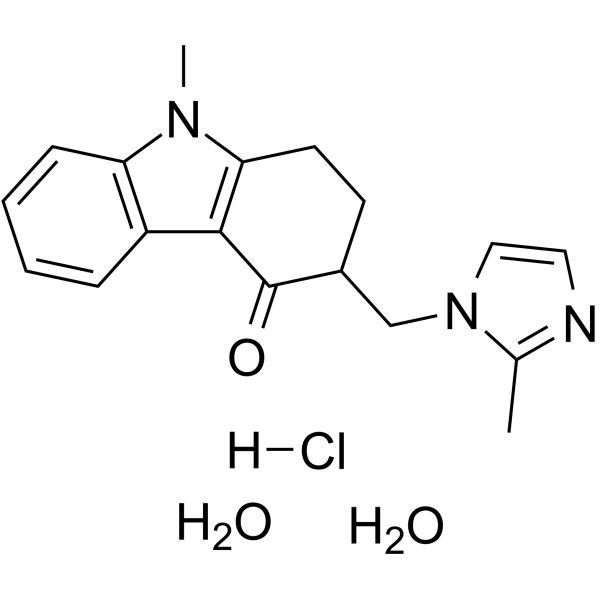
盐酸昂丹司琼属于咔唑类药物。盐酸昂丹司琼是昂丹司琼的外消旋混合物的盐酸盐。昂丹司琼是咔唑衍生物,是一种选择性竞争性5-HT3受体拮抗剂,具有抗呕吐活性。尽管其作用机制尚未完全阐明,但昂丹司琼似乎通过竞争性阻断外周胃肠道和延髓(含有中枢神经系统化学感受器触发区(CTZ))中的5-HT3受体的作用,从而抑制化疗和放疗引起的恶心和呕吐。它是一种竞争性5-HT3受体拮抗剂。对由细胞毒性化疗药物(包括顺铂)引起的恶心和呕吐有效,并已被报道具有抗焦虑和抗精神病作用。另见:盐酸昂丹司琼(注释已移动)。
盐酸昂丹司琼二水合物(CAS 103639-04-9)是一种口服生物利用度高、选择性和竞争性的5-HT3受体拮抗剂,能够穿透血脑屏障。主要用于预防由癌症化疗、放疗和手术引起的恶心和呕吐。它是选择性5-HT3受体拮抗剂中的首个药物。仅供研究用途。 |
| 分子式 |
C18H24CLN3O3
|
|---|---|
| 分子量 |
365.85
|
| 精确质量 |
365.15
|
| CAS号 |
103639-04-9
|
| 相关CAS号 |
Ondansetron;99614-02-5;Ondansetron hydrochloride;99614-01-4
|
| PubChem CID |
59774
|
| 外观&性状 |
White to off-white solid powder
|
| 密度 |
1.1±0.1 g/cm3
|
| 沸点 |
267.0±9.0 °C at 760 mmHg
|
| 熔点 |
231-232ºC
|
| 闪点 |
144.9±5.1 °C
|
| 蒸汽压 |
0.0±0.5 mmHg at 25°C
|
| 折射率 |
1.523
|
| LogP |
-0.37
|
| tPSA |
58.28
|
| 氢键供体(HBD)数目 |
3
|
| 氢键受体(HBA)数目 |
4
|
| 可旋转键数目(RBC) |
2
|
| 重原子数目 |
25
|
| 分子复杂度/Complexity |
440
|
| 定义原子立体中心数目 |
0
|
| SMILES |
CC1=NC=CN1CC2CCC3=C(C2=O)C4=CC=CC=C4N3C.O.O.Cl
|
| InChi Key |
VRSLTNZJOUZKLX-UHFFFAOYSA-N
|
| InChi Code |
InChI=1S/C18H19N3O.ClH.2H2O/c1-12-19-9-10-21(12)11-13-7-8-16-17(18(13)22)14-5-3-4-6-15(14)20(16)2;;;/h3-6,9-10,13H,7-8,11H2,1-2H3;1H;2*1H2
|
| 化学名 |
9-methyl-3-[(2-methylimidazol-1-yl)methyl]-2,3-dihydro-1H-carbazol-4-one;dihydrate;hydrochloride
|
| HS Tariff Code |
2934.99.9001
|
| 存储方式 |
Powder -20°C 3 years 4°C 2 years In solvent -80°C 6 months -20°C 1 month 注意: (1). 请将本产品存放在密封且受保护的环境中(例如氮气保护),避免吸湿/受潮和光照。 (2). 该产品在溶液状态不稳定,请现配现用。 |
| 运输条件 |
Room temperature (This product is stable at ambient temperature for a few days during ordinary shipping and time spent in Customs)
|
| 溶解度 (体外实验) |
DMSO: 100 mg/mL (273.34 mM)
H2O: 16.67 mg/mL (45.57 mM) |
|---|---|
| 溶解度 (体内实验) |
配方 1 中的溶解度: ≥ 2.5 mg/mL (6.83 mM) (饱和度未知) in 10% DMSO + 40% PEG300 + 5% Tween80 + 45% Saline (这些助溶剂从左到右依次添加,逐一添加), 澄清溶液。
例如,若需制备1 mL的工作液,可将100 μL 25.0 mg/mL澄清DMSO储备液加入到400 μL PEG300中,混匀;然后向上述溶液中加入50 μL Tween-80,混匀;加入450 μL生理盐水定容至1 mL。 *生理盐水的制备:将 0.9 g 氯化钠溶解在 100 mL ddH₂O中,得到澄清溶液。 配方 2 中的溶解度: ≥ 2.5 mg/mL (6.83 mM) (饱和度未知) in 10% DMSO + 90% (20% SBE-β-CD in Saline) (这些助溶剂从左到右依次添加,逐一添加), 澄清溶液。 例如,若需制备1 mL的工作液,可将 100 μL 25.0 mg/mL澄清DMSO储备液加入900 μL 20% SBE-β-CD生理盐水溶液中,混匀。 *20% SBE-β-CD 生理盐水溶液的制备(4°C,1 周):将 2 g SBE-β-CD 溶解于 10 mL 生理盐水中,得到澄清溶液。 请根据您的实验动物和给药方式选择适当的溶解配方/方案: 1、请先配制澄清的储备液(如:用DMSO配置50 或 100 mg/mL母液(储备液)); 2、取适量母液,按从左到右的顺序依次添加助溶剂,澄清后再加入下一助溶剂。以 下列配方为例说明 (注意此配方只用于说明,并不一定代表此产品 的实际溶解配方): 10% DMSO → 40% PEG300 → 5% Tween-80 → 45% ddH2O (或 saline); 假设最终工作液的体积为 1 mL, 浓度为5 mg/mL: 取 100 μL 50 mg/mL 的澄清 DMSO 储备液加到 400 μL PEG300 中,混合均匀/澄清;向上述体系中加入50 μL Tween-80,混合均匀/澄清;然后继续加入450 μL ddH2O (或 saline)定容至 1 mL; 3、溶剂前显示的百分比是指该溶剂在最终溶液/工作液中的体积所占比例; 4、 如产品在配制过程中出现沉淀/析出,可通过加热(≤50℃)或超声的方式助溶; 5、为保证最佳实验结果,工作液请现配现用! 6、如不确定怎么将母液配置成体内动物实验的工作液,请查看说明书或联系我们; 7、 以上所有助溶剂都可在 Invivochem.cn网站购买。 |
| 制备储备液 | 1 mg | 5 mg | 10 mg | |
| 1 mM | 2.7334 mL | 13.6668 mL | 27.3336 mL | |
| 5 mM | 0.5467 mL | 2.7334 mL | 5.4667 mL | |
| 10 mM | 0.2733 mL | 1.3667 mL | 2.7334 mL |
1、根据实验需要选择合适的溶剂配制储备液 (母液):对于大多数产品,InvivoChem推荐用DMSO配置母液 (比如:5、10、20mM或者10、20、50 mg/mL浓度),个别水溶性高的产品可直接溶于水。产品在DMSO 、水或其他溶剂中的具体溶解度详见上”溶解度 (体外)”部分;
2、如果您找不到您想要的溶解度信息,或者很难将产品溶解在溶液中,请联系我们;
3、建议使用下列计算器进行相关计算(摩尔浓度计算器、稀释计算器、分子量计算器、重组计算器等);
4、母液配好之后,将其分装到常规用量,并储存在-20°C或-80°C,尽量减少反复冻融循环。
计算结果:
工作液浓度: mg/mL;
DMSO母液配制方法: mg 药物溶于 μL DMSO溶液(母液浓度 mg/mL)。如该浓度超过该批次药物DMSO溶解度,请首先与我们联系。
体内配方配制方法:取 μL DMSO母液,加入 μL PEG300,混匀澄清后加入μL Tween 80,混匀澄清后加入 μL ddH2O,混匀澄清。
(1) 请确保溶液澄清之后,再加入下一种溶剂 (助溶剂) 。可利用涡旋、超声或水浴加热等方法助溶;
(2) 一定要按顺序加入溶剂 (助溶剂) 。
Link: https://clinicaltrials.gov/ct2/show/NCT02473042
Conditions:Post-Operative Nausea and Vomiting|Breast CancerLink: https://clinicaltrials.gov/ct2/show/NCT04240626
Conditions:Obesity, Morbid|Surgery|Bariatric Surgery CandidateLink: https://clinicaltrials.gov/ct2/show/NCT04766996
Conditions:Anesthesia|Opioid Use
Title:Study to Evaluate Rate of Nausea in Healthy Premenopausal Female Subjects Treated With Single Dose of Bremelanotide Alone or With Zofran
Status:Completed
updateDate:2022-04-04
Ctid:NCT03973047
Link: https://clinicaltrials.gov/ct2/show/NCT03973047
Conditions:NauseaLink: https://clinicaltrials.gov/ct2/show/NCT04872270
Conditions:Caffeine|Pain, JointLink: https://clinicaltrials.gov/ct2/show/NCT01217190
Conditions:Nausea and Vomiting, Postoperative|Nausea With Vomiting Chemotherapy-InducedLink: https://clinicaltrials.gov/ct2/show/NCT02246439
Conditions:Gastroenteritis|GastritisLink: https://clinicaltrials.gov/ct2/show/NCT03254459
Conditions:Pain, PostoperativeLink: https://clinicaltrials.gov/ct2/show/NCT02110719
Conditions:Narcotic Use|Pain|Constipation|NauseaLink: https://clinicaltrials.gov/ct2/show/NCT01953978
Conditions:PainLink: https://clinicaltrials.gov/ct2/show/NCT01933542
Conditions:Chlorzoxazone|Postoperative PainLink: https://clinicaltrials.gov/ct2/show/NCT01819857
Conditions:Cardiac RepolarizationLink: https://clinicaltrials.gov/ct2/show/NCT01719042
Conditions:Mycobacterium Avium Complex|Adverse EffectsLink: https://clinicaltrials.gov/ct2/show/NCT00659074
Conditions:HealthyLink: https://clinicaltrials.gov/ct2/show/NCT00654277
Conditions:HealthyLink: https://clinicaltrials.gov/ct2/show/NCT00653458
Conditions:HealthyLink: https://www.clinicaltrialsregister.eu/ctr-search/search?query=2011-005216-28
Condition:Post-operative nausea and vomiting (PONV)Link: https://www.clinicaltrialsregister.eu/ctr-search/search?query=2010-022872-30
Condition:Study to evaluate the efficacy and safety of two different doses of palonosetron compared to ondansetron in the prevention of CINV in pediatric patients undergoing single and repeated cycles of MEC or HECLink: https://www.clinicaltrialsregister.eu/ctr-search/search?query=2010-022971-79
Condition:Postoperative nausea and vomiting (PONV)Link: https://www.clinicaltrialsregister.eu/ctr-search/search?query=2008-004789-20
Condition:Prevention of post-operative nausea and vomiting.Link: https://www.clinicaltrialsregister.eu/ctr-search/search?query=2007-005311-25
Condition:Tähystysleikkauksen jälkeinen kipuLink: https://www.clinicaltrialsregister.eu/ctr-search/search?query=2006-000526-31
Condition:Peripheral neuropathyLink: https://www.clinicaltrialsregister.eu/ctr-search/search?query=2006-003512-22
Condition:Chemotherapy-induced Nausea and VomittingLink: https://www.clinicaltrialsregister.eu/ctr-search/search?query=2006-002033-21
Condition:Chemotherapy induced nausea and vomiting (CINV) due to Highly Emetogenic Chemotherapy (HEC)Link: https://www.clinicaltrialsregister.eu/ctr-search/search?query=2006-000781-37
Condition:Chemotherapy induced nausea and vomiting (CINV) due to Moderately Emetogenic Chemotherapy (MEC)Link: https://www.clinicaltrialsregister.eu/ctr-search/search?query=2006-001761-42
Condition:Postoperative Nausea and VomitingLink: https://www.clinicaltrialsregister.eu/ctr-search/search?query=2005-005856-42
Condition:Postoperative Nausea and Vomiting (PONV)Link: https://www.clinicaltrialsregister.eu/ctr-search/search?query=2005-005855-16
Condition:Postoperative Nausea and Vomiting (PONV)Link: https://www.clinicaltrialsregister.eu/ctr-search/search?query=2004-000370-31
Condition:Post Operative Nausea and Vomiting (PONV)Post Discharge Nausea and Vomiting (PDNV)Link: https://www.clinicaltrialsregister.eu/ctr-search/search?query=2004-001021-22
Condition:Post Operative Nausea and Vomiting (PONV)Post Discharge Nausea and Vomiting (PDNV)Link: https://www.clinicaltrialsregister.eu/ctr-search/search?query=2004-000369-37
Condition:Post Operative Nausea and Vomiting (PONV)Post Discharge Nausea and Vomiting (PDNV)Link: https://www.clinicaltrialsregister.eu/ctr-search/search?query=2004-001020-20
Condition:Chemotherapy Induced Nausea and Vomiting (CINV) 0 Moderately Emetogenic Chemotherapy (MEC)Link: https://www.clinicaltrialsregister.eu/ctr-search/search?query=2004-000371-34
Condition:Chemotherapy-Induced Nausea and Vomiting (CINV) - Highly Emetogenic Chemotherapy (HEC)Link: https://www.clinicaltrialsregister.eu/ctr-search/search?query=2011-004372-11
Condition:Enfants de 6 mois à 15 ans inclus, consultant aux urgences pour gastroentérite aiguë et ayant eu au moins 3 vomissements non bilieux, non sanglants dans les 12 heures qui précèdent la consultation.InvivoChem的所有产品仅用于作科学研究,不面向患者销售
Copyright 2020 InvivoChem LLC | All Rights Reserved 粤ICP备20063088号-1


 粤公网安备 44011102003439号
 463611831
