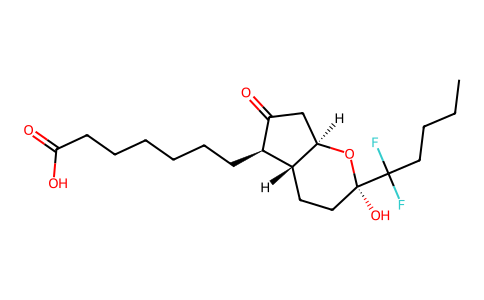
| 规格 | 价格 | 库存 | 数量 |
|---|---|---|---|
| 100mg |
|
||
| Other Sizes |
|

| 靶点 |
Lubiprostone targets chloride channel type 2 (ClC-2) in the apical membrane of gastrointestinal epithelial cells. Activation of ClC-2 leads to increased chloride secretion into the intestinal lumen, which is followed by passive movement of sodium and water, resulting in increased intestinal fluid volume. This enhances gastrointestinal motility and softens the stool, providing relief from constipation.
|
|---|---|
| 体外研究 (In Vitro) |
体外实验表明,鲁比前列酮可激活胃肠道上皮细胞中的ClC-2氯离子通道。该化合物的活性可通过膜片钳或Ussing室等电生理技术测定氯离子通量来评估。鲁比前列酮对ClC-2通道的选择性激活优于其他氯离子通道,这赋予了其胃肠道特异性。
|
| 体内研究 (In Vivo) |
在体内实验中,鲁比前列酮已在便秘动物模型中显示出疗效。该化合物可增加啮齿动物模型的胃肠道转运和粪便排出量。在临床试验中,鲁比前列酮显著改善了慢性特发性便秘和阿片类药物引起的便秘患者的排便频率和粪便性状。该化合物为口服给药。
|
| 酶活实验 |
鲁比前列酮的体外ClC-2通道活性测定采用表达重组ClC-2通道的细胞进行。该化合物激活通道的能力通过膜片钳等电生理技术,或荧光膜电位或离子流测定法进行测量。通道激活的EC₅₀值由浓度-效应曲线确定。
|
| 细胞实验 |
在表达ClC-2的胃肠道上皮细胞系中,对鲁比前列酮进行了体外细胞活性测定。用不同浓度的鲁比前列酮处理细胞,并使用荧光氯离子敏感探针或电生理技术测量氯离子通量。同时评估该化合物对细胞活力和增殖的影响。
|
| 动物实验 |
鲁比前列酮的体内疗效研究是在啮齿动物便秘模型中进行的,例如洛哌丁胺诱导的便秘模型。该化合物以0.1–10 mg/kg的剂量口服给药。采用活性炭餐或其他标记物测量胃肠道转运。监测粪便排出量和粪便性状。评估该化合物促进肠道蠕动的能力。
|
| 药代性质 (ADME/PK) |
吸收、分布和排泄
口服鲁比前列酮后,其全身生物利用度较低,血浆浓度低于定量限 (10 pg/mL)。血浆峰浓度出现在约 1.14 小时,大部分药物在 48 小时内经尿液排出。鲁比前列酮和 M3 仅以痕量存在于人粪便中。代谢/代谢物 人体和动物研究表明,鲁比前列酮通过 15 位还原、α 链 β-氧化和 ω 链 ω-氧化迅速且广泛地代谢。这些生物转化并非由肝细胞色素 P450 系统介导,而是由普遍表达的羰基还原酶介导。 M3 是鲁比前列酮在人和动物体内的代谢产物,由 15-羟基上的羰基还原形成,包含 α-羟基和 β-羟基差向异构体。M3 的含量不到放射性标记鲁比前列酮剂量的 10%。 生物半衰期 0.9 至 1.4 小时 鲁比前列酮口服给药,由于首过代谢广泛,其全身生物利用度较低。该化合物迅速转化为其活性代谢物,并在胃肠道局部发挥作用。消除半衰期短,支持每日两次给药。该化合物吸收极少,不会在体内蓄积。 |
| 毒性/毒理 (Toxicokinetics/TK) |
肝毒性
在临床试验中,鲁比前列素治疗未引起血清酶水平的显著变化或具有临床意义的肝损伤事件。自获批以来,申办方收到了一些血清转氨酶升高的病例报告,但尚未有已发表的鲁比前列素引起具有临床意义的肝损伤的报告。因此,即使发生,鲁比前列素引起的肝损伤也极其罕见。概率评分:E(不太可能引起具有临床意义的肝损伤)。妊娠和哺乳期影响 ◉ 哺乳期用药概述 目前尚无关于哺乳期使用鲁比前列素的信息。生产商报告称,该药物及其代谢物在大鼠乳汁中无法检测到,预计不会对母乳喂养的婴儿产生任何不良影响。应监测母乳喂养婴儿的腹泻情况。 ◉ 对母乳喂养婴儿的影响 截至修订日期,未找到相关的已发表信息。 ◉ 对哺乳和母乳的影响 截至修订日期,未找到相关的已发表信息。 蛋白结合率 94% 鲁比前列酮通常耐受性良好。常见不良反应包括恶心、腹泻和腹痛。严重不良反应罕见。该化合物禁用于机械性胃肠道梗阻患者。临床前毒理学研究表明,在治疗剂量下未观察到显著毒性。 |
| 参考文献 | |
| 其他信息 |
卢比前列素是一种用于治疗特发性慢性便秘的药物。卢比前列素是前列腺素 E1 的衍生物,属于双环脂肪酸家族,能够激活位于胃肠道上皮细胞顶膜上的 ClC-2 氯离子通道。激活这些通道促进富含氯的液体分泌,从而软化粪便,增加胃肠道运动,并诱导自发排便(SBM)。卢比前列素是一种氯通道激活剂。其作用机制是作为氯通道激活剂。卢比前列素是肠道氯通道(ClC-2)的激活剂,用于治疗慢性便秘和肠易激综合症。在使用卢比前列素治疗期间,未观察到血清酶升高或临床显著的肝损伤事件。卢比前列素是从前列腺素 E1 衍生的双环脂肪酸,是一种具有泻药活性的氯通道激活剂。给药后,卢比前列素特异性结合并激活胃肠道上皮细胞顶膜上的 II 型氯通道(ClC-2)。这导致氯离子外流,从而将水吸引到胃肠腔内。随之而来的肠道液体体积增加软化粪便,增加肠道运动,改善排便。它属于从前列腺素 E1 衍生的双环脂肪酸类化合物,并参与氯离子通道的门控。药物适应症 卢比前列素适用于治疗成人特发性慢性便秘,或用于治疗慢性非癌性疼痛患者的阿片类药物引起的便秘。它还适用于治疗18岁及以上女性的以便秘为主的肠易激综合症(IBS-C)。便秘的治疗机制 卢比前列素通过特异性激活 ClC-2 氯离子通道发挥作用,该通道是人类肠道顶膜的正常成分,其作用不依赖于蛋白激酶 A。激活 ClC-2 氯离子通道导致氯离子外流到肠腔,从而通过旁细胞途径引起钠离子外流,以维持等电点平衡。因此,水离子随钠离子进入肠腔以维持等渗平衡,从而增加肠道液体分泌。通过增加肠道液体分泌,卢比前列素可以增强肠道运动,从而促进粪便排出,缓解与特发性慢性便秘相关的症状。激活 ClC-2 氯离子通道可能通过恢复肠道紧密连接蛋白复合体来促进粘膜屏障功能的恢复。使用人类细胞系的膜片钳研究表明,卢比前列素及其代谢物的大多数有益生物活性仅存在于胃肠道上皮细胞的顶膜(腔内)部分。
卢比前列素(Amitiza®)是前列腺素 E1 衍生物,用于治疗特发性慢性便秘和阿片类药物引起的便秘。它激活胃肠道中的 ClC-2 氯通道,增加肠道液体分泌并增强运动。该化合物口服给药,系统生物利用度低。该产品仅供研究使用,不用于人类治疗。 |
| 分子式 |
C20H32F2O5
|
|---|---|
| 分子量 |
390.46
|
| 精确质量 |
390.221
|
| CAS号 |
333963-40-9
|
| PubChem CID |
157920
|
| 外观&性状 |
White to off-white solid powder
|
| 密度 |
1.2±0.1 g/cm3
|
| 沸点 |
532.3±50.0 °C at 760 mmHg
|
| 闪点 |
275.7±30.1 °C
|
| 蒸汽压 |
0.0±3.2 mmHg at 25°C
|
| 折射率 |
1.486
|
| LogP |
2.85
|
| tPSA |
83.83
|
| 氢键供体(HBD)数目 |
2
|
| 氢键受体(HBA)数目 |
7
|
| 可旋转键数目(RBC) |
11
|
| 重原子数目 |
27
|
| 分子复杂度/Complexity |
525
|
| 定义原子立体中心数目 |
4
|
| SMILES |
CCCCC([C@]1(CC[C@@H]2[C@@H](CCCCCCC(=O)O)C(=O)C[C@H]2O1)O)(F)F
|
| InChi Key |
WGFOBBZOWHGYQH-MXHNKVEKSA-N
|
| InChi Code |
InChI=1S/C20H32F2O5/c1-2-3-11-19(21,22)20(26)12-10-15-14(16(23)13-17(15)27-20)8-6-4-5-7-9-18(24)25/h14-15,17,26H,2-13H2,1H3,(H,24,25)/t14-,15-,17-,20-/m1/s1
|
| 化学名 |
7-[(2R,4aR,5R,7aR)-2-(1,1-difluoropentyl)-2-hydroxy-6-oxo-3,4,4a,5,7,7a-hexahydrocyclopenta[b]pyran-5-yl]heptanoic acid
|
| 存储方式 |
Powder -20°C 3 years 4°C 2 years In solvent -80°C 6 months -20°C 1 month |
| 制备储备液 | 1 mg | 5 mg | 10 mg | |
| 1 mM | 2.5611 mL | 12.8054 mL | 25.6108 mL | |
| 5 mM | 0.5122 mL | 2.5611 mL | 5.1222 mL | |
| 10 mM | 0.2561 mL | 1.2805 mL | 2.5611 mL |
1、根据实验需要选择合适的溶剂配制储备液 (母液):对于大多数产品,InvivoChem推荐用DMSO配置母液 (比如:5、10、20mM或者10、20、50 mg/mL浓度),个别水溶性高的产品可直接溶于水。产品在DMSO 、水或其他溶剂中的具体溶解度详见上”溶解度 (体外)”部分;
2、如果您找不到您想要的溶解度信息,或者很难将产品溶解在溶液中,请联系我们;
3、建议使用下列计算器进行相关计算(摩尔浓度计算器、稀释计算器、分子量计算器、重组计算器等);
4、母液配好之后,将其分装到常规用量,并储存在-20°C或-80°C,尽量减少反复冻融循环。
计算结果:
工作液浓度: mg/mL;
DMSO母液配制方法: mg 药物溶于 μL DMSO溶液(母液浓度 mg/mL)。如该浓度超过该批次药物DMSO溶解度,请首先与我们联系。
体内配方配制方法:取 μL DMSO母液,加入 μL PEG300,混匀澄清后加入μL Tween 80,混匀澄清后加入 μL ddH2O,混匀澄清。
(1) 请确保溶液澄清之后,再加入下一种溶剂 (助溶剂) 。可利用涡旋、超声或水浴加热等方法助溶;
(2) 一定要按顺序加入溶剂 (助溶剂) 。
Link: https://clinicaltrials.gov/ct2/show/NCT07277907
Conditions:Slow Transit Constipation|PharmacotherapyLink: https://clinicaltrials.gov/ct2/show/NCT03720613
Conditions:Opioid-induced ConstipationLink: https://clinicaltrials.gov/ct2/show/NCT01839734
Conditions:HIV
Title:Amitiza® Plus GoLYTELY® (PEG) Versus Placebo Plus GoLYTELY® for Outpatient Colonoscopy Preparation
Status:Completed
updateDate:2023-06-01
Ctid:NCT00645801
Link: https://clinicaltrials.gov/ct2/show/NCT00645801
Conditions:ColonoscopyLink: https://clinicaltrials.gov/ct2/show/NCT00908076
Conditions:Parkinson's DiseaseLink: https://clinicaltrials.gov/ct2/show/NCT01096290
Conditions:ConstipationLink: https://clinicaltrials.gov/ct2/show/NCT00746395
Conditions:Inflammatory Bowel DiseaseLink: https://clinicaltrials.gov/ct2/show/NCT02481947
Conditions:Chronic Idiopathic ConstipationLink: https://clinicaltrials.gov/ct2/show/NCT02042183
Conditions:Constipation - FunctionalLink: https://clinicaltrials.gov/ct2/show/NCT02766777
Conditions:Constipation - FunctionalLink: https://clinicaltrials.gov/ct2/show/NCT01298219
Conditions:Opioid-induced Bowel DysfunctionLink: https://clinicaltrials.gov/ct2/show/NCT02138136
Conditions:Constipation - FunctionalLink: https://clinicaltrials.gov/ct2/show/NCT03097861
Conditions:Chronic Idiopathic ConstipationLink: https://clinicaltrials.gov/ct2/show/NCT02544152
Conditions:Irritable Bowel SyndromeLink: https://clinicaltrials.gov/ct2/show/NCT00399542
Conditions:Irritable Bowel Syndrome|ConstipationLink: https://clinicaltrials.gov/ct2/show/NCT00452335
Conditions:ConstipationLink: https://clinicaltrials.gov/ct2/show/NCT00595946
Conditions:Opioid-Induced Bowel DysfunctionLink: https://clinicaltrials.gov/ct2/show/NCT01993875
Conditions:Chronic Idiopathic ConstipationLink: https://clinicaltrials.gov/ct2/show/NCT00597428
Conditions:Opioid-Induced Bowel DysfunctionLink: https://clinicaltrials.gov/ct2/show/NCT00380250
Conditions:Irritable Bowel Syndrome With ConstipationLink: https://clinicaltrials.gov/ct2/show/NCT02729909
Conditions:ConstipationLink: https://clinicaltrials.gov/ct2/show/NCT01190020
Conditions:Chronic Constipation, MethanogenesisLink: https://clinicaltrials.gov/ct2/show/NCT02695719
Conditions:Chronic Idiopathic ConstipationLink: https://clinicaltrials.gov/ct2/show/NCT02651155
Conditions:ConstipationLink: https://clinicaltrials.gov/ct2/show/NCT01460225
Conditions:Chronic Idiopathic ConstipationLink: https://clinicaltrials.gov/ct2/show/NCT00844831
Conditions:ConstipationLink: https://clinicaltrials.gov/ct2/show/NCT01469819
Conditions:Chronic Idiopathic ConstipationLink: https://clinicaltrials.gov/ct2/show/NCT01447849
Conditions:ConstipationLink: https://clinicaltrials.gov/ct2/show/NCT01162863
Conditions:Irritable Bowel Syndrome|ConstipationLink: https://clinicaltrials.gov/ct2/show/NCT00669461
Conditions:Constipation|Parkinson's DiseaseLink: https://clinicaltrials.gov/ct2/show/NCT01170039
Conditions:Constipation|DiabetesLink: https://clinicaltrials.gov/ct2/show/NCT01236534
Conditions:Multiple Sclerosis|ConstipationLink: https://clinicaltrials.gov/ct2/show/NCT00689026
Conditions:Diabetes Mellitus, Type 1|Diabetes Mellitus, Type 2Link: https://clinicaltrials.gov/ct2/show/NCT01674530
Conditions:Chronic Idiopathic ConstipationLink: https://clinicaltrials.gov/ct2/show/NCT00934479
Conditions:Other Constipation|Irritable Bowel SyndromeLink: https://clinicaltrials.gov/ct2/show/NCT01324284
Conditions:Colorectal CarcinomaLink: https://clinicaltrials.gov/ct2/show/NCT00662363
Conditions:ConstipationLink: https://clinicaltrials.gov/ct2/show/NCT00953017
Conditions:ColonoscopyLink: https://clinicaltrials.gov/ct2/show/NCT00611442
Conditions:Bowel Preparation for ColonoscopyLink: https://clinicaltrials.gov/ct2/show/NCT01372423
Conditions:Chronic Idiopathic ConstipationLink: https://clinicaltrials.gov/ct2/show/NCT00953043
Conditions:HealthyLink: https://clinicaltrials.gov/ct2/show/NCT01085643
Conditions:Constipation-predominant Irritable Bowel SyndromeLink: https://clinicaltrials.gov/ct2/show/NCT01166789
Conditions:Irritable Bowel SyndromeLink: https://clinicaltrials.gov/ct2/show/NCT00706004
Conditions:Constipation|Cystic FibrosisLink: https://rctportal.mhlw.go.jp/en/detail?trial_id=UMIN000022200
Condition:gastric emptyingLink: https://rctportal.mhlw.go.jp/en/detail?trial_id=UMIN000022117
Condition:primary lung cancerLink: https://rctportal.mhlw.go.jp/en/detail?trial_id=UMIN000017430
Condition:Chronic Kidney Disease (CKD)Link: https://rctportal.mhlw.go.jp/en/detail?trial_id=UMIN000012693
Condition:Healthy volunteersLink: https://rctportal.mhlw.go.jp/en/detail?trial_id=UMIN000010965
Condition:healthy volunteersInvivoChem的所有产品仅用于作科学研究,不面向患者销售
Copyright 2020 InvivoChem LLC | All Rights Reserved 粤ICP备20063088号-1


 粤公网安备 44011102003439号
 463611831
