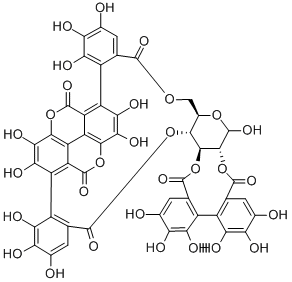
| 规格 | 价格 | 库存 | 数量 |
|---|---|---|---|
| 1mg |
|
||
| 5mg |
|
||
| 10mg |
|
||
| 25mg |
|
||
| 50mg |
|
||
| Other Sizes |
|

| 靶点 |
Natural product from Pomegranate; 3CLpro; SARS-CoV-2
|
|---|---|
| 体外研究 (In Vitro) |
HT-29 和 HCT116 恒温细胞可被安石榴苷 (100 mg/mL) 诱导 [1]。安石榴苷的 IC50 值大于 50 μM,可轻微抑制 PLpro 活性 [4]。安石榴苷的 EC50 值为 7.20 μM,并能以剂量依赖的方式减少 SARS-CoV-2 噬斑的形成 [4]。安石榴苷通过与二聚体表面的变构位点结合,阻断 S 蛋白介导的病毒进入细胞外环境,从而抑制 SARS-CoV-2 的复制 [4]。石榴 (Punica granatum L.) 果实被广泛用于榨汁 (PJ)。石榴汁强大的抗氧化和抗动脉粥样硬化活性归因于其多酚类物质,包括安石榴苷、主要果实成分鞣花单宁和鞣花酸 (EA)。石榴苷是石榴汁中的主要抗氧化多酚成分。本研究评估了石榴苷、乙酸乙酯(EA)、标准化总石榴单宁(TPT)提取物和石榴汁的体外抗增殖、促凋亡和抗氧化活性。在浓度为12.5-100 μg/ml的条件下,评估了石榴苷、乙酸乙酯和总石榴单宁对人口腔癌细胞(KB、CAL27)、结肠癌细胞(HT-29、HCT116、SW480、SW620)和前列腺癌细胞(RWPE-1、22Rv1)的抗增殖活性。在浓度为100 μg/ml的条件下评估了石榴苷、乙酸乙酯和总石榴单宁的促凋亡作用,在浓度为10 μg/ml的条件下评估了其抗氧化活性。然而,为了评估其他石榴汁植物化学成分的协同和/或累加作用,我们测试了浓度标准化的石榴汁,使其与安石榴苷(w/w)的含量相当。我们评估了石榴汁对HT-29和HCT116结肠癌细胞系的凋亡效应。抗氧化作用则通过抑制脂质过氧化和Trolox当量抗氧化能力(TEAC)测定进行评估。石榴汁对所有细胞系均表现出最强的抗增殖活性,其增殖抑制率达30%至100%。在100 μg/ml的浓度下,石榴汁、桉油精(EA)、安石榴苷和三萜类化合物(TPT)均能诱导HT-29结肠癌细胞凋亡。然而,在HCT116结肠癌细胞中,只有桉油精、安石榴苷和三萜类化合物能诱导凋亡,而石榴汁则不能。抗氧化活性顺序为:石榴汁>三萜类化合物>安石榴苷>桉油精。与纯化的多酚相比,PJ 具有更优异的生物活性,这表明多种化合物协同作用的多重效应和化学协同作用优于单一纯化活性成分。[2]
安石榴苷 在浓度为 12.5、25、50 和 100 μg/mL 的条件下处理 48 小时后,以剂量依赖的方式抑制多种人类肿瘤细胞系的增殖。在 KB 口腔癌细胞中,增殖抑制率范围为 0% 至 42%。在 CAL27 口腔癌细胞中,抑制率范围为 10% 至 96%。在 SW480 非转移性结肠癌细胞中,抑制率范围为 1% 至 65%。在 SW620 转移性结肠癌细胞中,抑制率范围为 0% 至 57%。在 HT-29 结肠癌细胞中,抑制率范围为 1% 至 55%。在HCT116结肠癌细胞中,抑制率范围为0%至72%。在RWPE-1永生化前列腺上皮细胞中,抑制率范围为64%至94%。在22Rv1转移性前列腺癌细胞中,抑制率范围为68%至90%。所有抗增殖活性均使用CellTiter-Glo®发光细胞活力检测法测定,数据以未处理细胞的百分比表示。[1] 浓度为100 μg/mL时,安石榴苷诱导HT-29结肠癌细胞凋亡的程度是溶剂对照组的2.65倍。在HCT116结肠癌细胞中,安石榴苷诱导细胞凋亡的程度是溶剂对照组的1.52倍。采用细胞死亡检测ELISAPLUS法评估细胞凋亡,该方法可定量检测核小体间DNA降解(组蛋白相关的单核小体和寡核小体)。[1] 安石榴苷(10 μg/mL)通过抑制脂质体模型(大单层囊泡)中Fe(II)诱导的脂质过氧化反应,表现出抗氧化活性。21分钟内荧光强度的相对下降表明安石榴苷抑制了脂质过氧化反应,但其抑制效果不如石榴汁(PJ)和石榴总单宁(TPT)提取物。[1] 安石榴苷(10 μg/mL)的Trolox当量抗氧化能力(TEAC)值为90 μM Trolox当量。总抗氧化活性顺序为:PJ > TPT > 安石榴苷 > EA。[1] |
| 体内研究 (In Vivo) |
安石榴苷(10 mg/kg)可抑制水肿达58.15%。安石榴苷和安石榴素均分离自榄仁树(Terminalia catappa L.)的叶片。本研究评估了安石榴苷和安石榴素对角叉菜胶诱导的大鼠后爪水肿的抗炎活性。抗炎效果评估结果显示,角叉菜胶给药可加重水肿,而药物治疗可减轻水肿。角叉菜胶给药4小时后,安石榴苷(10 mg/kg)治疗组效果最佳(抑制率为58.15%),其次是安石榴苷(5 mg/kg)治疗组(抑制率为39.15%)。然而,即使在 5 mg/kg 剂量下,安石榴苷的抗炎活性与安石榴素相同,但更大剂量的安石榴苷抑制效果增强,而更大剂量的安石榴素抑制效果反而减弱。数据表明,安石榴苷和安石榴素均具有抗炎活性,但大剂量安石榴素治疗可能会诱发一些细胞损伤。[2]
|
| 酶活实验 |
采用双荧光素酶报告基因检测法检测HBV核心启动子活性[3]
将HepG2和Huh7细胞瞬时共转染质粒pHBVCP-Luc报告基因(该质粒是通过将HBV核心启动子插入pGL3-basic载体中的萤火虫荧光素酶基因之前构建的)和报告基因质粒pRL-TK(作为内参),转染试剂为FuGENE-HD(He et al., 2011)。转染24小时后,用化合物处理细胞3天,每天更换新鲜培养基。使用双荧光素酶报告基因检测系统测定荧光素酶活性,从而确定HBV核心启动子活性。 基于假病毒SARS-CoV-2的入侵抑制实验[3] 按照先前描述的方法(Xia et al., 2020)制备了携带SARS-CoV-2 S蛋白的慢病毒假病毒(SARS-CoV-2pp),并以瞬时表达人ACE2和TMPRSS2的293T细胞作为靶细胞(图S1A)。将SARS-CoV-2pp接种到靶细胞中,并加入浓度递增的测试化合物,最终浓度范围为100 μM至1.56 μM。孵育48小时后,分析荧光素酶活性以监测病毒入侵效率。 3-胰凝乳蛋白酶样半胱氨酸蛋白酶 (3CLpro) 的酶抑制试验 [3] SARS-CoV-2 3CLpro 的原核表达和纯化方法与之前报道的方法略有不同 (Ma et al., 2020b)。酶抑制试验中,将重组 3CLpro(终浓度为 250 nM)与不同浓度的化合物在 90 μL 反应缓冲液(50 mM Tris-HCl,pH 7.3,1 mM EDTA)中孵育 30 分钟 (Dai et al., 2020)。反应通过加入 10 μL 终浓度为 50 μM 的基于 FRET 的肽底物 (Dabcyl-KTSAVLQ/SGFRKME-Edans) 启动。使用配备激发波长为 336/20 nm、发射波长为 490/20 nm 滤光片的 Bio-Tek Synergy4 酶标仪,每 20 秒立即测量一次荧光信号,持续 30 分钟。计算反应的初始反应速率 (V0) 以指示酶活性。进行了三次独立实验,并使用 GraphPad Prism 软件分析了 IC50 曲线。 脂质过氧化抑制试验:使用荧光光谱法,通过脂质体氧化模型系统分析了抑制脂质过氧化的能力。将脂质 1-硬脂酰-2-亚油酰-sn-甘油-3-磷酸胆碱和荧光探针 3-[p-(6-苯基)-1,3,5-己三烯基]-苯基丙酸在二甲基甲酰胺中混合,制备大单层囊泡 (LUV)。最终反应体系包含HEPES缓冲液、测试样品或DMSO(对照)以及20 μl脂质体悬浮液。加入FeCl₂·4H₂O (0.5 mM)引发过氧化反应。安石榴苷的测试浓度为10 μg/mL。使用数字荧光计在384 nm处测量荧光强度,并在0、1、3分钟以及之后每隔3分钟监测一次,直至21分钟。相对荧光强度随时间降低的速率反映了过氧化反应的速率。每个样品均进行三次重复进样。[1] Trolox当量抗氧化能力(TEAC)测定:将固体二氧化锰加入5 mM ABTS⁺水溶液中制备ABTS⁺自由基阳离子。Trolox用作抗氧化剂标准品。将 10 μg/mL 的安石榴苷与 200 μl ABTS+ 自由基阳离子溶液混合于 96 孔板中,并在 5 至 75 分钟后用微孔板读数仪读取吸光度。Trolox 当量(以 μM 为单位)由 5 分钟孵育时的标准曲线得出。[1] |
| 细胞实验 |
抗病毒活性测定和细胞毒性测定[4]
为了检测CHLA或安石榴苷/PUG的抗SARS-CoV-2活性,进行了噬斑减少试验。简而言之,将培养于12孔板中的Vero-E6单层细胞用递增浓度的测试化合物预处理1小时,然后在测试化合物存在的情况下用SARS-CoV-2(MOI为0.0001)感染。DMSO和瑞德西韦(3 μM)分别用作阴性和阳性对照。孵育1小时后,更换培养基为含有1.25% Avicel和测试化合物的新鲜MEM培养基,并将培养板在37℃、5% CO2条件下继续孵育48小时。然后用10%甲醛固定细胞,并用1%结晶紫染色以观察噬斑。测定了使病毒噬斑形成减少 50% 所需的受试化合物浓度(50% 有效浓度 [EC50])。为了评估 CHLA 或安石榴苷/PUG 对 VERO-E6 细胞的细胞毒性,根据制造商的说明进行了 Cell-Titer Glo® 发光细胞活力检测(Promega)。根据不同浓度下 CHLA 或安石榴苷/PUG 抑制细胞活力的百分比,计算了半数细胞毒性浓度 (CC50) 值。 细胞增殖试验(抗增殖活性):采用检测活细胞 ATP 的发光细胞活力检测方法来测量细胞增殖。将细胞(KB、CAL27、SW480、SW620、HT-29、HCT116、RWPE-1、22Rv1)以每孔10,000个细胞的密度接种于96孔板中,并培养24小时。将安石榴苷超声溶解于DMSO中,过滤除菌后,用培养基稀释至终浓度分别为12.5、25、50和100 μg/mL。每孔加入100 μL对照培养基或待测样品,培养48小时。48小时后,将培养板在室温下平衡30分钟,然后向每孔加入100 μL检测试剂,并在摇床上振荡2分钟以诱导细胞裂解。将培养板在室温下孵育 10 分钟以稳定发光信号,然后在微孔板发光仪上读取结果。数据以未处理细胞的百分比表示,平均值 ± 标准误差,重复三次。[1] 细胞凋亡评估:采用光度酶联免疫测定法评估细胞凋亡,该方法可定量测量 DNA 的核小体间降解(检测组蛋白相关的单核小体和寡核小体)。将 HT-29 和 HCT116 细胞以 100,000 个细胞/皿的密度接种于 60 mm 培养皿中,并使其贴壁 24 小时。用载体对照(100% DMSO;终浓度 0.3%)或安石榴苷(100 μg/mL)处理细胞 48 小时。处理后,收集未贴壁细胞,并在 200 xg 下离心 10 分钟。弃去上清液;细胞沉淀用冰冷的无钙镁磷酸盐缓冲液(CMF-PBS)洗涤并再次离心。贴壁细胞用冰冷的无钙镁磷酸盐缓冲液(CMF-PBS)洗涤,经胰蛋白酶消化后收集,并与未贴壁细胞合并,最终加入1 mL DMEM培养基中。采用台盼蓝染色排除法计数活细胞和死细胞,并将等量的细胞加入微孔板中,用于所有处理组。细胞凋亡检测按照制造商的说明进行。数据以各样本在405 nm处的吸光度值与载体对照组的比值表示。[1] |
| 药代性质 (ADME/PK) |
吸收、分布和排泄
…本研究评估了含6%安石榴苷的37天口服饮食对Sprague-Dawley大鼠的潜在毒性。采用HPLC-DAD-MS-MS技术在血浆、肝脏和肾脏中鉴定了安石榴苷及其相关代谢物。在肝脏和肾脏中检测到五种安石榴苷相关代谢物:两种鞣花酸衍生物、没食子酸、3,8-二羟基-6H-二苯并[b,d]吡喃-6-酮葡萄糖醛酸苷和3,8,10-三羟基-6H-二苯并[b,d]吡喃-6-酮。PMID:12744688Cerda B等;J Agric Food Chem. 51 (11): 3493-501 (2003) 代谢/代谢物 石榴,一种原产于中东的水果,已成为功能性食品和营养补充剂的热门来源。人们研究了石榴果实、果汁和提取物对多种慢性疾病的健康影响。人体临床试验表明,石榴在预防心血管疾病、糖尿病和前列腺癌方面具有良好的效果。石榴的体外抗氧化活性归因于其高含量的多酚,特别是石榴素、没食子酸和鞣花酸。这些化合物在消化过程中代谢为鞣花酸和尿石素,这表明提供体内抗氧化活性的生物活性化合物可能与完整食物中存在的化合物不同……PMID:22129380 Johanningsmeier SD, Harris GK; Annu Rev Food Sci Technol. 2: 181-201 (2011) 研究表明,石榴含有124种不同的植物化学物质,其中一些具有协同作用,可对癌细胞发挥抗氧化和抗炎作用。鞣花酸是石榴中存在的一种生物活性多酚。压榨整个果实得到的石榴汁比任何普通果汁都含有最高浓度的鞣花酸,并且含有一种独特的鞣花酸——石榴素。石榴素是已知分子量最大的多酚。石榴鞣花单宁不能完全被血液吸收;相反,它们会在肠道中水解成鞣花酸,这个过程需要几个小时。鞣花单宁还会被肠道菌群代谢成尿石素,尿石素随后在肝脏中结合,并随尿液排出体外。这些尿石素也具有生物活性,能够抑制前列腺癌细胞的生长…… 腹腔注射和口服合成尿石素A后,前列腺组织会吸收尿石素A及其结合物,且在前列腺、结肠和肠道组织中的含量高于其他器官。目前尚不清楚为什么石榴鞣花单宁代谢物在前列腺、结肠和肠道组织中的含量高于其他研究器官。重要的是,具有生物活性的石榴鞣花单宁代谢物倾向于聚集在前列腺组织中。结合临床数据证实石榴汁具有抗癌作用,这表明石榴产品可能在前列腺癌的化学预防中发挥作用。长期饮用石榴汁或石榴提取物后,人前列腺组织中的尿石素是否可以作为生物标志物,还需要进一步研究。本研究评估了含6%安石榴苷的37天口服饮食对Sprague-Dawley大鼠的潜在毒性。采用高效液相色谱-二极管阵列检测器-串联质谱法(HPLC-DAD-MS-MS)在血浆、肝脏和肾脏中鉴定了安石榴苷及其相关代谢物。在肝脏和肾脏中检测到五种安石榴苷相关代谢物:两种鞣花酸衍生物、没食子酸、3,8-二羟基-6H-二苯并[b,d]吡喃-6-酮葡萄糖醛酸苷和3,8,10-三羟基-6H-二苯并[b,d]吡喃-6-酮。PMID:12744688 据报道,多种果汁可引起食物-药物相互作用,主要影响细胞色素P450活性;然而,果汁对结合反应的影响知之甚少。在测试的几种果汁(苹果汁、桃汁、橙汁、菠萝汁、葡萄柚汁和石榴汁)中,石榴汁能有效抑制Caco-2细胞中1-萘酚的磺化反应。这种抑制作用呈剂量和培养时间依赖性,半数抑制浓度(IC50)为2.7%(体积比)。相反,在所有测试的果汁中均未观察到对1-萘酚葡萄糖醛酸化的显著抑制作用。石榴汁中最丰富的抗氧化多酚——石榴素,也被发现能强烈抑制Caco-2细胞中的磺化反应,其IC50为45 μM,与石榴汁的结果一致。这些数据表明,石榴汁的主要成分是石榴素,它能抑制磺化反应。作者还证实,在体外实验中,石榴汁和石榴苷均能抑制Caco-2细胞中酚磺酰转移酶的活性,其浓度几乎与Caco-2细胞内使用的浓度相当。然而,石榴汁对Caco-2细胞中磺酰转移酶SULT1A家族基因(SULT1A1和SULT1A3)的表达没有影响。这些结果表明,石榴苷对Caco-2细胞中磺酰转移酶活性的抑制是1-萘基硫酸盐积累减少的原因。数据还表明,石榴汁中的成分,很可能是石榴苷,会损害肠道中的磺化功能,这可能会影响药物以及食物和环境中其他化合物的生物利用度。这些影响可能与石榴汁的抗癌特性有关。 |
| 毒性/毒理 (Toxicokinetics/TK) |
毒理学信息
相互作用 为了寻找含有可抑制黑色素生物合成的多酚类化合物的植物,我们发现了一种新的组合:西伯利亚落叶松(Larix sibirica)提取物(标准化至80%紫杉素)和石榴果实(Punica granatum)提取物(含20%石榴素)。该组合对Melan-a细胞中的黑色素生物合成表现出协同抑制作用。与单独使用西伯利亚落叶松或石榴提取物相比,西伯利亚落叶松和石榴提取物(1:1)的组合使黑色素含量降低了2倍,且未对细胞活力产生相应影响。西伯利亚落叶松和石榴果实提取物抑制了黑素细胞特异性基因酪氨酸酶(Tyr)、小眼畸形转录因子(Mitf)和黑素体结构蛋白(Pmel17和Mart1)的表达,但并未抑制酪氨酸酶活性。这些结果表明,西伯利亚落叶松和石榴提取物单独或联合使用抑制黑色素生物合成的机制是通过下调黑素细胞特异性基因的表达,而不是抑制酪氨酸酶活性。PMID:22714008 榄仁树(Terminalia catappa L.)是台湾常用的民间草药,用于预防肝癌和治疗肝炎。本文作者研究了榄仁树叶水提取物(TCE)及其主要单宁成分石榴苷对博来霉素诱导的中国仓鼠卵巢细胞遗传毒性的保护作用。用三氯乙烯(TCE)或石榴苷预处理可预防博来霉素诱导的hgprt基因突变和DNA链断裂。TCE和石榴苷抑制了博来霉素诱导的细胞内自由基(超氧化物和过氧化氢)的生成。三氯乙烯 (TCE) 和石榴苷对博来霉素诱导的遗传毒性的有效性可能至少部分归因于它们的抗氧化能力。PMID:10773401 作者研究了石榴苷 (PC) 对苯并[a]芘 (BP) 诱导的 DNA 加合物在体外和体内的影响。将大鼠肝微粒体、适当的辅助因子和 DNA 与 BP (1 μM) 在溶剂中或在石榴苷 (1–40 μM) 存在下孵育,结果显示生成的 DNA 加合物呈剂量依赖性抑制,在 40 μM 时几乎完全抑制 (97%)。然而,在体外非微粒体系统中,PC 未能抑制 BPDE 诱导的 DNA 加合物,这表明微粒体 BP-DNA 加合物的抑制是由于 PC 抑制了 P450 1A1。为了确定其体内疗效,雌性S/D大鼠分别通过饮食(1500 ppm;约19 mg/天/只)或皮下植入聚合物植入物(两个2 cm、200 mg、载药量20%的植入物;每个植入物含40 mg PC)的方式给予辛辣糖苷,随后通过皮下植入物(2 cm、200 mg、载药量10%的植入物;每个植入物含20 mg BP)持续给予低剂量BP治疗。10天后处死大鼠。采用32P-后标记法分析肺DNA,结果显示植入物给药的PC显著抑制了DNA加合物的形成(60%;p=0.029),而饮食途径的抑制作用较弱(34%),但差异无统计学意义。此外,植入物给药的PC总剂量约为饮食途径给药剂量的1/38。肺微粒体分析显示细胞色素P450 1A1活性显著受到抑制,谷胱甘肽水平显著升高。植入物中PC的释放呈双相性,先是短暂的爆发式释放,随后逐渐减少。超高效液相色谱(UHPLC)分析显示,血浆中未检测到PC,但其水解产物鞣花酸却很容易被检测到。植入组血浆中鞣花酸的浓度(589 ± 78 ng/mL)比膳食组(4.36 ± 0.83 ng/mL)高出两个数量级以上。我们的数据共同表明,通过植入方式递送PC可显著降低其有效剂量,体内DNA加合物的抑制可能归因于PC转化为鞣花酸。PMID:22234049 从榄仁树(Terminalia catappa L.)叶片中分离得到的石榴素和石榴苷用于治疗皮炎和肝炎。两种化合物均具有很强的抗氧化活性。本研究评估了石榴苷和石榴素对四氯化碳(CCl4)诱导的大鼠肝毒性的抗肝毒性作用。CCl4给药可升高血清天冬氨酸氨基转移酶(AST)和丙氨酸氨基转移酶(ALT)水平,而药物治疗可降低这些酶的水平。药物治疗还改善了中央肝静脉周围的组织学改变和CCl4诱导的氧化损伤。结果表明,石榴苷和石榴素均具有抗肝毒性活性,但大剂量石榴苷会诱发肝损伤。因此,即使单宁在极低剂量下具有很强的抗氧化活性,高剂量处理仍可导致细胞损伤。PMID:9720629 解毒剂和急救措施 /SRP:/ 立即采取的急救措施:确保已进行充分的去污处理。如果患者停止呼吸,应立即开始人工呼吸,最好使用按需呼吸机、球囊面罩呼吸器或简易呼吸面罩,并遵循培训指导。必要时进行心肺复苏。立即用清水冲洗受污染的眼睛。不要催吐。如果发生呕吐,应将患者向前倾斜或置于左侧卧位(如果可能,头部向下),以保持呼吸道通畅并防止误吸。保持患者镇静并维持正常体温。寻求医疗救助。/A类和B类毒物/ /SRP:/ 基本治疗:建立通畅的呼吸道(必要时使用口咽或鼻咽通气道)。根据需要进行吸痰。观察呼吸衰竭的迹象,必要时提供辅助通气。通过无创通气面罩以每分钟10至15升的流速给予氧气。监测肺水肿并根据需要进行治疗……监测休克并根据需要进行治疗……预判癫痫发作并根据需要进行治疗……如果眼睛受到污染,立即用水冲洗。在转运过程中,持续用0.9%生理盐水(NS)冲洗每只眼睛……不要使用催吐剂。如果吞咽,漱口并用5毫升/公斤体重兑200毫升水稀释,前提是患者能够吞咽、有强烈的咽反射且没有流口水……去污后,用干燥的无菌敷料覆盖皮肤烧伤……/A类和B类毒物/ /SRP:/ 高级治疗:对于意识状态改变、严重肺水肿或严重呼吸窘迫的患者,考虑进行口咽或鼻咽气管插管以控制气道。使用球囊面罩进行正压通气可能有效。考虑对肺水肿进行药物治疗……对于严重的支气管痉挛,可考虑使用β受体激动剂(例如沙丁胺醇)……监测心律,并根据需要治疗心律失常……开始静脉输注5%葡萄糖溶液(D5W)/SRP:“保持静脉通畅”,最小流速/。如果出现低血容量的迹象,则使用0.9%生理盐水(NS)或乳酸林格氏液。对于伴有低血容量迹象的低血压患者,应谨慎输液。注意液体过量的迹象……使用地西泮或劳拉西泮治疗癫痫发作……使用盐酸普罗米卡因作为眼部冲洗的辅助药物……/毒素A和B/ 人体毒性摘录 /人体暴露研究/人类胎盘对妊娠结局至关重要,许多复杂妊娠中存在的氧化应激升高会导致胎盘功能障碍和不良妊娠结局。本研究检验了石榴汁(富含多酚类抗氧化剂)能否在体内外限制胎盘滋养层细胞损伤的假设。单胎妊娠的孕妇在妊娠35至38周之间被随机分为两组:一组每日饮用8盎司石榴汁,另一组饮用苹果汁(安慰剂),直至分娩。研究人员从12名患者(石榴汁组4名,对照组8名)中采集胎盘组织样本进行氧化应激分析。初步的体内研究结果被扩展至体外氧化应激和细胞死亡检测。研究人员将胎盘组织块和培养的原代人滋养层细胞暴露于石榴汁或葡萄糖(对照组)中,并施加特定的氧张力和化学刺激。研究发现,与苹果汁对照组相比,孕期摄入石榴汁的足月人胎盘中氧化应激水平降低。此外,石榴汁可降低足月绒毛组织块和原代滋养层细胞培养物在缺氧、缺氧模拟物氯化钴和激酶抑制剂星状肽(astroneme)处理下的体外氧化应激、细胞凋亡和总体细胞死亡。石榴汁中的两种主要多酚——安石榴苷(而非鞣花酸)——可降低培养的合体滋养层细胞的氧化应激和刺激诱导的细胞凋亡。作者得出结论,石榴汁在体内和体外均可降低胎盘氧化应激,同时还能限制培养的人类滋养层细胞的刺激诱导死亡。多酚安石榴苷模拟了这种保护作用。作者推测,孕期摄入石榴可能减少胎盘损伤,从而保护胎儿。PMID:22374759 /替代方案和体外实验/ 与块体材料相比,纳米颗粒具有独特的化学和生物学特性。将生物活性食品成分封装在纳米颗粒中可能具有更高的生物利用度和生物活性。本研究制备了由部分纯化的辛辣鞣花单宁(PPE)和明胶按三种不同质量比(1:5、5:5 和 7:5)组成的纳米颗粒。PPE 含有 16.6% (w/w) 的辛辣糖苷 A、32.5% (w/w) 的辛辣糖苷 B 以及少量的鞣花酸己糖苷和鞣花酸(1%,w/w)。按 5:5 比例制备的纳米颗粒粒径为 149.3 ± 1.8 nm,zeta 电位为 17.8 ± 0.9 mV,制备效率为 53.0 ± 4.2%,扫描电镜观察显示其呈球形。这些颗粒中辛辣苷A和辛辣苷B的载药率分别为94.2 ± 0.4%和83.8 ± 0.5%,载药量分别为14.8 ± 1.5%和25.7 ± 2.2%。只有安石榴苷异构体能与明胶结合形成纳米颗粒,而鞣花酸己糖苷或鞣花酸则不能。傅里叶变换红外光谱分析表明,鞣花单宁与明胶之间的相互作用是氢键和疏水相互作用的结合。PPE-明胶纳米颗粒悬浮液在诱导人早幼粒白血病细胞HL-60早期凋亡方面不如PPE有效,但在诱导晚期凋亡和坏死方面效果相似。安石榴苷鞣花单宁与明胶结合形成自组装纳米颗粒。纳米颗粒包裹的鞣花单宁对HL-60白血病细胞的凋亡作用减弱。 非人毒性值 小鼠口服LD50 >5000 mg/kg 大鼠腹腔注射LD50 217 mg/kg 小鼠腹腔注射LD50 187 mg/kg 大鼠口服LD50 >5000 mg/kg |
| 参考文献 |
|
| 其他信息 |
由于目前乙型肝炎治疗的局限性,迫切需要开发靶向HBV cccDNA的新型药物。我们利用基于细胞的检测方法(其中HBeAg的产生依赖于cccDNA)筛选了一个源自传统中药的化合物库,以鉴定HBV cccDNA抑制剂。我们筛选出三种可水解单宁,即安石榴苷、安石榴素和香叶醇,作为新型抗HBV药物。在我们的实验中,这些化合物以剂量依赖的方式显著降低了分泌型HBeAg和cccDNA的产生,而未显著改变病毒DNA复制。此外,安石榴苷不影响前核心/核心启动子活性、pgRNA转录、核心蛋白表达或HBsAg分泌。通过基于细胞的cccDNA积累和稳定性实验,我们发现这些单宁显著抑制了cccDNA的形成,并适度促进了已存在的cccDNA的降解。我们的研究结果共同表明,可水解单宁通过双重机制抑制HBV cccDNA的产生:阻止cccDNA的形成并促进cccDNA的降解,尽管后者的作用相对较小。这些可水解单宁可能作为先导化合物,用于开发治疗HBV感染的新药。[3]
SARS-CoV-2感染是全球COVID-19大流行的病因。迄今为止,可用于对抗该疾病的治疗选择有限。在此,我们研究了两种广谱抗病毒天然产物——诃子酸(CHLA)和石榴素(PUG)对SARS-CoV-2病毒复制的抑制作用。CHLA和PUG均在非细胞毒性浓度下,通过作为变构调节剂靶向病毒3-胰凝乳蛋白酶样半胱氨酸蛋白酶(3CLpro)的酶活性,从而减少Vero-E6单层细胞中病毒诱导的噬斑形成。我们的研究表明,CHLA 和 PUG 具有作为新型 COVID-19 疗法的潜在应用价值。[4] 作用机制 富含多酚的膳食食品因其癌症化学预防和化学治疗特性而备受关注。鞣花单宁 (ET) 是一种可水解单宁,存在于草莓、覆盆子、核桃、石榴和橡木桶陈酿红葡萄酒等食物中。据报道,ET 及其水解产物鞣花酸 (EA) 均可诱导肿瘤细胞凋亡。鞣花单宁在体内不被吸收,而是到达结肠并释放 EA,后者随后被人体肠道菌群代谢。我们的目的是研究膳食中的 ET [石榴素 (PUNI)] 和 EA 对人结肠癌 Caco-2 细胞和正常结肠细胞 CCD-112CoN 的影响。 PUNI 和 EA 对 Caco-2 细胞产生相同的效应:细胞周期蛋白 A 和 B1 下调,细胞周期蛋白 E 上调,细胞周期停滞于 S 期,通过内源性途径(不依赖于 FAS 和 caspase 8)诱导细胞凋亡,具体表现为 bcl-XL 下调和线粒体释放细胞色素 c 至胞质溶胶,以及起始 caspase 9 和效应 caspase 3 的激活。EA 和 PUNI 均未诱导正常结肠细胞 CCD-112CoN 凋亡(未检测到染色质浓缩或 caspase 3 和 9 的激活)。对于 Caco-2 细胞,由于 PUNI 在培养基中水解生成 EA,而 EA 进入细胞后代谢为二甲基-EA 衍生物,因此其特异性效应不能归因于 PUNI。我们的研究表明,膳食中 ETs 的抗癌作用可能主要归因于其水解产物 EA。EA 可通过线粒体途径诱导结肠癌 Caco-2 细胞凋亡,但对正常结肠细胞无此作用。Larrosa M 等;《营养生物化学杂志》17 (9): 611-625 (2006) 诃子及其主要单宁成分刺蒺藜皂苷已被证实具有抗氧化和抗基因毒性活性。然而,它们对活性氧 (ROS) 介导的致癌作用的影响尚不明确。本研究采用 H-ras 转化的 NIH3T3 细胞评估了诃子水提取物 (TCE) 和刺蒺藜皂苷的化学预防作用。在细胞增殖实验中,三氯乙烯(TCE)和辛辣苷类化合物以剂量依赖的方式抑制了H-ras转化NIH3T3细胞的增殖,但对未转化NIH3T3细胞的增殖仅有部分抑制作用。TCE/辛辣苷类化合物对H-ras转化和未转化NIH3T3细胞的差异性细胞毒性表明,TCE/辛辣苷类化合物对H-ras诱导的转化具有选择性。TCE或辛辣苷类化合物处理均降低了细胞的非锚定依赖性生长,这可能是由于细胞周期停滞于G0/G1期所致。已知可调节下游Ras蛋白信号通路的细胞内超氧化物水平在辛辣苷类化合物处理后降低。磷酸化JNK-1和p38的水平在辛辣苷类化合物处理后也降低。因此,辛辣苷类化合物对H-ras诱导转化的化学预防作用可能是通过抑制细胞内氧化还原状态和JNK-1/p38活化来实现的。 安石榴苷是石榴中的主要鞣花单宁,据报道,它贡献了石榴汁50%以上的抗氧化活性。其在石榴汁中的含量可超过2 g/L。本研究首次评估了安石榴苷对人口腔癌、结肠癌和前列腺癌细胞系的抗增殖和促凋亡作用。虽然纯化的安石榴苷本身就显示出显著的抗增殖、促凋亡和抗氧化作用,但全石榴汁(PJ)更优异的生物活性表明,与单一纯化活性成分相比,多种化合物的多因素作用和化学协同效应发挥了重要作用。该研究以癌细胞系为研究对象,因为癌细胞处于氧化应激状态,而富含抗氧化植物化学物质的食物对预防疾病至关重要。[1] |
| 分子式 |
C48H28O30
|
|---|---|
| 分子量 |
1084.7179
|
| 精确质量 |
1084.066
|
| 元素分析 |
C, 53.15; H, 2.60; O, 44.25
|
| CAS号 |
65995-63-3
|
| PubChem CID |
16129719
|
| 外观&性状 |
Light yellow to yellow solid powder
|
| 密度 |
2.1±0.1 g/cm3
|
| 折射率 |
1.893
|
| LogP |
2.36
|
| tPSA |
518.76
|
| 氢键供体(HBD)数目 |
17
|
| 氢键受体(HBA)数目 |
30
|
| 可旋转键数目(RBC) |
2
|
| 重原子数目 |
78
|
| 分子复杂度/Complexity |
2360
|
| 定义原子立体中心数目 |
0
|
| SMILES |
O1[C@]([H])([C@@]2([H])[C@]([H])([C@@]3([H])[C@@]1([H])C([H])([H])OC(C1=C([H])C(=C(C(=C1C1=C(C(=C4C5=C1C(=O)OC1=C(C(=C(C(C(=O)O4)=C51)C1=C(C(=C(C([H])=C1C(=O)O3)O[H])O[H])O[H])O[H])O[H])O[H])O[H])O[H])O[H])O[H])=O)OC(C1=C([H])C(=C(C(=C1C1=C(C(=C(C([H])=C1C(=O)O2)O[H])O[H])O[H])O[H])O[H])O[H])=O)O[H]
|
| InChi Key |
ZJVUMAFASBFUBG-UYMKNUMKSA-N
|
| InChi Code |
InChI=1S/C48H28O30/c49-10-1-6-17(31(59)27(10)55)19-23-21-22-24(47(70)76-38(21)35(63)33(19)61)20(34(62)36(64)39(22)75-46(23)69)18-9(4-13(52)28(56)32(18)60)43(66)74-37-14(5-72-42(6)65)73-48(71)41-40(37)77-44(67)7-2-11(50)25(53)29(57)15(7)16-8(45(68)78-41)3-12(51)26(54)30(16)58/h1-4,14,37,40-41,48-64,71H,5H2/t14-,37-,40+,41-,48?/m1/s1
|
| 化学名 |
(1R,35R,38R,55S)-6,7,8,11,12,23,24,27,28,29,37,43,44,45,48,49,50-heptadecahydroxy-2,14,21,33,36,39,54-heptaoxaundecacyclo[33.20.0.04,9.010,19.013,18.016,25.017,22.026,31.038,55.041,46.047,52]pentapentaconta-4,6,8,10,12,16,18,22,24,26,28,30,41,43,45,47,49,51-octadecaene-3,15,20,32,40,53-hexone
|
| 别名 |
Punicalagin; HSDB 8106; DTXSID40894768; 3,4,5,16,17,18-Hexahydroxy-8,13-dioxo-11-(3,4,5,11,17,18,19,22,23,34,35-undecahydroxy-8,14,26,31-tetraoxo-9,13,25,32-tetraoxaheptacyclo[25.8.0.02,7.015,20.021,30.024,29.028,33]pentatriaconta-1(35),2,4,6,15,17,19,21,23,27,29,33-dodecaen-10-yl)-9,12-dioxatricyclo[12.4.0.02,7]octadeca-1(18),2,4,6,14,16-hexaene-10-carbaldehyde; D-Glucose, cyclic4,6-[(2S,2'S)-2,2'-(5,10-dihydro-2,3,7,8-tetrahydroxy-5,10-dioxo[1]benzopyrano[5,4,3-cde][1]benzopyran-1,6-diyl)bis[3,4,5-trihydroxybenzoate]]cyclic2,3-[(S)-4,4',5,5',6,6'-hexahydroxy[1,1'-biphenyl]-2,2'-dicarboxylate]; D-Glucose, cyclic 4,6-(2,2'-(5,10-dihydro-2,3,7,8-tetrahydroxy-5,10-dioxo(1)benzopyrano(5,4,3-cde)(1)benzopyran-1,6-diyl)bis(3,4,5-trihydroxybenzoate)) cyclic 2,3-(4,4',5,5',6,6'-hexahydroxy(1,1'-biphenyl)-2,2'-dicarboxylate)-, (2(S),4(S,S))-; Punicalagin (Standard); CHEMBL1984101;
|
| HS Tariff Code |
2934.99.9001
|
| 存储方式 |
Powder -20°C 3 years 4°C 2 years In solvent -80°C 6 months -20°C 1 month 注意: (1). 本产品在运输和储存过程中需避光。 (2). 该产品溶液不稳定,请使用新鲜配制的工作溶液以获得最佳效果 |
| 运输条件 |
Room temperature (This product is stable at ambient temperature for a few days during ordinary shipping and time spent in Customs)
|
| 溶解度 (体外实验) |
H2O : ~100 mg/mL (~92.19 mM)
DMSO : ~50 mg/mL (~46.09 mM) |
|---|---|
| 溶解度 (体内实验) |
配方 1 中的溶解度: ≥ 2.17 mg/mL (2.00 mM) (饱和度未知) in 10% DMSO + 40% PEG300 + 5% Tween80 + 45% Saline (这些助溶剂从左到右依次添加,逐一添加), 澄清溶液。
例如,若需制备1 mL的工作液,可将100 μL 21.7 mg/mL澄清DMSO储备液加入400 μL PEG300中,混匀;然后向上述溶液中加入50 μL Tween-80,混匀;加入450 μL生理盐水定容至1 mL。 *生理盐水的制备:将 0.9 g 氯化钠溶解在 100 mL ddH₂O中,得到澄清溶液。 配方 2 中的溶解度: ≥ 2.17 mg/mL (2.00 mM) (饱和度未知) in 10% DMSO + 90% (20% SBE-β-CD in Saline) (这些助溶剂从左到右依次添加,逐一添加), 澄清溶液。 例如,若需制备1 mL的工作液,可将 100 μL 21.7 mg/mL澄清DMSO储备液加入900 μL 20% SBE-β-CD生理盐水溶液中,混匀。 *20% SBE-β-CD 生理盐水溶液的制备(4°C,1 周):将 2 g SBE-β-CD 溶解于 10 mL 生理盐水中,得到澄清溶液。 请根据您的实验动物和给药方式选择适当的溶解配方/方案: 1、请先配制澄清的储备液(如:用DMSO配置50 或 100 mg/mL母液(储备液)); 2、取适量母液,按从左到右的顺序依次添加助溶剂,澄清后再加入下一助溶剂。以 下列配方为例说明 (注意此配方只用于说明,并不一定代表此产品 的实际溶解配方): 10% DMSO → 40% PEG300 → 5% Tween-80 → 45% ddH2O (或 saline); 假设最终工作液的体积为 1 mL, 浓度为5 mg/mL: 取 100 μL 50 mg/mL 的澄清 DMSO 储备液加到 400 μL PEG300 中,混合均匀/澄清;向上述体系中加入50 μL Tween-80,混合均匀/澄清;然后继续加入450 μL ddH2O (或 saline)定容至 1 mL; 3、溶剂前显示的百分比是指该溶剂在最终溶液/工作液中的体积所占比例; 4、 如产品在配制过程中出现沉淀/析出,可通过加热(≤50℃)或超声的方式助溶; 5、为保证最佳实验结果,工作液请现配现用! 6、如不确定怎么将母液配置成体内动物实验的工作液,请查看说明书或联系我们; 7、 以上所有助溶剂都可在 Invivochem.cn网站购买。 |
| 制备储备液 | 1 mg | 5 mg | 10 mg | |
| 1 mM | 0.9219 mL | 4.6095 mL | 9.2190 mL | |
| 5 mM | 0.1844 mL | 0.9219 mL | 1.8438 mL | |
| 10 mM | 0.0922 mL | 0.4609 mL | 0.9219 mL |
1、根据实验需要选择合适的溶剂配制储备液 (母液):对于大多数产品,InvivoChem推荐用DMSO配置母液 (比如:5、10、20mM或者10、20、50 mg/mL浓度),个别水溶性高的产品可直接溶于水。产品在DMSO 、水或其他溶剂中的具体溶解度详见上”溶解度 (体外)”部分;
2、如果您找不到您想要的溶解度信息,或者很难将产品溶解在溶液中,请联系我们;
3、建议使用下列计算器进行相关计算(摩尔浓度计算器、稀释计算器、分子量计算器、重组计算器等);
4、母液配好之后,将其分装到常规用量,并储存在-20°C或-80°C,尽量减少反复冻融循环。
计算结果:
工作液浓度: mg/mL;
DMSO母液配制方法: mg 药物溶于 μL DMSO溶液(母液浓度 mg/mL)。如该浓度超过该批次药物DMSO溶解度,请首先与我们联系。
体内配方配制方法:取 μL DMSO母液,加入 μL PEG300,混匀澄清后加入μL Tween 80,混匀澄清后加入 μL ddH2O,混匀澄清。
(1) 请确保溶液澄清之后,再加入下一种溶剂 (助溶剂) 。可利用涡旋、超声或水浴加热等方法助溶;
(2) 一定要按顺序加入溶剂 (助溶剂) 。
| NCT Number | Recruitment | interventions | Conditions | Sponsor/Collaborators | Start Date | Phases |
| NCT02042742 | Completed | Dietary Supplement: punicalagin and hydroxytyrosol mixture Dietary Supplement: Control supplement (maltodextrin) |
Healthy | Instituto de Investigación Hospital Universitario La Paz |
April 2013 | Phase 4 |
InvivoChem的所有产品仅用于作科学研究,不面向患者销售
Copyright 2020 InvivoChem LLC | All Rights Reserved 粤ICP备20063088号-1


 COA
COA
 粤公网安备 44011102003439号
 463611831
