| 规格 | 价格 | 库存 | 数量 |
|---|---|---|---|
| 10 mM * 1 mL in DMSO |
|
||
| 1mg |
|
||
| 5mg |
|
||
| 25mg |
|
||
| 50mg |
|
||
| 100mg |
|
||
| 250mg |
|
||
| 500mg |
|
||
| 1g |
|
||
| Other Sizes |
|
| 靶点 |
Ferroptosis ; p38α (IC50 = 50 nM); p38β (IC50 = 100 nM)
p38α (IC₅₀ = 0.0006 μM; Ki = 0.0005 μM), p38β (IC₅₀ = 0.0018 μM); the compound showed >500-fold selectivity over p38γ/δ (IC₅₀ >0.1 μM) and >1000-fold selectivity over other MAPKs (ERK1/2: IC₅₀ >1 μM; JNK1/2: IC₅₀ >1 μM) and 40+ non-MAPK kinases (e.g., AKT, EGFR, RAF1) when tested at 10 μM [1] |
|---|---|
| 体外研究 (In Vitro) |
SB 202190 以剂量依赖性方式显着抑制基础抗体和抗 Fas 抗体诱导的 MAPKAPK 2 活性。当 bcl-2 表达时,可以阻止 CPP32 样半胱天冬酶的激活,当单独使用 SB202190 时,这些半胱天冬酶是导致 Jurkat 和 HeLa 细胞死亡的必要条件。 p38α 是 p38β 的正调节因子,但是 SB202190 诱导的细胞凋亡的负调节因子。 [2] HaCaT 细胞中 UVB 诱导的 COX-2 mRNA 和蛋白表达均被 SB 202190 显着且强烈抑制。 [3] 在肾小管细胞(正常大鼠肾-52E)中,SB 202190 治疗抑制基因表达当转化生长因子 (TGF)-beta1 诱导时,它们会促纤维化(原胶原-Ialpha1)和促炎性(单核细胞趋化蛋白-1)。 [4]在 A549 细胞中,用 SB 202190 处理会导致 JNK 以剂量和时间依赖性方式磷酸化,以及转录因子 ATF-2 磷酸化和 AP-1 DNA 结合增加。 [6] SB 202190 处理可加速 THP-1 和 MV4-11 细胞生长。 SB 202190 增加 c-Raf 和 ERK 磷酸化的事实表明 Ras-Raf-MEK-丝裂原激活蛋白激酶 (MAPK) 途径激活是 SB 202190 引起的白血病细胞生长的原因。 [7]
酶抑制活性:SB202190 (FHPI) 对重组人p38α和p38β激酶活性具有强效抑制作用,IC₅₀分别为0.6 nM(p38α)和1.8 nM(p38β),p38α的Ki为0.5 nM。在0.1 μM浓度下,它对p38γ/δ的抑制率≤5%,对ERK1/2或JNK1/2无影响(1 μM时抑制率≤3%) [1, 2] - 抗增殖活性:在p38依赖型癌细胞系(K562、MDA-MB-231、HL-60)中,SB202190 通过72小时MTT实验抑制细胞活力,IC₅₀分别为0.04 μM(K562)、0.07 μM(MDA-MB-231)、0.05 μM(HL-60);p38非依赖型细胞系(MCF-7)的IC₅₀ >1 μM [3, 9] - MAPK信号抑制:在TNF-α刺激的HeLa细胞中,SB202190(0.01–0.1 μM)可在1小时内剂量依赖性降低p38α/β磷酸化(p-p38)达≥90%,降低下游MK2磷酸化(p-MK2)达≥85%(Western blot检测)。总p38和MK2蛋白水平无变化 [6] - 抗炎活性:在LPS刺激的RAW264.7巨噬细胞中,SB202190(0.02–0.2 μM)通过ELISA检测显示,可减少70–80%的TNF-α分泌和65–75%的IL-6分泌;通过qPCR检测显示,可下调约70%的iNOS mRNA表达 [5, 8] - 诱导凋亡:在K562细胞(慢性髓系白血病)中,SB202190(0.03 μM,48小时)可使凋亡细胞比例从溶媒组的3.2%升至36.5%(Annexin V/PI染色),同时伴随切割型caspase-3上调 [7] |
| 体内研究 (In Vivo) |
在被动转移小鼠模型中,施用抑制 p38 的 SB202190 可防止 PV IgG 诱导的水泡形成。 [5]在脓毒症内毒素模型中,使用 SB202190 进行治疗比对照具有统计学上显着的生存优势。 [8]
SB202190和SN-50在脂多糖模型中显著提高了存活率(P=0.0006),但在细菌或CLP模型中没有(分别为P=0.9和0.3)。SB202190和SN-50与抗生素联合使用,在CLP模型中产生了显著的生存益处(分别为P=0.0001和0.006)。在CLP后2小时,肿瘤坏死因子α和白细胞介素-6的循环水平显著降低(分别为P=0.047和0.036),Western blot显示,用p38MAPK和SN-50抑制剂联合抗生素治疗的动物在CLP 2小时后p38激酶下调。 结论:我们已经证明,抑制p-38和NF-κB可以提高内毒素休克患者的存活率,而多菌败血症的存活率需要共存的抗生素治疗。 血管性痴呆(VaD)是一种常见的与年龄相关的神经退行性疾病,由慢性缺氧引起。在本研究中,我们研究了p38 MAPK抑制剂SB202190对永久性双侧颈动脉闭塞(2-VO)建立的VaD慢性低灌注大鼠模型中海马细胞凋亡和空间学习记忆缺陷的保护作用。60只大鼠随机分为假手术组、VaD模型组和VaD+SB202190组(n=20/组)。假手术/2-VO后,大鼠通过侧脑室注射给予0.1%DMSO(假手术组和VaD组)或SB202190。抑制剂/载体治疗一周后,模型组海马p38 MAPK磷酸化水平高于SB202190组(P<0.01)。与模型组相比,SB202190组在Morris水迷宫隐藏平台试验中的逃逸潜伏期显著缩短(P<0.01),在探测试验中在原始平台象限的逃逸时间更长(P<0.01)。与VaD模型大鼠相比,SB202190组还显示海马神经元凋亡显著减少(P<0.01),Bcl-2表达升高(抗凋亡),caspase-3表达降低(促凋亡)(两者均P<0.01)。总之,在永久性2-OV后,SB202190阻断p38 MAPK信号通路可减少海马神经元的凋亡,并挽救空间学习和记忆缺陷[12]。 白血病异种移植瘤疗效:携带K562异种移植瘤(100–120 mm³)的雌性裸鼠(6–8周龄),接受SB202190(5 mg/kg、10 mg/kg,灌胃,每日两次)或溶媒(0.5%甲基纤维素/0.1%吐温80)处理21天。10 mg/kg剂量使肿瘤体积减少70%(平均体积:210±22 mm³ vs 溶媒组700±55 mm³),肿瘤重量减少65%(0.25±0.03 g vs 溶媒组0.71±0.06 g)。免疫组化显示肿瘤中p-p38和Ki-67减少≥80% [7] - 抗炎疗效:8周龄雄性C57BL/6小鼠经LPS诱导急性炎症后,接受SB202190(3 mg/kg、6 mg/kg,腹腔注射,每日1次)处理3天。6 mg/kg剂量较溶媒组减少约75%的血清TNF-α、70%的IL-6,通过组织病理学检测显示可减少>65%的肺中性粒细胞浸润 [8] - 联合抗肿瘤疗效:在MDA-MB-231异种移植瘤中,SB202190(5 mg/kg,灌胃,每日两次)与紫杉醇(2 mg/kg,静脉注射,每周1次)联合使用,肿瘤体积抑制率达85%(紫杉醇单药组为50%),中位生存期延长14天 [10] |
| 酶活实验 |
p38α 和 p38β 在 25 mM Tris-HCl(pH 7.5)中测量,以 0.1 mM EGTA 和 0.33 mg/mL 髓磷脂碱性蛋白作为底物。使用 [γ-33P]ATP 时,可以在 50 L 培养箱中在 30 °C 下手动运行检测 10 分钟,或者使用 Biomek 2000 实验室自动化工作站在 96 孔板中在 25 L 培养箱中在室温下自动运行 40 分钟。乙酸镁和 ATP 的浓度分别为 10 和 0.1 mM。 MgATP 用于启动每次测定。为了结束手动测定,将孵育的等分试样点在磷酸纤维素纸上,然后浸没在 50 mM 磷酸中。通过添加 5 μL 0.5 M 磷酸,然后将等分试样点样到 P30 过滤垫上,结束机器人测定。然后将所有纸张在 50 mM 磷酸中清洗四次以去除 ATP,在丙酮(用于手动孵化)或甲醇(用于机器人孵化)中清洗一次,干燥,并计算放射性。
蛋白激酶测定[2] MAPKAPK 2测定如前所述进行。简而言之,Jurkat细胞被血清饥饿24小时,然后在用抗Fas单克隆抗体(100 ng/ml)处理2小时或如图图例所示单独处理之前,与或不与特异性p38抑制剂SB202190一起孵育30分钟。在裂解缓冲液中收获细胞,并通过离心澄清。在4°C下用抗MAPKAPK 2多克隆抗体免疫沉淀内源性MAPKAPK 2中3小时。以GST-hsp27为底物,在1μm ATP/10μCi[γ-32P]ATP(10 Ci/mmol)存在下,在30μl激酶缓冲液中于30°C下测定免疫复合物的活性30分钟。用Laemmli样品缓冲液终止反应。蛋白质经13%SDS-聚丙烯酰胺凝胶电泳和放射自显影分离。磷酸化的蛋白质由PhosphorImager定量。 半胱天冬酶活性测定[2] 在胱天蛋白酶抑制剂苄氧羰基Val-Ala-Asp(zVAD)-氟甲基酮存在或不存在的情况下,用或不用SB202190(50μm)、PD098059(50μm)处理Jurkat/neo或Jurkat/bcl-2细胞(106个细胞)24小时。然后在裂解缓冲液(25 mm Hepes,pH 7.4,0.25%Nonidet P-40,10μg/ml亮肽,10μg/ml抑肽酶,5 mm EDTA,2 mm苏二硫糖醇和10 mm地高辛)中收获细胞。裂解物通过离心澄清,上清液用于胱天蛋白酶测定。在含有20μg细胞提取物、20μm荧光肽乙酰基Asp-Glu-Val-Asp-氨基甲基香豆素(DEVD-AMC)的反应混合物中测量胱天蛋白酶活性,如所述。使用Cytofluor II荧光板读数器在360nm激发、460nm发射下测量荧光AMC产物形成。 p38α激酶活性测定(放射性法):将经MKK6激活的重组人p38α,与反应缓冲液(25 mM Tris-HCl pH 7.5、10 mM MgCl₂、1 mM DTT、0.01% BSA)、0.2 mg/mL MBP(底物)、10 μM ATP(含[γ-³²P]ATP)及系列浓度的SB202190(0.0001–1 μM)共同孵育。30°C孵育40分钟后,将反应液点样至P81磷酸纤维素纸上,用1%磷酸洗涤未结合的ATP,通过闪烁计数器测量放射性(³²P掺入MBP的量),计算IC₅₀ [1] - p38β激酶活性测定(荧光法):将重组p38β与反应缓冲液(25 mM HEPES pH 7.4、10 mM MgCl₂、1 mM DTT)、0.1 mg/mL荧光标记MK2肽(底物)、5 μM ATP及SB202190(0.0005–0.5 μM)共同孵育。30°C孵育30分钟后,在485 nm(激发光)和535 nm(发射光)处测量荧光偏振(FP)值,从FP剂量反应曲线推导Ki [2] |
| 细胞实验 |
用不同浓度的 SB 202190 处理血清饥饿细胞 24 小时。使用台盼蓝排除或碘化丙啶排除后进行流式细胞术分析以确定细胞的活力。 H33258染色用于观察凋亡细胞核。
在人角质形成细胞系HaCaT中研究了p38 MAP激酶和ERK在UVB诱导的cox-2基因表达中的作用。UVB显著增加了cox-2基因在蛋白质和mRNA水平上的表达。正如我们之前报道的那样,在HaCaT细胞中,UVB照射后p38和ERK被显著激活。此外,用p38抑制剂SB202190或MEK抑制剂PD98059处理细胞分别特异性抑制UVB诱导的p38或ERK激活。在这项研究中,我们进一步研究了p38和ERK在UVB诱导的HaCaT细胞中cox-2基因表达中的作用。我们发现SB202190在不同时间点和不同UVB剂量下强烈抑制UVB诱导的COX-2蛋白表达。此外,SB202190显著抑制了UVB诱导的cox-2 mRNA。我们的数据表明,ERK在UVB诱导人角质形成细胞中的cox-2基因表达中不起作用,因为ERK的抑制不会显著改变UVB诱导cox-2蛋白和mRNA的增加。这些结果首次表明,UVB诱导人类角质形成细胞cox-2基因的表达需要p38的激活。由于cox-2的表达在紫外线致癌中起着重要作用,p38可能是癌症化学预防的潜在分子靶点。[2] 在肾损伤期间,近端肾小管细胞中p38丝裂原活化蛋白激酶(MAPK)的激活在最终导致肾纤维化的炎症事件中起着重要作用。我们假设,在这些细胞内局部抑制p38可能是治疗肾纤维化的一种有趣方法。为了实现这一点,我们开发了p38抑制剂SB202190[4-(4-氟苯基)-2-(4-羟基苯基)-5-(4-吡啶基)1H-咪唑]和载体溶菌酶的肾特异性结合物。首先,我们证明SB202190抑制了肾小管细胞(正常大鼠肾脏-52E)中白蛋白诱导的促炎(单核细胞趋化蛋白-1)和转化生长因子(TGF)-β1诱导的促纤维化(前胶原-α1)基因超过50%的表达。接下来,我们通过氨基甲酸酯键将SB202190与溶菌酶结合。然而,这种结合物在血清中孵育后迅速释放药物。因此,我们应用了一种新的基于铂(II)的连接体方法,即所谓的通用连接系统(ULS),它与SB202190形成配位键。SB202190 ULS溶菌酶在血清中保持稳定,但在肾匀浆中释放药物。SB202190 ULS溶菌酶在肾小管细胞中有效积累,并在单次静脉注射后3天内提供局部药物库。SB202190 ULS溶菌酶处理抑制了HK-2细胞中TGF-β1诱导的前胶原α1基因表达64%。最后,我们评估了单剂量偶联物在单侧肾缺血再灌注大鼠模型中的疗效。缺血再灌注损伤4天后,观察到肾内p38磷酸化和α平滑肌肌动蛋白蛋白表达减少。总之,我们开发了一种局部递送p38 MAPK抑制剂SB202190的新策略,该策略可用于治疗肾纤维化[3]。 细胞活力测定(MTT法):K562/MDA-MB-231细胞以5×10³/孔接种于96孔板,过夜孵育后,用SB202190(0.001–1 μM)在37°C(5% CO₂)下处理72小时。每孔加入10 μL MTT试剂(5 mg/mL)孵育4小时,用DMSO溶解甲臜晶体,在570 nm处测定吸光度,通过非线性回归计算IC₅₀ [3, 9] - p-p38/MK2 Western blot检测:HeLa细胞(1×10⁶/孔,6孔板)血清饥饿24小时,用SB202190(0.01–0.1 μM)预处理1小时,再用TNF-α(10 ng/mL)刺激15分钟。用含蛋白酶/磷酸酶抑制剂的RIPA缓冲液裂解细胞,裂解物(20 μg蛋白)经SDS-PAGE分离后,用抗p-p38α/β(Thr180/Tyr182)、抗总p38、抗p-MK2(Thr334)和抗β-肌动蛋白抗体孵育,通过密度测定法量化条带强度 [6] - 细胞因子ELISA测定:RAW264.7细胞(1×10⁵/孔,24孔板)用SB202190(0.02–0.2 μM)预处理1小时,再用LPS(1 μg/mL)刺激24小时。收集培养上清,通过夹心ELISA检测TNF-α/IL-6水平 [5] - 凋亡测定(Annexin V/PI法):K562细胞(2×10⁵/孔,6孔板)用SB202190(0.03 μM)或溶媒处理48小时。收集细胞,用PBS洗涤后,与Annexin V-FITC和PI共染,通过流式细胞术分析,计数凋亡细胞(Annexin V⁺/PI⁻ + Annexin V⁺/PI⁺)比例 [7] |
| 动物实验 |
C57BL/6J 小鼠皮内注射无菌对照 IgG 或 PV IgG 溶液
12.5 μg 皮内注射 60 只 Wistar 大鼠使用随机数字表随机分为假手术组、VaD 模型组和 SB202190 组(每组 20 只)。VaD 大鼠模型(n = 40)通过双侧颈动脉双支阻断(2-VO)建立。假手术组(n = 20)采用相同方法分离双侧颈动脉,但不进行结扎。恢复后,SB202190组的动物接受了脑室内(ICV)注射SB202190(溶于100% DMSO,然后用生理盐水(NS)稀释,使DMSO的最终浓度为0.1%),VaD模型组和假手术组均接受了脑室内注射等体积的0.1% DMSO。每组选取8只大鼠进行Morris水迷宫实验以评估其空间学习和记忆能力;处死6只大鼠并制备脑组织切片用于TUNEL染色和Bcl-2/caspase-3免疫组化分析;另处死6只大鼠并制备组织匀浆用于磷酸化p38 MAPK表达的Western blot分析。[12]所有动物在假手术或双侧视神经切除术(2-VO)后立即通过脑室内注射(ICV)给予0.1% DMSO或SB202190。简而言之,在腹腔注射10%水合氯醛(0.35 mL/100 g体重)麻醉后,将动物固定在江湾IC大鼠立体定位仪上。脑室内注射部位位于前囟后方0.8 mm,中线右侧1.5 mm处。使用电钻水平钻孔,并用微量注射器注入5 μL 0.1% DMSO或10 μmol/L SB202190溶液。注射在4分钟内完成,针头在原位停留2分钟。脑室内注射一周后,对动物进行Morris水迷宫实验或处死,并制备脑组织用于TUNEL染色、免疫荧光和Western blot分析。[2] 腹腔注射脂多糖(30 mg/kg)、尾静脉注射细菌(金黄色葡萄球菌+鼠伤寒沙门氏菌,5 x 10⁷ CFU/kg)以及盲肠结扎穿刺术(CLP)(可联合或不联合抗生素,如阿莫西林克拉维酸钾,100 mg/kg)是所采用的脓毒症模型。动物分别接受对照组、SB-202190(p38抑制剂)或SN-50(NF-κB抑制剂)治疗,并通过log-rank分析评估死亡率。在不同时间点采集血液进行细胞因子分析,并提取脾脏组织进行胞质蛋白提取,以评估激酶激活情况。[8] K562异种移植瘤研究:将5×10⁶个K562细胞(悬浮于100 μL PBS/Matrigel,1:1)皮下注射到雌性裸鼠右侧腹部。当肿瘤体积达到100–120 mm³时,将小鼠随机分为3组(每组n=8):(1)载体组(0.5%甲基纤维素/0.1% Tween 80,口服,每日两次);(2)SB202190组(5 mg/kg,口服,每日两次); (3) SB202190 10 mg/kg(口服,每日两次)。每周测量两次肿瘤体积(体积 = 长 × 宽² × 0.5)。21 天后,处死小鼠;称量肿瘤重量并固定用于免疫组化[7] - LPS 炎症模型:雄性 C57BL/6 小鼠(每组 n=6)随机分为 3 组:(1)载体组(5% DMSO/95% 生理盐水,腹腔注射,每日一次);(2)SB202190 3 mg/kg 组(腹腔注射,每日一次);(3)SB202190 6 mg/kg 组(腹腔注射,每日一次)。第 1 天,除对照组外,所有组均腹腔注射 LPS(5 mg/kg)。治疗持续 3 天;在第 4 天,处死小鼠进行血清细胞因子和肺组织病理学分析[8] - 药代动力学 (PK) 研究:雄性 CD-1 小鼠(每时间点 n=3)分别通过灌胃(10 mg/kg,溶剂对照)或静脉注射(2 mg/kg,5% DMSO/95% 生理盐水)给予 SB202190。分别于给药后 0.25、0.5、1、2、4、6、8 和 12 小时采集血样(50 μL)。采用 LC-MS/MS 法测定血浆药物浓度;采用非房室模型分析计算 PK 参数[4] |
| 药代性质 (ADME/PK) |
口服生物利用度:在 CD-1 小鼠中,SB202190 的口服生物利用度约为 32%(口服 AUC₀₋∞ = 10.8 μg·h/mL;静脉注射 AUC₀₋∞ = 33.8 μg·h/mL)[4]
- 血浆药代动力学:口服给药(10 mg/kg)后,Cmax 为 2.5 μg/mL(Tmax = 1.5 小时),末端 T₁/₂ = 2.6 小时。静脉注射(2 mg/kg)后,Cmax = 7.8 μg/mL,T₁/₂ = 2.2 小时 [4] - 组织分布:在 K562 异种移植小鼠中,SB202190(口服 10 mg/kg)的肿瘤/血浆比为 3.2(给药后 2 小时),肝脏分布中等(肝脏/血浆比为 2.4),脑渗透性低(脑/血浆比为 0.19)[4] - 代谢:在人肝微粒体中,SB202190 主要通过 CYP3A4(占总代谢的 ≥60%)和 CYP2C9(约占 25%)代谢。与 CYP3A4 抑制剂(酮康唑)共同孵育可降低约 65% 的代谢 [4] |
| 毒性/毒理 (Toxicokinetics/TK) |
血浆蛋白结合率:SB202190 在人血浆中的血浆蛋白结合率约为 95%(通过平衡透析法测定)[4]
- 急性毒性:在 CD-1 小鼠中,单次口服剂量高达 200 mg/kg 未引起死亡或临床症状(例如嗜睡、体重减轻)。给药后 24 小时,血清 ALT、AST、BUN 和肌酐均在正常范围内[4] - 慢性毒性:一项为期 28 天的大鼠重复给药研究(5–20 mg/kg,口服,每日一次)显示,在 ≤15 mg/kg 的剂量下,未观察到明显的器官毒性(肝脏、肾脏、脾脏)。在 20 mg/kg 剂量下,6 只大鼠中有 2 只观察到轻度肾小管空泡化 [4] - 正常细胞毒性:在原代人外周血单核细胞 (PBMC) 中,SB202190 (0.01–1 μM) 处理 72 小时后细胞活力 >90%,表明其对正常造血细胞的毒性较低 [7] |
| 参考文献 |
[1]. Biochem J. 2000 Oct 1;351(Pt 1):95-105. [2]. J Biol Chem. 1998 Jun 26;273(26):16415-20. [3]. Oncogene. 2001 Jun 28;20(29):3921-6. [4]. J Pharmacol Exp Ther. 2006 Oct;319(1):8-19. [5]. Proc Natl Acad Sci U S A. 2006 Aug 22;103(34):12855-60. [6]. Cell Signal. 2008 Apr;20(4):675-83. [7]. Leuk Res. 2009 May;33(5):693-9. [8]. J Surg Res. 2009 Mar;152(1):46-53. [9]. Cancer Res. 2011 Feb 1;71(3):1041-9. [10]. Mol Cancer Ther. 2012 Mar;11(3):561-71. |
| 其他信息 |
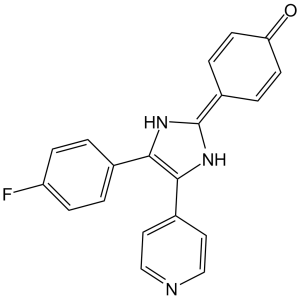
SB-202190 属于咪唑类化合物,其结构为 1H-咪唑,其中 2、4 和 5 位上的氢原子分别被 4-羟基苯基、吡啶-4-基和 4-氟苯基取代。它是一种广泛使用的丝裂原活化蛋白激酶 (MAPK) α 和 β 抑制剂。它既是 EC 2.7.11.24(丝裂原活化蛋白激酶)抑制剂,也是细胞凋亡诱导剂。它属于咪唑类、酚类、吡啶类和有机氟化合物。
4-(4-氟苯基)-2-(4-羟基苯基)-5-(4-吡啶基)-1H-咪唑已在暹罗巨藻(Mammea siamensis)中被报道,并有相关数据。 p38是丝裂原活化蛋白激酶的一个亚家族,能够响应各种细胞外刺激来调控基因表达。吡啶基咪唑类化合物,例如SB202190,是p38α和p38β的特异性抑制剂,已被广泛用于研究p38的生物学功能。本文表明,SB202190本身足以诱导细胞死亡,并表现出典型的凋亡特征,例如细胞核浓缩和核内DNA片段化。 SB202190 刺激了 CPP32 样半胱天冬酶的活性,其凋亡作用可被蛋白酶抑制剂苄氧羰基-Val-Ala-Asp-氟甲基酮和 bcl-2 的表达完全阻断。此外,SB202190 能够增强 Fas(APO-1) 配体结合或紫外线照射诱导的细胞凋亡。p38β 的表达减弱了 SB202190 的凋亡作用以及 Fas 配体结合和紫外线照射诱导的细胞死亡。相反,p38α 的表达仅轻微诱导细胞死亡。这些结果表明,SB202190 通过激活 CPP32 样半胱天冬酶诱导细胞凋亡,并提示丝裂原活化蛋白激酶 p38 亚家族的不同成员在细胞凋亡中具有不同的功能。[1] 作用机制:SB202190 是一种可逆的、ATP 竞争性 p38α/β 抑制剂。它与 p38α 的 ATP 结合口袋结合,与 Glu71(铰链区)和 Asp168(催化环)残基形成氢键,从而阻断 ATP 的配位和激酶的激活 [1, 2] - 研究应用:该化合物广泛用作研究炎症、血液系统恶性肿瘤(例如慢性粒细胞白血病)和实体瘤中 p38α/β 介导通路的工具化合物。由于高浓度下可能存在脱靶效应,因此尚未进入临床开发阶段 [11, 12] - 耐药性说明:在长期使用 SB202190 处理的 K562 细胞中,获得性耐药与 p38γ 表达增加(约 2.2 倍)和 PI3K-AKT 通路的激活相关 [9] |
| 分子式 |
C20H14N3OF
|
|---|---|
| 分子量 |
331.34
|
| 精确质量 |
331.112
|
| 元素分析 |
C, 72.50; H, 4.26; F, 5.73; N, 12.68; O, 4.83
|
| CAS号 |
152121-30-7
|
| 相关CAS号 |
SB 202190 hydrochloride;350228-36-3
|
| PubChem CID |
5169
|
| 外观&性状 |
white solid powder
|
| 密度 |
1.3±0.1 g/cm3
|
| 沸点 |
565.7±50.0 °C at 760 mmHg
|
| 熔点 |
240-243℃
|
| 闪点 |
295.9±30.1 °C
|
| 蒸汽压 |
0.0±1.6 mmHg at 25°C
|
| 折射率 |
1.653
|
| LogP |
5
|
| tPSA |
61.8
|
| 氢键供体(HBD)数目 |
2
|
| 氢键受体(HBA)数目 |
4
|
| 可旋转键数目(RBC) |
3
|
| 重原子数目 |
25
|
| 分子复杂度/Complexity |
415
|
| 定义原子立体中心数目 |
0
|
| SMILES |
FC1C([H])=C([H])C(=C([H])C=1[H])C1=C(C2C([H])=C([H])N=C([H])C=2[H])N([H])C(C2C([H])=C([H])C(=C([H])C=2[H])O[H])=N1
|
| InChi Key |
QHKYPYXTTXKZST-UHFFFAOYSA-N
|
| InChi Code |
InChI=1S/C20H14FN3O/c21-16-5-1-13(2-6-16)18-19(14-9-11-22-12-10-14)24-20(23-18)15-3-7-17(25)8-4-15/h1-12,25H,(H,23,24)
|
| 化学名 |
4-[4-(4-fluorophenyl)-5-pyridin-4-yl-1H-imidazol-2-yl]phenol
|
| 别名 |
FHPI; SB-202190; SB202190; 152121-30-7; SB 202190; SB202190; SB-202190; FHPI; 4-(4-Fluorophenyl)-2-(4-hydroxyphenyl)-5-(4-pyridyl)-1H-imidazole; SB202190 (FHPI); 4-(4-(4-fluorophenyl)-5-(pyridin-4-yl)-1H-imidazol-2-yl)phenol; SB202190
|
| HS Tariff Code |
2934.99.9001
|
| 存储方式 |
Powder -20°C 3 years 4°C 2 years In solvent -80°C 6 months -20°C 1 month |
| 运输条件 |
Room temperature (This product is stable at ambient temperature for a few days during ordinary shipping and time spent in Customs)
|
| 溶解度 (体外实验) |
|
|||
|---|---|---|---|---|
| 溶解度 (体内实验) |
配方 1 中的溶解度: ≥ 2.08 mg/mL (6.28 mM) (饱和度未知) in 10% DMSO + 40% PEG300 + 5% Tween80 + 45% Saline (这些助溶剂从左到右依次添加,逐一添加), 澄清溶液。
例如,若需制备1 mL的工作液,可将100 μL 20.8 mg/mL澄清DMSO储备液加入400 μL PEG300中,混匀;然后向上述溶液中加入50 μL Tween-80,混匀;加入450 μL生理盐水定容至1 mL。 *生理盐水的制备:将 0.9 g 氯化钠溶解在 100 mL ddH₂O中,得到澄清溶液。 配方 2 中的溶解度: ≥ 2.08 mg/mL (6.28 mM) (饱和度未知) in 10% DMSO + 90% (20% SBE-β-CD in Saline) (这些助溶剂从左到右依次添加,逐一添加), 澄清溶液。 例如,若需制备1 mL的工作液,可将 100 μL 20.8 mg/mL澄清DMSO储备液加入900 μL 20% SBE-β-CD生理盐水溶液中,混匀。 *20% SBE-β-CD 生理盐水溶液的制备(4°C,1 周):将 2 g SBE-β-CD 溶解于 10 mL 生理盐水中,得到澄清溶液。 View More
配方 3 中的溶解度: ≥ 2.08 mg/mL (6.28 mM) (饱和度未知) in 10% DMSO + 90% Corn Oil (这些助溶剂从左到右依次添加,逐一添加), 澄清溶液。 配方 4 中的溶解度: 1% DMSO+30% polyethylene glycol+1% Tween 80: 30mg/mL 1、请先配制澄清的储备液(如:用DMSO配置50 或 100 mg/mL母液(储备液)); 2、取适量母液,按从左到右的顺序依次添加助溶剂,澄清后再加入下一助溶剂。以 下列配方为例说明 (注意此配方只用于说明,并不一定代表此产品 的实际溶解配方): 10% DMSO → 40% PEG300 → 5% Tween-80 → 45% ddH2O (或 saline); 假设最终工作液的体积为 1 mL, 浓度为5 mg/mL: 取 100 μL 50 mg/mL 的澄清 DMSO 储备液加到 400 μL PEG300 中,混合均匀/澄清;向上述体系中加入50 μL Tween-80,混合均匀/澄清;然后继续加入450 μL ddH2O (或 saline)定容至 1 mL; 3、溶剂前显示的百分比是指该溶剂在最终溶液/工作液中的体积所占比例; 4、 如产品在配制过程中出现沉淀/析出,可通过加热(≤50℃)或超声的方式助溶; 5、为保证最佳实验结果,工作液请现配现用! 6、如不确定怎么将母液配置成体内动物实验的工作液,请查看说明书或联系我们; 7、 以上所有助溶剂都可在 Invivochem.cn网站购买。 |
| 制备储备液 | 1 mg | 5 mg | 10 mg | |
| 1 mM | 3.0180 mL | 15.0902 mL | 30.1805 mL | |
| 5 mM | 0.6036 mL | 3.0180 mL | 6.0361 mL | |
| 10 mM | 0.3018 mL | 1.5090 mL | 3.0180 mL |
1、根据实验需要选择合适的溶剂配制储备液 (母液):对于大多数产品,InvivoChem推荐用DMSO配置母液 (比如:5、10、20mM或者10、20、50 mg/mL浓度),个别水溶性高的产品可直接溶于水。产品在DMSO 、水或其他溶剂中的具体溶解度详见上”溶解度 (体外)”部分;
2、如果您找不到您想要的溶解度信息,或者很难将产品溶解在溶液中,请联系我们;
3、建议使用下列计算器进行相关计算(摩尔浓度计算器、稀释计算器、分子量计算器、重组计算器等);
4、母液配好之后,将其分装到常规用量,并储存在-20°C或-80°C,尽量减少反复冻融循环。
计算结果:
工作液浓度: mg/mL;
DMSO母液配制方法: mg 药物溶于 μL DMSO溶液(母液浓度 mg/mL)。如该浓度超过该批次药物DMSO溶解度,请首先与我们联系。
体内配方配制方法:取 μL DMSO母液,加入 μL PEG300,混匀澄清后加入μL Tween 80,混匀澄清后加入 μL ddH2O,混匀澄清。
(1) 请确保溶液澄清之后,再加入下一种溶剂 (助溶剂) 。可利用涡旋、超声或水浴加热等方法助溶;
(2) 一定要按顺序加入溶剂 (助溶剂) 。
Inhibiting p38MAPK prevents clinical blistering in PV passive transfer mice. Neonatal C57BL/6J mice were injected i.d. with either PV IgG (1.5 mg of IgG/g body weight) (Left) or PV IgG (1.5 mg of IgG/g body weight) plus SB202190 (Right). After 18 h, the skin of neonatal mice from the test and control groups was examined clinically. PV IgG-treated mice have a positive Nikolsky’s sign (white arrows), demonstrating loss of epithelial cell–cell adhesion. In contrast, mice treated with the SB202190 and PV IgG have a negative Nikoslky’s sign, indicating that epithelial adhesion remains intact. Proc Natl Acad Sci U S A. 2006 Aug 22; 103(34): 12855–12860. |
Inhibition of PV IgG-mediated p38MAPK and HSP27 phosphorylation in skin of PV IgG plus SB202190-treated mice. Neonatal C57BL/6 WT mice were injected i.d. with control IgG (CON; 1 mg of IgG/g body weight), PV IgG (1 mg of IgG/g body weight), or SB202190 and then PV IgG (PV IgG plus SB202190). Skin biopsies were obtained after 18 h of treatment and extracted in IEF lysis buffer. Proc Natl Acad Sci U S A. 2006 Aug 22; 103(34): 12855–12860. |
 BChE/p38-α MAPK-IN-1
 p38 Kinase-IN-9
 MKK6 SDTD Recombinant Human Active Protein Kinase
 BMS-626531
InvivoChem的所有产品仅用于作科学研究,不面向患者销售
Copyright 2020 InvivoChem LLC | All Rights Reserved 粤ICP备20063088号-1


 COA
COA


 粤公网安备 44011102003439号
 463611831
