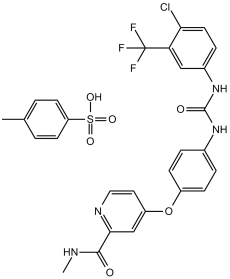
Sorafenib Tosylate (Bay 43-9006; Nexavar)

别名: BAY 43-9006 tosylate; BAY549085; BAY-439-006; BAY 549085;BAY-439006 tosylate; BAY 439006; BAY439006 tosylate; BAY-549085; Nexavar; SFN; Sorafenib; 284461-73-0; Nexavar; BAY 43-9006; sorafenibum; 4-[4-({[4-chloro-3-(trifluoromethyl)phenyl]carbamoyl}amino)phenoxy]-N-methylpyridine-2-carboxamide; 4-(4-(3-(4-CHLORO-3-(TRIFLUOROMETHYL)PHENYL)UREIDO)PHENOXY)-N-METHYLPICOLINAMIDE; Sorafenib free base; 甲苯磺酸索拉菲尼; 4-{4-[3-(4-氯-3-三氟甲基苯基)酰脲]苯氧基}吡啶-2-甲酰胺对甲苯磺酸盐; 甲苯磺酸索拉非尼;索拉非尼及其中间体;甲磺酸索拉非尼;甲磺酸索拉非尼(对甲苯磺酸索拉非尼);SORAFENIB 对甲苯磺酸酯 INN;索拉非尼对甲苯磺酸盐;
目录号: V1003 纯度: =99.89%
索拉非尼甲苯磺酸盐(BAY439006;BAY-439006;BAY549085;BAY-549085;Nexavar;SFN)是索拉非尼的甲苯磺酸盐,是一种已批准的抗癌药物,是一种有效的 Raf-1、B-Raf 和 VEGFR 多激酶抑制剂。 2 具有潜在的抗肿瘤活性。
Sorafenib Tosylate (Bay 43-9006; Nexavar) CAS号: 475207-59-1
产品类别: Raf
产品仅用于科学研究,不针对患者销售
规格 价格 库存 数量
10 mM * 1 mL in DMSO
5mg
10mg
50mg
100mg
500mg
1g
2g
5g
10g
25g
50g
Other Sizes

Other Forms of Sorafenib Tosylate (Bay 43-9006; Nexavar):

  • Sorafenib N-oxide
  • Sorafenib impurity 5
  • Sorafenib impurity 2
  • Sorafenib impurity 6
  • Sorafenib impurity 3
  • 索拉非尼
点击了解更多
InvivoChem产品被CNS等顶刊论文引用
纯度/质量控制文件

纯度: ≥98%

纯度: =99.89%

产品描述
Sorafenib Tosylate (BAY439006; BAY-439006; BAY549085; BAY-549085; Nexavar; SFN) 是一种有效的 Raf-1、B-Raf 和 VEGFR-2 多激酶抑制剂,具有潜在的抗肿瘤活性,是索拉非尼的甲苯磺酸盐,一种授权的抗癌药物。在酶测定中,其对 Raf-1、B-Raf 和 VEGFR-2 的 IC50 值分别为 6 nM、22 nM 和 90 nM。此外,索拉非尼抑制 VEGFR-2/PDGFR-β 信号级联,防止肿瘤血管生成。 RAF激酶是RAF/MEK/ERK信号通路中调节细胞分裂和增殖的关键酶。 2005年,晚期肾癌获准使用索拉非尼治疗。
生物活性&实验参考方法
靶点
VEGFR3 (IC50 = 20 nM); Braf (IC50 = 22 nM); Raf-1 (IC50 = 6 nM); VEGFR2 (IC50 = 90 nM); PDGFRβ (IC50 = 57 nM); BrafV599E (IC50 = 38 nM); c-Kit (IC50 = 68 nM); Flt3 (IC50 = 58 nM)
Sorafenib Tosylate (Bay 43-9006; Nexavar) is a multi-targeted kinase inhibitor. It inhibits RAF family kinases: B-RAF (IC₅₀ = 22 nM), C-RAF (IC₅₀ = 28 nM); receptor tyrosine kinases: vascular endothelial growth factor receptor 2 (VEGFR2, IC₅₀ = 90 nM), platelet-derived growth factor receptor β (PDGFRβ, IC₅₀ = 57 nM), and c-KIT (IC₅₀ = 68 nM) [1]
体外研究 (In Vitro)
甲苯磺酸索拉非尼还抑制 BRAFwt (IC50=22 nM)、BRAFV599E (IC50=38 nM)、VEGFR-2 (IC50=90 nM)、VEGFR-3 (IC50=20 nM)、PDGFR-β (IC50=57 nM)、生化检测中的 c-KIT (IC50=68 nM) 和 Flt3 (IC50=58 nM)[1]。当抗人抗 HGF 抗体同时给予 10-0505 细胞时,甲苯磺酸索拉非尼诱导的 c-Met、p70S6K 和 4EBP1 磷酸化显着降低,表明甲苯磺酸索拉非尼治疗可增加 HGF 分泌并激活 c-Met 和 mTOR 靶标。 2]。
多肿瘤细胞增殖抑制:在人肿瘤细胞系中,Sorafenib Tosylate (Bay 43-9006; Nexavar)(0.1-10 μM)浓度依赖性抑制增殖:A375黑色素瘤细胞(B-RAF突变)IC₅₀=0.6 μM、HT-29结肠癌细胞IC₅₀=5.2 μM、HepG2肝癌细胞IC₅₀=7.0 μM。在A375细胞中,2 μM剂量可使ERK1/2磷酸化水平降低75%,阻断RAF/MEK/ERK通路[1]
- 肝癌细胞生长抑制:在HepG2肝癌细胞中,Sorafenib Tosylate (Bay 43-9006; Nexavar)(1-10 μM)抑制生长的IC₅₀=7.2 μM;与雷帕霉素(0.1 μM)联用后IC₅₀降至2.5 μM,协同抑制增殖。Western blot显示联用组p-mTOR降低60%、p-ERK降低80%[2]
- 抗血管生成活性:在人脐静脉内皮细胞(HUVECs)中,Sorafenib Tosylate (Bay 43-9006; Nexavar)(0.1-5 μM)抑制VEGF诱导的迁移(IC₅₀=0.8 μM)和管形成(2 μM时抑制90%),1 μM剂量可使VEGFR2磷酸化水平降低85%[1]
- 肝癌细胞凋亡诱导:在Hep3B肝癌细胞中,Sorafenib Tosylate (Bay 43-9006; Nexavar)(5 μM)单独处理诱导18%细胞凋亡;与丙戊酸(VPA,2 mM)联用后凋亡率升至45%,同时伴随Notch3(降低70%)和pAkt(降低65%)的下调(Western blot检测)[4]
体内研究 (In Vivo)
甲苯磺酸索拉非尼(10、30、50和100 mg/kg,口服)治疗以剂量依赖性方式抑制06-0606和10-0505异种移植物的肿瘤生长(P<0.01)。索拉非尼还显着减慢异种移植物06-0606和10-0505的生长。接受索拉非尼 50 mg/kg 和 100 mg/kg 治疗的小鼠的 06-0606 肿瘤重量分别约为对照组的 13% 和 5%。索拉非尼 50 mg 剂量显着降低 5-1318、26-1004 和 10-0505 系小鼠的肿瘤生长(P<0.01)。对于 50 mg 剂量,06-0606、26-1004、5-1318 和 10-0505 异种移植物的 T/C 比率分别为 0.13、0.10、0.12 和 0.49,其中 T 和 C 是中位重量(mg) 治疗结束时经索拉非尼和媒介物治疗的肿瘤[2]。与正常对照组的100%相比,二乙基亚硝胺(DENA)组的存活率为73.3%,索拉非尼组的存活率为83.3%。与 DENA 组相比,索拉非尼治疗导致肝脏指数显着降低 (p<0.05),但与正常组相比,DENA 组的肝脏指数显着增加(增加 1.51 倍,p<0.05)控制组。与正常对照组相比,索拉非尼组的肝脏指数显着下降至较低值[3]。
多肿瘤异种移植模型:在荷A375黑色素瘤异种移植瘤的裸鼠中,口服Sorafenib Tosylate (Bay 43-9006; Nexavar)(30、60、100 mg/kg/天,每日一次)剂量依赖性抑制肿瘤生长:100 mg/kg在第21天较溶媒组使肿瘤体积减少80%,无显著体重下降;在HT-29结直肠癌异种移植模型中,60 mg/kg/天抑制肿瘤生长65%[1]
- 小鼠肝癌模型:在二乙基亚硝胺(DEN)诱导的C57BL/6小鼠肝癌模型中,口服Sorafenib Tosylate (Bay 43-9006; Nexavar)(30 mg/kg/天,每日一次)4周,较溶媒组减少肿瘤体积35%;与雷帕霉素(2 mg/kg/天,腹腔注射)联用后抑制率升至60%,瘤内微血管密度降低50%(CD31染色)[2]
- 大鼠肝癌预防模型:在DEN诱导肝肿瘤的F344大鼠中,口服Sorafenib Tosylate (Bay 43-9006; Nexavar)(10 mg/kg/天,每日一次)12周,肝肿瘤结节数从每肝8.5个降至3.2个,结节体积减少40%,同时氧化应激标志物MDA水平降低30%[3]
- Hep3B异种移植模型:在荷Hep3B肝癌异种移植瘤的裸鼠中,口服Sorafenib Tosylate (Bay 43-9006; Nexavar)(50 mg/kg/天,每日一次)第28天使肿瘤生长抑制40%;与VPA(200 mg/kg/天,腹腔注射)联用后抑制率升至75%,中位生存期从32天延长至50天[4]
酶活实验
检测缓冲液含有 20 mM Tris (pH 8.2)、100 mM NaCl、5 mM MgCl2 和 0.15% β-巯基乙醇,用于组合 Raf-1 (80 ng)、wt BRAF (80 ng) 或 V599E BRAF (80 ng) 与 MEK-1 (1 μg) 一起测试化合物对不同 RAF 激酶亚型的抑制作用。将 25 μL 10 μM γ-[33P]ATP (400 Ci/mol) 添加到 RAF 激酶测定的 50 μL 终体积中,在 32°C 下孵育 25 分钟。通过过滤到磷酸纤维素垫上,获得磷酸化的MEK-1。然后使用 1% 磷酸去除未结合的放射性。利用 β 板计数器,通过微波加热干燥后测量过滤器结合的放射性[1]。
BRAF/CRAF激酶实验:将重组人B-RAF(50 ng/孔)或C-RAF(50 ng/孔)与激酶缓冲液(50 mM Tris-HCl pH7.5、10 mM MgCl₂、1 mM DTT、20 μM ATP)、生物素化MEK1肽(底物,1 μM)及不同浓度的Sorafenib Tosylate (Bay 43-9006; Nexavar)(0.001-100 μM)在30°C孵育60 min。通过HTRF(铕标记抗磷酸化MEK抗体+链霉亲和素-APC)检测磷酸化底物,激酶活性归一化为溶媒组,计算IC₅₀值[1]
- VEGFR2激酶实验:将重组人VEGFR2(40 ng/孔)与激酶缓冲液(25 mM HEPES pH7.4、5 mM MnCl₂、1 mM DTT、10 μM ATP)、生物素化KKKSPGEYVNIEFG肽(底物,2 μM)及Sorafenib Tosylate (Bay 43-9006; Nexavar)(0.01-100 μM)在37°C孵育45 min。采用放射性检测(³²P-ATP掺入)测定激酶活性,非线性回归计算IC₅₀[1]
细胞实验
将10-0505、06-0606和26-1004肿瘤切碎并在改良Eagle培养基(MEM)中彻底清洗3次。 800×g 离心 10 分钟收集细胞。在存在或不存在 5 μg/mL 抗人肝细胞生长因子 (HGF) 抗体的情况下,用无血清 MEM 中的 3 或 6 μM 索拉非尼处理细胞 48 小时。收集并浓缩来自用索拉非尼或载体(不含抗人抗体)处理的动物的 2 mL 条件培养基后,使用蛋白质印迹法测定条件培养基中分泌的 HGF 量[2]。
肿瘤细胞增殖实验:A375/HT-29/HepG2细胞以5×10³个细胞/孔接种于96孔板,用含10% FBS的DMEM培养。贴壁24 h后加入Sorafenib Tosylate (Bay 43-9006; Nexavar)(0.1-10 μM)±雷帕霉素/VPA,孵育72 h。MTT法(570 nm吸光度)检测细胞活力并计算IC₅₀。Western blot实验中,细胞裂解后用抗p-ERK、抗p-mTOR、抗Notch3或抗pAkt抗体检测[1,2,4]
- HUVEC迁移实验:HUVECs接种于Transwell上室(8 μm孔径),培养基为无血清EBM-2;下室为含VEGF(50 ng/mL)±Sorafenib Tosylate (Bay 43-9006; Nexavar)(0.1-5 μM)的EBM-2。37°C孵育6 h后,去除上室未迁移细胞,下室迁移细胞经固定、结晶紫染色后计数[1]
- 肝癌细胞凋亡实验:Hep3B细胞以1×10⁵个细胞/孔接种于24孔板,用Sorafenib Tosylate (Bay 43-9006; Nexavar)(5 μM)±VPA(2 mM)处理48 h。收集细胞,Annexin V-FITC/PI双染色后流式细胞术分析,计算凋亡细胞百分比(Annexin V⁺/PI⁻和Annexin V⁺/PI⁺)[4]
动物实验
小鼠:为进行剂量反应实验,分别给予携带 06-0606 和 10-0505 异种移植瘤的小鼠口服四种不同剂量的索拉非尼(每日 10、30、50 和 100 mg/kg)。每组治疗组包含 5 只小鼠。为研究索拉非尼的抗肿瘤作用,给予携带肿瘤的小鼠每日一次口服 50 mg/kg 索拉非尼,持续 12 天。每个实验至少重复两次,每组治疗组包含 14 只动物。肿瘤植入 7 天后开始治疗。此时,HCC 异种移植瘤已生长至约 100 mm³。将携带肿瘤的小鼠(每组14只)分别每日口服200 μL载体、50 mg/kg索拉非尼、1 mg/kg雷帕霉素或雷帕霉素联合索拉非尼,持续指定天数,以研究雷帕霉素联合索拉非尼对10-0505异种移植瘤生长的影响。每周至少两次使用游标卡尺测量肿瘤的长和宽,以追踪肿瘤生长情况。肿瘤体积的计算公式为[长×宽²×π/6]。实验结束后处死小鼠,记录其体重和肿瘤重量,并收集肿瘤进行检查。大鼠:实验采用体重100-120 g的雄性白化大鼠。适应环境后,称量大鼠体重并随机分为三组:第一组(正常对照组;n = 10)每日给予载体,持续八周。第2组(DENA组;n=15)大鼠静脉注射200 mg/kg的DENA。第3组(索拉非尼组;n=12)大鼠在静脉注射DENA后,每日两次口服索拉非尼,持续两周。实验结束后(8周),称量大鼠体重,用乙醚麻醉后处死,并解剖肝脏。新鲜肝脏经冰盐水冲洗和干燥两次后称重。肝脏指数的计算公式为:肝脏重量(g)/最终体重(g)×100。取肝脏五份,其中一份保存在10%福尔马林溶液中用于组织病理学分析,其余四份立即冷冻于液氮中,并保存在80℃。
A375/HT-29异种移植方案:将A375(5×10⁶个细胞/只)或HT-29(1×10⁷个细胞/只)皮下注射到雌性裸鼠(6-7周龄)右侧腹部。当肿瘤体积达到 100 mm³ 时,将小鼠随机分为 4 组(每组 n=7):载体组(0.5% 甲基纤维素 + 0.2% Tween 80,口服)、索拉非尼甲苯磺酸盐组 30 mg/kg(口服,每日一次)、60 mg/kg(口服,每日一次)、100 mg/kg(口服,每日一次)。药物每日给药,持续 21 天。每 3 天测量一次肿瘤体积(V = π×L×W²/6)和体重[1]
- DEN 诱导的小鼠肝细胞癌 (HCC) 实验方案:雄性 C57BL/6 小鼠(4 周龄)单次腹腔注射 DEN(25 mg/kg)以诱导 HCC。在第16周,将小鼠分为3组(每组n=8):载体组、索拉非尼甲苯磺酸盐30 mg/kg(口服,每日一次)组、索拉非尼甲苯磺酸盐30 mg/kg + 雷帕霉素2 mg/kg(腹腔注射,每日一次)组。治疗持续4周。切除肿瘤,称重,并进行CD31染色以评估微血管密度[2]。
- 大鼠肝细胞癌预防方案:雄性F344大鼠(6周龄)单次腹腔注射DEN(100 mg/kg)。在第8周,将大鼠随机分为2组(每组n=10):载体组、索拉非尼甲苯磺酸盐10 mg/kg(口服,每日一次)组。治疗持续12周。取出肝脏,计数并测量肿瘤结节。检测肝脏MDA水平以评估氧化应激[3]
- Hep3B异种移植实验方案:将Hep3B细胞(2×10⁶个细胞/只)皮下注射到6周龄雌性裸鼠体内。当肿瘤体积达到120 mm³时,将小鼠分为3组(每组n=6):载体组、索拉非尼甲苯磺酸盐50 mg/kg(口服,每日一次)组、索拉非尼甲苯磺酸盐50 mg/kg + 丙戊酸200 mg/kg(腹腔注射,每日一次)组。治疗持续28天。每3天测量一次肿瘤体积,并监测生存情况[4]
药代性质 (ADME/PK)
口服吸收:在健康志愿者(n=6)中,口服索拉非尼甲苯磺酸盐(Bay 43-9006;Nexavar)(400 mg)在 3-4 小时(Tmax)达到血浆峰浓度(Cmax)2.8 μg/mL,绝对口服生物利用度为 38-49%(部分首过代谢)[1]
- 代谢:索拉非尼甲苯磺酸盐(Bay 43-9006;Nexavar)主要在肝脏中通过细胞色素 P450 酶 CYP3A4(主要)和 UDP-葡萄糖醛酸转移酶 UGT1A9(次要)代谢,形成无活性代谢物(例如,M2、M4)。未观察到 CYP2D6 或 CYP2C9 的显著代谢 [1]
- 排泄和半衰期:在人体内,索拉非尼甲苯磺酸盐(Bay 43-9006;Nexavar)的末端消除半衰期 (t₁/₂) 为 24–48 小时。给药剂量的约77%在7天内经粪便排出(69%为代谢物,8%为原药),19%经尿液排出(15%为代谢物,4%为原药)[1]
- 组织分布:在裸鼠中,口服索拉非尼甲苯磺酸盐(Bay 43-9006;Nexavar)(100 mg/kg)后4小时,肿瘤/血浆浓度比达到1.3,且肿瘤浓度持续高于A375细胞的IC₅₀,持续12小时[1]
毒性/毒理 (Toxicokinetics/TK)
妊娠期和哺乳期影响
◉ 哺乳期用药概述
目前尚无索拉非尼在哺乳期临床应用的信息。由于索拉非尼与血浆蛋白的结合率高达99.5%,因此其在乳汁中的含量可能很低。然而,其半衰期为25至48小时,因此可能会在婴儿体内蓄积。制造商建议在索拉非尼治疗期间以及末次给药后 2 周内停止母乳喂养。
◉ 对母乳喂养婴儿的影响
截至修订日期,未找到相关的已发表信息。
◉ 对泌乳和母乳的影响
截至修订日期,未找到相关的已发表信息。
血浆蛋白结合率:在人血浆中(通过超滤法测定),索拉非尼甲苯磺酸盐(Bay 43-9006;Nexavar)在浓度为 0.1–10 μg/mL 时,蛋白结合率为 99.5%,且与浓度无关 [1]
- 急性毒性:在 Sprague-Dawley 大鼠中,索拉非尼甲苯磺酸盐(Bay 43-9006;Nexavar)的口服 LD₅₀ >2000 mg/kg;在小鼠中,口服LD₅₀ >1500 mg/kg。在大鼠中,剂量高达1000 mg/kg时,观察到轻微的短暂性腹泻(发生率<15%)和轻微的体重减轻(<5%),未见器官损伤[1]
- 慢性毒性:在为期12周的大鼠肝细胞癌模型(10 mg/kg/天)中,索拉非尼甲苯磺酸盐(Bay 43-9006;Nexavar)不会引起血清ALT/AST(肝脏标志物)或肌酐(肾脏标志物)的显著变化。肝脏、肾脏或心脏均未发现组织病理学病变[3]
- 临床相关毒性:在临床前研究中,常见不良反应包括手足皮肤反应(小鼠在100 mg/kg/天剂量下发生率约为20%)、疲劳和高血压(大鼠收缩压轻度升高10-15 mmHg)。这些作用可通过降低剂量逆转[1]
- 药物相互作用:在人体中,索拉非尼甲苯磺酸盐(Bay 43-9006;Nexavar)(400 mg,每日两次)与酮康唑(CYP3A4抑制剂,400 mg/天)合用可使索拉非尼的Cmax增加1.4倍,t₁/₂增加至56小时,但不会增加严重不良反应[1]
参考文献

[1]. BAY 43-9006 exhibits broad spectrum oral antitumor activity and targets the RAF/MEK/ERK pathway and receptor tyrosine kinases involved in tumor progression and angiogenesis. Cancer Res. 2004 Oct 1;64(19):7099-109.

[2]. Sorafenib and rapamycin induce growth suppression in mouse models of hepatocellular carcinoma. J Cell Mol Med. 2009 Aug;13(8B):2673-83.

[3]. Sorafenib effect on liver neoplastic changes in rats: more than a kinase inhibitor. Clin Exp Med. 2016 Apr 16.

[4]. Combination of sorafenib and Valproic acid synergistically induces cell apoptosis and inhibits hepatocellular carcinoma growth via down-regulating Notch3 and pAkt. Am J Cancer Res. 2017 Dec 1;7(12):2503-2514.

其他信息
索拉非尼甲苯磺酸盐是一种有机磺酸盐,含有索拉非尼分子。
索拉非尼甲苯磺酸盐是索拉非尼的甲苯磺酸盐,索拉非尼是一种靶向生长信号传导和血管生成的合成化合物。索拉非尼可阻断RAF激酶,RAF激酶是RAF/MEK/ERK信号通路的关键组成部分,该通路控制细胞分裂和增殖;此外,索拉非尼还抑制VEGFR-2/PDGFR-β信号级联,从而阻断肿瘤血管生成。
它是一种烟酰胺和苯脲衍生物,可抑制多种被认为参与血管生成的细胞内和细胞表面激酶,包括RAF激酶和VEGF受体。它用于治疗晚期肾细胞癌和肝细胞癌,以及对放射性碘治疗无效的甲状腺癌。
另见:索拉非尼(含有活性成分)。
药物适应症
肝细胞癌:Nexavar适用于治疗肝细胞癌。肾细胞癌:Nexavar适用于治疗既往接受过干扰素-α或白细胞介素-2治疗失败或不适合接受此类治疗的晚期肾细胞癌患者。分化型甲状腺癌 Nexavar 适用于治疗对放射性碘治疗无效的进展性、局部晚期或转移性分化型(乳头状/滤泡状/Hürthle 细胞)甲状腺癌患者。
索拉非尼甲苯磺酸盐(Bay 43-9006;Nexavar)是首个于 2005 年获得 FDA 批准用于治疗晚期肾细胞癌 (RCC) 的口服多靶点激酶抑制剂,随后又获批用于治疗不可切除的肝细胞癌 (HCC) (2007 年) 和放射性碘治疗无效的分化型甲状腺癌 (2013 年) [1,2]
- 作用机制:其抗肿瘤作用是双重的:1) 抑制 RAF/MEK/ERK 信号通路以抑制肿瘤细胞增殖; 2) 阻断受体酪氨酸激酶(VEGFR2、PDGFRβ)以抑制血管生成,切断肿瘤营养供应[1,4]
- 协同组合:临床前研究表明,索拉非尼甲苯磺酸盐(Bay 43-9006;Nexavar)与雷帕霉素(mTOR抑制剂)和丙戊酸(HDAC抑制剂)具有协同作用,可增强肝细胞癌(HCC)的抗肿瘤疗效,克服单药耐药性[2,4]
- 临床意义:它是首个改善不可切除HCC患者总生存期的药物(SHARP试验中,索拉非尼组的中位总生存期为10.7个月,而安慰剂组为7.9个月),为HCC治疗树立了新的标准[1,2]
*注: 文献方法仅供参考, InvivoChem并未独立验证这些方法的准确性
化学信息 & 存储运输条件
分子式
C21H16CLF3N4O3.C7H8O3S
分子量
637.03
精确质量
636.105
元素分析
C, 52.79; H, 3.80; Cl, 5.56; F, 8.95; N, 8.80; O, 15.07; S, 5.03
CAS号
475207-59-1
相关CAS号
Sorafenib;284461-73-0
PubChem CID
406563
外观&性状
White solid powder
密度
1.454 g/cm3
沸点
523.3ºC at 760 mmHg
闪点
270.3ºC
LogP
8.349
tPSA
158.59
氢键供体(HBD)数目
4
氢键受体(HBA)数目
10
可旋转键数目(RBC)
6
重原子数目
43
分子复杂度/Complexity
853
定义原子立体中心数目
0
SMILES
CC1=CC=C(S(O)(=O)=O)C=C1.CNC(C1C=C(OC2=CC=C(NC(NC3=CC(C(F)(F)F)=C(Cl)C=C3)=O)C=C2)C=CN=1)=O
InChi Key
IVDHYUQIDRJSTI-UHFFFAOYSA-N
InChi Code
InChI=1S/C21H16ClF3N4O3.C7H8O3S/c1-26-19(30)18-11-15(8-9-27-18)32-14-5-2-12(3-6-14)28-20(31)29-13-4-7-17(22)16(10-13)21(23,24)25;1-6-2-4-7(5-3-6)11(8,9)10/h2-11H,1H3,(H,26,30)(H2,28,29,31);2-5H,1H3,(H,8,9,10)
化学名
4-[4-[[4-chloro-3-(trifluoromethyl)phenyl]carbamoylamino]phenoxy]-N-methylpyridine-2-carboxamide;4-methylbenzenesulfonic acid
别名
BAY 43-9006 tosylate; BAY549085; BAY-439-006; BAY 549085;BAY-439006 tosylate; BAY 439006; BAY439006 tosylate; BAY-549085; Nexavar; SFN; Sorafenib; 284461-73-0; Nexavar; BAY 43-9006; sorafenibum; 4-[4-({[4-chloro-3-(trifluoromethyl)phenyl]carbamoyl}amino)phenoxy]-N-methylpyridine-2-carboxamide; 4-(4-(3-(4-CHLORO-3-(TRIFLUOROMETHYL)PHENYL)UREIDO)PHENOXY)-N-METHYLPICOLINAMIDE; Sorafenib free base;
HS Tariff Code
2934.99.9001
存储方式

Powder      -20°C    3 years

                     4°C     2 years

In solvent   -80°C    6 months

                  -20°C    1 month

注意: 请将本产品存放在密封且受保护的环境中,避免吸湿/受潮。
运输条件
Room temperature (This product is stable at ambient temperature for a few days during ordinary shipping and time spent in Customs)
溶解度数据
溶解度 (体外实验)
DMSO: ~127 mg/mL (~199.4 mM)
Water: <1 mg/mL(slightly soluble or insoluble)
Ethanol: <1 mg/mL
溶解度 (体内实验)
配方 1 中的溶解度: 2.08 mg/mL (3.27 mM) in 10% DMSO + 40% PEG300 + 5% Tween80 + 45% Saline (这些助溶剂从左到右依次添加,逐一添加), 悬浮液;超声助溶。
例如,若需制备1 mL的工作液,可将100 μL 20.8 mg/mL澄清DMSO储备液加入400 μL PEG300中,混匀;然后向上述溶液中加入50 μL Tween-80,混匀;加入450 μL生理盐水定容至1 mL。
*生理盐水的制备:将 0.9 g 氯化钠溶解在 100 mL ddH₂O中,得到澄清溶液。

配方 2 中的溶解度: ≥ 2.08 mg/mL (3.27 mM) (饱和度未知) in 10% DMSO + 90% (20% SBE-β-CD in Saline) (这些助溶剂从左到右依次添加,逐一添加), 澄清溶液。
例如,若需制备1 mL的工作液,可将 100 μL 20.8 mg/mL澄清DMSO储备液加入900 μL 20% SBE-β-CD生理盐水溶液中,混匀。
*20% SBE-β-CD 生理盐水溶液的制备(4°C,1 周):将 2 g SBE-β-CD 溶解于 10 mL 生理盐水中,得到澄清溶液。

View More

配方 3 中的溶解度: ≥ 2.08 mg/mL (3.27 mM) (饱和度未知) in 10% DMSO + 90% Corn Oil (这些助溶剂从左到右依次添加,逐一添加), 澄清溶液。
例如,若需制备1 mL的工作液,可将 100 μL 20.8 mg/mL 澄清 DMSO 储备液加入到 900 μL 玉米油中并混合均匀。


配方 4 中的溶解度: 2% Cremophor EL, 2% N,N-dimethylacetamide: 30 mg/mL

配方 5 中的溶解度: 5 mg/mL (7.85 mM) in 20% HP-β-CD in Saline (这些助溶剂从左到右依次添加,逐一添加), 悬浊液; 超声助溶。
*生理盐水的制备:将 0.9 g 氯化钠溶解在 100 mL ddH₂O中,得到澄清溶液。

请根据您的实验动物和给药方式选择适当的溶解配方/方案:
1、请先配制澄清的储备液(如:用DMSO配置50 或 100 mg/mL母液(储备液));
2、取适量母液,按从左到右的顺序依次添加助溶剂,澄清后再加入下一助溶剂。以 下列配方为例说明 (注意此配方只用于说明,并不一定代表此产品 的实际溶解配方):
10% DMSO → 40% PEG300 → 5% Tween-80 → 45% ddH2O (或 saline);
假设最终工作液的体积为 1 mL, 浓度为5 mg/mL: 取 100 μL 50 mg/mL 的澄清 DMSO 储备液加到 400 μL PEG300 中,混合均匀/澄清;向上述体系中加入50 μL Tween-80,混合均匀/澄清;然后继续加入450 μL ddH2O (或 saline)定容至 1 mL;

3、溶剂前显示的百分比是指该溶剂在最终溶液/工作液中的体积所占比例;
4、 如产品在配制过程中出现沉淀/析出,可通过加热(≤50℃)或超声的方式助溶;
5、为保证最佳实验结果,工作液请现配现用!
6、如不确定怎么将母液配置成体内动物实验的工作液,请查看说明书或联系我们;
7、 以上所有助溶剂都可在 Invivochem.cn网站购买。
制备储备液 1 mg 5 mg 10 mg
1 mM 1.5698 mL 7.8489 mL 15.6978 mL
5 mM 0.3140 mL 1.5698 mL 3.1396 mL
10 mM 0.1570 mL 0.7849 mL 1.5698 mL

1、根据实验需要选择合适的溶剂配制储备液 (母液):对于大多数产品,InvivoChem推荐用DMSO配置母液 (比如:5、10、20mM或者10、20、50 mg/mL浓度),个别水溶性高的产品可直接溶于水。产品在DMSO 、水或其他溶剂中的具体溶解度详见上”溶解度 (体外)”部分;

2、如果您找不到您想要的溶解度信息,或者很难将产品溶解在溶液中,请联系我们;

3、建议使用下列计算器进行相关计算(摩尔浓度计算器、稀释计算器、分子量计算器、重组计算器等);

4、母液配好之后,将其分装到常规用量,并储存在-20°C或-80°C,尽量减少反复冻融循环。

计算器

摩尔浓度计算器可计算特定溶液所需的质量、体积/浓度,具体如下:

  • 计算制备已知体积和浓度的溶液所需的化合物的质量
  • 计算将已知质量的化合物溶解到所需浓度所需的溶液体积
  • 计算特定体积中已知质量的化合物产生的溶液的浓度
使用摩尔浓度计算器计算摩尔浓度的示例如下所示:
假如化合物的分子量为350.26 g/mol,在5mL DMSO中制备10mM储备液所需的化合物的质量是多少?
  • 在分子量(MW)框中输入350.26
  • 在“浓度”框中输入10,然后选择正确的单位(mM)
  • 在“体积”框中输入5,然后选择正确的单位(mL)
  • 单击“计算”按钮
  • 答案17.513 mg出现在“质量”框中。以类似的方式,您可以计算体积和浓度。

稀释计算器可计算如何稀释已知浓度的储备液。例如,可以输入C1、C2和V2来计算V1,具体如下:

制备25毫升25μM溶液需要多少体积的10 mM储备溶液?
使用方程式C1V1=C2V2,其中C1=10mM,C2=25μM,V2=25 ml,V1未知:
  • 在C1框中输入10,然后选择正确的单位(mM)
  • 在C2框中输入25,然后选择正确的单位(μM)
  • 在V2框中输入25,然后选择正确的单位(mL)
  • 单击“计算”按钮
  • 答案62.5μL(0.1 ml)出现在V1框中
g/mol

分子量计算器可计算化合物的分子量 (摩尔质量)和元素组成,具体如下:

注:化学分子式大小写敏感:C12H18N3O4  c12h18n3o4
计算化合物摩尔质量(分子量)的说明:
  • 要计算化合物的分子量 (摩尔质量),请输入化学/分子式,然后单击“计算”按钮。
分子质量、分子量、摩尔质量和摩尔量的定义:
  • 分子质量(或分子量)是一种物质的一个分子的质量,用统一的原子质量单位(u)表示。(1u等于碳-12中一个原子质量的1/12)
  • 摩尔质量(摩尔重量)是一摩尔物质的质量,以g/mol表示。
/

配液计算器可计算将特定质量的产品配成特定浓度所需的溶剂体积 (配液体积)

  • 输入试剂的质量、所需的配液浓度以及正确的单位
  • 单击“计算”按钮
  • 答案显示在体积框中
动物体内实验配方计算器(澄清溶液)
第一步:请输入基本实验信息(考虑到实验过程中的损耗,建议多配一只动物的药量)
第二步:请输入动物体内配方组成(配方适用于不溶/难溶于水的化合物),不同的产品和批次配方组成不同,如对配方有疑问,可先联系我们提供正确的体内实验配方。此外,请注意这只是一个配方计算器,而不是特定产品的确切配方。
+
+
+

计算结果:

工作液浓度 mg/mL;

DMSO母液配制方法 mg 药物溶于 μL DMSO溶液(母液浓度 mg/mL)。如该浓度超过该批次药物DMSO溶解度,请首先与我们联系。

体内配方配制方法μL DMSO母液,加入 μL PEG300,混匀澄清后加入μL Tween 80,混匀澄清后加入 μL ddH2O,混匀澄清。

(1) 请确保溶液澄清之后,再加入下一种溶剂 (助溶剂) 。可利用涡旋、超声或水浴加热等方法助溶;
            (2) 一定要按顺序加入溶剂 (助溶剂) 。

临床试验信息
A Phase III Clinical Trial of AK105 Injection Combined With Anlotinib Hydrochloride Capsules Versus Sorafenib in Subjects With Advanced Hepatocellular Carcinoma (HCC)
CTID: NCT04344158
Phase: Phase 3    Status: Active, not recruiting
Date: 2024-12-02
Navitoclax and Sorafenib Tosylate in Treating Patients With Relapsed or Refractory Solid Tumors
CTID: NCT02143401
Phase: Phase 1    Status: Completed
Date: 2024-11-22
Bortezomib and Sorafenib Tosylate in Treating Patients With Newly Diagnosed Acute Myeloid Leukemia
CTID: NCT01371981
Phase: Phase 3    Status: Active, not recruiting
Date: 2024-10-22
Bortezomib, Sorafenib Tosylate, and Decitabine in Treating Patients With Acute Myeloid Leukemia
CTID: NCT01861314
Phase: Phase 1    Status: Active, not recruiting
Date: 2024-09-19
Riluzole and Sorafenib Tosylate in Treating Patients With Advanced Solid Tumors or Melanoma
CTID: NCT01303341
Phase: Phase 1    Status: Active, not recruiting
Date: 2024-09-19
View More

Sorafenib in Treating Patients With Malignant Gastrointestinal Stromal Tumor That Progressed During or After Previous Treatment With Imatinib Mesylate and Sunitinib Malate
CTID: NCT00265798
Phase: Phase 2    Status: Active, not recruiting
Date: 2024-08-21


Sorafenib, Valproic Acid, and Sildenafil in Treating Patients With Recurrent High-Grade Glioma
CTID: NCT01817751
Phase: Phase 2    Status: Completed
Date: 2024-07-17
Sorafenib Tosylate and Pembrolizumab in Treating Patients With Advanced or Metastatic Liver Cancer
CTID: NCT03211416
Phase: Phase 1/Phase 2    Status: Active, not recruiting
Date: 2024-07-03
Nexavar for Neoadjuvant Treatment of Anaplastic Thyroid Cancer
CTID: NCT03565536
Phase: Phase 2    Status: Completed
Date: 2024-04-19
Sorafenib Tosylate Before and After Donor Bone Marrow Transplant in Treating Patients With Acute Myeloid Leukemia
CTID: NCT01578109
Phase: Phase 1    Status: Completed
Date: 2024-04-02
Clofarabine, Idarubicin, Cytarabine, Vincristine Sulfate, and Dexamethasone in Treating Patients With Newly Diagnosed or Relapsed Mixed Phenotype Acute Leukemia
CTID: NCT02135874
Phase: Phase 2    Status: Completed
Date: 2024-03-22
Sorafenib in Treating Patients With Metastatic Breast Cancer
CTID: NCT00096434
Phase: Phase 2    Status: Completed
Date: 2024-03-07
Sorafenib Tosylate in Treating Patients With Metastatic, Locally Advanced, or Recurrent Medullary Thyroid Cancer
CTID: NCT00390325
Phase: Phase 2    Status: Completed
Date: 2024-02-06
Chemoembolization With or Without Sorafenib Tosylate in Treating Patients With Liver Cancer That Cannot Be Removed by Surgery
CTID: NCT01004978
Phase: Phase 3    Status: Completed
Date: 2024-01-03
Sorafenib Tosylate Following a Liver Transplant in Treating Patients With Liver Cancer
CTID: NCT01624285
Phase: Phase 2    Status: Completed
Date: 2023-12-14
Sorafenib in Treating Patients With Metastatic or Recurrent Prostate Cancer
CTID: NCT00093457
Phase: Phase 2    Status: Completed
Date: 2023-08-04
Sorafenib Tosylate in Treating Patients With Desmoid Tumors or Aggressive Fibromatosis
CTID: NCT02066181
Phase: Phase 3    Status: Completed
Date: 2023-06-07
The Phase III Study of Icaritin Versus Sorafenib in PD-L1 Positive Advanced Hepatocellular Carcinoma Subjects
CTID: NCT03236649
Phase: Phase 3    Status: Terminated
Date: 2023-02-08
Sorafenib Tosylate and Everolimus in Treating Patients With Advanced Solid Tumors and Metastatic Pancreatic Cancer That Does Not Respond to Gemcitabine Hydrochloride
CTID: NCT00981162
Phase: Phase 1    Status: Completed
Date: 2022-09-13
Sorafenib Tosylate With or Without Doxorubicin Hydrochloride in Treating Patients With Locally Advanced or Metastatic Liver Cancer
CTID: NCT01015833
Phase: Phase 3    Status: Completed
Date: 2022-08-04
Sorafenib Tosylate and Chemotherapy in Treating Older Patients With Acute Myeloid Leukemia
CTID: NCT01253070
Phase: Phase 2    Status: Completed
Date: 2022-08-04
Sorafenib Tosylate in Treating Patients With Liver Cancer That Cannot Be Removed by Surgery
CTID: NCT02072486
Phase: N/A    Status: Completed
Date: 2022-07-25
Temozolomide and Sorafenib in Treating Patients With Metastatic or Unresectable Melanoma
CTID: NCT00602576
Phase: Phase 2    Status: Completed
Date: 2022-06-14
Trebananib With or Without Bevacizumab, Pazopanib Hydrochloride, Sorafenib Tosylate, or Sunitinib Malate in Treating Patients With Advanced Kidney Cancer
CTID: NCT01664182
Phase: Phase 2    Status: Completed
Date: 2022-06-07
Bevacizumab and Sorafenib as First-Line Therapy in Treating Patients With Locally Advanced or Metastatic Liver Cancer
CTID: NCT00867321
Phase: Phase 1/Phase 2    Status: Completed
Date: 2022-04-19
Sorafenib Tosylate, Combination Chemotherapy, Radiation Therapy, and Surgery in Treating Patients With High-Risk Stage IIB-IV Soft Tissue Sarcoma
CTID: NCT02050919
Phase: Phase 2    Status: Completed
Date: 2022-03-21
Sorafenib and Docetaxel in Patients With Prostate Cancer That Did Not Respond to Previous Hormone Therapy
CTID: NCT00589420
Phase: Phase 2    Status: Completed
Date: 2022-02-17
Sorafenib With or Without Paclitaxel and Carboplatin in Treating Patients With Recurrent Ovarian Cancer, Primary Peritoneal Cancer, or Fallopian Tube Cancer
CTID: NCT00096200
Phase: Phase 2    Status: Completed
Date: 2022-02-08
Sunitinib Malate or Sorafenib Tosylate in Treating Patients With Kidney Cancer That Was Removed By Surgery
CTID: NCT00326898
Phase: Phase 3    Status: Completed
Date: 2022-02-08
Sorafenib Tosylate and Yttrium Y 90 Glass Microspheres in Treating Patients With Liver Cancer That Cannot Be Removed by Surgery
CTID: NCT01900002
Phase: Phase 2    Status: Completed
Date: 2021-12-30
Targeted Therapy in Treating Patients With Relapsed or Refractory Acute Lymphoblastic Leukemia or Acute Myelogenous Leukemia
CTID: NCT01620216
Phase: Phase 2    Status: Terminated
Date: 2021-11-04
Sorafenib, Gemcitabine, and Capecitabine in Treating Patients With Unresectable and/or Metastatic Kidney Cancer
CTID: NCT00121251
Phase: Phase 1/Phase 2    Status: Completed
Date: 2021-04-06
Sorafenib in Treating Young Patients With Relapsed or Refractory Solid Tumors or Leukemia
CTID: NCT01445080
Phase: Phase 1/Phase 2    Status: Completed
Date: 2021-02-02
Chinese Herbal Formulation PHY906 and Sorafenib Tosylate in Treating Patients With Advanced Liver Cancer
CTID: NCT01666756
Phase: Phase 1    Status: Completed
Date: 2021-01-27
Vemurafenib With Sorafenib Tosylate or Crizotinib in Treating Patients With Advanced Malignancies With BRAF Mutations
CTID: NCT01531361
Phase: Phase 1    Status: Completed
Date: 2021-01-22
Sorafenib and Paclitaxel in Treating Patients With Metastatic Breast Cancer
CTID: NCT00622466
Phase: Phase 2    Status: Terminated
Date: 2020-10-19
Personalized Kinase Inhibitor Therapy Combined With Chemotherapy in Treating Patients With Newly Diagnosed Acute Myeloid Leukemia and Acute Lymphoblastic Leukemia
CTID: NCT02779283
Phase: Phase 1    Status: Completed
Date: 2020-05-26
Sorafenib Tosylate With or Without Pravastatin in Treating Patients With Liver Cancer and Cirrhosis
CTID: NCT01075555
Phase: Phase 3    Status: Completed
Date: 2020-03-30
Sorafenib Tosylate and Hypoxia-Activated Prodrug TH-302 in Treating Patients With Advanced Kidney Cancer or Liver Cancer That Cannot Be Removed By Surgery
CTID: NCT01497444
Phase: Phase 1    Status: Completed
Date: 2020-02-06
Study to Compare Pharmacokinetic Property of SYO-1644 Tab. and Nexavar Tab. in Healthy Male Volunteers
CTID: NCT03674060
Phase: Phase 1    Status: Completed
Date: 2019-08-30
Sorafenib, Lenalidomide, and Dexamethasone in Treating Patients With Relapsed or Refractory Multiple Myeloma
CTID: NCT00687674
Phase: Phase 1    Status: Terminated
Date: 2019-08-20
Sorafenib and Vorinostat in Treating Patients With Advanced Liver Cancer
CTID: NCT01075113
Phase: Phase 1    Status: Completed
Date: 2019-08-20
Sorafenib in Treating Patients With Persistent or Recurrent Ovarian Epithelial or Peritoneal Cancer
CTID: NCT00093626
Phase: Phase 2    Status: Completed
Date: 2019-07-23
Sorafenib With or Without Gemcitabine and Oxaliplatin in Treating Patients With Locally Advanced, Unresectable, or Metastatic Liver Cancer
CTID: NCT00941967
Phase: Phase 2    Status: Completed
Date: 2019-07-10
External-Beam Radiation Therapy, Capecitabine, and Sorafenib in Treating Patients With Locally Advanced Rectal Cancer
CTID: NCT00869570
Phase: Phase 1/Phase 2    Status: Completed
Date: 2019-05-15
Sorafenib Tosylate With or Without Everolimus in Treating Patients With Localized, Unresectable, or Metastatic Liver Cancer
CTID: NCT01005199
Phase: Phase 2    Status: Completed
Date: 2019-05-15
Phase 2b Study of Taxol Plus Sorafenib or Placebo in Patients With Advanced Breast Cancer
CTID: NCT00499525
Phase: Phase 2    Status: Unknown status
Date: 2019-05-03
Sorafenib and High-Dose Carboplatin, Paclitaxel, and External-Beam Radiation Therapy in Treating Patients With Stage III Non-Small Cell Lung Cancer
CTID: NCT00547443
Phase: Phase 1/Phase 2    Status: Withdrawn
Date: 2019-01-10
Sorafenib in Treating Patients Who Are Undergoing Surgery for Metastatic Kidney Cancer
CTID: NCT00126659
Phase: Phase 2    Status: Terminated
Date: 2018-11-20
Bevacizumab, Sorafenib Tosylate, and Temsirolimus in Treating Patients With Metastatic Kidney Cancer
CTID: NCT00378703
Phase: Phase 2    Status: Completed
Date: 2018-11-14
Sorafenib Tosylate and Temsirolimus in Treating Patients With Recurrent Glioblastoma
CTID: NCT00329719
Phase: Phase 1/Phase 2    Status: Completed
Date: 2018-10-16
Sorafenib, Epirubicin, Ifosfamide, and Radiation Therapy Followed By Surgery in Treating Patients With High-Risk Stage II or Stage III Soft Tissue Sarcoma
CTID: NCT00822848
Phase: Phase 1    Status: Completed
Date: 2018-09-07
Sorafenib as Adjuvant Treatment in the Prevention Of Recurrence of Hepatocellular Carcinoma (STORM)
CTID: NCT00692770
Phase: Phase 3    Status: Completed
Date: 2018-08-08
Sorafenib in Treating Patients With Advanced or Metastatic Cancer of the Urinary Tract
CTID: NCT00112671
Phase: Phase 2    Status: Completed
Date: 2018-07-27
Sorafenib Combined With Erlotinib, Tipifarnib, or Temsirolimus in Treating Patients With Recurrent Glioblastoma Multiforme or Gliosarcoma
CTID: NCT00335764
Phase: Phase 1/Phase 2    Status: Completed
Date: 2018-07-02
Sorafenib Tosylate in Treating Younger Patients With Relapsed or Refractory Rhabdomyosarcoma, Wilms Tumor, Liver Cancer, or Thyroid Cancer
CTID: NCT01502410
Phase: Phase 2    Status: Completed
Date: 2018-06-26
Sorafenib Tosylate, Cisplatin, and Docetaxel in Treating Patients With Recurrent or Metastatic Squamous Cell Carcinoma of the Head and Neck
CTID: NCT02035527
Phase: Phase 1    Status: Completed
Date: 2018-05-24
Bevacizumab and Sorafenib in Treating Patients With Recurrent Glioblastoma Multiforme
CTID: NCT00621686
Phase: Phase 2    Status: Completed
Date: 2018-05-08
Study to Compare Selective Internal Radiation Therapy (SIRT) Versus Sorafenib in Locally Advanced Hepatocellular Carcinoma (HCC)
CTID: NCT01135056
Phase: Phase 3    Status: Unknown status
Date: 2018-04-24
Sorafenib and Fulvestrant in Treating Patients With Locally Advanced or Metastatic Breast Cancer That Did Not Respond to Aromatase Inhibitor Therapy
CTID: NCT00722072
Phase: Phase 2    Status: Terminated
Date: 2018-02-26
Phase II Randomized Trial of the Combination of Cetuximab and Sorafenib or Single Agent Cetuximab
CTID: NCT00939627
Phase: Phase 2    Status: Completed
Date: 2018-01-23
Sorafenib in Treating Patients With Advanced Anaplastic Thyroid Cancer
CTID: NCT00126568
Phase: Phase 2    Status: Terminated
Date: 2018-01-19
Sorafenib Tosylate and Chemoembolization With Doxorubicin Hydrochloride and Mitomycin in Treating Patients With Liver Cancer That Cannot Be Removed By Surgery
CTID: NCT01011010
Phase: Phase 1    Status: Completed
Date: 2018-01-05
Bevacizumab and Sorafenib in Treating Patients With Unresectable Stage III or Stage IV Malignant Melanoma
CTID: NCT00387751
Phase: Phase 2    Status: Completed
Date: 2017-11-22
Sorafenib Tosylate and Gene Expression Analysis in Patients Undergoing Surgery For High-Risk Localized Prostate Cancer
CTID: NCT00466752
Phase: Phase 2    Status: Completed
Date: 2017-11-22
Bevacizumab and Erlotinib or Sorafenib as First-Line Therapy in Treating Patients With Advanced Liver Cancer
CTID: NCT00881751
Phase: Phase 2    Status: Completed
Date: 2017-09-11
Sorafenib and Bevacizumab in Treating Patients With Metastatic Colorectal Cancer
CTID: NCT00826540
Phase: Phase 2    Status: Completed
Date: 2017-09-06
Sorafenib Tosylate and Stereotactic Radiosurgery in Treating Patients With Brain Metastases
CTID: NCT01276210
Phase: Phase 1    Status: Completed
Date: 2017-07-17
Tipifarnib and Sorafenib Tosylate in Treating Patients With Biopsiable Advanced Cancer
CTID: NCT00244972
Phase: Phase 1    Status: Completed
Date: 2017-04-27
Sorafenib Tosylate, Bevacizumab, Irinotecan Hydrochloride, Leucovorin Calcium, and Fluorouracil in Treating Patients With Metastatic Colorectal Cancer
CTID: NCT01383343
Phase: Phase 1    Status: Completed
Date: 2017-04-19
Sorafenib in Treating Patients Undergoing Surgery for Stage II, Stage III, or Stage IV Kidney Cancer
CTID: NCT00405366
PhaseEarly Phase 1    Status: Completed
Date: 2017-04-18
Pemetrexed Disodium With or Without Sorafenib as Second-Line Therapy in Treating Patients With Stage IIIB or Stage IV Non-Small Cell Lung Cancer
CTID: NCT00454194
Phase: Phase 2    Status: Completed
Date: 2017-03-21
Sorafenib and Vinorelbine in Treating Women With Stage IV Breast Cancer
CTID: NCT00828074
Phase: Phase 1/Phase 2    Status: Completed
Date: 2017-02-27
Sorafenib in Children and Young Adults With Recurrent or Progressive Low-Grade Astrocytomas
CTID: NCT01338857
Phase: Phase 2    Status: Terminated
Date: 2017-02-17
Sorafenib in Treating Patients With Stage IIIB or Stage IV Non-Small Cell Lung Cancer
CTID: NCT00098540
Phase: Phase 2    Status: Completed
Date: 2016-12-29
Sorafenib Tosylate With or Without Recombinant Interferon Alfa-2b in Treating Patients With Metastatic Kidney Cancer
CTID: NCT00126594
Phase: Phase 2    Status: Completed
Date: 2016-09-16
Developing and Treating a Mouse Model of Acute Myeloid Leukemia Using Tissue Samples From Younger Patients With Acute Myeloid Leukemia
CTID: NCT01576185
Phase:    Status: Completed
Date: 2016-05-17
Cixutumumab and Sorafenib Tosylate in Treating Patients With Advanced Liver Cancer
CTID: NCT01008566
Phase: Phase 1    Status: Completed
Date: 2016-05-12
Erlotinib and Sorafenib in Treating Patients With Progressive or Recurrent Glioblastoma Multiforme
CTID: NCT00445588
Phase: Phase 2    Status: Completed
Date: 2016-04-27
Sorafenib in Treating Patients With Ovarian Epithelial Cancer, Fallopian Tube Cancer, or Peritoneal Cancer in at Least the Second Remission
CTID: NCT00522301
Phase: Phase 2    Status: Terminated
Date: 2016-02-29
Pemetrexed Disodium and Sorafenib Tosylate in Treating Patients With Advanced Solid Tumors
CTID: NCT01450384
Phase: Phase 1    Status: Completed
Date: 2016-02-23
Sorafenib and Letrozole, Anastrozole, or Exemestane in Treating Postmenopausal Women With Estrogen Receptor-Positive and/or Progesterone Receptor-Positive Metastatic Breast Cancer
CTID: NCT00573755
Phase: Phase 2    Status: Terminated
Date: 2016-02-05
Sorafenib in Treating Patients With Advanced or Recurrent Uterine Cancer
CTID: NCT00238121
Phase: Phase 2    Status: Completed
Date: 2015-11-20
Bioequivalence Study of Sorafenib Tablet and Nexavar
CTID: NCT02599337
Phase: Phase 1    Status: Completed
Date: 2015-11-06
Carboplatin and Paclitaxel With or Without Sorafenib Tosylate in Treating Patients With Stage III or Stage IV Melanoma That Cannot Be Removed by Surgery
CTID: NCT00110019
Phase: Phase 3    Status: Completed
Date: 2015-10-19
Sorafenib Tosylate in Treating Patients With Recurrent Aggressive Non-Hodgkin's Lymphoma
CTID: NCT00131937
Phase: Phase 2    Status: Completed
Date: 2015-09-03
Sorafenib and Erlotinib in Treating Patients With Metastatic or Unresectable Solid Tumors
CTID: NCT00126620
Phase: Phase 1    Status: Completed
Date: 2015-07-23
Sorafenib Tosylate and Erlotinib Hydrochloride in Treating Patients With Locally Advanced, Unresectable, or Metastatic Gallbladder Cancer or Cholangiocarcinoma
CTID: NCT01093222
Phase: Phase 2    Status: Completed
Date: 2015-06-30
Profile of Soluble and Cellular Biomarkers and of Functional Imaging During Antiangiogenic Therapies in Cancer Patients
CTID: NCT01507740
Phase:    Status: Terminated
Date: 2015-04-29
Sorafenib in Treating Patients With Refractory or Relapsed Acute Leukemia, Myelodysplastic Syndromes, or Blastic Phase Chronic Myelogenous Leukemia
CTID: NCT00217646
Phase: Phase 1    Status: Completed
Date: 2015-04-28
Sorafenib and Temsirolimus in Treating Patients With Metastatic, Recurrent, or Unresectable Melanoma
CTID: NCT01851408
Phase: Phase 2    Status: Withdrawn
Date: 2015-04-15
Sorafenib and Temsirolimus in Treating Patients With Unresectable or Metastatic Solid Tumors
CTID: NCT00255658
Phase: Phase 1    Status: Completed
Date: 2015-04-15
Sorafenib Tosylate in Treating Patients With Liver Cancer Who Have Undergone a Liver Transplant
CTID: NCT00844168
Phase: Phase 1    Status: Completed
Date: 2015-03-27
Neoadjuvant Chemotherapy Including Sorafenib in Women With Previously Untreated Primary Breast Cancer
CTID: NCT00548899
Phase: Phase 2    Status: Completed
Date: 2015-03-09
Sorafenib and Isolated Limb Infusion of Melphalan in Treating Patients With Stage III Melanoma of the Arm or Leg
CTID: NCT00565968
Phase: Phase 1    Status: Completed
Date: 2015-03-06
Sorafenib Tosylate and Bevacizumab in Treating Patients With Advanced Kidney Cancer
CTID: NCT00126503
Phase: Phase 1/Phase 2    Status: Completed
Date: 2015-01-15
Sorafenib With or Without Gemcitabine in Treating Patients With Metastatic Pancreatic Cancer
CTID: NCT00114244
Phase: Phase 2    Status: Completed
Date: 2015-01-14
Sorafenib. ICORG 06-41, V4
CTID: NCT01158287
Phase: Phase 2    Status: Completed
Date: 2014-12-31
An Open-Label, Non-Comparative, Phase III Study of the Raf-Kinase Inhibitor BAY 43-9006 as a Subsequent to First-Line Therapy in Patients With Advanced Renal Cell Carcinoma
CTID: NCT00492986
Phase: Phase 3    Status: Completed
Date: 2014-12-30
BAY43-9006 Phase II Study for Renal Cell Carcinoma
CTID: NCT00661375
Phase: Phase 2    Status: Completed
Date: 2014-12-25
Open Label Phase II Study of BAY 43-9006 in Chronic Myelogenous Leukemia (CML) Patients Resistant to Gleevec
CTID: NCT00661180
Phase: Phase 2    Status: Completed
Date: 2014-12-23
Extension Program for Bay 43-9006
CTID: NCT00657254
Phase: Phase 2    Status: Completed
Date: 2014-12-23
Sorafenib, Cisplatin, and Etoposide in Treating Patients With Extensive-Stage Small Cell Lung Cancer
CTID: NCT00726986
Phase: Phase 2    Status: Terminated
Date: 2014-11-19
Sorafenib Tosylate in Treating Patients With Progressive Metastatic Neuroendocrine Tumors
CTID: NCT00131911
Phase: Phase 2    Status: Completed
Date: 2014-11-17
Sorafenib, Carboplatin, and Paclitaxel in Treating Patients With Stage IV Melanoma of the Eye
CTID: NCT00329641
Phase: Phase 2    Status: Completed
Date: 2014-07-31
Sorafenib in Treating Patients With Metastatic Kidney Cancer That Has Not Responded to Sunitinib or Bevacizumab
CTID: NCT00866320
Phase: Phase 2    Status: Completed
Date: 2014-07-23
Sorafenib/ Carboplatin/ Paclitaxel in Patients With Solid Tumors
CTID: NCT00606125
Phase: Phase 1    Status: Completed
Date: 2014-06-23
17-AAG and Sorafenib in Treating Patients With Unresectable or Metastatic Solid Tumors
CTID: NCT00121264
Phase: Phase 1    Status: Completed
Date: 2014-06-17
Sorafenib in Treating Patients With Recurrent or Progressive Malignant Glioma
CTID: NCT00093613
Phase: Phase 1    Status: Completed
Date: 2014-05-30
Sorafenib in Treating Patients With Regional or Metastatic Cancer of the Urothelium
CTID: NCT00112905
Phase: Phase 2    Status: Terminated
Date: 2014-05-30
Sorafenib and Anastrozole in Treating Postmenopausal Women With Metastatic Breast Cancer
CTID: NCT00217399
Phase: Phase 1/Phase 2    Status: Completed
Date: 2014-05-28
Sorafenib in Treating Patients With Metastatic, Locally Advanced, or Recurrent Sarcoma
CTID: NCT00245102
Phase: Phase 2    Status: Completed
Date: 2014-05-23
Sorafenib in Treating Patients With Extensive Stage Small Cell Lung Cancer
CTID: NCT00182689
Phase: Phase 2    Status: Completed
Date: 2014-05-21
Sorafenib With Either Temsirolimus or Tipifarnib in Treating Patients With Stage IV Malignant Melanoma That Cannot Be Removed By Surgery
CTID: NCT00281957
Phase: Phase 2    Status: Completed
Date: 2014-05-20
Sorafenib in Treating Patients With Relapsed Chronic Lymphocytic Leukemia
CTID: NCT00303966
Phase: Phase 2    Status: Terminated
Date: 2014-05-07
Sorafenib in Treating Patients With Soft Tissue Sarcomas (Extremity Sarcoma Closed to Entry as of 5/30/07)
CTID: NCT00330421
Phase: Phase 2    Status: Completed
Date: 2014-04-30
Sequential Study to Treat Renal Cell Carcinoma
CTID: NCT00732914
Phase: Phase 3    Status: Completed
Date: 2014-04-23
Sorafenib, Cetuximab, and Irinotecan in Treating Patients With Advanced or Metastatic Colorectal Cancer
CTID: NCT00134069
Phase: Phase 1    Status: Completed
Date: 2014-04-16
Sorafenib and Temsirolimus in Treating Patients With Metastatic, Recurrent, or Unresectable Melanoma
CTID: NCT00349206
Phase: Phase 1    Status: Completed
Date: 2014-04-10
Sorafenib in Treating Patients With Advanced Solid Tumors
CTID: NCT00436579
Phase: Phase 1    Status: Terminated
Date: 2014-02-24
Sorafenib Tosylate in Treating Patients With Locally Advanced, Metastatic, or Locally Recurrent Thyroid Cancer
CTID: NCT00095693
Phase: Phase 2    Status: Terminated
Date: 2014-01-16
Sorafenib, Tamoxifen, and Cisplatin in Treating Patients With High-Risk Stage III Melanoma
CTID: NCT00492505
Phase: Phase 2    Status: Unknown status
Date: 2014-01-10
Sorafenib, Bevacizumab, and Oxaliplatin in Treating Patients With Metastatic Malignant Melanoma
CTID: NCT00538005
Phase: Phase 1/Phase 2    Status: Unknown status
Date: 2014-01-10
Phase I Study of Sorafenib Dosed Continuously With Cyclophosphamide and Doxorubicin
CTID: NCT00562913
Phase: Phase 1    Status: Completed
Date: 2013-11-26
Dose Escalating Study With BAY43-9006 With Carboplatin, Paclitaxel and Bevacizumab in Untreated Stage IIIb Non-small Cell Lung Cancer (NSCLC)
CTID: NCT01069328
Phase: Phase 1    Status: Completed
Date: 2013-11-13
Research Study for Patients With Metastatic Renal Cell Carcinoma
CTID: NCT00110344
Phase: Phase 2    Status: Terminated
Date: 2013-10-11
Entinostat and Sorafenib Tosylate in Treating Patients With Advanced or Metastatic Solid Tumors or Refractory or Relapsed Acute Myeloid Leukemia
CTID: NCT01159301
Phase: Phase 1    Status: Terminated
Date: 2013-09-19
Multicentre, Dose Finding, Ph II,CP-4055 in Comb. With Sorafenib - Patients With Metastatic Malignant Melanoma
CTID: NCT00498836
Phase: Phase 2    Status: Completed
Date: 2013-09-12
Sorafenib Treatment in Non-Small Cell Lung Cancer After Failure of Epidermal Growth Factor Receptor-tyrosine Kinase Inhibitor
CTID: NCT00922584
Phase: Phase 2    Status: Completed
Date: 2013-08-21
Sorafenib in Treating Patients at Risk of Relapse After Undergoing Surgery to Remove Kidney Cancer
CTID: NCT00492258
Phase: Phase 3    Status: Completed
Date: 2013-08-12
Cisplatin, Gemcitabine Hydrochloride, and Sorafenib Tosylate in Treating Patients With Transitional Cell Cancer of the Bladder
CTID: NCT01222676
Phase: Phase 2    Status: Unknown status
Date: 2013-08-12
Sorafenib and Gemcitabine in Treating Patients With Locally Advanced or Metastatic Pancreatic Cancer
CTID: NCT00095966
Phase: Phase 2    Status: Completed
Date: 2013-07-02
Sorafenib and Interferon Alfa in Treating Patients With Locally Advanced or Metastatic Kidney Cancer
CTID: NCT00098618
Phase: Phase 2    Status: Terminated
Date: 2013-07-02
Sorafenib Tosylate and Gemcitabine Hydrochloride in Treating Patients With Recurrent Epithelial Ovarian Cancer
CTID: NCT00096395
Phase: Phase 2    Status: Completed
Date: 2013-06-13
Sorafenib Tosylate in Treating Patients With Malignant Mesothelioma.
CTID: NCT00107432
Phase: Phase 2    Status: Completed
Date: 2013-06-05
Sorafenib and Bortezomib in Treating Patients With Advanced Cancer
CTID: NCT00303797
Phase: Phase 1    Status: Completed
Date: 2013-03-19
Sorafenib and Interferon Alfa in Treating Patients With Metastatic or Unresectable Kidney Cancer
CTID: NCT00101114
Phase: Phase 2    Status: Completed
Date: 2013-02-28
S0420, Sorafenib in Treating Patients With Recurrent or Metastatic Head and Neck Cancer
CTID: NCT00096512
Phase: Phase 2    Status: Completed
Date: 2013-02-28
Sorafenib Tosylate and Chemoembolization in T
A Randomized, Open-label, Multicenter Phase 3 Study to Compare the Efficacy and Safety of BGB-A317 versus Sorafenib as First-Line Treatment in Patients with Unresectable Hepatocellular Carcinoma
CTID: null
Phase: Phase 3    Status: Ongoing, GB - no longer in EU/EEA, Completed
Date: 2018-08-24
A multicenter, randomized, open-label phase 3 study of two anti-angiogenic strategies in advanced hepatocellular carcinoma patients with cross-over at first-line failure: metronomic Capecitabine/Sorafenib (Arm A) vs Sorafenib/metronomic Capecitabine (Arm B).
CTID: null
Phase: Phase 3    Status: Prematurely Ended
Date: 2018-01-19
A Phase 3 Randomized, Open-Label Study Comparing Pexa-Vec (Vaccinia GM-CSF / Thymidine Kinase-Deactivated Virus) Followed by Sorafenib Versus Sorafenib in Patients with Advanced Hepatocellular Carcinoma (HCC) Without Prior Systemic Therapy
CTID: null
Phase: Phase 3    Status: Prematurely Ended
Date: 2016-09-29
A Phase 3, Randomized, Controlled, Multi-Center, Open-Label Study to Compare Tivozanib Hydrochloride to Sorafenib in Subjects With Refractory Advanced Renal Cell Carcinoma
CTID: null
Phase: Phase 3    Status: Ongoing, GB - no longer in EU/EEA, Completed
Date: 2016-04-21
Molecular-biological tumor profiling for drug treatment selection in patients with advanced and refractory carcinoma
CTID: null
Phase: Phase 2    Status: Completed
Date: 2015-05-04
Activity and safety of third line tyrosin kinase inhibitor (TKI) after 2 tyrosin kinase inhibitors(TKIs) in patients with metastatic renal cell carcinoma (mRCC) (Tokio Study)
CTID: null
Phase: Phase 2    Status: Prematurely Ended
Date: 2014-08-07
Activity and safety of second line SOrafenib After Pazopanib in patients with metastatic renal cell carcinoma (SOAP Study)
CTID: null
Phase: Phase 2    Status: Prematurely Ended
Date: 2014-06-19
------"font strong").innerText = 'View More' } else if(up_display === 'none

生物数据图片
  • Sorafenib Tosylate

  • Sorafenib Tosylate
  • Sorafenib Tosylate

    The number of nuclei breaking the internal limiting membrane (ILM). A: Controlled group; B: ROP group; C: Vehicle-treated ROP group; D: Low doses sorafenib-treated ROP group; E: Middle doses sorafenib-treated ROP group; F: High dose sorafenib-treated ROP group.

相关产品
联系我们