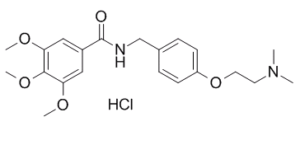
Trimethobenzamide HCl (Ro 2-9578)

别名: Ro-2-9578; Ro-2 9578; Ro 2 9578; Tebamide; Ticon; Tigan; trimethobenzamide; trimethobenzamide monohydrochloride 盐酸曲美苄胺; 盐酸三甲氧苯酰胺; 盐酸曲美苄胺 USP标准品; 盐酸三甲氧苯酰胺 标准品; N-[4-[2-(二甲氨基)乙氧基]苄基]-3,4,5-三甲氧基苯甲酰胺盐酸盐
目录号: V2067 纯度: ≥98%
Trimethobenzamide(也称为 Ro 2-9578;商品名 Tebamide、Tigan)是 D2 受体阻滞剂,是一种有效的止吐药,用于预防恶心和呕吐。
Trimethobenzamide HCl (Ro 2-9578) CAS号: 554-92-7
产品类别: Dopamine Receptor
产品仅用于科学研究,不针对患者销售
规格 价格 库存 数量
50mg
100mg
250mg
500mg
1g
2g
Other Sizes

Other Forms of Trimethobenzamide HCl (Ro 2-9578):

  • Trimethobenzamide (Ro 2-9578 free base)
  • Trimethobenzamide-d6 (Ro 2-9578 (free base D6))
点击了解更多
InvivoChem产品被CNS等顶刊论文引用
纯度/质量控制文件

纯度: ≥98%

产品描述
Trimethobenzamide(也称为 Ro 2-9578;商品名 Tebamide、Tigan)是 D2 受体阻滞剂,是一种有效的止吐药,用于预防恶心和呕吐。它通常用于治疗胃肠炎、药物引起的恶心和其他疾病的患者。三甲苯甲酰胺通常被认为是最有效的止吐药,对血清素能、多巴胺能或组胺能系统没有影响,因此引起不良副作用的可能性较低。在美国,需要处方。尽管三甲苯甲酰胺发挥作用的具体机制尚不清楚,但据信它会影响延髓的化学感受器触发区(CTZ)。
生物活性&实验参考方法
靶点
D2 receptor
Dopamine D2 receptor (Ki = 32 nM, determined by radioligand binding assay) [1]
体外研究 (In Vitro)
Trimethobenzamide 是一种(非吩噻嗪)苯甲酰胺止吐药,可中枢阻断 D2 受体,从而通过阻断呕吐中枢的催吐冲动来抑制髓质化学感受器触发区 [1]。
作为多巴胺D2受体的选择性竞争性拮抗剂,亲和力高(Ki = 32 nM),对其他多巴胺受体亚型(D1、D3、D4)无明显结合活性[1]
- 以浓度依赖性方式取代[3H]-螺哌隆与重组人多巴胺D2受体的结合,1 μM 三甲氧苯酰胺盐酸盐(Ro 2-9578)抑制特异性结合约90%[1]
- 对血清素(5-HT2)受体和组胺(H1)受体无显著亲和力,两者的Ki均>1000 nM[1]
体内研究 (In Vivo)
Trimethobenzamide 的口服生物利用度为 60% 至 100%。口服给药后约45分钟达到峰值;肌内给药后约30分钟进行肌内(IM)给药[1]。
在雄性Sprague-Dawley大鼠中,腹腔注射三甲氧苯酰胺盐酸盐(Ro 2-9578)(25-100 mg/kg)剂量依赖性抑制阿朴吗啡诱导的呕吐(类呕吐行为);100 mg/kg剂量较溶媒对照组减少约85%的呕吐次数[1]
- 犬口服50 mg/kg 三甲氧苯酰胺盐酸盐(Ro 2-9578),显著延长顺铂诱导呕吐的潜伏期(从约30分钟延长至约120分钟),并减少约70%的总呕吐频率[1]
- 治疗剂量(≤100 mg/kg)下,通过旷场实验和转棒实验评估,未引起大鼠明显镇静或运动功能障碍[1]
酶活实验
多巴胺D2受体放射配体结合实验:将表达重组人多巴胺D2受体的细胞膜制剂与[3H]-螺哌隆及不同浓度的三甲氧苯酰胺盐酸盐(Ro 2-9578)在结合缓冲液中孵育。37°C孵育60分钟后,通过玻璃纤维滤膜快速过滤去除未结合配体。闪烁计数器测量结合部分的放射性强度,竞争结合分析计算Ki值[1]
细胞实验
阿朴吗啡诱导呕吐大鼠模型:200-250 g雄性Sprague-Dawley大鼠随机分为溶媒组和给药组。三甲氧苯酰胺盐酸盐(Ro 2-9578)溶于生理盐水,以25、50或100 mg/kg剂量腹腔注射。30分钟后,皮下注射阿朴吗啡(2 mg/kg)诱导呕吐。观察大鼠2小时,记录呕吐次数和首次呕吐潜伏期[1]
- 顺铂诱导呕吐犬模型:10-15 kg比格犬禁食过夜。三甲氧苯酰胺盐酸盐(Ro 2-9578)悬浮于0.5%羧甲基纤维素中,以50 mg/kg剂量口服给药。1小时后,静脉注射顺铂(5 mg/kg)诱导呕吐。监测犬6小时,记录呕吐频率、持续时间和潜伏期[1]
动物实验
Apomorphine-induced emesis rat model: Male Sprague-Dawley rats (200-250 g) were randomly divided into vehicle and treatment groups. Trimethobenzamide HCl (Ro 2-9578) was dissolved in normal saline and administered intraperitoneally at doses of 25, 50, or 100 mg/kg. Thirty minutes later, apomorphine (2 mg/kg) was injected subcutaneously to induce emesis. Rats were observed for 2 hours, and the number of emetic episodes and latency to first emesis were recorded [1]
- Cisplatin-induced emesis dog model: Beagle dogs (10-15 kg) were fasted overnight. Trimethobenzamide HCl (Ro 2-9578) was suspended in 0.5% carboxymethylcellulose and administered orally at 50 mg/kg. One hour later, cisplatin (5 mg/kg) was injected intravenously to induce emesis. Dogs were monitored for 6 hours, and vomiting frequency, duration, and latency were recorded [1]
药代性质 (ADME/PK)
Absorption, Distribution and Excretion
The relative bioavailability of the capsules is 100% (compared to the solution). Following a single human dose, 30%–50% of the drug is excreted unchanged in the urine within 48–72 hours. After oral administration of 0.5 mg/kg tricresylformamide, the plasma concentration is 0.1–0.2 mg%. (Data from table) In humans, approximately 30%–50% of the dose is excreted unchanged in the urine within 48–72 hours; 20% of the dose is excreted within the first 24 hours. In dogs, the drug is distributed to the liver, kidneys, and lungs… The drug and its N-demethyl and N-oxide derivatives are excreted in the urine and bile. In adults, after oral or rectal administration of 500 mg… the mean peak plasma concentration of the free drug is 1–2 μg/mL. …It is usually cleared from the blood within 2 hours… Measurable concentrations may persist for more than 24 hours (in humans).
Metabolism/Metabolites
Hepatic metabolism.
In canine liver, it is metabolized to N-demethyl and N-oxide derivatives. In adults, an unidentified metabolite has been confirmed following oral or rectal administration of 500 mg.
Biological half-life>
The mean elimination half-life of tricresylformamide is 7 to 9 hours.
The oral bioavailability in humans is approximately 70% after a single oral dose of 300 mg; the peak plasma concentration (Cmax) reaches approximately 1.2 μg/mL 2–3 hours after administration [1]
-The human plasma half-life (t1/2) is approximately 8 hours; the drug is metabolized in the liver via N-demethylation, and approximately 60% of the dose is excreted in the urine as metabolites within 24 hours [1]
-The drug is widely distributed in tissues and has sufficient central nervous system (CNS) permeability (brain/plasma concentration ratio of approximately 0.3) to exert an antiemetic effect [1]
毒性/毒理 (Toxicokinetics/TK)
Hepatotoxicity
Elevated serum transaminase levels during trimetobenzamide treatment are uncommon, and no such elevations have been reported in large clinical trials. A case report of hepatitis and jaundice caused by trimetobenzamide was published in 1967, before hepatitis A, B, and C testing and modern imaging techniques were widely available. The incubation period in this case was approximately 2 weeks, and the injury pattern was mixed. The patient had no immune allergies or autoimmune characteristics and recovered rapidly after discontinuation of the drug. Since that report, only one case has been mentioned that trimetobenzamide may cause hepatotoxicity; this case presented with prolonged hepatocellular damage, cholestatic liver biopsy, but mild jaundice. Therefore, clinically significant liver injury caused by trimetobenzamide is very rare, and symptoms are usually mild and resolve spontaneously. Probability Score: D (Possibly a rare cause of clinically significant liver injury).
Effects during pregnancy and lactation>
◉ Overview of medication use during lactation
Since there is currently no information regarding the continued use of trimetobenzamide during lactation, alternative medications are recommended, especially for breastfeeding newborns or premature infants. Occasional, short-term use of trimetobenzamide to treat nausea and vomiting appears to be acceptable.
◉ Effects on breastfed infants
As of the revision date, no relevant published information was found.
◉ Effects on lactation and breast milk
As of the revision date, no relevant published information was found.
Acute toxicity: LD50 = 1800 mg/kg (oral in rats); LD50 = 800 mg/kg (intraperitoneal in rats) [1]
- Subchronic toxicity: Oral administration of 300 mg/kg daily to dogs for 4 weeks did not cause significant changes in liver and kidney function, hematological parameters, or histological abnormalities of major organs [1]
- Human plasma protein binding rate is approximately 85% [1]
- Mild and transient side effects in humans include drowsiness (reported in approximately 10% of patients) and dry mouth (reported in approximately 5%). No serious adverse events were reported at therapeutic doses [1]
参考文献

[1]. Dopamine receptor antagonists. Ann Palliat Med. 2012 Jul;1(2):137-42.

其他信息
Trimethobenzamide is an amide formed by the condensation of 3,4,5-trihydroxybenzoic acid and 4-[2-(N,N-dimethylamino)ethoxy]benzylamine. It is used to prevent nausea and vomiting in humans and has an antiemetic effect. It is a tertiary amine compound belonging to the benzamide class. Trimethylbenzamide is a novel antiemetic that prevents nausea and vomiting in humans. Its mechanism of action is not yet clear, but it is likely related to the chemoreceptor trigger zone (CTZ). In dogs pretreated with trimethylbenzamide hydrochloride, apomorphine-induced vomiting was suppressed, but there was little protection against vomiting induced by intragastric administration of copper sulfate. Trimethylbenzamide is an antiemetic. Trimetobenzamide's physiological action is achieved by inhibiting vomiting. Trimetobenzamide is an oral antiemetic used to treat nausea and vomiting caused by drugs, gastrointestinal disorders, viral infections, and other illnesses. There is no conclusive evidence that trimetobenzamide is associated with elevated serum enzymes during treatment. Despite its widespread use for nearly 50 years, it has rarely been found to be associated with clinically significant liver damage and jaundice.
See also: Trimetobenzamide hydrochloride (salt form).
Drug Indications
For the treatment of postoperative nausea and vomiting and nausea caused by gastroenteritis.
FDA Label
Mechanism of Action
The mechanism of action of trimetobenzamide, as determined in animal studies, is unclear, but may involve the chemoreceptor trigger zone (CTZ), the area in the medulla oblongata that transmits vomiting impulses; impulses directly stimulating the vomiting center do not appear to be similarly inhibited.
Drug…has been shown to inhibit stimulation of the chemoreceptor trigger zone in animals…/hydrochloride/
Therapeutic Use
Antiemetic
When administered subcutaneously, its antiemetic potency is approximately one-tenth that of chlorpromazine; when administered orally, it is approximately one-quarter that of chlorpromazine. /hydrochloride/
…It has little value in the prevention and treatment of motion sickness. /Hydrochloride/
Studies of trichomoniasis hydrochloride suppositories for the treatment of nausea and vomiting in children. Results showed that the drug was not superior to placebo in treating vomiting caused by gastritis; patients receiving nausea treatment reported symptom relief.
Drug (Veterinary): Antiemetic/Hydrochloride/
Drug Warnings
Central nervous system reactions such as opisthotonus, seizures, coma, and extrapyramidal symptoms may occur in patients with acute fever, illness, encephalitis, gastroenteritis, dehydration, and electrolyte imbalance (especially in children, the elderly, and the debilitated)...but it cannot be determined that all these effects are caused by the drug in all cases. Hydrochloride/
...Caution should be exercised when using trichomoniasis hydrochloride.../For patients with acute febrile illness, encephalitis, gastroenteritis, dehydration, and electrolyte imbalance (especially in children, the elderly, and the debilitated). /Hydrochloride/
Injection is contraindicated in children; suppositories are contraindicated in premature infants or newborns; and patients with known hypersensitivity to this product are contraindicated. Furthermore, suppositories are contraindicated in patients with known hypersensitivity to benzocaine or similar topical medications. Anesthetics. /Hydrochloride/
Caution should be exercised when using all antiemetics, as they may mask symptoms of organic diseases (such as gastrointestinal or central nervous system disorders) or the toxic effects of other drugs. …Personnel requiring vigilance…should use antiemetics with extreme caution. /Antiemetics/
Pharmacodynamics
Tripetrombinamide is a novel antiemetic used to prevent nausea and vomiting in humans. Its mechanism of action is not fully understood, but it is likely related to the chemoreceptor trigger zone (CTZ). In dogs pretreated with trimetrombinamide hydrochloride, apomorphine-induced vomiting was suppressed, while there was little or no protection against vomiting induced by intragastric copper. Sulfates.
Trimetobenzamide hydrochloride (Ro 2-9578) is a first-generation dopamine D2 receptor antagonist primarily used as an antiemetic [1]
- Its antiemetic mechanism involves blocking dopamine D2 receptors in the medullary chemoreceptor trigger zone (CTZ), thereby inhibiting the vomiting reflex [1]
- Clinically, it is indicated for the treatment of nausea and vomiting caused by surgery, chemotherapy, radiotherapy, and gastrointestinal disorders [1]
- Due to its moderate affinity for D2 receptors and limited central nervous system penetration, it carries a lower risk of extrapyramidal symptoms compared to other potent dopamine antagonists such as haloperidol [1]
*注: 文献方法仅供参考, InvivoChem并未独立验证这些方法的准确性
化学信息 & 存储运输条件
分子式
C21H29CLN2O5
分子量
424.9184
精确质量
424.176
元素分析
C, 59.36; H, 6.88; Cl, 8.34; N, 6.59; O, 18.83
CAS号
554-92-7
相关CAS号
Trimethobenzamide; 138-56-7; Trimethobenzamide-d6
PubChem CID
5577
外观&性状
White to off-white solid powder
密度
1.131g/cm3
沸点
506.9ºC at 760mmHg
熔点
187.5-190°
LogP
3.775
tPSA
69.26
氢键供体(HBD)数目
1
氢键受体(HBA)数目
6
可旋转键数目(RBC)
10
重原子数目
28
分子复杂度/Complexity
440
定义原子立体中心数目
0
SMILES
Cl[H].O(C1C([H])=C([H])C(=C([H])C=1[H])C([H])([H])N([H])C(C1C([H])=C(C(=C(C=1[H])OC([H])([H])[H])OC([H])([H])[H])OC([H])([H])[H])=O)C([H])([H])C([H])([H])N(C([H])([H])[H])C([H])([H])[H]
InChi Key
WIIZEEPFHXAUND-UHFFFAOYSA-N
InChi Code
InChI=1S/C21H28N2O5.ClH/c1-23(2)10-11-28-17-8-6-15(7-9-17)14-22-21(24)16-12-18(25-3)20(27-5)19(13-16)26-4;/h6-9,12-13H,10-11,14H2,1-5H3,(H,22,24);1H
化学名
N-[[4-[2-(dimethylamino)ethoxy]phenyl]methyl]-3,4,5-trimethoxybenzamide;hydrochloride
别名
Ro-2-9578; Ro-2 9578; Ro 2 9578; Tebamide; Ticon; Tigan; trimethobenzamide; trimethobenzamide monohydrochloride
HS Tariff Code
2934.99.9001
存储方式

Powder      -20°C    3 years

                     4°C     2 years

In solvent   -80°C    6 months

                  -20°C    1 month

注意: 请将本产品存放在密封且受保护的环境中,避免吸湿/受潮。
运输条件
Room temperature (This product is stable at ambient temperature for a few days during ordinary shipping and time spent in Customs)
溶解度数据
溶解度 (体外实验)
DMSO: ≥ 100 mg/mL (~235.3 mM)
溶解度 (体内实验)
配方 1 中的溶解度: ≥ 2.5 mg/mL (5.88 mM) (饱和度未知) in 10% DMSO + 40% PEG300 + 5% Tween80 + 45% Saline (这些助溶剂从左到右依次添加,逐一添加), 澄清溶液。
例如,若需制备1 mL的工作液,可将100 μL 25.0 mg/mL澄清DMSO储备液加入到400 μL PEG300中,混匀;然后向上述溶液中加入50 μL Tween-80,混匀;加入450 μL生理盐水定容至1 mL。
*生理盐水的制备:将 0.9 g 氯化钠溶解在 100 mL ddH₂O中,得到澄清溶液。

配方 2 中的溶解度: ≥ 2.5 mg/mL (5.88 mM) (饱和度未知) in 10% DMSO + 90% (20% SBE-β-CD in Saline) (这些助溶剂从左到右依次添加,逐一添加), 澄清溶液。
例如,若需制备1 mL的工作液,可将 100 μL 25.0 mg/mL澄清DMSO储备液加入900 μL 20% SBE-β-CD生理盐水溶液中,混匀。
*20% SBE-β-CD 生理盐水溶液的制备(4°C,1 周):将 2 g SBE-β-CD 溶解于 10 mL 生理盐水中,得到澄清溶液。

View More

配方 3 中的溶解度: ≥ 2.5 mg/mL (5.88 mM) (饱和度未知) in 10% DMSO + 90% Corn Oil (这些助溶剂从左到右依次添加,逐一添加), 澄清溶液。
例如,若需制备1 mL的工作液,可将 100 μL 25.0 mg/mL 澄清 DMSO 储备液加入到 900 μL 玉米油中并混合均匀。


请根据您的实验动物和给药方式选择适当的溶解配方/方案:
1、请先配制澄清的储备液(如:用DMSO配置50 或 100 mg/mL母液(储备液));
2、取适量母液,按从左到右的顺序依次添加助溶剂,澄清后再加入下一助溶剂。以 下列配方为例说明 (注意此配方只用于说明,并不一定代表此产品 的实际溶解配方):
10% DMSO → 40% PEG300 → 5% Tween-80 → 45% ddH2O (或 saline);
假设最终工作液的体积为 1 mL, 浓度为5 mg/mL: 取 100 μL 50 mg/mL 的澄清 DMSO 储备液加到 400 μL PEG300 中,混合均匀/澄清;向上述体系中加入50 μL Tween-80,混合均匀/澄清;然后继续加入450 μL ddH2O (或 saline)定容至 1 mL;

3、溶剂前显示的百分比是指该溶剂在最终溶液/工作液中的体积所占比例;
4、 如产品在配制过程中出现沉淀/析出,可通过加热(≤50℃)或超声的方式助溶;
5、为保证最佳实验结果,工作液请现配现用!
6、如不确定怎么将母液配置成体内动物实验的工作液,请查看说明书或联系我们;
7、 以上所有助溶剂都可在 Invivochem.cn网站购买。
制备储备液 1 mg 5 mg 10 mg
1 mM 2.3534 mL 11.7669 mL 23.5338 mL
5 mM 0.4707 mL 2.3534 mL 4.7068 mL
10 mM 0.2353 mL 1.1767 mL 2.3534 mL

1、根据实验需要选择合适的溶剂配制储备液 (母液):对于大多数产品,InvivoChem推荐用DMSO配置母液 (比如:5、10、20mM或者10、20、50 mg/mL浓度),个别水溶性高的产品可直接溶于水。产品在DMSO 、水或其他溶剂中的具体溶解度详见上”溶解度 (体外)”部分;

2、如果您找不到您想要的溶解度信息,或者很难将产品溶解在溶液中,请联系我们;

3、建议使用下列计算器进行相关计算(摩尔浓度计算器、稀释计算器、分子量计算器、重组计算器等);

4、母液配好之后,将其分装到常规用量,并储存在-20°C或-80°C,尽量减少反复冻融循环。

计算器

摩尔浓度计算器可计算特定溶液所需的质量、体积/浓度,具体如下:

  • 计算制备已知体积和浓度的溶液所需的化合物的质量
  • 计算将已知质量的化合物溶解到所需浓度所需的溶液体积
  • 计算特定体积中已知质量的化合物产生的溶液的浓度
使用摩尔浓度计算器计算摩尔浓度的示例如下所示:
假如化合物的分子量为350.26 g/mol,在5mL DMSO中制备10mM储备液所需的化合物的质量是多少?
  • 在分子量(MW)框中输入350.26
  • 在“浓度”框中输入10,然后选择正确的单位(mM)
  • 在“体积”框中输入5,然后选择正确的单位(mL)
  • 单击“计算”按钮
  • 答案17.513 mg出现在“质量”框中。以类似的方式,您可以计算体积和浓度。

稀释计算器可计算如何稀释已知浓度的储备液。例如,可以输入C1、C2和V2来计算V1,具体如下:

制备25毫升25μM溶液需要多少体积的10 mM储备溶液?
使用方程式C1V1=C2V2,其中C1=10mM,C2=25μM,V2=25 ml,V1未知:
  • 在C1框中输入10,然后选择正确的单位(mM)
  • 在C2框中输入25,然后选择正确的单位(μM)
  • 在V2框中输入25,然后选择正确的单位(mL)
  • 单击“计算”按钮
  • 答案62.5μL(0.1 ml)出现在V1框中
g/mol

分子量计算器可计算化合物的分子量 (摩尔质量)和元素组成,具体如下:

注:化学分子式大小写敏感:C12H18N3O4  c12h18n3o4
计算化合物摩尔质量(分子量)的说明:
  • 要计算化合物的分子量 (摩尔质量),请输入化学/分子式,然后单击“计算”按钮。
分子质量、分子量、摩尔质量和摩尔量的定义:
  • 分子质量(或分子量)是一种物质的一个分子的质量,用统一的原子质量单位(u)表示。(1u等于碳-12中一个原子质量的1/12)
  • 摩尔质量(摩尔重量)是一摩尔物质的质量,以g/mol表示。
/

配液计算器可计算将特定质量的产品配成特定浓度所需的溶剂体积 (配液体积)

  • 输入试剂的质量、所需的配液浓度以及正确的单位
  • 单击“计算”按钮
  • 答案显示在体积框中
动物体内实验配方计算器(澄清溶液)
第一步:请输入基本实验信息(考虑到实验过程中的损耗,建议多配一只动物的药量)
第二步:请输入动物体内配方组成(配方适用于不溶/难溶于水的化合物),不同的产品和批次配方组成不同,如对配方有疑问,可先联系我们提供正确的体内实验配方。此外,请注意这只是一个配方计算器,而不是特定产品的确切配方。
+
+
+

计算结果:

工作液浓度 mg/mL;

DMSO母液配制方法 mg 药物溶于 μL DMSO溶液(母液浓度 mg/mL)。如该浓度超过该批次药物DMSO溶解度,请首先与我们联系。

体内配方配制方法μL DMSO母液,加入 μL PEG300,混匀澄清后加入μL Tween 80,混匀澄清后加入 μL ddH2O,混匀澄清。

(1) 请确保溶液澄清之后,再加入下一种溶剂 (助溶剂) 。可利用涡旋、超声或水浴加热等方法助溶;
            (2) 一定要按顺序加入溶剂 (助溶剂) 。

临床试验信息
NCT Number Recruitment interventions Conditions Sponsor/Collaborators Start Date Phases
NCT02262767 Completed Drug: PF-06649751
Drug: Trimethobenzamide Hydrochloride
Healthy Pfizer November 2014 Phase 1
NCT01770145 Completed Drug: APOKYN
Drug: Trimethobenzamide
Akinesia
Motor Symptoms
Hypomobility
MDD US Operations, LLC a
subsidiary of Supernus
Pharmaceuticals
December 2012 Phase 4
NCT02373072 Completed Drug: PF-06649751
Drug: Trimethobenzamide Hydrochloride
Idiopathic Parkinson Disease Pfizer March 2015 Phase 1
相关产品
联系我们