| 规格 | 价格 | 库存 | 数量 |
|---|---|---|---|
| 10 mM * 1 mL in DMSO |
|
||
| 1mg |
|
||
| 5mg |
|
||
| 10mg |
|
||
| 25mg |
|
||
| 50mg |
|
||
| 100mg |
|
||
| 250mg |
|
||
| Other Sizes |
|
| 靶点 |
PKD3 (IC50 = 109.4 nM); PKD2 (IC50 = 133.4 nM); PKD1 (IC50 = 154.6 nM); v-Fyn (IC50 = 0.6 μM); c-Abl (IC50 = 0.6 μM)
Protein Kinase D (PKD) isoforms (PKD1, PKD2, PKD3) (IC₅₀≈100 nM for each isoform) [2] Engineered gatekeeper mutant PKD1(M659G) (12-fold higher sensitivity to 1-Naphthyl PP1 (1-NA-PP1) compared to wild-type PKD1) [2] Analog-sensitive Protein Kinase C epsilon (AS-PKCε) (no definite IC₅₀, Ki, or EC₅₀ data provided; does not inhibit wild-type PKCε) [3] |
|---|---|
| 体外研究 (In Vitro) |
1-NA-PP1和IKK-16是新型泛pkd抑制剂。[1]
1-NA-PP1是一种atp竞争性抑制剂,对密切相关的激酶具有高选择性。[1] 1-NA-PP1在前列腺癌细胞中具有细胞活性并引起靶抑制。[1] 1-NA-PP1通过诱导G2/M阻滞有效阻断前列腺癌细胞增殖。[1] 1- na - pp1诱导的生长停滞是通过靶向抑制PKD介导的。[1] 1-NA-PP1能有效抑制前列腺肿瘤细胞的迁移和侵袭。[1] 在完整细胞中,PKD1的守门人突变体对1-NA-PP1抑制的敏感性提高了12倍。[1] 1. 重组PKD亚型抑制作用:在体外放射学激酶实验中,1-萘基PP1(1-NA-PP1)以浓度依赖性方式抑制重组人PKD1、PKD2和PKD3的活性。所有三种亚型的IC₅₀均约为100 nM,计算方式为至少3次独立实验的均值±标准误,每个抑制剂浓度设3次重复测定[2] 2. ATP竞争性抑制:1-萘基PP1(1-NA-PP1)是PKD1的ATP竞争性抑制剂。通过在递增ATP浓度下测定PKD1活性,并绘制不同1-萘基PP1(1-NA-PP1)浓度对应的双倒数图(Lineweaver-Burke图),观察到竞争性抑制特征性的平行线,证实其作用机制[2] 3. 激酶选择性:1-萘基PP1(1-NA-PP1)对PKD具有高选择性,不抑制相关激酶(包括PKCα、PKCδ(测试浓度10 nM、100 nM、1 μM、10 μM)和CAMKIIα),而阳性对照PKC抑制剂GF109203X可有效抑制PKCα和PKCδ[2] 4. LNCaP细胞中PKD1激活抑制:不同剂量1-萘基PP1(1-NA-PP1)预处理LNCaP细胞45分钟,可阻断10 nM PMA(刺激20分钟)诱导的内源性PKD1在S⁹¹⁶和S⁷⁴⁴/⁷⁴⁸位点的磷酸化(Western blot检测)。对Western blot条带进行光密度定量分析,可计算抑制PKD1激活的IC₅₀[2] 5. PC3细胞抗增殖作用:10 μM 1-萘基PP1(1-NA-PP1)可强效阻断PC3前列腺癌细胞增殖。将PC3细胞以3复孔接种于24孔板,过夜贴壁后第1天计数(基线),加入1-萘基PP1(1-NA-PP1)或溶媒(DMSO),每2天更换培养基和抑制剂,连续5天每日计数,结果显示抑制剂组细胞数量显著低于溶媒组[2] 6. 细胞活力抑制:1-萘基PP1(1-NA-PP1)可诱导PC3细胞死亡。96孔板中接种PC3细胞(3000个细胞/孔),过夜贴壁后加入0.3–100 μM 1-萘基PP1(1-NA-PP1)(溶媒为对照),孵育72小时。加入MTT溶液(5 mg/mL)孵育4小时,弃上清后加DMSO溶解甲臜结晶,在570 nm处测定吸光度。计算相对细胞活力,IC₅₀为2次独立实验的均值[2] 7. G2/M期细胞周期阻滞:10 μM 1-萘基PP1(1-NA-PP1)处理PC3细胞48小时可导致G2/M期阻滞。收集细胞用PBS洗涤,70%乙醇-20°C固定过夜,离心弃乙醇后,用含碘化丙啶(50 μg/mL)和RNase A(100 μg/mL)的PBS重悬,37°C孵育30分钟。流式细胞术分析细胞周期分布,显示G2/M期细胞比例显著高于DMSO对照组(p<0.001)[2] 8. 细胞迁移抑制:30 μM 1-萘基PP1(1-NA-PP1)可阻断PC3细胞迁移。PC3细胞在6孔板中培养至100%汇合,用无菌枪头制造均匀划痕,PBS洗涤去除脱落细胞后立即成像(0小时)。加入含30 μM 1-萘基PP1(1-NA-PP1)或DMSO的培养基,孵育22小时后再次成像。图像分析软件测量划痕面积,计算伤口愈合百分比为(1 -(22小时划痕面积/0小时划痕面积))×100[2] 9. 细胞侵袭抑制:30 μM 1-萘基PP1(1-NA-PP1)可抑制DU145前列腺癌细胞侵袭。Transwell小室用Matrigel包被,37°C孵育1小时成胶,上室接种DU145细胞(5×10⁴个细胞/小室)和含抑制剂或DMSO的培养基,下室加完全培养基。孵育20小时后,棉签去除上室非侵袭细胞,下室侵袭细胞用100%甲醇固定10分钟、0.4%苏木精染色15分钟,随机选取6个视野计数,计算相对于DMSO对照组的侵袭百分比[2] 10. PKD过表达拯救实验:60 mm培养皿接种PC3细胞(5×10⁵个细胞),过夜孵育后用含PKD1(Adv-PKD1)、PKD3(Adv-PKD3)或空载体(Adv-null)的腺病毒以50–100 MOI感染。24小时后消化细胞,96孔板接种3000个细胞/孔(活力实验)或Transwell小室接种5×10⁴个细胞/小室(侵袭实验),用10/30 μM 1-萘基PP1(1-NA-PP1)或DMSO处理72小时(活力)或20小时(侵袭),按前述方法进行MTT或Matrigel侵袭实验。抗PKD1/PKD3抗体Western blot验证PKD过表达[2] 11. HEK293细胞突变PKD1磷酸化检测:用转染试剂将Flag标记的野生型PKD1、PKD1(M659G)或PKD1(M659A)质粒转染HEK293细胞。转染2天后血清饥饿24小时,无血清培养基中用递增浓度1-萘基PP1(1-NA-PP1)预处理45分钟,再用10 nM PMA刺激20分钟。裂解细胞提取蛋白,Western blot检测p-S⁹¹⁶-PKD1、Flag(检测PKD1)和微管蛋白(内参)[2] |
| 体内研究 (In Vivo) |
系统给药1-NA-PP1容易穿过血脑屏障,抑制pkcε介导的磷酸化。1-NA-PP1可逆地降低了AS-PKCε小鼠的乙醇消耗量,但对缺乏AS-PKCε突变的野生型小鼠没有作用。这些结果支持了PKCε催化活性抑制剂作为减少乙醇消耗的策略的开发,并且它们表明as - PKCε小鼠是研究PKCε在行为中的作用的有用工具。[3]
我们培育了一种新的AS-PKCε小鼠系,其ATP结合位点发生点突变,使其对纳米摩尔浓度的PP1类似物1-NA-PP1的抑制高度敏感。系统给药的1-NA-PP1穿过血脑屏障,在脑内达到足够高的浓度来抑制AS-PKCε。1-NA-PP1延长了乙醇的共济失调和催眠作用,减少了AS-PKCε小鼠的乙醇消耗。在缺乏AS-PKCε突变的野生型小鼠中未观察到1-NA-PP1的这些作用。这些结果表明,抑制PKCε催化活性的化合物可能有助于减少乙醇的消耗。 [3] 1-NA-PP1降低AS-PKCε小鼠的乙醇消耗[3] 为了确定1-NA-PP1是否会改变乙醇的消耗,我们对AS-PKCε小鼠进行了连续的两瓶选择饮用程序,其中乙醇浓度从3%上升到6%,最后在8天内上升到10%。小鼠习惯了载体注射并连续三次饮用10%乙醇达到稳定水平后[F(2,34) = 1.474, P = 0.2433;图4A],它们使用受试者内设计给药1-NA-PP1,其中所有动物在不同日期接受载体或1-NA-PP1。1-NA-PP1浓度为20或30mg/kg时,前24 h乙醇消耗量降低[F(2,34) = 10.69;P = 0.0003;图4 b)。这种效应是可逆的,因为乙醇消耗量在用载体或1-NA-PP1处理48小时后相似[F(2,34) = 3.058;P = 0.0601;图4 c)。1-NA-PP1未显著改变乙醇偏好[F(2,34) = 0.9508;P = 0.3965;图4 d)。虽然在30mg/kg时有减少水消耗的趋势,但这种影响在统计学上并不显著[F(2,34) = 1.722;P = 0.1940;图4 e]。 [3] 1-NA-PP1延长AS-PKCε小鼠乙醇中毒[3] 我们之前发现Prkce - / -小鼠由于对乙醇的急性功能耐受性受损而表现出长期的乙醇中毒迹象(Hodge等人,1999年,Wallace等人,2007年)。因此,为了确定抑制PKCε是否会改变乙醇中毒,并测试口服1-NA-PP1是否有效产生表型,我们给AS-PKCε小鼠喂食1-NA-PP1或对照食物和水11天。平均而言,1-NA-PP1组小鼠每天消耗3.00±0.14g 1-NA-PP1食物颗粒,低于对照组(3.65±0.16g/d;P = 0.02)。1-NA-PP1组小鼠的饮水量(2.00±0.01ml)也少于对照组(3.5±0.25ml);P < 0.0001)。然而,尽管在食物和水的摄取量上存在差异,但1- na - pp1喂养的动物(25.5±0.18g)和对照喂养的动物(25.8±0.23g)的体重相似。 1. 血脑屏障穿透:对AS-PKCε敲入小鼠腹腔注射1-萘基PP1(1-NA-PP1)(30 mg/kg)后,血浆和脑组织中均检测到该抑制剂,证实其可穿透血脑屏障[3] 2. 抑制PKCε介导的磷酸化:对AS-PKCε小鼠腹腔注射1-萘基PP1(1-NA-PP1)(25 mg/kg),可显著降低GABA_A γ2受体亚基在S327位点的磷酸化(Western blot检测)。均值±标准误结果显示,与溶媒组相比差异有统计学意义(每组n=5,p=0.0175)[3] 3. 减少乙醇消耗:1-萘基PP1(1-NA-PP1)(30 mg/kg,腹腔注射)可可逆性减少AS-PKCε小鼠的乙醇消耗。小鼠经溶媒注射习惯化后达到稳定饮酒基线,给药后乙醇消耗显著降低,给药48小时后抑制作用消失(每组n=18,p<0.05)[3] 4. 不影响乙醇偏好和饮水量:30 mg/kg 1-萘基PP1(1-NA-PP1)不改变AS-PKCε小鼠对乙醇的偏好(乙醇摄入/(乙醇摄入+水摄入)×100)和总饮水量(每组n=18)[3] 5. 调节味觉偏好:30 mg/kg 1-萘基PP1(1-NA-PP1)可降低AS-PKCε小鼠的糖精摄入量,但不影响奎宁摄入量(每组n=14,p<0.05)[3] 6. 不影响乙醇清除:30 mg/kg 1-萘基PP1(1-NA-PP1)不改变AS-PKCε小鼠的乙醇清除。腹腔注射1.5 g/kg乙醇后,不同时间点采集尾静脉血,酶法检测血乙醇浓度,结果显示与溶媒组无显著差异(每组n=7)[3] 7. 延长乙醇诱导的共济失调:30 mg/kg 1-萘基PP1(1-NA-PP1)(腹腔注射)可延长AS-PKCε小鼠乙醇(1.5 g/kg)诱导的共济失调恢复时间。小鼠在5 rpm旋转棒上的坠落时间(最长300秒)显著延长,恢复时间(可在棒上停留300秒)显著增加(溶媒组n=11,抑制剂组n=13,p=0.0014)[3] 8. 延长乙醇诱导的翻正反射丧失(LORR):30 mg/kg 1-萘基PP1(1-NA-PP1)(腹腔注射)可增加AS-PKCε小鼠乙醇(3.6 g/kg)诱导的LORR持续时间。LORR定义为小鼠失去自主翻正能力至恢复翻正能力(30秒内3次成功翻正)的时间,抑制剂组显著长于溶媒组(溶媒组n=25,抑制剂组n=26,p=0.0014)[3] 9. 对野生型小鼠无显著作用:20/30 mg/kg 1-萘基PP1(1-NA-PP1)(腹腔注射)不显著改变野生型C57BL/6NTac小鼠的乙醇消耗;仅在C57BL/6J小鼠中,20 mg/kg剂量轻微增加乙醇消耗,30 mg/kg剂量无影响(每组n=7–10)[3] 10. 不影响野生型小鼠的乙醇诱导行为:30 mg/kg 1-萘基PP1(1-NA-PP1)不改变野生型小鼠乙醇诱导的共济失调恢复时间或LORR持续时间(每组n=8)[3] |
| 酶活实验 |
体外放射学PKD1筛选试验[1]
采用体外放射激酶法筛选80个化合物库,在1µM浓度下检测PKD1抑制活性。用1.2µM的HDAC5肽作为底物进行反应。在含有50µL含有50 mM Tris-HCl、pH 7.5、4 mM MgCl2和10 mM β-巯基乙醇的激酶缓冲液中,用1µCi [γ-32P] ATP、25µM ATP、50 ng纯化的重组PKD1进行激酶反应,检测HDAC5的磷酸化。反应在30℃下孵育10分钟,取25µL的反应液滴在Whatman P81滤纸上。滤纸在0.5%磷酸中洗涤3次,风干后用Beckman LS6500多功能闪烁计数器计数。使用GraphPad Prism软件5.0绘制PKD1抑制百分比图。 体外放射PKC和CAMKIIα激酶测定[1] PKC激酶检测是通过将1µCi [γ-32P]ATP、20µM ATP、50 ng纯化PKCα或PKCδ和5µg髓鞘碱性蛋白4 - 14、0.25 mg/mL牛血清白蛋白、0.1 mg/mL磷脂酰胆碱/磷脂酰丝氨酸(80/20%)(1µM)、1µM二丁酸磷在50µL含有50 mM Tris-HCl、pH 7.5、4 mM MgCl2和10 mM β-巯基乙醇的激酶缓冲液中共孵育进行的。CAMK实验中,50 ng CAMKIIα和2µg syntide-2底物在50µL激酶缓冲液中与0.1 mM MgCl2、1µCi [γ-32P] ATP、70µM ATP孵育。0.5 mM CaCl2和30 ng/µL钙调素在冰上预孵育15 min后加入激酶反应。反应在30℃下孵育10 min,取25µL的反应液滴在Whatman P81滤纸上。滤纸在0.5%磷酸中洗涤3次,风干后用Beckman LS6500多功能闪烁计数器计数。 体外激酶测定[2] 我们在低ATP浓度(10 nM)的0.2µCiµl-1 [γ-32P]ATP存在下进行了体外激酶实验(Cdc28除外),因此IC50值代表了抑制常数(Ki)的粗略测量。抑制剂IC50值的测定方法如上所述。 纯化的Cdc28-His6 (1 nM)和MBP-Clb2 (3 nM)在25µl反应混合物中23°C孵育10分钟,反应混合物中含有5µg组蛋白H1, 1µCi的[γ-32P]ATP(1µCi / 10µM和1µCi / 1 mM),以及不同浓度的化合物9激酶缓冲液(25 mM hepe - naoh pH 7.4, 10 mM NaCl, 10 mM MgCl2和1 mM二硫代索糖醇)。反应产物用15% SDS-PAGE进行分析,然后进行放射自显影。为了测定Cdc28的动力学常数,不同浓度的[γ-32P]ATP(1µCi / 100µM)孵育和分析如上所述。 1. PKD亚型放射学激酶实验:制备重组人PKD1、PKD2或PKD3,构建含重组激酶、适宜底物、ATP(含放射性标记)和10种不同浓度1-萘基PP1(1-NA-PP1)的反应体系。在激酶活性最佳条件下孵育,放射检测器测量底物中放射性磷酸的掺入量以定量激酶活性。以抑制剂浓度为横坐标、活性为纵坐标绘制曲线,计算IC₅₀(至少3次独立实验,每个浓度3次重复,结果以均值±标准误表示)[2] 2. PKD1的ATP竞争性实验:构建含重组PKD1、底物和系列递增浓度ATP的反应体系,每个ATP浓度组加入不同浓度的1-萘基PP1(1-NA-PP1)。孵育完成后放射法检测PKD1活性,绘制双倒数图(1/活性 vs 1/ATP浓度),若图中线条平行,则证实抑制剂与ATP竞争结合激酶的ATP口袋[2] |
| 细胞实验 |
MTT试验[1]
PC3细胞接种于96孔板(3000个细胞/孔),贴壁过夜。然后将细胞在含有0.7-100µM抑制剂的培养基中孵育72 h,以2mg /mL浓度在PBS中制备3-(4,5-二甲基噻唑-2-基)-2,5-二苯基溴化甲基噻唑基四唑(MTT)溶液,通过0.2µM过滤器过滤灭菌,并用铝箔包裹以遮光。每孔加入50µL MTT溶液,37℃孵育4 h。然后去除培养基,每孔加入200µL DMSO。振荡混合5 min,在570 nm处测定光密度。 细胞增殖试验和细胞周期分析[1] 通过台盼蓝染色计数活细胞数(如前所述)来测量PC3细胞的增殖。按照描述进行细胞周期分析。简单地说,用指定的化合物在30µM下处理PC3细胞72 h,然后在70%的冷冻乙醇中固定过夜,然后用碘化丙啶标记。标记的细胞使用FACSCalibur流式细胞仪 进行分析。 创面愈合试验[1] PC3或DU145细胞在6孔板中培养融合。迁移是通过用移液管尖端刮擦单层开始的,形成一个“伤口”。在培养基中加入指定浓度的化合物,并立即在10倍物镜的倒置相差显微镜下对伤口进行成像。24小时后,拍摄最终图像。测量创面间隙,计算创面愈合率。平均伤口愈合百分比是根据至少6次伤口间隙测量来确定的。 基质侵袭试验[1] 将DU145细胞(4.0×10⁴ cells/ml)在含有0.1%胎牛血清(FBS)的RPMI中接种到BioCoat对照植入物(孔径8µm)或BioCoat Matrigel侵袭植入物(带有Matrigel涂层过滤器)的顶室中。为了刺激侵入,植入物下腔的介质中含有20%的FBS。上、下腔均加入浓度为30µM的抑制剂,细胞孵育22 h。孵育后,用棉签去除无创细胞,将有创细胞用100%甲醇固定,并用0.4%苏木精染色。染色后,在200倍放大镜下计数。侵染率由侵染基质的细胞数相对于通过对照插入的细胞数在5个区域内的细胞计数来确定。 1. LNCaP细胞PKD1激活的Western blot检测:LNCaP细胞接种于培养板,过夜贴壁后用不同剂量1-萘基PP1(1-NA-PP1)预处理45分钟,再用10 nM PMA刺激20分钟。适宜裂解液裂解细胞,提取总蛋白并定量。SDS-PAGE电泳后转膜,一抗孵育(抗p-S⁹¹⁶-PKD1、p-S⁷⁴⁴/⁷⁴⁸-PKD1和微管蛋白(内参)),二抗孵育后化学发光显影。光密度定量条带,绘制浓度-响应曲线计算IC₅₀[2] 2. PC3细胞增殖实验:24孔板中以3复孔接种PC3细胞(5×10³个细胞/孔),过夜贴壁。第1天用血细胞计数板计数(基线),加入1-萘基PP1(1-NA-PP1)(10 μM)或DMSO,每2天更换培养基和抑制剂,连续5天每日计数,计算每时间点3复孔均值,绘制细胞数量-时间曲线评估增殖[2] 3. MTT细胞活力实验:96孔板接种PC3细胞(3000个细胞/孔),过夜贴壁后加入0.3–100 μM 1-萘基PP1(1-NA-PP1)(DMSO为对照),孵育72小时。每孔加MTT溶液(5 mg/mL)孵育4小时,弃上清后加DMSO溶解甲臜,酶标仪测570 nm吸光度。计算相对细胞活力,IC₅₀为2次独立实验的均值[2] 4. 流式细胞术细胞周期分析:10 μM 1-萘基PP1(1-NA-PP1)或DMSO处理PC3细胞48小时,收集细胞用PBS洗涤,70%乙醇-20°C固定过夜。离心弃乙醇,用含碘化丙啶(50 μg/mL)和RNase A(100 μg/mL)的PBS重悬,37°C孵育30分钟。流式细胞术分析G1、S、G2/M期细胞比例,非配对t检验分析统计学差异[2] 5. 划痕愈合迁移实验:PC3细胞在6孔板中培养至100%汇合,无菌枪头制造均匀划痕,PBS洗涤后立即成像(0小时)。加入含30 μM 1-萘基PP1(1-NA-PP1)或DMSO的培养基,孵育22小时后再次成像。图像分析软件测量划痕面积,计算伤口愈合百分比[2] 6. Matrigel侵袭实验:Transwell小室用Matrigel包被并37°C孵育1小时成胶,上室接种DU145细胞(5×10⁴个细胞/小室)和含30 μM 1-萘基PP1(1-NA-PP1)或DMSO的培养基,下室加完全培养基。孵育20小时后,棉签去除上室非侵袭细胞,下室细胞用甲醇固定、苏木精染色,6个随机视野计数,计算相对侵袭率[2] 7. PKD过表达拯救实验:60 mm培养皿接种PC3细胞(5×10⁵个细胞),过夜孵育后用含PKD1、PKD3或空载体的腺病毒(50–100 MOI)感染。24小时后消化细胞,96孔板(活力实验)或Transwell小室(侵袭实验)接种,用10/30 μM 1-萘基PP1(1-NA-PP1)处理后进行MTT或侵袭实验,Western blot验证PKD过表达[2] 8. HEK293细胞突变PKD1磷酸化实验:转染HEK293细胞以表达Flag标记的野生型或突变型PKD1,转染2天后血清饥饿24小时,递增浓度1-萘基PP1(1-NA-PP1)预处理后PMA刺激,Western blot检测p-S⁹¹⁶-PKD1、Flag和微管蛋白[2] |
| 动物实验 |
1-NA-PP1 的给药方法 [3]
对于乙醇、糖精和奎宁的摄入研究,我们将 1-NA-PP1 溶解于 100% DMSO 中,浓度为 20 或 30 mg/ml,然后用含 10% Tween-80 的去离子水超声稀释 20 倍。对于口服给药研究,我们通过温和加热和超声处理,将 1-NA-PP1 配制成 100 mM 的 DMSO 储备液。为了提高适口性,我们将该储备液稀释至 500 µM,并加入 1% Cremophor-RH40 和 2 g/L 三氯蔗糖。对照组动物给予等量的 DMSO 溶剂(溶于 Cremophor-三氯蔗糖水溶液)。1-NA-PP1 饲料颗粒(1 g/kg)购自 Research Diets 公司(新泽西州新不伦瑞克)。对照组饲料颗粒中含有等量的溶剂(DMSO)。为了确定 1-NA-PP1 对蛋白质磷酸化的影响,我们将 1-NA-PP1 溶解于含有 5% DMSO 和 20% Cremophor EL 的溶剂中。构建 AS-PKCε 敲入小鼠:设计一个靶向载体,将 M486A 点突变(门控突变)引入小鼠 Prkce 基因的第 11 号外显子,该载体包含一个新霉素抗性 (Neo) 盒(两侧为 loxP 位点)用于阳性筛选,以及一个白喉毒素 A (DTA) 盒用于阴性筛选。将该载体转染至胚胎干细胞,通过同源重组筛选克隆,并使用 Cre 重组酶切除 Neo 盒。构建嵌合体小鼠,进行繁殖以获得种系遗传,并通过尾部 DNA 的 PCR 检测确认基因型。通过蛋白质印迹法(海马)和免疫组织化学法验证 PKCε 的表达水平和脑内分布[3] 2. 1-萘基 PP1 (1-NA-PP1) 的药代动力学测定:腹腔注射 1-萘基 PP1 (1-NA-PP1) (30 mg/kg) 至 AS-PKCε 小鼠。在注射后不同时间点(例如,0.25、0.5、1、2、4、8、12 小时),处死小鼠(每个时间点 n=3),采集血液(制备血浆)和全脑组织。使用合适的溶剂从血浆和脑组织中提取1-萘基PP1 (1-NA-PP1),并通过经验证的分析方法(例如,HPLC-MS/MS)定量其浓度,以生成血浆和脑组织浓度-时间曲线[3] 3. 小鼠GABA_A γ2磷酸化测定:向AS-PKCε小鼠腹腔注射1-萘基PP1 (1-NA-PP1)(25 mg/kg)或载体(DMSO生理盐水)。1小时后,处死小鼠(每组n=5),解剖脑组织(例如,皮层、海马),并制备蛋白提取物。使用针对磷酸化GABA_A γ2 (p-S327)和总GABA_A γ2的抗体进行Western blot分析。通过密度分析法定量分析条带强度,计算 p-S327 与总 GABA_A γ2 的比值,并使用非配对 t 检验比较抑制剂组和载体组之间的差异 [3] 4. 小鼠乙醇消耗量测定:将 AS-PKCε 小鼠单独饲养,自由摄取水和 10% (v/v) 乙醇溶液,持续 2 周,以建立稳定的饮水行为。使小鼠适应腹腔注射载体(每周 3 次),直至乙醇消耗量稳定。腹腔注射 1-萘基 PP1 (1-NA-PP1)(30 mg/kg)或载体,并连续 3 天(包括给药后 48 小时以评估可逆性)每日测量乙醇和水的摄入量。乙醇偏好性计算公式为(乙醇摄入量 /(乙醇摄入量 + 水摄入量))× 100。采用 Dunnett 检验进行统计分析(每组 n=18)[3] 5. 味觉偏好性测定(糖精和奎宁):对于糖精偏好性测定,让 AS-PKCε 小鼠自由饮水和 0.1% 糖精溶液 3 天,以建立基线摄入量。腹腔注射 1-萘基 PP1 (1-NA-PP1)(30 mg/kg)或溶剂,并测量 24 小时内的糖精和水摄入量。对于奎宁偏好性测定,使用 0.04% 奎宁溶液并重复上述步骤。偏好性比率计算公式为(味觉溶液摄入量 /(味觉溶液摄入量 + 水摄入量))× 100(每组 n=14)[3] 6.乙醇清除率测定:向 AS-PKCε 小鼠腹腔注射 1-萘基 PP1 (1-NA-PP1) (30 mg/kg) 或溶剂。30 分钟后,腹腔注射乙醇 (1.5 g/kg)。分别于注射乙醇后 15、30、60、90 和 120 分钟,从尾静脉采集血样。使用酶法测定试剂盒测定血液乙醇浓度。乙醇清除率计算为浓度-时间曲线的斜率(每组 n=7)[3] 7. 乙醇诱导共济失调测定:向 AS-PKCε 或野生型小鼠腹腔注射 1-萘基 PP1 (1-NA-PP1) (30 mg/kg) 或溶剂。30 分钟后,腹腔注射乙醇 (1.5 g/kg)。将小鼠置于旋转杆(5 rpm)上,分别在乙醇注射后 15、30、45、60 和 90 分钟测量其跌落的时间(最长 300 秒)。恢复时间定义为小鼠能够在旋转杆上停留 300 秒的时间 [3] 8. 乙醇诱导的翻正反射丧失 (LORR) 检测:向 AS-PKCε 或野生型小鼠腹腔注射 1-萘基 PP1 (1-NA-PP1)(30 mg/kg)或载体。30 分钟后,腹腔注射乙醇(3.6 g/kg),并将小鼠仰卧。LORR 的发生时间定义为小鼠失去翻正反射能力的时间;持续时间定义为从翻正反射发生到恢复的时间(小鼠可在 30 秒内翻正三次)[3] |
| 药代性质 (ADME/PK) |
为了测定1-NA-PP1在血浆和脑组织中的浓度和半衰期,我们对野生型C57BL/6J小鼠进行了药代动力学研究。小鼠腹腔注射了30 mg/kg的1-NA-PP1(溶于5% DMSO和10% Tween-80溶液中)(图2A)。注射后30分钟,血浆中1-NA-PP1的浓度达到7.3 ± 0.43 µM,并呈双相下降(R² = 0.94),半衰期分别为0.47小时和11.62小时(图2A)。注射后1小时,脑组织中1-NA-PP1的浓度达到2167 ± 85 ng/g(约6.8 ± 0.27 µM),并呈单相下降(R² = 0.93),半衰期为0.57小时(图2B)。这些结果表明,腹腔注射后,1-NA-PP1 能迅速有效地进入大脑,并达到基于体外研究预测的抑制 AS-PKCε 的浓度(Ki = 18.7 nM)(Qi 等,2007)。[3]
重复口服给药后,还测定了血浆和脑组织中 1-NA-PP1 的浓度。野生型 C57BL/6N 小鼠饲喂含有 1 g/kg 1-NA-PP1 的饲料颗粒和含有 500 µM 1-NA-PP1(溶于 1% Cremophor-RH40 和 0.2% 三氯蔗糖)的饮用水。对照组小鼠饲喂含有相应溶剂的饲料和饮用水。3 天后处死小鼠,并用 LC-MS/MS 法测定 1-NA-PP1 的浓度。口服1-NA-PP1后,血浆浓度为117 ± 23 nM (n=5),脑组织浓度为140 ± 54 ng/g蛋白(约441 ± 172 nM;n=5)。这些结果表明,在食物和水中重复给予1-NA-PP1可使脑组织和血浆中的1-NA-PP1浓度达到抑制AS-PKCε的预期水平(Qi等,2007)。[3] 为了确定全身给药1-NA-PP1是否抑制脑组织中AS-PKCε介导的磷酸化,我们检测了GABAA受体γ2亚基的磷酸化情况,因为我们之前发现PKCε可磷酸化该亚基的S327位点(Qi等,2007)。在本实验中,我们采用腹腔注射而非口服的方式给药1-NA-PP1,以便更好地控制剂量与组织采集时间的关系。将AS-PKCε小鼠注射25mg/kg 1-NA-PP1或载体,1小时后处死。尽管本实验使用了不同的载体(5%DMSO/20% Cremophor-EL)溶解1-NA-PP1,但腹腔注射30mg/kg 1-NA-PP1后,该载体的药代动力学分析显示,血浆(6.47 ± 0.25µM;n = 2)和脑组织(2055 ± 455ng/g;~4.43 ± 2.03µM;n = 2)中的1-NA-PP1浓度与溶解于5%DMSO/10% Tween-80中的1-NA-PP1的浓度相似。与注射载体的小鼠相比,1-NA-PP1处理组小鼠纹状体中γ2-S(P)327磷酸化免疫反应性降低了33%(图3)。 [3] 1. 血脑屏障穿透:腹腔注射1-萘基PP1 (1-NA-PP1) (30 mg/kg) 至 AS-PKCε 小鼠体内,结果在血浆和脑组织中均可检测到该药物。血浆浓度在注射后约 1 小时达到峰值(平均约 800 ng/mL),之后呈指数下降,半衰期约为 2 小时。注射后约 1.5 小时脑内药物浓度达到峰值(平均浓度约为 300 ng/mL),并至少在 4 小时内保持在 PKCε 抑制阈值以上,证实了药物能够穿透中枢神经系统 [3] 2. 浓度分布:注射后 0.5 小时,血浆中 1-萘基 PP1 (1-NA-PP1) 的平均浓度约为 600 ng/mL,脑内平均浓度约为 200 ng/mL;注射后 4 小时,血浆浓度约为 100 ng/mL,脑内浓度约为 50 ng/mL。所有时间点的脑/血浆浓度比约为 0.3–0.4,表明药物在脑内分布均匀 [3] |
| 参考文献 |
|
| 其他信息 |
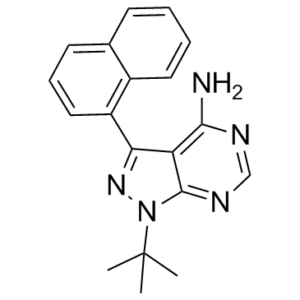
1-NA-PP1 是一种吡唑并嘧啶类化合物,具有酪氨酸激酶抑制剂的作用。
蛋白激酶 D (PKD) 作为多种疾病(包括癌症)的潜在治疗靶点,引发了人们对高效、选择性强且细胞渗透性良好的小分子抑制剂的探索。本研究描述了一种新型 PKD 抑制剂骨架——1-萘基 PP1 (1-NA-PP1) 的鉴定、体外表征、构效关系分析和生物学评价。在小规模靶向激酶抑制剂库筛选中,1-NA-PP1 和 IKK-16 被鉴定为泛 PKD 抑制剂。这两个筛选结果均以约 100 nM 的浓度抑制 PKD 亚型,且均为 ATP 竞争性抑制剂。对几种相关激酶的分析表明,与 IKK-16 相比,1-NA-PP1 对 PKD 具有高度选择性。构效关系分析表明,1-NA-PP1 的活性显著高于其他化合物,且吡唑并嘧啶核心上的取代基效应明显。1-NA-PP1 具有细胞活性,可通过诱导 G2/M 期阻滞有效抑制前列腺癌细胞增殖。此外,它还能有效抑制前列腺癌细胞的迁移和侵袭,展现出多方面的抗癌活性。PKD1 或 PKD3 的过表达几乎完全逆转了 1-NA-PP1 引起的生长阻滞和肿瘤细胞侵袭抑制作用,表明其抗增殖和抗侵袭活性是通过抑制 PKD 介导的。有趣的是,通过在PKD1活性位点引入一个“守门员”突变,可以使PKD1对1-NA-PP1的敏感性提高12倍,这表明1-NA-PP1可以与对类似物敏感的PKD1(M659G)结合使用,用于解析PKD在各种生物系统中的特异性功能和信号通路。[1] 蛋白激酶已被证明对设计高特异性抑制剂具有很强的抵抗力,即使借助组合化学也是如此。缺乏这些试剂使得确定特定激酶的信号传导功能变得复杂。本文描述了一种化学遗传策略,用于使蛋白激酶对不抑制野生型激酶的细胞渗透性分子更加敏感。我们从两个抑制剂骨架中筛选出了对来自五个不同亚家族的敏感化激酶具有高效选择性的抑制剂。酪氨酸激酶和丝氨酸/苏氨酸激酶同样适用于这种方法。我们分析了一种出芽酵母菌株,该菌株携带一种对抑制剂敏感的细胞周期蛋白依赖性激酶Cdc28 (CDK1),以取代野生型蛋白。体内特异性抑制Cdc28会导致有丝分裂前细胞周期阻滞,这与通常在温度敏感型cdc28突变体中观察到的G1期阻滞不同。赋予抑制剂敏感性的突变很容易通过一级序列比对来识别。因此,这种方法可用于系统地构建蛋白激酶的条件性等位基因,从而可以快速表征这一重要基因家族成员的功能。[2] 降低蛋白激酶Cε (PKCε)的表达或抑制其转位会延长小鼠的乙醇中毒时间并降低其乙醇摄入量。然而,我们尚不清楚这种表型是由于 PKCε 激酶活性降低还是由于非激酶依赖性功能受损所致。在本研究中,我们采用化学遗传学策略来确定一种高效且高选择性的 PKCε 催化活性抑制剂是否能降低乙醇摄入量。我们构建了 ATP 类似物特异性 PKCε (AS-PKCε) 敲入小鼠,该小鼠携带 PKCε ATP 结合位点的点突变,使得突变激酶对 1-叔丁基-3-萘-1-基吡唑并[3,4-d]嘧啶-4-胺 (1-NA-PP1) 的抑制作用高度敏感。全身给药的 1-NA-PP1 能够轻易穿过血脑屏障并抑制 PKCε 介导的磷酸化。1-NA-PP1 可逆地降低了 AS-PKCε 小鼠的乙醇摄入量,但对不携带 AS-PKCε 突变的野生型小鼠没有影响。这些结果支持开发 PKCε 催化活性抑制剂作为减少乙醇摄入的策略,并表明 AS-PKCε 小鼠是研究 PKCε 在行为学中作用的有用工具。[3] 1. 1-萘基 PP1 (1-NA-PP1) 属于吡唑并嘧啶化学骨架,最初是作为类似物敏感突变型 Src 激酶的抑制剂开发的;后来通过靶向激酶抑制剂库筛选,它被鉴定为一种有效的泛 PKD 抑制剂。[2] 2. 1-萘基 PP1 (1-NA-PP1) 的构效关系 (SAR) 分析表明,吡唑并嘧啶核心上的萘基对于 PKD 抑制至关重要,该位置的取代会显著影响效力和选择性。[2] 3. PKD1 中的门控突变 (M659G) 扩大了 ATP 结合口袋,从而容纳了 1-萘基 PP1 (1-NA-PP1) 的庞大萘基部分——这种结构修饰是灵敏度提高 12 倍的基础,使得能够特异性地解析 PKD 信号通路 [2] 4. 1-萘基 PP1 (1-NA-PP1) 具有细胞渗透性,这对于其在完整细胞(例如 LNCaP、PC3、HEK293)和体内(穿过血脑屏障)的活性至关重要 [2, 3] 5. 1-萘基PP1 (1-NA-PP1) 的化学名称为1-叔丁基-3-萘-1-基吡唑并[3,4-d]嘧啶-4-胺,其PubChem CID为4877 [3] 6. 1-萘基PP1 (1-NA-PP1) 特异性抑制靶激酶(PKD、AS-PKCε)的催化活性,而不影响其总蛋白表达水平,这已通过对细胞和鼠组织中PKD1、PKD3、PKCε和GABA_A γ2的Western blot分析得到证实[2, 3] |
| 分子式 |
C19H19N5
|
|---|---|
| 分子量 |
317.3877
|
| 精确质量 |
317.164
|
| CAS号 |
221243-82-9
|
| 相关CAS号 |
1-Naphthyl PP1 hydrochloride;956025-47-1
|
| PubChem CID |
4877
|
| 外观&性状 |
Light yellow to khaki solid
|
| 密度 |
1.3±0.1 g/cm3
|
| 沸点 |
527.8±45.0 °C at 760 mmHg
|
| 熔点 |
219-222ºC
|
| 闪点 |
273.0±28.7 °C
|
| 蒸汽压 |
0.0±1.4 mmHg at 25°C
|
| 折射率 |
1.688
|
| LogP |
3.88
|
| tPSA |
69.62
|
| 氢键供体(HBD)数目 |
1
|
| 氢键受体(HBA)数目 |
4
|
| 可旋转键数目(RBC) |
2
|
| 重原子数目 |
24
|
| 分子复杂度/Complexity |
448
|
| 定义原子立体中心数目 |
0
|
| SMILES |
N1(C2C(=C(N([H])[H])N=C([H])N=2)C(C2=C([H])C([H])=C([H])C3=C([H])C([H])=C([H])C([H])=C23)=N1)C(C([H])([H])[H])(C([H])([H])[H])C([H])([H])[H]
|
| InChi Key |
XSHQBIXMLULFEV-UHFFFAOYSA-N
|
| InChi Code |
InChI=1S/C19H19N5/c1-19(2,3)24-18-15(17(20)21-11-22-18)16(23-24)14-10-6-8-12-7-4-5-9-13(12)14/h4-11H,1-3H3,(H2,20,21,22)
|
| 化学名 |
1-tert-butyl-3-naphthalen-1-ylpyrazolo[3,4-d]pyrimidin-4-amine
|
| 别名 |
1-Naphthyl PP1; 221243-82-9; 1-NAPHTHYL PP1; 1-NA-PP1; 1-(tert-Butyl)-3-(naphthalen-1-yl)-1H-pyrazolo[3,4-d]pyrimidin-4-amine; 4-Amino-1-tert-butyl-3-(1'-naphthyl)pyrazolo[3,4-d]pyrimidine; 1-tert-butyl-3-naphthalen-1-ylpyrazolo[3,4-d]pyrimidin-4-amine; 1-(1,1-dimethylethyl)-3-(1-naphthalenyl)-1H-pyrazolo[3,4-d]pyrimidin-4-amine; C19H19N5; 1-NA-PP 1
|
| HS Tariff Code |
2934.99.9001
|
| 存储方式 |
Powder -20°C 3 years 4°C 2 years In solvent -80°C 6 months -20°C 1 month |
| 运输条件 |
Room temperature (This product is stable at ambient temperature for a few days during ordinary shipping and time spent in Customs)
|
| 溶解度 (体外实验) |
DMSO: 9~12.5 mg/mL (28.4~39.4 mM)
|
|---|---|
| 溶解度 (体内实验) |
配方 1 中的溶解度: ≥ 1.25 mg/mL (3.94 mM) (饱和度未知) in 10% DMSO + 40% PEG300 + 5% Tween80 + 45% Saline (这些助溶剂从左到右依次添加,逐一添加), 澄清溶液。
例如,若需制备1 mL的工作液,可将100 μL 12.5 mg/mL澄清的DMSO储备液加入到400 μL PEG300中,混匀;再向上述溶液中加入50 μL Tween-80,混匀;然后加入450 μL生理盐水定容至1 mL。 *生理盐水的制备:将 0.9 g 氯化钠溶解在 100 mL ddH₂O中,得到澄清溶液。 配方 2 中的溶解度: ≥ 1.25 mg/mL (3.94 mM) (饱和度未知) in 10% DMSO + 90% Corn Oil (这些助溶剂从左到右依次添加,逐一添加), 澄清溶液。 例如,若需制备1 mL的工作液,可将 100 μL 12.5 mg/mL 澄清 DMSO 储备液加入到 900 μL 玉米油中并混合均匀。 请根据您的实验动物和给药方式选择适当的溶解配方/方案: 1、请先配制澄清的储备液(如:用DMSO配置50 或 100 mg/mL母液(储备液)); 2、取适量母液,按从左到右的顺序依次添加助溶剂,澄清后再加入下一助溶剂。以 下列配方为例说明 (注意此配方只用于说明,并不一定代表此产品 的实际溶解配方): 10% DMSO → 40% PEG300 → 5% Tween-80 → 45% ddH2O (或 saline); 假设最终工作液的体积为 1 mL, 浓度为5 mg/mL: 取 100 μL 50 mg/mL 的澄清 DMSO 储备液加到 400 μL PEG300 中,混合均匀/澄清;向上述体系中加入50 μL Tween-80,混合均匀/澄清;然后继续加入450 μL ddH2O (或 saline)定容至 1 mL; 3、溶剂前显示的百分比是指该溶剂在最终溶液/工作液中的体积所占比例; 4、 如产品在配制过程中出现沉淀/析出,可通过加热(≤50℃)或超声的方式助溶; 5、为保证最佳实验结果,工作液请现配现用! 6、如不确定怎么将母液配置成体内动物实验的工作液,请查看说明书或联系我们; 7、 以上所有助溶剂都可在 Invivochem.cn网站购买。 |
| 制备储备液 | 1 mg | 5 mg | 10 mg | |
| 1 mM | 3.1507 mL | 15.7535 mL | 31.5070 mL | |
| 5 mM | 0.6301 mL | 3.1507 mL | 6.3014 mL | |
| 10 mM | 0.3151 mL | 1.5753 mL | 3.1507 mL |
1、根据实验需要选择合适的溶剂配制储备液 (母液):对于大多数产品,InvivoChem推荐用DMSO配置母液 (比如:5、10、20mM或者10、20、50 mg/mL浓度),个别水溶性高的产品可直接溶于水。产品在DMSO 、水或其他溶剂中的具体溶解度详见上”溶解度 (体外)”部分;
2、如果您找不到您想要的溶解度信息,或者很难将产品溶解在溶液中,请联系我们;
3、建议使用下列计算器进行相关计算(摩尔浓度计算器、稀释计算器、分子量计算器、重组计算器等);
4、母液配好之后,将其分装到常规用量,并储存在-20°C或-80°C,尽量减少反复冻融循环。
计算结果:
工作液浓度: mg/mL;
DMSO母液配制方法: mg 药物溶于 μL DMSO溶液(母液浓度 mg/mL)。如该浓度超过该批次药物DMSO溶解度,请首先与我们联系。
体内配方配制方法:取 μL DMSO母液,加入 μL PEG300,混匀澄清后加入μL Tween 80,混匀澄清后加入 μL ddH2O,混匀澄清。
(1) 请确保溶液澄清之后,再加入下一种溶剂 (助溶剂) 。可利用涡旋、超声或水浴加热等方法助溶;
(2) 一定要按顺序加入溶剂 (助溶剂) 。
InvivoChem的所有产品仅用于作科学研究,不面向患者销售
Copyright 2020 InvivoChem LLC | All Rights Reserved 粤ICP备20063088号-1


 COA
COA


 粤公网安备 44011102003439号
 463611831
