| 规格 | 价格 | 库存 | 数量 |
|---|---|---|---|
| 50mg |
|
||
| 100mg |
|
||
| 500mg |
|
||
| 1g |
|
||
| Other Sizes |
|

| 靶点 |
Lysyl oxidase (LOX)
|
|---|---|
| 体外研究 (In Vitro) |
β-氨基丙腈 (BAPN)/β-Aminopropionitrile 可增强体外胰岛素抵抗模型中的葡萄糖吸收,并使 GLUT4 和脂联素的表达正常化 [1]。 β-氨基丙腈(500 μM;72 h)可抑制体外宫颈癌细胞的侵袭和迁移,同时抑制缺氧诱导的 EMT 形态和标志蛋白变化[2]。
BAPN/β-氨基丙腈抑制低氧诱导的宫颈癌症细胞侵袭[2] 癌症转移过程的第一步是细胞侵袭。为了研究LOX抑制对宫颈癌细胞行为的影响,我们在体外检测了HeLa和SiHa细胞的侵袭性。在有或没有500μM BAPN(一种LOX抑制剂)的情况下,在常氧或缺氧条件下,将两种细胞系在Matrigel涂层的透孔滤膜上孵育48小时。孵育后,对跨膜(侵袭)细胞进行染色(图2A和B)并计数(图2C和D)。如图所示,与常氧相比,两种细胞系在缺氧条件下表现出强烈的侵袭现象。值得注意的是,在两种细胞模型中,灭活LOX活性的BAPN显著降低了缺氧诱导的细胞侵袭(图2A和B)。侵袭细胞数量的计数进一步说明了形态学结论。如图所示(图2C和D),在500μM BAPN的存在下,缺氧使癌症细胞的侵袭增强到对照的220和250%,在HeLa和SiHa细胞中分别抑制到对照的50%和60%。因此,LOX在宫颈癌细胞侵袭的发展中起着关键作用。 BAPN/β-氨基丙腈消除HeLa和SiHa细胞中的EMT形态改变[2] 为了回答BAPN是否抑制癌症细胞模型中低氧诱导的EMT,我们用相差显微镜检查了BAPN对低氧条件下宫颈癌细胞形态变化的影响。暴露于缺氧48小时的HeLa和SiHa细胞显示出向间充质样外观的形态变化(图5)。缺氧的HeLa和SiHa细胞不再能够形成上皮细胞典型的“鹅卵石”簇,而是获得了更细长的纺锤状形态,这是EMT的关键标志。这些形态学变化与缺氧下宫颈癌细胞的侵袭和迁移有关(33)。这是基于BAPN抑制肿瘤细胞侵袭和迁移的研究结果(图2和图3)在低氧条件下拮抗癌症细胞的形态学变化,并逆转与常氧条件下相似的细胞表型。因此,BAPN阻止了HeLa和SiHa细胞向EMT方向缺氧诱导的形态变化。 BAPN/β-氨基丙腈拮抗缺氧诱导的HeLa和SiHa细胞EMT标志物蛋白的变化[2] 最后,我们检测了BAPN对暴露于缺氧48小时的HeLa和SiHa细胞中E-cadherin、α-SMA、波形蛋白、MMP-2和MMP-9蛋白(EMT标志物)表达的影响。如图所示,BAPN有效地阻止了缺氧诱导的E-cadherian下调(图6A和B),并强烈抑制了缺氧诱导了α-SMA和波形蛋白的上调(图6C和D)。尽管在缺氧或缺氧加BAPN的情况下,HeLa和SiHa细胞中的MMP-2没有显著变化,但两种细胞系中的MMP-9在实验条件(缺氧和BAPN处理)下都发生了显著变化。缺氧使SiHa细胞中MMP-9的表达增加,高达对照组的1.65倍(47.5密度单位),在500μM BAPN的存在下,MMP-9的表达变为对照组的0.88倍(47.5%密度单位)。此外,BAPN还将HeLa细胞中MMP-9的表达降低到对照组的0.41(128密度单位),以应对缺氧。BAPN对EMT标记蛋白影响的密度测量数据如表I所示。这些结果与BAPN对肿瘤细胞侵袭和迁移的影响一致,有力地支持LOX是调节低氧诱导的EMT、宫颈癌症细胞侵袭和转移的重要因素的结论。 BAPN/β-Aminopropionitrile/β-氨基丙腈使GLUT4和脂联素的表达正常化,并改善胰岛素抵抗体外模型中的葡萄糖摄取[1] 为了确定BAPN是否直接影响脂肪细胞功能,我们在分化的3T3-L1脂肪细胞中进行了TNFα诱导的胰岛素抵抗模型的体外实验。如图5所示和之前所述(Stephens等人,1997;Sethi和Hotamisligil,1999),TNFα降低了这些细胞中GLUT4和脂联素的表达,并增加了SOCS3蛋白水平。有趣的是,BAPN阻止了这些影响(图5A-C)。因此,BAPN使分化的3T3-L1脂肪细胞中观察到的TNFα诱导的胰岛素刺激葡萄糖摄取减少正常化(图5D)。 |
| 体内研究 (In Vivo) |
在饮食引起的肥胖大鼠中,β-氨基丙腈 /β-Aminopropionitrile(BAPN)(100 毫克/公斤/天;口服;6 周)可改善代谢状况并减少体重增加[1]。 C57BL/6 小鼠给予 β-氨基丙腈单富马酸盐(1 g/kg/天;口服;4 周)以诱导胸主动脉夹层[3]。
BAPN/β-氨基丙腈改善HFD喂养大鼠的体重增加、肥胖和脂肪组织纤维化[1] 为了研究LOX是否会导致与肥胖相关的脂肪组织功能障碍,对患有HFD的大鼠进行了BAPN治疗,BAPN是一种不可逆的LOX活性特异性抑制剂。如图3A所示,HFD导致体重显著增加,从第三周开始达到显著差异。经过三周的治疗,BAPN显著阻止了HFD大鼠体重的增加,但在喂食标准饮食的动物中则没有(图3A)。这些差异一直持续到研究结束(表1,图3A)。同样,BAPN减少了肥胖动物白色脂肪组织(附睾和腰椎)重量的增加(表1),并减轻了其增强的肥胖(表1。应该指出的是,在喂食HFD的大鼠中,BAPN引发的体重变化与食物摄入量的差异无关(表1)。 β-氨基丙腈/β-Aminopropionitrile引起的HFD喂养大鼠脂肪组织质量的变化促使我们确定LOX抑制是否可以调节脂肪细胞面积。附睾脂肪组织的组织学分析显示,HFD组脂肪细胞面积增加。在接受BAPN治疗的肥胖动物中观察到该参数衰减的趋势(图3B,C)。此外,与喂食HFD的大鼠相比,在BAPN治疗的肥胖动物中检测到向较小脂肪细胞的转变(图3D)。有趣的是,通过Picrosirius红染色分析,LOX抑制阻止了肥胖大鼠细胞周胶原含量的增加(图3E,F)。 BAPN/β-氨基丙腈改善肥胖大鼠体内观察到的代谢变化[1] 接下来,我们研究了抑制LOX活性是否会改变肥胖动物的代谢参数。BAPN治疗改善了HFD组的空腹血糖和胰岛素水平,从而降低了HOMA指数(表1)。LOX抑制也降低了肥胖动物的血浆甘油三酯,但总胆固醇水平没有显著差异(表1)。 BAPN/β-氨基丙腈改善肥胖动物脂肪组织中的胰岛素信号传导[1] 为了了解BAPN如何改善肥胖动物的胰岛素敏感性,我们分析了附睾脂肪组织中参与控制胰岛素敏感性的蛋白质水平。HFD组中观察到的葡萄糖转运蛋白4(GLUT4)和脂联素表达的减少通过抑制LOX活性而恢复正常(图4A,B)。此外,BAPN完全阻止了HFD引发的DPP4和细胞因子信号传导抑制因子3(SOCS3)蛋白水平的增加(图4C,D)。 β-氨基丙腈/β-Aminopropionitrile治疗小鼠的基础特征,有或没有Ang II[3] 据报道,用LOX抑制剂BAPN加Ang II治疗FVB小鼠可诱导TAD 8。我们最近发现,在C57BL/6背景下,相同剂量的BAPN在Ang II给药前导致约56%的小鼠突然死亡,这是由胸主动脉破裂引起的4。因此,我们比较了BAPN对具有两种遗传背景的小鼠的影响。FVB或C57BL/6背景的雄性小鼠(3周龄)在饮用水中以1 每公斤体重g,持续4周。BAPN治疗降低了舒张压(图1a),对收缩压(图1b)没有影响,表明主动脉僵硬度增加。BAPN治疗还减轻了FVB和C57BL/6小鼠的体重增加(图1c,d),并显著降低了血浆甘油三酯和胆固醇水平(图1e,f)。 BAPN/β-氨基丙腈治疗诱发TAD[3] 接下来,我们研究了BAPN治疗对TAD发病率的影响。为了确定血管紧张素II是否也是TAD发展所必需的,在BAPN治疗4周后处死小鼠进行尸检,有或没有24周 h的Ang II输注。与之前的报告8一致,BAPN加Ang II给药在所有小鼠中都诱导了TAD,而单独用BAPN治疗的FVB小鼠中约有75%没有发生TAD(图2a和表1)。然而,仅用BAPN治疗的C57BL/6小鼠的TAD发生率达到87%(图2a和表1),该组45%的小鼠死于主动脉破裂。在所有用BAPN加Ang II治疗的C57BL/6小鼠中也观察到TAD,其中50%在24小时内发生主动脉破裂 h的Ang II输注。给予BAPN(含或不含Ang II输注)的C57BL/6小鼠的主动脉从根部扩大到胸段,在某些情况下,腹部也受到影响。病变中观察到血肿,表明血栓形成(图2a)。 BAPN/β-氨基丙腈诱导TAD的剂量优化[3] 为了进一步研究内侧变性对TAD形成的因果关系,我们通过给3周龄的C57BL/6雄性小鼠喂食含有0、0.4、1.0或1.5的饮食,应用了不同剂量的BAPN g每100个BAPN g小鼠进食4周。体重随着BAPN剂量的增加而降低(图3a)。所有六只喂食0.4的小鼠 g每100个BAPN g在BAPN给药后2至4周,饮食发生TAD,5人死于夹层破裂。在六只喂食1.0的小鼠中 g BAPN饮食,两名患者在治疗结束时出现TAD,但未出现破裂。最令人惊讶的是,在喂食1.5的小鼠中没有观察到TAD的形成 g BAPN饮食(图3b)。 β-氨基丙腈/β-Aminopropionitrile诱导的TAD的分子表型特征[3] 由于BAPN诱导的TAD表现出人类疾病的典型组织学特征,我们接下来检查了主动脉培养基中TAD相关基因的表达是否也发生了变化。选择了一组已知在TAD形成的中间降解过程中失调的基因进行分析。这些是基质金属蛋白酶(MMPs,MMP2/3/9)5,8,11,12和组织蛋白酶(组织蛋白酶S/K/L)13(降解细胞外基质),I型胶原α1(COL1α1)和结缔组织生长因子(CTGF)(指示LDS中TGF-β信号通路激活的靶基因)14,α-平滑肌肌动蛋白(α-SMA)和β-肌球蛋白重链(β-MHC)(与家族性胸主动脉瘤和夹层综合征有关)15。在对照组和BAPN处理的C57BL/6小鼠中比较这些基因的表达。在BAPN治疗组中,与对照组相比,MMP2显著上调(图4a),而MMP3和MMP9下调(图4b,c)。组织蛋白酶S和组织蛋白酶K水平在两组中没有差异(图4d,e),而组织蛋白酶L在BAPN组中显著降低(图4f)。经BAPN处理后,COL1α1和α-SMA的表达均显著降低(图4g,h),而CTGF和β-MHC水平没有变化(图4i,j)。这些结果表明,BAPN诱导的TAD与典型的ECM降解有关,可能是通过MMP2,SMC的损失导致α-SMA降低,这与之前在人类和小鼠模型中的观察结果一致。 |
| 酶活实验 |
葡萄糖摄取测量[1]
完全分化的3T3-L1脂肪细胞被剥夺胰岛素,并在TNFα存在或不存在的情况下用β-氨基丙腈预处理24小时 h.脂肪细胞被血清剥夺3 h在添加有或不添加TNFα和β-Aminopropionitrile/BAPN的2%无脂肪酸牛血清白蛋白(BSA)的DMEM中。然后去除无血清培养基,用1 ml克雷布斯-林格HEPES(KRH)缓冲液pH 7.4加0.2%BSA。葡萄糖摄取从0.9开始 ml含100的KRH缓冲液 mM胰岛素30 min,然后加100 µM 2-脱氧-d-葡萄糖和1 μCi/ml[3H]-2-脱氧-d-葡萄糖/ml。10 min,用50℃的冰冷溶液洗涤细胞 mM d-葡萄糖在PBS中三次。用含有0.5 使用液体闪烁计数器测量细胞裂解物保留的放射性。测量一式三份,并校正非特异性扩散。[3H]-2-脱氧葡萄糖的计数被标准化为蛋白质水平。 LOX活性测定[2] 将无酚红DMEM中的宫颈癌细胞在常氧或缺氧条件下孵育。收集条件培养基,在Amplex Red荧光测定中使用二氨基戊烷作为底物测定LOX活性。反应混合物由1.2 mol/l尿素、0.05 mol/l硼酸钠(pH 8.2)、10 mmol/l二氨基戊烷、10μmol/l Amplex red和1 U/ml辣根过氧化物酶组成,最终体积为1 ml。在存在或不存在0.5 mmol/lβ-氨基丙腈(BAPN)的情况下,将条件培养基(500μl)加入反应混合物中,BAPN是LOX的活性位点抑制剂。样品在37°C下孵育30分钟,置于冰上,然后在563nm的激发波长和587nm的发射波长下记录(31)。所有酶活性均计算为荧光单位高于BAPN对照背景水平的增加,并归一化为总细胞蛋白。 体外侵袭和迁移试验[2] 细胞被血清剥夺24小时,以50000个细胞/孔的密度接种在Matrigel涂层过滤器的顶部,转移到含有600μl 10%FBS作为化学引诱剂的腔室中,并在常氧或缺氧条件下孵育48小时。在缺氧前24小时向培养物中加入β-Aminopropionitrile/β-氨基丙腈(500μM),并在整个实验过程中继续。同时,将相等的细胞铺入96孔板中进行细胞数量测定(MTT)。将细胞(经处理和未经处理)在常氧或缺氧条件下在37°C下孵育48小时,然后用棉签取出Matrigel。将侵入的细胞固定,用苏木精染色并计数。宫颈癌细胞的侵袭性由侵袭评分的百分比(侵袭细胞数/总细胞数100%)决定。实验重复了三次。体外细胞迁移试验基于所述的膜侵袭培养系统,但在使用未涂覆Matrigel的过滤器方面有所不同。 |
| 细胞实验 |
蛋白质印迹分析[1]
细胞类型: 3T3-L1 脂肪细胞 测试浓度: 200 μM,含 1.15 nM 和 2.87 nM TNFα 孵育时间:72 小时 实验结果:TNFα 降低了这些细胞中 GLUT4 和脂联素的表达,并增加了 SOCS3 蛋白水平。这些影响都被阻止了。细胞侵袭测定[2] 细胞类型: HeLa 和 SiHa 细胞 测试浓度: 500 μM 孵育时间: 72 小时 实验结果:两种细胞模型中缺氧引起的细胞侵袭均显着减少。 细胞迁移测定 [2] 细胞类型: HeLa 和 SiHa 细胞 测试浓度: 500 μM 孵育时间: 72 小时 实验结果: HeLa 和 SiHa 细胞中缺氧诱导的迁移分别从 180% 和 240% 减少到 60% 和 70%。 蛋白质印迹分析[2] 细胞类型: HeLa 和 SiHa 细胞 测试浓度: 500 μM 孵育时间:72小时 实验结果:有效阻止缺氧引起的E-cadherin下调,并强烈抑制缺氧引起的α-SMA和vimentin上调。 |
| 动物实验 |
动物/疾病模型: 150 g雄性Wistar大鼠,高脂饮食(HFD)模型[1]
剂量: 100 mg/kg/天 给药途径: 饮用水中添加,持续6周 实验结果: 显著抑制了HFD大鼠的体重增加,但对喂食标准饮食的动物无此作用。降低了肥胖动物白色脂肪组织(包括附睾和腰部脂肪)的重量增加,并减轻了其脂肪堆积。改善了HFD组的空腹血糖和胰岛素水平,从而降低了HOMA指数。改善了肥胖动物脂肪组织中的胰岛素信号传导。 动物/疾病模型: C57BL/6 小鼠[3] 剂量: 1 g/kg/天 给药途径: 饮用水中添加,持续 4 周 实验结果: 24 小时血管紧张素 II (Ang II) 输注可诱导所有小鼠发生胸主动脉夹层 (TAD)。87% 的 C57BL/6 小鼠在未接受 Ang II 输注的情况下也发生了 TAD。 150 g 的雄性 Wistar 大鼠分别喂食高脂饮食 (HFD,33.5% 脂肪) 或标准饮食 (3.5% 脂肪),持续 6 周。每组动物的一半在饮用水中添加不可逆的LOX活性抑制剂β-氨基丙腈/BAPN(100 mg/kg/天),持续相同时间,如前所述(Brasselet等,2005)。根据每日饮水量计算每只动物每日实际摄入的β-氨基丙腈/BAPN量。定期监测动物体重以调整BAPN的目标剂量。在整个实验期间记录食物和水的摄入量。在用氯胺酮(70 mg/kg;腹腔注射)和赛拉辛(Rompun 2%,6 mg/kg)的混合麻醉剂麻醉动物的前一天,动物禁食。收集血清和血浆,并解剖腹部脂肪组织进行进一步分析。脂肪指数计算公式为:脂肪垫总和/[(体重-脂肪垫重量)×100]。 [1] 动物模型和伦理声明[3] 三周龄雄性小鼠饲喂正常饲料,并按照先前描述的方法8,在饮用水中连续4周给予新鲜配制的β-氨基丙腈/BAPN溶液(1 g/kg/d)。采用尾套法测量BAPN给药前后4周的血压。干预持续4周,每周测量体重。如先前报道,在7周龄时,皮下植入以1 μg/kg/min输注Ang II的渗透泵,并在植入后24小时处死小鼠17。所有在实验预期结束时间前死亡的小鼠均立即进行尸检,并在这些小鼠的胸腔内发现血凝块。实验结束时存活的小鼠被注射过量戊巴比妥钠处死,并采集其血液和组织样本进行进一步分析。组织病理学分析[3] 对对照组和β-氨基丙腈(BAPN)处理组小鼠的样本进行了完整的肉眼和组织病理学评估。处死后,从升主动脉到髂动脉采集正常和解剖的主动脉,并像人组织一样,用10%中性缓冲福尔马林固定。将固定、石蜡包埋的组织切成5 μm厚的切片,按照标准程序进行苏木精-伊红染色,并在光学显微镜下进行观察,如前所述4。 |
| 药代性质 (ADME/PK) |
吸收、分布和排泄
口服β-氨基丙腈 (BAPN) 后1小时内即可在尿液中检测到。每日每隔6小时口服250毫克BAPN,持续21天,尿液中BAPN的回收率约为总剂量的16%。停用BAPN 7小时后采集的尿液样本中未检测到BAPN。尿液中氰基乙酸的出现速度比BAPN慢,并逐渐增加至尿液中BAPN的约3倍。停用 BAPN 后,尿液中持续排出 BAPN 衍生的氰乙酸。 将 (14)C-BAPN 游离碱涂抹于大鼠皮肤后,其吸收速度和程度均高于富马酸盐。局部涂抹游离碱六小时后,仅在皮肤上检测到痕量的 (14)C,且皮肤内的剂量不足总剂量的 1%,表明药物吸收迅速。 代谢/代谢物 ……β-氨基丙腈/代谢/生成氰基乙酸…… 口服β-氨基丙腈 (BAPN) 后 1 小时内即可在尿液中检测到。每日每隔 6 小时口服 250 毫克 BAPN,持续 21 天,尿液中 BAPN 的回收率约为总剂量的 16%。在停用 BAPN 7 小时后采集的样本中未检测到 BAPN。尿氰乙酸的出现速度比 BAPN 慢,并逐渐增加至尿 BAPN 的约 3 倍。停用 BAPN 后,尿液中持续排出 BAPN 衍生的氰乙酸。 有机腈在肝脏中经细胞色素 P450 酶的作用转化为氰离子。氰化物被迅速吸收并分布于全身。氰化物主要通过硫氰酸酶或 3-巯基丙酮酸硫转移酶代谢为硫氰酸盐。氰化物代谢物经尿液排出。(L96) |
| 毒性/毒理 (Toxicokinetics/TK) |
毒性概述
有机腈在体内和体外均可分解为氰离子。因此,有机腈的主要毒性机制是产生有毒的氰离子或氰化氢。氰离子是电子传递链第四复合物(位于真核细胞线粒体膜上)中细胞色素c氧化酶的抑制剂。它与该酶中的三价铁原子形成复合物。氰离子与该细胞色素的结合会阻止电子从细胞色素c氧化酶传递到氧气。结果,电子传递链被破坏,细胞无法再进行有氧呼吸产生ATP供能。主要依赖有氧呼吸的组织,例如中枢神经系统和心脏,尤其容易受到影响。氰化物还可通过与过氧化氢酶、谷胱甘肽过氧化物酶、高铁血红蛋白、羟钴胺素、磷酸酶、酪氨酸酶、抗坏血酸氧化酶、黄嘌呤氧化酶、琥珀酸脱氢酶和铜/锌超氧化物歧化酶结合而产生一些毒性作用。氰化物与高铁血红蛋白的铁离子结合形成无活性的氰化高铁血红蛋白。(L97) 相互作用 连续8周使用BAPN(1克/公斤/天)导致大鼠皮肤和主动脉结缔组织同时发生改变。在皮肤中,胶原组织移位并断裂成碎片,弹性组织消失,成纤维细胞空泡化。在BAPN中添加吡啶醇氨基甲酸酯(PDC)可防止弹性组织和成纤维细胞损伤的形成。在停止致敏原治疗后给予PDC,可阻止损伤的形成并加速其消退。 在妊娠第11天通过灌胃给予妊娠仓鼠2500 mg/kg剂量的BAPN,导致其后代69.5%出现骨骼畸形。在妊娠动物注射BAPN后立即给予β-羟乙基芦丁(可保护胶原蛋白免受致畸剂损伤),可显著降低致畸反应。这支持了BAPN诱导骨骼发育不良的机制是抑制胶原纤维成熟过程中的交联这一观点。 非人类毒性值 小鼠腹腔注射LD50:1152 mg/kg |
| 参考文献 |
[1]. The lysyl oxidase inhibitor β-aminopropionitrile reduces body weight gain and improves the metabolic profile in diet-induced obesity in rats. Dis Model Mech. 2015 Jun;8(6):543-51.
[2]. Inactivation of lysyl oxidase by β-aminopropionitrile inhibits hypoxia-induced invasion and migration of cervical cancer cells. Oncol Rep. 2013 Feb;29(2):541-8. [3]. β-Aminopropionitrile monofumarate induces thoracic aortic dissection in C57BL/6 mice. Sci Rep. 2016 Jun 22;6:28149. |
| 其他信息 |
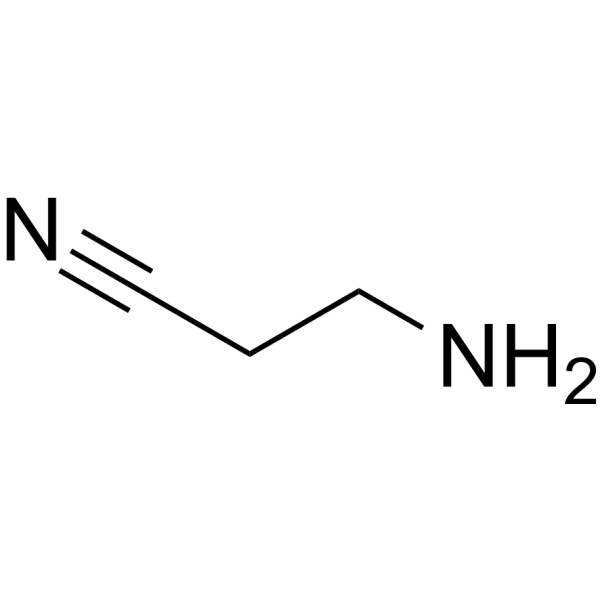
β-氨基丙腈是一种在β位带有氨基的氨基丙腈。它是一种植物代谢产物,也是一种抗肿瘤药物、抗风湿药物和胶原交联抑制剂。它是β-氨基丙腈的共轭碱。
β-氨基丙腈是大肠杆菌(K12菌株、MG1655菌株)中发现或产生的代谢产物。 已有报道称在眼虫(Euglena gracilis)中发现了3-氨基丙腈,并有相关数据。 β-氨基丙腈是一种有毒的氨基酸衍生物。一例罕见的早产儿坎特雷尔综合征病例,伴有肢体发育不全、右肾发育不全、小脑发育不全和局限性皮肤发育不全。母亲病史提示孕前曾职业性接触氨基丙腈。坎特雷尔综合征的特征性表现——前胸腹壁缺损伴异位心、膈肌、胸骨、心包和心脏缺陷——在母体服用β-氨基丙腈后,动物身上也观察到了。某些野豌豆属植物(如野豌豆,与栽培野豌豆相关),尤其是香野豌豆,虽然不能诱发人类的野豌豆中毒,但却含有β-氨基丙腈,这种物质可诱发实验动物的骨骼(骨野豌豆中毒)和血管(血管野豌豆中毒)发生病理改变,且不会损害神经系统。 β-氨基丙腈已被提议用于药物控制人体不必要的瘢痕组织。β-氨基丙腈是一种试剂,用作β-丙氨酸和泛酸生产的中间体。(A11439, A11440, A11441) 用作β-丙氨酸和泛酸生产的中间体。 另见:……查看更多…… 作用机制 其作用机制尚不清楚,但据推测是通过对某些中胚层组织生长的某种作用实现的。其作用并非由其主要代谢产物氰基乙酸引起,游离氨基和氰基似乎都是其活性所必需的。如果氨基位于α位,或者位于丁腈的γ位,则不会产生该物质。 有研究表明,致晕剂的作用机制是通过阻断胶原蛋白中通常存在的某些羰基,从而干扰交联的形成。利沙平或钙盐可以延缓其作用。/致晕剂/ 治疗用途 实验应用:给予赖氨酰氧化酶抑制剂BAPN可预防高血压的发生,并降低已诱导高血压大鼠的血管胶原蛋白含量。组织学检查显示,BAPN 可预防动脉硬化改变。 实验应用:在年轻的高血压大鼠中,BAPN(20 毫克,每日腹腔注射,持续 2 周)可预防高血压的发生。在成年自发性高血压大鼠中(50 mg,腹腔注射,每日一次,持续 2 周),血压下降。 实验应用:皮下植入聚乙烯醇海绵并有皮肤切口伤口的大鼠,接受单次注射 β-氨基丙腈 (BAPN),剂量范围为 1-40 mg/100 g,共 4 个剂量。即使是最低剂量的 BAPN 也能抑制赖氨酰氧化酶活性 6 小时;剂量越大,抑制作用持续时间越长,40 mg BAPN 的抑制作用至少持续 48 小时。抑制的程度和持续时间反映在胶原蛋白的提取率和伤口的破裂强度上。数据表明,如果降低药物代谢(通过单胺氧化酶抑制剂)或使用缓释制剂,则最小剂量的 BAPN 即可达到临床疗效。 实验应用:在仓鼠博来霉素诱导的肺纤维化模型中,测试了 β-氨基丙腈 (BAPN) 预防胶原蛋白过度生成的能力。两组动物接受了1次气管内注射博来霉素;其中一组动物每天两次注射BAPN,持续30天。第三组动物接受了生理盐水和BAPN。博来霉素增加了胶原蛋白含量,减少了肺容量,并导致纤维化,死亡率为51%。对接受博来霉素治疗的动物给予BAPN可防止胶原蛋白过度积累,减少纤维化,并将死亡率降低至24%。单独使用BAPN对肺力学或胶原蛋白含量无影响。 脂肪组织的细胞外基质(ECM)重塑在肥胖的病理生理过程中起着关键作用。赖氨酰氧化酶(LOX)家族的胺氧化酶,包括LOX和LOX样(LOXL)同工酶,控制着ECM的成熟,LOX活性的上调在纤维化中至关重要;然而,其在肥胖脂肪组织功能障碍中的作用尚不清楚。在本研究中,我们观察到LOX是人类脂肪组织中表达的主要同工酶,并且在接受减肥手术的肥胖个体样本中其表达显著上调。在喂食高脂饮食(HFD)的雄性Wistar大鼠的脂肪组织中,LOX的表达也被诱导。有趣的是,使用β-氨基丙腈(BAPN)——一种特异性且不可逆的LOX活性抑制剂——进行治疗,可以减轻肥胖动物体重和脂肪量的增加,并使脂肪细胞体积向更小的方向转变。BAPN还能改善肥胖动物脂肪组织中胶原蛋白含量的增加,并改善多种代谢指标——包括降低葡萄糖和胰岛素水平、降低稳态模型评估(HOMA)指数以及降低血浆甘油三酯水平。此外,在肥胖动物的白色脂肪组织中,BAPN还能阻止高脂饮食(HFD)诱导的脂联素和葡萄糖转运蛋白4(GLUT4)的下调,以及细胞因子信号抑制因子3(SOCS3)和二肽基肽酶4(DPP4)水平的升高。同样,在TNFα诱导的胰岛素抵抗3T3-L1脂肪细胞模型中,BAPN阻止了脂联素和GLUT4的下调以及SOCS3水平的升高,从而使胰岛素刺激的葡萄糖摄取恢复正常。因此,我们的数据表明,LOX在肥胖引起的代谢功能障碍中发挥着病理学上的作用,并强调了针对脂肪组织纤维化和LOX活性的新型药物干预措施在肥胖症临床治疗中的重要性。[1] 肿瘤侵袭和转移是宫颈癌患者死亡的主要原因。缺氧条件下的肿瘤更具侵袭性,转移活性更高。赖氨酰氧化酶(LOX)是一种缺氧反应基因。研究表明,LOX对于乳腺癌缺氧诱导的转移至关重要。然而,LOX对宫颈癌细胞运动的直接影响仍知之甚少。我们的研究表明,宫颈癌细胞在缺氧条件下,LOX蛋白和催化活性水平均上调。缺氧诱导HeLa和SiHa细胞发生间质样形态改变,并伴有间质标志物α-SMA和波形蛋白(vimentin)的上调以及上皮标志物E-钙黏蛋白(E-cadherin)的下调,表明宫颈癌细胞在缺氧条件下发生了上皮-间质转化(EMT)。用LOX活性位点抑制剂β-氨基丙腈(BAPN)处理肿瘤细胞,可阻断缺氧诱导的EMT形态及标志蛋白的改变,并抑制宫颈癌细胞的体外侵袭和迁移能力。综上所述,这些结果表明LOX通过EMT增强缺氧诱导的宫颈癌细胞侵袭和迁移,而BAPN可以抑制这一过程。 [2]胸主动脉夹层 (TAD) 是一种高死亡率和高致残率的灾难性疾病,其特征是弹性蛋白断裂和平滑肌细胞丢失。然而,由于缺乏合适的动物模型,该疾病的潜在病理机制仍不清楚,这限制了有效治疗策略的发现。我们用赖氨酰氧化酶的不可逆抑制剂β-氨基丙腈单富马酸盐 (BAPN) 治疗 C57BL/6 和 FVB 遗传背景的小鼠 4 周,随后输注血管紧张素 II (Ang II) 24 小时。我们发现,BAPN 联合 Ang II 治疗在两种遗传背景的小鼠中均 100% 诱发了主动脉夹层的形成。不含血管紧张素II的BAPN仅导致少数FVB小鼠发生主动脉夹层,却导致87%的C57BL/6小鼠发生TAD,其中37%死于主动脉夹层破裂。此外,较低剂量的BAPN可更早地诱导TAD形成和破裂,且对体重的影响较小。因此,我们已在C57BL/6小鼠中建立了一种可靠且便捷的TAD模型,可用于研究TAD的病理过程并探索其治疗靶点。[3] |
| 分子式 |
C₃H₆N₂
|
|---|---|
| 分子量 |
70.09
|
| 精确质量 |
70.053
|
| CAS号 |
151-18-8
|
| PubChem CID |
1647
|
| 外观&性状 |
Colorless to light yellow Liquid
|
| 密度 |
0.9±0.1 g/cm3
|
| 沸点 |
186.3±13.0 °C at 760 mmHg
|
| 熔点 |
< 25 °C
|
| 闪点 |
66.5±19.8 °C
|
| 蒸汽压 |
0.7±0.4 mmHg at 25°C
|
| 折射率 |
1.430
|
| LogP |
-1.02
|
| tPSA |
49.81
|
| 氢键供体(HBD)数目 |
1
|
| 氢键受体(HBA)数目 |
2
|
| 可旋转键数目(RBC) |
1
|
| 重原子数目 |
5
|
| 分子复杂度/Complexity |
49.2
|
| 定义原子立体中心数目 |
0
|
| SMILES |
C(CN)C#N
|
| InChi Key |
AGSPXMVUFBBBMO-UHFFFAOYSA-N
|
| InChi Code |
InChI=1S/C3H6N2/c4-2-1-3-5/h1-2,4H2
|
| 化学名 |
3-aminopropanenitrile
|
| 别名 |
β-Aminopropionitrile; 3-aminopropionitrile; 3-Aminopropanenitrile; 151-18-8; 2-Cyanoethylamine; Aminopropionitrile; BETA-AMINOPROPIONITRILE; Propanenitrile, 3-amino-; beta-Cyanoethylamine; β Aminopropionitrile
|
| HS Tariff Code |
2934.99.9001
|
| 存储方式 |
Powder -20°C 3 years 4°C 2 years In solvent -80°C 6 months -20°C 1 month 注意: (1). 本产品在运输和储存过程中需避光。 (2). 请将本产品存放在密封且受保护的环境中(例如氮气保护),避免吸湿/受潮。 |
| 运输条件 |
Room temperature (This product is stable at ambient temperature for a few days during ordinary shipping and time spent in Customs)
|
| 溶解度 (体外实验) |
DMSO : ~100 mg/mL (~1426.74 mM)
H2O : ~50 mg/mL (~713.37 mM) |
|---|---|
| 溶解度 (体内实验) |
配方 1 中的溶解度: ≥ 3.25 mg/mL (46.37 mM) (饱和度未知) in 10% DMSO + 40% PEG300 + 5% Tween80 + 45% Saline (这些助溶剂从左到右依次添加,逐一添加), 澄清溶液。
例如,若需制备1 mL的工作液,可将100 μL 32.5 mg/mL澄清DMSO储备液加入到400 μL PEG300中,混匀;然后向上述溶液中加入50 μL Tween-80,混匀;加入450 μL生理盐水定容至1 mL。 *生理盐水的制备:将 0.9 g 氯化钠溶解在 100 mL ddH₂O中,得到澄清溶液。 配方 2 中的溶解度: ≥ 3.25 mg/mL (46.37 mM) (饱和度未知) in 10% DMSO + 90% (20% SBE-β-CD in Saline) (这些助溶剂从左到右依次添加,逐一添加), 澄清溶液。 例如,若需制备1 mL的工作液,可将 100 μL 32.5 mg/mL 澄清 DMSO 储备液加入 900 μL 20% SBE-β-CD 生理盐水溶液中,混匀。 *20% SBE-β-CD 生理盐水溶液的制备(4°C,1 周):将 2 g SBE-β-CD 溶解于 10 mL 生理盐水中,得到澄清溶液。 View More
配方 3 中的溶解度: ≥ 3.25 mg/mL (46.37 mM) (饱和度未知) in 10% DMSO + 90% Corn Oil (这些助溶剂从左到右依次添加,逐一添加), 澄清溶液。 配方 4 中的溶解度: 100 mg/mL (1426.74 mM) in PBS (这些助溶剂从左到右依次添加,逐一添加), 澄清溶液; 超声助溶. 1、请先配制澄清的储备液(如:用DMSO配置50 或 100 mg/mL母液(储备液)); 2、取适量母液,按从左到右的顺序依次添加助溶剂,澄清后再加入下一助溶剂。以 下列配方为例说明 (注意此配方只用于说明,并不一定代表此产品 的实际溶解配方): 10% DMSO → 40% PEG300 → 5% Tween-80 → 45% ddH2O (或 saline); 假设最终工作液的体积为 1 mL, 浓度为5 mg/mL: 取 100 μL 50 mg/mL 的澄清 DMSO 储备液加到 400 μL PEG300 中,混合均匀/澄清;向上述体系中加入50 μL Tween-80,混合均匀/澄清;然后继续加入450 μL ddH2O (或 saline)定容至 1 mL; 3、溶剂前显示的百分比是指该溶剂在最终溶液/工作液中的体积所占比例; 4、 如产品在配制过程中出现沉淀/析出,可通过加热(≤50℃)或超声的方式助溶; 5、为保证最佳实验结果,工作液请现配现用! 6、如不确定怎么将母液配置成体内动物实验的工作液,请查看说明书或联系我们; 7、 以上所有助溶剂都可在 Invivochem.cn网站购买。 |
| 制备储备液 | 1 mg | 5 mg | 10 mg | |
| 1 mM | 14.2674 mL | 71.3369 mL | 142.6737 mL | |
| 5 mM | 2.8535 mL | 14.2674 mL | 28.5347 mL | |
| 10 mM | 1.4267 mL | 7.1337 mL | 14.2674 mL |
1、根据实验需要选择合适的溶剂配制储备液 (母液):对于大多数产品,InvivoChem推荐用DMSO配置母液 (比如:5、10、20mM或者10、20、50 mg/mL浓度),个别水溶性高的产品可直接溶于水。产品在DMSO 、水或其他溶剂中的具体溶解度详见上”溶解度 (体外)”部分;
2、如果您找不到您想要的溶解度信息,或者很难将产品溶解在溶液中,请联系我们;
3、建议使用下列计算器进行相关计算(摩尔浓度计算器、稀释计算器、分子量计算器、重组计算器等);
4、母液配好之后,将其分装到常规用量,并储存在-20°C或-80°C,尽量减少反复冻融循环。
计算结果:
工作液浓度: mg/mL;
DMSO母液配制方法: mg 药物溶于 μL DMSO溶液(母液浓度 mg/mL)。如该浓度超过该批次药物DMSO溶解度,请首先与我们联系。
体内配方配制方法:取 μL DMSO母液,加入 μL PEG300,混匀澄清后加入μL Tween 80,混匀澄清后加入 μL ddH2O,混匀澄清。
(1) 请确保溶液澄清之后,再加入下一种溶剂 (助溶剂) 。可利用涡旋、超声或水浴加热等方法助溶;
(2) 一定要按顺序加入溶剂 (助溶剂) 。
InvivoChem的所有产品仅用于作科学研究,不面向患者销售
Copyright 2020 InvivoChem LLC | All Rights Reserved 粤ICP备20063088号-1


 COA
COA
 粤公网安备 44011102003439号
 463611831
