| 规格 | 价格 | 库存 | 数量 |
|---|---|---|---|
| 5mg |
|
||
| 10mg |
|
||
| 50mg |
|
||
| 100mg |
|
||
| 250mg |
|
||
| Other Sizes |
|
| 靶点 |
Sigma-1 receptor (σ1 receptor) with a Ki of 41-75 nM. Carbetapentane is a high-affinity agonist at the σ1 receptor. The suppression of the central cough reflex is primarily mediated by its high-affinity agonism at the σ1 receptor. The compound also has antimuscarinic, anticonvulsant, and local anesthetic properties.
|
|---|---|
| 体外研究 (In Vitro) |
戊托韦林以竞争性结合方式与豚鼠脑膜上[3H]-喷他佐辛标记的位点结合,其Ki值为75 nM [4]。
卡贝他喷坦通过与脑内的σ1受体结合,抑制咳嗽反射,发挥中枢镇咳作用。该化合物对σ1受体的Ki值为41-75 nM。卡贝他喷坦还具有抗毒蕈碱、抗惊厥和局部麻醉作用。据报道,它能与右美沙芬结合于脑组织中的共同结合位点,并在大鼠中产生抗惊厥作用。 |
| 体内研究 (In Vivo) |
在豚鼠中,戊托韦林(1-5 mg/kg;单次腹腔注射)可减轻柠檬酸引起的咳嗽[4]。
体内,卡贝他喷坦是一种中枢性非阿片类镇咳药,用于缓解干咳症状。该化合物在大鼠中也显示出抗惊厥作用。它具有抗毒蕈碱和局部麻醉特性。卡贝他喷坦通常以柠檬酸盐的形式口服给药。 |
| 酶活实验 |
体外受体结合试验测定卡贝他戊烷与σ1受体的亲和力,采用放射性配体结合技术。将表达σ1受体的组织膜与放射性标记的σ1配体和递增浓度的卡贝他戊烷孵育。通过过滤分离结合的配体和游离的配体,并测量放射性。根据竞争性结合曲线确定Ki值(41-75 nM)。
|
| 细胞实验 |
卡贝他戊烷的细胞活性检测包括用该化合物处理表达σ1受体的细胞,并测量σ1受体介导的信号传导。通过测量下游信号事件,可以评估该化合物对σ1受体的激动活性。这些检测证实了卡贝他戊烷对σ1受体的激动作用。
|
| 动物实验 |
卡贝他喷烷的体内动物研究通常采用啮齿动物模型,以评估其镇咳、抗惊厥或解痉作用。研究表明,卡贝他喷烷对大鼠具有抗惊厥作用。该化合物的镇咳作用可在刺激物诱发咳嗽模型中进行评估。这些研究证实了卡贝他喷烷在多种临床前模型中的疗效。
|
| 药代性质 (ADME/PK) |
吸收、分布和排泄
在人体内,口服给药后1.2小时达到血浆峰浓度。药代动力学数据暂缺。代谢/代谢物:药代动力学数据暂缺。生物半衰期:口服给药后的半衰期为2.3小时。 卡贝他喷坦的药代动力学研究表明,该化合物口服后可被吸收。该化合物在人体内的临床药理学已得到一定程度的研究,但其在临床前动物模型中的药代动力学和代谢的全面概述尚未公开。卡贝他喷坦在肝脏代谢,并通过尿液和粪便排泄。 |
| 毒性/毒理 (Toxicokinetics/TK) |
蛋白质结合
暂无药代动力学数据。 卡贝他喷坦的临床前毒性研究已证实其作为镇咳药的安全性。该化合物在治疗剂量下通常耐受性良好。不良反应可能包括嗜睡、口干和胃肠道不适,这是由于其抗胆碱能特性所致。该化合物具有较宽的治疗指数,在许多国家被认为可安全作为非处方药使用。 |
| 参考文献 |
|
| 其他信息 |
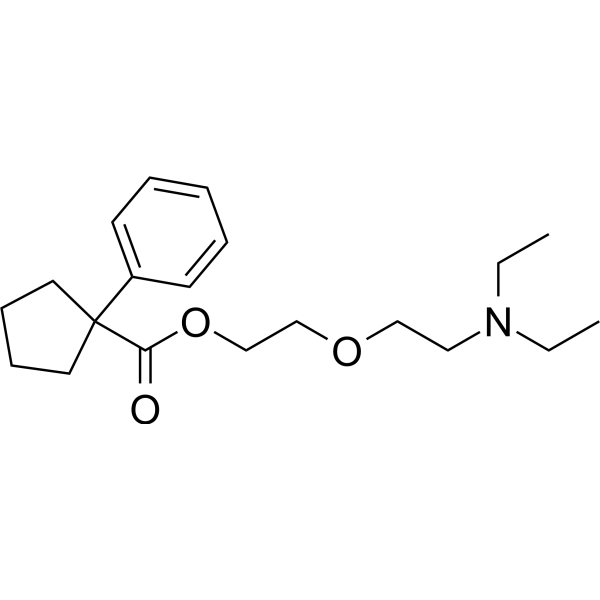
1-苯乙酸2-[2-(二乙氨基)乙氧基]乙酯属于苯类化合物。
哌利酮(又名卡贝他喷)是一种非阿片类中枢镇咳药,具有抗胆碱能、抗惊厥和局部麻醉作用。它常与愈创甘油醚和H1受体拮抗剂联合使用,也是许多非处方止咳药的活性成分。哌利酮作用于σ-1受体以及κ和μ阿片受体。美国食品药品监督管理局(FDA)已撤销所有含哌利酮柠檬酸盐的口服凝胶制剂的批准。其他形式的哌利酮柠檬酸盐仍可在市场上购买。 适应症用于缓解普通感冒、流感、支气管炎和鼻窦炎引起的咳嗽。 作用机制 哌替啶镇咳作用的机制尚未完全阐明,但普遍认为其作用机制是通过中枢神经系统表达的σ-1受体介导的。作为σ受体激动剂,哌替啶的Ki值为75 ± 28 nM,这已通过竞争性结合实验得到证实。σ受体在镇咳活性中的作用尚不明确,但这些受体在脑干孤束核(NTS)中高表达,传入纤维首先在此处形成突触。孤束核位于脑干咳嗽中枢附近,可能作为咳嗽反射的“门户”,使σ-1受体激动剂能够在传入神经到达咳嗽中枢之前调节咳嗽反射。研究表明,高亲脂性的σ-1受体激动剂在全身给药后可能穿透中枢神经系统。当以气雾剂形式给药时,σ-1受体激动剂可能暂时性地发挥外周作用,通过激活肺部表达的σ受体来调节咳嗽。然而,目前关于气雾剂给药后σ受体激动剂的外周定位以及排除全身暴露的证据有限。己酮可可碱的局部麻醉作用可能是通过抑制电压门控钠离子电流实现的。已知许多药物通过其中枢作用来减轻咳嗽,但其确切机制仍未完全阐明。/非阿片类镇咳药/ 治疗用途 镇咳 ……以前用作中枢性镇咳药的药物包括……卡贝他喷雾剂…… 药物警告 以前用作……镇咳药的其他药物包括……卡贝他喷雾剂、卡拉米芬和奥索拉明。总体而言,它们的毒性较低,但目前缺乏足够的对照临床研究来确定它们是否能替代研究更充分的药物。 一般来说,任何中枢性镇咳药与其他中枢性镇咳药联合使用时都应谨慎。/Antussis/ 药效学 戊酮可引起镇咳作用。动物研究表明,腹腔注射戊酮可抑制豚鼠柠檬酸诱发的咳嗽。一些小鼠和大鼠研究表明,戊酮也可能具有抗惊厥活性,但不能预防NMDA受体诱导的死亡。腹腔注射或口服戊酮可观察到戊氧维林对最大电休克诱发的癫痫发作具有剂量依赖性的保护作用。在hERG转染细胞中,戊氧维林以3.0 µM的半数抑制浓度(IC50)抑制hERG离子通道的外向电流。在接受鞘内注射的大鼠中,戊氧维林表现出剂量依赖性的脊髓阻滞作用,其感觉选择性强于运动阻滞。与利多卡因相比,戊氧维林诱导的脊髓阻滞表现出更强的感觉/伤害性选择性,而非运动阻滞。 戊氧维林(卡贝他喷坦)是一种非阿片类中枢镇咳药,用于缓解干咳症状。它作为σ1受体的高亲和力激动剂,Ki值为41-75 nM。该化合物还具有抗毒蕈碱、抗惊厥和局部麻醉作用。卡贝他喷坦在许多国家无需处方即可购买,是一种广泛使用的止咳药。 |
| 分子式 |
C20H31NO3
|
|---|---|
| 分子量 |
333.46504
|
| 精确质量 |
333.23
|
| CAS号 |
77-23-6
|
| 相关CAS号 |
Pentoxyverine citrate;23142-01-0
|
| PubChem CID |
2562
|
| 外观&性状 |
White to off-white solid powder
|
| 密度 |
1.0±0.1 g/cm3
|
| 沸点 |
435.5±30.0 °C at 760 mmHg
|
| 熔点 |
90-95
|
| 闪点 |
217.2±24.6 °C
|
| 蒸汽压 |
0.0±1.0 mmHg at 25°C
|
| 折射率 |
1.517
|
| LogP |
3.29
|
| tPSA |
38.77
|
| 氢键供体(HBD)数目 |
0
|
| 氢键受体(HBA)数目 |
4
|
| 可旋转键数目(RBC) |
11
|
| 重原子数目 |
24
|
| 分子复杂度/Complexity |
356
|
| 定义原子立体中心数目 |
0
|
| InChi Key |
CFJMRBQWBDQYMK-UHFFFAOYSA-N
|
| InChi Code |
InChI=1S/C20H31NO3/c1-3-21(4-2)14-15-23-16-17-24-19(22)20(12-8-9-13-20)18-10-6-5-7-11-18/h5-7,10-11H,3-4,8-9,12-17H2,1-2H3
|
| 化学名 |
2-[2-(diethylamino)ethoxy]ethyl 1-phenylcyclopentane-1-carboxylate
|
| HS Tariff Code |
2934.99.9001
|
| 存储方式 |
Powder -20°C 3 years 4°C 2 years In solvent -80°C 6 months -20°C 1 month |
| 运输条件 |
Room temperature (This product is stable at ambient temperature for a few days during ordinary shipping and time spent in Customs)
|
| 溶解度 (体外实验) |
DMSO : ~250 mg/mL (~749.69 mM)
|
|---|---|
| 溶解度 (体内实验) |
配方 1 中的溶解度: ≥ 2.08 mg/mL (6.24 mM) (饱和度未知) in 10% DMSO + 40% PEG300 + 5% Tween80 + 45% Saline (这些助溶剂从左到右依次添加,逐一添加), 澄清溶液。
例如,若需制备1 mL的工作液,可将100 μL 20.8 mg/mL澄清DMSO储备液加入400 μL PEG300中,混匀;然后向上述溶液中加入50 μL Tween-80,混匀;加入450 μL生理盐水定容至1 mL。 *生理盐水的制备:将 0.9 g 氯化钠溶解在 100 mL ddH₂O中,得到澄清溶液。 配方 2 中的溶解度: ≥ 2.08 mg/mL (6.24 mM) (饱和度未知) in 10% DMSO + 90% (20% SBE-β-CD in Saline) (这些助溶剂从左到右依次添加,逐一添加), 澄清溶液。 例如,若需制备1 mL的工作液,可将 100 μL 20.8 mg/mL澄清DMSO储备液加入900 μL 20% SBE-β-CD生理盐水溶液中,混匀。 *20% SBE-β-CD 生理盐水溶液的制备(4°C,1 周):将 2 g SBE-β-CD 溶解于 10 mL 生理盐水中,得到澄清溶液。 View More
配方 3 中的溶解度: ≥ 2.08 mg/mL (6.24 mM) (饱和度未知) in 10% DMSO + 90% Corn Oil (这些助溶剂从左到右依次添加,逐一添加), 澄清溶液。 1、请先配制澄清的储备液(如:用DMSO配置50 或 100 mg/mL母液(储备液)); 2、取适量母液,按从左到右的顺序依次添加助溶剂,澄清后再加入下一助溶剂。以 下列配方为例说明 (注意此配方只用于说明,并不一定代表此产品 的实际溶解配方): 10% DMSO → 40% PEG300 → 5% Tween-80 → 45% ddH2O (或 saline); 假设最终工作液的体积为 1 mL, 浓度为5 mg/mL: 取 100 μL 50 mg/mL 的澄清 DMSO 储备液加到 400 μL PEG300 中,混合均匀/澄清;向上述体系中加入50 μL Tween-80,混合均匀/澄清;然后继续加入450 μL ddH2O (或 saline)定容至 1 mL; 3、溶剂前显示的百分比是指该溶剂在最终溶液/工作液中的体积所占比例; 4、 如产品在配制过程中出现沉淀/析出,可通过加热(≤50℃)或超声的方式助溶; 5、为保证最佳实验结果,工作液请现配现用! 6、如不确定怎么将母液配置成体内动物实验的工作液,请查看说明书或联系我们; 7、 以上所有助溶剂都可在 Invivochem.cn网站购买。 |
| 制备储备液 | 1 mg | 5 mg | 10 mg | |
| 1 mM | 2.9988 mL | 14.9939 mL | 29.9877 mL | |
| 5 mM | 0.5998 mL | 2.9988 mL | 5.9975 mL | |
| 10 mM | 0.2999 mL | 1.4994 mL | 2.9988 mL |
1、根据实验需要选择合适的溶剂配制储备液 (母液):对于大多数产品,InvivoChem推荐用DMSO配置母液 (比如:5、10、20mM或者10、20、50 mg/mL浓度),个别水溶性高的产品可直接溶于水。产品在DMSO 、水或其他溶剂中的具体溶解度详见上”溶解度 (体外)”部分;
2、如果您找不到您想要的溶解度信息,或者很难将产品溶解在溶液中,请联系我们;
3、建议使用下列计算器进行相关计算(摩尔浓度计算器、稀释计算器、分子量计算器、重组计算器等);
4、母液配好之后,将其分装到常规用量,并储存在-20°C或-80°C,尽量减少反复冻融循环。
计算结果:
工作液浓度: mg/mL;
DMSO母液配制方法: mg 药物溶于 μL DMSO溶液(母液浓度 mg/mL)。如该浓度超过该批次药物DMSO溶解度,请首先与我们联系。
体内配方配制方法:取 μL DMSO母液,加入 μL PEG300,混匀澄清后加入μL Tween 80,混匀澄清后加入 μL ddH2O,混匀澄清。
(1) 请确保溶液澄清之后,再加入下一种溶剂 (助溶剂) 。可利用涡旋、超声或水浴加热等方法助溶;
(2) 一定要按顺序加入溶剂 (助溶剂) 。
InvivoChem的所有产品仅用于作科学研究,不面向患者销售
Copyright 2020 InvivoChem LLC | All Rights Reserved 粤ICP备20063088号-1


 粤公网安备 44011102003439号
 463611831
