| 规格 | 价格 | 库存 | 数量 |
|---|---|---|---|
| 1mg |
|
||
| 5mg |
|
||
| 10mg |
|
||
| 25mg |
|
||
| 50mg |
|
||
| Other Sizes |
|

| 靶点 |
Penicillin-binding proteins (PBPs); bacterial cell wall synthesis.
Ceftobiprole binds to and inactivates penicillin-binding proteins (PBPs) located on the inner membrane of the bacterial cell wall. PBPs are enzymes involved in the terminal stages of assembling the bacterial cell wall and in reshaping the cell wall during growth and division. Ceftobiprole inhibits transpeptidases essential to building cell walls and is a poor substrate for most beta-lactamases. As a fifth-generation cephalosporin, it has enhanced activity against MRSA. |
|---|---|
| 体外研究 (In Vitro) |
头孢吡肟(Ro 63-9141)的MIC90值分别为0.25、2和2 μg/mL,对粪肠球菌、耐甲氧西林金黄色葡萄球菌和肺炎链球菌等主要革兰氏阳性菌有效。该抗生素的最低抑菌浓度(MIC)为2 μg/mL,体外实验也显示其对多种临床分离的耐甲氧西林金黄色葡萄球菌(CA-MRSA)、金黄色葡萄球菌(VISA)和耐万古霉素金黄色葡萄球菌(VRSA)具有强效抗菌活性[1]。头孢吡肟对金黄色葡萄球菌的MIC范围为0.12至4 mg/L(仅有一株耐药菌株的MIC为4 mg/L),表现出较强的抗菌活性。此外,头孢吡肟对甲氧西林敏感金黄色葡萄球菌(MSSA)菌株的MIC50和MIC90均为0.5 mg/L,是其对耐甲氧西林金黄色葡萄球菌(MRSA)菌株(1 mg/L)的两倍。而且,头孢吡肟对Panton-Valentine白细胞毒素(PVL)+ MRSA的MIC50和MIC90分别为0.5 mg/L和1 mg/L,略高于PVL-MRSA(MIC50和MIC90均为1 mg/L)[2]。
头孢吡肟对包括肺炎链球菌(PRSP)、耐甲氧西林金黄色葡萄球菌(MRSA)和粪肠球菌在内的重要革兰氏阳性菌均具有活性。该抗生素对这些微生物的MIC90值分别为0.25、2和2 mcg/mL。该抗生素对主要革兰氏阳性菌有效,也对革兰氏阴性菌有活性。 |
| 体内研究 (In Vivo) |
头孢比罗(Ceftobiprole medocaril)是一种抗菌药物,适用于治疗成人金黄色葡萄球菌血流感染(菌血症)(SAB),包括右侧感染性心内膜炎。此外,它还适用于治疗成人急性细菌性皮肤及皮肤软组织感染(ABSSSI)。它适用于治疗成人和3个月及以上儿童的社区获得性细菌性肺炎(CABP)。在加拿大,它适用于治疗社区获得性肺炎和医院获得性肺炎(不包括呼吸机相关性肺炎)。
在嗜中性粒细胞减少的小鼠大腿感染模型中,治疗效果与游离头孢比罗血浆浓度超过金黄色葡萄球菌最低抑菌浓度(MIC)的时间相关。头孢吡肟对肺炎链球菌和肠杆菌科细菌无效。它对产生TEM、SHV或CTX-M家族超广谱β-内酰胺酶(ESBLs)、丝氨酸碳青霉烯酶(如KPC)、B类金属β-内酰胺酶、高表达的C类(AmpC头孢菌素酶)以及包括碳青霉烯酶在内的Ambler D类β-内酰胺酶无效。头孢吡肟不适用于呼吸机相关性细菌性肺炎(VABP)患者——临床试验显示,与对照组相比,接受头孢吡肟治疗的VABP患者的死亡率显著升高。头孢吡肟用于治疗住院患者的严重细菌感染。它是一种第五代头孢菌素,对耐甲氧西林金黄色葡萄球菌(MRSA)有效。该化合物对耐药菌的增强活性使其成为治疗严重感染的有效选择。它也被称为Zeftera/Zevtera。 |
| 酶活实验 |
头孢吡肟的活性评估采用标准的体外微生物药敏试验方法。最低抑菌浓度 (MIC) 的测定针对多种细菌菌株,包括耐甲氧西林金黄色葡萄球菌 (MRSA) 和耐药金黄色葡萄球菌 (PRSP)。该化合物与青霉素结合蛋白 (PBP) 的结合亲和力可通过放射性标记青霉素的竞争性结合试验进行评估。该化合物对β-内酰胺酶的稳定性可通过标准的β-内酰胺酶抑制试验进行评估。
|
| 细胞实验 |
采用标准微生物学技术和细菌培养方法对头孢吡肟进行细胞活性测定。通过测定其对包括耐甲氧西林金黄色葡萄球菌(MRSA)在内的多种细菌菌株的最低抑菌浓度(MIC)来评价该化合物的抗菌活性。细菌生长抑制情况通过测量光密度或菌落形成单位计数来评估。该化合物对革兰氏阳性菌和革兰氏阴性菌的活性均进行了评价。
|
| 动物实验 |
头孢吡肟的体内动物模型实验包括对严重细菌感染的动物模型进行给药,以评估其疗效。该化合物对耐甲氧西林金黄色葡萄球菌(MRSA)的增强活性使其适用于研究耐药感染。此类研究对于了解该化合物的体内行为和治疗潜力至关重要。
|
| 药代性质 (ADME/PK) |
吸收
由于头孢吡罗美多卡利是静脉给药,其生物利用度为100%。多次给药后,平均Cmax和AUC0-8h分别为33.0 µg/mL和102 µg/mL。 消除途径 活性药物[头孢吡罗]主要以原形经肾脏排泄。约89%的给药剂量以活性头孢吡罗(83%)、开环代谢物(5%)和头孢吡罗(<1%)的形式经尿液排出。由于头孢吡罗主要经肾脏排泄,肾功能不全患者接受头孢吡罗治疗时可能需要降低剂量。 分布容积 活性药物[头孢吡罗]的稳态分布容积为15.5–18.0 L,与人体细胞外液容积相似。 清除率 多次给药后活性药物[头孢吡罗]的平均清除率为4.98 L/h。 蛋白结合率 活性药物[头孢吡罗]与血浆蛋白的结合率极低(16%)。 代谢/代谢物 前药头孢吡罗甲酯转化为活性药物头孢吡罗的过程迅速,由非特异性血浆酯酶介导。头孢吡肟本身代谢为一种微生物无活性的开环代谢物,在肾功能正常的受试者中,该代谢物约占母体药物暴露量的4%。 生物半衰期 多次给药后,活性药物[头孢吡肟]的半衰期约为3.3小时。 头孢吡肟是一种新一代(第五代)头孢菌素类抗生素。现有文献中关于其具体药代动力学数据尚不详尽。作为第五代头孢菌素,预计其具有良好的药代动力学特性。该化合物通过肠外途径给药。 |
| 毒性/毒理 (Toxicokinetics/TK) |
对于患有葡萄球菌菌血症 (SAB) 的成人患者,Zevtera 最常见的副作用包括贫血、恶心、低钾血症、呕吐、腹泻、肝功能指标(肝酶和胆红素)升高、血清肌酐升高、高血压、白细胞减少、发热、腹痛、真菌感染、头痛和呼吸困难。对于患有急性细菌性皮肤及皮肤软组织感染 (ABSSSI) 的成人患者,Zevtera 最常见的副作用包括恶心、腹泻、头痛、注射部位反应、肝酶升高、皮疹、呕吐和味觉障碍。对于患有社区获得性细菌性肺炎 (CABP) 的成人患者,Zevtera 最常见的副作用包括恶心、肝酶升高、呕吐、腹泻、头痛、皮疹、失眠、腹痛、静脉炎、高血压和头晕。对于患有社区获得性细菌性肺炎 (CABP) 的儿科患者,Zevtera 最常见的副作用包括呕吐、头痛、肝酶升高、腹泻、输注部位反应、静脉炎和发热。
如果患者已知对头孢吡肟或 Zevtera 的任何成分,或对其他头孢菌素类抗生素有严重过敏史,则不应使用 Zevtera。 Zevtera 附带多项警告和注意事项,例如:呼吸机相关性细菌性肺炎患者死亡率增加(未经批准的使用)、过敏反应、癫痫发作和其他中枢神经系统反应,以及艰难梭菌相关性腹泻。 https://www.fda.gov/news-events/press-announcements/fda-approves-new-antibiotic-three-different-uses 头孢吡肟作为一种头孢菌素类抗生素,通常耐受性良好。与头孢菌素相关的常见不良反应包括胃肠道紊乱、超敏反应(尤其是在对青霉素过敏的患者中)以及注射部位的局部反应。 |
| 参考文献 |
[1]. Ceftobiprole, a Broad-Spectrum Cephalosporin With Activity against Methicillin-Resistant Staphylococcus aureus (MRSA). P T. 2008 Nov;33(11):631-41.
[2]. In vitro activity of ceftobiprole on 440 Staphylococcus aureus strains isolated from bronchopulmonary infections. Med Mal Infect. 2017 Mar;47(2):152-157. [3]. Efficacy of BAL5788, a prodrug of cephalosporin BAL9141, in a mouse model of acute pneumococcal pneumonia. Antimicrob Agents Chemother. 2004 Apr;48(4):1105-11. |
| 其他信息 |
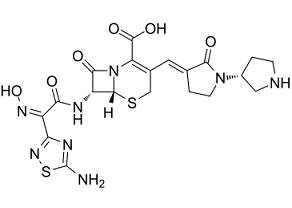
头孢吡肟是一种第五代头孢菌素类抗生素。其分子结构在3位和7位分别含有(E)-[(3'R)-2-氧代[1,3'-联吡咯烷]-3-亚甲基]甲基和[(2Z)-2-(5-氨基-1,2,4-噻二唑-3-基)-2-(羟基亚氨基)乙酰基]氨基侧链。它用于治疗医院获得性肺炎(HAP,不包括呼吸机相关性肺炎,VAP)和社区获得性肺炎(CAP)。它是一种抗菌药物,属于头孢菌素类和噻二唑类。头孢吡肟对耐甲氧西林金黄色葡萄球菌(MRSA)有效。它由巴塞尔制药公司发现,目前由强生公司的研发部门进行开发。头孢吡肟是首个在耐甲氧西林金黄色葡萄球菌(MRSA)感染患者中证实具有临床疗效的头孢菌素类药物。若获得监管机构批准,有望成为治疗复杂性皮肤感染和肺炎的有效药物之一。头孢吡肟是一种广谱第五代吡咯烷酮类头孢菌素,具有抗菌活性。头孢吡肟可与位于细菌细胞壁内膜上的青霉素结合蛋白(PBPs)结合并使其失活。PBPs是参与细菌细胞壁组装最后阶段以及细菌生长和分裂过程中细胞壁重塑的酶。PBPs的失活会干扰肽聚糖链的交联,而肽聚糖链的交联对于维持细菌细胞壁的强度和刚性至关重要。这会导致细菌细胞壁的弱化和细胞裂解。适应症:用于治疗住院患者的严重细菌感染。
作用机制 头孢氨苄类抗生素,例如头孢吡肟,具有杀菌活性,其作用机制与其他β-内酰胺类抗生素(例如青霉素)相同。头孢菌素类抗生素会破坏细菌细胞壁中肽聚糖层的合成。肽聚糖层对于细胞壁的结构完整性至关重要,尤其是在革兰氏阳性菌中。肽聚糖合成的最后转肽步骤由一种称为青霉素结合蛋白 (PBP) 的转肽酶促进。PBP 与肽聚糖前体(细胞壁肽)的 D-Ala-D-Ala 末端结合,导致肽聚糖交联。β-内酰胺类抗生素模拟该位点,通过竞争性抑制 PBP 与肽聚糖的交联来发挥作用。 药效学 头孢吡肟是一种头孢菌素类抗生素,对耐甲氧西林金黄色葡萄球菌(MRSA)有效。 头孢吡肟左旋多巴是一种头孢菌素,可用作前药。 头孢吡肟美多卡利是头孢吡肟的前药,头孢吡肟是一种第五代半合成头孢菌素类抗生素。头孢吡肟是一种广谱抗生素,对革兰氏阳性菌和革兰氏阴性菌均有效,包括耐甲氧西林金黄色葡萄球菌(MRSA)。 2010年2月,欧洲药品管理局人用药品委员会(CHMP)对头孢吡肟钠(头孢吡肟)发布了否定意见,建议欧盟拒绝批准其上市,主要原因是关键临床研究的数据质量存在问题。该药物于2017年10月在加拿大获批用于治疗某些细菌性肺炎患者,随后于2024年4月在美国获批用于治疗皮肤和软组织感染以及菌血症。头孢吡肟钠是头孢吡肟钠的钠盐形式,头孢吡肟钠是头孢吡肟的水溶性前药。头孢吡肟是一种吡咯烷酮类头孢菌素抗生素,具有杀菌活性。头孢吡肟与青霉素结合蛋白(PBP)结合并使其失活,PBP是一种参与细菌生长和分裂过程中细胞壁组装和重塑最后阶段的酶。该药物对革兰氏阴性菌和革兰氏阳性菌均具有广谱抗菌活性,包括耐甲氧西林金黄色葡萄球菌 (MRSA)、万古霉素中介金黄色葡萄球菌 (VISA) 和耐万古霉素金黄色葡萄球菌 (VRSA)。头孢吡肟不易被 A 类和 C 类 β-内酰胺酶水解。一项随机、对照、双盲、多国、多中心试验评估了 Zevtera 治疗金黄色葡萄球菌菌血症 (SAB) 的疗效。在该试验中,研究人员将 390 名受试者随机分为 Zevtera 组(192 名受试者)和达托霉素联合可选氨曲南组(对照组)(198 名受试者)。主要疗效终点为治疗后评估访视时的总体成功率(定义为生存、症状改善、金黄色葡萄球菌菌血症清除、无新的金黄色葡萄球菌菌血症并发症,且未使用其他潜在有效的抗生素),该访视在随机分组接受抗生素治疗后70天进行。接受Zevtera治疗的受试者总体成功率为69.8%,接受对照药物治疗的受试者总体成功率为68.7%。一项随机、对照、双盲、多中心试验评估了Zevtera治疗急性细菌性皮肤及皮肤结构感染(ABSSSI)的疗效。在该试验中,研究人员将679名受试者随机分配至Zevtera组(335名受试者)或万古霉素联合氨曲南组(344名受试者)(对照药物)。主要疗效终点为治疗开始后48-72小时内的早期临床反应。早期临床疗效定义为原发性皮肤病变减少至少20%,存活至少72小时,且无需额外抗生素治疗或计划外手术。在接受Zevtera治疗的受试者中,91.3%在规定时间内达到早期临床疗效,而接受对照药物治疗的受试者中,这一比例为88.1%。一项随机、对照、双盲、多国、多中心试验评估了Zevtera治疗成人社区获得性细菌性肺炎(CABP)的疗效。在该试验中,638例因CABP住院且需接受至少3天静脉抗生素治疗的成年患者被随机分配至Zevtera组(314例)或头孢曲松联合利奈唑胺(对照药物)(324例)。主要疗效终点为治疗结束后7-14天进行的治愈评估访视时的临床治愈率。在接受Zevtera治疗的受试者中,76.4%达到临床治愈,而接受对照药物治疗的受试者中,这一比例为79.3%。另一项分析考虑了更早的临床成功时间点(第3天),Zevtera组的成功率为71%,对照药物组为71.1%。鉴于成人和儿童社区获得性细菌性肺炎(CABP)的病程相似,Zevtera今天获批用于治疗3个月至18岁患有CABP的儿童。此次批准基于Zevtera在成人中进行的CABP试验以及一项纳入138名3个月至18岁肺炎患儿的试验的证据。 https://www.fda.gov/news-events/press-announcements/fda-approves-new-antibiotic-three-different-uses 头孢吡肟(CAS# 209467-52-7)是一种新一代(第五代)头孢菌素类抗生素,对耐甲氧西林金黄色葡萄球菌(MRSA)具有活性。它是一种广谱β-内酰胺类第五代头孢菌素类抗生素。头孢吡肟与青霉素结合蛋白(PBPs)结合并使其失活,从而抑制构建细胞壁所必需的转肽酶。它用于治疗住院患者的严重细菌感染。 |
| 分子式 |
C20H22N8O6S2
|
|---|---|
| 分子量 |
534.56900
|
| 精确质量 |
534.11
|
| 元素分析 |
C, 44.94; H, 4.15; N, 20.96; O, 17.96; S, 12.00
|
| CAS号 |
209467-52-7
|
| 相关CAS号 |
252188-71-9 (medocaril);209467-52-7; 376653-43-9;
|
| PubChem CID |
135413542
|
| 外观&性状 |
Light yellow to yellow solid powder
|
| 密度 |
2.0±0.1 g/cm3
|
| 折射率 |
1.942
|
| LogP |
-2.69
|
| tPSA |
256.98
|
| 氢键供体(HBD)数目 |
5
|
| 氢键受体(HBA)数目 |
13
|
| 可旋转键数目(RBC) |
6
|
| 重原子数目 |
36
|
| 分子复杂度/Complexity |
1100
|
| 定义原子立体中心数目 |
3
|
| SMILES |
O=C(C(N12)=C(/C=C3C(N([C@H]4CNCC4)CC/3)=O)CS[C@]2([H])[C@H](NC(/C(C5=NSC(N)=N5)=N\O)=O)C1=O)O
|
| InChi Key |
VOAZJEPQLGBXGO-SDAWRPRTSA-N
|
| InChi Code |
InChI=1S/C20H22N8O6S2/c21-20-24-14(26-36-20)11(25-34)15(29)23-12-17(31)28-13(19(32)33)9(7-35-18(12)28)5-8-2-4-27(16(8)30)10-1-3-22-6-10/h5,10,12,18,22,34H,1-4,6-7H2,(H,23,29)(H,32,33)(H2,21,24,26)/b8-5+,25-11-/t10-,12-,18-/m1/s1
|
| 化学名 |
(6R,7R)-7-((Z)-2-(5-amino-1,2,4-thiadiazol-3-yl)-2-(hydroxyimino)acetamido)-8-oxo-3-((E)-((R)-2-oxo-[1,3'-bipyrrolidin]-3-ylidene)methyl)-5-thia-1-azabicyclo[4.2.0]oct-2-ene-2-carboxylic
acid
|
| 别名 |
Ro 63-9141; Ro-63-9141; Ro63-9141; BAL 9141;Ceftobiprole medocaril; Ceftobiprole medocaril sodium; BAL5788; Ro 65-5788; (6R,7R)-7-[[(2Z)-2-(5-amino-1,2,4-thiadiazol-3-yl)-2-hydroxyiminoacetyl]amino]-3-[(E)-[1-[(3R)-1-[(5-methyl-2-oxo-1,3-dioxol-4-yl)methoxycarbonyl]pyrrolidin-3-yl]-2-oxopyrrolidin-3-ylidene]methyl]-8-oxo-5-thia-1-azabicyclo[4.2.0]oct-2-ene-2-carboxylic acid; AC1OCFF8; Zeftera; UNII-5T97333YZK; BAL-9141; BAL9141.
|
| HS Tariff Code |
2934.99.9001
|
| 存储方式 |
Powder -20°C 3 years 4°C 2 years In solvent -80°C 6 months -20°C 1 month 注意: 该产品在溶液状态不稳定,请现配现用。 |
| 运输条件 |
Room temperature (This product is stable at ambient temperature for a few days during ordinary shipping and time spent in Customs)
|
| 溶解度 (体外实验) |
DMSO : ~4.95 mg/mL (~9.26 mM)
|
|---|---|
| 溶解度 (体内实验) |
配方 1 中的溶解度: ≥ 0.5 mg/mL (0.94 mM) (饱和度未知) in 10% DMSO + 40% PEG300 + 5% Tween80 + 45% Saline (这些助溶剂从左到右依次添加,逐一添加), 澄清溶液。
例如,若需制备1 mL的工作液,可将100 μL 5.0 mg/mL澄清DMSO储备液加入400 μL PEG300中,混匀;然后向上述溶液中加入50 μL Tween-80,混匀;加入450 μL生理盐水定容至1 mL。 *生理盐水的制备:将 0.9 g 氯化钠溶解在 100 mL ddH₂O中,得到澄清溶液。 配方 2 中的溶解度: ≥ 0.5 mg/mL (0.94 mM) (饱和度未知) in 10% DMSO + 90% (20% SBE-β-CD in Saline) (这些助溶剂从左到右依次添加,逐一添加), 澄清溶液。 例如,若需制备1 mL的工作液,可将 100 μL 5.0 mg/mL 澄清 DMSO 储备液加入 900 μL 20% SBE-β-CD 生理盐水溶液中,混匀。 *20% SBE-β-CD 生理盐水溶液的制备(4°C,1 周):将 2 g SBE-β-CD 溶解于 10 mL 生理盐水中,得到澄清溶液。 View More
配方 3 中的溶解度: ≥ 0.5 mg/mL (0.94 mM) (饱和度未知) in 10% DMSO + 90% Corn Oil (这些助溶剂从左到右依次添加,逐一添加), 澄清溶液。 1、请先配制澄清的储备液(如:用DMSO配置50 或 100 mg/mL母液(储备液)); 2、取适量母液,按从左到右的顺序依次添加助溶剂,澄清后再加入下一助溶剂。以 下列配方为例说明 (注意此配方只用于说明,并不一定代表此产品 的实际溶解配方): 10% DMSO → 40% PEG300 → 5% Tween-80 → 45% ddH2O (或 saline); 假设最终工作液的体积为 1 mL, 浓度为5 mg/mL: 取 100 μL 50 mg/mL 的澄清 DMSO 储备液加到 400 μL PEG300 中,混合均匀/澄清;向上述体系中加入50 μL Tween-80,混合均匀/澄清;然后继续加入450 μL ddH2O (或 saline)定容至 1 mL; 3、溶剂前显示的百分比是指该溶剂在最终溶液/工作液中的体积所占比例; 4、 如产品在配制过程中出现沉淀/析出,可通过加热(≤50℃)或超声的方式助溶; 5、为保证最佳实验结果,工作液请现配现用! 6、如不确定怎么将母液配置成体内动物实验的工作液,请查看说明书或联系我们; 7、 以上所有助溶剂都可在 Invivochem.cn网站购买。 |
| 制备储备液 | 1 mg | 5 mg | 10 mg | |
| 1 mM | 1.8707 mL | 9.3533 mL | 18.7066 mL | |
| 5 mM | 0.3741 mL | 1.8707 mL | 3.7413 mL | |
| 10 mM | 0.1871 mL | 0.9353 mL | 1.8707 mL |
1、根据实验需要选择合适的溶剂配制储备液 (母液):对于大多数产品,InvivoChem推荐用DMSO配置母液 (比如:5、10、20mM或者10、20、50 mg/mL浓度),个别水溶性高的产品可直接溶于水。产品在DMSO 、水或其他溶剂中的具体溶解度详见上”溶解度 (体外)”部分;
2、如果您找不到您想要的溶解度信息,或者很难将产品溶解在溶液中,请联系我们;
3、建议使用下列计算器进行相关计算(摩尔浓度计算器、稀释计算器、分子量计算器、重组计算器等);
4、母液配好之后,将其分装到常规用量,并储存在-20°C或-80°C,尽量减少反复冻融循环。
计算结果:
工作液浓度: mg/mL;
DMSO母液配制方法: mg 药物溶于 μL DMSO溶液(母液浓度 mg/mL)。如该浓度超过该批次药物DMSO溶解度,请首先与我们联系。
体内配方配制方法:取 μL DMSO母液,加入 μL PEG300,混匀澄清后加入μL Tween 80,混匀澄清后加入 μL ddH2O,混匀澄清。
(1) 请确保溶液澄清之后,再加入下一种溶剂 (助溶剂) 。可利用涡旋、超声或水浴加热等方法助溶;
(2) 一定要按顺序加入溶剂 (助溶剂) 。
InvivoChem的所有产品仅用于作科学研究,不面向患者销售
Copyright 2020 InvivoChem LLC | All Rights Reserved 粤ICP备20063088号-1


 COA
COA
 粤公网安备 44011102003439号
 463611831
