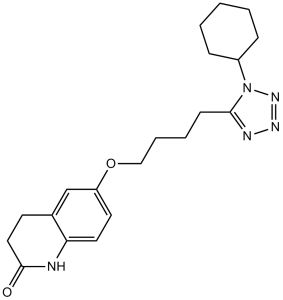
| 规格 | 价格 | 库存 | 数量 |
|---|---|---|---|
| 10 mM * 1 mL in DMSO |
|
||
| 5mg |
|
||
| 10mg |
|
||
| 50mg |
|
||
| 100mg |
|
||
| 250mg |
|
||
| 500mg |
|
||
| 1g |
|
||
| 2g |
|
||
| 5g |
|
||
| 10g |
|
||
| Other Sizes |
|

| 靶点 |
PDE 3A (IC50 = 0.2 μM)
Cilostazol acts as a specific inhibitor of cyclic guanosine monophosphate (cGMP)-inhibited phosphodiesterase (PDE), specifically targeting PDE3 (including PDE3A and PDE3B isoforms). The IC50 value for PDE3 inhibition is approximately 0.2 μM, with high selectivity over other PDE isoforms (e.g., PDE1, PDE2, PDE4, PDE5) where inhibition is negligible even at concentrations up to 100 μM. [1] - Cilostazol selectively inhibits cGMP-inhibited phosphodiesterase (PDE3), which is the key enzyme regulating intracellular cyclic adenosine monophosphate (cAMP) levels in platelets and vascular smooth muscle cells. [2] |
|---|---|
| 体外研究 (In Vitro) |
西洛他唑是由不同激动剂引起的血小板聚集的强抑制剂,并且特异性抑制 cGMP 抑制的磷酸二酯酶 (PDE 3) [2]。氯他唑对应激诱导的人血小板聚集的 IC50 为 15 μM,对 ADP 诱导的血小板聚集的 IC50 为 12.5 μM,以剂量依赖性方式抑制这两种类型的人血小板聚集 [2]。西洛他唑直接有效地抑制 HSC 活化,但不抑制库普弗细胞活化 [3]。
西洛他唑(Cilostazol) 在体外可抑制多种激动剂(如ADP、胶原、凝血酶)诱导的血小板聚集。在1–10 μM浓度下,其可使富血小板血浆(PRP)中ADP诱导的血小板聚集率降低30–60%,胶原诱导的聚集率降低25–55%。此外,在5 μM浓度下,它可使血小板内cAMP水平升高2–3倍,这是其发挥抗聚集作用的核心机制。[1] - 西洛他唑(Cilostazol) 在体外和离体内(ex vivo)均可抑制剪切应力诱导的血小板聚集。在暴露于剪切应力(10–20 dyne/cm²)的人PRP中,0.1–10 μM的西洛他唑可浓度依赖性地降低聚集率:0.1 μM时抑制率约15%,1 μM时约40%,10 μM时约75%。离体内实验中,家兔口服西洛他唑(10 mg/kg)后,其PRP的剪切应力诱导聚集率较溶剂对照组降低35%。[2] - 西洛他唑(Cilostazol) 在体外可减弱肝星状细胞(HSC)的活化。从小鼠肝脏分离的HSC在培养基中培养以诱导活化后,加入1–10 μM的西洛他唑孵育48小时:通过Western blot检测发现,HSC活化标志物α-平滑肌肌动蛋白(α-SMA)的表达降低20–50%;通过ELISA检测发现,I型胶原的分泌量降低30–45%。此外,其还可抑制HSC增殖(MTT法检测),增殖抑制的IC50约为3 μM。[3] - 西洛他唑(Cilostazol) 在体外可保护原代小鼠皮质神经元免受缺血损伤。神经元经2小时氧糖剥夺(OGD)处理后再复氧,细胞死亡率达60%;而提前1小时用0.1–5 μM的西洛他唑预处理,可浓度依赖性地将细胞死亡率降至45–20%。同时,它还可使OGD诱导的caspase-3活化水平降低30–60%,活性氧(ROS)生成量降低25–50%。[4] |
| 体内研究 (In Vivo) |
氯他唑可减轻CCl4引起的体内肝纤维化(临床剂量;口服2周);这种效应可能归因于 HSC 活化的直接抑制 [3]。腹腔注射西洛他唑(10 mg/kg,持续 7 天)可减少神经功能缺损、脑萎缩和梗塞面积。它还可以防止缺血期间星形胶质细胞增殖和神经胶质疤痕形成。 7天和28天后,缺血边界区的血管生成加速[4]。
西洛他唑(Cilostazol) 在大鼠动脉血栓模型(FeCl3诱导颈动脉血栓)中可减少血栓形成。大鼠口服西洛他唑(3–30 mg/kg/天)连续7天,与溶剂对照组相比,血栓闭塞时间延长2–4倍,其中30 mg/kg剂量的作用最显著。[1] - 西洛他唑(Cilostazol) 可保护小鼠免受四氯化碳(CCl4)诱导的肝纤维化。小鼠每周2次腹腔注射CCl4(0.5 mL/kg,用橄榄油1:4稀释),连续8周,同时通过灌胃给予西洛他唑(10或30 mg/kg/天)。实验结束时,30 mg/kg剂量的西洛他唑可使肝胶原沉积(Masson三色染色评估)减少约50%,α-SMA阳性HSC数量减少约40%,血清丙氨酸转氨酶(ALT)和天冬氨酸转氨酶(AST)水平较单纯CCl4组降低约35%。[3] - 西洛他唑(Cilostazol) 可改善小鼠大脑中动脉阻塞(MCAO)模型的急性和迟发性缺血性脑损伤。急性损伤实验:MCAO后1小时腹腔注射西洛他唑(10 mg/kg),24小时后脑梗死体积减少约30%,神经功能缺损评分(5分制)改善约2分。迟发性损伤实验:MCAO后24小时开始,每日灌胃给予西洛他唑(10 mg/kg)连续7天,7天后脑萎缩程度减少约25%,长期神经功能(如转棒实验表现)改善约40%(均与溶剂对照组相比)。[4] |
| 酶活实验 |
西洛他唑是磷酸二酯酶(PDE)3A的选择性和强效抑制剂(IC50:0.2µm),PDE 3的心血管亚型。在治疗性血浆水平约为3-5µm时,该化合物不会影响其他PDE;然而,由于药物的亲脂性,该化合物的局部组织水平可能高于血浆中的游离浓度。重要的是,西洛他唑在相当浓度下对PDE 1、2和4没有相关影响,对PDE 5只有轻微影响(IC50:5-8µm)。PDE 3增加cAMP的分解。由于血小板和血管平滑肌细胞都含有PDE 3A,这一机制似乎可以解释血小板功能的抑制以及血管舒张作用[1]。
最近,西洛他唑的另一个药理学特性被发现:抑制腺苷摄取。这导致腺苷通过A1和A2受体增强作用。在血小板和血管细胞中,A2介导的cAMP增加增强了PDE抑制的后果,即导致cAMP的额外增加。在携带A1受体亚型的心肌细胞中,将存在Gi介导的腺苷酸环化酶抑制,随后cAMP减少(图2)。目前尚不清楚这一概念是否在体内有效。根据目前的知识,西洛他唑对其临床疗效最重要的作用涉及对血小板和血管细胞的影响[1]。 西洛他唑(Cilostazol) 对PDE3活性的抑制实验:将纯化的重组人PDE3(PDE3A或PDE3B)与含[³H]-cAMP(底物)、Mg²+及不同浓度西洛他唑(0.01–10 μM)的反应体系在37°C孵育30分钟。加入PDE抑制剂(如IBMX)终止反应后,通过液体闪烁计数法检测水解生成的[³H]-5'-AMP含量。以溶剂对照组为参照,计算不同浓度西洛他唑对PDE3活性的抑制百分比,再通过 sigmoid 剂量-反应曲线拟合计算IC50值。[1] - 西洛他唑(Cilostazol) 对血小板内cAMP水平的影响实验(间接反映PDE3抑制效果):将分离的人血小板悬浮于缓冲液中,与0.1–10 μM的西洛他唑在37°C预孵育15分钟,随后加入cAMP升高剂(如前列腺素E1)继续孵育10分钟。用冰浴三氯乙酸裂解血小板后,采用竞争性放射免疫分析(RIA)试剂盒定量检测细胞内cAMP水平,通过与溶剂对照组的比值计算cAMP水平的变化倍数,以反映PDE3的抑制程度。[2] |
| 细胞实验 |
为了研究西洛他唑对肝细胞的影响,使用原代肝星状细胞(HSC)、库普弗细胞和补充西洛他氮的肝细胞进行了体外研究。[3]
西洛他唑可以放松血管平滑肌,引起血管舒张。PDE抑制和可能抑制腺苷摄取两者可能协同作用。有趣的是,西洛他唑还抑制了细胞因子诱导的单核细胞趋化蛋白-1(MCP-1)的表达。MCP-1在动脉粥样硬化病变中介导单核细胞募集中起着重要作用。这种作用也可能是由于cAMP升高,可能有助于该化合物的抗炎作用。最近对非胰岛素依赖型糖尿病患者的一项研究表明,口服西洛他唑4周可显著降低血液中可溶性粘附分子的浓度,这可能表明其具有血管保护作用。此外,西洛他唑降低了间歇性跛行患者的血清甘油三酯水平,同时增加了跑步机行走时间。所有这些数据表明,西洛他唑治疗后患者的临床状况有所改善[1]。 剪切应力诱导的血小板聚集实验:将人全血以150 × g离心15分钟制备PRP,向PRP中加入0.01–10 μM的西洛他唑,37°C孵育20分钟。随后用锥板粘度计对PRP施加15 dyne/cm²的剪切应力,持续5分钟。通过聚集仪实时监测光透射率变化以评估血小板聚集情况,计算相对于溶剂对照组的聚集百分比。[2] - 肝星状细胞(HSC)活化实验:通过胶原酶消化和密度梯度离心从小鼠肝脏分离原代HSC,在培养基中培养7天以诱导活化。向培养基中加入1–10 μM的西洛他唑,孵育48小时后进行检测:α-SMA检测——用多聚甲醛固定细胞,Triton X-100透化,加入抗α-SMA一抗和荧光二抗,通过荧光显微镜定量平均荧光强度;胶原mRNA检测——提取HSC总RNA并逆转录为cDNA,用I型胶原特异性引物进行实时荧光定量PCR(qPCR),以管家基因(如GAPDH)归一化,计算相对于溶剂对照组的mRNA表达倍数变化。[3] - 氧糖剥夺(OGD)诱导的神经元死亡实验:原代小鼠皮质神经元在神经基础培养基中培养14天。OGD处理时,将神经元转移至无糖培养基,置于缺氧培养箱(95% N2、5% CO2)中37°C孵育2小时。OGD前1小时用0.1–5 μM的西洛他唑预处理神经元,OGD后恢复正常培养基孵育24小时。采用MTT法(检测570 nm吸光度)评估细胞活力,计算相对于非OGD对照组的活细胞百分比。[4] |
| 动物实验 |
动物/疾病模型:雄性C57BL/6J小鼠[3]
剂量:0.1% w/w,0.3% w/w 给药途径:口服;喂食正常饮食2周 实验结果:纤维化面积小于对照组。 动物/疾病模型:雄性ICR小鼠[4] 剂量:10 mg/kg 给药途径:腹腔注射;缺血后7天 实验结果:对晚期损伤有显著疗效。 小鼠四氯化碳诱导肝纤维化模型:雄性C57BL/6小鼠(8-10周龄)随机分为三组:溶剂对照组、仅四氯化碳组和四氯化碳+西洛他唑组。四氯化碳组小鼠每周两次腹腔注射四氯化碳(0.5 mL/kg,橄榄油1:4稀释),持续8周。西洛他唑溶于0.5%羧甲基纤维素(CMC)溶液中,从首次四氯化碳注射前1周开始,以10或30 mg/kg/天的剂量灌胃给药,持续整个8周。研究结束时,对小鼠实施安乐死,采集血液样本用于血清ALT/AST测定,并取肝组织进行组织病理学染色(Masson三色染色)和Western blot分析(α-SMA)。[3] - 小鼠MCAO诱导的缺血性脑损伤模型:雄性ICR小鼠(25-30 g)用异氟烷麻醉。使用尼龙单丝(硅涂层)经颈外动脉插入颈内动脉,直至感到阻力,从而阻塞右侧大脑中动脉(MCA)。急性损伤评估:将西洛他唑溶于二甲基亚砜(DMSO)中,并用生理盐水稀释(最终DMSO浓度<1%),然后在MCAO后1小时腹腔注射(10 mg/kg)。小鼠在MCAO后24小时处死,取出脑组织,切成2毫米厚的切片,并用2,3,5-氯化三苯基四氮唑(TTC)染色;使用图像分析软件计算梗死体积。为评估晚期损伤:从MCAO后24小时开始,通过灌胃给予小鼠西洛他唑(10 mg/kg/天),持续7天。在第7天使用转棒试验(10 rpm转棒停留时间)评估神经功能,并通过比较同侧(损伤侧)和对侧(未损伤侧)半球的体积来测量脑萎缩程度。 [4] - 大鼠 FeCl3 诱导动脉血栓模型:雄性 Sprague-Dawley 大鼠(250–300 g)连续 7 天口服西洛他唑(3、10 或 30 mg/kg/天)或赋形剂(0.5% CMC)。第 7 天,麻醉大鼠,暴露左侧颈总动脉。将浸有 10% FeCl3 溶液的滤纸敷于动脉上 5 分钟以诱导血栓形成。将多普勒血流探头连接至动脉以监测血流,并记录从敷用 FeCl3 到血流完全停止的时间(闭塞时间)。[1] |
| 药代性质 (ADME/PK) |
吸收、分布和排泄
口服后,西洛他唑可被吸收。高脂饮食可增加吸收,使Cmax增加约90%,AUC增加约25%。绝对生物利用度尚不清楚。 西洛他唑主要通过肝细胞色素P-450酶代谢,主要是3A4,其次是2C19,代谢产物主要经尿液排泄。西洛他唑主要通过代谢及其代谢产物经尿液排泄而消除。主要排泄途径是尿液(74%),其余部分经粪便排泄(20%)。尿液中未检测到可测量的原形西洛他唑,以3,4-脱氢西洛他唑形式排泄的剂量不足2%。约30%的剂量以4'-反式-羟基西洛他唑的形式经尿液排出。 /乳汁/ 据报道,西洛他唑可转移至大鼠乳汁中。 单次口服100毫克西洛他唑并同时进食高脂餐后,血浆西洛他唑峰浓度和血浆浓度-时间曲线下面积(AUC)分别增加约90%和25%。 口服后,普利他唑可被吸收。高脂餐可增加吸收,使Cmax增加约90%,AUC增加约25%。绝对生物利用度尚不清楚。 主要排泄途径为尿液(74%),其余部分经粪便排出(20%)。尿液中未检测到可测量的原形西洛他唑,不到2%的剂量以3,4-脱氢西洛他唑的形式排出。约30%的剂量以4'-反式-羟基西洛他唑的形式排出。其余部分以其他代谢物的形式排出,但均未超过5%。未发现微粒体酶诱导的证据。 有关西洛他唑(共7种)的更多吸收、分布和排泄(完整)数据,请访问HSDB记录页面。 代谢/代谢物 肝脏代谢。西洛他唑主要通过肝细胞色素P-450酶代谢,主要是3A4,其次是2C19,代谢物主要经尿液排出。西洛他唑有两种活性代谢物,其中一种代谢物在给药后至少贡献了50%的药理活性(PDE III抑制)。口服100 mg放射性标记的西洛他唑后,血浆中总分析物中56%为西洛他唑,15%为3,4-脱氢西洛他唑(活性是西洛他唑的4-7倍),4%为4'-反式-羟基西洛他唑(活性是西洛他唑的20%)。西洛他唑主要通过代谢及其代谢物经尿液排泄而消除。体外研究表明,参与西洛他唑代谢的主要同工酶是CYP3A4,CYP2C19的作用较小。负责代谢活性最高的代谢物3,4-脱氢西洛他唑的酶尚不清楚。 西洛他唑主要通过肝细胞色素P-450酶代谢,主要是3A4,其次是2C19,代谢物主要经尿液排泄。有两种代谢物具有活性,其中一种代谢物在服用普利他唑(Pletal)后,似乎至少贡献了50%的药理活性(PDE III抑制)。 本研究考察了雄性和雌性大鼠口服和静脉注射西洛他唑后的药代动力学。口服给药后,雌性大鼠的血清浓度-时间曲线下面积(AUC)约为雄性大鼠的35倍,绝对生物利用度约为雄性大鼠的5.8倍。雌性大鼠的总清除率(CL(total))约为雄性大鼠的六分之一。基于离体肝灌注研究计算的体内肝清除率(CL(h))甚至高于或约为雌性和雄性大鼠体内西洛他唑总清除率的90%,表明西洛他唑在雄性和雌性大鼠体内均主要通过肝脏清除。利用肝微粒体和重组细胞色素(CYP)同工酶进行的体外代谢研究清楚地表明,西洛他唑的主要代谢物在雄性大鼠的肝微粒体中大量生成,并且雄性大鼠特有的CYP3A2和CYP2C11是西洛他唑肝脏代谢的主要酶。因此,西洛他唑药代动力学的显著性别差异主要归因于肝脏代谢的显著差异。我们的实验结果还表明,西洛他唑在小肠中的大量代谢及其可能的饱和作用是造成雄性和雌性大鼠体内剂量依赖性生物利用度的原因。 主要排泄途径是尿液(74%),其余部分经粪便排出(20%)。尿液中未检测到可测量的原形西洛他唑,不到2%的剂量以3,4-脱氢西洛他唑的形式排出。约30%的剂量以4'-反式-羟基西洛他唑的形式经尿液排出。其余部分以其他代谢物的形式排出,每种代谢物的含量均不超过5%。未发现微粒体酶诱导的证据。 西洛他唑已知的代谢产物包括 OPC-13217 和 OPC-13326。 生物半衰期 11-13 小时。 西洛他唑及其活性代谢产物的表观消除半衰期约为 11-13 小时。 口服吸收:西洛他唑口服后在人体内吸收良好,生物利用度约为 85%(范围 70-100%)。单次口服 100 mg 后,2-4 小时达到血浆峰浓度 (Cmax) 为 0.5-1.2 μg/mL。食物摄入不会显著影响吸收程度,但可能会使 Tmax 延迟 1-2 小时。 [1] - 分布:西洛他唑在人体内的分布容积 (Vd) 较大,约为 10 L/kg,表明其组织渗透性广泛。它与血浆蛋白的结合率很高 (95–98%),主要与白蛋白和 α1-酸性糖蛋白结合。[1] - 代谢:西洛他唑主要在肝脏中通过细胞色素 P450 (CYP) 酶代谢,主要是 CYP3A4 和 CYP2C19。主要活性代谢物是 3,4-脱氢西洛他唑,其 PDE3 抑制活性约为母体药物的 40%。次要代谢物包括葡萄糖醛酸苷结合物,这些结合物无活性。[1] - 排泄:西洛他唑及其代谢物主要经尿液 (70–80%) 和粪便 (20–30%) 排泄。西洛他唑在人体内的消除半衰期(t1/2)约为11小时,而3,4-脱氢西洛他唑的t1/2约为13小时。[1] |
| 毒性/毒理 (Toxicokinetics/TK) |
毒性概述
识别和用途:西洛他唑形成无色针状晶体。作为口服药物普利他唑(Pletal),它适用于缓解间歇性跛行症状。人体暴露和毒性:急性过量服用的体征和症状可能包括剧烈头痛、腹泻、低血压、心动过速,以及可能出现的心律失常。动物研究:大鼠连续5周或13周服用剂量高达1500 mg/kg/天的西洛他唑后,未观察到心血管病变。在此剂量下,游离西洛他唑的全身暴露量(AUC)仅为最大推荐人剂量(MRHD)下人体暴露量的约1.5倍(雄性大鼠)和5倍(雌性大鼠)。对犬只反复口服西洛他唑可导致心血管损伤,包括心内膜出血、左心室含铁血黄素沉积和纤维化、右心房壁出血、冠状动脉壁平滑肌出血和坏死、冠状动脉内膜增厚以及冠状动脉炎和冠状动脉周围炎。在为期 52 周的研究中,在与心血管损伤相关的最低剂量下,游离西洛他唑的 AUC 低于人类最大推荐人用量 (MRHD) 100 mg 每日两次时的 AUC。在一项大鼠发育毒性研究中,每日口服1000 mg/kg西洛他唑与胎儿体重下降以及心血管、肾脏和骨骼畸形发生率增加(包括室间隔、主动脉弓和锁骨下动脉异常、肾盂扩张、第14肋骨异常和骨化迟缓)相关。西洛他唑在细菌基因突变、细菌DNA修复、哺乳动物细胞基因突变和体内小鼠骨髓染色体畸变试验中均呈阴性。然而,在体外中国仓鼠卵巢细胞试验中,西洛他唑与染色体畸变显著增加相关。对大鼠和小鼠进行长达104周的膳食西洛他唑给药,未发现其具有致癌性。在大鼠和小鼠研究中,基于全身暴露量,所给予的最大剂量均低于该药物最大推荐人用量(MRHD)下的人体暴露量。 肝毒性 在多项大型前瞻性西洛他唑治疗试验的发表结果中,并未提供治疗期间血清ALT升高的发生率。此外,也未报告有临床表现明显的急性肝损伤病例。自西洛他唑获批并广泛应用以来,尚未有已发表的肝毒性相关报告。然而,目前的产品标签提到,申办方已收到血清酶升高和肝炎病例报告。尚未有关于西洛他唑治疗期间肝功能异常的发生时间、临床表现和病程的报道。 可能性评分:E(不太可能是临床上明显的肝损伤的原因)。 妊娠和哺乳期影响 ◉ 哺乳期用药概述 由于尚无关于哺乳期使用西洛他唑的信息,因此可能更倾向于选择其他药物,尤其是在哺乳新生儿或早产儿时。如果哺乳期母亲使用,请监测婴儿是否有瘀伤和出血。 ◉ 对母乳喂养婴儿的影响 截至修订日期,未找到相关的已发表信息。 ◉ 对泌乳和母乳的影响 截至修订日期,未找到相关的已发表信息。 蛋白结合率 95-98% 相互作用 与CYP2C19抑制剂(包括奥美拉唑)存在药代动力学相互作用(活性代谢物3,4-脱氢西洛他唑的血浆浓度升高);谨慎使用并考虑降低剂量。 洛伐他汀是CYP3A4的底物,可能与西洛他唑发生潜在的药代动力学相互作用(血浆洛伐他汀浓度升高,血浆西洛他唑浓度降低),但这种相互作用不太可能具有临床意义。 存在药代动力学相互作用(血浆西洛他唑浓度升高);谨慎使用并考虑降低剂量。西洛他唑与其他CYP3A4同工酶抑制剂可能存在药代动力学相互作用(血浆西洛他唑浓度升高,清除率降低),包括但不限于某些唑类抗真菌药(例如氟康唑、伊曲康唑、酮康唑、咪康唑)、某些大环内酯类抗生素(例如红霉素或克拉霉素,但不包括阿奇霉素)、某些选择性5-羟色胺再摄取抑制剂(例如氟西汀、氟伏沙明、奈法唑酮、舍曲林)、某些抗逆转录病毒药物(例如茚地那韦)、甲硝唑、地尔硫卓和达那唑。 西洛他唑与氯吡格雷合用可能具有叠加的抗血小板作用。建议谨慎用药,并在联合用药期间监测出血时间。不太可能发生药代动力学相互作用。 有关西洛他唑(共 10 项)的更多相互作用(完整)数据,请访问 HSDB 记录页面。 非人类毒性值 犬口服 LD50 > 2 g/kg 大鼠口服 LD50 > 5 g/kg 小鼠口服 LD50 > 5 g/kg 人类不良反应:西洛他唑(治疗剂量为每日两次,每次 100 mg)最常见的不良反应包括头痛(20-30%)、腹泻(15-20%)、头晕(10-15%)和心悸(5-10%)。这些不良反应通常为轻度至中度,并会在继续治疗后消退。 [1] - 血浆蛋白结合率:西洛他唑在人血浆中具有较高的血浆蛋白结合率(95-98%),在治疗浓度下不会被其他常用药物(例如华法林、阿司匹林)显著置换。[1] - 肝肾毒性:在小鼠四氯化碳诱导的肝纤维化模型中,西洛他唑(每日剂量高达30 mg/kg,持续8周)不会升高血清ALT/AST水平或引起肝损伤的组织病理学迹象;相反,它能减轻四氯化碳诱导的肝损伤。[1, 3] - 药物相互作用:西洛他唑是CYP3A4和CYP2C19的底物;与强效CYP3A4抑制剂(例如酮康唑)合用可使西洛他唑血浆浓度升高约2-3倍,而与CYP3A4诱导剂(例如利福平)合用则可使血浆浓度降低约50%。[1] |
| 参考文献 | |
| 其他信息 |
治疗用途
/临床试验/ ClinicalTrials.gov 是一个注册库和结果数据库,收录了全球范围内由公共和私人机构资助的人体临床研究。该网站由美国国家医学图书馆 (NLM) 和美国国立卫生研究院 (NIH) 维护。ClinicalTrials.gov 上的每条记录都包含研究方案的摘要信息,包括:疾病或病症;干预措施(例如,正在研究的医疗产品、行为或程序);研究的标题、描述和设计;参与要求(资格标准);研究开展地点;研究地点的联系方式;以及其他健康网站相关信息的链接,例如 NLM 的 MedlinePlus(提供患者健康信息)和 PubMed(提供医学领域学术文章的引文和摘要)。西洛他唑已收录于该数据库中。 普利他唑适用于减轻间歇性跛行症状,表现为步行距离增加。 /美国产品标签包含/ 由于其抗血小板活性,西洛他唑可单独使用或与其他抗血小板药物(例如阿司匹林、氯吡格雷)联合使用,以预防冠状动脉成形术/支架植入术后的血栓形成和再狭窄。/美国产品标签未包含/ 西洛他唑已用于既往有非心源性卒中或短暂性脑缺血发作(TIA)病史患者的卒中二级预防。/美国产品标签未包含/ /探索性治疗/我们开展了一项随机、双盲、安慰剂对照试验,以评估选择性磷酸二酯酶3抑制剂西洛他唑在血管痉挛性心绞痛(VSA)患者中的疗效和安全性。西洛他唑已被证实可诱导血管扩张,但其在VSA患者中的疗效尚不明确。 2011年10月至2012年7月,50例确诊为血管性心绞痛(VSA)且尽管接受氨氯地平治疗(5 mg/天)仍每周发生≥1次心绞痛的患者被随机分配接受西洛他唑(最高剂量200 mg/天)或安慰剂治疗,疗程为4周。所有患者均被要求填写日记,记录胸痛的频率和严重程度(0-10分)。主要终点是每周胸痛发生率的相对降低。两组患者的基线特征相似。在49例可评估的患者中(西洛他唑组25例,安慰剂组24例),西洛他唑组的主要终点降低幅度显著高于安慰剂组(分别为-66.5±88.6%和-17.6±140.1%,p=0.009)。次要终点指标,包括胸痛频率的变化(分别为-3.7±0.5和-1.9±0.6,p=0.029)、胸痛严重程度评分的变化(分别为-2.8±0.4和-1.1±0.4,p=0.003)以及无胸痛患者的比例(分别为76.0%和33.3%,p=0.003),也均显著有利于西洛他唑组。头痛是两组中最常见的不良事件(分别为40.0%和20.8%,p=0.217)。西洛他唑是治疗常规氨氯地平治疗无效的血管痉挛性心绞痛(VSA)患者的有效疗法,且无严重副作用。 药物警告 /黑框警告/ 警告:禁用于心力衰竭患者。普利他林(Pletal)禁用于任何严重程度的心力衰竭患者。西洛他唑及其几种代谢物是磷酸二酯酶III抑制剂。一些具有这种药理作用的药物与安慰剂相比,导致III-IV级心力衰竭患者的生存率降低。 曾有报道,若未立即停用西洛他唑,则罕见地出现血小板减少症或白细胞减少症进展为粒细胞缺乏症;停用西洛他唑后,粒细胞缺乏症可逆转。 关于西洛他唑和氯吡格雷联合用药的安全性和有效性信息有限。目前尚不清楚西洛他唑和氯吡格雷联合治疗是否会对出血时间产生叠加效应。在联合治疗期间应谨慎,并监测出血时间。 西洛他唑可能引起心动过速、心悸、心律失常或低血压。服用西洛他唑后,心率大约增加 5 至 7 次/分。有缺血性心脏病史的患者可能存在心绞痛加重或心肌梗死的风险。 有关西洛他唑(共 10 条)的更多药物警告(完整)数据,请访问 HSDB 记录页面。 药效学 西洛他唑可减轻间歇性跛行症状,表现为步行距离增加。间歇性跛行是指行走时出现腿部疼痛,休息后疼痛消失。疼痛是由于腿部血流减少引起的。 作用机制:西洛他唑通过抑制 PDE3 发挥药理作用,从而导致细胞内 cAMP 水平升高。cAMP 升高激活蛋白激酶 A (PKA),PKA 进而磷酸化下游靶点:在血小板中,这抑制血小板聚集;在血管平滑肌细胞中,西洛他唑可诱导舒张(血管扩张);在增殖细胞(例如,造血干细胞、血管平滑肌细胞)中,西洛他唑可抑制增殖和迁移。[1, 3, 4] - 治疗适应症:西洛他唑已获准用于治疗人类间歇性跛行(外周动脉疾病的症状),因为它能通过增强血流和减少血小板聚集来改善步行距离。目前,西洛他唑也在研究用于预防卒中复发和治疗其他血管疾病(例如,血管成形术后的再狭窄)。[1] - 选择性:与其他PDE3抑制剂(例如,米力农)相比,西洛他唑对PDE3的选择性高于其他PDE亚型,从而降低了脱靶效应的风险(例如,与PDE5抑制相关的心律失常)。 [1] - 对肝纤维化的影响:西洛他唑不仅通过抑制肝星状细胞(HSC)活化和胶原蛋白生成来减轻肝纤维化,而且还通过降低肝脏中的氧化应激和炎症(例如,降低四氯化碳(CCl4)处理的小鼠体内肿瘤坏死因子-α(TNF-α)和白细胞介素-6(IL-6)的水平)来减轻肝纤维化。[3] - 对缺血性脑损伤的影响:西洛他唑通过多种机制保护脑免受缺血性损伤,包括改善脑血流(通过血管舒张)、减少血小板聚集(预防微血栓形成)、抑制神经元凋亡和抑制神经炎症(例如,降低小胶质细胞活化)。[4] |
| 分子式 |
C20H27N5O2
|
|
|---|---|---|
| 分子量 |
369.46
|
|
| 精确质量 |
369.216
|
|
| 元素分析 |
C, 57.08; H, 6.46; Cl, 7.33; F, 3.93; N, 8.68; O, 16.53
|
|
| CAS号 |
73963-72-1
|
|
| 相关CAS号 |
Cilostazol-d11;1073608-02-2;Cilostazol-d4;1215541-47-1
|
|
| PubChem CID |
2754
|
|
| 外观&性状 |
White to off-white solid powder
|
|
| 密度 |
1.3±0.1 g/cm3
|
|
| 沸点 |
664.7±55.0 °C at 760 mmHg
|
|
| 熔点 |
159-160ºC
|
|
| 闪点 |
355.8±31.5 °C
|
|
| 蒸汽压 |
0.0±2.0 mmHg at 25°C
|
|
| 折射率 |
1.676
|
|
| LogP |
3.05
|
|
| tPSA |
81.93
|
|
| 氢键供体(HBD)数目 |
1
|
|
| 氢键受体(HBA)数目 |
5
|
|
| 可旋转键数目(RBC) |
7
|
|
| 重原子数目 |
27
|
|
| 分子复杂度/Complexity |
485
|
|
| 定义原子立体中心数目 |
0
|
|
| SMILES |
O=C1NC2=C(C=C(OCCCCC3=NN=NN3C4CCCCC4)C=C2)CC1
|
|
| InChi Key |
RRGUKTPIGVIEKM-UHFFFAOYSA-N
|
|
| InChi Code |
InChI=1S/C20H27N5O2/c26-20-12-9-15-14-17(10-11-18(15)21-20)27-13-5-4-8-19-22-23-24-25(19)16-6-2-1-3-7-16/h10-11,14,16H,1-9,12-13H2,(H,21,26)
|
|
| 化学名 |
6-[4-(1-cyclohexyltetrazol-5-yl)butoxy]-3,4-dihydro-1H-quinolin-2-one
|
|
| 别名 |
|
|
| HS Tariff Code |
2934.99.9001
|
|
| 存储方式 |
Powder -20°C 3 years 4°C 2 years In solvent -80°C 6 months -20°C 1 month |
|
| 运输条件 |
Room temperature (This product is stable at ambient temperature for a few days during ordinary shipping and time spent in Customs)
|
| 溶解度 (体外实验) |
|
|||
|---|---|---|---|---|
| 溶解度 (体内实验) |
配方 1 中的溶解度: 2 mg/mL (5.41 mM) in 10% DMSO + 90% (20% SBE-β-CD in Saline) (这些助溶剂从左到右依次添加,逐一添加), 悬浮液;超声助溶。
例如,若需制备1 mL的工作液,可将100 μL 20.0mg/mL澄清的DMSO储备液加入到900μL 20%SBE-β-CD生理盐水中,混匀。 *20% SBE-β-CD 生理盐水溶液的制备(4°C,1 周):将 2 g SBE-β-CD 溶解于 10 mL 生理盐水中,得到澄清溶液。 配方 2 中的溶解度: ≥ 2 mg/mL (5.41 mM) (饱和度未知) in 10% DMSO + 90% Corn Oil (这些助溶剂从左到右依次添加,逐一添加), 澄清溶液。 例如,若需制备1 mL的工作液,可将 100 μL 20.0 mg/mL 澄清 DMSO 储备液添加到 900 μL 玉米油中并混合均匀。 请根据您的实验动物和给药方式选择适当的溶解配方/方案: 1、请先配制澄清的储备液(如:用DMSO配置50 或 100 mg/mL母液(储备液)); 2、取适量母液,按从左到右的顺序依次添加助溶剂,澄清后再加入下一助溶剂。以 下列配方为例说明 (注意此配方只用于说明,并不一定代表此产品 的实际溶解配方): 10% DMSO → 40% PEG300 → 5% Tween-80 → 45% ddH2O (或 saline); 假设最终工作液的体积为 1 mL, 浓度为5 mg/mL: 取 100 μL 50 mg/mL 的澄清 DMSO 储备液加到 400 μL PEG300 中,混合均匀/澄清;向上述体系中加入50 μL Tween-80,混合均匀/澄清;然后继续加入450 μL ddH2O (或 saline)定容至 1 mL; 3、溶剂前显示的百分比是指该溶剂在最终溶液/工作液中的体积所占比例; 4、 如产品在配制过程中出现沉淀/析出,可通过加热(≤50℃)或超声的方式助溶; 5、为保证最佳实验结果,工作液请现配现用! 6、如不确定怎么将母液配置成体内动物实验的工作液,请查看说明书或联系我们; 7、 以上所有助溶剂都可在 Invivochem.cn网站购买。 |
| 制备储备液 | 1 mg | 5 mg | 10 mg | |
| 1 mM | 2.7067 mL | 13.5333 mL | 27.0665 mL | |
| 5 mM | 0.5413 mL | 2.7067 mL | 5.4133 mL | |
| 10 mM | 0.2707 mL | 1.3533 mL | 2.7067 mL |
1、根据实验需要选择合适的溶剂配制储备液 (母液):对于大多数产品,InvivoChem推荐用DMSO配置母液 (比如:5、10、20mM或者10、20、50 mg/mL浓度),个别水溶性高的产品可直接溶于水。产品在DMSO 、水或其他溶剂中的具体溶解度详见上”溶解度 (体外)”部分;
2、如果您找不到您想要的溶解度信息,或者很难将产品溶解在溶液中,请联系我们;
3、建议使用下列计算器进行相关计算(摩尔浓度计算器、稀释计算器、分子量计算器、重组计算器等);
4、母液配好之后,将其分装到常规用量,并储存在-20°C或-80°C,尽量减少反复冻融循环。
计算结果:
工作液浓度: mg/mL;
DMSO母液配制方法: mg 药物溶于 μL DMSO溶液(母液浓度 mg/mL)。如该浓度超过该批次药物DMSO溶解度,请首先与我们联系。
体内配方配制方法:取 μL DMSO母液,加入 μL PEG300,混匀澄清后加入μL Tween 80,混匀澄清后加入 μL ddH2O,混匀澄清。
(1) 请确保溶液澄清之后,再加入下一种溶剂 (助溶剂) 。可利用涡旋、超声或水浴加热等方法助溶;
(2) 一定要按顺序加入溶剂 (助溶剂) 。
| NCT Number | Recruitment | interventions | Conditions | Sponsor/Collaborators | Start Date | Phases |
| NCT01915069 | Completed | Drug: Cilostazol | Contraception | University of Southern California | July 2013 | Phase 2 |
| NCT05671497 | Recruiting | Drug: Cilostazol 100 MG | Rheumatoid Arthritis | Ain Shams University | November 1, 2022 | Phase 2 Phase 3 |
| NCT02374957 | Terminated Has Results | Drug: Cilostazol | Peripheral Arterial Disease Claudication (Finding) |
Wake Forest University Health Sciences | February 2015 | Phase 4 |
| NCT05126836 | Completed Has Results | Drug: Cilostazol 100Mg Tab Drug: Placebo |
Heart Failure With Preserved Ejection Fraction |
University of Minnesota | September 1, 2021 | Phase 2 |
InvivoChem的所有产品仅用于作科学研究,不面向患者销售
Copyright 2020 InvivoChem LLC | All Rights Reserved 粤ICP备20063088号-1


 COA
COA
 粤公网安备 44011102003439号
 463611831
