| 规格 | 价格 | 库存 | 数量 |
|---|---|---|---|
| 1mg |
|
||
| 5mg |
|
||
| 10mg |
|
||
| 25mg |
|
||
| 50mg |
|
||
| 100mg |
|
||
| 250mg |
|
||
| Other Sizes |
|

| 靶点 |
RIP3 or RIPK3 (receptor-interacting protein kinase 3) (IC50 = 0.3 nM)
GSK840 targets receptor-interacting serine/threonine-protein kinase 3 (RIP3) (kinase activity IC50 = 1.3 nM; binding Ki = 0.9 nM) [1] |
|---|---|
| 体外研究 (In Vitro) |
GSK840 (GSK'840)(0.01-3 μM;24 小时)以浓度依赖性方式抑制 TNF 诱导的坏死性凋亡 [1]。 GSK840 比 RIP1 激酶抑制剂具有更广泛的靶点范围,并且在与激酶结构域结合后抑制激酶活性具有良好的特异性。
|
| 体内研究 (In Vivo) |
Rip3K51A/K51A激酶死亡敲入小鼠存活[1]
RIP3激酶死亡突变体的行为支持在D161N突变敲入小鼠中观察到的惊人的妊娠中期致命性(Newton等人,2014),并预测无毒突变体将出现相反的结果。当产生Rip3K51A/K51A激酶死亡敲入小鼠时,小鼠明显具有活力和生育能力(图7A和7B)。该突变株对妊娠中期或围产期死亡没有表现出任何易感性。为了确定存活的Rip3K51A/K51A突变体是否像致死性Rip3D161N/D161N突变体(Newton et al., 2014)一样,挽救了Casp8−/−胚胎的胚胎致死性,我们进行了杂交,并以预期的孟德尔频率挽救了存活和可育的Casp8−/−Rip3K51A/K51A小鼠(图7B和S6A)。这扩展了先前对Casp8−/−Rip3−/−小鼠的拯救(Kaiser et al., 2011;Oberst et al., 2011;Zhang et al., 2011)清楚地表明,在没有Rip3D161N/D161N突变并发症的casp8缺陷胚胎妊娠中期死亡中,早衰RIP3酶活性的贡献(Newton et al., 2014)。
|
| 酶活实验 |
RIP3高通量筛选荧光极化(FP)试验用于筛选与RIP3激酶结构域荧光标记探针(GSK ' 657)结合竞争的小分子化合物文库(Pope et al., 1999)。文库化合物抑制RIP3激酶活性的能力是通过使用ADP-Glo测量ATP消耗的实验来评估的(Li et al., 2009)。编码库技术筛选按照前面描述进行(Deng et al., 2012)。kinome面板的体外分析由Reaction Biology Corporation使用“HotSpot”分析平台进行(Anastassiadis等,2011)。Kinome树表示是使用Kinome Mapper生成的。[1]
1. Radiometric RIP3 kinase activity assay: - Recombinant human RIP3 kinase domain is diluted in kinase buffer to a final concentration of 50 nM [1] - GSK840 is serially diluted (0.1 nM to 100 nM) and mixed with RIP3, followed by incubation at room temperature for 30 minutes [1] - ATP (50 μM, including [γ-32P]ATP) and recombinant MLKL (substrate, 1 μg) are added to initiate the reaction, which is incubated at 30°C for 60 minutes [1] - The reaction is terminated by adding SDS sample buffer, and proteins are separated by SDS-PAGE [1] - Phosphorylated MLKL is detected by autoradiography, and IC50 is calculated by quantifying the reduction in radioactive signal [1] 2. Surface Plasmon Resonance (SPR) binding assay: - RIP3 kinase domain is immobilized on a CM5 sensor chip via amine coupling to a density of ~700 resonance units (RU) [1] - GSK840 is serially diluted (0.2 nM to 20 nM) in running buffer (PBS with 0.05% Tween-20) and injected over the chip at a flow rate of 25 μl/min [1] - Association (180 seconds) and dissociation (300 seconds) phases are monitored, and the chip is regenerated with 10 mM glycine-HCl (pH 2.2) [1] - Binding affinity (Ki) is calculated using a 1:1 Langmuir binding model with reference subtraction [1] |
| 细胞实验 |
细胞活力测定 [1]
细胞类型:人 HT-29 细胞(TNF 10 ng/ml + zVAD-fmk 20 μM + SMAC007 100 nM) 测试浓度: 0.01-3 μM 孵育时间: 24 小时 实验结果: 阻断 TNF 诱导的坏死细胞凋亡浓度依赖性方式。 |
| 动物实验 |
小鼠、感染和器官获取 [1] RIP3K51A/K51A 小鼠和 RIP1K45A/K45A 小鼠(Berger 等,2014)由 Genoway 公司(法国里昂)构建。Rip3-/-(Newton 等,2004)、Tnf-/-(Pasparakis 等,1997)、Rip3-/-Casp8-/-(Kaiser 等,2011)、Rip1-/-Rip3-/-Casp8-/- 和 Rip1-/-Rip3+/-Casp8-/-(Kaiser 等,2014)小鼠已有相关描述。C57BL/6 小鼠购自 Jackson Laboratory,Rip3-/- 小鼠(Ripk3tm1Vmd)购自 Genentech 公司(Newton 等,2004)。野生型 MCMV K181 株以及 M45mutRHIM 株和表达 lacZ 的 RM461 株此前已有描述(Stoddart 等,1994;Upton 等,2010)。小鼠腹腔注射 10⁶ PFU MCMV M45mutRHIM 株。感染后 14 天,小鼠再次腹腔注射表达 lacZ 的 MCMV 株 RM427,4 天后采集器官。器官病毒滴度测定方法如前所述(Upton 等,2010)。
|
| 参考文献 | |
| 其他信息 |
受体相互作用蛋白激酶3 (RIP3 或 RIPK3) 已成为坏死性凋亡的核心参与者,也是控制炎症性疾病的潜在靶点。本文研究表明,三种选择性小分子化合物能够抑制 RIP3 激酶依赖性坏死性凋亡,但令人惊讶的是,它们会浓度依赖性地诱导细胞凋亡,这削弱了它们的治疗价值。这些化合物与 RIP3 相互作用,通过 RHIM 驱动的 RIP1 (RIPK1) 募集激活 caspase 8 (Casp8),从而组装成 Casp8-FADD-cFLIP 复合物,该过程完全独立于促坏死激酶活性和 MLKL。RIP3 激酶失活的 D161N 突变体能够诱导自发性细胞凋亡,而无需化合物参与;而 D161G、D143N 和 K51A 突变体与野生型一样,只有在化合物存在的情况下才会触发细胞凋亡。因此,RIP3-K51A突变小鼠(Rip3(K51A/K51A))具有生存能力和生育能力,这与Rip3(D161N/D161N)小鼠的围产期致死形成鲜明对比。由此可见,RIP3通过类似Ripoptosome的平台维持坏死性凋亡和细胞凋亡的平衡。这项工作揭示了一种共同机制,即通过治疗或基因手段扰乱RIP3来揭示RHIM驱动的细胞凋亡。[1]
|
| 分子式 |
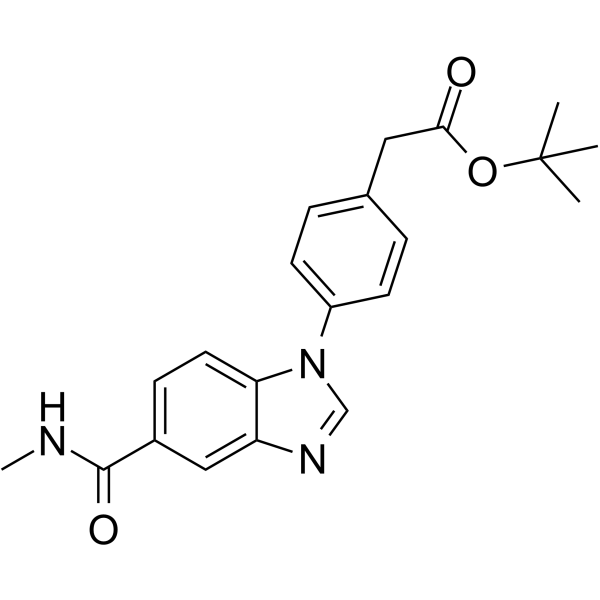
C21H23N3O3
|
|---|---|
| 分子量 |
365.425625085831
|
| 精确质量 |
365.173
|
| 元素分析 |
C, 69.02; H, 6.34; N, 11.50; O, 13.13
|
| CAS号 |
2361146-30-5
|
| PubChem CID |
138377545
|
| 外观&性状 |
Light yellow to yellow solid powder
|
| LogP |
3.1
|
| tPSA |
73.2
|
| 氢键供体(HBD)数目 |
1
|
| 氢键受体(HBA)数目 |
4
|
| 可旋转键数目(RBC) |
6
|
| 重原子数目 |
27
|
| 分子复杂度/Complexity |
537
|
| 定义原子立体中心数目 |
0
|
| SMILES |
O(C(CC1C=CC(=CC=1)N1C=NC2C=C(C(NC)=O)C=CC1=2)=O)C(C)(C)C
|
| InChi Key |
UGTLDBJIOSYXRR-UHFFFAOYSA-N
|
| InChi Code |
InChI=1S/C21H23N3O3/c1-21(2,3)27-19(25)11-14-5-8-16(9-6-14)24-13-23-17-12-15(20(26)22-4)7-10-18(17)24/h5-10,12-13H,11H2,1-4H3,(H,22,26)
|
| 化学名 |
tert-butyl 2-[4-[5-(methylcarbamoyl)benzimidazol-1-yl]phenyl]acetate
|
| 别名 |
GSK840; 2361146-30-5; CHEMBL4439913; tert-butyl 2-(4-(5-(methylcarbamoyl)-1H-benzo[d]imidazol-1-yl)phenyl)acetate; tert-butyl 2-[4-[5-(methylcarbamoyl)benzimidazol-1-yl]phenyl]acetate; tert-butyl 2-{4-[5-(methylcarbamoyl)-1H-1,3-benzodiazol-1-yl]phenyl}acetate; SCHEMBL21678866;
|
| HS Tariff Code |
2934.99.9001
|
| 存储方式 |
Powder -20°C 3 years 4°C 2 years In solvent -80°C 6 months -20°C 1 month |
| 运输条件 |
Room temperature (This product is stable at ambient temperature for a few days during ordinary shipping and time spent in Customs)
|
| 溶解度 (体外实验) |
DMSO : ~110 mg/mL (~301.02 mM)
|
|---|---|
| 溶解度 (体内实验) |
配方 1 中的溶解度: ≥ 2.75 mg/mL (7.53 mM) (饱和度未知) in 10% DMSO + 40% PEG300 + 5% Tween80 + 45% Saline (这些助溶剂从左到右依次添加,逐一添加), 澄清溶液。
例如,若需制备1 mL的工作液,可将100 μL 27.5 mg/mL澄清DMSO储备液加入400 μL PEG300中,混匀;然后向上述溶液中加入50 μL Tween-80,混匀;加入450 μL生理盐水定容至1 mL。 *生理盐水的制备:将 0.9 g 氯化钠溶解在 100 mL ddH₂O中,得到澄清溶液。 配方 2 中的溶解度: ≥ 2.75 mg/mL (7.53 mM) (饱和度未知) in 10% DMSO + 90% (20% SBE-β-CD in Saline) (这些助溶剂从左到右依次添加,逐一添加), 澄清溶液。 例如,若需制备1 mL的工作液,可将 100 μL 27.5mg/mL澄清的DMSO储备液加入到900μL 20%SBE-β-CD生理盐水中,混匀。 *20% SBE-β-CD 生理盐水溶液的制备(4°C,1 周):将 2 g SBE-β-CD 溶解于 10 mL 生理盐水中,得到澄清溶液。 View More
配方 3 中的溶解度: ≥ 2.75 mg/mL (7.53 mM) (饱和度未知) in 10% DMSO + 90% Corn Oil (这些助溶剂从左到右依次添加,逐一添加), 澄清溶液。 1、请先配制澄清的储备液(如:用DMSO配置50 或 100 mg/mL母液(储备液)); 2、取适量母液,按从左到右的顺序依次添加助溶剂,澄清后再加入下一助溶剂。以 下列配方为例说明 (注意此配方只用于说明,并不一定代表此产品 的实际溶解配方): 10% DMSO → 40% PEG300 → 5% Tween-80 → 45% ddH2O (或 saline); 假设最终工作液的体积为 1 mL, 浓度为5 mg/mL: 取 100 μL 50 mg/mL 的澄清 DMSO 储备液加到 400 μL PEG300 中,混合均匀/澄清;向上述体系中加入50 μL Tween-80,混合均匀/澄清;然后继续加入450 μL ddH2O (或 saline)定容至 1 mL; 3、溶剂前显示的百分比是指该溶剂在最终溶液/工作液中的体积所占比例; 4、 如产品在配制过程中出现沉淀/析出,可通过加热(≤50℃)或超声的方式助溶; 5、为保证最佳实验结果,工作液请现配现用! 6、如不确定怎么将母液配置成体内动物实验的工作液,请查看说明书或联系我们; 7、 以上所有助溶剂都可在 Invivochem.cn网站购买。 |
| 制备储备液 | 1 mg | 5 mg | 10 mg | |
| 1 mM | 2.7365 mL | 13.6825 mL | 27.3650 mL | |
| 5 mM | 0.5473 mL | 2.7365 mL | 5.4730 mL | |
| 10 mM | 0.2737 mL | 1.3683 mL | 2.7365 mL |
1、根据实验需要选择合适的溶剂配制储备液 (母液):对于大多数产品,InvivoChem推荐用DMSO配置母液 (比如:5、10、20mM或者10、20、50 mg/mL浓度),个别水溶性高的产品可直接溶于水。产品在DMSO 、水或其他溶剂中的具体溶解度详见上”溶解度 (体外)”部分;
2、如果您找不到您想要的溶解度信息,或者很难将产品溶解在溶液中,请联系我们;
3、建议使用下列计算器进行相关计算(摩尔浓度计算器、稀释计算器、分子量计算器、重组计算器等);
4、母液配好之后,将其分装到常规用量,并储存在-20°C或-80°C,尽量减少反复冻融循环。
计算结果:
工作液浓度: mg/mL;
DMSO母液配制方法: mg 药物溶于 μL DMSO溶液(母液浓度 mg/mL)。如该浓度超过该批次药物DMSO溶解度,请首先与我们联系。
体内配方配制方法:取 μL DMSO母液,加入 μL PEG300,混匀澄清后加入μL Tween 80,混匀澄清后加入 μL ddH2O,混匀澄清。
(1) 请确保溶液澄清之后,再加入下一种溶剂 (助溶剂) 。可利用涡旋、超声或水浴加热等方法助溶;
(2) 一定要按顺序加入溶剂 (助溶剂) 。
InvivoChem的所有产品仅用于作科学研究,不面向患者销售
Copyright 2020 InvivoChem LLC | All Rights Reserved 粤ICP备20063088号-1


 粤公网安备 44011102003439号
 463611831
