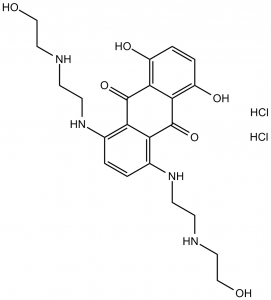
Mitoxantrone HCl (mitozantrone)

别名: NSC-301739; CL-232325; NSC301739; CL 232325; NSC 301739; DHAQ; CL232325; Mitozantrone; Mitoxantrone HCl; Mitoxantrone dihydrchloride; US brand name: Novantrone. NSC 301739; DHAQ; CL232325; Foreign brand names: Mitroxone; Neotalem; Onkotrone; Pralifan 盐酸米托蒽醌;1,4-二羟基-5,8-双[[2-[(2-羟基乙基)氨基]乙基]氨基]-9,10-蒽醌二盐酸盐;盐酸米托蒽醌 EP标准品;盐酸米托蒽醌 Mitoxantrone HCl;盐酸米托蒽醌 USP标准品;盐酸米托蒽醌 标准品; 1,4-二羟基-5,8-双[[2-[(2-羟乙基)氨基]乙基]氨基]-9,10-蒽醌二盐酸盐;米托蒽醌二盐酸盐;米托蒽醌盐酸盐;1,4-二羟基-5,8-双[[2-[(2-羟乙基)氨基]乙基]氨基]蒽-9,10-二酮二盐酸盐 盐酸米托蒽醌;1,4-二羟基-5,8-双[[2-[(2-羟乙基)氨基]乙基]氨基]蒽醌二盐酸盐 盐酸米托蒽醌
目录号: V1404 纯度: ≥98%
Mitoxantrone HCl (原 NSC-301739; NSC301739;DHAQ; CL-232325; Mitroxone; Neotalem; Onkotrone; Pralifan;Novantrone) 是蒽二酮抗癌剂 Mitoxantrone 的盐酸盐,是一种有效的 II 型拓扑异构酶抑制剂,具有潜在的抗肿瘤活性。
Mitoxantrone HCl (mitozantrone) CAS号: 70476-82-3
产品类别: Topoisomerase
产品仅用于科学研究,不针对患者销售
规格 价格 库存 数量
10 mM * 1 mL in DMSO
1mg
5mg
10mg
25mg
50mg
100mg
250mg
500mg
1g
5g
Other Sizes

Other Forms of Mitoxantrone HCl (mitozantrone):

  • 米托蒽醌
  • 米托蒽醌二醋酸盐
点击了解更多
InvivoChem产品被CNS等顶刊论文引用
纯度/质量控制文件

纯度: ≥98%

产品描述
Mitoxantrone HCl(原 NSC-301739;NSC301739;DHAQ;CL-232325;Mitroxone;Neotalem;Onkotrone;Pralifan;Novantrone)是 Mitoxantrone 的盐酸盐,是一种蒽二酮抗癌剂,是一种有效的 II 型拓扑异构酶抑制剂,具有潜在的潜力抗肿瘤活性。它在 HepG2 和 MCF-7/wt 细胞中抑制 TOPO II,IC50 分别为 2.0 μM、0.42 mM。它被用作治疗白血病和其他类型癌症的抗肿瘤药物,也是治疗多发性硬化症的经过验证的药物。米托蒽醌通过抑制 DNA 合成和细胞周期进程来抑制白血病。它对不同的免疫细胞(如T细胞、B细胞、巨噬细胞等)有作用。它干扰 TOPO-II 介导的 DNA 切割,导致多重 DSB(DNA 链断裂)、染色质结构变化等。
生物活性&实验参考方法
靶点
PKC ( IC50 = 8.5 μM ); Topoisomerase II
DNA topoisomerase II [2]
Viral DNA replication machinery (EC50 = 0.3 μM for cowpox virus; EC50 = 0.5 μM for monkeypox virus) [1]
体外研究 (In Vitro)
米托蒽醌在所有研究的患者中诱导 DNA 片段化和聚(ADP-核糖)聚合酶(PARP)(半胱天冬酶激活的标志物)的蛋白水解裂解,证明米托蒽醌的细胞毒性作用是由于诱导细胞凋亡。 Mitoxantrone 在早幼粒细胞白血病细胞系 HL60 中激活 NFkappaB 并刺激 IkappaBalpha 降解,但在变异细胞 HL60/MX2 细胞中则不然,该细胞缺乏拓扑异构酶 II 的 β 亚型并表达截短的 α 亚型,从而导致亚细胞分布发生改变。 Mitoxantrone 以剂量依赖性方式抑制抗原呈递细胞 (APC) 上刺激的活化 PBMC、B 淋巴细胞或抗原特异性 T 细胞系 (TCL) 的增殖。低浓度的米托蒽醌会诱导 PBMC、单核细胞和 DC 细胞凋亡,而较高剂量会导致细胞裂解。激酶测定:米托蒽醌对组蛋白H1以竞争性方式抑制PKC,其Ki值为6.3μM,对磷脂酰丝氨酸和ATP以非竞争性方式抑制PKC。用米托蒽醌 (0.5 μg/mL) 处理 B-CLL 细胞 48 小时会导致细胞活力下降。 Mitoxantrone 诱导 DNA 片段化和聚(ADP-核糖)聚合酶(PARP)的蛋白水解裂解,证明 mitoxantrone 的细胞毒性作用是由于诱导细胞凋亡所致。 Mitoxantrone 对人乳腺癌细胞系 MDA-MB-231 和 MCF-7 具有细胞毒性,IC50 值分别为 18 和 196 nM。细胞测定:将人乳腺癌细胞系MDA-MB-231和MCF-7接种于标准96孔板中。接种一天后,更换培养基,并在7天内更换为含有不同浓度米托蒽醌(10-5至5μM)和或不含DHA(30μM)的培养基。通过四唑盐测定来测量细胞的整体活力。
在Vero细胞中,针对牛痘病毒和猴痘病毒,盐酸米托蒽醌(mitozantrone)表现出强效抗病毒活性,以浓度依赖方式抑制病毒复制。EC50值分别为0.3 μM(牛痘病毒)和0.5 μM(猴痘病毒),浓度高达10 μM时无显著细胞毒性(CC50>10 μM)[1]
- 在多种肿瘤细胞系中,盐酸米托蒽醌(mitozantrone)抑制DNA合成并诱导凋亡,表现为DNA片段化和半胱天冬酶激活。它可嵌入DNA链,阻断核酸复制和转录[2]
- 该药物抑制DNA拓扑异构酶II活性,稳定酶-DNA切割复合物并阻止DNA链连接,这一作用是其抗肿瘤和抗病毒活性的重要机制[2]
体内研究 (In Vivo)
以最佳剂量(1.6 mg/kg/天;作为游离碱)腹膜内给予米托蒽醌,可在腹膜内植入 L1210 白血病小鼠中产生具有统计学意义的 60 天存活率(疗效)。在 SC 植入型 Lewis 肺癌中,静脉注射米托蒽醌和 ADM 也显示出有效的抗肿瘤活性,分别产生 60% 和 45% 的 ILS。
酶活实验
米托蒽醌对磷脂酰丝氨酸和 ATP 以非竞争性方式抑制 PKC,但对组蛋白 H1 以竞争性方式抑制 PKC,其 Ki 值为 6.3 μM。当 B-CLL 细胞用米托蒽醌 (0.5 μg/mL) 处理 48 小时时,细胞活力会降低。聚(ADP-核糖)聚合酶(PARP)在米托蒽醌诱导下发生蛋白水解切割和 DNA 片段化,表明该药物的细胞毒性作用是细胞凋亡诱导的结果。人乳腺癌细胞系 MDA-MB-231 和 MCF-7 对米托蒽醌表现出细胞毒性,IC50 值分别为 18 和 196 nM。
DNA拓扑异构酶II活性检测:将纯化的DNA拓扑异构酶II与超螺旋质粒DNA在反应缓冲液中于37°C孵育。加入系列浓度(0.1-5 μM)的盐酸米托蒽醌(mitozantrone),混合物孵育45分钟。加入SDS和蛋白酶K终止反应,随后在55°C孵育1小时。通过1%琼脂糖凝胶电泳分离DNA产物,溴化乙锭染色。通过测量超螺旋DNA条带强度定量拓扑异构酶II介导的DNA松弛抑制效果。证实该药物可稳定酶-DNA切割复合物[2]
细胞实验
在标准 96 孔板中,接种人乳腺癌细胞系 MDA-MB-231 和 MCF-7。接种后 7 天,将培养基更换为含有不同浓度米托蒽醌(10-5 至 5 μM)、含或不含 DHA(30 μM)的培养基。四唑盐测定用于确定细胞的整体活力。
抗病毒活性检测:将Vero细胞以2×10⁴个细胞/孔接种到96孔板中,过夜贴壁。以感染复数(MOI)=0.1的剂量用牛痘病毒或猴痘病毒感染细胞。吸附1小时后,加入浓度范围为0.01-10 μM的盐酸米托蒽醌(mitozantrone)。在37°C、5% CO₂条件下孵育72小时后,通过实时荧光定量PCR检测病毒DNA拷贝数评估病毒复制情况。采用比色法检测细胞毒性,确定CC50值[1]
- 肿瘤细胞抗增殖及凋亡检测:将肿瘤细胞以5×10⁵个细胞/孔接种到6孔板中,用0.1-5 μM的盐酸米托蒽醌(mitozantrone)处理24-48小时。通过放射性胸腺嘧啶掺入法检测DNA合成情况。通过DAPI染色(核碎裂)和蛋白质印迹法检测半胱天冬酶-3激活情况,鉴定凋亡细胞[2]
动物实验
1.6 mg/kg/天;腹腔注射或静脉注射
小鼠 与先前报道的米托蒽醌/MXN对BALB/c小鼠鼻内感染痘苗病毒(VACV)无体内活性(Deng等,2007)一致,我们观察到其对BALB/c小鼠鼻内感染痘苗病毒(CPXV)也无疗效。然而,米托蒽醌在治疗腹腔感染的C57Bl/6小鼠时显示出疗效,这表明感染途径和不同小鼠品系对感染的易感性差异可能影响MXN的疗效。虽然已有报道称相关蒽醌类化合物对非痘病毒具有体内抗病毒活性(Dang等,2009;Sill等,1974),但据我们所知,这是首次报道MXN对痘病毒具有有限的体内抗病毒活性。[1]
药代性质 (ADME/PK)
吸收、分布和排泄
口服吸收不良
1000 L/m2
21.3 L/hr/m2 [老年乳腺癌患者接受 15-90 mg/m2 静脉给药]
28.3 L/hr/m2 [非老年鼻咽癌患者接受 15-90 mg/m2 静脉给药]
16.2 L/hr/m2 [非老年恶性淋巴瘤患者接受 15-90 mg/m2 静脉给药]
代谢/代谢物
肝脏
肝脏
半衰期:75 小时
生物半衰期
75 小时
毒性/毒理 (Toxicokinetics/TK)
毒性概述
米托蒽醌是一种DNA反应剂,它通过氢键嵌入脱氧核糖核酸(DNA)中,导致DNA交联和链断裂。米托蒽醌还会干扰核糖核酸(RNA),并且是拓扑异构酶II的强效抑制剂,拓扑异构酶II是一种负责解旋和修复受损DNA的酶。它对增殖和非增殖的培养人细胞均具有细胞毒性作用,表明其缺乏细胞周期特异性。
肝毒性
单独使用米托蒽醌化疗会导致高达40%的患者出现血清酶升高,但这些升高通常为轻度至中度,短暂且不伴有症状或黄疸。包含米托蒽醌的联合化疗方案中,肝酶升高的发生率更高。高剂量米托蒽醌与较高的黄疸发生率相关,但高胆红素血症程度较轻,呈短暂性,且不伴有显著的血清酶升高或肝炎证据。服用米托蒽醌的患者中曾有罕见的急性肝损伤病例报告,其中包括一例伴有嗜酸性粒细胞增多和全身症状的药物疹(DRESS)。该病例的潜伏期为8周,血清酶升高模式最初为胆汁淤积型,后期为混合型。免疫过敏反应特征显著,且似乎对糖皮质激素治疗有效。该患者同时服用其他药物,因此无法确定其与米托蒽醌的关联(病例1)。因此,米托蒽醌可能引起特异性且临床表现明显的肝损伤,但这种情况非常罕见。
可能性评分:D(可能是临床表现明显的肝损伤的罕见原因)。
妊娠和哺乳期影响
◉ 哺乳期用药概述
大多数资料认为,在母亲接受抗肿瘤药物治疗(例如米托蒽醌)期间,哺乳是禁忌的。间歇性治疗期间,如果哺乳期适当,或许可以安全地进行母乳喂养,但哺乳期的具体时长尚不明确。在一例患者中,服用每平方米6毫克剂量的米托蒽醌28天后,乳汁中仍可检测到米托蒽醌。化疗可能会对母乳的正常微生物群和化学成分产生不利影响。妊娠期接受化疗的女性更容易出现哺乳困难。
◉ 对母乳喂养婴儿的影响
一位母亲接受了为期3天的静脉注射米托蒽醌(6 mg/m²),同时还接受了为期5天的静脉注射依托泊苷(80 mg/m²)和阿糖胞苷(170 mg/m²)。在第三次注射米托蒽醌3周后,她恢复了母乳喂养,此时乳汁中仍可检测到米托蒽醌。该婴儿在16个月大时未见明显异常。
◉ 对哺乳和母乳的影响
截至修订日期,未找到相关的已发表信息。
蛋白质结合
78%
体外细胞毒性:米托蒽醌盐酸盐(米托蒽醌)对Vero细胞的细胞毒性较低,CC50 > 10 μM,表明其抗病毒活性具有较高的治疗指数[1]
参考文献

[1]. Antiviral Res. 2011 Dec 11;93(2):305–308. Inhibition of cowpox virus and monkeypox virus infection by mitoxantrone

[2]. Mechanism of action of mitoxantrone. Neurology.2004 Dec 28;63(12 Suppl 6):S15-8.

其他信息
药效学
体外研究表明,米托蒽醌可抑制B细胞、T细胞和巨噬细胞增殖,并损害抗原呈递以及干扰素γ、TNFα和IL-2的分泌。
米托蒽醌盐酸盐(米托蒽醌)是一种蒽醌衍生物,具有抗肿瘤和抗病毒活性[1][2]
- 作用机制:它通过两条主要途径发挥生物学效应——嵌入DNA以阻断复制/转录,以及通过稳定酶-DNA切割复合物来抑制DNA拓扑异构酶II。抗病毒活性方面,它可能干扰病毒DNA复制机制[1][2]
- 治疗潜力:体外实验表明其对痘病毒(牛痘、猴痘)有效,临床上用于治疗血液系统恶性肿瘤(例如白血病、淋巴瘤)和实体瘤[1][2]
- 抗病毒特异性:该药物抑制痘病毒复制,且对宿主细胞无明显毒性,提示其在治疗痘病毒感染方面具有潜在应用价值[1]
*注: 文献方法仅供参考, InvivoChem并未独立验证这些方法的准确性
化学信息 & 存储运输条件
分子式
C22H29CLN4O6.HCL
分子量
517.4
精确质量
516.154
元素分析
C, 51.07; H, 5.84; Cl, 13.70; N, 10.83; O, 18.55
CAS号
70476-82-3
相关CAS号
65271-80-9; 70476-82-3 (HCl salt); 70711-41-0 (diacetate)
PubChem CID
4212
外观&性状
Black solid powder
沸点
805.7ºC at 760 mmHg
熔点
203-205ºC
闪点
441.1ºC
LogP
2.392
tPSA
163.18
氢键供体(HBD)数目
8
氢键受体(HBA)数目
10
可旋转键数目(RBC)
12
重原子数目
32
分子复杂度/Complexity
571
定义原子立体中心数目
0
SMILES
Cl[H].Cl[H].O=C1C2=C(C([H])=C([H])C(=C2C(C2=C(C([H])=C([H])C(=C21)N([H])C([H])([H])C([H])([H])N([H])C([H])([H])C([H])([H])O[H])N([H])C([H])([H])C([H])([H])N([H])C([H])([H])C([H])([H])O[H])=O)O[H])O[H]
InChi Key
ZAHQPTJLOCWVPG-UHFFFAOYSA-N
InChi Code
InChI=1S/C22H28N4O6.2ClH/c27-11-9-23-5-7-25-13-1-2-14(26-8-6-24-10-12-28)18-17(13)21(31)19-15(29)3-4-16(30)20(19)22(18)32;;/h1-4,23-30H,5-12H2;2*1H
化学名
1,4-dihydroxy-5,8-bis[2-(2-hydroxyethylamino)ethylamino]anthracene-9,10-dione;dihydrochloride
别名
NSC-301739; CL-232325; NSC301739; CL 232325; NSC 301739; DHAQ; CL232325; Mitozantrone; Mitoxantrone HCl; Mitoxantrone dihydrchloride; US brand name: Novantrone. NSC 301739; DHAQ; CL232325; Foreign brand names: Mitroxone; Neotalem; Onkotrone; Pralifan
HS Tariff Code
2934.99.9001
存储方式

Powder      -20°C    3 years

                     4°C     2 years

In solvent   -80°C    6 months

                  -20°C    1 month

注意: 请将本产品存放在密封且受保护的环境中(例如氮气保护),避免吸湿/受潮和光照。
运输条件
Room temperature (This product is stable at ambient temperature for a few days during ordinary shipping and time spent in Customs)
溶解度数据
溶解度 (体外实验)
DMSO: ~89 mg/mL (~172.0 mM)
Water: ~89 mg/mL (172.0 mM)
Ethanol: <1 mg/mL
溶解度 (体内实验)
配方 1 中的溶解度: ≥ 2.5 mg/mL (4.83 mM) (饱和度未知) in 10% DMSO + 40% PEG300 + 5% Tween80 + 45% Saline (这些助溶剂从左到右依次添加,逐一添加), 澄清溶液。
例如,若需制备1 mL的工作液,可将100 μL 25.0 mg/mL澄清DMSO储备液加入到400 μL PEG300中,混匀;然后向上述溶液中加入50 μL Tween-80,混匀;加入450 μL生理盐水定容至1 mL。
*生理盐水的制备:将 0.9 g 氯化钠溶解在 100 mL ddH₂O中,得到澄清溶液。

配方 2 中的溶解度: ≥ 2.5 mg/mL (4.83 mM) (饱和度未知) in 10% DMSO + 90% (20% SBE-β-CD in Saline) (这些助溶剂从左到右依次添加,逐一添加), 澄清溶液。
例如,若需制备1 mL的工作液,可将 100 μL 25.0 mg/mL澄清DMSO储备液加入900 μL 20% SBE-β-CD生理盐水溶液中,混匀。
*20% SBE-β-CD 生理盐水溶液的制备(4°C,1 周):将 2 g SBE-β-CD 溶解于 10 mL 生理盐水中,得到澄清溶液。

View More

配方 3 中的溶解度: Saline: 30 mg/mL


配方 4 中的溶解度: 2 mg/mL (3.87 mM) in PBS (这些助溶剂从左到右依次添加,逐一添加), 澄清溶液; 超声助溶 (<60°C).

请根据您的实验动物和给药方式选择适当的溶解配方/方案:
1、请先配制澄清的储备液(如:用DMSO配置50 或 100 mg/mL母液(储备液));
2、取适量母液,按从左到右的顺序依次添加助溶剂,澄清后再加入下一助溶剂。以 下列配方为例说明 (注意此配方只用于说明,并不一定代表此产品 的实际溶解配方):
10% DMSO → 40% PEG300 → 5% Tween-80 → 45% ddH2O (或 saline);
假设最终工作液的体积为 1 mL, 浓度为5 mg/mL: 取 100 μL 50 mg/mL 的澄清 DMSO 储备液加到 400 μL PEG300 中,混合均匀/澄清;向上述体系中加入50 μL Tween-80,混合均匀/澄清;然后继续加入450 μL ddH2O (或 saline)定容至 1 mL;

3、溶剂前显示的百分比是指该溶剂在最终溶液/工作液中的体积所占比例;
4、 如产品在配制过程中出现沉淀/析出,可通过加热(≤50℃)或超声的方式助溶;
5、为保证最佳实验结果,工作液请现配现用!
6、如不确定怎么将母液配置成体内动物实验的工作液,请查看说明书或联系我们;
7、 以上所有助溶剂都可在 Invivochem.cn网站购买。
制备储备液 1 mg 5 mg 10 mg
1 mM 1.9327 mL 9.6637 mL 19.3274 mL
5 mM 0.3865 mL 1.9327 mL 3.8655 mL
10 mM 0.1933 mL 0.9664 mL 1.9327 mL

1、根据实验需要选择合适的溶剂配制储备液 (母液):对于大多数产品,InvivoChem推荐用DMSO配置母液 (比如:5、10、20mM或者10、20、50 mg/mL浓度),个别水溶性高的产品可直接溶于水。产品在DMSO 、水或其他溶剂中的具体溶解度详见上”溶解度 (体外)”部分;

2、如果您找不到您想要的溶解度信息,或者很难将产品溶解在溶液中,请联系我们;

3、建议使用下列计算器进行相关计算(摩尔浓度计算器、稀释计算器、分子量计算器、重组计算器等);

4、母液配好之后,将其分装到常规用量,并储存在-20°C或-80°C,尽量减少反复冻融循环。

计算器

摩尔浓度计算器可计算特定溶液所需的质量、体积/浓度,具体如下:

  • 计算制备已知体积和浓度的溶液所需的化合物的质量
  • 计算将已知质量的化合物溶解到所需浓度所需的溶液体积
  • 计算特定体积中已知质量的化合物产生的溶液的浓度
使用摩尔浓度计算器计算摩尔浓度的示例如下所示:
假如化合物的分子量为350.26 g/mol,在5mL DMSO中制备10mM储备液所需的化合物的质量是多少?
  • 在分子量(MW)框中输入350.26
  • 在“浓度”框中输入10,然后选择正确的单位(mM)
  • 在“体积”框中输入5,然后选择正确的单位(mL)
  • 单击“计算”按钮
  • 答案17.513 mg出现在“质量”框中。以类似的方式,您可以计算体积和浓度。

稀释计算器可计算如何稀释已知浓度的储备液。例如,可以输入C1、C2和V2来计算V1,具体如下:

制备25毫升25μM溶液需要多少体积的10 mM储备溶液?
使用方程式C1V1=C2V2,其中C1=10mM,C2=25μM,V2=25 ml,V1未知:
  • 在C1框中输入10,然后选择正确的单位(mM)
  • 在C2框中输入25,然后选择正确的单位(μM)
  • 在V2框中输入25,然后选择正确的单位(mL)
  • 单击“计算”按钮
  • 答案62.5μL(0.1 ml)出现在V1框中
g/mol

分子量计算器可计算化合物的分子量 (摩尔质量)和元素组成,具体如下:

注:化学分子式大小写敏感:C12H18N3O4  c12h18n3o4
计算化合物摩尔质量(分子量)的说明:
  • 要计算化合物的分子量 (摩尔质量),请输入化学/分子式,然后单击“计算”按钮。
分子质量、分子量、摩尔质量和摩尔量的定义:
  • 分子质量(或分子量)是一种物质的一个分子的质量,用统一的原子质量单位(u)表示。(1u等于碳-12中一个原子质量的1/12)
  • 摩尔质量(摩尔重量)是一摩尔物质的质量,以g/mol表示。
/

配液计算器可计算将特定质量的产品配成特定浓度所需的溶剂体积 (配液体积)

  • 输入试剂的质量、所需的配液浓度以及正确的单位
  • 单击“计算”按钮
  • 答案显示在体积框中
动物体内实验配方计算器(澄清溶液)
第一步:请输入基本实验信息(考虑到实验过程中的损耗,建议多配一只动物的药量)
第二步:请输入动物体内配方组成(配方适用于不溶/难溶于水的化合物),不同的产品和批次配方组成不同,如对配方有疑问,可先联系我们提供正确的体内实验配方。此外,请注意这只是一个配方计算器,而不是特定产品的确切配方。
+
+
+

计算结果:

工作液浓度 mg/mL;

DMSO母液配制方法 mg 药物溶于 μL DMSO溶液(母液浓度 mg/mL)。如该浓度超过该批次药物DMSO溶解度,请首先与我们联系。

体内配方配制方法μL DMSO母液,加入 μL PEG300,混匀澄清后加入μL Tween 80,混匀澄清后加入 μL ddH2O,混匀澄清。

(1) 请确保溶液澄清之后,再加入下一种溶剂 (助溶剂) 。可利用涡旋、超声或水浴加热等方法助溶;
            (2) 一定要按顺序加入溶剂 (助溶剂) 。

临床试验信息
TINI 2: Total Therapy for Infants With Acute Lymphoblastic Leukemia II
CTID: NCT05848687
Phase: Phase 1/Phase 2    Status: Recruiting
Date: 2024-11-25
Venetoclax and CLAG-M for the Treatment of Acute Myeloid Leukemia and High-Grade Myeloid Neoplasms
CTID: NCT04797767
Phase: Phase 1    Status: Suspended
Date: 2024-11-21
Blinatumomab in Treating Younger Patients With Relapsed B-cell Acute Lymphoblastic Leukemia
CTID: NCT02101853
Phase: Phase 3    Status: Active, not recruiting
Date: 2024-11-13
CLAG-M or FLAG-Ida Chemotherapy and Reduced-Intensity Conditioning Donor Stem Cell Transplant for the Treatment of Relapsed or Refractory Acute Myeloid Leukemia, Myelodysplastic Syndrome, or Chronic Myelomonocytic Leukemia
CTID: NCT04375631
Phase: Phase 1    Status: Recruiting
Date: 2024-11-04
Study of Magrolimab Combinations in Participants With Myeloid Malignancies
CTID: NCT04778410
Phase: Phase 2    Status: Completed
Date: 2024-10-08
View More

Lintuzumab-Ac225 in Combination with Cladribine + Cytarabine + Filgastrim + Mitoxantrone (CLAG-M) for Relapsed/Refractory Acute Myeloid Leukemia
CTID: NCT03441048
Phase: Phase 1    Status: Completed
Date: 2024-10-08


CPX-351 or CLAG-M Regimen for the Treatment of Acute Myeloid Leukemia or Other High-Grade Myeloid Neoplasms in Medically Less-Fit Patients
CTID: NCT04195945
Phase: Phase 2    Status: Recruiting
Date: 2024-09-19
Mitoxantrone for Venetoclax Resistant Acute Myeloid Leukemia
CTID: NCT06429449
Phase: Phase 1    Status: Recruiting
Date: 2024-08-15
Venetoclax-Navitoclax With Cladribine-based Salvage Therapy in Patients With Relapsed/Refractory Acute Myeloid Leukemia
CTID: NCT06007911
Phase: Phase 1    Status: Withdrawn
Date: 2024-08-13
Safety Study of AG-120 or AG-221 in Combination With Induction and Consolidation Therapy in Participants With Newly Diagnosed Acute Myeloid Leukemia (AML) With an IDH1 and/or IDH2 Mutation
CTID: NCT02632708
Phase: Phase 1    Status: Active, not recruiting
Date: 2024-07-25
Study of Carfilzomib in Combination With Induction Chemotherapy in Children With Relapsed or Refractory Acute Lymphoblastic Leukemia
CTID: NCT02303821
Phase: Phase 1    Status: Completed
Date: 2024-07-16
Study of Crenolanib Combined With Chemotherapy in FLT3-mutated Acute Myeloid Leukemia Patients
CTID: NCT02400281
Phase: Phase 1/Phase 2    Status: Completed
Date: 2024-07-03
A Trial of Epigenetic Priming in Patients With Newly Diagnosed Acute Myeloid Leukemia
CTID: NCT03164057
Phase: Phase 2    Status: Active, not recruiting
Date: 2024-05-29
Isatuximab in Combination With Chemotherapy in Pediatric Patients With Relapsed/Refractory Acute Lymphoblastic Leukemia or Acute Myeloid Leukemia
CTID: NCT03860844
Phase: Phase 2    Status: Terminated
Date: 2024-05-16
Management of Radiotherapy-related Xerostomia With Green Tea and Peppermint
CTID: NCT06414161
Phase: N/A    Status: Recruiting
Date: 2024-05-16
Mitoxantrone, Etoposide, and Cytarabine (MEC) Plus Lenalidomide for Relapsed or Refractory Acute Myeloid Leukemia
CTID: NCT03118466
Phase: Phase 2    Status: Completed
Date: 2024-04-23
Phase II Study of the Combination of Mitoxantrone, Etoposide and Gemtuzumab Ozogamicin (MEGO) for Patients With Acute Myeloid Leukemia Refractory to Initial Standard Induction Therapy
CTID: NCT03839446
Phase: Phase 2    Status: Active, not recruiting
Date: 2024-04-18
A Global Study of Midostaurin in Combination With Chemotherapy to Evaluate Safety, Efficacy and Pharmacokinetics in Newly Diagnosed Pediatric Patients With FLT3 Mutated AML
CTID: NCT03591510
Phase: Phase 2    Status: Recruiting
Date: 2024-04-05
CHIP-AML22/Quizartinib: Quizartinib + Chemotherapy in Newly Diagnosed Pediatric FLT3-ITD+ and NPM1wt AML Patients
CTID: NCT06262438
Phase: Phase 2    Status: Recruiting
Date: 2024-02-16
Total Therapy for Infants With Acute Lymphoblastic Leukemia (ALL) I
CTID: NCT02553460
Phase: Phase 1/Phase 2    Status: Active, not recruiting
Date: 2024-01-18
Continuous Infusion Chemotherapy (CI-CLAM) for the Treatment of Relapsed or Refractory Acute Myeloid Leukemia or Other High-Grade Myeloid Neoplasms
CTID: NCT04196010
Phase: Phase 1    Status: Terminated
Date: 2023-12-28
Pilot Study of Crenolanib Combined With Standard Salvage Chemotherapy in Subjects With R/R AML
CTID: NCT02626338
Phase: Phase 1/Phase 2    Status: Completed
Date: 2023-12-20
Alvocidib Biomarker-driven Phase 2 AML Study
CTID: NCT02520011
Phase: Phase 2    Status: Terminated
Date: 2023-11-15
Study for Patients With Newly Diagnosed, High-risk Acute Promyelocytic Leukemia
CTID: NCT02688140
Phase: Phase 3    Status: Active, not recruiting
Date: 2023-11-02
Biomarkers in Predicting Treatment Response to Sirolimus and Chemotherapy in Patients With High-Risk Acute Myeloid Leukemia
CTID: NCT02583893
Phase: Phase 2    Status: Completed
Date: 2023-10-10
Treateament of Newly Diagnosed Acute Monocytic Leukemia in Children
CTID: NCT05313958
Phase: Phase 2/Phase 3    Status: Recruiting
Date: 2023-07-27
Filgrastim, Cladribine, Cytarabine, and Mitoxantrone With Sorafenib in Treating Patients With Newly-Diagnosed, Acute Myeloid Leukemia or High-Risk Myelodysplastic Syndrome
CTID: NCT02728050
Phase: Phase 1/Phase 2    Status: Completed
Date: 2023-07-05
GM-CLAG in Relapsed/Refractory FLT3-mutated AML
CTID: NCT05330377
Phase: Phase 1    Status: Withdrawn
Date: 2023-04-25
National Multicenter, Controlled, Single-blind Study With Two Parallel Groups Evaluating the Safety and Efficacy of Sequential Treatment With Mitoxantrone and Interferon Versus Interferon Alone in Patients With Strong Risk of Progression in the Initial Phase of Multiple Sclerosis
CTID: NCT02937285
Phase: Phase 3    Status: Completed
Date: 2023-03-29
German Multicenter Trial for Treatment of Newly Diagnosed Acute Lymphoblastic Leukemia in Adults (05/93)
CTID: NCT00199069
Phase: Phase 4    Status: Completed
Date: 2023-03-17
Imatinib + MTC in Relapsed / Refractory Acute Myeloid Leukemia (AML)
CTID: NCT00744081
Phase: Phase 2    Status: Completed
Date: 2023-03-10
Mitoxantrone and Clofarabine for Treatment of Recurrent NHL or Acute Leukemia
CTID: NCT01842672
Phase: Phase 1/Phase 2    Status: Completed
Date: 2022-10-25
Trial of DFP-10917 vs Non-Intensive or Intensive Reinduction for AML Patients in 2nd/3rd/4th Salvage
CTID: NCT03926624
Phase: Phase 3    Status: Unknown status
Date: 2022-10-20
Therapy for Pediatric Relapsed or Refractory Precursor B-Cell Acute Lymphoblastic Leukemia and Lymphoma
CTID: NCT01700946
Phase: Phase 2    Status: Completed
Date: 2022-09-28
Dasatinib Combined With Chemotherapy in Philadelphia Chromosome-positive Acute Lymphoblastic Leukemia
CTID: NCT02523976
Phase: Phase 2    Status: Completed
Date: 2022-08-03
A Study for Improving the Outcome of Childhood Acute Promyeloid Leukemia
CTID: NCT02200978
Phase: Phase 4    Status: Completed
Date: 2022-05-10
Rituximab, Fludarabine, Mitoxantrone, Dexamethasone (R-FND) Plus Zevalin for High-Risk Follicular Lymphoma
CTID: NCT00290511
Phase: Phase 2    Status: Completed
Date: 2022-04-22
A Study of DSP-2033 (Alvocidib) in Patients With Acute Myeloid Leukemia
CTID: NCT03563560
Phase: Phase 1    Status: Completed
Date: 2022-04-12
Combination Chemotherapy and Rituximab With Pegfilgrastim Followed by Rituximab, in Large B-Cell Non-Hodgkin's Lymphoma
CTID: NCT00193479
Phase: Phase 2    Status: Completed
Date: 2022-03-03
International Randomised Phase III Clinical Trial in Children With Acute Myeloid Leukaemia
CTID: NCT02724163
Phase: Phase 3    Status: Recruiting
Date: 2021-10-08
Study Investigating the Efficacy of Crenolanib With Chemotherapy vs Chemotherapy Alone in R/R FLT3 Mutated AML
CTID: NCT03250338
Phase: Phase 3    Status: Unknown status
Date: 2021-04-30
A Pilot Study of Mitoxantrone for the Treatment of Recurrent Neuromyelitis Optica (Devic's Disease)
CTID: NCT00304291
Phase: Phase 4    Status: Completed
Date: 2020-12-28
A Pilot Study of Decitabine and Vorinostat With Chemotherapy for Relapsed ALL
CTID: NCT01483690
Phase: Phase 1/Phase 2    Status: Terminated
Date: 2020-10-27
Brentuximab Vedotin + Re-induction Chemotherapy for AML
CTID: NCT01830777
Phase: Phase 1    Status: Completed
Date: 2020-04-14
Treatment of High Risk Adult Acute Lymphoblastic Leukemia
CTID: NCT00853008
Phase: Phase 4    Status: Completed
Date: 2020-04-07
Bendamustine, Mitoxantrone, and Rituximab (BMR) for Patients With Untreated High Risk Follicular Lymphoma
CTID: NCT00901927
Phase: Phase 2    Status: Terminated
Date: 2020-04-03
A Study of Olaratumab (IMC-3G3) in Prostate Cancer
CTID: NCT01204710
Phase: Phase 2    Status: Completed
Date: 2019-09-20
Fludarabine, Mitoxantrone and Rituximab in Relapsed or Primary Failing Advanced Follicular Non-Hodgkin's Lymphoma
CTID: NCT00169208
Phase: Phase 2    Status: Completed
Date: 2019-08-28
Four Drug Reinduction With Bortezomib for Relapsed or Refractory ALL or LL in Children and Young Adults
CTID: NCT02535806
Phase: Phase 2    Status: Terminated
Date: 2019-08-13
Clofarabine, Etoposide, and Mitoxantrone for Relapsed and Refractory Acute Leukemias
CTID: NCT00882076
Phase: Phase 1    Status: Terminated
Date: 2019-07-24
Medium Dose of Cytarabine and Mitoxantrone
CTID: NCT04024241
Phase:    Status: Unknown status
Date: 2019-07-18
Prexasertib in Combination With MEC in Relapsed/Refractory AML and High Risk MDS - a Phase I Trial
CTID: NCT03735446
Phase: Phase 1    Status: Terminated
Date: 2019-06-12
Study to Determine Safety, Pharmacokinetics and Efficacy of GMI-1271 in Combination With Chemotherapy in AML
CTID: NCT02306291
Phase: Phase 1/Phase 2    Status: Completed
Date: 2019-05-17
FCM-R (Fludarabine, Cyclophosphamide, Mitoxantrone, Rituximab) in Previously Untreated Patients With Chronic Lymphocytic Leukemia (CLL) < 70 Years
CTID: NCT00254410
Phase: Phase 2    Status: Completed
Date: 2019-05-01
Re-Induction Therapy for Relapsed Pediatric T-Cell Acute Lymphoblastic Leukemia or Lymphoma
CTID: NCT02518750
Phase: Phase 2    Status: Terminated
Date: 2019-04-03
Phase I Study of Weekly Intravenous PS-341 (Bortezomib) Plus Mitoxantrone
CTID: NCT00059631
Phase: Phase 1    Status: Completed
Date: 2018-11-15
Study of Cabozantinib (XL184) Versus Mitoxantrone Plus Prednisone in Men With Previously Treated Symptomatic Castration-resistant Prostate Cancer
CTID: NCT01522443
Phase: Phase 3    Status: Terminated
Date: 2018-05-23
Bortezomib and Vorinostat in Younger Patients With Refractory or Relapsed MLL Rearranged Hematologic Malignancies
CTID: NCT02419755
Phase: Phase 2    Status: Terminated
Date: 2018-03-07
Trial of Intensive Chemotherapy With or Without Volasertib in Patients With Newly Diagnosed High-Risk Myelodysplastic Syndrome (MDS) and Acute Myeloid Leukemia (AML)
CTID: NCT02198482
Phase: Phase 2    Status: Terminated
Date: 2018-02-28
Phase I Study of Mitoxantrone and Etoposide Combined With Hydroxychloroquine, for Relapsed Acute Myelogenous Leukemia
CTID: NCT02631252
Phase: Phase 1    Status: Terminated
Date: 2018-02-23
-----------
A Phase 2, Randomized, Biomarker-driven, Clinical Study in Patients with Relapsed or Refractory Acute Myeloid Leukemia (AML) with an Exploratory Arm in Patients with Newly Diagnosed High-Risk AML and Exploratory
CTID: null
Phase: Phase 2    Status: Prematurely Ended
Date: 2017-10-10
A Phase 3, Multicenter, Randomized, Open-Label Study of Guadecitabine (SGI-110) versus Treatment Choice in Adults with Previously Treated Acute Myeloid Leukemia
CTID: null
Phase: Phase 3    Status: Completed
Date: 2017-06-19
A Phase 3, Multicenter, Randomized, Open-Label Study of Guadecitabine (SGI-110) versus Treatment Choice in Adults with Myelodysplastic Syndromes (MDS) or Chronic Myelomonocytic Leukemia (CMML) Previously Treated with Hypomethylating Agents
CTID: null
Phase: Phase 3    Status: Completed
Date: 2017-03-17
A Phase 3 Open-Label, Multicenter, Randomized Study of ASP2215 versus Salvage Chemotherapy in Patients with Relapsed or Refractory Acute Myeloid Leukemia (AML) with FLT3 Mutation
CTID: null
Phase: Phase 3    Status: Ongoing, GB - no longer in EU/EEA, Completed
Date: 2016-04-20
Study Protocol LAM 2013/01
CTID: null
Phase: Phase 3    Status: Ongoing
Date: 2015-02-04
A Phase 3 Open-Label Randomized Study of Quizartinib Monotherapy Versus Salvage Chemotherapy in Subjects with FLT3-ITD Positive Acute Myeloid Leukemia (AML) Refractory To or Relapsed After First-line Treatment With or Without Hematopoietic Stem Cell Transplant (HSCT) Consolidation.
CTID: null
Phase: Phase 3    Status: Ongoing, Completed
Date: 2014-06-18
A PHASE III MULTICENTER, RANDOMIZED STUDY COMPARING CONSOLIDATION WITH (90)YTTRIUM-LABELED IBRITUMOMAB TIUXETAN (ZEVALIN®) RADIOIMMUNOTHERAPY VS AUTOLOGOUS STEM CELL TRANSPLANTATION (ASCT) IN PATIENTS WITH RELAPSED FOLLICULAR LYMPHOMA (FL) AGED 18-65 YEARS
CTID: null
Phase: Phase 3    Status: Ongoing
Date: 2013-10-08
NOPHO-DBH AML 2012 Protocol
CTID: null
Phase: Phase 3    Status: Trial now transitioned, Ongoing
Date: 2013-01-22
Response-Adapted Sequential Azacitidine And Chemotherapy in Patients > 60 Years Old With Newly Diagnosed AML Eligible for Chemotherapy and allogeneic hematopoietic cell transplantation: A Multicentre Phase I/II study of the East German Hematology and Oncology Study Group (OSHO)
CTID: null
Phase: Phase 1, Phase 2    Status: Completed
Date: 2012-08-31
A Phase 3, randomized, double-blind, controlled trial of cabozantinib (XL184) vs. mitoxantrone plus prednisone in men with previously treated symptomatic castration-resistant prostate cancer
CTID: null
Phase: Phase 3    Status: Completed
Date: 2012-07-11
An Open-label, Randomized Phase 3 Study of Inotuzumab Ozogamicin Compared to a Defined Investigator’s Choice in Adult Patients with Relapsed or Refractory CD22-Positive Acute Lymphoblastic Leukemia (ALL)
CTID: null
Phase: Phase 3    Status: Completed
Date: 2012-06-13
A Randomized Phase 2 Study of Human Anti-PDGFRα Monoclonal Antibody IMC-3G3 plus Mitoxantrone plus Prednisone or Mitoxantrone plus Prednisone in Metastatic Castration-Refractory Prostate Cancer (CRPC) Following Disease Progression or Intolerance on Docetaxel-based Chemotherapy.
CTID: null
Phase: Phase 2    Status: Completed
Date: 2010-10-20
Dutch-Belgian pediatric AML protocol for children with newly diagnosed acute myeloid leukemia, based on the NOPHO-AML 2004 study
CTID: null
Phase: Phase 3    Status: Completed
Date: 2010-05-04
A phase Ib, open-label, multi-center dose-finding study of oral panobinostat (LBH589) in combination with ara-C and mitoxantrone as salvage therapy for refractory or relapsed acute myeloid leukemia
CTID: null
Phase: Phase 1, Phase 2    Status: Completed
Date: 2010-01-08
Phase II Trial of Combined Immunochemotherapy with
CTID: null
Phase: Phase 2    Status: Completed
Date: 2009-12-07
MITOXANTRONE/GLATIRAMER ACETATE COMBINED TREATMENT IN THE THERAPY OF SECONDARY-PROGRESSIVE MULTIPLE SCLEROSIS
CTID: null
Phase: Phase 3    Status: Prematurely Ended
Date: 2009-07-30
Brief induction chemoimmunotherapy with Rituximab + Bendamustine + Mitoxantrone followed by Rituximab in elderly patients with advanced stage previously untreated follicular lymphoma
CTID: null
Phase: Phase 2    Status: Completed
Date: 2009-07-20
TREATMENT STUDY FOR CHILDREN AND ADOLESCENTS WITH ACUTE PROMYELOCYTIC LEUKEMIA
CTID: null
Phase: Phase 3    Status: Ongoing
Date: 2009-07-16
Attenuated dose Rituximab with ChemoTherapy In CLL:
CTID: null
Phase: Phase 4    Status: GB - no longer in EU/EEA
Date: 2009-06-25
A Randomized Phase III study comparing conventional chemotherapy to low dose total body irradiation-based conditioning and hematopoietic cell transplantation from related and unrelated donors as consolidation therapy for older Patients with AML in first Complete Remission.
CTID: null
Phase: Phase 3    Status: Prematurely Ended, Completed
Date: 2009-03-26
A Randomized, Risk and Age Adapted Comparison of the Dose-Dense Regimen S-HAM (sequential high dose cytosine arabinoside and mitoxantrone) versus Standard Double Induction for Initial Chemotherapy of Adult Patients with Acute Myeloid Leukemia
CTID: null
Phase: Phase 3    Status: Completed
Date: 2009-03-10
An exploratory phase IIa study to evaluate the safety and immunological effects of intravenous interferonβ-1a (IFNβ-1a, Rebif®) therapy in the induction of tolerance to IFNβ in MS patients with neutralising antibodies (NAbs) to subcutaneous IFNβ-1a (Rebif® or Avonex®)
CTID: null
Phase: Phase 2    Status: Prematurely Ended
Date: 2009-02-16
ADMIRE: Does the ADdition of Mitoxantrone Improve REsponse
CTID: null
Phase: Phase 4    Status: GB - no longer in EU/EEA
Date: 2009-02-09
A Phase 1b/2 Study to Assess the Safety and Efficacy of AMG 102 in Combination with
CTID: null
Phase: Phase 1, Phase 2    Status: Prematurely Ended, Completed
Date: 2009-01-05
An Open-Label, Randomized, Phase 3 Study of Inotuzumab Ozogamicin (CMC-544) Administered in Combination With Rituximab Compared to a Defined Investigator’s Choice Therapy in Subjects With Relapsed or Refractory, CD22- Positive, Follicular B-Cell Non Hodgkin’s Lymphoma
CTID: null
Phase: Phase 3    Status: Prematurely Ended, Completed
Date: 2008-04-25
Klassische Konditionierung immunologischer Reaktionen bei Patienten mit Multipler Sklerose während Mitoxantrontherapie
CTID: null
Phase: Phase 4    Status: Completed
Date: 2007-12-12
A Phase II Study of PHA-739358 in Patients with Metastatic Hormone Refractory Prostate Cancer.
CTID: null
Phase: Phase 2    Status: Completed
Date: 2007-11-29
HIGH-DOSE SEQUENTIAL CHEMOTHERAPY AND RITUXIMAB (R-HDS) IN HIV+ PATIENTS WITH NON-HODGKIN LYMPHOMA (NHL) REFRACTORY OR RELAPSED AFTER 1st LINE TREATMENT
CTID: null
Phase: Phase 2    Status: Prematurely Ended
Date: 2007-10-19
A randomised phase III study to compare arsenic trioxide (ATO) combined to ATRA versus standard ATRA and anthracycline-based chemotherapy (AIDA regimen) for newly diagnosed, non high-risk acute promyelocytic leukemia
CTID: null
Phase: Phase 3    Status: Completed
Date: 2007-07-10
A Phase 2 Multicenter, Open-label Study of CNTO 328 (Anti-IL-6 Monoclonal Antibody) in Combination with Mitoxantrone versus Mitoxantrone in Subjects with Metastatic Hormone-Refractory Prostate Cancer (HRPC)
CTID: null
Phase: Phase 2    Status: Completed
Date: 2007-05-23
A Randomized, Open Label Multi-Center Study of XRP6258 At 25 mg/m2 in Combination With Prednisone Every 3 Weeks Compared To Mitoxantrone in Combination With Prednisone For The Treatment of Hormone Refractory Metastatic Prostate Cancer Previously Treated With A Taxotere®-Containing Regimen
CTID: null
Phase: Phase 3    Status: Completed
Date: 2006-11-29
Exploratory trial to evaluate the risk-benefit ratio of the use of mitoxantrone in patients under treatment with high dose interferon-beta-1a for relapsing-remitting or relapsing secondary progresive multiple sclerosis with high activity.
CTID: null
Phase: Phase 2    Status: Ongoing
Date: 2006-09-08
Curative and palliative treatment of adults aged > 60 years with AML.A randomised trial by OSHO on the role of (1) early intensification {OSHO protocol} vs. common standard arm of German AML Intergroup Study, (2) allografting as consolidative immunotherapy vs. a second consolidation course in elderly patients,(3) prospective evaluation of the decision between curative and palliative treatment-intention.
CTID: null
Phase: Phase 3    Status: Ongoing
Date: 2006-03-08
Phase III multicentric IIL study, three randomized arms (R-CVP vs R-CHOP vs R-FM),for treatment of patients with stage II-IV follicular lymphoma
CTID: null
Phase: Phase 3    Status: Completed
Date: 2006-01-30
A phase III, multicentric randomized study for the treatment of young patients with unfavorable prognosis Diffuse Large Cell B Lymphoma IPI 2-3 . Dose-dense chemotherapy Rituximab +/- intensive and high-dose chemo-immunotherapy with autologus pheripherical staminal cells.
CTID: null
Phase: Phase 3    Status: Completed
Date: 2006-01-20
Treatment protocol for relapsed anaplastic large cell lymphoma of childhood and adolescence
CTID: null
Phase: Phase 3    Status: Completed
Date: 2005-12-23
International Collaborative Treatment Protocol for the Infants Under One Year with Acute Lymphoblastic or Biphenotypic Leukemia
CTID: null
Phase: Phase 3    Status: Ongoing, Completed
Date: 2005-11-24
A pilot multi-centre randomised controlled trial of sequential treatment with Mitoxantrone and Glatiramer Acetate vs. Interferon Beta-1a in early active relapsing remitting Multiple Sclerosis.
CTID: null
Phase: Phase 4    Status: Completed
Date: 2005-07-26
MULTI-CENTRE, RANDOMISED, PHASE III TRIAL COMPARING HIGH DOSE SEQUENTIAL CHEMOTHERAPY hds WITH RITUXIMAB AND AUTOLOGOUS PERIPHERAL BLOOD PROGENITUR ALL TRANSPLANTION VERSUS 2- WEEKLY CHOP WITH RITUXIMAB AS FRONT LINE THERAPY OF HIGH RISK PATIENT WITH DIFFUSE LARGE B- CELL NON HODGKIN LYMPHOMA
CTID: null
Phase: Phase 3    Status: Completed
Date: 2005-04-12
A multicentre, phase III, open-label, randomised study in patients with advanced follicular lymphoma evaluating the benefit of maintenance therapy with Rituximab (MabThera®) after induction of response with chemotherapy plus Rituximab in comparison with no maintenance therapy
CTID: null
Phase: Phase 3    Status: Completed
Date: 2005-02-22
MULTICENTTRIC, NATIONAL, SINGLE BLIND,CONTROLLED IN PARALLEL GROUP TO EVALUATE THE SAFETY AND EFFICACY OF THE SEQUENTIAL COMBINATION OF MITOXANTRONE AND BETA INTERFERON REBIF 44 mcg X 3 TIMES WEEKLY IN PATIENTS AFFECTED BY MULTIPLE SCLEROSIS, IN THE FIRST STEP OF THE DISEASE
CTID: null
Phase: Phase 3    Status: Ongoing, Completed
Date: 2004-11-19
Evaluation of the intensification of post-remissional therapy in the treatment of high-risks adult Acute Lymphoblastic Leukemia and monitoring of the minimal residual disease
CTID: null
Phase: Phase 3    Status: Completed
Date: 2004-11-08
Pixantrone (BBR 2778) versus Other Chemotherapeutic Agents for Third-line Single Agent Treatment of Patients with Relapsed Aggressive Non-Hodgkin’s Lymphoma: A Randomized, Controlled, Phase III Comparative Trial
CTID: null
Phase: Phase 3    Status: Ongoing, Prematurely Ended, Completed
Date: 2004-11-02
IntReALL HR 2010
CTID: null
Phase: Phase 2    Status: Trial now transitioned, Ongoing, Prematurely Ended
Date:

相关产品
联系我们