| 规格 | 价格 | 库存 | 数量 |
|---|---|---|---|
| 5mg |
|
||
| 10mg |
|
||
| 25mg |
|
||
| 50mg |
|
||
| 100mg |
|
||
| 250mg |
|
||
| 500mg |
|
||
| Other Sizes |
|

| 靶点 |
α7 nAChR/α7 nicotinic acetylcholine receptor
In rat brain homogenate, PNU-282987 (compound C7) has a Ki of 27 nM and replaces the R7-selective antagonist methylaconitine (MLA) [1]. With an EC50 of 154 nM, PNU-282987 exhibits α7 nAChR agonist activity [1]. Moreover, PNU-282987 blocks 5-HT3 receptors with an IC50 of 4541nM[1]. Several assays were used to validate that the chimera assay could be used to identify agonists of native receptors. In a binding assay, PNU-282987 displaced the α7 selective antagonist methyllycaconitine (MLA) from rat brain homogenates with a Ki of 27 nM. Also, when applied to cultured rat hippocampal neurons, PNU-282987 evoked a rapidly desensitizing inward whole-cell current that was concentration-dependent and blockable by MLA, consistent with opening of the α7 receptor [1] The selectivity of PNU-282987 over related receptors was also evaluated. In particular researchers were concerned with agonism of the neuromuscular junction form of the receptor (α1β1γδ) and the predominant ganglionic nAChR (α3β4). Activation of these receptors was shown to cause many of the undesirable effects of nonspecific agonists such as epibatidine and nicotine. 15 PNU-282987 showed no detectable agonist activity up to 100 μM and negligible antagonist activity (IC50 ≥ 60 μM) at both receptor subtypes. Further, PNU-282987 did not significantly displace tritiated cytisine from rat brain homogenates at 1 μM (14% inhibition), suggesting a high selectivity over the α4β2 subtype. 16 With respect to the 5-HT3 receptor, PNU-282987 displaced tritiated GR-65630 with a Ki of 1662 nM, 17 translating into a selectivity of about 62-fold for α7 compared to the high selectivity of 1 for the 5-HT3R (over 500-fold). In a cell-based FLIPR assay, PNU-282987 was found to be a functional antagonist of the 5-HT3 receptor (IC50 = 4541 nM). Broader selectivity of PNU-282987 was evaluated in a screen of 32 receptors, ion channels, and enzymes at Cerep (Rueil-Malmaison, France). At a test concentration of 1 μM, PNU-282987 produced <30% inhibition of specific binding or enzyme activity at all targets except the 5-HT3 receptor[1]. |
|---|---|
| 体外研究 (In Vitro) |
在大鼠脑匀浆中,PNU-282987(化合物 C7)的 Ki 为 27 nM,可替代 R7 选择性拮抗剂甲基乌头碱 (MLA) [1]。 PNU-282987 的 EC50 为 154 nM,具有 α7 nAChR 激动剂活性 [1]。此外,PNU-282987 还能阻断 5-HT3 受体,IC50 为 4541nM[1]。
使用了几种试验来验证嵌合体试验可用于鉴定天然受体的激动剂。在结合试验中,PNU-282987以27 nM的Ki从大鼠脑匀浆中置换了α7选择性拮抗剂甲基乌头碱(MLA)。此外,当应用于培养的大鼠海马神经元时,PNU-282987诱发了一种快速脱敏的内向全细胞电流,该电流具有浓度依赖性,可被MLA阻断,与α7受体的开放一致[1] 还评估了PNU-282987对相关受体的选择性。研究人员特别关注神经肌肉接头形式的受体(α1β1γδ)和主要神经节nAChR(α3β4)的激动作用。这些受体的激活被证明会导致非特异性激动剂如依巴替丁和尼古丁的许多不良反应。15 PNU-282987在两种受体亚型上均未检测到高达100μM的激动剂活性,拮抗剂活性可忽略不计(IC50≥60μM)。此外,PNU-282987在1μM下没有显著取代大鼠脑匀浆中的氚化金雀花碱(14%的抑制率),表明其对α4β2亚型具有高选择性。16关于5-HT3受体,PNU-282987以1662 nM的Ki取代了氚化的GR-65630,17与5-HT3R的高选择性1(超过500倍)相比,α7的选择性约为62倍。在基于细胞的FLIPR测定中,发现PNU-282987是5-HT3受体的功能性拮抗剂(IC50=4541nM)。在Cerep(法国Rueil-Malmaison)的32个受体、离子通道和酶的筛选中评估了PNU-282987的更广泛选择性。在1μM的测试浓度下,PNU-282987对除5-HT3受体外的所有靶点的特异性结合或酶活性产生了<30%的抑制[1]。 PNU-282987 在基于细胞的FLIPR实验中,被鉴定为α7-5HT₃嵌合受体的强效激动剂,EC₅₀为154 nM。在结合实验中,它能从大鼠脑匀浆中置换选择性α7拮抗剂甲基牛扁碱(MLA),Ki为27 nM。在原代培养的大鼠海马神经元中,PNU-282987 能以浓度依赖性方式(0.3-30 μM)诱发快速脱敏的内向全细胞电流,且该电流可被10 nM MLA阻断,证实了其对天然α7 nAChR的激活作用。 选择性分析表明,PNU-282987(浓度高达100 μM)对神经肌肉接头型(α1β1γδ)和神经节型(α3β4)nAChR亚型没有可检测的激动剂活性,拮抗活性也很弱(IC₅₀ ≥ 60 μM)。在1 μM浓度下,它不能显著置换大鼠脑匀浆中的[³H]cytisine(抑制率14%),表明对α4β2 nAChR亚型具有高选择性。在针对32种受体、离子通道和酶的广谱筛选中(测试浓度为1 μM),PNU-282987 对除5-HT₃受体外的所有靶点产生的抑制率均低于30%。[1] |
| 体内研究 (In Vivo) |
PNU-282987(化合物 C7)(iv;1、3 mg/kg)可以逆转门控缺陷[1]。在大鼠海马神经元中,PNU-282987 (30 μM) 以浓度依赖性和 MLA 可阻断的方式刺激电流 [1]。
研究人员还在感觉门控受损的大鼠模型中测试了PNU-282987,该模型已用已知的α7部分激动剂GTS-21进行了验证。18全身给药d-苯丙胺(0.3或1mg/kg,iv)显著扰乱了麻醉大鼠的听觉门控,因为条件反射同时降低,测试反应相应增加。随后给予α7 nAChR激动剂PNU-282987(iv,1或3 mg/kg,n=10)显著逆转了苯丙胺诱导的门控缺陷(图4)。相比之下,在对照组大鼠中应用赋形剂并没有使苯丙胺诱导的门控缺陷正常化(n=9)。此外,PNU-282987(1mg/kg)对麻醉大鼠的正常门控(n=4)没有显著影响。 静脉全身给予 PNU-282987 (1 或 3 mg/kg)能显著逆转麻醉大鼠由右旋苯丙胺(0.3 或 1 mg/kg,静脉注射)诱导的听觉感觉门控缺陷。相反,给予载体不能使缺陷恢复正常。此外,PNU-282987 (1 mg/kg)对麻醉大鼠正常的听觉门控没有显著影响。[1] |
| 酶活实验 |
脑匀浆结合试验([3H]-MLA,[3H]-金雀花碱,[3H]-GR65630):[1]
通过断头处死雄性Sprague-Dawley大鼠(300-350g),快速解剖大脑(全脑减去小脑),称重并在50℃下使用旋转杵在9体积/g湿重的0.32M冰冷蔗糖中均质化(10次上下击打)。将匀浆在40°C下以1000 x g离心10分钟。收集上清液,在40°C.下以20000 x g离心20分钟。将所得沉淀重新悬浮至蛋白质浓度为1-8mg/ml。将5ml匀浆的等分试样在-80°C.下冷冻,直至需要进行分析。在测定当天,将等分试样在室温下解冻,并用含有4.16 mM NaHCO3、0.44 mM KH2PO4、127 mM NaCl、5.36 mM KCl、1.26 mM CaCl2和0.98 mM MgCl2的Kreb's-20 mM HEPES缓冲液pH 7.0(在室温下)稀释,从而每个试管中添加25-150 mg蛋白质。以牛血清白蛋白为标准,采用Bradford法测定蛋白质浓度。对于α7,在放射性配体之前添加1µM MLA的情况下平行孵育的组织中测定了非特异性结合,在竞争研究中,在添加约3 nM[3H]-MLA(25 Ci/mmol)之前,将化合物以越来越高的浓度添加到试管中。对于α4,在放射性配体之前添加1 mM(-)-尼古丁的情况下平行孵育的组织中测定了非特异性结合,在竞争研究中,在添加约1.0 nM[3H]-金雀花碱之前,将化合物以越来越高的浓度添加到试管中。对于5-HT3,在放射性配体之前添加1µM ICS-205930的情况下,在平行孵育的组织中测定非特异性结合,在竞争研究中,在添加约0.45 nM[3H]-GR65630之前,将化合物以越来越高的浓度添加到试管中。对于所有结合试验,将0.4 ml匀浆加入含有缓冲液、试验化合物和放射性配体的试管中,并在25°下以0.5 ml的最终体积孵育1小时。通过安装在48孔Brandel细胞采集器上的Whatman GF/B玻璃滤纸进行快速真空过滤,终止培养。过滤器预先浸泡在50 mM Tris-HCl pH 7.0-0.05%聚乙烯亚胺中。用5ml等分的0.9%冷盐水洗涤过滤器两次,然后通过液体闪烁光谱法计算放射性。抑制常数(Ki)是通过将数据拟合到Cheng-Prusoff方程中获得的放射性配体结合的浓度依赖性抑制来计算的。PNU-282987在该测定中的Ki为27±1nM(n=48) PNU-282987在1µM时没有显著置换大鼠脑匀浆中的氚化金雀花碱(抑制率=14±4%,n=13)。就5-HT3受体而言,PNU-28298.7置换了氚化GR-65630,Ki为1662±331 nM(n=10) 使用大鼠脑匀浆进行放射性配体结合实验。该实验测量PNU-282987与选择性α7拮抗剂[³H]甲基牛扁碱(MLA)竞争结合的能力。将匀浆与[³H]MLA及不同浓度的测试化合物共同孵育。通过过滤分离结合放射性,并根据竞争曲线计算Ki值。[1] |
| 细胞实验 |
α7/5-HT3嵌合体、5-HT3、神经肌肉接头(α1β1γδ)和神经节(α3β4)nAChRs的功能性高通量筛选:[1]
α7/5-HT3嵌合体和5-HT3受体在SH-EP1细胞中稳定表达。TE671和SH-SY5Y细胞分别用作神经肌肉接头和神经节nAChRs的内源性来源。所有功能性高通量筛选均使用荧光成像板读数器进行钙通量测定。转染的SH-EP1细胞在含有非必需氨基酸的最低必需培养基(MEM)中生长,该培养基补充了10%胎牛血清、L-谷氨酰胺、100单位/ml青霉素/链霉素、250 ng/ml真菌素、400µg/ml Hygromycin-B和800µg/ml Geneticin。根据已发表的方法培养TE671和SH-SY5Y细胞。所有细胞均在37°C、6%CO2的培养箱中生长。在分析前两天,细胞被胰蛋白酶消化,并以每孔26×104个细胞的密度铺在96孔板中,板壁深色,底部透明。将细胞装载在2 mM钙绿-1、在无水二甲亚砜中制备的AM和20%普朗尼克F-127的1:1混合物中。将该试剂直接添加到每个孔的生长培养基中,以达到2µM钙绿-1,AM的最终浓度。然后将细胞在37°C的染料中孵育一小时,然后用4个周期的Bio-Tek洗板机洗涤。每个循环被编程为用Mark改良的Earle平衡盐溶液(MMEBSS)洗涤每个孔四次,该溶液由以下成分组成(单位为mM):CaCl2(4)、MgSO4(0.8)、NaCl(20)、KCl(5.3)、D-葡萄糖(5.6)、Tris-HPES(20),N-甲基-D-葡糖胺(120),pH 7.4。第三个循环后,让细胞在37°C下孵育至少10分钟。每个孔中MMEBSS的最终体积为100µl。FLIPR被设置为使用500 mW的功率在488 nm处激发钙绿,并读取525 nm以上的荧光发射。使用0.5秒的曝光时间照射每个孔。使用2.0或1.2的F-stop集检测荧光。具体来说,在基线记录30秒后,使用3倍原液中的50µL将测试化合物添加到96孔板的每个孔中。在每个实验中,使用4个孔作为溶剂对照。PNU-282987基于细胞的FLIPR检测数据:α7/5-HT3受体嵌合体(EC50=178±5 nM(n=70))。5-羟色胺3受体功能拮抗剂(IC50=4541±413 nM,n=46)。α3:在高达100µM的浓度下没有可检测到的激动剂活性(n=69),对于拮抗剂活性,IC50≥60µM(n=70)。 使用荧光成像板读数仪(FLIPR)实验评估化合物对α7-5HT₃嵌合受体的激动剂活性。表达嵌合受体的SHEP细胞预先装载钙敏感荧光染料。测量加入化合物后细胞内钙流的变化,作为受体激活的指标,并根据浓度-反应曲线确定EC₅₀值。 使用全细胞膜片钳电生理学技术在原代培养的大鼠海马神经元上评估化合物对天然α7 nAChR的功能活性。将神经元电压钳制,记录由浴槽施加PNU-282987所诱发的内向电流。这些电流可被共同施加的MLA所阻断,从而确认了对α7 nAChR的特异性。 使用基于FLIPR的功能实验在适当的细胞系上测定化合物对5-HT₃受体的拮抗活性,测量PNU-282987对标准激动剂反应的抑制作用。[1] |
| 动物实验 |
动物/疾病模型: 大鼠[1]
剂量: 1、3 mg/kg 给药途径: 静脉注射 (iv) 实验结果: 显著逆转了苯丙胺诱导的门控缺陷。 膜片钳电生理:培养神经元的制备参照Brewer的方法。简而言之,将Sprague-Dawley大鼠(出生后第3天)断头处死,取出脑组织并置于冰冷的Hibernate-A培养基中。轻轻取出海马区,切成小块,置于含有1 mg/ml木瓜蛋白酶的Hibernate-A培养基中,于35°C孵育60分钟。消化后,将组织用Hibernate-A培养基洗涤数次,然后转移至含有6 ml含2% B-27补充剂的Hibernate-A培养基的50 ml锥形管中。通过轻柔研磨将神经元分离,并以300-700个细胞/mm²的密度接种于聚赖氨酸/层粘连蛋白包被的盖玻片上,然后转移至含有预热培养基的24孔组织培养板中。该培养基由Neurobasal-A培养基、2% B-27补充剂、0.5 mM L-谷氨酰胺、100 U/ml青霉素、100 mg/ml链霉素和0.25 mg/ml两性霉素B组成。细胞在37℃、6% CO₂的加湿培养箱中培养1-2周。培养基在24小时后更换一次,之后大约每三天更换一次。使用弗莱明/布朗微量移液管拉制仪,以硼硅酸盐毛细管玻璃为材料拉制膜片钳电极,并填充内液,内液成分为(单位:mM):CsCH3SO3 (126)、CsCl (10)、NaCl (4)、MgCl2 (1)、CaCl2 (0.5)、EGTA (5)、HEPES (10)、ATP-Mg (3)、GTP-Na (0.3)、磷酸肌酸 (4),pH 7.2。填充内液后,膜片钳电极的电阻范围为 3 – 6 MΩ。所有实验均在室温下进行。培养细胞持续灌注含有以下成分(单位:mM)的外部浴液:NaCl (140)、KCl (5)、CaCl2 (2)、MgCl2 (1)、HEPES (10)、葡萄糖 (10)、比库啉 (0.01)、CNQX (0.005)、D-AP-5 (0.005)、河豚毒素 (0.0005),pH 7.4。化合物溶于水或DMSO,并稀释到最终DMSO浓度为0.1%的外部浴液中,通过多管快速灌注系统进行灌注。使用Axopatch 200B放大器(Axon Instruments,Union City,CA)记录全细胞电流。模拟信号以采样频率的1/5进行滤波,数字化,存储,并使用pCLAMP软件(Axon Instruments)进行测量。所有数据均以平均值±标准误(SEM)表示。[1] 听觉门控实验。实验对象为雄性Sprague-Dawley大鼠(体重250-300克),采用水合氯醛麻醉(400 mg/kg,腹腔注射)。分别对大鼠的股动脉和股静脉进行插管,用于监测动脉血压和给药或追加麻醉剂。使用置于CA3区的金属单极宏电极记录单侧海马场电位(EEG)(坐标:距前囟后3.0-3.5 mm,侧方2.6-3.0 mm,腹侧3.8-4.0 mm;Paxinos和Watson,1986)。场电位经放大、滤波(0.1-100 Hz)、显示和记录后,用于在线和离线分析(Spike3软件)。定量EEG分析采用快速傅里叶变换(FFT)(Spike3软件)。听觉刺激由一对持续10毫秒、频率为5千赫兹的纯音脉冲组成,第一个“条件刺激”和第二个“测试刺激”之间有0.5秒的延迟。通过对50对刺激(刺激间隔为10秒)的反应取平均值来计算听觉诱发电位。门控百分比的计算公式为:(1 - 测试振幅/条件振幅) × 100。为了破坏感觉门控,给予安非他明(硫酸右旋安非他明,0.3-1毫克/千克,静脉注射)。在给予安非他明5分钟后开始记录诱发电位,仅使用门控缺陷超过20%的大鼠进行后续α7 nAChR激动剂或溶剂对照的评估。统计学显著性采用双尾配对t检验确定。 [1] 本研究在麻醉大鼠中评估了听觉门控效应。大鼠麻醉后进行听觉诱发电位记录。通过静脉注射右旋安非他明(0.3 或 1 mg/kg)诱导感觉门控缺陷。安非他明注射后,静脉注射PNU-282987(1 或 3 mg/kg)。记录听觉诱发电位(条件刺激和测试刺激),并计算测试反应幅度与条件刺激幅度的比值(T/C 比值)以评估门控效果。T/C 比值越低,感觉门控效果越好。对照组动物注射溶剂代替测试化合物。[1] |
| 参考文献 | |
| 其他信息 |
PNU-282987 是一种强效的α7尼古丁乙酰胆碱受体 (nAChR) 激动剂。PNU-282987 也是5-HT₃受体的功能性拮抗剂。PNU-282987 可用于中枢和周围神经系统的研究。
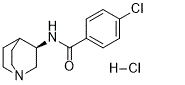
PNU-282987 (N-[(3R)-1-氮杂双环[2.2.2]辛-3-基]-4-氯苯甲酰胺) 是一系列奎宁环苯甲酰胺类化合物中最有效的α7 nAChR激动剂。3-氨基奎宁环的(R)-对映体是α7活性的优选构型,这与同一化学类别中5-HT₃受体拮抗的构效关系相反。苯甲酰胺环上的小对位取代基(例如 Cl、F、OMe、Me)对药物效力至关重要;该位置空间位阻的增加会显著降低活性。该化合物可作为一种选择性药理学工具,并有望成为开发治疗精神分裂症等疾病相关认知和注意力缺陷药物的模板,因为它能够逆转啮齿动物模型中的感觉门控缺陷。[1] |
| 分子式 |
C14H18CL2N2O
|
|
|---|---|---|
| 分子量 |
301.21
|
|
| 精确质量 |
300.079
|
|
| 元素分析 |
C, 55.83; H, 6.02; Cl, 23.54; N, 9.30; O, 5.31
|
|
| CAS号 |
123464-89-1
|
|
| 相关CAS号 |
737727-12-7 (S enantiomer); 128311-08-0 (S enantiomer hydrochloride); PNU-282987 free base;711085-63-1
|
|
| PubChem CID |
11243536
|
|
| 外观&性状 |
White to off-white solid powder
|
|
| 密度 |
1.3±0.1 g/cm3
|
|
| 沸点 |
431.5±30.0 °C at 760 mmHg
|
|
| 闪点 |
214.8±24.6 °C
|
|
| 蒸汽压 |
0.0±1.0 mmHg at 25°C
|
|
| 折射率 |
1.612
|
|
| LogP |
2.49
|
|
| tPSA |
32.34
|
|
| 氢键供体(HBD)数目 |
2
|
|
| 氢键受体(HBA)数目 |
2
|
|
| 可旋转键数目(RBC) |
2
|
|
| 重原子数目 |
19
|
|
| 分子复杂度/Complexity |
307
|
|
| 定义原子立体中心数目 |
1
|
|
| SMILES |
O=C(N[C@H]1CN2CCC1CC2)C3=CC=C(Cl)C=C3.[H]Cl
|
|
| InChi Key |
HSEQUIRZHDYOIX-ZOWNYOTGSA-N
|
|
| InChi Code |
InChI=1S/C14H17ClN2O.ClH/c15-12-3-1-11(2-4-12)14(18)16-13-9-17-7-5-10(13)6-8-17;/h1-4,10,13H,5-9H2,(H,16,18);1H/t13-;/m0./s1
|
|
| 化学名 |
|
|
| 别名 |
|
|
| HS Tariff Code |
2934.99.9001
|
|
| 存储方式 |
Powder -20°C 3 years 4°C 2 years In solvent -80°C 6 months -20°C 1 month 注意: 请将本产品存放在密封且受保护的环境中,避免吸湿/受潮。 |
|
| 运输条件 |
Room temperature (This product is stable at ambient temperature for a few days during ordinary shipping and time spent in Customs)
|
| 溶解度 (体外实验) |
|
|||
|---|---|---|---|---|
| 溶解度 (体内实验) |
配方 1 中的溶解度: 1 mg/mL (3.32 mM) in 10% DMSO + 40% PEG300 + 5% Tween80 + 45% Saline (这些助溶剂从左到右依次添加,逐一添加), 悬浮液;超声助溶。
例如,若需制备1 mL的工作液,可将100 μL 10.0 mg/mL澄清DMSO储备液加入400 μL PEG300中,混匀;然后向上述溶液中加入50 μL Tween-80,混匀;加入450 μL生理盐水定容至1 mL。 *生理盐水的制备:将 0.9 g 氯化钠溶解在 100 mL ddH₂O中,得到澄清溶液。 配方 2 中的溶解度: ≥ 1 mg/mL (3.32 mM) (饱和度未知) in 10% DMSO + 90% Corn Oil (这些助溶剂从左到右依次添加,逐一添加), 澄清溶液。 例如,若需制备1 mL的工作液,可将 100 μL 10.0 mg/mL 澄清 DMSO 储备液加入到 900 μL 玉米油中并混合均匀。 View More
配方 3 中的溶解度: 50 mg/mL (166.00 mM) in PBS (这些助溶剂从左到右依次添加,逐一添加), 澄清溶液; 超声助溶. 1、请先配制澄清的储备液(如:用DMSO配置50 或 100 mg/mL母液(储备液)); 2、取适量母液,按从左到右的顺序依次添加助溶剂,澄清后再加入下一助溶剂。以 下列配方为例说明 (注意此配方只用于说明,并不一定代表此产品 的实际溶解配方): 10% DMSO → 40% PEG300 → 5% Tween-80 → 45% ddH2O (或 saline); 假设最终工作液的体积为 1 mL, 浓度为5 mg/mL: 取 100 μL 50 mg/mL 的澄清 DMSO 储备液加到 400 μL PEG300 中,混合均匀/澄清;向上述体系中加入50 μL Tween-80,混合均匀/澄清;然后继续加入450 μL ddH2O (或 saline)定容至 1 mL; 3、溶剂前显示的百分比是指该溶剂在最终溶液/工作液中的体积所占比例; 4、 如产品在配制过程中出现沉淀/析出,可通过加热(≤50℃)或超声的方式助溶; 5、为保证最佳实验结果,工作液请现配现用! 6、如不确定怎么将母液配置成体内动物实验的工作液,请查看说明书或联系我们; 7、 以上所有助溶剂都可在 Invivochem.cn网站购买。 |
| 制备储备液 | 1 mg | 5 mg | 10 mg | |
| 1 mM | 3.3199 mL | 16.5997 mL | 33.1994 mL | |
| 5 mM | 0.6640 mL | 3.3199 mL | 6.6399 mL | |
| 10 mM | 0.3320 mL | 1.6600 mL | 3.3199 mL |
1、根据实验需要选择合适的溶剂配制储备液 (母液):对于大多数产品,InvivoChem推荐用DMSO配置母液 (比如:5、10、20mM或者10、20、50 mg/mL浓度),个别水溶性高的产品可直接溶于水。产品在DMSO 、水或其他溶剂中的具体溶解度详见上”溶解度 (体外)”部分;
2、如果您找不到您想要的溶解度信息,或者很难将产品溶解在溶液中,请联系我们;
3、建议使用下列计算器进行相关计算(摩尔浓度计算器、稀释计算器、分子量计算器、重组计算器等);
4、母液配好之后,将其分装到常规用量,并储存在-20°C或-80°C,尽量减少反复冻融循环。
计算结果:
工作液浓度: mg/mL;
DMSO母液配制方法: mg 药物溶于 μL DMSO溶液(母液浓度 mg/mL)。如该浓度超过该批次药物DMSO溶解度,请首先与我们联系。
体内配方配制方法:取 μL DMSO母液,加入 μL PEG300,混匀澄清后加入μL Tween 80,混匀澄清后加入 μL ddH2O,混匀澄清。
(1) 请确保溶液澄清之后,再加入下一种溶剂 (助溶剂) 。可利用涡旋、超声或水浴加热等方法助溶;
(2) 一定要按顺序加入溶剂 (助溶剂) 。
InvivoChem的所有产品仅用于作科学研究,不面向患者销售
Copyright 2020 InvivoChem LLC | All Rights Reserved 粤ICP备20063088号-1


 COA
COA
 粤公网安备 44011102003439号
 463611831
