
| 靶点 |
α2-adrenergic receptor[1]
|
|---|---|
| 体内研究 (In Vivo) |
给予赛拉嗪(5.2 mg/kg;腹膜内注射;10-60分钟;雄性 Sprague-Dawley 大鼠)可改变 AMPK 信号分子的 mRNA 表达和蛋白质磷酸化水平,表明 LKB1-AMPK 通路在赛拉嗪治疗引起的中枢神经系统镇静和安神作用中发挥作用[1]。
|
| 动物实验 |
Animal/Disease Models:Male Sprague-Dawley rats (160-180 g)[1]
Doses: 5.2 mg/kg Route of Administration: Intraperitoneal injection; for 10 minutes, 20 minutes, 40 minutes or 60 minutes Experimental Results: Increased in AMPK activity in the cerebral cortex, hippocampus, thalamus and cerebellum. Phosphorylated LKB1 and AMPKα protein levels were decreased. |
| 毒性/毒理 (Toxicokinetics/TK) |
5707 women TDLo oral 8 mg/kg BEHAVIORAL: SOMNOLENCE (GENERAL DEPRESSED ACTIVITY); BEHAVIORAL: CHANGES IN MOTOR ACTIVITY (SPECIFIC ASSAY); CARDIAC: PULSE RATE Clinical Toxicology., 18(663), 1981 [PMID:6115734]
5707 women TDLo intramuscular 734 ug/kg SENSE ORGANS AND SPECIAL SENSES: MIOSIS (PUPILLARY CONSTRICTION): EYE; CARDIAC: PULSE RATE; VASCULAR: BP LOWERING NOT CHARACTERIZED IN AUTONOMIC SECTION American Journal of Emergency Medicine., 4(222), 1986 [PMID:3964361] 5707 women TDLo intramuscular 22 mg/kg BEHAVIORAL: SOMNOLENCE (GENERAL DEPRESSED ACTIVITY); CARDIAC: PULSE RATE; LUNGS, THORAX, OR RESPIRATION: PLEURAL THICKENING American Journal of Emergency Medicine., 4(222), 1986 [PMID:3964361] 5707 rat LD50 oral 130 mg/kg Deutsche Tieraerztliche Wochenschrift., 75(565), 1968 [PMID:4973114] 5707 mouse LD50 oral 240 mg/kg Deutsche Tieraerztliche Wochenschrift., 75(565), 1968 [PMID:4973114] |
| 参考文献 | |
| 其他信息 |
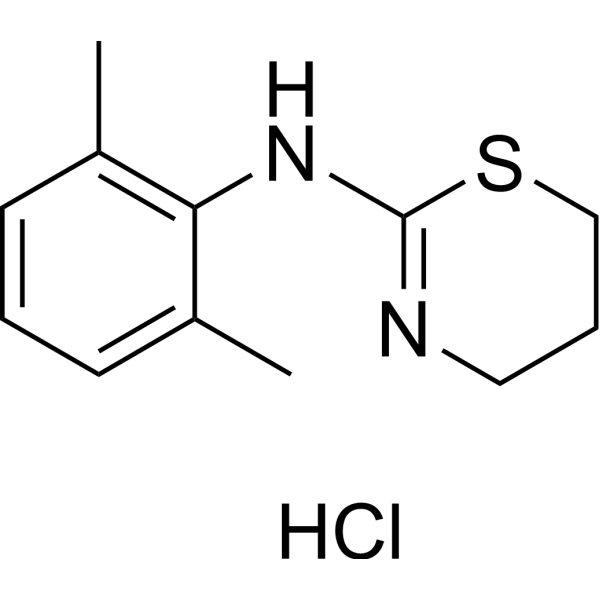
Xylazine hydrochloride is the hydrochloride salt of xylazine. It is used as a sedative, analgesic, and muscle relaxant in veterinary medicine. It has a role as an alpha-adrenergic agonist, an analgesic, an emetic, a muscle relaxant and a sedative. It contains a xylazine(1+).
An adrenergic alpha-2 agonist used as a sedative, analgesic and centrally acting muscle relaxant in VETERINARY MEDICINE. See also: Xylazine (has active moiety). Xylazine is a potent analgesic extensively used in veterinary and animal experimentation. Evidence exists that the analgesic effect can be inhibited using adenosine 5'-monophosphate activated protein kinase (AMPK) inhibitors. Considering this idea, the aim of this study was to investigate whether the AMPK signaling pathway is involved in the central analgesic mechanism of xylazine in the rat. Xylazine was administrated via the intraperitoneal route. Sprague-Dawley rats were sacrificed and the cerebral cortex, cerebellum, hippocampus, thalamus and brainstem were collected for determination of liver kinase B1 (LKB1) and AMPKα mRNA expression using quantitative real-time polymerase chain reaction (qPCR), and phosphorylated LKB1 and AMPKα levels using western blot. The results of our study showed that compared with the control group, xylazine induced significant increases in AMPK activity in the cerebral cortex, hippocampus, thalamus and cerebellum after rats received xylazine (P < 0.01). Increased AMPK activities were accompanied with increased phosphorylation levels of LKB1 in corresponding regions of rats. The protein levels of phosphorylated LKB1 and AMPKα in these regions returned or tended to return to control group levels. However, in the brainstem, phosphorylated LKB1 and AMPKα protein levels were decreased by xylazine compared with the control (P < 0.05). In conclusion, our data indicates that xylazine alters the activities of LKB1 and AMPK in the central nervous system of rats, which suggests that xylazine affects the regulatory signaling pathway of the analgesic mechanism in the rat brain.[1] |
| 分子式 |
C12H17CLN2S
|
|---|---|
| 分子量 |
256.79
|
| 精确质量 |
256.08
|
| CAS号 |
23076-35-9
|
| 相关CAS号 |
7361-61-7 (Parent)
|
| PubChem CID |
68554
|
| 外观&性状 |
Solid powder
|
| 密度 |
1.15g/cm3
|
| 沸点 |
334.2ºC at 760mmHg
|
| 熔点 |
150-164?C (dec.)
|
| 闪点 |
155.9ºC
|
| 蒸汽压 |
0.00013mmHg at 25°C
|
| LogP |
3.518
|
| tPSA |
49.69
|
| 氢键供体(HBD)数目 |
2
|
| 氢键受体(HBA)数目 |
2
|
| 可旋转键数目(RBC) |
2
|
| 重原子数目 |
16
|
| 分子复杂度/Complexity |
230
|
| 定义原子立体中心数目 |
0
|
| SMILES |
Cl[H].S1C(=NC([H])([H])C([H])([H])C1([H])[H])N([H])C1C(C([H])([H])[H])=C([H])C([H])=C([H])C=1C([H])([H])[H]
|
| InChi Key |
QYEFBJRXKKSABU-UHFFFAOYSA-N
|
| InChi Code |
InChI=1S/C12H16N2S.ClH/c1-9-5-3-6-10(2)11(9)14-12-13-7-4-8-15-12;/h3,5-6H,4,7-8H2,1-2H3,(H,13,14);1H
|
| 化学名 |
N-(2,6-dimethylphenyl)-5,6-dihydro-4H-1,3-thiazin-2-amine;hydrochloride
|
| 别名 |
Xylazine hydrochloride; N-(2,6-Dimethylphenyl)-5,6-dihydro-4H-1,3-thiazin-2-amine; Rompun; Xilazina; Xylazin; Chanazine; Xylazinum; BAY 1470 hydrochloride
|
| HS Tariff Code |
2934.99.9001
|
| 存储方式 |
Powder -20°C 3 years 4°C 2 years In solvent -80°C 6 months -20°C 1 month 注意: 请将本产品存放在密封且受保护的环境中,避免吸湿/受潮。 |
| 运输条件 |
Room temperature (This product is stable at ambient temperature for a few days during ordinary shipping and time spent in Customs)
|
| 溶解度 (体外实验) |
DMSO : ≥ 100 mg/mL (389.42 mM)
H2O : ≥ 50 mg/mL (194.71 mM) |
|---|---|
| 溶解度 (体内实验) |
配方 1 中的溶解度: ≥ 2.5 mg/mL (9.74 mM)(饱和度未知) in 10% DMSO 40% PEG300 5% Tween-80 45% Saline (这些助溶剂从左到右依次添加,逐一添加),澄清溶液。
例如,若需制备1 mL的工作液,可将100 μL 25.0 mg/mL 的澄清 DMSO 储备液加到 400 μL PEG300 中,混合均匀;再向上述体系中加入 50 μL Tween-80,混合均匀;然后再继续加入 450 μL 生理盐水 定容至 1 mL。 *生理盐水的制备:将 0.9 g 氯化钠溶解在 100 mL ddH₂O中,得到澄清溶液。 配方 2 中的溶解度: ≥ 2.5 mg/mL (9.74 mM)(饱和度未知) in 10% DMSO 90% (20% SBE-β-CD in Saline) (这些助溶剂从左到右依次添加,逐一添加),澄清溶液。 例如,若需制备1 mL的工作液,可将100 μL 25.0 mg/mL 的澄清 DMSO 储备液加到 900 μL 20% 的 SBE-β-CD 生理盐水水溶液 中,混合均匀。 *20% SBE-β-CD 生理盐水溶液的制备(4°C,1 周):将 2 g SBE-β-CD 溶解于 10 mL 生理盐水中,得到澄清溶液。 View More
配方 3 中的溶解度: ≥ 2.5 mg/mL (9.74 mM)(饱和度未知) in 10% DMSO 90% Corn Oil (这些助溶剂从左到右依次添加,逐一添加),澄清溶液。 1、请先配制澄清的储备液(如:用DMSO配置50 或 100 mg/mL母液(储备液)); 2、取适量母液,按从左到右的顺序依次添加助溶剂,澄清后再加入下一助溶剂。以 下列配方为例说明 (注意此配方只用于说明,并不一定代表此产品 的实际溶解配方): 10% DMSO → 40% PEG300 → 5% Tween-80 → 45% ddH2O (或 saline); 假设最终工作液的体积为 1 mL, 浓度为5 mg/mL: 取 100 μL 50 mg/mL 的澄清 DMSO 储备液加到 400 μL PEG300 中,混合均匀/澄清;向上述体系中加入50 μL Tween-80,混合均匀/澄清;然后继续加入450 μL ddH2O (或 saline)定容至 1 mL; 3、溶剂前显示的百分比是指该溶剂在最终溶液/工作液中的体积所占比例; 4、 如产品在配制过程中出现沉淀/析出,可通过加热(≤50℃)或超声的方式助溶; 5、为保证最佳实验结果,工作液请现配现用! 6、如不确定怎么将母液配置成体内动物实验的工作液,请查看说明书或联系我们; 7、 以上所有助溶剂都可在 Invivochem.cn网站购买。 |
| 制备储备液 | 1 mg | 5 mg | 10 mg | |
| 1 mM | 3.8942 mL | 19.4712 mL | 38.9423 mL | |
| 5 mM | 0.7788 mL | 3.8942 mL | 7.7885 mL | |
| 10 mM | 0.3894 mL | 1.9471 mL | 3.8942 mL |
1、根据实验需要选择合适的溶剂配制储备液 (母液):对于大多数产品,InvivoChem推荐用DMSO配置母液 (比如:5、10、20mM或者10、20、50 mg/mL浓度),个别水溶性高的产品可直接溶于水。产品在DMSO 、水或其他溶剂中的具体溶解度详见上”溶解度 (体外)”部分;
2、如果您找不到您想要的溶解度信息,或者很难将产品溶解在溶液中,请联系我们;
3、建议使用下列计算器进行相关计算(摩尔浓度计算器、稀释计算器、分子量计算器、重组计算器等);
4、母液配好之后,将其分装到常规用量,并储存在-20°C或-80°C,尽量减少反复冻融循环。
计算结果:
工作液浓度: mg/mL;
DMSO母液配制方法: mg 药物溶于 μL DMSO溶液(母液浓度 mg/mL)。如该浓度超过该批次药物DMSO溶解度,请首先与我们联系。
体内配方配制方法:取 μL DMSO母液,加入 μL PEG300,混匀澄清后加入μL Tween 80,混匀澄清后加入 μL ddH2O,混匀澄清。
(1) 请确保溶液澄清之后,再加入下一种溶剂 (助溶剂) 。可利用涡旋、超声或水浴加热等方法助溶;
(2) 一定要按顺序加入溶剂 (助溶剂) 。
 Chloroguanabenz acetate
 RS-79948-197 hemihydrate
 Dehydro silodosin
 Nebivolol O-β-D-glucuronide
InvivoChem的所有产品仅用于作科学研究,不面向患者销售
Copyright 2020 InvivoChem LLC | All Rights Reserved 粤ICP备20063088号-1


 粤公网安备 44011102003439号
 463611831
