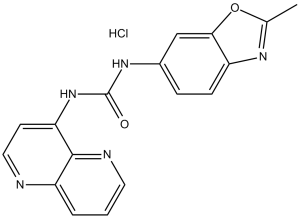
SB-334867 HCl

别名: SB334867A; SB334867; SB 334867; SB334867 HCl; SB334867 hydrochloride; SB-334867A; SB 334867A SB-334867 HCl
目录号: V1309 纯度: ≥98%
SB-334867 HCl (SB-334867A; SB334867; SB 334867) 是 SB-334867 的盐酸盐,是一种新型非肽、选择性 orexin-1 (OX1) 受体拮抗剂,具有治疗睡眠障碍的潜力。
SB-334867 HCl CAS号: 249889-64-3
产品类别: OX Receptor
产品仅用于科学研究,不针对患者销售
规格 价格 库存 数量
5mg
10mg
25mg
50mg
100mg
250mg
Other Sizes

Other Forms of SB-334867 HCl:

  • SB-334867
点击了解更多
InvivoChem产品被CNS等顶刊论文引用
顾客使用InvivoChem 产品SB-334867 HCl发表1篇科研文献
纯度/质量控制文件

纯度: ≥98%

产品描述
SB-334867 HCl (SB-334867A; SB334867; SB 334867) 是 SB-334867 的盐酸盐,是一种新型非肽选择性 orexin-1 (OX1) 受体拮抗剂,具有治疗睡眠障碍的潜力。它抑制 orexin-1,pKb 值为 7.2。它是第一个开发的非肽拮抗剂,对食欲素受体亚型 OX1 具有选择性,对 OX1 受体的选择性约为 OX2 受体的 50 倍。它已被证明可以在动物中产生镇静和厌食作用,并且可用于表征与食欲和睡眠以及其他生理过程有关的大脑系统的食欲调节。
生物活性&实验参考方法
靶点
OX1 receptor
体外研究 (In Vitro)
体外活性:在 CHO-OX1 细胞中,SB-334867 抑制 orexin-A (10 nM) 和 orexin-B (100 nM) 诱导的钙反应,pKB 分别为 7.27 和 7.23,对 UTP (3 microM) 没有影响。 )诱导的钙反应。激酶测定:SB-334867 游离碱是一种选择性非肽食欲素 OX1 受体拮抗剂,pKb 值为 7.2。 IC50 值:7.2 (pKb)。 SB-334867-A抑制食欲素-A (10 nM)和食欲素-B (100 nM)诱导的钙反应(pK(B)分别=7.27+/-0.04和7.23+/-0.03,n=8),但对 CHO-OX(1) 细胞中 UTP (3 microM) 诱导的钙反应没有影响。 SB-334867-A (10 microM) 还抑制 OX(2) 介导的钙反应(与 orexin-A 相比,为 32.7+/-1.9%)。细胞测定:食欲素-A 和食欲素-B 是从大鼠下丘脑分离的两种肽。它们参与一些生理功能,如控制进食、能量代谢和调节睡眠-觉醒周期。 SB-334867 可抑制 CHO-OX1 细胞中 orexin-A 和 orexin-B 诱导的钙反应,pKB 值分别为 7.27 和 7.23。 SB-334867 对 OX1 受体的选择性高于 OX2 受体。它分别抑制 CHO-OX2 细胞中食欲素 A 和食欲素 B 诱导的钙反应 32.7% 和 22%。
体内研究 (In Vivo)
在雄性和雌性大鼠中,SB-334867(30 mg/kg,腹膜内注射)显着减少自然和食欲素 A 诱导的食物摄入。 SB-334867(2 mg/kg,静脉注射)可阻断抗精神病药物对大鼠多巴胺神经元活动的影响。 SB-334867 还抑制大鼠吗啡镇痛耐受的发展。
本研究的重点是SB-334867,一种食欲素-1受体拮抗剂,在吗啡诱导小鼠运动活动敏化的获得中的作用。行为致敏是对相同剂量的成瘾物质的一种增强的全身反应,这可能会增加对药物的渴望和复发成瘾的风险。吗啡诱导的小鼠致敏是通过零星剂量(每3天注射5次)吗啡(10 mg/kg, i.p)实现的,而7天后注射吗啡(10 mg/kg)。为了评估食欲素系统阻断对致敏性获得的影响,除吗啡激发剂量外,每次吗啡注射前均给予SB-334867。吗啡给药后每天进行运动活动试验。行为学测试后收集脑结构(纹状体、海马和前额皮质)进行分子实验,利用qRT-PCR技术检测食欲素、多巴胺和腺苷受体mRNA表达。此外,采用相同的技术分析GFAP和Iba-1等标记物的mRNA表达。SB-334867抑制吗啡诱导的小鼠运动活动敏化。在行为致敏过程中,食欲素、多巴胺和腺苷受体mRNA表达以及GFAP和Iba-1的表达均发生了显著变化,表明食欲素、多巴胺、腺苷和胶质细胞在中脑边缘系统中存在广泛的相互作用。综上所述,食欲素系统可能是抑制吗啡诱导的行为致敏的有效措施。[1] 为了研究orexin-1和orexin-2受体活性在乙醇自我给药中的作用,我们利用高饮啮齿动物模型,在不同的自我给药范式中评估了不同的orexin (OX)受体亚型靶向化合物。采用2瓶选择法,研究了OX1拮抗剂SB334867、OX2拮抗剂LSN2424100和混合OX1/2拮抗剂almorexant (ACT-078573)对乙醇偏好(P)大鼠家笼乙醇消耗的影响。在单独的实验中,我们评估了SB334867、LSN2424100和almorexant对维持渐进式比例强化操作计划的P大鼠操作性乙醇自我给药的影响。在第三个系列的实验中,我们将SB334867、LSN2424100和almorexant给药于乙醇偏好的C57BL/6J小鼠,以观察在狂饮(黑暗中饮酒)模型中,OX受体阻断对乙醇摄入的影响。在长期在家笼中自由选择乙醇的P大鼠中,SB334867和almorexant显著减少了乙醇摄入量,但almorexant也减少了水摄入量,表明对完成行为有非特异性影响。在递进比例操作实验中,LSN2424100和almorexant降低了P大鼠的断点和乙醇消耗,而almorexant无活性对构象和SB334867对乙醇消耗动机没有显著影响。正如预期的那样,车辆注射小鼠在黑暗中饮酒模型中表现出类似狂欢的饮酒模式。与对照对照相比,这三种OX拮抗剂均降低了乙醇摄入量和由此产生的血液乙醇浓度,但SB334867和LSN2424100在不同的小鼠队列中也降低了蔗糖消耗,提示非特异性作用。总的来说,这些结果提供了越来越多的证据,表明OX1和OX2受体活性影响乙醇的自我给药,尽管这种影响可能对乙醇的消耗没有选择性。[2]
酶活实验
SB-334867 free base 的 IC50 值为 7.2 (pKb),是一种选择性非肽 orexin OX1 受体拮抗剂。在 CHO-OX(1) 细胞中,SB-334867-A 不影响 UTP (3 microM) 诱导的钙反应,但确实抑制对 orexin-A (10 nM) 和 orexin-B (100 nM) 的反应( pK(B)分别=7.27+/-0.04和7.23+/-0.03,n=8)。 OX(2) 介导的钙反应也被 SB-334867-A (10 microM) 抑制(与 orexin-A 相比,抑制率为 32.7+/-1.9%)。
细胞实验
从大鼠下丘脑提取的两种肽称为食欲素-A 和食欲素-B。它们参与的一些生理过程包括摄食调节、能量代谢和睡眠-觉醒周期调节。在 CHO-OX1 细胞中,SB-334867 可以抑制 orexin-A 和 orexin-B 诱导的钙反应,pKB 值分别为 7.27 和 7.23。对于 OX1 受体,SB-334867 比 OX2 受体表现出更高的选择性。它可抑制 CHO-OX2 细胞中由 orexin-A 和 orexin-B 分别诱导 32.7% 和 22% 的钙反应。
动物实验
Drugs in Behavioral Experiments[1]
The following drugs were used in the experiments: morphine hydrochloride trihydrate (Cosmetic Pharma, Poland) and 1-(2-methyylbenzoxanzol-6-yl)-3-[1,5]naphthyridin-4-yl-urea hydrochloride (SB-334867)—a selective OX-1 receptor antagonist. Morphine was dissolved in 0.9% saline, and SB-334867 was dissolved in three drops of DMSO and diluted in 0.9% saline (final the DMSO concentration 0.1%). All used substances were delivered intraperitoneally (i.p.) in a volume of 10 ml/kg. Morphine was used at the dose of 10 mg/kg, and SB-334867 was injected at the dose of 20 mg/kg. As literature data show, the minimal effective dose of SB-334867 is 30 mg/kg. According to the generally accepted principles of behavioral sensitization research, an ineffective dose of pharmacological agents (SB-334867 in our study) is recommended. Therefore, based on the literature data and on our preliminary unpublished results, the dose of SB-334867 (20 mg/kg), administered in the reported study, was subthreshold. The animals in a control group received the same volume of saline at the respective time point before the test.
Procedure of Behavioral Sensitization[1]
The Influence of SB-334867(OX-1 Receptor Antagonist, 20 mg/kg, i.p.) on the Acquisition of Morphine Sensitization to Locomotor Activity[1]
The induced morphine behavioral sensitization in mice was based on the method, described by Kuribara, with a modification of Kotlińska and Bocheński. The animals received five injections of morphine (i.p.) at the dose of 10 mg/kg every 3 days (on the 1st, 4th, 7th, 10th, and 13th day of the experiment). Seven days after the last morphine injection (on the 20th day of the study), the mice were administered with a challenge dose of morphine (10 mg/kg, i.p.). Aiming to grade the development of behavioral sensitization, the mice were immediately placed into the actometer to record their locomotor activity for the period of 60 min. The control animals were administered with saline (i.p.).[1]
Afterwards, the effects of SB-334867 (the selective OX-1 receptor antagonist) on the acquisition of morphine-induced sensitization were explored. SB-334867 was administered 15 min before morphine injection on the 1st, 4th, 7th, 10th, and 13th day of the experiment, but not on the 20th day. The control animals were administered with saline (i.p.).
All 32 P rats had chronic access to ethanol in the home cage for approximately 8–14 months before the current studies were conducted. P rats were divided into 3 groups. One group (n = 10) was used to test the effects of SB-334867 and a second group (n = 11) was used to test the effects of LSN2424100 (one rat was excluded from the experiment due to low baseline drinking). A within-subjects experimental design was used to test the OX1 and OX2 receptor antagonists. These rats, along with another group of 11 (i.e., all 32 P rats) were tested in the almorexant study using a between-subjects design (n = 8/dose).[2]
N-((1H-imidazol-2-yl)methyl)-N-([1,1′-biphenyl]-2-yl)-4-fluorobenzenesulfonamide hydrochloride (LSN2424100), SB-334867, (S)-almorexant (ACT-078573), and the inactive (R) enantiomer of almorexant were synthesized at Lilly Research Laboratories (Indianapolis, IN). Naltrexone hydrochloride was purchased from Sigma Aldrich (St. Louis, MO). For rat experiments, the OX1 antagonist SB-334867 was dissolved in a vehicle of 10% (2-hydroxypropyl)-β-cyclodextrin, 2% dimethyl sulfoxide, and 0.05% lactic acid in water, and administered by intraperitoneal (i.p.) injection in a dose volume of 1 ml/kg. The OX2 antagonist LSN2424100 was suspended in 1% carboxymethyl cellulose, 0.25% polysorbate-80 and 0.05% Dow antifoam in water, and administered by i.p. injection in a dose volume of 1 ml/kg. The mixed OX1/2 antagonist almorexant, and its inactive enantiomer, were dissolved in a 20% Captisol solution and administered orally (p.o.) in a dose volume of 1 ml/kg. Naltrexone was dissolved in water with the addition of 15 μl 85% lactic acid.[2]
For mouse experiments, SB-334867 was dissolved using 0.01% polysorbate-80 in saline. Almorexant was dissolved in 20% Captisol in water. LSN2424100 was suspended using 1% carboxymethyl cellulose and 0.25% polysorbate-80 in water. All compounds were administered by i.p. injection at a dose volume of 10 ml/kg.
Home cage 2-bottle choice drinking in P rats[2]
P rats were housed individually in TSE LabMaster cages with food, water, and 15% ethanol (v/v) available at all times. Water and ethanol intake (in ml) were measured once every 5 min throughout the 12-h dark cycle and recorded for later analysis. In the first experiment, rats (n = 10) received vehicle, 3, 10, or 30 mg/kg SB-334867 (i.p.), 60 min before onset of the 12-h dark phase of the light-dark cycle, using a within-subjects design. In the second experiment, rats (n = 10) received vehicle, naltrexone (10 mg/kg), or LSN2424100 at doses of 10 or 30 mg/kg (i.p.), 60 min before onset of the 12-h dark phase, using a within-subjects design (one rat was excluded from the experiment due to low baseline drinking). In the third experiment, rats (n = 32) received vehicle, naltrexone (10 mg/kg), or S-almorexant at doses of 60 or 100 mg/kg (p.o.), 60 min before onset of the dark cycle, using a between-subjects design. Naltrexone was included in the study design as a positive control, since this dose of naltrexone has been shown to effectively reduce ethanol consumption in P rats under these testing conditions. For all experiments, a 60-min pre-treatment period was chosen so that the onset of the dark cycle roughly coincided with the time at which maximal brain concentrations were achieved (data not reported). Consumption of water and ethanol was measured during the first 3 h of the dark cycle, based on the short half-lives and high metabolism of the compounds.
Experiments were conducted using a within-subject design, with 3–4 days washout between administration of different doses, which were counterbalanced using a Latin square design. One group of n = 10 rats was used to test the effects of SB-334867, LSN2424100, and almorexant on operant responding maintained on a progressive ratio schedule, in separate experiments. Drugs were administered two days per week (Tues and Fri) to allow for washout between subsequent doses. Rats received vehicle, 3, 10, or 30 mg/kgSB-334867 (i.p., 30 min prior to the session); vehicle, 3, 10, or 30 mg/kg LSN2424100 (i.p., 30 min prior to the session); or vehicle, 10, 30, or 60 mg/kg almorexant or 60 mg/kg of the inactive enantiomer of almorexant (p.o., 60 min prior to the session). On all other days, rats received progressive ratio operant testing without any drug treatments to maintain operant performance and confirm return to baseline behaviors. One rat was excluded from testing 60 mg/kg almorexant due to observation of a skin rash not related to the study drug.[2]
Binge drinking in C57BL/6J mice[2]
One week prior to ethanol intake testing, mice were given daily saline injections (i.p.) to acclimate them to handling and injection procedures. Ethanol consumption was assessed using a 4-day drinking-in-the-dark (DID) paradigm during which the water bottle in the home cage was replaced with a single bottle of ethanol (20% v/v) starting 3 h after the onset of the dark cycle. This procedure has been shown to produce high blood ethanol concentrations (BECs) resulting from high levels of ethanol consumption in a relatively short period of time (Rhodes et al., 2005). On the first three days, animals were injected with saline or vehicle 30 min prior to a 2-h period of access to ethanol. On the 4th day, drugs were administered via i.p. injection 30 min prior to the test session, which was extended to 4 h. One cohort of mice was administered vehicle, 3, 10, or 30 mg/kg SB-334867 (n = 10/dose). A second cohort of mice was tested with vehicle, 15, 30, or 60 mg/kg LSN2424100 (n = 9–10/dose). A third cohort of animals was given vehicle, 25, 50, or 100 mg/kg almorexant (n = 10/dose). In order to assess resulting BECs, immediately upon removal of ethanol bottles, blood samples were collected from the retro-orbital sinus and centrifuged. [2]
In order to assess the specificity of drug effects on ethanol consumption, an additional group of ethanol-naïve animals was tested with sucrose solution (1% w/v) in the same DID paradigm (Days 1–3: 2-h access with saline injections; Day 4: 4-h test session with drug pretreatment). On the 4th day, vehicle, 3, 10, or 30 mg/kg (n = 6–7/dose) SB-334867 was administered prior to the 4-h access period. During a subsequent week of testing, these same mice were administered either vehicle or 100 mg/kg almorexant (n = 14/dose) before the 4-h intake session. In a separate cohort of mice, vehicle or 60 mg/kg LSN2424100 (n = 9–10/dose) was administered prior to the 4-h test.
Dissolved in 10% (w/v) Encapsin in sterile water; 30 mg/kg; i.p. administration
Male and female Sprague–Dawley rats
参考文献

[1]. 1,3-Biarylureas as selective non-peptide antagonists of the orexin-1 receptor.Bioorg Med Chem Lett. 2001 Jul 23;11(14):1907-10.

[2]. SB-334867 (an Orexin-1 Receptor Antagonist) Effects on Morphine-Induced Sensitization in Mice-a View on Receptor Mechanisms. Mol Neurobiol. 2018 Nov;55(11):8473-8485.

[3]. Orexin-1 and orexin-2 receptor antagonists reduce ethanol self-administration in high-drinking rodent models.Front Neurosci. 2014 Feb 25;8:33.

[4]. SB-334867-A: the first selective orexin-1 receptor antagonist.Br J Pharmacol. 2001 Mar;132(6):1179-82.

其他信息
1-(2-Methyl-1,3-benzoxazol-6-yl)-3-(1,5-naphthid-4-yl)urea is a naphthidine derivative. This study focuses on the role of the orexin-1 receptor antagonist SB-334867 in morphine-induced motor sensitization in mice. Behavioral sensitization refers to an enhanced systemic response to the same dose of an addictive substance, which is thought to increase drug cravings and the risk of relapse. Morphine sensitization was induced in mice by intermittent injections of morphine (10 mg/kg, intraperitoneally, every 3 days for a total of 5 injections), followed by a challenge dose of morphine (10 mg/kg) 7 days later. To assess the effect of orexin system blockade on the acquisition of sensitization, SB-334867 was administered before each morphine injection, except for the challenge dose. Motor activity was tested on the day of each morphine administration. After behavioral testing, brain tissue (striatum, hippocampus and prefrontal cortex) was collected for molecular experiments. The mRNA expression of orexin, dopamine and adenosine receptors was detected by qRT-PCR. In addition, the mRNA expression of markers such as GFAP and Iba-1 was analyzed by the same technique. SB-334867 inhibited the acquisition of morphine-induced motor activity sensitization in mice. During behavioral sensitization, the mRNA expression of orexin, dopamine and adenosine receptors as well as the expression of GFAP and Iba-1 were significantly altered, indicating that there is extensive interaction between orexin, dopamine, adenosine and glial cells in the mesolimbic system. In summary, the orexin system may be an effective means of inhibiting morphine-induced behavioral sensitization. [1]
To study the role of orexin-1 and orexin-2 receptor activity in ethanol self-administration, we used a high-drinking rodent model to evaluate compounds that differentially target orexin (OX) receptor subtypes in various self-administration paradigms. This study employed a two-bottle selection method to test the effects of the OX1 antagonist SB334867, the OX2 antagonist LSN2424100, and the mixed OX1/2 antagonist allomorexant (ACT-078573) on cage-borne ethanol intake in alcohol-loving (P) rats. In another experiment, the effects of SB334867, LSN2424100, and allomorexant on operant ethanol self-administration in P rats trained with a progressive ratio operant reinforcement program were assessed. In a third experiment, SB334867, LSN2424100, and allomorexant were administered to alcohol-loving C57BL/6J mice to investigate the effect of OX receptor blockade on ethanol intake in a binge-drinking (drinking in secret) model. In P rats subjected to long-term free choice of ethanol consumption, both SB334867 and allomorexant significantly reduced ethanol intake, but allomorexant also reduced water consumption, suggesting a non-specific effect on feeding behavior. In the progressive ratio operant conditioning experiment, LSN2424100 and almorexant reduced breakpoint and ethanol consumption in P rats, while the inactive enantiomer of almorexant and SB334867 had no significant effect on ethanol intake motivation. As expected, in the dark drinking model, mice injected with the vehicle exhibited a binge-drinking pattern. Compared with the control group injected with the vehicle, all three OX antagonists reduced ethanol intake and blood ethanol concentration, but SB334867 and LSN2424100 also reduced sucrose consumption in another group of mice, suggesting a non-specific effect. Overall, these results provide growing evidence that OX1 and OX2 receptor activity influences ethanol self-administration, although this effect may not be selectively targeted at ethanol intake. [2]
The pharmacology of various peptide and non-peptide ligands in Chinese hamster ovary (CHO) cells stably expressing human orexin-1 (OX(1)) or orexin-2 (OX(2)) receptors was investigated by measuring intracellular calcium ([Ca(2+)](i)) using Fluo-3AM. Orexin A and orexin B increased intracellular calcium concentration [Ca(2+)](i) in CHO-OX(1) cells (pEC(50) 8.38±0.04 and 7.26±0.05, n=12, respectively) and CHO-OX(2) cells (pEC(50) 8.20±0.03 and 8.26±0.04, respectively, n=8, respectively). However, neuropeptide Y and secretin (10 pM - 10 μM) did not exhibit agonist or antagonist properties in either cell line. SB-334867-A (1-(2-methylbenzoxazol-6-yl)-3-[1,5]naphthidium-4-ylurea hydrochloride) inhibited orexin A (10 nM) and orexin B (100 nM) induced calcium responses (pK(B) 7.27±0.04 and 7.23±0.03, respectively, n=8), but had no effect on UTP (3 μM) induced calcium responses in CHO-OX(1) cells. SB-334867-A (10 μM) also inhibited OX(2) mediated calcium responses (32.7±1.9% inhibition compared to orexin A). SB-334867-A did not exhibit agonist properties in either cell line. In conclusion, SB-334867-A is a non-peptide OX(1) selective receptor antagonist. [3]
*注: 文献方法仅供参考, InvivoChem并未独立验证这些方法的准确性
化学信息 & 存储运输条件
分子式
C17H14NCLN5O2
分子量
319.32
精确质量
319.11
元素分析
C, 57.39; H, 3.97; Cl, 9.96; N, 19.68; O, 8.99
CAS号
249889-64-3
相关CAS号
SB-334867 free base; 792173-99-0
PubChem CID
6604926
外观&性状
White to off-white solid powder
密度
1.472g/cm3
沸点
450.5ºC at 760 mmHg
闪点
226.2ºC
蒸汽压
2.63E-08mmHg at 25°C
折射率
1.793
LogP
3.869
tPSA
92.94
氢键供体(HBD)数目
2
氢键受体(HBA)数目
5
可旋转键数目(RBC)
2
重原子数目
24
分子复杂度/Complexity
462
定义原子立体中心数目
0
SMILES
O=C(NC1=CC(OC(C)=N2)=C2C=C1)NC3=CC=NC4=CC=CN=C43.Cl
InChi Key
AKMNUCBQGHFICM-UHFFFAOYSA-N
InChi Code
InChI=1S/C17H13N5O2.ClH/c1-10-20-12-5-4-11(9-15(12)24-10)21-17(23)22-14-6-8-18-13-3-2-7-19-16(13)14;/h2-9H,1H3,(H2,18,21,22,23);1H
化学名
1-(2-methylbenzo[d]oxazol-6-yl)-3-(1,5-naphthyridin-4-yl)urea hydrochloride
别名
SB334867A; SB334867; SB 334867; SB334867 HCl; SB334867 hydrochloride; SB-334867A; SB 334867A
HS Tariff Code
2934.99.9001
存储方式

Powder      -20°C    3 years

                     4°C     2 years

In solvent   -80°C    6 months

                  -20°C    1 month

注意: 请将本产品存放在密封且受保护的环境中,避免吸湿/受潮。
运输条件
Room temperature (This product is stable at ambient temperature for a few days during ordinary shipping and time spent in Customs)
溶解度数据
溶解度 (体外实验)
DMSO: ~63 mg/mL (~197.3 mM)
Water: <1 mg/mL
Ethanol: ~3 mg/mL(~9.4 mM)
制备储备液 1 mg 5 mg 10 mg
1 mM 3.1317 mL 15.6583 mL 31.3165 mL
5 mM 0.6263 mL 3.1317 mL 6.2633 mL
10 mM 0.3132 mL 1.5658 mL 3.1317 mL

1、根据实验需要选择合适的溶剂配制储备液 (母液):对于大多数产品,InvivoChem推荐用DMSO配置母液 (比如:5、10、20mM或者10、20、50 mg/mL浓度),个别水溶性高的产品可直接溶于水。产品在DMSO 、水或其他溶剂中的具体溶解度详见上”溶解度 (体外)”部分;

2、如果您找不到您想要的溶解度信息,或者很难将产品溶解在溶液中,请联系我们;

3、建议使用下列计算器进行相关计算(摩尔浓度计算器、稀释计算器、分子量计算器、重组计算器等);

4、母液配好之后,将其分装到常规用量,并储存在-20°C或-80°C,尽量减少反复冻融循环。

计算器

摩尔浓度计算器可计算特定溶液所需的质量、体积/浓度,具体如下:

  • 计算制备已知体积和浓度的溶液所需的化合物的质量
  • 计算将已知质量的化合物溶解到所需浓度所需的溶液体积
  • 计算特定体积中已知质量的化合物产生的溶液的浓度
使用摩尔浓度计算器计算摩尔浓度的示例如下所示:
假如化合物的分子量为350.26 g/mol,在5mL DMSO中制备10mM储备液所需的化合物的质量是多少?
  • 在分子量(MW)框中输入350.26
  • 在“浓度”框中输入10,然后选择正确的单位(mM)
  • 在“体积”框中输入5,然后选择正确的单位(mL)
  • 单击“计算”按钮
  • 答案17.513 mg出现在“质量”框中。以类似的方式,您可以计算体积和浓度。

稀释计算器可计算如何稀释已知浓度的储备液。例如,可以输入C1、C2和V2来计算V1,具体如下:

制备25毫升25μM溶液需要多少体积的10 mM储备溶液?
使用方程式C1V1=C2V2,其中C1=10mM,C2=25μM,V2=25 ml,V1未知:
  • 在C1框中输入10,然后选择正确的单位(mM)
  • 在C2框中输入25,然后选择正确的单位(μM)
  • 在V2框中输入25,然后选择正确的单位(mL)
  • 单击“计算”按钮
  • 答案62.5μL(0.1 ml)出现在V1框中
g/mol

分子量计算器可计算化合物的分子量 (摩尔质量)和元素组成,具体如下:

注:化学分子式大小写敏感:C12H18N3O4  c12h18n3o4
计算化合物摩尔质量(分子量)的说明:
  • 要计算化合物的分子量 (摩尔质量),请输入化学/分子式,然后单击“计算”按钮。
分子质量、分子量、摩尔质量和摩尔量的定义:
  • 分子质量(或分子量)是一种物质的一个分子的质量,用统一的原子质量单位(u)表示。(1u等于碳-12中一个原子质量的1/12)
  • 摩尔质量(摩尔重量)是一摩尔物质的质量,以g/mol表示。
/

配液计算器可计算将特定质量的产品配成特定浓度所需的溶剂体积 (配液体积)

  • 输入试剂的质量、所需的配液浓度以及正确的单位
  • 单击“计算”按钮
  • 答案显示在体积框中
动物体内实验配方计算器(澄清溶液)
第一步:请输入基本实验信息(考虑到实验过程中的损耗,建议多配一只动物的药量)
第二步:请输入动物体内配方组成(配方适用于不溶/难溶于水的化合物),不同的产品和批次配方组成不同,如对配方有疑问,可先联系我们提供正确的体内实验配方。此外,请注意这只是一个配方计算器,而不是特定产品的确切配方。
+
+
+

计算结果:

工作液浓度 mg/mL;

DMSO母液配制方法 mg 药物溶于 μL DMSO溶液(母液浓度 mg/mL)。如该浓度超过该批次药物DMSO溶解度,请首先与我们联系。

体内配方配制方法μL DMSO母液,加入 μL PEG300,混匀澄清后加入μL Tween 80,混匀澄清后加入 μL ddH2O,混匀澄清。

(1) 请确保溶液澄清之后,再加入下一种溶剂 (助溶剂) 。可利用涡旋、超声或水浴加热等方法助溶;
            (2) 一定要按顺序加入溶剂 (助溶剂) 。

生物数据图片

  • SB-334867 HCl

    SB-334867-A inhibits human OX1 receptor-mediated calcium responses in a concentration-dependent manner.Br J Pharmacol. 2001 Mar; 132(6): 1179–1182.

  • SB-334867 HCl
    Effects of olanzapine (3 mg/kg, i.v.) followed 30 min later by administration of the SB-334867 (SB; 2 mg/kg, i.v.) or vehicle (veh) on the firing rate of locus coeruleus (LC) neurons.Neuropsychopharmacology.2007 Apr;32(4):786-92.


  • SB-334867 HCl
    Effect of chronic administration of olanzapine (OLZ; 10 mg/kg/day, s.c. times 21 days) or vehicle (VEH) and acute administration of SB-334867 (SB; 2 mg/kg, i.v.) on the number of A9 and A10 dopamine cells per track.Neuropsychopharmacology.2007 Apr;32(4):786-92.
相关产品
联系我们