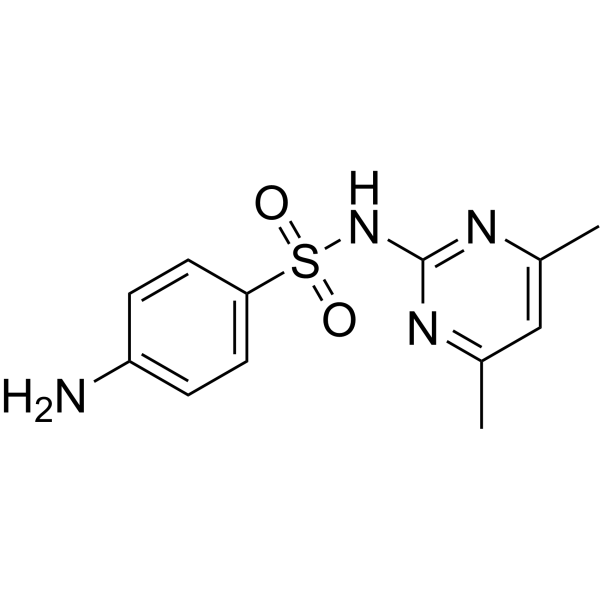
Sulfamethazine

别名: HSDB 4157; HSDB 4157; HSDB 4157 磺胺二甲嘧啶;2-(对氨基苯磺酰胺基)-4,6-二甲基嘧啶;磺胺间二甲嘧啶;磺胺二甲基嘧啶; 磺胺二甲嘧啶标准品;工业磺胺;磺胺二甲嘧啶 EP标准品;磺胺二甲嘧啶 USP标准品;磺胺二甲嘧啶 标准品;磺胺二甲嘧啶峰鉴别 EP标准品;磺胺二甲嘧啶饲料添加剂;4-氨基-N-(4,6-二甲基-2-嘧啶基)苯磺酰胺;防治抗菌;磺胺双甲基嘧啶;4,6-二甲基磺胺嘧啶;N-(4,6-二甲基-2-嘧啶基)-4-氨基苯磺酰胺;磺胺间二甲氧嘧啶
目录号: V15464 纯度: ≥98%
磺胺二甲嘧啶(Sulfadimidine)是一种抗菌剂,广泛用于研究和预防多种动物疾病(如胃肠道和呼吸道感染)。
Sulfamethazine CAS号: 57-68-1
产品类别: New1
产品仅用于科学研究,不针对患者销售
规格 价格 库存 数量
500mg
Other Sizes

Other Forms of Sulfamethazine:

  • Sulfamethazine sodium (磺胺二甲嘧啶钠; Sulfadimidine sodium; Sulfadimerazine sodium)
  • N-Acetyl sulfamethazine-d4
  • 氘代磺胺二甲基嘧啶
  • 磺胺二甲嘧啶-13C6
点击了解更多
InvivoChem产品被CNS等顶刊论文引用
产品描述
磺胺二甲嘧啶(Sulfadimidine)是一种抗菌剂,广泛用于研究和预防多种动物疾病(如胃肠道和呼吸道感染)。在中国和欧盟委员会,动物产品中磺胺二甲嘧啶的最大残留水平为100微克/千克。
生物活性&实验参考方法
体内研究 (In Vivo)
磺胺二甲嗪(80 mg/kg;静脉注射;健康母猪)治疗导致单次肌肉注射80 mg/kg磺胺二甲恶嗪,显着增加t1/2α、Vd和CIB,并显着降低α、β和AUC0->∞ 。猪的绝对生物利用度为 1.01 [1]。
动物实验
Animal/Disease Models: 19 healthy sows (6 weeks old, 4.5-6.2 kg) [1]
Doses: 80 mg/kg
Route of Administration: intravenous (iv) (iv)injection (pharmacokinetic/PK/PK study)
Experimental Results: The half-life of the distribution period is 0.23 hrs (hrs (hours)) and a half - The lifetime of the elimination phase is 9.8 hrs (hrs (hours)). α, β and AUC0->∞ were Dramatically diminished, t1/2α, Vd and CIB were Dramatically increased, and the absolute bioavailability in pigs was 1.01.
药代性质 (ADME/PK)
Absorption, Distribution and Excretion
Rapidly absorbed following oral administration.
The pharmacokinetics and metabolism of sulfadimidine (SDM) following intravenous administration of 100 mg/kg were studied in seven dwarf preruminant kids at 12 weeks of age, and again at the ruminant stage, when the animals were 18 weeks old. The persistence of SDM in 18-week-old kids was prolonged in comparison to the 12-week-old animals: a lower total body clearance and a prolonged elimination of SDM were obtained in the older animals. The renal clearance values of SDM and its metabolites were the same at both ages. The decrease of SDM clearance is related to the significant reduction in SDM hydroxylation at the older age. The reduced oxidative hepatic metabolism may result from the sexual maturation of the kids.
Sulfamethazine acetylation phenotypes were determined in 19 healthy adults (aged 17-46 years; 15 men, four women; nine white, nine oriental, one black) given a single oral dose of 20 mg/kg bw sulfamethazine in 200 mL of water. The results showed a welldefined trimodal pattern for acetylation clearance and for overall elimination or metabolic rate constants and confirmed that the fast acetylator phenotype can be subdivided into intermediate and rapid acetylator groups. The average acetylation clearance rate for rapid acetylators (1.34 mL/min per kg bw) was 8.8 times the estimated clearance for slow acetylators (0.15 mL/min per kg bw) and 1.8 times that for intermediate acetylators (0.75 mL/min per kg bw). The average percentage of an absorbed dose excreted as acetylsulfamethazine in 72-hr urine was 93.7 for rapid acetylators, 87.7 for intermediate acetylators and 65.6 for slow acetylators.
The depletion of sulfadimidine (SDM) and its N4-acetyl and hydroxy metabolites was studied in eggs laid by hens after administration of either a single or multiple oral dosages of 100 mg SDM/kg. During medication and until 1 day after the last dose, the SDM and its metabolite concentrations in the egg white exceeded those in the egg yolk and reflected the plasma levels. In the period starting 2 days after the (last) dosage, the SDM concentration in the yolk became higher than in the egg white, and the drug depletion curves ran parallel. The mean maximum amount of SDM found in the whole egg was 1500 micrograms after a single and 1280 ug after multiple dosage. In eggs, traces of the N4-acetyl and 6-methylhydroxy metabolites could be detected (mainly in the egg white), and their concentrations were approximately 40 times lower than those of the parent drug. A highly significant correlation (P less than 0.005) was found between the development stage of the oocyte at the time of (last) medication and the amount of SDM found in the egg that developed from it. A period of 7 or 8 days after the (last) dosage of 100 mg SDM/kg/day is required to obtain SDM levels below 0.1 ug/g egg.
Relatively strong blood-brain barrier to sulfamethazine was observed in rats. Passage of sulfamethazine from blood to brain was slow and difficult.
For more Absorption, Distribution and Excretion (Complete) data for SULFAMETHAZINE (12 total), please visit the HSDB record page.
Metabolism / Metabolites
Plasma disposition of sulfadimidine (SDM) and its metabolites was studied in laying hens after 100 mg SDM kg-1 doses were administered as a single intravenous dose, a single oral dose and multiple oral doses once daily for five consecutive days. SDM was extensively metabolized by acetylation and hydroxylation. In plasma, the metabolite observed with the highest concentration was N4-acetylsulfadimidine (N4-SDM) followed by hydroxymethylsulfadimidine (CH2OH) and 5-hydroxysulfadimidine. Following intravenous administration a biphasic elimination (as seen for a capacity limited reaction) pattern for SDM and its metabolites was observed. Multiple (5x) SDM dosing revealed plasma SDM concentrations ranging between 7 and 108 ug mL-1; within 96 hours of termination of the multiple SDM dosing, the plasma SDM concentration was below 0.01 ug mL-1. The renal clearances of N4-SDM and the hydroxy metabolites were approximately 10 times greater than that of SDM. The SDM mass balance (fecal/urinary recovery) showed a loss of 56 per cent after intravenous dosage and of 67 per cent after a single oral dosage; the hydroxy metabolites accounted for the highest percentage in feces/urine. Thus additional metabolic pathways must exist in laying hens.
After 10 male and two female healthy volunteers were given oral doses of sulfamethazine of 12-17 mg/kg bw, 10-20% of the dose was excreted in the urine as free and conjugated hydroxylated metabolites and 61-81% as N4-acetylsulfamethazine. Six of the individuals were considered to be fast acetylators and six slow acetylators. The plasma concentration-time curve for sulfamethazine in the fast acetylators was biphasic, with half-times of 1.7 and 5.4 hr, respectively, whereas in the slow acetylators it was monophasic, with a half-time of 7.6 hr.
Sulfamethazine is metabolized similarly in animals and humans, with N4-acetylation dominating. A trimodal pattern of sulfamethazine acetylation is seen in humans. Differences in acetylation rates were observed between male and female rats and among females of different strains.
The pharmacokinetics of sulfamethizole, sulfamethoxazole, sulfadiazine, sulfapyridine and sulfadimidine have been studied in man. Renal clearance values of the metabolite N4-acetylsulphonamide are 6 to 20 times higher than those of the corresponding parent compound. The renal clearance of sulfonamides is dependent on the urine flow. N4-Acetylsulfonamide concentration-time profiles for plasma and urine have been constructed for the sulfonamides. The percentage N4-acetylsulfonamide-time profiles for plasma are excellent tools for establishing the acetylator phenotype, while those constructed from urine samples are less useful. Evidence is obtained that sulfadimidine is metabolically processes by 2 different isoenzymes, while sulfadiazine, sulfapyridine and sulfamethoxazole are processes by 1 acetylating isoenzyme. Sulfamethizole is acetylated to very little extent.
For more Metabolism/Metabolites (Complete) data for SULFAMETHAZINE (9 total), please visit the HSDB record page.
Biological Half-Life
After 10 male and two female healthy volunteers were given oral doses of sulfamethazine of 12-17 mg/kg bw, 10-20% of the dose was excreted in the urine as free and conjugated hydroxylated metabolites and 61-81% as N4-acetylsulfamethazine. Six of the individuals were considered to be fast acetylators and six slow acetylators. The plasma concentration-time curve for sulfamethazine in the fast acetylators was biphasic, with half-times of 1.7 and 5.4 hr, respectively, whereas in the slow acetylators it was monophasic, with a half-time of 7.6 hr.
Sulfadimidine is acetylated and hydroxylated in humans. ... The plasma concentration-time curve of sulfadimidine in fast acetylators is biphasic, with half-lives of 1.7 and 5.4 hr, whereas that in slow acetylators is monophasic, with a half-life of 7.6 hr. ...
... /Following oral administration to swine,/ the mean half-life for sulfamethazine, the N4-glucose conjugate of sulfamethazine, and N4-acetylsulfamethazine was estimated to be 0.8 day. ...
毒性/毒理 (Toxicokinetics/TK)
Toxicity Summary
IDENTIFICATION AND USE: Sulfamethazine (SMZ) is a creamy-white powder or crystals. It is anti-infective agent used in veterinary medicine. Sulfamethazine is used as a broad-spectrum antimicrobial to treat or prevent infections caused by susceptible organisms. Infections treated may include pneumonia, intestinal infections (especially coccidia), soft tissue infections and urinary tract infections. HUMAN EXPOSURE AND TOXICITY: Sulfamethazine did not induce unscheduled DNA synthesis in human fibroblasts in culture. ANIMAL STUDIES: In rats fed diets containing 600 mg/kg sulfadimidine, hyperplasia and limited hypertrophy of thyroid were seen in some rats at weeks 4 and 8 but not at week 13. There was complete recovery of the changes noted in the thyroid after the recovery period. Absolute and relative thyroid weights increased significantly in normal rats consuming diets containing 2400 and 4800 mg sulfadimidine/kg feed. In the hypophysectomized rats, relative thyroid weights tended to be slightly less than those of normal controls, but no effects of sulfadimidine treatment were found. Follicular-cell hypertrophy and hyperplasia were observed in normal sulfadimidine-treated rats. Hypophysectomized rats (with no TSH) administered SMZ did not develop morphologic changes in the thyroid. Sulfamethazine did not increase thyroid cell proliferation in vitro in the absence of TSH and there was no effect on thyroid structure/function in cynomolgus monkeys administered sulfamethazine. Nonhuman primates and human beings are known to be more resistant than rodents to the inhibition of thyroperoxidase. Female mice were fed either a control diet or a diet containing 300, 600, 1200, 2400 or 3600 mg/kg sulfamethazine for 90 days. In the mice, no treatment-related lesions were seen grossly or by light microscopy. The incidence of thyroid tumors was increased in both male and female mice after 2 yr in the high-dose (4800 ppm) group but not in the lower-dose groups. Rats were given 10, 40, 600, 1200 or 2400 ppm SMZ in the diet to determine the toxicity and potential carcinogenicity of SMZ. A statistically significant dose-related increase in the incidence of follicular cell adenocarcinomas of the thyroid gland was observed in the animals killed after 24 months. The incidences of non-neoplastic lesions of the thyroid gland in treated animals were significantly higher among treated animals than among controls; these lesions included follicular cell hyperplasia, follicular cell focal cellular change and multilocular cysts. The incidences of retinal atrophy, atrophy of the acinar pancreas (males) also increased with increasing SMZ dose. In several avian species exposure to SMZ results in plasma elevation of gonadotropins and prolactin. No treatment-related histopathological effects were observed in the pituitary or reproductive organs of male or female mice in the group fed 1% sulfamethazine. Rats were dosed by gavage with 0, 540, 680, or 860 mg sulfadimidine/kg bw/day on days 6-15 of gestation. Maternal body-weight gain was decreased and relative liver weight was increased in all treated dams. In the high-dose group, fetuses had decreased body weights and the number of malformed fetuses/litter was increased. The incidence of gross or visceral malformations of fetuses/litter was increased with the predominant malformations being cleft palate, hydroureter, and hydronephrosis. The incidence of hydroureter and hydronephrosis was also elevated in the mid-dose group. Sulfamethazine was tested for mutagenicity in the Salmonella/microsome preincubation assay in 5 Salmonella typhimurium strains (TA 1535, TA 1537, TA 97, TA 98, and TA 100) in the presence and absence of metabolic activation. Sulfamethazine was negative in these tests and the highest ineffective dose tested was 1000 ug/plate (1.0 mg/plate).
Interactions
Sixteen healthy volunteers took part in a cross-over study examining the effect of ethanol on the rate of sulphadimidine acetylation (blood ethanol concentration about 1 g/1). In both rapid and slow acetylators the apparent half life of the drug decreased by about 20% after ethanol (mean reduction 39 +/- SE 8 min) and the amount of drug acetylated, measured in blood and urine, increased. In three slow acetylators the rate of acetylation in blood increased so noticeably after ethanol that they would otherwise have been classified as rapid acetylators. Suspensions of isolated rat liver cells showed an increase of about 30% in the rate of sulphadimidine acetylation after the addition of ethanol (2 g/1). Patients' usual alcohol consumption should be taken into account in determining their acetylator status.
Sulfonamides may interact with other drugs, including warfarin, methanamine, dapsone, and etodolac. They may potentiate adverse effects caused by methotrexate and pyrimethamine. Sulfonamdies will increase metabolism of cyclosporine resulting in decreased plasma concentrations. Methanamine is metabolized to formaldehyde, which may form a complex and precipitate with sulfonamides. Sulfonamdies administered to horses that are receiving detomidine may develop cardiac arrhythmias. This precaution is only listed for intravenous forms of trimethoprim-sulfonamides. /Sulfonamides/
The pharmacokinetic aspects of sulphadimidine were studied in clinically healthy (control) and Flunixin-medicated horses after a single intravenous and oral administration of 100 mg/kg body weight. Plasma sulphadimidine concentration was determined by high-performance liquid chromatography (HPLC). Following the intravenous injection, all plasma sulphadimidine data were best approximated by a two-compartment open model using sequential, weight non-linear regression. Flunixin induced a 67% increase in the rate of sulphadimidine return to the central compartment from peripheral tissues (K21) and there were a trend to a 30% increase in K12. The sulphadimidine elimination half-life was decreased 21%, the Vdss was reduced by 18% and MRT was decreased by 20%. Following the oral administration, sulphadimidine was rapidly absorbed in control and Flunixin-medicated horses with absorption half-lives (t1/2 ab) of 0.5 and 0.43 hours respectively. The peak plasma concentration (Cmax) were 93.7 and 109 micrograms/ml attained at (tmax) 2.36 and 1.9 hours respectively. The elimination half-life after oral administration (t1/2 ab) was shorter in flunixin pre-medicated horses than in control ones. The systemic bioavalability percentages (F%) of sulphadimidine after oral administration of 100 mg/kg body weight was 79.3 and 71.2% in control and flunixin medicated horses, respectively. Therefore care should be exercised in the use of sulphadimidine in equine patients concurrently treated with flunixin.
Non-Human Toxicity Values
LD50 Mouse ip 1.06 g/kg
参考文献
[1]. VAN Poucke LSG, et al. Pharmacokinetics and Tissue Residues of Sulfathiazole and Sulfamethazine in Pigs. J Food Prot. 1994 Sep;57(9):796-801.
[2]. Sheng Y J, et al. Production of chicken yolk IgY to sulfamethazine: comparison with rabbit antiserum IgG. Food and Agricultural Immunology. 2015, 26(3):305-316.
其他信息
Sulfamethazine appears as odorless sticky, white or creamy-white crystalline powder. Slightly bitter taste. An antibacterial.
Sulfamethazine is a sulfonamide consisting of pyrimidine with methyl substituents at the 4- and 6-positions and a 4-aminobenzenesulfonamido group at the 2-position. It has a role as an antiinfective agent, a carcinogenic agent, a ligand, an antibacterial drug, an antimicrobial agent, an EC 2.5.1.15 (dihydropteroate synthase) inhibitor, an environmental contaminant, a xenobiotic and a drug allergen. It is a member of pyrimidines, a sulfonamide and a sulfonamide antibiotic. It is functionally related to a sulfanilamide.
A sulfanilamide anti-infective agent. It has a spectrum of antimicrobial action similar to other sulfonamides.
Sulfamethazine has been reported in Euglena gracilis with data available.
Sulfamethazine is a sulfonamide antibiotic used in the lifestock industry.
A sulfanilamide anti-infective agent. It has a spectrum of antimicrobial action similar to other sulfonamides.
See also: Sulfamethazine Sodium (active moiety of); Sulfamethazine Bisulfate (is active moiety of); Chlortetracycline; Sulfamethazine (component of) ... View More ...
Drug Indication
For the treatment bacterial infections causing bronchitis, prostatitis and urinary tract infections.
Mechanism of Action
Sulfonamides inhibit the enzymatic conversion of pteridine and p-aminobenzoic acid (PABA) to dihydropteroic acid by competing with PABA for binding to dihydrofolate synthetase, an intermediate of tetrahydrofolic acid (THF) synthesis. THF is required for the synthesis of purines and dTMP and inhibition of its synthesis inhibits bacterial growth. Pyrimethamine and trimethoprim inhibit dihydrofolate reductase, another step in THF synthesis, and therefore act synergistically with the sulfonamides.
Therapeutic Uses
Anti-Infective agents
/CLINICAL TRIALS/ ClinicalTrials.gov is a registry and results database of publicly and privately supported clinical studies of human participants conducted around the world. The Web site is maintained by the National Library of Medicine (NLM) and the National Institutes of Health (NIH). Each ClinicalTrials.gov record presents summary information about a study protocol and includes the following: Disease or condition; Intervention (for example, the medical product, behavior, or procedure being studied); Title, description, and design of the study; Requirements for participation (eligibility criteria); Locations where the study is being conducted; Contact information for the study locations; and Links to relevant information on other health Web sites, such as NLM's MedlinePlus for patient health information and PubMed for citations and abstracts for scholarly articles in the field of medicine. Sulfamethazine is included in the database.
MEDICATION (VET): Sulfamethazine is used as a broad-spectrum antimicrobial to treat or prevent infections caused by susceptible organisms. Infections treated may include pneumonia, intestinal infections (especially coccidia), soft tissue infections and urinary tract infections (UTIs).
MEDICATION (VET): Sulfadimidine, which is also known as sulfamethazine, is widely used in veterinary medicine in combination with chlortetracycline and penicillin in pigs for maintenance of weight gain in the presence of atrophic rhinitis, growth promotion and increased feed efficiency. Sulfadimidine is also effective against a wide variety of diseases in food-producing animals. Common therapeutic uses in cattle include: treatment of bovine respiratory disease complex (shipping fever complex); necrotic pododermatitis (foot rot) and calf diphtheria; colibacillosis (bacterial scours); coccidiosis and acute mastitis and acute metritis. Common therapeutic uses in sheep include: treatment of pasteurellosis; bacteria pneumonia; colibacillosis (bacterial scours) and control and treatment of coccidiosis. Common therapeutic uses in pigs include: treatment of bacterial pneumonia; porcine colibacillosis (bacterial scours); bacterial swine enteritis; and reduction in the incidence of cervical abscesses. Common therapeutic uses in chickens include: control of infectious coryza; coccidiosis; acute fowl cholera; and pullorum disease. Common therapeutic uses in turkeys include: control of coccidiosis.
For more Therapeutic Uses (Complete) data for SULFAMETHAZINE (7 total), please visit the HSDB record page.
Drug Warnings
VET: Adverse effects associated with sulfonamides include allergic reactions, Type II and Type III hypersensitivity, arthropathy, anemia, thrombocytopenia, hepatopathy, hypothyroidism (with prolonged therapy), keratoconjunctivitis sicca, and skin reactions. Dogs may be more sensitive to sulfonamides than other animals because dogs lack the ability to acetylate sulfonamides to metabolites. Other, more toxic metabolites may persist. /Sulfonamides/
VET: Do not administer to animals with sensitivity to sulfonamides. Doberman pinschers may be more sensitive than other canine breeds to reactions from sulfonamides. Use cautiously in this breed. /Sulfonamides/
Pharmacodynamics
Sulfamethazine is a sulfonamide drug that inhibits bacterial synthesis of dihydrofolic acid by competing with para-aminobenzoic acid (PABA) for binding to dihydropteroate synthetase (dihydrofolate synthetase). Sulfamethazine is bacteriostatic in nature. Inhibition of dihydrofolic acid synthesis decreases the synthesis of bacterial nucleotides and DNA.
*注: 文献方法仅供参考, InvivoChem并未独立验证这些方法的准确性
化学信息 & 存储运输条件
分子式
C12H14N4O2S
分子量
278.33
精确质量
278.083
CAS号
57-68-1
相关CAS号
Sulfamethazine sodium;1981-58-4;Sulfamethazine-d4;1020719-82-7;Sulfamethazine-13C6;77643-91-5
PubChem CID
5327
外观&性状
Crystals from dioxane-water
Creamy-white powder or crystals from dioxan
White or yellowish-white powder
密度
1.4±0.1 g/cm3
沸点
526.2±52.0 °C at 760 mmHg
熔点
197 °C
闪点
272.1±30.7 °C
蒸汽压
0.0±1.4 mmHg at 25°C
折射率
1.644
LogP
0.8
tPSA
106.35
氢键供体(HBD)数目
2
氢键受体(HBA)数目
6
可旋转键数目(RBC)
3
重原子数目
19
分子复杂度/Complexity
377
定义原子立体中心数目
0
SMILES
S(C1C([H])=C([H])C(=C([H])C=1[H])N([H])[H])(N([H])C1=NC(C([H])([H])[H])=C([H])C(C([H])([H])[H])=N1)(=O)=O
InChi Key
ASWVTGNCAZCNNR-UHFFFAOYSA-N
InChi Code
InChI=1S/C12H14N4O2S/c1-8-7-9(2)15-12(14-8)16-19(17,18)11-5-3-10(13)4-6-11/h3-7H,13H2,1-2H3,(H,14,15,16)
化学名
4-amino-N-(4,6-dimethylpyrimidin-2-yl)benzenesulfonamide
别名
HSDB 4157; HSDB 4157; HSDB 4157
HS Tariff Code
2934.99.9001
存储方式

Powder      -20°C    3 years

                     4°C     2 years

In solvent   -80°C    6 months

                  -20°C    1 month

运输条件
Room temperature (This product is stable at ambient temperature for a few days during ordinary shipping and time spent in Customs)
溶解度数据
溶解度 (体外实验)
DMSO : ~100 mg/mL (~359.29 mM)
溶解度 (体内实验)
配方 1 中的溶解度: ≥ 2.5 mg/mL (8.98 mM) (饱和度未知) in 10% DMSO + 40% PEG300 + 5% Tween80 + 45% Saline (这些助溶剂从左到右依次添加,逐一添加), 澄清溶液。
例如,若需制备1 mL的工作液,可将100 μL 25.0 mg/mL澄清DMSO储备液加入到400 μL PEG300中,混匀;然后向上述溶液中加入50 μL Tween-80,混匀;加入450 μL生理盐水定容至1 mL。
*生理盐水的制备:将 0.9 g 氯化钠溶解在 100 mL ddH₂O中,得到澄清溶液。

配方 2 中的溶解度: ≥ 2.5 mg/mL (8.98 mM) (饱和度未知) in 10% DMSO + 90% (20% SBE-β-CD in Saline) (这些助溶剂从左到右依次添加,逐一添加), 澄清溶液。
例如,若需制备1 mL的工作液,可将 100 μL 25.0 mg/mL澄清DMSO储备液加入900 μL 20% SBE-β-CD生理盐水溶液中,混匀。
*20% SBE-β-CD 生理盐水溶液的制备(4°C,1 周):将 2 g SBE-β-CD 溶解于 10 mL 生理盐水中,得到澄清溶液。

View More

配方 3 中的溶解度: ≥ 2.5 mg/mL (8.98 mM) (饱和度未知) in 10% DMSO + 90% Corn Oil (这些助溶剂从左到右依次添加,逐一添加), 澄清溶液。
例如,若需制备1 mL的工作液,可将 100 μL 25.0 mg/mL 澄清 DMSO 储备液加入到 900 μL 玉米油中并混合均匀。


请根据您的实验动物和给药方式选择适当的溶解配方/方案:
1、请先配制澄清的储备液(如:用DMSO配置50 或 100 mg/mL母液(储备液));
2、取适量母液,按从左到右的顺序依次添加助溶剂,澄清后再加入下一助溶剂。以 下列配方为例说明 (注意此配方只用于说明,并不一定代表此产品 的实际溶解配方):
10% DMSO → 40% PEG300 → 5% Tween-80 → 45% ddH2O (或 saline);
假设最终工作液的体积为 1 mL, 浓度为5 mg/mL: 取 100 μL 50 mg/mL 的澄清 DMSO 储备液加到 400 μL PEG300 中,混合均匀/澄清;向上述体系中加入50 μL Tween-80,混合均匀/澄清;然后继续加入450 μL ddH2O (或 saline)定容至 1 mL;

3、溶剂前显示的百分比是指该溶剂在最终溶液/工作液中的体积所占比例;
4、 如产品在配制过程中出现沉淀/析出,可通过加热(≤50℃)或超声的方式助溶;
5、为保证最佳实验结果,工作液请现配现用!
6、如不确定怎么将母液配置成体内动物实验的工作液,请查看说明书或联系我们;
7、 以上所有助溶剂都可在 Invivochem.cn网站购买。
制备储备液 1 mg 5 mg 10 mg
1 mM 3.5929 mL 17.9643 mL 35.9286 mL
5 mM 0.7186 mL 3.5929 mL 7.1857 mL
10 mM 0.3593 mL 1.7964 mL 3.5929 mL

1、根据实验需要选择合适的溶剂配制储备液 (母液):对于大多数产品,InvivoChem推荐用DMSO配置母液 (比如:5、10、20mM或者10、20、50 mg/mL浓度),个别水溶性高的产品可直接溶于水。产品在DMSO 、水或其他溶剂中的具体溶解度详见上”溶解度 (体外)”部分;

2、如果您找不到您想要的溶解度信息,或者很难将产品溶解在溶液中,请联系我们;

3、建议使用下列计算器进行相关计算(摩尔浓度计算器、稀释计算器、分子量计算器、重组计算器等);

4、母液配好之后,将其分装到常规用量,并储存在-20°C或-80°C,尽量减少反复冻融循环。

计算器

摩尔浓度计算器可计算特定溶液所需的质量、体积/浓度,具体如下:

  • 计算制备已知体积和浓度的溶液所需的化合物的质量
  • 计算将已知质量的化合物溶解到所需浓度所需的溶液体积
  • 计算特定体积中已知质量的化合物产生的溶液的浓度
使用摩尔浓度计算器计算摩尔浓度的示例如下所示:
假如化合物的分子量为350.26 g/mol,在5mL DMSO中制备10mM储备液所需的化合物的质量是多少?
  • 在分子量(MW)框中输入350.26
  • 在“浓度”框中输入10,然后选择正确的单位(mM)
  • 在“体积”框中输入5,然后选择正确的单位(mL)
  • 单击“计算”按钮
  • 答案17.513 mg出现在“质量”框中。以类似的方式,您可以计算体积和浓度。

稀释计算器可计算如何稀释已知浓度的储备液。例如,可以输入C1、C2和V2来计算V1,具体如下:

制备25毫升25μM溶液需要多少体积的10 mM储备溶液?
使用方程式C1V1=C2V2,其中C1=10mM,C2=25μM,V2=25 ml,V1未知:
  • 在C1框中输入10,然后选择正确的单位(mM)
  • 在C2框中输入25,然后选择正确的单位(μM)
  • 在V2框中输入25,然后选择正确的单位(mL)
  • 单击“计算”按钮
  • 答案62.5μL(0.1 ml)出现在V1框中
g/mol

分子量计算器可计算化合物的分子量 (摩尔质量)和元素组成,具体如下:

注:化学分子式大小写敏感:C12H18N3O4  c12h18n3o4
计算化合物摩尔质量(分子量)的说明:
  • 要计算化合物的分子量 (摩尔质量),请输入化学/分子式,然后单击“计算”按钮。
分子质量、分子量、摩尔质量和摩尔量的定义:
  • 分子质量(或分子量)是一种物质的一个分子的质量,用统一的原子质量单位(u)表示。(1u等于碳-12中一个原子质量的1/12)
  • 摩尔质量(摩尔重量)是一摩尔物质的质量,以g/mol表示。
/

配液计算器可计算将特定质量的产品配成特定浓度所需的溶剂体积 (配液体积)

  • 输入试剂的质量、所需的配液浓度以及正确的单位
  • 单击“计算”按钮
  • 答案显示在体积框中
动物体内实验配方计算器(澄清溶液)
第一步:请输入基本实验信息(考虑到实验过程中的损耗,建议多配一只动物的药量)
第二步:请输入动物体内配方组成(配方适用于不溶/难溶于水的化合物),不同的产品和批次配方组成不同,如对配方有疑问,可先联系我们提供正确的体内实验配方。此外,请注意这只是一个配方计算器,而不是特定产品的确切配方。
+
+
+

计算结果:

工作液浓度 mg/mL;

DMSO母液配制方法 mg 药物溶于 μL DMSO溶液(母液浓度 mg/mL)。如该浓度超过该批次药物DMSO溶解度,请首先与我们联系。

体内配方配制方法μL DMSO母液,加入 μL PEG300,混匀澄清后加入μL Tween 80,混匀澄清后加入 μL ddH2O,混匀澄清。

(1) 请确保溶液澄清之后,再加入下一种溶剂 (助溶剂) 。可利用涡旋、超声或水浴加热等方法助溶;
            (2) 一定要按顺序加入溶剂 (助溶剂) 。

相关产品
联系我们