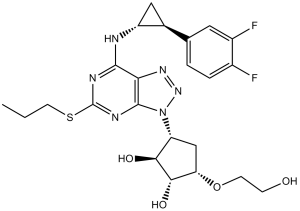
Ticagrelor (AZD6140)

别名: AZD 6140; AZD 6140; AR-C 126532XX; AR-C-126532XX; AZD-6140; AZD6140; AR-C126532XX; Ticagrelor; brand name: Brilinta; Brilique; Possia 替卡格雷;替卡格雷杂质; 替卡格雷(Anticogulant);替卡格雷标准品;替卡格雷标准品及杂质;替卡格雷及其中间体;替卡格雷药;替卡格雷杂质及标准品
目录号: V1303 纯度: ≥98%
替格瑞洛(以前称为 AZD-6140;AR-C 126532XX;AZD6140;AR-C126532XX;商品名:Brilinta;Brilique;Possia)是第一个可逆结合、有效且具有口服生物活性的 P2Y12 受体拮抗剂,用作抗血小板和抗凝剂。
Ticagrelor (AZD6140) CAS号: 274693-27-5
产品类别: P2 Receptor
产品仅用于科学研究,不针对患者销售
规格 价格 库存 数量
25mg
50mg
100mg
250mg
500mg
1g
2g
Other Sizes
点击了解更多
  • 与全球5000+客户建立关系
  • 覆盖全球主要大学、医院、科研院所、生物/制药公司等
  • 产品被大量CNS顶刊文章引用
InvivoChem产品被CNS等顶刊论文引用
纯度/质量控制文件

纯度: ≥98%

产品描述
替格瑞洛(以前称为 AZD-6140;AR-C 126532XX;AZD6140;AR-C126532XX;商品名:Brilinta;Brilique;Possia)是第一个可逆结合、有效且具有口服生物活性的 P2Y12 受体拮抗剂,用作抗血小板和抗凝剂。它抑制 P2Y12 受体,Ki 为 2 NM。替格瑞洛于 2011 年被 FDA 批准作为一种抗血小板药物,用于预防急性冠状动脉综合征(即冠状动脉血液供应问题)患者的中风、心脏病发作和其他事件。与噻吩并吡啶类普拉格雷、氯吡格雷和噻氯匹定一样,替格瑞洛可阻断 P2Y12 亚型的腺苷二磷酸 (ADP) 受体。与其他抗血小板药物相比,替格瑞洛具有与 ADP 不同的结合位点,使其成为变构拮抗剂,并且阻断是可逆的。
生物活性&实验参考方法
靶点
The targets of Ticagrelor (AZD6140) are the P2Y12 receptor (Ki = 3.2 nM, human recombinant P2Y12 receptor) and the ENT1 transporter (IC50 = 0.8 μmol/L, human erythrocyte ENT1 transporter) [1]
体外研究 (In Vitro)
与其他 P2Y12R 拮抗剂相比,替格瑞洛可更好地抑制缺血性血小板中 5'-二磷酸腺苷 (ADP) 诱导的 Ca2+ 释放。除了对 P2Y12R 的拮抗作用外,替格瑞洛还抑制血小板上的平衡核苷转运蛋白 1 (ENT1),从而导致细胞外腺苷积累和 Gs 偶联腺苷 A2A 受体被激活[1]。与用盐水治疗的小鼠相比,B16-F10 细胞与用替格瑞洛治疗的小鼠的血小板的相互作用较少[2]。
人富血小板血浆实验中,Ticagrelor (AZD6140) 以浓度依赖性抑制 ADP 诱导的血小板聚集,1 μmol/L 浓度下抑制率可达 90% 以上,且作用具有可逆性,停药后血小板功能可快速恢复 [1][3]
- 重组 P2Y12 受体实验中,Ticagrelor (AZD6140) 表现为反向激动活性,可抑制受体基础活性,降低细胞内 cAMP 水平,该效应独立于 ADP 结合 [1]
- 人红细胞实验中,Ticagrelor (AZD6140) 可阻断 ENT1 转运体介导的腺苷摄取,0.5 μmol/L 浓度下腺苷摄取抑制率达 80%,进而升高胞外腺苷浓度,增强腺苷介导的抗血小板效应 [1]
- 人乳腺癌(MDA-MB-231)、肺癌(A549)细胞体外实验中,Ticagrelor (AZD6140) 可抑制细胞迁移和侵袭,10 μmol/L 浓度下迁移能力下降 50% 以上,且可下调基质金属蛋白酶(MMP-2、MMP-9)的表达 [2]
- 大鼠富血小板血浆实验中,Ticagrelor (AZD6140) 对 ADP 诱导的血小板聚集的抑制强度与普拉格雷相当,但起效更快,100 nmol/L 浓度下 5 分钟内即可达到最大抑制效果 [3]
体内研究 (In Vivo)
在 B16-F10 黑色素瘤静脉内和脾内转移模型中,给予治疗剂量的替格瑞洛(10 mg/kg)的小鼠显示肺(84%)和肝(86%)转移显着减少。此外,用替格瑞洛治疗的动物比用盐水治疗的动物有更高的存活率。在 4T1 乳腺癌模型中也看到了类似的结果,其中替格瑞洛治疗减少了肺 (55%) 和骨髓 (87%) 转移[2]。口服替卡格雷(1-10 mg/kg)一次对血小板聚集具有剂量相关的抑制作用。当替格瑞洛最大剂量为10 mg/kg时,血小板聚集在用药后一小时开始受到显着抑制,并在四小时后达到峰值[3]。
小鼠乳腺癌(4T1)和肺癌(LLC)转移模型中,口服给予 Ticagrelor (AZD6140)(10、30 mg/kg,每日 2 次,持续 21 天)可剂量依赖性减少肺部转移灶数量,30 mg/kg 剂量下转移灶减少 60% 以上,同时延长小鼠生存期(中位生存期延长 30%-40%)[2]
- 大鼠 FeCl3 诱导颈动脉血栓模型中,口服 Ticagrelor (AZD6140)(1、3、10 mg/kg)可剂量依赖性延长血栓形成时间,10 mg/kg 剂量下血栓形成时间较对照组延长 2 倍以上;与普拉格雷(3 mg/kg)相比,两者抗血栓效果相当,但 Ticagrelor (AZD6140) 停药后止血功能恢复更快 [3]
- 大鼠出血模型中,Ticagrelor (AZD6140)(10 mg/kg)口服给药后,出血时间较对照组延长 1.5 倍,而普拉格雷(3 mg/kg)组出血时间延长 2 倍,提示 Ticagrelor (AZD6140) 出血风险相对更低 [3]
- 小鼠体内实验中,Ticagrelor (AZD6140) 可抑制肿瘤细胞与血小板的结合,减少循环肿瘤细胞的存活,进而抑制远处转移 [2]
酶活实验
P2Y12 受体结合与反向激动活性实验:将重组人 P2Y12 受体膜制剂与不同浓度的 Ticagrelor (AZD6140) 及放射性标记配体共同孵育,通过过滤法分离结合态与游离态配体,计算 Ki 值;同时,将转染 P2Y12 受体的细胞与药物孵育,检测细胞内 cAMP 水平变化,评估反向激动活性 [1]
- ENT1 转运体活性抑制实验:分离人红细胞,与 Ticagrelor (AZD6140) 预处理 30 分钟后,加入放射性标记腺苷,孵育一定时间后终止反应,检测红细胞内放射性强度,计算腺苷摄取抑制率,确定 IC50 值 [1]
细胞实验
血小板聚集实验:采集人或大鼠静脉血,离心分离富血小板血浆,调整血小板浓度后,加入不同浓度的 Ticagrelor (AZD6140) 孵育 5 分钟,再加入 ADP 诱导聚集,通过血小板聚集仪记录聚集曲线,计算抑制率 [1][3]
- 肿瘤细胞迁移与侵袭实验:将 MDA-MB-231 或 A549 细胞接种于 Transwell 小室(迁移实验)或基质胶包被的 Transwell 小室(侵袭实验),上室加入含 Ticagrelor (AZD6140)(1、10、30 μmol/L)的培养基,下室加入趋化因子,培养 24-48 小时后,计数穿过小室的细胞数量;同时通过 Western blot 检测细胞内 MMP-2、MMP-9 蛋白表达水平 [2]
- 肿瘤细胞-血小板结合实验:将荧光标记的肿瘤细胞与富血小板血浆及 Ticagrelor (AZD6140)(10 μmol/L)共同孵育,通过流式细胞术检测肿瘤细胞-血小板复合物的形成率 [2]
动物实验
Mice: Female BALB/c mice are inoculated subcutaneously in the fourth mammary pad with 4T1 breast cancer cells. Once a tumor is palpable, mice receive daily injections of PBS or ticagrelor (10 mg/kg). One week later, mice undergo primary tumor resection. At 28 days mice are sacrificed and lungs, femurs and tibiae harvested. Dissociated cells from lung and bone marrow are plated in medium containing 60 μM 6-thioguanine. After 14 days, culture plates are fixed with methanol and stained with 0.03% methylene blue to enumerate metastatic 4T1 colonies.
Mice bearing B16-F10 melanoma tumor
Mouse tumor metastasis experiment: 6-8-week-old BALB/c or C57BL/6 mice were injected with 4T1 breast cancer cells or LLC lung cancer cells via the tail vein to establish metastasis models. From the day of modeling, the administration group was orally given Ticagrelor (AZD6140) (10, 30 mg/kg) twice daily, and the control group was given an equal volume of vehicle (0.5% sodium carboxymethylcellulose) for 21 consecutive days. At the end of the experiment, the number of lung metastases was counted, and the survival time of mice was recorded [2]
- Rat thrombosis and hemostasis experiment: Adult male Wistar rats were randomly divided into a control group, Ticagrelor (AZD6140) groups (1, 3, 10 mg/kg), and prasugrel group (3 mg/kg). The drug was dissolved in 0.5% sodium carboxymethylcellulose and administered orally once daily for 3 consecutive days. Two hours after the last administration, carotid artery thrombosis was induced by FeCl3 soaking, and the thrombosis time was recorded; meanwhile, the bleeding time was detected by tail transection to evaluate hemostatic function [3]
药代性质 (ADME/PK)
吸收、分布和排泄
替格瑞洛的口服生物利用度为36%。单次口服200mg替格瑞洛后,其血药浓度峰值(Cmax)为923ng/mL,达峰时间(Tmax)为1.5小时,药时曲线下面积(AUC)为6675ng/mL。替格瑞洛的活性代谢物Cmax为264ng/mL,达峰时间(Tmax)为3.0小时,药时曲线下面积(AUC)为2538ng/mL。
放射性标记的替格瑞洛剂量有57.8%从粪便中回收,26.5%从尿液中回收。未代谢的母体药物回收率不足1%。活性代谢物AC-C124910XX占粪便回收量的21.7%。代谢物 AR-C133913XX 占尿液回收量的 9.2%,占粪便回收量的 2.7%。其他次要代谢物主要在尿液中回收。替格瑞洛的稳态分布容积为 88 L。替格瑞洛的肾清除率为 0.00584 L/h。该药物主要通过细胞色素 P-450 (CYP) 同工酶 3A4 代谢为一种活性代谢物,该代谢物具有与母体药物相似的抗血小板活性。替格瑞洛及其活性代谢物的血浆浓度呈剂量依赖性增加,分别在约 1.5 小时和 2.5 小时达到峰值浓度。替格瑞洛主要经粪便排泄,少量经尿液排泄;尿液中回收的药物(包括母体药物和活性代谢物)不足剂量的 1%。替格瑞洛及其活性代谢物均与人血浆蛋白广泛结合(结合率超过99%)。与高脂餐同服可使替格瑞洛的全身暴露量增加21%,并使活性代谢物的血浆峰浓度降低22%,但对替格瑞洛的血浆峰浓度或活性代谢物的全身暴露量无影响。
口服替格瑞洛后吸收迅速。
替格瑞洛的主要清除途径是肝脏代谢。当使用放射性标记的替格瑞洛时,放射性的平均回收率约为84%(粪便中58%,尿液中26%)。尿液中替格瑞洛及其活性代谢物的回收率均低于给药剂量的1%。替格瑞洛主要代谢物的排泄途径很可能是胆汁分泌。
/乳汁/ 尚不清楚替格瑞洛或其活性代谢物是否会分泌到人乳中。替格瑞洛会分泌到大鼠乳汁中。
有关替格瑞洛(共6种代谢物)的更多吸收、分布和排泄(完整)数据,请访问HSDB记录页面。
代谢/代谢物
所有替格瑞洛代谢物的完整结构尚未明确。替格瑞洛可在环戊烷环的5位脱烷基化,形成活性代谢物AR-C124910XX。AR-C124910XX的环戊烷环可进一步发生葡萄糖醛酸化,或与硫原子相连的烷基链可发生羟基化。替格瑞洛也可发生葡萄糖醛酸化或羟基化。替格瑞洛也可经N-去烷基化生成AR-C133913XX,后者可进一步发生葡萄糖醛酸化或羟基化。
CYP3A4是负责替格瑞洛代谢及其主要活性代谢物生成的主要酶。替格瑞洛及其主要活性代谢物均为弱P-糖蛋白底物和抑制剂。活性代谢物的全身暴露量约为替格瑞洛暴露量的30-40%。
该药物主要通过细胞色素P-450 (CYP) 同工酶3A4代谢为活性代谢物,该代谢物与母体药物具有相似的抗血小板活性。
替格瑞洛是一种可逆性结合的口服P2Y12受体拮抗剂,目前正在开发用于预防急性冠脉综合征患者的血栓事件。本研究在6名健康男性受试者中,单次口服200 mg (14)C-替格瑞洛混悬液,持续168小时,考察了替格瑞洛的药代动力学、代谢和排泄情况。……血浆和粪便中的主要循环成分被鉴定为替格瑞洛和AR-C124910XX,而尿液中的主要成分是代谢物M5 (AR-C133913XX)及其葡萄糖醛酸苷结合物M4。尿液中原形替格瑞洛和AR-C124910XX的含量均低于0.05%,表明替格瑞洛和AR-C124910XX的肾清除率很低。尿液和粪便提取物的个体间差异均较小,仅存在少量定量差异。所有10种代谢物均已完全或部分表征,并提出了替格瑞洛的完整生物转化途径。在该途径中,替格瑞洛羟乙基侧链的氧化丢失形成AR-C124910XX,而第二条氧化途径导致替格瑞洛的N-去烷基化,形成AR-C133913XX。
生物半衰期
替格瑞洛的血浆半衰期约为8小时,而其活性代谢物的血浆半衰期约为12小时。
据报道,替格瑞洛及其活性代谢物的平均终末半衰期分别约为7小时和9小时。
替格瑞洛是一种可逆性结合的口服P2Y12受体拮抗剂,目前正在开发用于预防急性冠脉综合征患者的血栓事件。本研究对六名健康男性受试者单次口服200 mg (14)C-替格瑞洛混悬液后,在168小时内考察了替格瑞洛的药代动力学、代谢和排泄情况。大多数受试者在20小时后血浆中检测不到放射性,12小时后全血中检测不到放射性(半衰期分别为6.3小时和4.6小时)。
吸收:替格瑞洛(AZD6140)口服后迅速吸收。大鼠口服10 mg/kg后,达峰时间(tmax)约为1小时,绝对生物利用度约为36%[3]
- 分布:该药物广泛分布于全身组织,在大鼠体内血浆蛋白结合率约为97%-98%[3]
- 代谢:主要在肝脏代谢,无明显活性代谢产物,且代谢途径不依赖于细胞色素P450酶的强催化作用[3]
- 排泄:代谢产物主要经粪便(约60%)排泄,部分经肾脏(约30%)排泄,在大鼠体内半衰期(t1/2)约为2-3小时[3]
毒性/毒理 (Toxicokinetics/TK)
毒性概述
识别和用途:替格瑞洛为结晶性粉末。作为药物倍林达(Brilinta),它适用于降低急性冠脉综合征(ACS)或有心肌梗死(MI)病史患者的心血管死亡、心肌梗死和卒中发生率。倍林达还能降低接受支架植入治疗ACS患者的支架内血栓形成率。人体暴露和毒性:过量服用症状可能包括出血、胃肠道反应(恶心、呕吐和腹泻)以及心室停搏。失血是主要风险。动物研究:该药物的急性毒性被认为较低。在小鼠和大鼠中进行的单剂量研究结果表明,以mg/kg为单位,灌胃给予替格瑞洛剂量约为推荐人日剂量的550倍时,耐受性良好。在小鼠、大鼠和狨猴中进行了重复给药研究。所有物种均观察到亚临床出血的迹象。啮齿动物在高剂量下出现肝脏重量增加。在剂量高达60 mg/kg/天(相当于人治疗暴露量的4.6倍)时,替格瑞洛对大鼠的分娩或产后发育无影响,但在180 mg/kg剂量下,对幼鼠的母体和发育毒性有影响。在器官形成期,大鼠口服剂量高达100 mg/kg/天(相当于人治疗暴露量的5.1倍)以及兔子口服剂量高达42 mg/kg/天(相当于人治疗暴露量)时,替格瑞洛对胎儿发育无影响。替格瑞洛及其活性代谢物AR-C124910XX在体外细菌试验、体外小鼠淋巴瘤L5178Y TK+/- 3.7.2C细胞试验以及体内大鼠骨髓微核试验中均未显示出任何遗传毒性。
肝毒性
在多项大型临床试验中,替格瑞洛治疗期间未出现血清酶升高,也未报告任何临床上明显的肝损伤病例。虽然有个别病例报告在替格瑞洛治疗期间出现短暂且轻微的血清酶升高,但这些升高持续时间短且无症状。此外,自上市以来,尚未有与替格瑞洛治疗相关的孤立性临床上明显的肝损伤或黄疸病例报告,且产品标签中也未提及肝毒性。另一方面,已有数例黄疸和肝损伤的报道,这些黄疸和肝损伤与横纹肌溶解症和血栓性血小板减少性紫癜相关,代表了这些严重不良事件的继发效应。因此,替格瑞洛可导致显著的肝损伤,但这种情况大多与其他危及生命的并发症同时发生。
可能性评分:D(可能是严重过敏反应或药物相互作用并发症导致肝损伤的罕见原因)。
妊娠和哺乳期影响
◉ 哺乳期用药概述
目前尚无关于哺乳期使用替格瑞洛的公开信息。由于替格瑞洛及其活性代谢物与血浆蛋白的结合率超过99%,因此其在乳汁中的含量可能很低。但是,尤其是在哺乳新生儿或早产儿时,可能更倾向于选择其他药物。如果哺乳期母亲使用本品,请密切观察婴儿是否有瘀伤和出血。
◉ 对母乳喂养婴儿的影响
截至修订日期,未找到相关的已发表信息。
◉ 对泌乳和母乳的影响
截至修订日期,未找到相关的已发表信息。
蛋白结合
替格瑞洛及其活性代谢物在血浆中的蛋白结合率>99%,尤其是白蛋白。
相互作用
替格瑞洛与地高辛合用不会显著影响地高辛的药代动力学;因此,这两种药物可以同时使用,无需调整剂量。然而,由于P-糖蛋白抑制可能导致地高辛浓度升高,因此在开始使用替格瑞洛治疗期间以及任何治疗方案改变后,均应监测血清地高辛浓度。
当替格瑞洛与每日维持剂量超过100 mg的阿司匹林联合使用时,替格瑞洛的疗效可能会降低。
替格瑞洛是P-糖蛋白转运系统的底物和弱抑制剂。当这些药物与替格瑞洛同时使用时,P-糖蛋白底物(例如地高辛)的血清浓度可能会升高;建议进行适当的实验室和/或临床监测。
替格瑞洛与利福平600 mg每日一次联合用药会显著降低替格瑞洛的血浆峰浓度和全身暴露量。因此,应避免同时使用替格瑞洛和利福平。
有关替格瑞洛的更多相互作用(完整)数据(共9项),请访问HSDB记录页面。
体内毒性:大鼠连续3天口服最大剂量10 mg/kg的替格瑞洛(AZD6140)后,未观察到明显的体重减轻、行为异常或肝肾功能指标(ALT、AST、BUN、Cr)升高[3]
- 出血风险:替格瑞洛(AZD6140)可轻微延长出血时间,但在等效抗血栓剂量下,其出血风险低于普拉格雷[3]
- 血浆蛋白结合率:大鼠血浆蛋白结合率为97%-98%,人血浆蛋白结合率约为99%[3]体外毒性:在 100 μmol/L 浓度下,对人血小板和肿瘤细胞无明显细胞毒性,细胞存活率高于 90% [1][2]
参考文献

[1]. Inverse agonism at the P2Y12 receptor and ENT1 transporter blockade contribute to platelet inhibition by ticagrelor. Blood. 2016 Dec 8;128(23):2717-2728.

[2]. The reversible P2Y12 inhibitor ticagrelor inhibits metastasis and improves survival in mouse models of cancer. Int J Cancer. 2015 Jan 1;136(1):234-40.

[3]. A comparison of the pharmacological profiles of prasugrel and ticagrelor assessed by platelet aggregation, thrombus formation and haemostasis in rats. Br J Pharmacol. 2013 May;169(1):82-9.

其他信息
治疗用途
嘌呤能P2Y受体拮抗剂
/临床试验/ ClinicalTrials.gov 是一个注册库和结果数据库,收录了全球范围内由公共和私人机构资助的人体临床研究。该网站由美国国家医学图书馆 (NLM) 和美国国立卫生研究院 (NIH) 维护。ClinicalTrials.gov 上的每条记录都包含研究方案的摘要信息,包括:疾病或病症;干预措施(例如,正在研究的医疗产品、行为或程序);研究的标题、描述和设计;参与要求(资格标准);研究开展地点;研究地点的联系方式;以及其他健康网站相关信息的链接,例如 NLM 的 MedlinePlus(用于患者健康信息)和 PubMed(用于医学领域学术文章的引文和摘要)。替格瑞洛已收录于数据库中。
Brilinta适用于降低急性冠脉综合征(ACS)或有心肌梗死(MI)病史患者的心血管死亡、心肌梗死和卒中发生率。在ACS发生后的至少前12个月内,其疗效优于氯吡格雷。/美国产品标签包含/
Brilinta还可降低接受支架植入治疗急性冠脉综合征(ACS)患者的支架内血栓形成率。/美国产品标签包含/
药物警告
/黑框警告/出血风险。Brilinta与其他抗血小板药物一样,可能导致严重甚至致命的出血。对于有活动性病理性出血或颅内出血病史的患者,禁用Brilinta。对于正在接受紧急冠状动脉旁路移植术(CABG)的患者,禁用Brilinta。如果可能,应在不停用倍林达(Brilinta)的情况下控制出血。停用倍林达会增加后续心血管事件的风险。
/黑框警告/ 阿司匹林剂量与倍林达疗效。维持剂量超过 100 mg 的阿司匹林会降低倍林达的疗效,应避免使用。
通常情况下,不应过早停用替格瑞洛治疗,因为这会增加心血管事件的风险。对于冠状动脉支架植入患者,过早停用抗血小板治疗(例如,P2Y12 腺苷二磷酸 (ADP) 受体拮抗剂、阿司匹林)与缺血性心血管事件(例如,支架血栓形成、心肌梗死 (MI)、死亡)风险增加相关。如果必须暂时停用替格瑞洛,例如在择期手术前或为了控制出血,应尽快重新开始用药。应告知患者,即使其他临床医生(例如牙医)指示停止服用替格瑞洛,也切勿在未咨询处方医生的情况下擅自停药。在安排侵入性操作前,患者应告知临床医生(包括牙医)其目前正在服用替格瑞洛,执行侵入性操作的临床医生在停止服用替格瑞洛前应咨询处方医生。
服用替格瑞洛的患者曾出现过缓慢性心律失常,包括室性停搏。在血小板抑制与患者预后研究(PLATO)中,接受替格瑞洛治疗的患者在治疗第一周内,动态心电图监测检测到的至少3秒的室性停搏发生率高于接受氯吡格雷治疗的患者(分别为5.8%和3.6%)。两组患者发生具有临床意义的缓慢性心律失常(例如晕厥、需要植入起搏器)的总体风险无差异。室性停搏大多无症状,归因于窦房结抑制。PLATO 研究排除了基线心动过缓风险增加的患者(例如,病态窦房结综合征、二度或三度房室传导阻滞、未植入起搏器但因心动过缓引起的晕厥患者);因此,一些临床医生建议对这类患者谨慎使用替格瑞洛。
有关替格瑞洛的更多药物警告(完整)数据(共 15 条),请访问 HSDB 记录页面。
药效学
替格瑞洛是一种 P2Y12 受体拮抗剂,可抑制血栓形成,从而降低心肌梗死和缺血性卒中的风险。由于每日两次给药,其作用持续时间适中;由于单次高剂量耐受性良好,其治疗指数较宽。应告知患者出血、呼吸困难和心动过缓的风险。
替格瑞洛 (AZD6140) 是一种可逆性 P2Y12 受体拮抗剂,同时具有 ENT1 转运体阻断活性,通过双重机制发挥抗血小板作用 [1]
- 它与 P2Y12 受体的结合是可逆的,停药后血小板功能可以迅速恢复。与不可逆拮抗剂(如普拉格雷和氯吡格雷)相比,替格瑞洛具有出血风险低、停药后止血功能恢复快的优势[3]。除了抗血小板作用外,替格瑞洛(AZD6140)还能通过抑制肿瘤细胞迁移、侵袭和肿瘤细胞-血小板相互作用,在小鼠癌症模型中发挥抗转移作用,提示其具有潜在的抗癌应用价值[2]。临床上,替格瑞洛主要用于治疗急性冠脉综合征等血栓性疾病,以降低心血管事件的风险。其独特的双重作用机制和可逆结合特性使其在临床用药中具有灵活的调整空间[1][3]。
*注: 文献方法仅供参考, InvivoChem并未独立验证这些方法的准确性
化学信息 & 存储运输条件
分子式
C23H28F2N6O4S
分子量
522.57
精确质量
522.186
CAS号
274693-27-5
相关CAS号
274693-27-5
PubChem CID
9871419
外观&性状
Off-white to yellow solid powder
密度
1.7±0.1 g/cm3
沸点
777.6±70.0 °C at 760 mmHg
闪点
424.0±35.7 °C
蒸汽压
0.0±2.8 mmHg at 25°C
折射率
1.744
LogP
1.9
tPSA
163.74
氢键供体(HBD)数目
4
氢键受体(HBA)数目
12
可旋转键数目(RBC)
10
重原子数目
36
分子复杂度/Complexity
736
定义原子立体中心数目
6
SMILES
CCCSC1=NC(=C2C(=N1)N(N=N2)[C@@H]3C[C@@H]([C@H]([C@H]3O)O)OCCO)N[C@@H]4C[C@H]4C5=CC(=C(C=C5)F)F
InChi Key
OEKWJQXRCDYSHL-FNOIDJSQSA-N
InChi Code
InChI=1S/C23H28F2N6O4S/c1-2-7-36-23-27-21(26-15-9-12(15)11-3-4-13(24)14(25)8-11)18-22(28-23)31(30-29-18)16-10-17(35-6-5-32)20(34)19(16)33/h3-4,8,12,15-17,19-20,32-34H,2,5-7,9-10H2,1H3,(H,26,27,28)/t12-,15+,16+,17-,19-,20+/m0/s1
化学名
(1S,2S,3R,5S)-3-[7-[(1R,2S)-2-(3,4-Difluorophenyl)cyclopropylamino]-5-(propylthio)- 3H-[1,2,3]triazolo[4,5-d]pyrimidin-3-yl]-5-(2-hydroxyethoxy)cyclopentane-1,2-diol
别名
AZD 6140; AZD 6140; AR-C 126532XX; AR-C-126532XX; AZD-6140; AZD6140; AR-C126532XX; Ticagrelor; brand name: Brilinta; Brilique; Possia
HS Tariff Code
2934.99.9001
存储方式

Powder      -20°C    3 years

                     4°C     2 years

In solvent   -80°C    6 months

                  -20°C    1 month

注意: (1). 本产品在运输和储存过程中需避光。  (2). 请将本产品存放在密封且受保护的环境中(例如氮气保护),避免吸湿/受潮。
运输条件
Room temperature (This product is stable at ambient temperature for a few days during ordinary shipping and time spent in Customs)
溶解度数据
溶解度 (体外实验)
DMSO: 105 mg/mL (200.9 mM)
Water:<1 mg/mL
Ethanol: 53 mg/mL (101.4 mM)
溶解度 (体内实验)
配方 1 中的溶解度: ≥ 2 mg/mL (3.83 mM) (饱和度未知) in 10% DMSO + 40% PEG300 + 5% Tween80 + 45% Saline (这些助溶剂从左到右依次添加,逐一添加), 澄清溶液。
例如,若需制备1 mL的工作液,可将100 μL 20.0 mg/mL澄清DMSO储备液加入400 μL PEG300中,混匀;然后向上述溶液中加入50 μL Tween-80,混匀;加入450 μL生理盐水定容至1 mL。
*生理盐水的制备:将 0.9 g 氯化钠溶解在 100 mL ddH₂O中,得到澄清溶液。

配方 2 中的溶解度: ≥ 2 mg/mL (3.83 mM) (饱和度未知) in 10% DMSO + 90% (20% SBE-β-CD in Saline) (这些助溶剂从左到右依次添加,逐一添加), 澄清溶液。
例如,若需制备1 mL的工作液,可将 100 μL 20.0mg/mL澄清的DMSO储备液加入到900μL 20%SBE-β-CD生理盐水中,混匀。
*20% SBE-β-CD 生理盐水溶液的制备(4°C,1 周):将 2 g SBE-β-CD 溶解于 10 mL 生理盐水中,得到澄清溶液。

View More

配方 3 中的溶解度: ≥ 2 mg/mL (3.83 mM) (饱和度未知) in 10% DMSO + 90% Corn Oil (这些助溶剂从左到右依次添加,逐一添加), 澄清溶液。
例如,若需制备1 mL的工作液,可将 100 μL 20.0 mg/mL 澄清 DMSO 储备液加入900 μL 玉米油中,混合均匀。


请根据您的实验动物和给药方式选择适当的溶解配方/方案:
1、请先配制澄清的储备液(如:用DMSO配置50 或 100 mg/mL母液(储备液));
2、取适量母液,按从左到右的顺序依次添加助溶剂,澄清后再加入下一助溶剂。以 下列配方为例说明 (注意此配方只用于说明,并不一定代表此产品 的实际溶解配方):
10% DMSO → 40% PEG300 → 5% Tween-80 → 45% ddH2O (或 saline);
假设最终工作液的体积为 1 mL, 浓度为5 mg/mL: 取 100 μL 50 mg/mL 的澄清 DMSO 储备液加到 400 μL PEG300 中,混合均匀/澄清;向上述体系中加入50 μL Tween-80,混合均匀/澄清;然后继续加入450 μL ddH2O (或 saline)定容至 1 mL;

3、溶剂前显示的百分比是指该溶剂在最终溶液/工作液中的体积所占比例;
4、 如产品在配制过程中出现沉淀/析出,可通过加热(≤50℃)或超声的方式助溶;
5、为保证最佳实验结果,工作液请现配现用!
6、如不确定怎么将母液配置成体内动物实验的工作液,请查看说明书或联系我们;
7、 以上所有助溶剂都可在 Invivochem.cn网站购买。
制备储备液 1 mg 5 mg 10 mg
1 mM 1.9136 mL 9.5681 mL 19.1362 mL
5 mM 0.3827 mL 1.9136 mL 3.8272 mL
10 mM 0.1914 mL 0.9568 mL 1.9136 mL

1、根据实验需要选择合适的溶剂配制储备液 (母液):对于大多数产品,InvivoChem推荐用DMSO配置母液 (比如:5、10、20mM或者10、20、50 mg/mL浓度),个别水溶性高的产品可直接溶于水。产品在DMSO 、水或其他溶剂中的具体溶解度详见上”溶解度 (体外)”部分;

2、如果您找不到您想要的溶解度信息,或者很难将产品溶解在溶液中,请联系我们;

3、建议使用下列计算器进行相关计算(摩尔浓度计算器、稀释计算器、分子量计算器、重组计算器等);

4、母液配好之后,将其分装到常规用量,并储存在-20°C或-80°C,尽量减少反复冻融循环。

计算器

摩尔浓度计算器可计算特定溶液所需的质量、体积/浓度,具体如下:

  • 计算制备已知体积和浓度的溶液所需的化合物的质量
  • 计算将已知质量的化合物溶解到所需浓度所需的溶液体积
  • 计算特定体积中已知质量的化合物产生的溶液的浓度
使用摩尔浓度计算器计算摩尔浓度的示例如下所示:
假如化合物的分子量为350.26 g/mol,在5mL DMSO中制备10mM储备液所需的化合物的质量是多少?
  • 在分子量(MW)框中输入350.26
  • 在“浓度”框中输入10,然后选择正确的单位(mM)
  • 在“体积”框中输入5,然后选择正确的单位(mL)
  • 单击“计算”按钮
  • 答案17.513 mg出现在“质量”框中。以类似的方式,您可以计算体积和浓度。

稀释计算器可计算如何稀释已知浓度的储备液。例如,可以输入C1、C2和V2来计算V1,具体如下:

制备25毫升25μM溶液需要多少体积的10 mM储备溶液?
使用方程式C1V1=C2V2,其中C1=10mM,C2=25μM,V2=25 ml,V1未知:
  • 在C1框中输入10,然后选择正确的单位(mM)
  • 在C2框中输入25,然后选择正确的单位(μM)
  • 在V2框中输入25,然后选择正确的单位(mL)
  • 单击“计算”按钮
  • 答案62.5μL(0.1 ml)出现在V1框中
g/mol

分子量计算器可计算化合物的分子量 (摩尔质量)和元素组成,具体如下:

注:化学分子式大小写敏感:C12H18N3O4  c12h18n3o4
计算化合物摩尔质量(分子量)的说明:
  • 要计算化合物的分子量 (摩尔质量),请输入化学/分子式,然后单击“计算”按钮。
分子质量、分子量、摩尔质量和摩尔量的定义:
  • 分子质量(或分子量)是一种物质的一个分子的质量,用统一的原子质量单位(u)表示。(1u等于碳-12中一个原子质量的1/12)
  • 摩尔质量(摩尔重量)是一摩尔物质的质量,以g/mol表示。
/

配液计算器可计算将特定质量的产品配成特定浓度所需的溶剂体积 (配液体积)

  • 输入试剂的质量、所需的配液浓度以及正确的单位
  • 单击“计算”按钮
  • 答案显示在体积框中
动物体内实验配方计算器(澄清溶液)
第一步:请输入基本实验信息(考虑到实验过程中的损耗,建议多配一只动物的药量)
第二步:请输入动物体内配方组成(配方适用于不溶/难溶于水的化合物),不同的产品和批次配方组成不同,如对配方有疑问,可先联系我们提供正确的体内实验配方。此外,请注意这只是一个配方计算器,而不是特定产品的确切配方。
+
+
+

计算结果:

工作液浓度 mg/mL;

DMSO母液配制方法 mg 药物溶于 μL DMSO溶液(母液浓度 mg/mL)。如该浓度超过该批次药物DMSO溶解度,请首先与我们联系。

体内配方配制方法μL DMSO母液,加入 μL PEG300,混匀澄清后加入μL Tween 80,混匀澄清后加入 μL ddH2O,混匀澄清。

(1) 请确保溶液澄清之后,再加入下一种溶剂 (助溶剂) 。可利用涡旋、超声或水浴加热等方法助溶;
            (2) 一定要按顺序加入溶剂 (助溶剂) 。

临床试验信息
Comparison of Anti-coagulation and Anti-Platelet Therapies for Intracranial Vascular Atherostenosis
CTID: NCT05047172
Phase: Phase 3    Status: Recruiting
Date: 2024-11-26
Switching From Dual Antiplatelet Therapy to Monotherapy With Potent P2Y12 Inhibitors
CTID: NCT06691191
Phase: Phase 4    Status: Not yet recruiting
Date: 2024-11-15
A Drug-drug Interaction Study of YZJ-1139 Tablets and Ticagrelor Tablets in Healthy Subjects
CTID: NCT06671470
Phase: Phase 1    Status: Active, not recruiting
Date: 2024-11-04
One-Month DAPT in CABG Patients
CTID: NCT05997693
Phase: Phase 3    Status: Recruiting
Date: 2024-11-01
TISSARA Trial: Ticagrelor Intervention to Reduce Stent Thrombosis and Acute MI Risk
CTID: NCT06667349
Phase: Phase 4    Status: Completed
Date: 2024-10-31
View More

Dual Antiplatelet Therapy for Shock Patients with Acute Myocardial Infarction
CTID: NCT03551964
Phase: Phase 4    Status: Active, not recruiting
Date: 2024-10-17


A Study to Investigate the Effect of Oral Ticagrelor on the Pharmacokinetics of Oral Rosuvastatin When Given in Healthy Participants
CTID: NCT06554821
Phase: Phase 1    Status: Completed
Date: 2024-10-15
Chewed Versus Integral Pill of Ticagrelor
CTID: NCT03708588
Phase: Phase 4    Status: Completed
Date: 2024-10-03
Study to Assess Pharmacokinetics, Pharmacodynamics and Safety of Tiprogrel in Healthy Subjects
CTID: NCT06584812
Phase: Phase 1    Status: Active, not recruiting
Date: 2024-09-25
Safety of Ticagrelor Monotherapy After Primary Percutaneous Coronary Intervention for ST-elevation Myocardial Infarction and the Effect on Intramyocardial Haemorrhage
CTID: NCT05986968
Phase: N/A    Status: Recruiting
Date: 2024-09-23
Combining Aspirin With Ticagrelor or Clopidogrel in Large-vessel Minor Stroke or TIA
CTID: NCT06591338
Phase: Phase 3    Status: Recruiting
Date: 2024-09-19
Combining Aspirin With Ticagrelor or Clopidogrel in Minor Stroke or TIA
CTID: NCT06591312
Phase: Phase 3    Status: Recruiting
Date: 2024-09-19
Combining Aspirin With Ticagrelor or Cilostazol in Minor Stroke or TIA
CTID: NCT06591390
Phase: Phase 3    Status: Recruiting
Date: 2024-09-19
Combining Aspirin With Ticagrelor or Cilostazol in Large-vessel Minor Stroke or TIA
CTID: NCT06591377
Phase: Phase 3    Status: Recruiting
Date: 2024-09-19
Ticagrelor Versus Cilostazol in Large-vessel Ischemic Stroke
CTID: NCT06202755
Phase: Phase 3    Status: Recruiting
Date: 2024-08-20
Ticagrelor Versus Cilostazol in Ischemic Stroke
CTID: NCT06561867
Phase: Phase 3    Status: Recruiting
Date: 2024-08-20
Ticagrelor Versus Cilostazol in Minor Ischemic Stroke or TIA
CTID: NCT06196047
Phase: Phase 3    Status: Recruiting
Date: 2024-08-20
Ticagrelore Alone Post PCI
CTID: NCT06509893
Phase: Phase 4    Status: Not yet recruiting
Date: 2024-07-30
Tailoring P2Y12 Inhibiting Therapy in Patients Requiring Oral Anticoagulation After PCI
CTID: NCT04483583
Phase: Phase 4    Status: Active, not recruiting
Date: 2024-07-18
Pharmacodynamic Evaluation of Switching From Prasugrel to Ticagrelor
CTID: NCT02016170
Phase: N/A    Status: Completed
Date: 2024-07-03
IndObufen Versus asPirin After Coronary Drug-eluting Stent implantaTION in Elderly Patients With Acute Coronary Syndrome
CTID: NCT06451198
Phase: Phase 4    Status: Not yet recruiting
Date: 2024-06-18
Ticagrelor With Low-dose Versus Regular Aspirin in Patients With Acute Coronary Syndrome (ACS) at High-Risk for Ischemia After Percutaneous Coronary Intervention
CTID: NCT04240834
Phase: Phase 4    Status: Recruiting
Date: 2024-06-18
Evaluation of Low Dose Colchicine and Ticagrelor in Prevention of Ischemic Stroke in Patients With Stroke Due to Atherosclerosis
CTID: NCT05476991
Phase: Phase 3    Status: Recruiting
Date: 2024-06-03
Ticagrelor Monotherapy After Stenting
CTID: NCT05149560
Phase: Phase 2    Status: Recruiting
Date: 2024-05-16
Ticagrelor Versus Clopidogrel in Ischemic Stroke
CTID: NCT05553613
Phase: Phase 3    Status: Completed
Date: 2024-05-14
CES1 Crossover Trial of Clopidogrel and Ticagrelor
CTID: NCT03161678
Phase: Phase 4    Status: Completed
Date: 2024-05-06
Effects of Low-dose Ticagrelor vs. Clopidogrel in Stable Patients Undergoing Elective Percutaneous Coronary Intervention
CTID: NCT06228456
Phase: Phase 4    Status: Recruiting
Date: 2024-04-23
P2Y12 Inhibitor Monotherapy Versus Extended DAPT in Patients Treated With Bioresorbable Scaffold
CTID: NCT03119012
Phase: Phase 4    Status: Terminated
Date: 2024-04-22
A sTudy of Low Dose vs Standard Dose of tIcaGrelor on Platelet Function After intErvention for Acute Coronary syndRome in Diabetes Mellitus Patients
CTID: NCT04307511
Phase: Phase 4    Status: Recruiting
Date: 2024-04-22
TADCLOT- a Double Blind Randomized Controlled Trial
CTID: NCT06318481
Phase: Phase 3    Status: Recruiting
Date: 2024-03-19
A Prospective, Experimental, Multicenter, Open-label, Randomized, Controlled Trial of 3-month Dual Antiplatelet Therapy Followed by Ticagrelor Versus 6-month Dual Antiplatelet Therapy Followed by Ticagrelor After Implanting Bridge
CTID: NCT06301776
Phase: N/A    Status: Recruiting
Date: 2024-03-08
Paclitaxel-Coated Balloon Versus Zotarolimus-Eluting Stent for Treatment of De Novo Coronary Artery Lesions
CTID: NCT05209412
Phase: N/A    Status: Active, not recruiting
Date: 2024-01-24
Fentanyl and Crushed Ticagrelor in Percutaneous Coronary Intervention
CTID: NCT03476369
Phase: Phase 4    Status: Recruiting
Date: 2024-01-24
The Value of Screening for HPR in Patients Undergoing Lower Extremity Arterial Endovascular Interventions
CTID: NCT04007055
Phase: Phase 3    Status: Recruiting
Date: 2024-01-05
Ticagrelor Versus Clopidogrel in Large Vessel Ischemic Stroke
CTID: NCT06120725
Phase: Phase 3    Status: Completed
Date: 2023-12-29
Multicentric Study on Clopidogrel Resistance in DAPT for CAS (MULTI-RESCLOSA)
CTID: NCT05566301
Phase:    Status: Recruiting
Date: 2023-12-28
Safety, Tolerability, Pharmacokinetics and Pharmacodynamics Study of AZD3366 in Healthy Subjects, Japanese and Chinese Subjects
CTID: NCT04588727
Phase: Phase 1    Status: Completed
Date: 2023-12-18
A Study of Low and Standard-dose Ticagrelor After Intervention for ACS Patients
CTID: NCT04255602
Phase: Phase 4    Status: Recruiting
Date: 2023-12-07
A Study to Evaluate BMS-986141 Added on to Aspirin or Ticagrelor or the Combination, on Thrombus Formation in a Thrombosis Chamber Model in Participants With Stable Coronary Artery Disease and Healthy Participants
CTID: NCT05093790
Phase: Phase 2    Status: Completed
Date: 2023-12-05
1-month DAPT Plus 5-month Ticagrelor Monotherapy Versus 12-month DAPT in Patients With Drug-coated Balloon
CTID: NCT04971356
Phase: N/A    Status: Active, not recruiting
Date: 2023-11-14
Ticagrelor Compared to Clopidogrel in Acute Coronary Syndromes
CTID: NCT04057300
Phase: Phase 4    Status: Completed
Date: 2023-11-03
Efficacy of Ticagrelor Plus Aspirin in Mild Non-cardioembolic Ischemic Stroke
CTID: NCT04738097
Phase: Phase 3    Status: Completed
Date: 2023-10-19
Ticagrelor Single Antiplatelet Therapy in Patients With High Risk of Bleeding After DCB for Coronary Small Vessel Disease
CTID: NCT06088433
Phase: Phase 4    Status: Not yet recruiting
Date: 2023-10-18
A Study of Low Dose vs Standard Ticagrelor on Platelet Function After Intervention for Acute Coronary Syndrome in Senior Patients
CTID: NCT04307485
Phase: Phase 4    Status: Recruiting
Date: 2023-10-06
Differential EFfects of Dual antIplatelet and Dual aNtithrombotic thErapy on Hemostasis in Chronic Coronary Syndrome Patients
CTID: NCT05116995
Phase: Phase 4    Status: Recruiting
Date: 2023-09-22
Replication of the ISAR-REACT 5 Antiplatelet Trial in Healthcare Claims Data
CTID: NCT05086081
Phase:    Status: Completed
Date: 2023-07-27
Replication of the PLATO Antiplatelet Trial in Healthcare Claims Data
CTID: NCT04237935
Phase:    Status: Completed
Date: 2023-07-27
Individualized and Combined Effects of Diabetes and Smoking on the Antiplatelet Activity of Ticagrelor in Acute Myocardial Infarction Patients Undergoing Primary PCI
CTID: NCT05911659
Phase:    Status: Recruiting
Date: 2023-06-22
Ticagrelor vs. Clopidogrel in Post PCI Patients
CTID: NCT05858918
Phase: N/A    Status: Completed
Date: 2023-05-16
De-escalation of Ticagrelor in Post PPCI
CTID: NCT05831462
Phase: Phase 1/Phase 2    Status: Not yet recruiting
Date: 2023-04-26
Switching From DAPT to Dual Pathway Inhibition With Low-dose Rivaroxaban in Adjunct to Aspirin in Patients With Coronary Artery Disease
CTID: NCT04006288
Phase: Phase 4    Status: Completed
Date: 2023-04-26
Evaluation of Safety and Efficacy of Two Ticagrelor-based De-escalation Antiplatelet Strategies in Acute Coronary Syndrome
CTID: NCT04718025
Phase: Phase 3    Status: Recruiting
Date: 2023-04-21
Effectiveness of Lower Maintenance Dose of Ticagrelor Early After Myocardial Infarction (ELECTRA) Pilot Study
CTID: NCT03251859
Phase: Phase 3    Status: Completed
Date: 2023-04-21
Safety of 'Ticagrelor+ Warfarin'in Comparison With 'Clopidogrel+Aspirin+Warfarin'
CTID: NCT02206815
Phase: Phase 4    Status: Completed
Date: 2023-04-14
The Impact of Aspirin Dose Modification on the Innate Immune Response - Will Lower Dose Aspirin Therapy Reduce the Response to Endotoxin
CTID: NCT03869268
Phase: Phase 4    Status: Completed
Date: 2023-04-13
Optical Coherence Tomography-Guided PCI With Single-Antiplatelet Therapy
CTID: NCT04766437
Phase: Phase 2    Status: Completed
Date: 2023-03-06
Prospective, Randomized Trial of Ticagrelor Versus Prasugrel in Patients With Acute Coronary Syndrome
CTID: NCT01944800
Phase: Phase 4    Status: Completed
Date: 2023-02-06
The Safety and Efficacy Of Rivaroxaban and Ticagrelor for Patients With Atrial Fibrillation After Percutaneous Coronary Intervention
CTID: NCT03331484
Phase: Phase 3    Status: Active, not recruiting
Date: 2023-01-17
ADHerence of ticagrelOr in Real World Patients With aCute Coronary Syndrome
CTID: NCT03129867
Phase:    Status: Completed
Date: 2023-01-12
Chronic Kidney Disease (CKD) Platelet Study
CTID: NCT03649711
Phase: Phase 3    Status: Completed
Date: 2022-12-29
Effects of Ticagrelor Versus Prasugrel on Coronary Microcirculation in Patients Undergoing Elective Percutaneous Coronary Intervention: Results of the PROtecting MICROcirculation During Coronary Angioplasty (PROMICRO)-3 Randomised Study
CTID: NCT05643586
Phase: Phase 4    Status: Completed
Date: 2022-12-08
A Study to Investigate the Interaction Between ACT-246475 and Clopidogrel, Prasugrel, and Ticagrelor in Healthy Subjects
CTID: NCT03430661
Phase: Phase 1    Status: Completed
Date: 2022-11-16
Ticagrelor Antiplatelet Therapy to Reduce Graft Events and Thrombosis
CTID: NCT02053909
Phase: Phase 4    Status: Completed
Date: 2022-09-14
Bioequivalence Study of Anplag® 90mg (Ticagrelor) Tablet & Brilinta® 90 mg (Ticagrelor) Tablet in Healthy Adult Male Pakistani Subjects Under Fasting Condition
CTID: NCT04941196
Phase: Phase 1    Status: Completed
Date: 2022-09-08
Impact of CYP2C19 Genotype-guided Clopidogrel and Ticagrelor Treatment on Platelet Function Test and Metabolomics Profile
CTID: NCT05516784
Phase: Phase 4    Status: Completed
Date: 2022-09-01
A REAl-life Study on Short-term DAPT in Patients With Ischemic Stroke or TIA
CTID: NCT05476081
Phase:    Status: Unknown status
Date: 2022-08-02
Testing P2Y12 Platelet Inhibitors Generics Beyond Bioequivalence
CTID: NCT05474053
Phase: Phase 3    Status: Completed
Date: 2022-07-26
SAPT Versus DAPT in Incomplete Revascularization After CABG
CTID: NCT03789916
Phase: Phase 3    Status: Recruiting
Date: 2022-07-21
Inflammation and Thrombosis in Patients With Severe Aortic Stenosis After Transcatheter Aortic Valve Replacement (TAVR)
CTID: NCT02486367
Phase: Phase 4    Status: Completed
Date: 2022-07-20
Platelet Inhibition With Ticagrelor 60 mg Versus Ticagrelor 90 mg in Elderly Patients With ACS
CTID: NCT04739384
Phase: Phase 3    Status: Completed
Date: 2022-07-07
Ticagrelor Versus Clopidogrel in Carotid Artery Stenting
CTID: NCT02677545
Phase: Phase 2    Status: Completed
Date: 2022-06-28
The Risk of Major Bleeding With Novel Anti-platelets: A Comparison of Ticagrelor With Clopidogrel in a Real World Population of 5000 Patients Treated for Acute Coronary Syndrome
CTID: NCT02484924
Phase:    Status: Completed
Date: 2022-06-09
Determine the Safety/Efficacy of Ticagrelor for Maintaining Patency of Arterio-Venous Fistulae Created for Hemodialysis
CTID: NCT02335099
Phase: Phase 1/Phase 2    Status: Completed
Date: 2022-06-08
KF2019#1-trial: Effects of a Thrombocyte Inhibitor on a Cholesterol-lowering Drug
CTID: NCT05373277
Phase: Phase 1    Status: Unknown status
Date: 2022-05-13
Single Antiplatelet Treatment With Ticagrelor or Aspirin After Transcatheter Aortic Valve Implantation
CTID: NCT05283356
Phase: Phase 4    Status: Recruiting
Date: 2022-03-31
Comparative Efficacy of Ticagrelor Versus Aspirin on Blood Viscosity in Peripheral Artery Disease Patients With Type 2 Diabetes
CTID: NCT02325466
Phase: Phase 3    Status: Completed
Date: 2022-03-21
Switching From Ticagrelor to Prasugrel in Patients With Acute Coronary Syndrome
CTID: NCT05183178
Phase: Phase 4    Status: Recruiting
Date: 2022-03-17
GLOBAL LEADERS: A Clinical Study Comparing Two Forms of Anti-platelet Therapy After Stent Implantation
CTID: NCT01813435
Phase: Phase 3    Status: Completed
Date: 2022-03-15
GM03 - Platelet RNA Signatures of Aspirin
CTID: NCT05278637
PhaseEarly Phase 1    Status: Completed
Date: 2022-03-14
Platelet REACtivity According to TICagrelor Dose After Transcatheter AorticValve Implantation
CTID: NCT04331145
Phase: Phase 4    Status: Completed
Date: 2022-03-02
Platelet Aggregation and Adenosine Levels Among Patients Taking Ticagrelor or Prasugrel
CTID: NCT05247385
Phase: Phase 4    Status: Completed
Date: 2022-02-18
Impact of Chronic Kidney Disease on the Effects of Ticagrelor in Patients With Diabetes and Coronary Artery Disease
CTID: NCT02539160
Phase: Phase 4    Status: Completed
Date: 2022-01-28
Optimal Dosage of Ticagrelor in Korean Patients With AMI
CTID: NCT05210595
Phase: Phase 4    Status: Unknown status
Date: 2022-01-27
Ticagrelor and Clopidogrel on Platelet Effects in Chinese Patients With Stable Coronary Artery Disease
CTID: NCT04001894
Phase: Phase 4    Status: Completed
Date: 2022-01-11
Dual Antiplatelet Therapy in Patients With Clopidogrel Resistance Following Off-Pump Coronary Artery Bypass
CTID: NCT05166538
Phase: Phase 4    Status: Unknown status
Date: 2021-12-22
Low-dose of Ticagrelor and Standard-dose Clopidogrel on Platelet Effects in Chinese Patients With Stable CAD.
CTID: NCT03679091
Phase: Phase 4    Status: Completed
Date: 2021-12-21
Low Maintenance Dose Ticagrelor Versus Clopidogrel in Diabetes Patients Undergoing PCI
CTID: NCT03437044
Phase: Phase 4    Status: Completed
Date: 2021-11-30
Tailored Antiplatelet Therapy Following PCI
CTID: NCT01742117
Phase: Phase 4    Status: Completed
Date: 2021-11-09
Dual Antithrombotic Therapy With Dabigatran and Ticagrelor in Patients With ACS and Non-valvular AF Undergoing PCI
CTID: NCT04695106
Phase: Phase 4    Status: Recruiting
Date: 2021-11-04
Impact of Anti-platelet Drug Exposure on Platelet mRNA Splicing in Healthy Subjects
CTID: NCT04088123
Phase:    Status: Withdrawn
Date: 2021-10-28
Ticagrelor in Methotrexate-Resistant Rheumatoid Arthritis
CTID: NCT02874092
Phase: Phase 4    Status: Completed
Date: 2021-10-25
The Antiplatelet and Immune Response Trial
CTID: NCT01846559
Phase: Phase 4    Status: Completed
Date: 2021-09-27
Ticagrelor Administered as Standard Tablet or Orodispersible Formulation
CTID: NCT03822377
Phase: Phase 3    Status: Completed
Date: 2021-09-08
Rapid P2Y12 Receptor Inhibition Attenuates Inflammatory Cell Infiltration in Thrombus Aspirated From the STEMI Patients
CTID: NCT02639143
Phase: Phase 4    Status: Completed
Date: 2021-08-23
Ticagrelor Versus High-dose Clopidogrel in Patients With High Platelet Reactivity on Clopidogrel After PCI
CTID: NCT03078465
Phase: Phase 3    Status: Withdrawn
Date: 2021-08-19
Ticagrelor in Elderly Patients Undergoing Percutaneous Coronary Intervention
CTID: NCT04999293
Phase:    Status: Completed
Date: 2021-08-10
Ticagrelor vs Clopidogrel for Platelet Inhibition in Stenting for Cerebral Aneurysm
CTID: NCT02675205
Phase: Phase 3    Status: Completed
Date: 2021-07-16
Comparison of the Efficacy of Ticagrelor Combined With ASA to ASA Alone in Patients With Stroke
CTID: NCT04962451
Phase: Phase 4    Status: Completed
Date: 2021-07-15
Establishing the Microcirculatory Effects of Ticagrelor on Tissue Perfusion in Critical Limb Ischemia
CTID: NCT02230527
Phase: Phase 2/Phase 3    Status: Terminated
Date: 2021-07-07
Ticagrelor in Post-transplant Patients With Pediatric Hepatic Artery Thrombosis (HAT)
CTID: NCT04946929
Phase: Phase 3    Status: Unknown status
Date: 2021-07-01
Effects and Plasma Concentration of Ticagrelor, After Crushed and Non-crushed Intake, After Acute Coronary Syndrome
CTID: NCT02341729
Phase: Phase 4    Status: Completed
Date: 2021-05-10
PK Study of Ticagrelor in Children Aged Less Than 24 Months, With Sickle Cell Disease (HESTIA4)
CTID: NCT03492931
Phase: Phase 1    Status: Completed
Date: 2021-05-10
Dual Therapy With Dabigatran/Ticagrelor Versus Dual Therapy With Dabigatran/Clopidogrel in ACS Patients With Indication for NOAC Undergoing PCI
CTID: NCT04688723
Phase: Phase 4    Status: Unknown status
Date: 2021-04-30
Effect of Ticagrelor vs. Placebo in the Reduction of Vaso-occlusive Crises in Pediatric Patients With Sickle Cell Disease
CTID: NCT03615924
Phase: Phase 3    Status: Terminated
Date: 2021-04-09
NIRS Ticagrelor Evaluation
CTID: NCT02282332
Phase: Phase 4    Status: Completed
Date: 2021-04-08
TicAgrelor Versus CLOpidogrel in Stabilized Patients With Acute Myocardial Infarction: TALOS-AMI
CTID: NCT02018055
Phase: Phase 4    Status: Completed
Date: 2021-04-02
Safety and Effectiveness of Ticagrelor in Patients Undergoing Carotid Stenting
CTID: NCT04091074
Phase: Phase 1    Status: Unknown status
Date: 2021-03-23
Ticagrelor De-escalation Strategy in East Asian Patients With AMI
CTID: NCT04755387
Phase: Phase 4    Status: Unknown status
Date: 2021-02-16
Prasugrel 5 mg vs. Ticagrelor 60 mg in CHIP (E5TION)
CTID: NCT04734353
Phase: Phase 4    Status: Unknown status
Date: 2021-02-02
TicagRelor Or Clopidogrel in Severe and Terminal Chronic Kidney Disease Patients Undergoing PERcutaneous Coronary Intervention for an Acute Coronary Syndrome.
CTID: NCT03357874
Phase: Phase 3    Status: Unknown status
Date: 2021-01-22
Ticagrelor With Aspirin or Alone in High-Risk Patients After Coronary Intervention
CTID: NCT02270242
Phase: Phase 4    Status: Completed
Date: 2021-01-13
Antiplatelet Therapy Effect on Extracellular Vesicles in Acute Myocardial Infarction
CTID: NCT02931045
Phase: Phase 4    Status: Completed
Date: 2020-12-23
THALES - Acute STroke or Transient IscHaemic Attack Treated With TicAgreLor and ASA for PrEvention of Stroke and Death
CTID: NCT03354429
Phase: Phase 3    Status: Completed
Date: 2020-12-22
Safety and Efficacy of Ticagrelor vs Clopidogrel in Patients With Acute Coronary Syndrome
CTID: NCT04630288
Phase:    Status: Unknown status
Date: 2020-11-16
Assessment of Loading With the P2Y12 Inhibitor Ticagrelor or Clopidogrel to Halt Ischemic Events in Patients Undergoing Elective Coronary Stenting
CTID: NCT02617290
Phase: Phase 3    Status: Completed
Date: 2020-10-14
Prasugrel Versus Ticagrelor in Patients With CYP2C19 Loss-of-function: a Validation Study
CTID: NCT03489863
Phase: Phase 4    Status: Completed
Date: 2020-09-16
Switching From Ticagrelor to Clopidogrel in Patients With Coronary Artery Disease
CTID: NCT02287909
Phase: Phase 4    Status: Completed
Date: 2020-09-16
Vorapaxar in Patients With Prior Myocardial Infarction Treated With Prasugrel and Ticagrelor
CTID: NCT02545933
Phase: Phase 4    Status: Completed
Date: 2020-09-16
A Pharmacodynamic Study Comparing Prasugrel Versus Ticagrelor in Patients Undergoing PCI With CYP2C19 Loss-of-function:
CTID: NCT02065479
Phase: Phase 4    Status: Completed
Date: 2020-09-16
Half Dose of Prasugrel and Ticagrelor in Acute Coronary Syndrome (HOPE-TAILOR)
CTID: NCT02944123
Phase: Phase 3    Status: Completed
Date: 2020-08-20
OPTImal Management of Antithrombotic Agents: OPTIMA-2 Trial
CTID: NCT01955200
Phase: Phase 4    Status: Completed
Date: 2020-08-18
ADHERE-S (NIS Brilique)
CTID: NCT03444012
Phase:    Status: Completed
Date: 2020-08-07
Study to Evaluate the Effect of Ticagrelor Versus Placebo in Reducing Vaso-Occlusive Crises Rate in Pediatric Patients With Sickle Cell Disease.
CTID: NCT04293172
Phase: Phase 3    Status: Withdrawn
Date: 2020-07-15
Platelet Inhibition After Pre-hospital Ticagrelor Using Fentanyl Compared to Morphine in Patients With ST-segment Elevation Myocardial Infarction Undergoing Primary Percutaneous Coronary Intervention
CTID: NCT02531165
Phase: N/A    Status: Completed
Date: 2020-07-15
A Single Center Study to Evaluate Ticagrelor Mechanism of Action in Inhibiting Juvenile Platelet ADP Response
CTID: NCT03027934
Phase: Phase 4    Status: Withdrawn
Date: 2020-07-15
Comparison of CABG Related Bleeding Complications in Patients Treated With Ticagrelor or Clopidogrel
CTID: NCT04431349
Phase:    Status: Completed
Date: 2020-06-16
The Effects of loW Dose tIcagrelor on Platelet Function Testing in Patients With Stable Coronary arTery Disease
CTID: NCT04206176
Phase: Phase 1/Phase 2    Status: Completed
Date: 2020-05-21
Edoxaban Treatment Versus Vitamin K Antagonist in Patients With Atrial Fibrillation Undergoing Percutaneous Coronary Intervention
CTID: NCT02866175
Phase: Phase 3    Status: Completed
Date: 2020-05-06
Crushed Ticagrelor Versus Eptifibatide Bolus + Clopidogrel
CTID: NCT02925923
Phase: Phase 2    Status: Completed
Date: 2020-05-04
Efficacy and Safety of Individualized P2Y12 Receptor Antagonists Treatment Based on Agregometry Versus Fixed Dose Regimen in Patients After Acute Myocardial Infarction
CTID: NCT04369534
Phase: Phase 4    Status: Completed
Date: 2020-04-30
The Effect Of Ticagrelor On Saphenous Vein Graft Patency In Patients Undergoing Coronary Artery Bypass Grafting Surgery
COATS study: genetic Clopidogrel response testing to finetune the antithrombotic regimen in (D)OAC Treated patients undergoing PCI
CTID: null
Phase: Phase 4    Status: Ongoing
Date: 2022-10-03
Anticoagulation for New-Onset Post-Operative Atrial Fibrillation after CABG
CTID: null
Phase: Phase 4    Status: Trial now transitioned
Date: 2022-07-26
Escalated single platelet inhibition for one month plus direct oral anticoagulation in patients with atrial fibrillation and acute coronary syndrome undergoing percutaneous coronary intervention
CTID: null
Phase: Phase 4    Status: Trial now transitioned
Date: 2022-04-21
Single antiplatelet therapy with Ticagrelor vs Aspirin after Transcatheter Aortic Valve Implantation: multicenter randomized clinical trial. REAC TAVI 2
CTID: null
Phase: Phase 4    Status: Ongoing
Date: 2021-10-15
Evaluation of safety and efficacy of two ticagrelor-based de-escalation antiplatelet strategies in acute coronary syndrome: the randomized, multicentre, double-blind ELECTRA RCT study.
CTID: null
Phase: Phase 3    Status: Ongoing
Date: 2021-09-30
Novel therapeutic strategies to reduce coronary microvascular obstruction and to OPTImize non-culprit stenoses revascularization in ST-Elevation acute Myocardial Infarction
CTID: null
Phase: Phase 2    Status: Completed
Date: 2021-07-09
Tailoring P2Y12 Inhibiting Therapy in Patients requiring Oral Anticoagulation after undergoing Percutaneous Coronary Intervention: The Switching Anti-Platelet and Anti-Coagulant Therapy – 2 Study
CTID: null
Phase: Phase 4    Status: Completed
Date: 2021-06-24
AlteRnative antIthrombotic pathwayS in acutE myocardial infarction:
CTID: null
Phase: Phase 4    Status: Ongoing
Date: 2021-04-21
Dual Antithrombotic Therapy with Dabigatran and Ticagrelor in Patients with Acute Coronary Syndrome and Non-valvular Atrial Fibrillation Undergoing Percutaneous Coronary Intervention (ADONIS-PCI)
CTID: null
Phase: Phase 3    Status: Ongoing
Date: 2021-04-14
Optical Coherence Tomography-Guided PCI with Single-Antiplatelet Therapy
CTID: null
Phase: Phase 2    Status: Ongoing
Date: 2021-01-29
Platelet inhibition with Ticagrelor 60 mg versus Ticagrelor 90 mg twice daily in elderly patients with acute coronary syndrome (ACS).
CTID: null
Phase: Phase 3    Status: Ongoing
Date: 2021-01-08
REACTIC-TAVI TRIAL: Platelet REACtivity according to TICagrelor dose after Trancathter Aortic Valve Implantation. A pilot study.
CTID: null
Phase: Phase 4    Status: Completed
Date: 2020-05-22
Assessment of Loading with the P2Y12 inhibitor Ticagrelor or clopidogrel to Halt ischemic Events in patients Undergoing elective coronary Stenting: the ALPHEUS study.
CTID: null
Phase: Phase 3    Status: Prematurely Ended
Date: 2019-11-19
Dual Antiplatelet Therapy For Shock Patients With Acute Myocardial Infarction
CTID: null
Phase: Phase 4    Status: Ongoing
Date: 2019-08-05
Cost-effectiveness of CYP2C19 guided treatment with antiplatelet drugs in patients with ST-segment-elevation myocardial infarction undergoing immediate percutaneous coronary intervention with stent implantation
CTID: null
Phase: Phase 4    Status: Completed
Date: 2019-04-23
The impact of aspirin dose modification on the innate immune response - WILL lOWer dose aspirin Therapy ReducE the response to Endotoxin? – (WILLOW TREE)
CTID: null
Phase: Phase 4    Status: GB - no longer in EU/EEA
Date: 2019-01-18
Can Very Low Dose Rivaroxaban (VLDR) in addition to dual antiplatelet therapy (DAPT) improve thrombotic status in acute coronary syndrome (ACS)
CTID: null
Phase: Phase 4    Status: GB - no longer in EU/EEA
Date: 2018-10-22
Single versus Dual Antiplatelet Therapy in patients with Incomplete Revascularization after Coronary artery bypass graft surgery
CTID: null
Phase: Phase 3    Status: Ongoing
Date: 2018-10-16
A randomized trial of the effect of antiplatelet therapy (Aspirin, Aspirin and Clopidogrel or Ticagrelor) on the occurrence of atherothrombotic and cardiovascular adverse events following lower extremity perctaneous transluminal angioplasty.
CTID: null
Phase: Phase 4    Status: Ongoing
Date: 2018-09-03
A Randomised, Double-Blind, Parallel-Group, Multicentre, Phase III Study to Evaluate the Effect of Ticagrelor versus Placebo in Reducing the Ra e.querySelector("font strong").innerText = 'View More' } else if(up_display === 'none' || up_display === '') { icon_angle_down.style.display = '

生物数据图片
相关产品
联系我们