| 规格 | 价格 | 库存 | 数量 |
|---|---|---|---|
| 5g |
|
||
| 10g |
|
||
| Other Sizes |
|

| 靶点 |
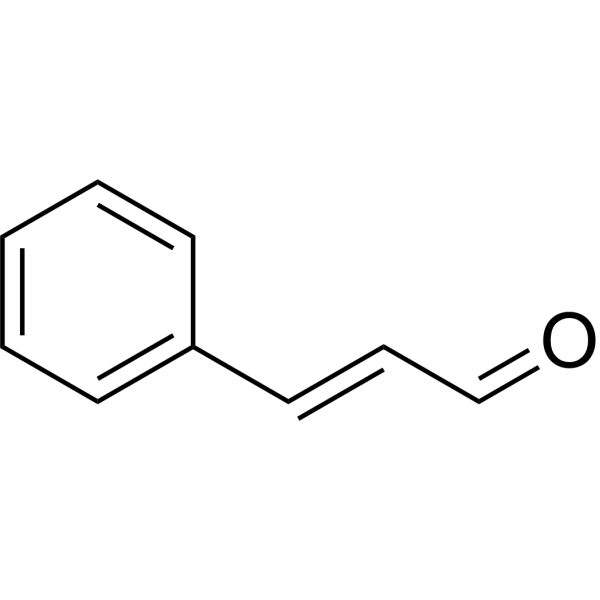
trans-Cinnamaldehyde is a major component of cinnamon oil with reported antibacterial and antitumor activities. The compound functions as a potent fumigant and practical repellent for adult mosquitoes. Its antibacterial activity is attributed to its ability to disrupt bacterial cell membranes and inhibit essential enzymes. The antitumor activity may involve induction of apoptosis, cell cycle arrest, and inhibition of proliferation through modulation of various signaling pathways. As an α,β-unsaturated aldehyde, trans-cinnamaldehyde can react with nucleophilic groups in proteins, potentially affecting enzyme activities and cellular functions. Its pungent, spicy odor is characteristic of its chemical structure and contributes to its use as a flavoring agent.
|
|---|---|
| 体外研究 (In Vitro) |
反式肉桂醛-β-环糊精复合物可有效抑制沙门氏菌属和李斯特菌属的生长。根据参考文献[1],最低抑制浓度为10和20 mg/mL。
体外实验表明,反式肉桂醛具有抗菌和抗肿瘤活性。该化合物对多种细菌菌株均有活性,使其成为一种强效熏蒸剂和实用的成蚊驱避剂。其抗肿瘤活性已在多种癌细胞系中得到证实,它能诱导细胞凋亡并抑制细胞增殖。该化合物的α,β-不饱和醛结构使其能够与细胞蛋白形成共价加合物,从而可能调节参与细胞存活和死亡的信号通路。其体外活性呈浓度依赖性,根据检测方法和目标生物的不同,在不同浓度下均能观察到疗效。反式肉桂醛是肉桂油的主要成分,并被用于传统医学。 |
| 体内研究 (In Vivo) |
体内实验表明,反式肉桂醛具有作为成蚊熏蒸剂和驱避剂的潜在应用价值。其抗菌和抗肿瘤活性提示其具有潜在的治疗应用价值。作为肉桂油的主要成分,肉桂油提取自著名的传统中药材肉桂皮,反式肉桂醛已被用于治疗多种疾病。然而,目前尚需从原始研究文献中获取反式肉桂醛详细的体内疗效、药代动力学和毒理学数据。该化合物仅供研究使用,尚未获准用于治疗用途。
|
| 酶活实验 |
体外酶/受体结合(非细胞)测定并非反式肉桂醛的标准药理学测定方法。然而,该化合物的抗菌活性可使用标准抗菌药物敏感性试验方法进行评估。其与蛋白质形成共价加合物的能力可通过使用模型蛋白或酶的生化测定进行研究。该化合物的α,β-不饱和醛结构使其能够与硫醇基团发生迈克尔加成反应,该反应可通过分光光度法或质谱法进行监测。可进行酶抑制测定以鉴定特定靶点。这些测定有助于阐明该化合物的作用机制和潜在生物活性。
|
| 细胞实验 |
利用多种癌细胞系或细菌菌株进行体外细胞实验,以评估反式肉桂醛的抗肿瘤和抗菌活性。将癌细胞培养于合适的培养基中,并用不同浓度的反式肉桂醛(通常为10-200 μM)处理24-72小时。采用MTT或CellTiter-Glo法评估细胞活力。通过Annexin V/PI染色和流式细胞术评估细胞凋亡。采用碘化丙啶染色后进行流式细胞术分析细胞周期。在抗菌研究中,用该化合物处理细菌培养物,并通过光密度或菌落计数测量生长抑制率。该化合物作为熏蒸剂和驱避剂的作用也可在细胞或生物体实验中进行评估。细胞在37°C、5% CO₂的条件下,并添加合适的培养基补充剂进行培养。
|
| 动物实验 |
已开展反式肉桂醛的体内动物研究,以评估其驱虫特性。蚊虫驱避研究通常包括将成蚊暴露于该化合物中,并评估其驱避率。抗肿瘤研究的标准体内模型包括在免疫缺陷小鼠体内移植癌细胞系异种移植瘤。动物接受不同剂量的反式肉桂醛,给药途径包括口服、腹腔注射或局部用药。疗效评估指标包括肿瘤体积、生存率和组织病理学检查。抗菌功效可在感染动物模型中进行评估。该化合物是肉桂油的主要成分,肉桂油提取自肉桂皮,并已应用于传统医学。
|
| 药代性质 (ADME/PK) |
吸收、分布和排泄
肉桂醛的皮肤吸收率为52%,并已被证实能被肠道快速吸收。它主要经代谢后通过尿液排出,少量经粪便排出。在大鼠和小鼠口服或腹腔注射肉桂醛后,24小时内尿液和粪便中回收了69%–98%的剂量。本研究探讨了微囊化肉桂醛(CNMA)在雄性F344大鼠体内的生物利用度。将CNMA溶解于玉米油中,并以50、250和500 mg/kg的剂量灌胃给予大鼠,分别采用微囊化制剂和纯CNMA。在所有剂量下,两种制剂的CNMA血浆浓度曲线或尿马尿酸排泄率均无差异。两种制剂在250和500 mg/kg剂量下均显示出较低的生物利用度(<20%)。无论使用何种制剂,灌胃给予CNMA均显著增加了尿液中马尿酸的排泄。约75%的CNMA剂量代谢为马尿酸并经尿液排出。50小时尿液收集中回收的马尿酸总量与CNMA剂量呈良好相关性。数据显示,CNMA可从微胶囊中完全释放,且CNMA的微囊化不影响其生物利用度或代谢…… 肉桂醛在体内可能被氧化为肉桂酸,肉桂酸以苯甲酸和马尿酸的形式经尿液排出。 大鼠腹腔注射肉桂醛后,尿液中排出6.5%的硫醚类化合物。 兔腹腔注射肉桂醛后,尿液中排出肉桂酸、肉桂酰甘氨酸、苯甲酸和马尿酸。 有关肉桂醛(7种类型)的吸收、分布和排泄的更完整数据,请访问HSDB记录页面。肉桂醛的代谢产物/代谢物代谢 本研究探讨了反式-[3-14C]肉桂醛对雄性和雌性Fischer 344大鼠以及CD1小鼠的影响。分别采用腹腔注射(2 mg/kg体重)和灌胃(250 mg/kg体重)给药。雄性小鼠采用灌胃给药。给药后72小时内,两种动物的粪便中均回收了约94%的给药剂量,其中大部分(75-81%)存在于0至24小时的尿液中。给药72小时后,动物尸体中检测到的给药剂量不足2%。采用色谱分析法鉴定尿液代谢物。两种动物尿液中的主要代谢物均为马尿酸,同时还检测到3-羟基-3-苯基丙酸、苯甲酸和苯甲酰葡糖醛酸苷。肉桂酸的甘氨酸结合物仅在小鼠体内大量生成。肉桂醛的氧化代谢与肉桂酸基本相同,均通过类似于脂肪酸的β-氧化途径进行。除肉桂酸和肉桂醛的常见代谢物外,大鼠尿液中0-24小时的14C含量有7%由两种新的代谢物组成,而小鼠尿液中则有三种新的代谢物。其他研究表明,这些代谢物来源于肉桂醛代谢的第二条途径,该途径涉及与谷胱甘肽结合。大鼠和小鼠体内肉桂醛的排泄模式和代谢谱不受性别、剂量或给药途径的系统性影响。本文探讨了这些数据与反式肉桂醛安全性评估的相关性,特别是将高剂量毒性数据外推至低剂量毒性数据的有效性。为了评估肉桂醛和肉桂醇在人体皮肤中的代谢程度,并提供皮肤醇脱氢酶 (ADH) 和醛脱氢酶 (ALDH) 在此代谢中作用的证据,我们分别在存在和不存在 ADH/细胞色素 P450 抑制剂 4-甲基吡唑和胞质 ALDH 抑制剂双硫仑的情况下,研究了人体皮肤匀浆和亚细胞组分中肉桂醇和肉桂醛的代谢程度。在不同的亚细胞组分中观察到肉桂醇和肉桂醛的代谢差异:皮肤细胞质被认为是肉桂酸类化合物代谢的主要场所。仅在全皮肤匀浆和细胞质组分中观察到4-甲基吡唑和双硫仑的显著代谢抑制作用……本研究表明,位于特定亚细胞区室的皮肤ADH和ALDH活性在皮肤中CAlc和CAld的活化和解毒过程中起着至关重要的作用…… 向兔腹腔注射肉桂醛后,尿液中排出肉桂酸、肉桂酰甘氨酸、苯甲酸和马尿酸。 在大鼠尿液中鉴定出两种含硫肉桂醛代谢物:3-S-(N-乙酰半胱氨酸)-3-苯基丙醇和3-S-(N-乙酰半胱氨酸)-3-苯基丙酸。 有关肉桂醛代谢/代谢物(共6种)的更完整数据,请访问HSDB记录页面。 肉桂醛是已知的……代谢物肉桂醛在人体内转化为肉桂酰辅酶A。肉桂醛在肉桂酰辅酶A还原酶的作用下转化为肉桂酰辅酶A。 反式肉桂醛的药代动力学性质尚未得到充分研究。该化合物的分子式为C₉H₈O,分子量为132.16 g/mol。它是一种淡黄色油状液体,沸点为250-252℃,25℃时的密度为1.05 g/mL,蒸气密度为4.6(相对于空气)。折射率为n20/D 1.622。闪点为71℃。溶解性:溶于醇和氯仿,微溶于水。储存条件:2-8℃。由于其为小分子亲脂性物质,预计其吸收和代谢良好。详细的药代动力学参数需要进一步研究。 |
| 毒性/毒理 (Toxicokinetics/TK) |
毒性概述
肉桂醛是一种过敏原。其生理效应是通过增加组胺释放和细胞介导的免疫反应实现的。毒性数据 LD50:3400 mg/kg(大鼠,口服)相互作用 本研究使用日本青鳉(Oryzias latipes)进行变态和幼体实验(MELA),以确定乙醇和调味成分肉桂醛(CAD)对青鳉发育的潜在不良影响……青鳉分别暴露于 100 mM 乙醇、10、1.0、0.67 或 0.50 mM CAD、乙醇和 CAD 的组合,或作为未处理的对照组。100 mM 乙醇无影响。单独使用 10 mM 和 1.0 mM CAD 处理可在受精后 1 天内致死。暴露于 100 mM 乙醇和 0.67 mM 肉桂醛 (CAD) 的胚胎表现出心血管和色素缺陷,且孵化延迟。与乙醇和肉桂醛联合处理相比,单独暴露于 0.50 mM 肉桂醛的胚胎表现出较轻的心血管问题。总之,这些结果表明乙醇和肉桂醛的联合作用大于其单独作用,提示需要监测鱼类孵化场的废水排放,以保护本地鱼类种群。 非人类毒性值 大鼠口服LD50:3400 mg/kg 小鼠口服LD50:200 mg/kg 小鼠腹腔注射LD50:200 mg/kg 小鼠静脉注射LD50:75 mg/kg 如需更完整的肉桂醛非人类毒性数据(共8个数值),请访问HSDB记录页面。 反式肉桂醛的毒理学信息表明,该化合物易燃,暴露于空气中会变稠。它具有强烈的辛辣肉桂气味。高浓度下,该化合物可能引起皮肤、眼睛或呼吸道刺激。作为传统医学中使用的肉桂油的主要成分和调味剂,它通常被认为在典型暴露水平下是安全的。处理化学品时应遵守标准安全预防措施,包括使用个人防护装备(手套、护目镜、实验服)并在通风良好的区域工作。该化合物仅供研究使用。 |
| 参考文献 |
|
| 其他信息 |
(E)-肉桂醛是肉桂醛的E(反式)立体异构体,肉桂醛是肉桂醛类化合物的母体化合物。它具有多种功能,包括降低血糖、作为EC 4.3.1.24(苯丙氨酸解氨酶)抑制剂、血管扩张剂、抗真菌剂、调味剂、植物代谢物和致敏剂。它是一种3-苯基丙烯醛,属于肉桂醛类化合物。肉桂醛是一种天然存在的黄酮类化合物,赋予香料肉桂独特的风味和香气。它天然存在于肉桂树皮以及樟属植物(例如樟树和肉桂树皮)中。对肉桂醛的敏感性可以通过临床斑贴试验检测出来。肉桂醛是一种标准化的化学过敏原。肉桂醛的生理效应是通过增加组胺释放和细胞介导免疫来实现的。据报道,姜黄(Curcuma xanthorrhiza)、生姜(Alpinia latilabris)以及其他一些具有相关数据的生物体中都含有肉桂醛。肉桂醛是赋予肉桂独特风味和香气的醛类物质。它天然存在于肉桂树皮以及其他肉桂属植物(如樟树和桂皮)的树皮中。这些树木是肉桂的天然来源,肉桂皮精油中约90%是肉桂醛。肉桂醛也可用作杀菌剂。它已被证明对40多种不同的作物有效,通常施用于植物根部。其低毒性和众所周知的特性使其成为农业的理想选择。肉桂醛在一定程度上也是一种有效的杀虫剂,其气味可以驱赶猫狗等动物。它还可以用作腐蚀性液体中钢和其他铁合金的缓蚀剂。它可以与其他成分混合使用,例如分散剂、溶剂和其他表面活性剂。浓缩的肉桂醛会刺激皮肤,大剂量服用有毒性,但目前没有任何机构怀疑该化合物具有致癌性或会造成长期健康危害。大部分肉桂醛以肉桂酸(肉桂醛的氧化形式)的形式从尿液中排出。肉桂醛是酿酒酵母的代谢产物。药物适应症:肉桂醛已获得美国食品药品监督管理局 (FDA) 的批准,用于过敏性皮肤斑贴试验,这是一种辅助诊断方法,用于诊断 6 岁及以上人群的过敏性接触性皮炎 (ACD)。治疗用途:锡兰肉桂 (Cinnamonum zeylanicum) 在印度传统医学中广泛用于治疗糖尿病。本研究旨在分离和鉴定潜在的抗糖尿病化合物……采用链脲佐菌素(STZ)(60 mg/kg 体重)诱导雄性糖尿病Wistar大鼠,并连续45天给予不同剂量(5、10和20 mg/kg 体重)的肉桂醛。结果显示,与对照组相比,血浆葡萄糖浓度呈剂量依赖性显著降低(p<0.05,降低63.29%)。此外,口服肉桂醛(20 mg/kg 体重)显著降低了糖化血红蛋白(HbA1c)、血清总胆固醇和甘油三酯水平,同时显著提高了血浆胰岛素、肝糖原和高密度脂蛋白胆固醇水平。此外,肉桂醛使异常的血浆酶水平(天冬氨酸氨基转移酶、丙氨酸氨基转移酶、乳酸脱氢酶、碱性磷酸酶和酸性磷酸酶)恢复至接近正常水平。给予参考药物格列本脲(0.6 mg/kg 体重)也显著降低了链脲佐菌素(STZ)诱导的糖尿病大鼠的血糖浓度(p < 0.05)。这些结果表明,肉桂醛对 STZ 诱导的糖尿病大鼠具有降血糖和降血脂作用。
反式肉桂醛(CAS 14371-10-9)是肉桂油的主要成分,提取自肉桂皮。该化合物的分子式为 C₉H₈O,分子量为 132.16 g/mol。它是一种淡黄色油状液体,具有强烈的辛辣肉桂气味。反式肉桂醛的沸点为 250-252°C,25°C 时的密度为 1.05 g/mL。已有报道称其具有抗菌和抗肿瘤活性。它是一种强效熏蒸剂,也是一种有效的成蚊驱避剂。又名(E)-肉桂醛和(E)-3-苯基丙烯醛。储存条件:2-8℃。 |
| 分子式 |
C₉H₈O
|
|---|---|
| 分子量 |
132.16
|
| 精确质量 |
132.057
|
| CAS号 |
14371-10-9
|
| PubChem CID |
637511
|
| 外观&性状 |
Colorless to light yellow liquid
|
| 密度 |
1.0±0.1 g/cm3
|
| 沸点 |
246.8±9.0 °C at 760 mmHg
|
| 熔点 |
−9-−4 °C(lit.)
|
| 闪点 |
71.1±0.0 °C
|
| 蒸汽压 |
0.0±0.5 mmHg at 25°C
|
| 折射率 |
1.577
|
| LogP |
2.12
|
| tPSA |
17.07
|
| 氢键供体(HBD)数目 |
0
|
| 氢键受体(HBA)数目 |
1
|
| 可旋转键数目(RBC) |
2
|
| 重原子数目 |
10
|
| 分子复杂度/Complexity |
121
|
| 定义原子立体中心数目 |
0
|
| SMILES |
O=C([H])/C(/[H])=C(\[H])/C1C([H])=C([H])C([H])=C([H])C=1[H]
|
| InChi Key |
KJPRLNWUNMBNBZ-QPJJXVBHSA-N
|
| InChi Code |
InChI=1S/C9H8O/c10-8-4-7-9-5-2-1-3-6-9/h1-8H/b7-4+
|
| 化学名 |
(E)-3-phenylprop-2-enal
|
| 别名 |
transCinnamaldehyde; trans Cinnamaldehyde
|
| HS Tariff Code |
2934.99.9001
|
| 存储方式 |
Powder -20°C 3 years 4°C 2 years In solvent -80°C 6 months -20°C 1 month 注意: 请将本产品存放在密封且受保护的环境中(例如氮气保护),避免吸湿/受潮。 |
| 运输条件 |
Room temperature (This product is stable at ambient temperature for a few days during ordinary shipping and time spent in Customs)
|
| 溶解度 (体外实验) |
DMSO : ~50 mg/mL (~378.33 mM)
|
|---|---|
| 溶解度 (体内实验) |
配方 1 中的溶解度: ≥ 2.5 mg/mL (18.92 mM) (饱和度未知) in 10% DMSO + 40% PEG300 + 5% Tween80 + 45% Saline (这些助溶剂从左到右依次添加,逐一添加), 澄清溶液。
例如,若需制备1 mL的工作液,可将100 μL 25.0 mg/mL澄清DMSO储备液加入到400 μL PEG300中,混匀;然后向上述溶液中加入50 μL Tween-80,混匀;加入450 μL生理盐水定容至1 mL。 *生理盐水的制备:将 0.9 g 氯化钠溶解在 100 mL ddH₂O中,得到澄清溶液。 配方 2 中的溶解度: ≥ 2.5 mg/mL (18.92 mM) (饱和度未知) in 10% DMSO + 90% (20% SBE-β-CD in Saline) (这些助溶剂从左到右依次添加,逐一添加), 澄清溶液。 例如,若需制备1 mL的工作液,可将 100 μL 25.0 mg/mL澄清DMSO储备液加入900 μL 20% SBE-β-CD生理盐水溶液中,混匀。 *20% SBE-β-CD 生理盐水溶液的制备(4°C,1 周):将 2 g SBE-β-CD 溶解于 10 mL 生理盐水中,得到澄清溶液。 View More
配方 3 中的溶解度: ≥ 2.5 mg/mL (18.92 mM) (饱和度未知) in 10% DMSO + 90% Corn Oil (这些助溶剂从左到右依次添加,逐一添加), 澄清溶液。 1、请先配制澄清的储备液(如:用DMSO配置50 或 100 mg/mL母液(储备液)); 2、取适量母液,按从左到右的顺序依次添加助溶剂,澄清后再加入下一助溶剂。以 下列配方为例说明 (注意此配方只用于说明,并不一定代表此产品 的实际溶解配方): 10% DMSO → 40% PEG300 → 5% Tween-80 → 45% ddH2O (或 saline); 假设最终工作液的体积为 1 mL, 浓度为5 mg/mL: 取 100 μL 50 mg/mL 的澄清 DMSO 储备液加到 400 μL PEG300 中,混合均匀/澄清;向上述体系中加入50 μL Tween-80,混合均匀/澄清;然后继续加入450 μL ddH2O (或 saline)定容至 1 mL; 3、溶剂前显示的百分比是指该溶剂在最终溶液/工作液中的体积所占比例; 4、 如产品在配制过程中出现沉淀/析出,可通过加热(≤50℃)或超声的方式助溶; 5、为保证最佳实验结果,工作液请现配现用! 6、如不确定怎么将母液配置成体内动物实验的工作液,请查看说明书或联系我们; 7、 以上所有助溶剂都可在 Invivochem.cn网站购买。 |
| 制备储备液 | 1 mg | 5 mg | 10 mg | |
| 1 mM | 7.5666 mL | 37.8329 mL | 75.6659 mL | |
| 5 mM | 1.5133 mL | 7.5666 mL | 15.1332 mL | |
| 10 mM | 0.7567 mL | 3.7833 mL | 7.5666 mL |
1、根据实验需要选择合适的溶剂配制储备液 (母液):对于大多数产品,InvivoChem推荐用DMSO配置母液 (比如:5、10、20mM或者10、20、50 mg/mL浓度),个别水溶性高的产品可直接溶于水。产品在DMSO 、水或其他溶剂中的具体溶解度详见上”溶解度 (体外)”部分;
2、如果您找不到您想要的溶解度信息,或者很难将产品溶解在溶液中,请联系我们;
3、建议使用下列计算器进行相关计算(摩尔浓度计算器、稀释计算器、分子量计算器、重组计算器等);
4、母液配好之后,将其分装到常规用量,并储存在-20°C或-80°C,尽量减少反复冻融循环。
计算结果:
工作液浓度: mg/mL;
DMSO母液配制方法: mg 药物溶于 μL DMSO溶液(母液浓度 mg/mL)。如该浓度超过该批次药物DMSO溶解度,请首先与我们联系。
体内配方配制方法:取 μL DMSO母液,加入 μL PEG300,混匀澄清后加入μL Tween 80,混匀澄清后加入 μL ddH2O,混匀澄清。
(1) 请确保溶液澄清之后,再加入下一种溶剂 (助溶剂) 。可利用涡旋、超声或水浴加热等方法助溶;
(2) 一定要按顺序加入溶剂 (助溶剂) 。
InvivoChem的所有产品仅用于作科学研究,不面向患者销售
Copyright 2020 InvivoChem LLC | All Rights Reserved 粤ICP备20063088号-1


 粤公网安备 44011102003439号
 463611831
