| 规格 | 价格 | 库存 | 数量 |
|---|---|---|---|
| 5mg |
|
||
| 10mg |
|
||
| 25mg |
|
||
| 50mg |
|
||
| 100mg |
|
||
| 250mg |
|
||
| 500mg |
|
||
| 1g |
|
||
| Other Sizes |
|
| 靶点 |
Mcl-1 (Ki=170 nM); Bcl-2 (Ki=260 nM); Bcl-xL (Ki=480 nM); Autophagy
Bcl-2 (Ki = 0.5 μM, fluorescence polarization assay for Bcl-2-BH3 peptide interaction), Bcl-xL (Ki = 0.8 μM, same assay), Mcl-1 (Ki = 1.2 μM, same assay); no significant binding to pro-apoptotic proteins Bax or Bak [1] Bcl-2 (IC50 = 0.6 μM, competition binding assay in SU-DHL-4 diffuse large B-cell lymphoma (DLBCL) cell lysates), Bcl-xL (IC50 = 0.9 μM, same assay); binding affinity to Mcl-1 was weaker than to Bcl-2/Bcl-xL, with no specific IC50 reported [2] |
|---|---|
| 体外研究 (In Vitro) |
(+)-棉酚和(R)-(-)-棉酚对映体是天然存在的外消旋棉酚的两种形式。棉酚 (AT-101) 和 (+) 位于 (R)-(-) 中 AT-101 在抑制细胞生长和诱导细胞凋亡方面比 (+)-棉酚更有效,可能是由于血清中的影响细胞培养实验。尽管 AT-101 和 (+)-棉酚都以相似的结合亲和力与 Bcl-2 或 Bcl-xL 结合。在 6 天的 MTT 测定中,根据 UM-SCC-6 和 UM-SCC-14A 评估棉酚的外消旋形式及其每种对映体。 (+)-棉酚和(R)-(-)-棉酚对映体是天然存在的外消旋棉酚的两种形式。棉酚 (AT-101) 和 (+) 位于 (R)-(-) 中 AT-101 在抑制细胞生长和诱导细胞凋亡方面比 (+)-棉酚更有效,可能是由于血清中的影响细胞培养实验。尽管 AT-101 和 (+)-棉酚都以相似的结合亲和力与 Bcl-2 或 Bcl-xL 结合。在 6 天的 MTT 测定中,根据 UM-SCC-6 和 UM-SCC-14A 评估棉酚的外消旋形式及其每种对映体。 AT-101 剂量比 HNSCC 细胞系生长所需剂量高 2 至 10 倍,可抑制人成纤维细胞系生长 50%。 (R)-(-)-棉酚 (AT-101) 浓度比 HNSCC 细胞系高 2 至 3 倍,可抑制人口腔角质形成细胞生长 50%。在 6 天 MTT 测定中,在 10 个 UM-SCC 细胞系中,(R)-(-)-Gossypol (AT-101) 在 0.5 至 10 M 范围内以剂量依赖性方式抑制细胞生长。一组细胞系的 IC50 为 2–5 M,而敏感性较低的一组细胞系的 IC50 约为 10 M[1]。 Bcl-2、Mcl-1 和 Bcl-xL 蛋白与 (R)-(-)-棉酚 (AT-101) 结合,Ki 值为 260–30 nM、170–10 nM 和 480–40 nM,分别[2]。
头颈部鳞状细胞癌(HNSCC)细胞:AT101抑制 SCC-15 细胞增殖的 IC50 为 1.1 μM,SCC-25 细胞为 1.3 μM,HN5 细胞为 1.5 μM(72 小时 MTT 实验)。克隆形成实验显示,1 μM AT101处理 SCC-15 细胞 14 天后,克隆数减少 70% [1] HNSCC 细胞凋亡:Annexin V-FITC/PI 染色显示,2 μM AT101处理 48 小时后,SCC-15 细胞凋亡率达 45%,SCC-25 细胞达 40%,HN5 细胞达 35%(溶媒对照组凋亡率为 5-8%)。Western blot 分析显示,SCC-15 细胞中切割型胱天蛋白酶 - 3(cleaved caspase-3)升高 2.8 倍,切割型胱天蛋白酶 - 9(cleaved caspase-9)升高 2.5 倍,Bax 蛋白升高 1.8 倍,Bcl-2 蛋白降低 40% [1] HNSCC 细胞线粒体功能障碍:JC-1 染色显示,1.5 μM AT101处理 SCC-15 细胞 24 小时后,线粒体膜电位(ΔΨm)降低 60%,同时 Western blot 检测胞质组分显示细胞色素 c 释放增加 2 倍 [1] DLBCL 细胞:AT101抑制 SU-DHL-4 细胞增殖的 IC50 为 2.0 μM,OCI-Ly3 细胞为 2.3 μM(72 小时 CCK-8 实验),其活性较衍生物 Apogossypolone 低 2-3 倍 [2] |
| 体内研究 (In Vivo) |
DLBCL 异种移植模型(6-8 周龄雌性裸鼠):向小鼠皮下注射 5×10^6 个 SU-DHL-4 细胞,待肿瘤体积达 120-150 mm³ 时,将小鼠随机分为两组(每组 6 只):溶媒对照组(0.5% 甲基纤维素)和AT101处理组(50 mg/kg,口服灌胃,每日一次,持续 21 天)。AT101处理使肿瘤体积减少 50%,肿瘤重量减少 45%。肿瘤组织免疫组化显示,切割型 caspase-3 阳性细胞增加 2.2 倍,增殖标志物 Ki-67 阳性细胞减少 35% [2]
|
| 酶活实验 |
对于该测定,使用源自用 6-羧基荧光素琥珀酰亚胺酯 (FAM-Bid) 标记的 Bid 的 21 残基 BH3 肽 QEDIIRNIARHLAQVGDSMDR 和源自人 Bcl-2、Bcl-XL 和 Mcl-1 的重组蛋白。测定FAM-Bid对Bcl-2蛋白的Ki为11nM,对Bcl-XL蛋白的Ki为25nM,对Mcl-1蛋白的Ki为5.7nM。 Bcl-XL 的竞争性结合测定与 Bcl-2 相同,但有以下例外:在以下测定缓冲液中加入 30 nM Bcl-XL 蛋白和 2.5 nM FAM-Bid 肽 [50 mM Tris-Bis (pH 7.4) 和0.01% 牛丙种球蛋白]。
Bcl-2 家族蛋白与 BH3 肽相互作用的荧光偏振实验:将重组人 Bcl-2、Bcl-xL、Mcl-1 蛋白(各 100 nM)与荧光素标记的 BH3 肽(50 nM)在实验缓冲液(20 mM Tris-HCl pH 7.4,150 mM NaCl,0.1% BSA)中混合,于 37°C 孵育 30 分钟。加入系列稀释的AT101(0.1-10 μM),在激发波长 490 nm、发射波长 520 nm 下检测荧光偏振值,通过拟合偏振抑制的剂量 - 效应曲线计算 Ki 值 [1] DLBCL 细胞裂解液中的竞争结合实验:将 SU-DHL-4 细胞裂解液与生物素标记的抗 Bcl-2 抗体及不同浓度的AT101(0.1-5 μM)在室温下孵育 1 小时,加入链霉亲和素包被的磁珠捕获 Bcl-2 - 抗体复合物,洗涤后通过 Western blot 检测结合的 Bcl-2 蛋白,将抑制 50% Bcl-2 - 抗体结合的AT101浓度定为 IC50 [2] |
| 细胞实验 |
将两种代表性 UM-SCC 细胞系 UM-SCC-6 和 UM-SCC-14A 连续暴露于 0(载体对照)、5 或 10 μM (±)-棉酚、(R)-(-)-棉酚或6 天 MTT 细胞存活测定中的 (+)-棉酚。
HNSCC 细胞活力实验(MTT 法):将 HNSCC 细胞(SCC-15、SCC-25、HN5)以 8×10^3 个细胞 / 孔的密度接种到 96 孔板,过夜孵育后加入系列稀释的AT101(0.2-5 μM),培养 72 小时。向每孔加入 MTT 试剂(5 mg/mL),孵育 4 小时后用 DMSO 溶解甲瓒结晶,通过酶标仪检测 570 nm 处吸光度,使用 GraphPad Prism 软件计算 IC50 值 [1] HNSCC 克隆形成实验:将 SCC-15 细胞以 2×10^3 个细胞 / 孔的密度接种到 6 孔板,孵育 24 小时使其贴壁。加入AT101(0.5-2 μM),每 3 天更换培养基,持续 14 天。用 4% 多聚甲醛固定克隆 15 分钟,0.1% 结晶紫染色 30 分钟,水洗后计数含 50 个以上细胞的克隆,克隆存活率按(处理组克隆数 / 对照组克隆数)×100% 计算 [1] HNSCC 凋亡实验(Annexin V-FITC/PI 染色):用 1-2 μM AT101处理 HNSCC 细胞 48 小时,胰酶消化收集细胞,用冷 PBS 洗涤两次。将细胞重悬于结合缓冲液,避光条件下加入 5 μL Annexin V-FITC 和 5 μL PI 染色 15 分钟,通过流式细胞术定量凋亡细胞(包括早期和晚期凋亡细胞) [1] DLBCL 细胞活力实验(CCK-8 法):将 SU-DHL-4 和 OCI-Ly3 细胞以 5×10^3 个细胞 / 孔的密度接种到 96 孔板,过夜孵育后加入系列稀释的AT101(0.5-5 μM),培养 72 小时。加入 CCK-8 试剂,孵育 2 小时后检测 450 nm 处吸光度,计算 IC50 值 [2] |
| 动物实验 |
~40 mg/kg
静脉注射或腹腔注射 携带 SK-Mel-147 黑色素瘤异种移植瘤的无胸腺 NCr-nu/nu 小鼠 DLBCL 异种移植瘤实验:雌性裸鼠(nu/nu 品系,6-8 周龄)在特定病原体清除 (SPF) 环境中适应 1 周。将 5×10^6 个 SU-DHL-4 细胞悬浮于 100 μL Matrigel/PBS 混合物(1:1,v/v)中,皮下注射到每只小鼠的右侧腹部。当肿瘤体积达到 120-150 mm³ 时,将小鼠随机分为两组(每组 n=6):(1)载体对照组:0.5% 甲基纤维素(100 μL/只,灌胃); (2)AT101治疗组:将AT101 50 mg/kg溶于0.5%甲基纤维素溶液中(100 μL/只小鼠,灌胃)。每日给药一次,连续21天。每3天测量一次肿瘤体积(计算公式为长×宽²/2)和体重。实验结束时,采用颈椎脱臼法处死小鼠,切除肿瘤并称重,取部分肿瘤组织用4%多聚甲醛固定,用于免疫组织化学染色[2] |
| 毒性/毒理 (Toxicokinetics/TK) |
裸鼠急性毒性:单次口服100 mg/kg AT101未导致死亡。30%的小鼠出现短暂性体重下降(<6%),并在5天内恢复。血清生化分析显示,与溶剂对照组相比,丙氨酸氨基转移酶(ALT ≤ 40 U/L)、天冬氨酸氨基转移酶(AST ≤ 85 U/L)、肌酐(≤ 0.7 mg/dL)或血尿素氮(BUN ≤ 20 mg/dL)均无显著变化[2]。
弥漫性大B细胞淋巴瘤(DLBCL)异种移植模型慢性毒性:小鼠接受50 mg/kg AT101(灌胃,每日一次,持续21天)治疗后,体重未出现显著变化(平均变化:-1.5%,而对照组为+2%)。肝脏、肾脏、脾脏和肺脏的组织病理学检查未发现药物引起的病变(如炎症或坏死)[2] 血浆蛋白结合率:采用超滤法测定,AT101在小鼠血浆中的血浆蛋白结合率为90%[2] |
| 参考文献 |
|
| 其他信息 |
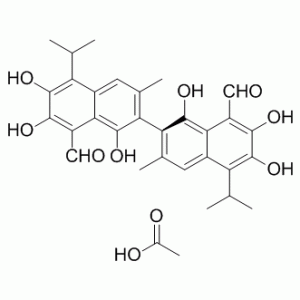
棉酚乙酸是棉酚的天然乙酸形式,是一种主要来源于棉籽的口服多酚醛,具有潜在的抗肿瘤活性。棉酚乙酸的生物活性与棉酚相似,包括抑制DNA复制、抑制肿瘤细胞增殖和男性避孕作用。(NCI04)
R-(-)-棉酚乙酸是棉酚R-(-)对映异构体与乙酸的口服生物利用度溶剂化物,具有潜在的抗肿瘤活性。作为一种BH3模拟物,R-(-)-棉酚与抗凋亡蛋白Bcl-2和Bcl-xL的疏水性表面结合槽BH3结合,阻断它们与Bcl-2家族促凋亡蛋白(如Bad、Bid和Bim)的异二聚化;这可能导致肿瘤细胞增殖受到抑制,并诱导肿瘤细胞凋亡。外消旋棉酚是从棉籽中分离得到的多酚化合物。 AT101 是棉酚的 (-)-对映异构体,棉酚是一种从棉籽中分离得到的天然产物。作为一种BH3模拟物,AT101与外消旋棉酚混合物相比,具有更高的效力和更低的毒性[1]。 作用机制:AT101特异性结合抗凋亡的Bcl-2家族蛋白(Bcl-2、Bcl-xL、Mcl-1),将促凋亡蛋白(Bax、Bak)从其与抗凋亡蛋白的复合物中置换出来,诱导线粒体外膜通透性(MOMP),将细胞色素c释放到细胞质中,激活caspase级联反应,最终触发内源性细胞凋亡[1,2]。 在弥漫性大B细胞淋巴瘤(DLBCL)细胞中,AT101的抗增殖效力低于其衍生物阿朴棉酚酮(IC50:2.0 μM vs. 阿朴棉酚酮的0.8 μM),但在裸鼠中具有更好的口服耐受性[2]。 目前尚无FDA警告信息或临床研究。已有关于AT101适应症的报道。根据发表时间(2004-2008年),AT101当时处于治疗实体瘤(例如头颈部鳞状细胞癌)和血液系统恶性肿瘤(例如弥漫性大B细胞淋巴瘤)的临床前或早期临床开发阶段[1,2]。 |
| 分子式 |
C30H30O8.C2H4O2
|
|
|---|---|---|
| 分子量 |
578.61
|
|
| 精确质量 |
578.215
|
|
| 元素分析 |
C, 66.43; H, 5.92; O, 27.65
|
|
| CAS号 |
866541-93-7
|
|
| 相关CAS号 |
(S)-Gossypol (acetic acid);1189561-66-7;Gossypol (acetic acid);12542-36-8;(R)-(-)-Gossypol;90141-22-3
|
|
| PubChem CID |
227456
|
|
| 外观&性状 |
Light yellow to brown solid powder
|
|
| LogP |
6.473
|
|
| tPSA |
192.82
|
|
| 氢键供体(HBD)数目 |
7
|
|
| 氢键受体(HBA)数目 |
10
|
|
| 可旋转键数目(RBC) |
5
|
|
| 重原子数目 |
42
|
|
| 分子复杂度/Complexity |
811
|
|
| 定义原子立体中心数目 |
0
|
|
| SMILES |
O=CC1C2C(=CC(C)=C(C3C(C)=CC4C(=C(C(=C(C=4C(C)C)O)O)C=O)C=3O)C=2O)C(C(C)C)=C(O)C=1O.O=C(C)O
|
|
| InChi Key |
NIOHNDKHQHVLKA-UHFFFAOYSA-N
|
|
| InChi Code |
InChI=1S/C30H30O8.C2H4O2/c1-11(2)19-15-7-13(5)21(27(35)23(15)17(9-31)25(33)29(19)37)22-14(6)8-16-20(12(3)4)30(38)26(34)18(10-32)24(16)28(22)36;1-2(3)4/h7-12,33-38H,1-6H3;1H3,(H,3,4)
|
|
| 化学名 |
acetic acid compound with (S)-1,1',6,6',7,7'-hexahydroxy-5,5'-diisopropyl-3,3'-dimethyl-[2,2'-binaphthalene]-8,8'-dicarbaldehyde (1:1)
|
|
| 别名 |
|
|
| HS Tariff Code |
2934.99.9001
|
|
| 存储方式 |
Powder -20°C 3 years 4°C 2 years In solvent -80°C 6 months -20°C 1 month 注意: (1). 本产品在运输和储存过程中需避光。 (2). 请将本产品存放在密封且受保护的环境中(例如氮气保护),避免吸湿/受潮。 (3). 该产品在溶液状态不稳定,请现配现用。 |
|
| 运输条件 |
Room temperature (This product is stable at ambient temperature for a few days during ordinary shipping and time spent in Customs)
|
| 溶解度 (体外实验) |
|
|||
|---|---|---|---|---|
| 溶解度 (体内实验) |
配方 1 中的溶解度: ≥ 1.25 mg/mL (2.16 mM) (饱和度未知) in 10% DMSO + 40% PEG300 + 5% Tween80 + 45% Saline (这些助溶剂从左到右依次添加,逐一添加), 澄清溶液。
例如,若需制备1 mL的工作液,可将100 μL 12.5 mg/mL澄清DMSO储备液加入400 μL PEG300中,混匀; 然后向上述溶液中加入50 μL Tween-80,混匀; 加入450 μL生理盐水定容至1 mL。 *生理盐水的制备:将 0.9 g 氯化钠溶解在 100 mL ddH₂O中,得到澄清溶液。 配方 2 中的溶解度: 1.25 mg/mL (2.16 mM) in 10% DMSO + 90% (20% SBE-β-CD in Saline) (这些助溶剂从左到右依次添加,逐一添加), 悬浊液; 超声助溶。 例如,若需制备1 mL的工作液,可将100 μL 12.5 mg/mL澄清DMSO储备液加入900 μL 20% SBE-β-CD生理盐水溶液中,混匀。 *20% SBE-β-CD 生理盐水溶液的制备(4°C,1 周):将 2 g SBE-β-CD 溶解于 10 mL 生理盐水中,得到澄清溶液。 View More
配方 3 中的溶解度: 0.5% CMC: 30mg/mL 1、请先配制澄清的储备液(如:用DMSO配置50 或 100 mg/mL母液(储备液)); 2、取适量母液,按从左到右的顺序依次添加助溶剂,澄清后再加入下一助溶剂。以 下列配方为例说明 (注意此配方只用于说明,并不一定代表此产品 的实际溶解配方): 10% DMSO → 40% PEG300 → 5% Tween-80 → 45% ddH2O (或 saline); 假设最终工作液的体积为 1 mL, 浓度为5 mg/mL: 取 100 μL 50 mg/mL 的澄清 DMSO 储备液加到 400 μL PEG300 中,混合均匀/澄清;向上述体系中加入50 μL Tween-80,混合均匀/澄清;然后继续加入450 μL ddH2O (或 saline)定容至 1 mL; 3、溶剂前显示的百分比是指该溶剂在最终溶液/工作液中的体积所占比例; 4、 如产品在配制过程中出现沉淀/析出,可通过加热(≤50℃)或超声的方式助溶; 5、为保证最佳实验结果,工作液请现配现用! 6、如不确定怎么将母液配置成体内动物实验的工作液,请查看说明书或联系我们; 7、 以上所有助溶剂都可在 Invivochem.cn网站购买。 |
| 制备储备液 | 1 mg | 5 mg | 10 mg | |
| 1 mM | 1.7283 mL | 8.6414 mL | 17.2828 mL | |
| 5 mM | 0.3457 mL | 1.7283 mL | 3.4566 mL | |
| 10 mM | 0.1728 mL | 0.8641 mL | 1.7283 mL |
1、根据实验需要选择合适的溶剂配制储备液 (母液):对于大多数产品,InvivoChem推荐用DMSO配置母液 (比如:5、10、20mM或者10、20、50 mg/mL浓度),个别水溶性高的产品可直接溶于水。产品在DMSO 、水或其他溶剂中的具体溶解度详见上”溶解度 (体外)”部分;
2、如果您找不到您想要的溶解度信息,或者很难将产品溶解在溶液中,请联系我们;
3、建议使用下列计算器进行相关计算(摩尔浓度计算器、稀释计算器、分子量计算器、重组计算器等);
4、母液配好之后,将其分装到常规用量,并储存在-20°C或-80°C,尽量减少反复冻融循环。
计算结果:
工作液浓度: mg/mL;
DMSO母液配制方法: mg 药物溶于 μL DMSO溶液(母液浓度 mg/mL)。如该浓度超过该批次药物DMSO溶解度,请首先与我们联系。
体内配方配制方法:取 μL DMSO母液,加入 μL PEG300,混匀澄清后加入μL Tween 80,混匀澄清后加入 μL ddH2O,混匀澄清。
(1) 请确保溶液澄清之后,再加入下一种溶剂 (助溶剂) 。可利用涡旋、超声或水浴加热等方法助溶;
(2) 一定要按顺序加入溶剂 (助溶剂) 。
Link: https://clinicaltrials.gov/ct2/show/NCT02697344
Conditions:Recurrent Plasma Cell MyelomaLink: https://clinicaltrials.gov/ct2/show/NCT05338931
Conditions:B-cell Non Hodgkin LymphomaLink: https://clinicaltrials.gov/ct2/show/NCT01003769
Conditions:Recurrent Chronic Lymphocytic Leukemia
Title:Gossypol in Treating Patients With Progressive or Recurrent Glioblastoma Multiforme
Status:Completed
updateDate:2017-08-11
Ctid:NCT00540722
Link: https://clinicaltrials.gov/ct2/show/NCT00540722
Conditions:Adult Giant Cell Glioblastoma|Adult Glioblastoma|Adult Gliosarcoma|Recurrent Adult Brain TumorLink: https://clinicaltrials.gov/ct2/show/NCT00773955
Conditions:Extensive Stage Small Cell Lung Cancer|Recurrent Small Cell Lung CancerLink: https://clinicaltrials.gov/ct2/show/NCT00848016
Conditions:Recurrent Adrenocortical Carcinoma|Stage III Adrenocortical Carcinoma|Stage IV Adrenocortical CarcinomaLink: https://clinicaltrials.gov/ct2/show/NCT00544596
Conditions:Extensive Stage Small Cell Lung Cancer|Unspecified Adult Solid Tumor, Protocol SpecificLink: https://clinicaltrials.gov/ct2/show/NCT00891072
Conditions:Adult Grade III Lymphomatoid Granulomatosis|Adult Nasal Type Extranodal NK/T-cell Lymphoma|Contiguous Stage II Adult Burkitt Lymphoma|Contiguous Stage II Adult Diffuse Large Cell Lymphoma|Contiguous Stage II Adult Diffuse Mixed Cell Lymphoma|Contiguous Stage II Adult Diffuse Small Cleaved Cell Lymphoma|Contiguous Stage II Adult Immunoblastic Large Cell Lymphoma|Contiguous Stage II Adult Lymphoblastic Lymphoma|Contiguous Stage II Grade 1 Follicular Lymphoma|Contiguous Stage II Grade 2 Follicular Lymphoma|Contiguous Stage II Grade 3 Follicular Lymphoma|Contiguous Stage II Mantle Cell Lymphoma|Contiguous Stage II Marginal Zone Lymphoma|Contiguous Stage II Small Lymphocytic Lymphoma|Extranodal Marginal Zone B-cell Lymphoma of Mucosa-associated Lymphoid Tissue|Nodal Marginal Zone B-cell Lymphoma|Noncontiguous Stage II Adult Burkitt Lymphoma|Noncontiguous Stage II Adult Diffuse Large Cell Lymphoma|Noncontiguous Stage II Adult Diffuse Mixed Cell Lymphoma|Noncontiguous Stage II Adult Diffuse Small Cleaved Cell Lymphoma|Noncontiguous Stage II Adult Immunoblastic Large Cell Lymphoma|Noncontiguous Stage II Adult Lymphoblastic Lymphoma|Noncontiguous Stage II Grade 1 Follicular Lymphoma|Noncontiguous Stage II Grade 2 Follicular Lymphoma|Noncontiguous Stage II Grade 3 Follicular Lymphoma|Noncontiguous Stage II Mantle Cell Lymphoma|Noncontiguous Stage II Marginal Zone Lymphoma|Noncontiguous Stage II Small Lymphocytic Lymphoma|Peripheral T-cell Lymphoma|Recurrent Adult Burkitt Lymphoma|Recurrent Adult Diffuse Large Cell Lymphoma|Recurrent Adult Diffuse Mixed Cell Lymphoma|Recurrent Adult Diffuse Small Cleaved Cell Lymphoma|Recurrent Adult Grade III Lymphomatoid Granulomatosis|Recurrent Adult Immunoblastic Large Cell Lymphoma|Recurrent Adult Lymphoblastic Lymphoma|Recurrent Grade 1 Follicular Lymphoma|Recurrent Grade 2 Follicular Lymphoma|Recurrent Grade 3 Follicular Lymphoma|Recurrent Mantle Cell Lymphoma|Recurrent Marginal Zone Lymphoma|Recurrent Small Lymphocytic Lymphoma|Splenic Marginal Zone Lymphoma|Stage I Adult Burkitt Lymphoma|Stage I Adult Diffuse Large Cell Lymphoma|Stage I Adult Diffuse Mixed Cell Lymphoma|Stage I Adult Diffuse Small Cleaved Cell Lymphoma|Stage I Adult Immunoblastic Large Cell Lymphoma|Stage I Adult Lymphoblastic Lymphoma|Stage I Grade 1 Follicular Lymphoma|Stage I Grade 2 Follicular Lymphoma|Stage I Grade 3 Follicular Lymphoma|Stage I Mantle Cell Lymphoma|Stage I Marginal Zone Lymphoma|Stage I Small Lymphocytic Lymphoma|Stage III Adult Burkitt Lymphoma|Stage III Adult Diffuse Large Cell Lymphoma|Stage III Adult Diffuse Mixed Cell Lymphoma|Stage III Adult Diffuse Small Cleaved Cell Lymphoma|Stage III Adult Immunoblastic Large Cell Lymphoma|Stage III Adult Lymphoblastic Lymphoma|Stage III Grade 1 Follicular Lymphoma|Stage III Grade 2 Follicular Lymphoma|Stage III Grade 3 Follicular Lymphoma|Stage III Mantle Cell Lymphoma|Stage III Marginal Zone Lymphoma|Stage III Small Lymphocytic Lymphoma|Stage IV Adult Burkitt Lymphoma|Stage IV Adult Diffuse Large Cell Lymphoma|Stage IV Adult Diffuse Mixed Cell Lymphoma|Stage IV Adult Diffuse Small Cleaved Cell Lymphoma|Stage IV Adult Immunoblastic Large Cell Lymphoma|Stage IV Adult Lymphoblastic Lymphoma|Stage IV Grade 1 Follicular Lymphoma|Stage IV Grade 2 Follicular Lymphoma|Stage IV Grade 3 Follicular Lymphoma|Stage IV Mantle Cell Lymphoma|Stage IV Marginal Zone Lymphoma|Stage IV Small Lymphocytic Lymphoma|Unspecified Adult Solid Tumor, Protocol Specific|Waldenström MacroglobulinemiaLink: https://clinicaltrials.gov/ct2/show/NCT00390403
Conditions:Brain and Central Nervous System TumorsInvivoChem的所有产品仅用于作科学研究,不面向患者销售
Copyright 2020 InvivoChem LLC | All Rights Reserved 粤ICP备20063088号-1


 COA
COA
 粤公网安备 44011102003439号
 463611831
