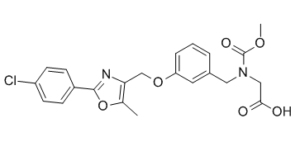
| 规格 | 价格 | 库存 | 数量 |
|---|---|---|---|
| 5mg |
|
||
| 10mg |
|
||
| 25mg |
|
||
| 50mg |
|
||
| 100mg |
|
||
| 250mg |
|
||
| Other Sizes |
|

| 靶点 |
Peroxisome Proliferator-Activated Receptor α (PPARα) (EC50 = 0.08 μM, PPRE-luciferase reporter gene assay in HEK293 cells; no significant activation of PPARγ or PPARδ at concentrations up to 10 μM) [1]
|
|---|---|
| 体外研究 (In Vitro) |
BMS-687453 对人 PPARα 的 EC50 和 IC50 分别为 10 nM 和 260 nM,在 PPAR-GAL4 反式激活中相对于人 PPARγ 4100 nM 和 >15000 nM 的选择性约为 410 倍和超过 57 倍,BMS-687453 是一种强效选择性药物。 PPARα 激动剂。在 HepG2 细胞中,与 PPARγ (EC50 = 2400 nM) 相比,BMS-687453 显示出约 50 倍的选择性和高 PPARα 效力 (EC50 = 47 nM)。 BMS-687453 在这两个物种中仍然是完全的 PPARα 激动剂,但它在啮齿动物 PPARα 功能测定中表现出较弱的活性,对小鼠的 EC50 适中,为 426 nM,对仓鼠为 488 nM[1]。
1. PPARα选择性激活:BMS-687453在共转染人PPARα表达质粒、RXRα表达质粒及PPRE驱动的荧光素酶报告质粒的HEK293细胞中,以剂量依赖性方式激活PPARα,EC50=0.08 μM。相同报告基因实验中,对PPARγ(EC50>10 μM)和PPARδ(EC50>10 μM)无显著激活,体现高亚型选择性[1] 2. PPARα靶基因上调:HepG2肝细胞经BMS-687453(0.1-10 μM)处理24小时后,qRT-PCR检测显示脂肪酸氧化及脂质代谢相关靶基因表达呈剂量依赖性上调,1 μM剂量下酰基辅酶A氧化酶1(ACOX1)升高3.8倍、肉碱棕榈酰转移酶1A(CPT1A)升高2.9倍、脂蛋白脂肪酶(LPL)升高2.5倍[1] 3. 与LXR激动剂协同作用:HepG2细胞经BMS-687453(1 μM)与肝X受体(LXR)激动剂(0.1 μM)联合处理后,胆固醇排泄相关基因ABCG5(4.2倍)和ABCG8(3.9倍)的mRNA表达协同上调,显著高于单药处理组(BMS-687453单药:ABCG5升高1.8倍、ABCG8升高1.6倍;LXR激动剂单药:ABCG5升高2.1倍、ABCG8升高1.9倍)[2] |
| 体内研究 (In Vivo) |
BMS-687453 可剂量依赖性地增加小鼠低密度脂蛋白胆固醇 (LDLc) 和血清 ApoA1 蛋白水平(10、50、100,po)。在高脂肪饮食喂养的仓鼠中,BMS-687453(1、3、10 mg/kg,口服)可降低 HDLc 水平[1]。 PDK4 mRNA 由 BMS-687453 在肝脏中诱导,ED50 值为 0.24 mg/kg[2]。口服 300 mg/kg BMS-687453 治疗的雄性大鼠出现骨骼肌纤维变性和坏死,其特征是盘状变化、肌原纤维溶解、玻璃样变和细胞浸润。对于雄性大鼠,BMS-687453(300 mg/kg,口服)会对快肌和慢肌产生轻微毒性[3]。
1. 高脂血症小鼠降脂活性:C57BL/6小鼠高脂饮食(45%脂肪)喂养8周诱导高脂血症,口服BMS-687453(1、3、10 mg/kg/天)连续14天,呈剂量依赖性降低血清甘油三酯(TG):1 mg/kg组降低25%、3 mg/kg组降低38%、10 mg/kg组降低45%;同时降低低密度脂蛋白胆固醇(LDL-C)20%-35%,升高高密度脂蛋白胆固醇(HDL-C)12%-25%[2] 2. 协同增强胆固醇排泄:高脂血症小鼠经BMS-687453(3 mg/kg/天)与LXR激动剂(1 mg/kg/天)联合给药后,粪便胆固醇排泄较溶媒组增加60%,显著高于单药组(BMS-687453单药增加22%;LXR激动剂单药增加28%)[2] 3. 调控肝脏脂质代谢基因:BMS-687453(10 mg/kg/天)处理组小鼠肝脏组织中,ACOX1(3.2倍)、CPT1A(2.7倍)、LPL(2.3倍)的mRNA表达上调,与体外实验结果一致[1][2] |
| 酶活实验 |
1. PPARα报告基因实验:HEK293细胞用转染试剂共转染人PPARα表达质粒、视黄醇X受体α(RXRα)表达质粒、PPAR反应元件(PPRE)驱动的萤火虫荧光素酶报告质粒及海肾荧光素酶内参质粒。转染24小时后接种于96孔板,用系列浓度BMS-687453(0.001-10 μM)处理24小时,检测双荧光素酶活性,计算萤火虫荧光素酶与海肾荧光素酶活性比值评估激活效率,通过剂量-反应曲线推导EC50值[1]
2. PPAR亚型选择性实验:采用上述报告基因实验流程,替换为PPARγ或PPARδ表达质粒,检测BMS-687453(0.001-10 μM)对各亚型的激活活性,计算EC50值以评估亚型选择性[1] |
| 细胞实验 |
1. PPARα靶基因表达实验:HepG2细胞以1×10^6个细胞/孔接种于6孔板,贴壁24小时后用BMS-687453(0.1、1、10 μM)处理24小时。提取总RNA并逆转录为cDNA,采用ACOX1、CPT1A、LPL及内参GAPDH的特异性引物进行qRT-PCR,通过2^(-ΔΔCt)法计算相对基因表达量[1]
2. 协同基因表达实验:HepG2细胞接种于6孔板,分别用BMS-687453(1 μM)、LXR激动剂(0.1 μM)或联合处理24小时,提取总RNA,qRT-PCR检测ABCG5和ABCG8的mRNA表达,以GAPDH为内参[2] |
| 动物实验 |
配制方法:2% Tween 80 和 0.5% CMC(羧甲基纤维素)溶于 97.5% Gibco 蒸馏水中;5 mL/kg;灌胃给药。
6-8 周龄雄性人 apoA1 转基因小鼠 1. 高脂血症小鼠模型的建立:将雄性 C57BL/6 小鼠(6-8 周龄,18-22 g)喂食高脂饮食(45% 脂肪,20% 蛋白质,35% 碳水化合物)8 周,以诱导高脂血症。选取血清甘油三酯 (TG) > 2.5 mmol/L 且低密度脂蛋白胆固醇 (LDL-C) > 1.5 mmol/L 的小鼠进行实验[2] 2. 实验分组和给药:将小鼠随机分为5组(每组n=8):溶剂对照组(0.5%羧甲基纤维素钠,CMC-Na)、BMS-687453 1 mg/kg组、BMS-687453 3 mg/kg组、BMS-687453 10 mg/kg组和联合用药组(BMS-687453 3 mg/kg + LXR激动剂 1 mg/kg)。BMS-687453悬浮于0.5% CMC-Na溶液中,每日灌胃一次,连续14天。对照组小鼠接受相同体积的0.5% CMC-Na溶液[2] 3. 样品采集与分析:实验结束时,小鼠禁食12小时,从眼眶静脉丛采集血液,分离血清,使用商业试剂盒检测甘油三酯(TG)、低密度脂蛋白胆固醇(LDL-C)和高密度脂蛋白胆固醇(HDL-C)。小鼠采用颈椎脱臼法处死,采集肝组织进行靶基因表达的qRT-PCR分析。在治疗的最后3天收集粪便,使用胆固醇检测试剂盒测定胆固醇排泄量[2] |
| 药代性质 (ADME/PK) |
1. 口服生物利用度:在大鼠中,口服BMS-687453(10 mg/kg)的绝对生物利用度为52% [1]
2. 血浆药代动力学:在大鼠中口服BMS-687453(10 mg/kg)后,血浆峰浓度(Cmax)为2.3 μM,达峰时间(Tmax)为1小时,曲线下面积(AUC0-24h)为15.6 μM·h,消除半衰期(t1/2)为6.8小时 [1] 3. 组织分布:在小鼠中,口服BMS-687453(10 mg/kg)2小时后,肝脏中检测到的药物浓度最高(5.8 μM),其次是脂肪组织(3.2 μM)和血浆(2.1 μM)。 μM),肾脏(1.7 μM)。脑组织浓度低于检测限(<0.1 μM)[1] |
| 毒性/毒理 (Toxicokinetics/TK) |
1. 急性毒性:在大鼠中,单次口服剂量高达 200 mg/kg 的 BMS-687453,在 14 天的观察期内未引起显著死亡或明显的毒性症状(例如,嗜睡、体重减轻、胃肠道不适)[1]
2. 慢性毒性:小鼠连续 28 天口服 BMS-687453(10 mg/kg/天),与对照组相比,肝功能(ALT、AST)或肾功能(BUN、肌酐)均未见显著变化。主要器官(肝脏、肾脏、心脏、肺)的组织病理学分析未发现异常病变[1] |
| 参考文献 |
|
| 其他信息 |
1. BMS-687453 是一种选择性过氧化物酶体增殖物激活受体α (PPARα) 激动剂,具有氧苄基甘氨酸骨架。它通过与 PPARα 的配体结合域结合来激活 PPARα,从而调节参与脂肪酸氧化、甘油三酯代谢和脂蛋白转运的基因表达[1]
2. 该药物在血脂异常动物模型中表现出显著的降脂活性,可降低甘油三酯 (TG) 和低密度脂蛋白胆固醇 (LDL-C),同时升高高密度脂蛋白胆固醇 (HDL-C),使其成为治疗血脂异常的潜在药物。其与LXR激动剂在胆固醇排泄方面的协同作用提示了一种有前景的联合降脂治疗策略[2] 3. BMS-687453具有良好的药代动力学特性,包括高口服生物利用度、有效的肝脏靶向性(肝脏是脂质代谢的关键器官)以及临床前研究中的低毒性,支持其临床开发潜力[1] 4. 对PPARα的高选择性最大限度地减少了与PPARγ或PPARδ激活相关的脱靶效应(例如体重增加、水肿),从而提高了其在脂质代谢紊乱长期治疗中的安全性[1] |
| 分子式 |
C₂₂H₂₁CLN₂O₆
|
|
|---|---|---|
| 分子量 |
444.86
|
|
| 精确质量 |
444.108
|
|
| CAS号 |
1000998-59-3
|
|
| 相关CAS号 |
|
|
| PubChem CID |
16725047
|
|
| 外观&性状 |
White to off-white solid powder
|
|
| 密度 |
1.3±0.1 g/cm3
|
|
| 沸点 |
642.7±65.0 °C at 760 mmHg
|
|
| 闪点 |
342.5±34.3 °C
|
|
| 蒸汽压 |
0.0±2.0 mmHg at 25°C
|
|
| 折射率 |
1.595
|
|
| LogP |
4.98
|
|
| tPSA |
102.1
|
|
| 氢键供体(HBD)数目 |
1
|
|
| 氢键受体(HBA)数目 |
7
|
|
| 可旋转键数目(RBC) |
9
|
|
| 重原子数目 |
31
|
|
| 分子复杂度/Complexity |
601
|
|
| 定义原子立体中心数目 |
0
|
|
| InChi Key |
UJIBXDMNCMEJAY-UHFFFAOYSA-N
|
|
| InChi Code |
InChI=1S/C22H21ClN2O6/c1-14-19(24-21(31-14)16-6-8-17(23)9-7-16)13-30-18-5-3-4-15(10-18)11-25(12-20(26)27)22(28)29-2/h3-10H,11-13H2,1-2H3,(H,26,27)
|
|
| 化学名 |
2-[[3-[[2-(4-chlorophenyl)-5-methyl-1,3-oxazol-4-yl]methoxy]phenyl]methyl-methoxycarbonylamino]acetic acid
|
|
| 别名 |
|
|
| HS Tariff Code |
2934.99.9001
|
|
| 存储方式 |
Powder -20°C 3 years 4°C 2 years In solvent -80°C 6 months -20°C 1 month |
|
| 运输条件 |
Room temperature (This product is stable at ambient temperature for a few days during ordinary shipping and time spent in Customs)
|
| 溶解度 (体外实验) |
|
|||
|---|---|---|---|---|
| 溶解度 (体内实验) |
配方 1 中的溶解度: ≥ 2.5 mg/mL (5.62 mM) (饱和度未知) in 10% DMSO + 40% PEG300 + 5% Tween80 + 45% Saline (这些助溶剂从左到右依次添加,逐一添加), 澄清溶液。
例如,若需制备1 mL的工作液,可将100 μL 25.0 mg/mL澄清DMSO储备液加入到400 μL PEG300中,混匀;然后向上述溶液中加入50 μL Tween-80,混匀;加入450 μL生理盐水定容至1 mL。 *生理盐水的制备:将 0.9 g 氯化钠溶解在 100 mL ddH₂O中,得到澄清溶液。 配方 2 中的溶解度: 2.5 mg/mL (5.62 mM) in 10% DMSO + 90% (20% SBE-β-CD in Saline) (这些助溶剂从左到右依次添加,逐一添加), 悬浊液; 超声助溶。 例如,若需制备1 mL的工作液,可将 100 μL 25.0 mg/mL澄清DMSO储备液加入900 μL 20% SBE-β-CD生理盐水溶液中,混匀。 *20% SBE-β-CD 生理盐水溶液的制备(4°C,1 周):将 2 g SBE-β-CD 溶解于 10 mL 生理盐水中,得到澄清溶液。 View More
配方 3 中的溶解度: ≥ 2.5 mg/mL (5.62 mM) (饱和度未知) in 10% DMSO + 90% Corn Oil (这些助溶剂从左到右依次添加,逐一添加), 澄清溶液。 1、请先配制澄清的储备液(如:用DMSO配置50 或 100 mg/mL母液(储备液)); 2、取适量母液,按从左到右的顺序依次添加助溶剂,澄清后再加入下一助溶剂。以 下列配方为例说明 (注意此配方只用于说明,并不一定代表此产品 的实际溶解配方): 10% DMSO → 40% PEG300 → 5% Tween-80 → 45% ddH2O (或 saline); 假设最终工作液的体积为 1 mL, 浓度为5 mg/mL: 取 100 μL 50 mg/mL 的澄清 DMSO 储备液加到 400 μL PEG300 中,混合均匀/澄清;向上述体系中加入50 μL Tween-80,混合均匀/澄清;然后继续加入450 μL ddH2O (或 saline)定容至 1 mL; 3、溶剂前显示的百分比是指该溶剂在最终溶液/工作液中的体积所占比例; 4、 如产品在配制过程中出现沉淀/析出,可通过加热(≤50℃)或超声的方式助溶; 5、为保证最佳实验结果,工作液请现配现用! 6、如不确定怎么将母液配置成体内动物实验的工作液,请查看说明书或联系我们; 7、 以上所有助溶剂都可在 Invivochem.cn网站购买。 |
| 制备储备液 | 1 mg | 5 mg | 10 mg | |
| 1 mM | 2.2479 mL | 11.2395 mL | 22.4790 mL | |
| 5 mM | 0.4496 mL | 2.2479 mL | 4.4958 mL | |
| 10 mM | 0.2248 mL | 1.1239 mL | 2.2479 mL |
1、根据实验需要选择合适的溶剂配制储备液 (母液):对于大多数产品,InvivoChem推荐用DMSO配置母液 (比如:5、10、20mM或者10、20、50 mg/mL浓度),个别水溶性高的产品可直接溶于水。产品在DMSO 、水或其他溶剂中的具体溶解度详见上”溶解度 (体外)”部分;
2、如果您找不到您想要的溶解度信息,或者很难将产品溶解在溶液中,请联系我们;
3、建议使用下列计算器进行相关计算(摩尔浓度计算器、稀释计算器、分子量计算器、重组计算器等);
4、母液配好之后,将其分装到常规用量,并储存在-20°C或-80°C,尽量减少反复冻融循环。
计算结果:
工作液浓度: mg/mL;
DMSO母液配制方法: mg 药物溶于 μL DMSO溶液(母液浓度 mg/mL)。如该浓度超过该批次药物DMSO溶解度,请首先与我们联系。
体内配方配制方法:取 μL DMSO母液,加入 μL PEG300,混匀澄清后加入μL Tween 80,混匀澄清后加入 μL ddH2O,混匀澄清。
(1) 请确保溶液澄清之后,再加入下一种溶剂 (助溶剂) 。可利用涡旋、超声或水浴加热等方法助溶;
(2) 一定要按顺序加入溶剂 (助溶剂) 。
 BMS-687453 (A and B) and BMS-711939 (C and D) raise HDLc (A and C) and ApoA1 (B and D) in human ApoA1 transgenic mice.
Synergistic increase in fecal cholesterol excretion by the combination of PPARα and LXR agonists in SV/129 wild-type or PPARα-humanized mice (A) and human ApoA1 transgenic mice (B and C).J Pharmacol Exp Ther.2008 Dec;327(3):716-26. |
|---|
 BMS-687453 lowers serum triglycerides (A) and LDLc (B) in fat-fed hamsters.J Pharmacol Exp Ther.2008 Dec;327(3):716-26.
Liver gene induction occurs at a much lower dose in PPARα-humanized mice compared with mice harboring wild-type (mouse) PPARα.J Pharmacol Exp Ther.2008 Dec;327(3):716-26. |
BMS-711939 lowers serum triglycerides (A) and LDLc (B) in fat-fed hamsters.
Plasma triglyceride lowering correlates with hepatic gene induction.J Pharmacol Exp Ther.2008 Dec;327(3):716-26. |
InvivoChem的所有产品仅用于作科学研究,不面向患者销售
Copyright 2020 InvivoChem LLC | All Rights Reserved 粤ICP备20063088号-1


 COA
COA


 粤公网安备 44011102003439号
 463611831
