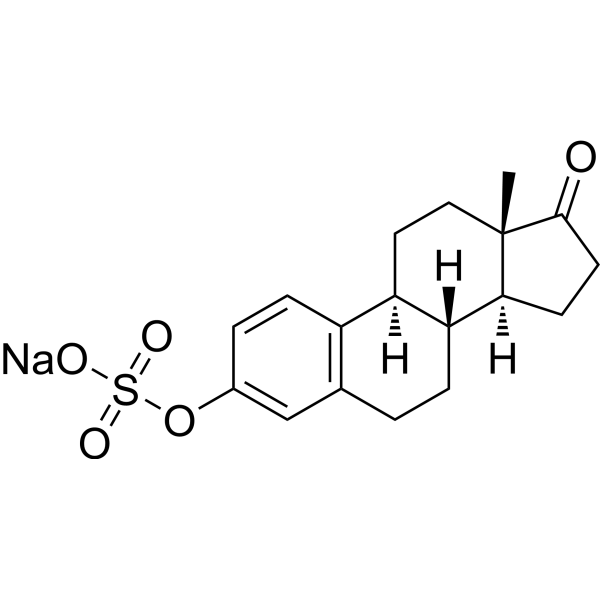
Estrone sulfate sodium

别名: Estrone sulfate sodium salt; Conestoral; Estrone sodium sulfate; Estrone sulfate sodium; Morestin; NSC 18313; Sodium estrone sulfate; Sodium estrone-3-sulfate; 雌酮硫酸钠;雌酮3-硫酸钠;雌酮3硫酸钠盐;3-硫酸雌酮钠盐
目录号: V41844 纯度: ≥98%
硫酸雌酮是雌激素的一种无生物活性形式,是主要的循环血浆雌激素,可通过类固醇硫酸酯酶 (STS) 转化为具有生物活性的雌激素雌酮。
Estrone sulfate sodium CAS号: 438-67-5
产品类别: New2
产品仅用于科学研究,不针对患者销售
规格 价格
500mg
1g
Other Sizes

Other Forms of Estrone sulfate sodium:

  • Estrone sulfate
点击了解更多
InvivoChem产品被CNS等顶刊论文引用
产品描述
硫酸雌酮是雌激素的一种无生物活性形式,是主要的循环血浆雌激素,可通过类固醇硫酸酯酶 (STS) 转化为具有生物活性的雌激素雌酮。硫酸雌酮可用于乳腺癌研究。
生物活性&实验参考方法
体外研究 (In Vitro)
用 SOAT 稳定转染 T47D 细胞后,在生理相关量的雌二醇和硫酸雌酮下培养细胞。 1 nM 雌二醇和硫酸雌酮的 EC50 为 2.2 nM,可显着增强细胞增殖 [3]。
药代性质 (ADME/PK)
Absorption, Distribution and Excretion
The conjugated estrogens are well absorbed in the gastrointestinal tract and the maximum plasma concentration of the conjugated estrogens is reached after 7 hours depending on the estrone component. The maximal plasma concentration of conjugated estrogens after multiple doses of 0.45 mg is reported to be of 2.6 ng/ml with an AUC in the steady state of 35 ng.h/ml. Unconjugated estrogens are known to be cleared from the circulation at a faster rate than their ester forms.
The conjugated estrogens are eliminated mainly in the urine. In this renal elimination, it is possible to find 17 beta-estradiol, estrone, estriol, as well as the glucuronide and sulfate conjugates of the estrogens.
The physiological distribution of estrogens in the body is very similar to what is seen in endogenous estrogens and hence, it is widely distributed. The conjugated estrogens are mainly found in the sex hormone target organs.
The reported normal clearance rate for estrogens is of approximately 615 L/m2.
Metabolism / Metabolites
The conjugated estrogens are metabolized by a number of different pathways. One of the metabolic pathways of the conjugated estrogens is driven by the action of the cytochrome isoenzyme CYP3A4. On the other hand, the conjugated estrogens can also be processed by a dynamic equilibrium of metabolic interconversion and sulfate conjugation. Some of the principal metabolic reactions of the conjugated estrogens are driven by the conversion of 17beta-estradiol to estrone and the further change to estriol. A portion of the administered conjugated estrogens will remain in the blood as sulfate conjugates which serve as a circulating reservoir for the generation of new estrogens. In the endometrium, equilin is metabolized to 2-hydroxy and 4-hydroxy equilin as well as 2-hydroxy and 4-hydroxy estradiol. This hydroxylation process is very large in various of the components of the conjugated estrogens and hence, the major metabolites in urine are known to be 17-ketosteroid-16-alpha-hydroxy estrone, 16-alpha-hydroxy-17-beta-dihydro equilin and 16-alpha-hydroxy-17-beta-dihydroequilenin.
Biological Half-Life
The median half-life of the conjugated estrogens is reported to be of 17 hours.
毒性/毒理 (Toxicokinetics/TK)
Protein Binding
Conjugated estrogens are bound to plasma proteins and this bound state can represent around 50-80% of the administered dose. It circulates in the blood mainly bound to sex-hormone binding globulin and albumin.
参考文献

[1]. Steroid sulfatase and estrogen sulfotransferase in the atherosclerotic human aorta. Am J Pathol. 2003;163(4):1329-1339.

[2]. Inhibition of estrone sulfatase activity by estrone-3-methylthiophosphonate: a potential therapeutic agent in breast cancer. Cancer Res. 1993;53(2):298-303.

[3]. Estrone-3-Sulfate Stimulates the Proliferation of T47D Breast Cancer Cells Stably Transfected With the Sodium-Dependent Organic Anion Transporter SOAT (SLC10A6). Front Pharmacol. 2018;9:941. Published 2018 Aug 21.

其他信息
Estrone sodium sulfate is a steroid sulfate and an organic sodium salt. It is functionally related to an estrone.
The conjugated estrogens are noncrystalline mixtures of purified female sex hormones obtained either by its isolation from the urine of pregnant mares or by synthetic generation from vegetal material. Both of these products are later conjugated to natrium sulfate by ester bonds in order to make them more water soluble. The conjugated estrogen product contains a mix of estrogen from which about 50% is represented by estrone sulfate followed by 25% of equilin sulfate, 15% of 17-alpha-dehydroequilenin sulfate, 3% of equilenin sulfate, 5% of 17-alpha and 17-beta-dihydroequilenin sulfate, 2% of 17-alpha-estradiolsulfate and 3% of 17-beta-estradiolsulfate. It also presents a large number of unidentified molecules with weak estrogenic activity as well as non-human molecules when it is obtained from pregnant mares urine. The conjugated estrogen mixture was approved for marketing in US in 1942 based on the efficacy against certain conditions. However, until 1986 official clinical trials were performed and this product was determined to be effective for the treatment of osteoporosis. The currently approved product of conjugated estrogens was developed by Wyeth Ayerst and FDA approved in 2003.
Drug Indication
The conjugated estrogens are indicated for several different conditions including: - Treatment of moderate to severe vasomotor symptoms due to menopause. - Treatment of moderate to severe symptoms of vulvar and vaginal atrophy due to menopause. - Treatment of hypoestrogenism due to hypogonadism, castration or primary ovarian failure. - Palliative treatment of breast cancer in appropriately selected patients with metastatic disease. - Palliative treatment of androgen-dependent carcinoma of the prostate. - Preventive therapy of postmenopausal osteoporosis.
FDA Label
Mechanism of Action
The conjugated estrogens, equally to the normal physiological estrogen, work by agonistically binding to the estrogen receptors alpha and beta. The estrogen receptors vary in quantity and proportion according to the tissues and hence, the activity of this conjugated estrogens is very variable. The activity made by the conjugated estrogens is driven by the increase in the synthesis of DNA, RNA and various proteins in responsive tissues which in order will reduce the release of gonadotropin-releasing hormone, follicle-stimulating hormone and leuteinizing hormone. The specific mechanism of action cannot be described only in terms of total estrogenic action as the pharmacokinetic profile, the tissue specificity and the tissue metabolism is different for each component of the product.
Pharmacodynamics
The binding of estrogens to the estrogen receptor produces the activation of nuclear receptors in order to bind to estrogen response elements in certain target genes. This mechanistic cascade results in histone acetylation, alteration of chromatin conformation and the initiation of transcription of certain specific drugs. In preclinical studies, the conjugated estrogens are known to have a similar estrogenic potency than estrone and the equilin components of the conjugated estrogens have similar potency in the liver when compared to bioidentical estradiol. It has also been tested and confirmed that conjugated estrogens present a selective estrogen receptor modulator profile which allows it to have a large beneficial effect on the bone and cardiovascular system. Clinically, the administration of conjugated estrogens is known to promote vasomotor stability, maintain genitourinary function, and normal growth and development of female sex hormones. It has also been shown to prevent accelerated bone loss by inhibiting bone resorption and restoring the balance of bone resorption. In the hormonal area, it is shown to inhibit luteinizing hormone and decrease the serum concentration of testosterone.
*注: 文献方法仅供参考, InvivoChem并未独立验证这些方法的准确性
化学信息 & 存储运输条件
分子式
C18H21O5S-.NA+
分子量
372.41114
精确质量
372.1
元素分析
C, 58.05; H, 5.68; Na, 6.17; O, 21.48; S, 8.61
CAS号
438-67-5
相关CAS号
481-97-0 (free acid);438-67-5 (sodium);
PubChem CID
23667301
外观&性状
White to off-white solid powder
密度
1.349 g/cm3
熔点
258-260°C
LogP
4.031
tPSA
91.88
氢键供体(HBD)数目
0
氢键受体(HBA)数目
5
可旋转键数目(RBC)
2
重原子数目
25
分子复杂度/Complexity
630
定义原子立体中心数目
4
SMILES
[Na+].O=S(OC1C=CC2[C@H]3CC[C@@]4(C(CC[C@H]4[C@@H]3CCC=2C=1)=O)C)(=O)[O-]
InChi Key
VUCAHVBMSFIGAI-ZFINNJDLSA-M
InChi Code
InChI=1S/C18H22O5S.Na/c1-18-9-8-14-13-5-3-12(23-24(20,21)22)10-11(13)2-4-15(14)16(18)6-7-17(18)19;/h3,5,10,14-16H,2,4,6-9H2,1H3,(H,20,21,22);/q;+1/p-1/t14-,15-,16+,18+;/m1./s1
化学名
sodium;[(8R,9S,13S,14S)-13-methyl-17-oxo-7,8,9,11,12,14,15,16-octahydro-6H-cyclopenta[a]phenanthren-3-yl] sulfate
别名
Estrone sulfate sodium salt; Conestoral; Estrone sodium sulfate; Estrone sulfate sodium; Morestin; NSC 18313; Sodium estrone sulfate; Sodium estrone-3-sulfate;
HS Tariff Code
2934.99.9001
存储方式

Powder      -20°C    3 years

                     4°C     2 years

In solvent   -80°C    6 months

                  -20°C    1 month

注意: 请将本产品存放在密封且受保护的环境中,避免吸湿/受潮。
运输条件
Room temperature (This product is stable at ambient temperature for a few days during ordinary shipping and time spent in Customs)
溶解度数据
溶解度 (体外实验)
DMSO : ~25 mg/mL (~67.13 mM)
溶解度 (体内实验)
配方 1 中的溶解度: ≥ 2.5 mg/mL (6.71 mM) (饱和度未知) in 10% DMSO + 40% PEG300 + 5% Tween80 + 45% Saline (这些助溶剂从左到右依次添加,逐一添加), 澄清溶液。
例如,若需制备1 mL的工作液,可将100 μL 25.0 mg/mL澄清DMSO储备液加入到400 μL PEG300中,混匀;然后向上述溶液中加入50 μL Tween-80,混匀;加入450 μL生理盐水定容至1 mL。
*生理盐水的制备:将 0.9 g 氯化钠溶解在 100 mL ddH₂O中,得到澄清溶液。

配方 2 中的溶解度: ≥ 2.5 mg/mL (6.71 mM) (饱和度未知) in 10% DMSO + 90% (20% SBE-β-CD in Saline) (这些助溶剂从左到右依次添加,逐一添加), 澄清溶液。
例如,若需制备1 mL的工作液,可将 100 μL 25.0 mg/mL澄清DMSO储备液加入900 μL 20% SBE-β-CD生理盐水溶液中,混匀。
*20% SBE-β-CD 生理盐水溶液的制备(4°C,1 周):将 2 g SBE-β-CD 溶解于 10 mL 生理盐水中,得到澄清溶液。

View More

配方 3 中的溶解度: ≥ 2.5 mg/mL (6.71 mM) (饱和度未知) in 10% DMSO + 90% Corn Oil (这些助溶剂从左到右依次添加,逐一添加), 澄清溶液。
例如,若需制备1 mL的工作液,可将 100 μL 25.0 mg/mL 澄清 DMSO 储备液加入到 900 μL 玉米油中并混合均匀。


请根据您的实验动物和给药方式选择适当的溶解配方/方案:
1、请先配制澄清的储备液(如:用DMSO配置50 或 100 mg/mL母液(储备液));
2、取适量母液,按从左到右的顺序依次添加助溶剂,澄清后再加入下一助溶剂。以 下列配方为例说明 (注意此配方只用于说明,并不一定代表此产品 的实际溶解配方):
10% DMSO → 40% PEG300 → 5% Tween-80 → 45% ddH2O (或 saline);
假设最终工作液的体积为 1 mL, 浓度为5 mg/mL: 取 100 μL 50 mg/mL 的澄清 DMSO 储备液加到 400 μL PEG300 中,混合均匀/澄清;向上述体系中加入50 μL Tween-80,混合均匀/澄清;然后继续加入450 μL ddH2O (或 saline)定容至 1 mL;

3、溶剂前显示的百分比是指该溶剂在最终溶液/工作液中的体积所占比例;
4、 如产品在配制过程中出现沉淀/析出,可通过加热(≤50℃)或超声的方式助溶;
5、为保证最佳实验结果,工作液请现配现用!
6、如不确定怎么将母液配置成体内动物实验的工作液,请查看说明书或联系我们;
7、 以上所有助溶剂都可在 Invivochem.cn网站购买。
制备储备液 1 mg 5 mg 10 mg
1 mM 2.6852 mL 13.4261 mL 26.8521 mL
5 mM 0.5370 mL 2.6852 mL 5.3704 mL
10 mM 0.2685 mL 1.3426 mL 2.6852 mL

1、根据实验需要选择合适的溶剂配制储备液 (母液):对于大多数产品,InvivoChem推荐用DMSO配置母液 (比如:5、10、20mM或者10、20、50 mg/mL浓度),个别水溶性高的产品可直接溶于水。产品在DMSO 、水或其他溶剂中的具体溶解度详见上”溶解度 (体外)”部分;

2、如果您找不到您想要的溶解度信息,或者很难将产品溶解在溶液中,请联系我们;

3、建议使用下列计算器进行相关计算(摩尔浓度计算器、稀释计算器、分子量计算器、重组计算器等);

4、母液配好之后,将其分装到常规用量,并储存在-20°C或-80°C,尽量减少反复冻融循环。

计算器

摩尔浓度计算器可计算特定溶液所需的质量、体积/浓度,具体如下:

  • 计算制备已知体积和浓度的溶液所需的化合物的质量
  • 计算将已知质量的化合物溶解到所需浓度所需的溶液体积
  • 计算特定体积中已知质量的化合物产生的溶液的浓度
使用摩尔浓度计算器计算摩尔浓度的示例如下所示:
假如化合物的分子量为350.26 g/mol,在5mL DMSO中制备10mM储备液所需的化合物的质量是多少?
  • 在分子量(MW)框中输入350.26
  • 在“浓度”框中输入10,然后选择正确的单位(mM)
  • 在“体积”框中输入5,然后选择正确的单位(mL)
  • 单击“计算”按钮
  • 答案17.513 mg出现在“质量”框中。以类似的方式,您可以计算体积和浓度。

稀释计算器可计算如何稀释已知浓度的储备液。例如,可以输入C1、C2和V2来计算V1,具体如下:

制备25毫升25μM溶液需要多少体积的10 mM储备溶液?
使用方程式C1V1=C2V2,其中C1=10mM,C2=25μM,V2=25 ml,V1未知:
  • 在C1框中输入10,然后选择正确的单位(mM)
  • 在C2框中输入25,然后选择正确的单位(μM)
  • 在V2框中输入25,然后选择正确的单位(mL)
  • 单击“计算”按钮
  • 答案62.5μL(0.1 ml)出现在V1框中
g/mol

分子量计算器可计算化合物的分子量 (摩尔质量)和元素组成,具体如下:

注:化学分子式大小写敏感:C12H18N3O4  c12h18n3o4
计算化合物摩尔质量(分子量)的说明:
  • 要计算化合物的分子量 (摩尔质量),请输入化学/分子式,然后单击“计算”按钮。
分子质量、分子量、摩尔质量和摩尔量的定义:
  • 分子质量(或分子量)是一种物质的一个分子的质量,用统一的原子质量单位(u)表示。(1u等于碳-12中一个原子质量的1/12)
  • 摩尔质量(摩尔重量)是一摩尔物质的质量,以g/mol表示。
/

配液计算器可计算将特定质量的产品配成特定浓度所需的溶剂体积 (配液体积)

  • 输入试剂的质量、所需的配液浓度以及正确的单位
  • 单击“计算”按钮
  • 答案显示在体积框中
动物体内实验配方计算器(澄清溶液)
第一步:请输入基本实验信息(考虑到实验过程中的损耗,建议多配一只动物的药量)
第二步:请输入动物体内配方组成(配方适用于不溶/难溶于水的化合物),不同的产品和批次配方组成不同,如对配方有疑问,可先联系我们提供正确的体内实验配方。此外,请注意这只是一个配方计算器,而不是特定产品的确切配方。
+
+
+

计算结果:

工作液浓度 mg/mL;

DMSO母液配制方法 mg 药物溶于 μL DMSO溶液(母液浓度 mg/mL)。如该浓度超过该批次药物DMSO溶解度,请首先与我们联系。

体内配方配制方法μL DMSO母液,加入 μL PEG300,混匀澄清后加入μL Tween 80,混匀澄清后加入 μL ddH2O,混匀澄清。

(1) 请确保溶液澄清之后,再加入下一种溶剂 (助溶剂) 。可利用涡旋、超声或水浴加热等方法助溶;
            (2) 一定要按顺序加入溶剂 (助溶剂) 。

联系我们