| 规格 | 价格 | |
|---|---|---|
| 500mg | ||
| 1g | ||
| Other Sizes |
| 体外研究 (In Vitro) |
pH值对新霉素B(又称新霉素B或夫雷霉素B)对RNase P RNA的抑制作用有影响,pH值升高会抵消其他系统的抑制作用[1]。人类和细胞核糖体翻译被新霉素B抑制。 5"-其氮基新霉素Fold B和新霉素B选择性抑制成熟miRNA的产生,增强转录因子,抑制HCC细胞系的右侧[2]。新霉素B与RNA的结构基序序列基序有主要同源性目标是16S rRNA解码位点,但它也与HIV-1锤头核酶、Rev反应元件和I族内含子结合,抑制它们的生物学功能[3]。这个过程导致误读遗传密码并抑制核糖体靶位点是 16 S rRNA 的 1400 至 1500 区域[4]。
|
|---|---|
| 药代性质 (ADME/PK) |
代谢/代谢物
新霉素经肠外给药后生物转化极少。 消除途径:少量吸收的药物迅速分布于组织中,并根据肾功能程度经肾脏排泄。 半衰期:2至3小时 |
| 毒性/毒理 (Toxicokinetics/TK) |
毒性概述
氨基糖苷类抗生素如新霉素可“不可逆地”与特定的30S亚基蛋白和16S rRNA结合。具体而言,新霉素与16S rRNA的四个核苷酸和S12蛋白的一个氨基酸结合。这会干扰30S亚基16S rRNA中第1400个核苷酸附近的解码位点。该区域与tRNA反密码子中的摆动碱基相互作用。这会导致起始复合物受到干扰,mRNA 错误读取,从而将错误的氨基酸插入多肽链,导致无功能或有毒肽的产生,以及多聚核糖体分解成无功能的单体核糖体。 妊娠和哺乳期影响 ◉ 哺乳期用药概述 虽然目前尚无关于新霉素分泌到乳汁中的信息,但其他氨基糖苷类抗生素分泌到母乳中的量很少。新生儿似乎会吸收少量氨基糖苷类抗生素,但其血清浓度远低于治疗新生儿感染时达到的浓度,因此不太可能出现新霉素的全身性作用。预计较大婴儿吸收的新霉素更少。密切观察婴儿胃肠道菌群可能受到的影响,例如腹泻、念珠菌病(如鹅口疮、尿布疹)或罕见的便血,便血可能提示抗生素相关性结肠炎。 口服、外用、眼用或耳用新霉素在母乳中的浓度应极低,对婴儿的风险可忽略不计,但乳头局部用药可能会增加婴儿腹泻的风险。仅应使用水溶性乳膏或凝胶产品涂抹于乳房,因为软膏可能通过舔舐使婴儿接触到高浓度的矿物油。 ◉ 对母乳喂养婴儿的影响 截至修订日期,未找到相关的已发表信息。 ◉ 对泌乳和母乳的影响 截至修订日期,未找到相关的已发表信息。 毒性数据 LD50:200 mg/kg(大鼠)(A308) |
| 参考文献 |
|
| 其他信息 |
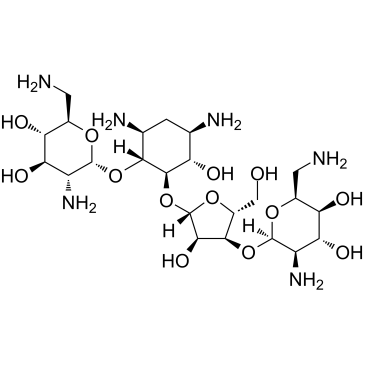
弗拉米西汀是一种源自新霉素的四环类抗菌剂,是新霉素胺和新霉素B的糖苷酯。它具有抗菌药物、过敏原和大肠杆菌代谢产物等多种功能。它是弗拉米西汀(6+)的共轭碱。
新霉素由弗氏链霉菌(Streptomyces fradiae)产生。水解后生成新霉素胺和新霉素B。(引自《默克索引》,第11版) 据报道,大豆(Glycine max)、白色链霉菌(Streptomyces albus)和其他一些有相关数据的微生物中也存在新霉素。 弗拉米西汀是一种从薰衣草链霉菌(Streptomyces lavendulae (decaris))中分离得到的氨基糖苷类抗生素,主要成分为新霉素B,具有广谱抗菌活性。弗拉米西汀主要用作外用制剂,吸收率低。肠外给药时,该药物可引起肾毒性和耳毒性。 新霉素的组成成分,由弗氏链霉菌(Streptomyces fradiae)产生。水解后生成新霉素胺和新霉素B。(引自《默克索引》,第11版)。新霉素是一种杀菌性氨基糖苷类抗生素,可与敏感菌的30S核糖体结合。结合会干扰mRNA结合位点和受体tRNA位点,导致产生无功能或有毒的肽。 新霉素的组成成分,由弗氏链霉菌(Streptomyces fradiae)产生。水解后生成新霉素胺和新霉素B。(引自《默克索引》,第11版) 另见:新霉素(注释已移至)硫酸新霉素(注释已移至)。 药物适应症 用于治疗细菌性睑缘炎、细菌性结膜炎、角膜损伤、角膜溃疡和睑板腺炎。用于异物取出后预防眼部感染。 作用机制 弗拉米西汀与特定的30S亚基蛋白和16S rRNA结合,结合16S rRNA的四个核苷酸和S12蛋白的一个氨基酸。这会干扰30S亚基16S rRNA中第1400个核苷酸附近的解码位点。该区域与tRNA反密码子中的摆动碱基相互作用。这会导致起始复合物的干扰,mRNA 的错读,从而将错误的氨基酸插入多肽链,产生无功能或有毒的肽,并导致多核糖体分解成无功能的单体核糖体。 药效学 弗拉米西汀用于治疗细菌性眼部感染,例如结膜炎。弗拉米西汀是一种抗生素。它对真菌、病毒和大多数厌氧菌无效。弗拉米西汀的作用机制是与细菌 30S 核糖体亚基结合,导致 tRNA 错读,使细菌无法合成对其生长至关重要的蛋白质。弗拉米西汀主要用于治疗需氧菌感染。 |
| 分子式 |
C23H46N6O13
|
|---|---|
| 分子量 |
614.64374
|
| 精确质量 |
614.312
|
| CAS号 |
119-04-0
|
| 相关CAS号 |
Framycetin sulfate;4146-30-9;Neomycin sulfate;1405-10-3
|
| PubChem CID |
8378
|
| 外观&性状 |
Colorless to light yellow liquid
|
| 密度 |
1.61 g/cm3
|
| 沸点 |
927.1ºC at 760 mmHg
|
| 熔点 |
6 °C (sulfate form)
|
| 闪点 |
514.5ºC
|
| 折射率 |
1.6000 (estimate)
|
| LogP |
-9
|
| tPSA |
353.11
|
| 氢键供体(HBD)数目 |
13
|
| 氢键受体(HBA)数目 |
19
|
| 可旋转键数目(RBC) |
9
|
| 重原子数目 |
42
|
| 分子复杂度/Complexity |
872
|
| 定义原子立体中心数目 |
19
|
| SMILES |
C1[C@H]([C@@H]([C@H]([C@@H]([C@H]1N)O[C@@H]2[C@@H]([C@H]([C@@H]([C@H](O2)CN)O)O)N)O[C@H]3[C@@H]([C@@H]([C@H](O3)CO)O[C@@H]4[C@@H]([C@H]([C@@H]([C@@H](O4)CN)O)O)N)O)O)N
|
| InChi Key |
PGBHMTALBVVCIT-KNSIFCLBSA-N InChi Code
|
| InChi Code |
InChI=1S/C23H46N6O13/c24-2-7-13(32)15(34)10(28)21(37-7)40-18-6(27)1-5(26)12(31)20(18)42-23-17(36)19(9(4-30)39-23)41-22-11(29)16(35)14(33)8(3-25)38-22/h5-23,30-36H,1-4,24-29H2/t5-,6+,7-,8+,9-,10-,11-,12+,13-,14-,15-,16-,17-,18-,19-,20-,21-,22-,23+/m1/s1
|
| 化学名 |
(2S,3S,4R,5R,6R)-5-amino-2-(aminomethyl)-6-(((2R,3S,4R,5S)-5-(((1R,2R,3S,5R,6S)-3,5-diamino-2-(((2R,3R,4R,5R,6R)-3-amino-6-(aminomethyl)-4,5-dihydroxytetrahydro-2H-pyran-2-yl)oxy)-6-hydroxycyclohexyl)oxy)-4-hydroxy-2-(hydroxymethyl)tetrahydrofuran-3-yl)oxy)tetrahydro-2H-pyran-3,4-diol
|
| 别名 |
Neomycin B Fradiomycin B Actilin Soframycin
|
| HS Tariff Code |
2934.99.9001
|
| 存储方式 |
Powder -20°C 3 years 4°C 2 years In solvent -80°C 6 months -20°C 1 month |
| 运输条件 |
Room temperature (This product is stable at ambient temperature for a few days during ordinary shipping and time spent in Customs)
|
| 溶解度 (体外实验) |
H2O : ~100 mg/mL (~162.70 mM)
DMSO : ~50 mg/mL (~81.35 mM) |
|---|---|
| 溶解度 (体内实验) |
配方 1 中的溶解度: ≥ 2.5 mg/mL (4.07 mM) (饱和度未知) in 10% DMSO + 40% PEG300 + 5% Tween80 + 45% Saline (这些助溶剂从左到右依次添加,逐一添加), 澄清溶液。
例如,若需制备1 mL的工作液,可将100 μL 25.0 mg/mL澄清DMSO储备液加入到400 μL PEG300中,混匀;然后向上述溶液中加入50 μL Tween-80,混匀;加入450 μL生理盐水定容至1 mL。 *生理盐水的制备:将 0.9 g 氯化钠溶解在 100 mL ddH₂O中,得到澄清溶液。 配方 2 中的溶解度: ≥ 2.5 mg/mL (4.07 mM) (饱和度未知) in 10% DMSO + 90% (20% SBE-β-CD in Saline) (这些助溶剂从左到右依次添加,逐一添加), 澄清溶液。 例如,若需制备1 mL的工作液,可将 100 μL 25.0 mg/mL澄清DMSO储备液加入900 μL 20% SBE-β-CD生理盐水溶液中,混匀。 *20% SBE-β-CD 生理盐水溶液的制备(4°C,1 周):将 2 g SBE-β-CD 溶解于 10 mL 生理盐水中,得到澄清溶液。 View More
配方 3 中的溶解度: ≥ 2.5 mg/mL (4.07 mM) (饱和度未知) in 10% DMSO + 90% Corn Oil (这些助溶剂从左到右依次添加,逐一添加), 澄清溶液。 配方 4 中的溶解度: 120 mg/mL (195.24 mM) in PBS (这些助溶剂从左到右依次添加,逐一添加), 澄清溶液; 超声助溶. 1、请先配制澄清的储备液(如:用DMSO配置50 或 100 mg/mL母液(储备液)); 2、取适量母液,按从左到右的顺序依次添加助溶剂,澄清后再加入下一助溶剂。以 下列配方为例说明 (注意此配方只用于说明,并不一定代表此产品 的实际溶解配方): 10% DMSO → 40% PEG300 → 5% Tween-80 → 45% ddH2O (或 saline); 假设最终工作液的体积为 1 mL, 浓度为5 mg/mL: 取 100 μL 50 mg/mL 的澄清 DMSO 储备液加到 400 μL PEG300 中,混合均匀/澄清;向上述体系中加入50 μL Tween-80,混合均匀/澄清;然后继续加入450 μL ddH2O (或 saline)定容至 1 mL; 3、溶剂前显示的百分比是指该溶剂在最终溶液/工作液中的体积所占比例; 4、 如产品在配制过程中出现沉淀/析出,可通过加热(≤50℃)或超声的方式助溶; 5、为保证最佳实验结果,工作液请现配现用! 6、如不确定怎么将母液配置成体内动物实验的工作液,请查看说明书或联系我们; 7、 以上所有助溶剂都可在 Invivochem.cn网站购买。 |
| 制备储备液 | 1 mg | 5 mg | 10 mg | |
| 1 mM | 1.6270 mL | 8.1348 mL | 16.2697 mL | |
| 5 mM | 0.3254 mL | 1.6270 mL | 3.2539 mL | |
| 10 mM | 0.1627 mL | 0.8135 mL | 1.6270 mL |
1、根据实验需要选择合适的溶剂配制储备液 (母液):对于大多数产品,InvivoChem推荐用DMSO配置母液 (比如:5、10、20mM或者10、20、50 mg/mL浓度),个别水溶性高的产品可直接溶于水。产品在DMSO 、水或其他溶剂中的具体溶解度详见上”溶解度 (体外)”部分;
2、如果您找不到您想要的溶解度信息,或者很难将产品溶解在溶液中,请联系我们;
3、建议使用下列计算器进行相关计算(摩尔浓度计算器、稀释计算器、分子量计算器、重组计算器等);
4、母液配好之后,将其分装到常规用量,并储存在-20°C或-80°C,尽量减少反复冻融循环。
计算结果:
工作液浓度: mg/mL;
DMSO母液配制方法: mg 药物溶于 μL DMSO溶液(母液浓度 mg/mL)。如该浓度超过该批次药物DMSO溶解度,请首先与我们联系。
体内配方配制方法:取 μL DMSO母液,加入 μL PEG300,混匀澄清后加入μL Tween 80,混匀澄清后加入 μL ddH2O,混匀澄清。
(1) 请确保溶液澄清之后,再加入下一种溶剂 (助溶剂) 。可利用涡旋、超声或水浴加热等方法助溶;
(2) 一定要按顺序加入溶剂 (助溶剂) 。
Decolonization of Carbapenem-resistant Enterobacterales (CRE) in Patients With Faecal Carriage of CRE With Neomycin
CTID: NCT05593601
Phase: Phase 4 Status: Unknown status
Date: 202
Intestinal colonization by multiresistant enterobacteria in patients with kidney and liver transplantation: multicentre cohort study and randomized, controlled, open clinical trial.
CTID: null
Phase: Phase 4 Status: Ongoing
Date: 2014-08-13
InvivoChem的所有产品仅用于作科学研究,不面向患者销售
Copyright 2020 InvivoChem LLC | All Rights Reserved 粤ICP备20063088号-1


 COA
COA
 粤公网安备 44011102003439号
 463611831
