| 规格 | 价格 | 库存 | 数量 |
|---|---|---|---|
| 1mg |
|
||
| 5mg |
|
||
| 10mg |
|
||
| 25mg |
|
||
| 50mg |
|
||
| 100mg |
|
||
| Other Sizes |
|
| 靶点 |
HIV-1 capsid
Lenacapavir targets the HIV-1 capsid protein (CA). It binds at the interface between capsid protein subunits in hexamers, a site critical for viral assembly and interaction with host factors. This binding disrupts capsid assembly, viral maturation, nuclear translocation of HIV-1 DNA, and ultimately inhibits HIV-1 replication. |
|---|---|
| 体外研究 (In Vitro) |
Lenacapavir 可干扰 HIV-1 复制的早期和晚期阶段,但对早期阶段的抑制效果更佳 [2]。Lenacapavi (GS-6207) 是一种强效的 HIV 衣壳抑制剂。Lenacapavi 在靶细胞 (EC50=23 pM)、全周期检测 (EC50=25 pM) 和病毒产生细胞 (EC50=439 pM) 中均表现出良好的活性。
体外实验表明,LEN 对 SHIV 和 HIV-1 均具有强效的抗病毒活性。在猕猴中,单次皮下注射 LEN 后,血浆药物浓度呈剂量比例增加,且持续时间更长。[3] 体外实验表明,lenacapavir 在靶细胞 (EC50 = 23 pM)、全周期检测 (EC50 = 25 pM) 和病毒产生细胞 (EC50 = 439 pM) 中均表现出亚纳摩尔级的活性。它对来自不同亚型的23株HIV-1临床分离株在人外周血单核细胞(PBMCs)中表现出强效的抗HIV活性,平均EC50值为50 pM。它能干扰HIV-1复制的早期和晚期阶段。 |
| 体内研究 (In Vivo) |
通过对未经治疗的猕猴进行病毒滴度测定,确定了用于PrEP疗效评估的高剂量SHIV接种物。在给药7周后,用LEN治疗的猕猴接受高剂量SHIV攻击,大多数猕猴仍保持保护状态,未感染病毒,这已通过血浆PCR、细胞相关前病毒DNA和血清学检测得到证实。在攻击时LEN血浆暴露量超过其模型调整后的临床疗效目标值的动物中,观察到完全保护,且疗效优于未治疗组。所有感染动物的LEN浓度均低于保护浓度,且未出现耐药性。这些数据表明,在临床相关的LEN暴露量下,LEN在严格的猕猴模型中可有效预防SHIV感染,并支持对LEN在人类HIV PrEP中的临床评估。[3]
在体内,lenacapavir在临床环境中显示出强大的抗病毒疗效。它是一种长效药物,无需频繁给药(例如,每6个月一次)。该药物已被证实能有效抑制多重耐药HIV-1感染患者的病毒载量。其长效作用和新颖的作用机制使其成为一种很有前景的HIV-1治疗药物,并可能用于预防HIV-1感染。 |
| 酶活实验 |
微量热泳分析 [1]
通过测量荧光标记的 CA 六聚体在不同浓度 Pep-1 或 PF74 存在下的热泳,确定了 CA 与 Pep-1 和 PF74 的结合亲和力。肽 Pep-1 由分子相互作用核心实验室合成,PF74 为市售产品。CA 与 Alexa Fluor 647 类似物 NT647 的荧光标记按照制造商说明书(MO-L004 Monolith 蛋白标记试剂盒)进行。简而言之,将 20 μM 蛋白与 3 M 过量染料在室温下于标记试剂盒提供的偶联缓冲液中孵育过夜。未反应的染料通过试剂盒提供的重力流柱过滤去除。洗脱液收集于 2× MST 缓冲液(40 mM MOPS,pH 7.2,200 mM NaCl 和 0.2% Pluronic F-127)中。采用 MST 法评估各组分的荧光强度,并将含有标记蛋白的组分合并。使用 NanoDrop 分光光度计测定蛋白浓度。将等分试样储存于 -80°C 直至使用。将含有 200 nM 标记 CA 六聚体和递增浓度 Pep-1(1–2,000 nM)的反应混合物加载到毛细管中,并在 20% LED 功率、高 MST 功率和 20 秒 MST 开启时间下监测热泳。 体外HIV-1 CA组装分析。[2] 在有或无小分子库化合物(10 μM)或2倍系列稀释的GS-6207的情况下,通过测量样品在350 nm处的吸光度随时间的变化来监测HIV-1 CA蛋白的体外组装。最终的组装反应包含20 μM CA、2 M NaCl、50 mM磷酸钠(pH 7.5)、0.005% Antifoam 204(Sigma-Aldrich)和1% DMSO。在96孔或384孔板中,使用M5酶标仪在25°C下监测样品在350 nm处的吸光度值随时间的变化,并校正不含CA或NaCl时的吸光度值。数据分析采用SoftMax Pro 6.3.1软件,如前所述38。 GS-6207结合试验。[2] 表面等离子共振生物传感器结合实验采用ProteOn XPR36平台(CA六聚体和五聚体蛋白)或Biacore T100平台(CA单体和Gag蛋白),如前所述21。数据分析采用ProteOn Manager 3.1.0或Scrubber 2.0软件,并根据需要添加质量传递项,拟合简单的动力学模型。 lenacapavir的体外试验测量其与HIV-1衣壳蛋白的结合及其抑制病毒复制的能力。结合试验通常采用表面等离子共振或等温滴定量热法等技术来确定与衣壳蛋白的亲和力。抗病毒活性则通过基于细胞的试验进行评估,使用HIV-1感染的细胞(例如MT-4细胞或PBMC)来测定EC50值。 |
| 细胞实验 |
细胞毒性试验。[2]
对于MT-4细胞、外周血单核细胞(PBMC)、原代人CD4+ T细胞和单核细胞来源的巨噬细胞的细胞毒性评估,试验方案与相应的抗病毒试验方案相同,包括试验持续时间,只是试验板中未添加病毒。Huh-7、Gal-HepG2、Gal-PC-3和MRC-5细胞系以及原代人肝细胞的细胞毒性评估方案已在之前的文献中描述37。使用CellTiter-Glo试剂盒测定测试化合物对细胞活力的影响。使用 GraphPad Prism 7.0 进行数据分析,计算 CC50 值。 GS-6207 耐药性分析。[2] 如前所述31,在感染 HIV-1HXB2D 的 MT-2 细胞中,采用 GS-6207 浓度两倍递增的方式进行剂量递增筛选,以筛选耐药 HIV-1 变异株。随后,在滴定病毒接种物以使所有样本的感染复数 (MOI) 标准化后,在为期 5 天的细胞保护抗病毒 MT-2 试验中评估每个新出现的病毒传代的耐药性谱。如前所述21,在 35 天内,在分别感染六种不同 HIV-1 分离株(BaL、92US657、91US0006、7406、7467 和 7576)的人外周血单核细胞 (PBMC) 中,在固定恒定的药物浓度条件下进行病毒突破筛选。 GS-6207 的测试浓度分别为其 EC95 值 0.23 nM 的 4 倍、8 倍和 16 倍(分别为 0.92 nM、1.9 nM 和 3.7 nM),每个实验条件设置六个重复细胞培养物。在 GS-6207 存在下产生的病毒通过群体测序进行基因分型。使用 QiaAMP 病毒 RNA 迷你试剂盒从模拟处理和 GS-6207 筛选的含病毒上清液中分离总 RNA。使用 Qiagen OneStep RT-PCR 试剂盒和引物 5'-CAGTAGCAACCCTCTATTGTGTGC-3' 和 5'-CCTAGGGGCCCTGCAATTT-3',通过 RT-PCR 扩增编码 HIV-1 衣壳及其相邻 p2 间隔肽的 986 bp 片段。 RT-PCR产物由Elim Biopharmaceuticals公司进行测序。为鉴定密码子改变,使用DNA Sequencher 4.9软件将选定的HIV-1变体的基因序列与输入病毒和在不含GS-6207的情况下传代的病毒的基因序列进行比对。对于含有超过1个密码子改变的样本,将PCR产物进行亚克隆,从单个细菌菌落中分离DNA,并对CA基因进行测序,以评估所有观察到的替换的关联性。体外细胞研究使用HIV-1靶细胞,例如MT-4细胞和外周血单核细胞(PBMC)。将细胞感染HIV-1,并用不同浓度的lenacapavir处理。通过定量病毒RNA或p24抗原的产生来测量病毒复制。EC50值由剂量反应曲线确定。研究还评估了该化合物对衣壳稳定性和HIV-1核心完整性的影响。 |
| 动物实验 |
药物和制剂。[3]
LEN 和液相色谱-质谱内标 GS-224337 均为内部合成,并经过标准质量控制分析。抗病毒活性测定中,LEN 溶于 DMSO 中,配制成 10 mM 的储备液,并于 -0°C 冷冻保存。动物给药研究中,LEN 溶于溶剂(58.03% 聚乙二醇 300、27.1% 水、6.78% 乙醇、6.61% 泊洛沙姆 188、1.48% 氢氧化钠)中,配制成 300 mg/mL 的溶液,于室温避光保存,直至给药。该制剂中添加了临床制剂中未包含的赋形剂,以调整其在猕猴体内的药代动力学特征。 动物研究。[3] 所有动物均饲养于Bioqual公司。在体内SHIV病毒滴度研究中,8只未经治疗的3-5岁印度雄性恒河猴(非近交系)接受了5轮直肠内病毒攻击,每次攻击的病毒剂量递增,范围从0.625到100 TCID50,其中100 TCID50的攻击重复两次以提高灵敏度(补充表2)。通过测量血浆病毒载量来确认感染状态。在LEN药代动力学和PrEP疗效测定中,20只3-5岁的印度雄性恒河猴(非近交系)被随机分配到5个研究组,各组体重分布均匀(补充表2)。在研究第0周,每组4只动物分别在肩胛区域皮下注射5、10、20、50或75 mg/kg的来那度胺(LEN)。LEN配制成300 mg/mL的储备液,每次皮下注射不超过2 mL。兽医人员每天监测注射部位,持续2周,之后每周监测一次,直至研究结束。在第7周,11只动物经直肠途径接种1 mL含有100 TCID50 SHIV-SF162P3的RPMI培养基进行病毒攻击。采集全血,并根据需要制备血浆和外周血单核细胞(PBMC),用于常规血液学和临床化学分析、病毒载量分析、血清学分析以及药物浓度生物分析。若动物在攻毒后第 10 周内,血浆 PCR 检测和酶联免疫测定血清学检测均呈 SHIV 阴性,则认为其受到保护。在病毒滴度测定和 PrEP 疗效研究中均确诊为 SHIV 阳性的动物,在感染后第 4 周至第 10 周期间接受每日皮下注射抗逆转录病毒疗法 (ART),以预防艾滋病进展。配制的 ART 混合液包含富马酸替诺福韦酯 (5.1 mg/mL)、恩曲他滨 (40 mg/mL) 和多替拉韦 (2.5 mg/mL),每日皮下注射一次,剂量为 1 mL/kg。 猕猴血浆中 LEN 的生物分析。[3] 恒河猴血浆样本冷冻保存于 -80°C,解冻后,取 50 μL 样本,加入 200 μL 含有内标的乙腈进行处理。蛋白质沉淀后,取100 μL上清液转移至干净的96孔板中,并与200 μL水混合。然后,取10 μL上述溶液注入Thermo Electron公司的Q-Exactive高分辨率质谱仪,采用正离子模式电喷雾电离。LEN的定量分析采用精确质量数([M+H]+) 968.1508,内标的定量分析采用精确质量数756.3289。LEN的定量下限和上限分别为1 nM和10,000 nM。 血浆病毒载量检测。[3] 使用Qiagen公司的QIAsymphony SP全自动样品制备平台、Virus/Pathogen DSP midi试剂盒和cellfree500方案从500 μL血浆中提取病毒RNA。将针对 SIVmac251 gag 基因的反向引物(5′-CACTAGGTGTCTCTGCACTATCTGTTTTG-3′)与提取的 RNA 退火,然后使用 SuperScript III 反转录酶和 RNAse Out(Thermo Fisher Scientific)反转录为 cDNA。将所得 cDNA 用 RNase H(Thermo Fisher Scientific)处理,然后将其(重复 2 次)添加到定制的 4× TaqMan 基因表达预混液(Thermo Fisher Scientific)中,该预混液包含针对 SIVmac251 gag 基因的引物和荧光标记的水解探针(正向引物 5′-GTCTGCGTCATCTGGTGCATTC-3′,反向引物 5′-CACTAGGTGTCTCTGCACTATCTGTTTTG-3′,探针 5′-/56-FAM/CTTCCTCAGTGTGTTTCACTTTCTCTTCTGCG/3BHQ_1/-3′)。随后在 QuantStudio 3 实时荧光定量 PCR 系统(Thermo Fisher Scientific)上进行 qPCR。利用定量循环数据和包含 SIV gag 基因 730 bp 序列的高度表征的定制 RNA 转录本的系列稀释液,插值计算每个反应的平均 SIV gag RNA 拷贝数。该检测的定量限约为每毫升样品 62 个 RNA 拷贝。 ELISA。[3] 使用 Bio-Rad 公司的 GS HIV-1/HIV-2 PLUS O EIA 试剂盒,通过 ELISA 检测病毒血症研究动物的恒河猴血清样本中是否存在抗 HIV-1 抗体。将 150 μL 恒河猴血清与试剂盒提供的 50 μL 样本稀释液混合,加入预先包被有重组纯化 HIV-1 衣壳蛋白 (p24) 和跨膜糖蛋白 (gp160) 的检测板中,并在室温下孵育 1 小时。随后,用试剂盒中含氯化钠和Tween 20的洗涤缓冲液洗涤微孔板3次,并在含有模拟HIV-1 gp160和p24蛋白各种免疫优势表位的肽段的HRP标记抗原溶液中孵育1小时。含有抗HIV-1抗体的孔与包被于孔上的抗原以及结合溶液中的辣根过氧化物酶标记抗原结合,形成固定的稳定抗原-抗体-抗原复合物。再次用上述洗涤缓冲液洗涤微孔板3次,用四甲基联苯胺工作液显色,加入1 N硫酸终止反应,最后使用配备Softmax Pro 6.5.1软件的Versamax微孔板读数仪在450 nm处进行分析。 OD450 nm 吸光度值大于 0.2 的样本被判定为阳性。 IPDA。[3] 采用 SHIV 适应性 IPDA 法 (SHIV-IPDA) 测定完整 SHIV 前病毒的数量。使用 QIAamp DNA Mini 试剂盒从未分选的 PBMC 中提取总基因组 DNA。分别通过分光光度法和荧光法评估 DNA 的质量和数量,然后对分离的 DNA 进行 SHIV-IPDA 检测。简而言之,SHIV-IPDA 由三组分多重液滴数字 PCR (ddPCR) 反应组成。第一组分是 SHIV 前病毒鉴别反应,靶向 SHIV 基因组中两个保守且经常缺失的区域,以确定完整前病毒的数量;第二组分是 2-LTR DNA 环反应,以确定 2-LTR 环的数量;第三步是针对核糖核酸酶P/MRP亚基P30 (RPP30) 的拷贝参考/DNA剪切反应,用于确定检测所需的细胞当量和DNA剪切指数。所有ddPCR反应均使用Bio-Rad QX200 AutoDG ddPCR系统和不含dUTP的Bio-Rad ddPCR探针专用混合液进行。经DNA剪切指数校正并扣除完整2-LTR环状DNA后,以每百万个输入细胞报告完整的原病毒频率。使用 Bio-Rad QuantaSoft 1.7.4.0917 版本采集终点 ddPCR 数据。 血浆病毒基因型分析。[3] 使用 MagMAX-96 病毒 RNA 分离试剂盒(Life Technologies)结合 Thermo Fisher Scientific KingFisher Flex 自动化提取平台,从每只病毒血症猴的 50 μL 血浆样本中提取总 RNA,并用 60 μL AVE 缓冲液洗脱。然后,根据制造商推荐的方案,使用 SuperScript IV 一步法 RT-PCR 系统(Life Technologies)和 Qiagen 一步法 RT-PCR 试剂盒,通过 RT-PCR 对每个样本中 gag 衣壳编码区进行单独扩增。使用引物(SIV-CA-F [5′-CCAAAAACAAGTAGACCAACAG-3′] 和 SIV-CA-R [5′-TGCAAAAGGGATTGGCAC-3′])扩增每个样本中的 SHIV 衣壳编码区,并将扩增产物送至 Elim Biopharmaceuticals Inc.,使用相同的引物组进行群体水平测序。为了鉴定密码子变化,使用 DNA Sequencher 软件(Gene Codes Corporation)将每个样本的衣壳编码序列与亲代攻击病毒株的序列进行比对。使用 BioEdit Sequence Alignment Editor 7.2.6 版对主要 HIV-1 亚型、HIV-2 和 SHIV-SF162P3 衣壳氨基酸序列进行序列比对。 lenacapavir 的体内动物实验在小鼠模型中进行,例如植入 HIV-1 感染细胞的小鼠模型。进行药代动力学和药效学研究以评估其长效特性和疗效。然而,由于该药物对 HIV-1 具有特异性,而 HIV-1 不会感染啮齿动物,因此典型的疗效研究是在人源化小鼠模型中进行的。 |
| 药代性质 (ADME/PK) |
吸收、分布和排泄
皮下注射后,lenakapavir 缓慢释放但完全吸收,血浆峰浓度出现在给药后 84 天。口服给药后的绝对生物利用度较低,约为 6% 至 10%。口服给药后达峰时间 (Tmax) 约为 4 小时。口服和皮下给药后的平均稳态血浆峰浓度 (Cmax) (%CV) 为 97.2 (70.3) ng/mL。基于群体药代动力学分析,既往接受过广泛治疗的 HIV-1 感染患者的 lenakapavir 暴露量(AUCtau、Cmax 和 Ctrough)比未感染 HIV-1 的患者高 29% 至 84%。低脂餐对药物吸收的影响可忽略不计。在健康受试者中单次静脉注射放射性标记的来那帕韦后,76%的总放射性物质从粪便中回收,不到1%从尿液中回收。血浆(69%)和粪便(33%)中的主要成分是未代谢的来那帕韦。在接受过大量治疗的HIV-1感染患者中,稳态分布容积为976升。在接受过大量治疗的HIV-1感染患者中,来那帕韦的清除率为3.62升/小时。代谢/代谢物:代谢在来那帕韦的清除中起次要作用。它通过CYP3A4和UGT1A1介导的氧化、N-去烷基化、氢化、酰胺水解、葡萄糖醛酸化、己糖结合、戊糖结合和谷胱甘肽结合进行代谢。来那帕韦的代谢物尚未完全阐明。没有单一循环代谢物占血浆药物暴露量的10%以上。生物半衰期:口服给药后的中位半衰期为10至12天;皮下注射给药后的中位半衰期为8至12周。 Lenacapavir的分子式为C39H32ClF10N7O5S2,分子量为968.28 g/mol。它是一种长效药物,具有良好的药代动力学特征,可皮下或口服给药。它与蛋白质高度结合,半衰期长,因此适合不频繁给药。该化合物有口服和注射两种给药途径。 |
| 毒性/毒理 (Toxicokinetics/TK) |
肝毒性
在上市前进行的一项小型开放标签临床试验中,10%的患者出现血清转氨酶升高,其中两例(3%)超过正常值上限的五倍。这两例患者均出现黄疸。然而,在这两例病例中均发现了其他肝损伤原因:一例归因于酒精性肝炎,另一例归因于HIV复制控制成功后免疫反应恢复所致的“重建综合征”。两例患者均继续接受lenacapavir治疗并成功康复。自lenacapavir获批并广泛应用以来,尚未有lenacapavir相关肝损伤的病例报道。lenacapavir等长效药物的一个缺点是,如果出现毒性或不耐受,治疗不能立即停止。最后,对于有慢性乙型或丙型肝炎病史的患者,在无效的抗逆转录病毒治疗方案中加入来那卡帕韦后,免疫反应的恢复可能导致重建综合征和慢性病毒性肝炎复发。 概率评分:E(不太可能是具有特定临床表现的肝损伤的原因)。 妊娠和哺乳期影响 ◉ 哺乳期用药概述 目前尚无关于哺乳期使用来那卡帕韦的信息。由于该药物的蛋白结合率超过98.5%,其在母乳中的浓度可能较低。通过抗逆转录病毒治疗实现并维持病毒抑制可以将母乳传播的风险降低到1%以下,但不能完全消除。对于接受抗逆转录病毒治疗且病毒载量持续低于检测限的HIV感染者,如果她们选择母乳喂养,应予以支持。如果病毒载量未得到抑制,建议使用巴氏消毒的捐赠母乳或配方奶。 ◉ 对母乳喂养婴儿的影响 截至修订日期,未找到已发表的信息。 ◉ 对哺乳和母乳的影响 截至修订日期,未找到已发表的信息。 蛋白质结合 体外研究表明,lenacapavir 与血浆蛋白的结合率约为 99.8%。 lenacapavir 的毒理学数据来源于临床试验和上市后监测。它通常耐受性良好。最常见的不良反应包括注射部位反应(皮下制剂)和恶心。由于其长效性,需要密切监测潜在的迟发性毒性。它不可用于研究;它是处方药。 |
| 参考文献 | |
| 其他信息 |
药效学
莱那卡帕韦是一种具有长效药代动力学特征的抗病毒药物。莱那卡帕韦通过抑制病毒复制来对抗HIV-1:它干扰病毒生命周期中的多个关键步骤,包括病毒的摄取、组装和释放。在健康志愿者中,单次皮下注射≥100 mg可使血浆药物浓度超过95%有效浓度(EC95)并维持≥12周,而注射≥300 mg可使血浆药物浓度超过EC95并维持≥24周。在初治HIV-1感染者中,单次皮下注射20-450 mg可在注射后第9天使血浆HIV-1 RNA的平均最大log10值变化为1.35-2.20。莱那卡帕韦是一种处方药,已获得美国食品药品监督管理局(FDA)的批准。该药物以两种不同的商品名获批用于以下用途: 来那卡帕韦口服片和注射剂(商品名:Sunlenca) 用于治疗对其他抗HIV药物无反应且符合医疗保健提供者确定的特定标准的HIV感染成人。来那卡帕韦用于HIV治疗必须与其他抗HIV药物联合使用。 来那卡帕韦口服片和注射剂(商品名:Yeztugo) 用于HIV暴露前预防(PrEP),以降低体重至少35公斤(77磅)、HIV检测结果为阴性且有性传播HIV感染风险的成人和青少年感染HIV的风险。用于暴露前预防(PrEP)时,应始终将勒那卡帕韦与安全性行为(例如使用安全套)结合使用,以降低感染其他性传播疾病的风险。 尽管已有多种有效的治疗方法,但艾滋病毒/艾滋病仍然是一个令人担忧的领域,这主要是由于多重耐药性的出现以及治疗方案依从性方面的困难。勒那卡帕韦是一种首创的衣壳抑制剂,在体外单药治疗中可达到皮摩尔级的HIV-1抑制效果。它与现有的抗逆转录病毒药物几乎没有交叉耐药性,并且皮下注射给药时具有更长的药代动力学特征。2022年8月22日,欧盟委员会首次批准勒那卡帕韦用于治疗成人多重耐药性HIV感染。同年12月22日,美国食品药品监督管理局(FDA)也批准勒那卡帕韦上市。利那卡帕韦是一种人类免疫缺陷病毒1型(HIV-1)衣壳抑制剂。其作用机制包括抑制HIV衣壳、细胞色素P450 3A、P-糖蛋白和乳腺癌耐药蛋白。利那卡帕韦常与其他抗逆转录病毒药物联合用于治疗多重耐药HIV感染患者。利那卡帕韦具有长效作用,有口服片剂和皮下注射液两种剂型。其半衰期长,可每26周给药一次。利那卡帕韦治疗期间,血清转氨酶水平会出现短暂且通常轻度的升高,但发生率低,且尚未发现与临床上显著的急性肝损伤病例相关。 LENACAPAVIR 是一种小分子药物,已完成 IV 期临床试验(涵盖所有适应症),于 2022 年首次获批,目前有 3 个获批适应症和 2 个在研适应症。作用机制:HIV-1 在其复制周期中利用多种宿主因子,包括宿主细胞入侵、核整合、复制和病毒颗粒组装。病毒衣壳与宿主细胞膜融合后,释放到宿主细胞质中。衣壳由约 250 个六聚体和 12 个五聚体组成,每个六聚体均由一个衣壳蛋白单体 (CA) 构成。每个 CA 单体具有 N 端结构域和 C 端结构域 (NTD/CTD),为宿主细胞机制提供相互作用表面。组装的多聚体中 CA 单体之间存在多个重要的蛋白质-蛋白质相互作用界面;这些蛋白质在组装的多聚体中的结合常数显著低于单个衣壳单体中的结合常数。为了促进HIV-1基因组整合,衣壳必须穿过核膜,这一过程由核孔复合体(NPC)完成。两种已被证实对衣壳进入细胞核至关重要的宿主蛋白是切割和多聚腺苷酸化特异性因子亚基6(CPSF6)和核孔蛋白153(Nup153,一种位于NPC复合体核质侧的蛋白),它们直接与衣壳结合。在多聚体CA组装体中,这两种蛋白都结合在相邻CA单体N端结构域(NTD)和C端结构域(CTD)之间的同一个苯丙氨酸-甘氨酸结合口袋中。Lenacapaver含有一个二氟苄基环,该环占据与CPSF6/Nup153相同的结合口袋,并与CPSF6中的F321和Nup153中的F1417的苄基形成重叠结构。 lenacapavir与CA六聚体结合的晶体结构显示,每个六聚体结合六个lenacapavir分子,形成广泛的疏水相互作用、两个阳离子-π相互作用和七个氢键,接触约2000 Ų的埋藏蛋白表面积。因此,lenacapavir的强结合会竞争性地干扰衣壳与CPSF6和Nup153之间的相互作用。体外实验表明,lenacapavir在多种细胞系中抑制HIV-1复制,EC50值约为12–314 pM,对早期复制步骤的抑制作用强于晚期复制步骤。在极低浓度(0.5 nM)下,lenacapavir抑制病毒核转运;在较高浓度(5–50 nM)下,它还抑制病毒DNA合成和逆转录。由于CPSF6和Nup153对病毒核转运至关重要,lenacapavir的结合可能抑制这些相互作用,从而阻断衣壳的核转运。lenacapavir的作用机制可能不仅限于阻断与宿主细胞因子的相互作用。Lenacapavir可提高CA组装的速率和程度,显著延长已组装CA结构的寿命,即使在高盐浓度下也是如此,并且会改变已组装衣壳的形态。其稳定浓度约为1:1,与分离的CA六聚体的结合化学计量比非常接近。进一步分析表明,lenacapavir的结合改变了六聚体内部和六聚体之间的相互作用,从而改变了最终组装体的结构和稳定性。在浓度递增的lenacapavir溶液中连续传代HIV-1病毒,导致了主要耐药突变Q67H和N74D的出现,这些突变对其他抗逆转录病毒药物仍然敏感。进一步的传代培养发现了其他突变,包括L56I、M66I、K70N、N74S和T107N。所有已鉴定的耐药突变均位于lenacapavir结合位点,除Q67H外,所有突变均表现出体外复制能力降低。其他研究表明,在与对其他抗逆转录病毒药物耐药相关的变异株或自然发生的多态性中,lenakapavir未表现出耐药性,这提示联合治疗中发生交叉耐药的可能性极低。 药物适应症 Lenacapavir 与其他抗逆转录病毒药物联合使用,适用于治疗因耐药、不耐受或安全问题而导致当前抗逆转录病毒治疗方案失败的多重耐药性 1 型人类免疫缺陷病毒 (HIV-1) 感染成人患者。 Sunlenca 注射液与其他抗逆转录病毒药物联合使用,适用于治疗无法建立抑制性抗逆转录病毒治疗方案的多重耐药性 HIV-1 感染成人患者(参见第 4.2 节和第 5.1 节)。Sunlenca 片剂与其他抗逆转录病毒药物联合使用,适用于治疗无法建立抑制性抗逆转录病毒治疗方案的多重耐药性 HIV-1 感染成人患者,作为长效 lenakapavir 注射前的口服负荷治疗(参见第 4.2 节和第 5.1 节)。 叶妥片需配合安全性行为使用,用于成人和青少年(体重至少35公斤)的暴露前预防(PrEP),以降低其通过性传播感染HIV-1的风险,尤其适用于HIV-1感染风险较高的人群:• 口服负荷疗法 • 口服桥接疗法(参见4.2、4.4和5.1节) 肝毒性概述 来那卡帕韦是一种人类免疫缺陷病毒(HIV)衣壳抑制剂,与其他抗逆转录病毒药物联合使用,用于治疗多重耐药HIV感染患者。来那卡帕韦作用持续时间长,有口服片剂和皮下注射液两种剂型。其半衰期长,可每26周给药一次。在接受来那帕韦治疗期间,血清转氨酶水平出现短暂且通常轻微升高的发生率较低,但尚未发现与具有临床意义的急性肝损伤病例相关。 来那帕韦也称为GS-6207,商品名为Sunlenca®。它是首个获得美国FDA、EMA和加拿大卫生部批准用于治疗多重耐药HIV-1感染的HIV-1衣壳抑制剂。其独特的作用机制和长效性使其成为HIV治疗领域的一项重大进展。 |
| 分子式 |
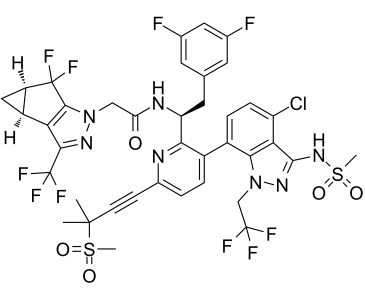
C39H32CLF10N7O5S2
|
|---|---|
| 分子量 |
968.2823
|
| 精确质量 |
967.14
|
| 元素分析 |
C, 48.38; H, 3.33; Cl, 3.66; F, 19.62; N, 10.13; O, 8.26; S, 6.62
|
| CAS号 |
2189684-44-2
|
| 相关CAS号 |
2283356-18-1 (HCl); 2937414-47-4 (Lenacapavir pacfosacil); 2189684-44-2;2283356-12-5 (sodium);
|
| PubChem CID |
133082658
|
| 外观&性状 |
White to light yellow solid powder
|
| LogP |
6.4
|
| tPSA |
175Ų
|
| 氢键供体(HBD)数目 |
2
|
| 氢键受体(HBA)数目 |
19
|
| 可旋转键数目(RBC) |
13
|
| 重原子数目 |
64
|
| 分子复杂度/Complexity |
2040
|
| 定义原子立体中心数目 |
3
|
| SMILES |
CC(C)(C#CC1=NC(=C(C=C1)C2=C3C(=C(C=C2)Cl)C(=NN3CC(F)(F)F)NS(=O)(=O)C)[C@H](CC4=CC(=CC(=C4)F)F)NC(=O)CN5C6=C([C@H]7C[C@H]7C6(F)F)C(=N5)C(F)(F)F)S(=O)(=O)C
|
| InChi Key |
BRYXUCLEHAUSDY-WEWMWRJBSA-N
|
| InChi Code |
InChI=1S/C39H32ClF10N7O5S2/c1-36(2,63(3,59)60)10-9-21-5-6-22(23-7-8-26(40)30-32(23)57(17-37(43,44)45)54-35(30)55-64(4,61)62)31(51-21)27(13-18-11-19(41)14-20(42)12-18)52-28(58)16-56-34-29(33(53-56)39(48,49)50)24-15-25(24)38(34,46)47/h5-8,11-12,14,24-25,27H,13,15-17H2,1-4H3,(H,52,58)(H,54,55)/t24-,25+,27-/m0/s1
|
| 化学名 |
N-((S)-1-(3-(4-chloro-3-(methylsulfonamido)-1-(2,2,2-trifluoroethyl)-1H-indazol-7-yl)-6-(3-methyl-3-(methylsulfonyl)but-1-yn-1-yl)pyridin-2-yl)-2-(3,5-difluorophenyl)ethyl)-2-((3bS,4aR)-5,5-difluoro-3-(trifluoromethyl)-3b,4,4a,5-tetrahydro-1H-cyclopropa[3,4]cyclopenta[1,2-c]pyrazol-1-yl)acetamide
|
| 别名 |
Lenacapavir; GS-6207; GS 6207; GS6207; GS 714207; GS-714207; GS714207; GS-CA-2; GS-CA2; GS-HIV;
|
| HS Tariff Code |
2934.99.9001
|
| 存储方式 |
Powder -20°C 3 years 4°C 2 years In solvent -80°C 6 months -20°C 1 month |
| 运输条件 |
Room temperature (This product is stable at ambient temperature for a few days during ordinary shipping and time spent in Customs)
|
| 溶解度 (体外实验) |
DMSO : ~200 mg/mL (~206.55 mM)
|
|---|---|
| 溶解度 (体内实验) |
配方 1 中的溶解度: ≥ 6.25 mg/mL (6.45 mM) (饱和度未知) in 10% DMSO + 90% Corn Oil (这些助溶剂从左到右依次添加,逐一添加), 澄清溶液。
例如,若需制备1 mL的工作液,可将100 μL 62.5 mg/mL 的澄清 DMSO 储备液加入到 900 μL 玉米油中并混合均匀。 配方 2 中的溶解度: 2.5 mg/mL (2.58 mM) in 5% DMSO + 40% PEG300 + 5% Tween80 + 50% Saline (这些助溶剂从左到右依次添加,逐一添加), 悬浊液; 超声助溶。 *生理盐水的制备:将 0.9 g 氯化钠溶解在 100 mL ddH₂O中,得到澄清溶液。 请根据您的实验动物和给药方式选择适当的溶解配方/方案: 1、请先配制澄清的储备液(如:用DMSO配置50 或 100 mg/mL母液(储备液)); 2、取适量母液,按从左到右的顺序依次添加助溶剂,澄清后再加入下一助溶剂。以 下列配方为例说明 (注意此配方只用于说明,并不一定代表此产品 的实际溶解配方): 10% DMSO → 40% PEG300 → 5% Tween-80 → 45% ddH2O (或 saline); 假设最终工作液的体积为 1 mL, 浓度为5 mg/mL: 取 100 μL 50 mg/mL 的澄清 DMSO 储备液加到 400 μL PEG300 中,混合均匀/澄清;向上述体系中加入50 μL Tween-80,混合均匀/澄清;然后继续加入450 μL ddH2O (或 saline)定容至 1 mL; 3、溶剂前显示的百分比是指该溶剂在最终溶液/工作液中的体积所占比例; 4、 如产品在配制过程中出现沉淀/析出,可通过加热(≤50℃)或超声的方式助溶; 5、为保证最佳实验结果,工作液请现配现用! 6、如不确定怎么将母液配置成体内动物实验的工作液,请查看说明书或联系我们; 7、 以上所有助溶剂都可在 Invivochem.cn网站购买。 |
| 制备储备液 | 1 mg | 5 mg | 10 mg | |
| 1 mM | 1.0328 mL | 5.1638 mL | 10.3276 mL | |
| 5 mM | 0.2066 mL | 1.0328 mL | 2.0655 mL | |
| 10 mM | 0.1033 mL | 0.5164 mL | 1.0328 mL |
1、根据实验需要选择合适的溶剂配制储备液 (母液):对于大多数产品,InvivoChem推荐用DMSO配置母液 (比如:5、10、20mM或者10、20、50 mg/mL浓度),个别水溶性高的产品可直接溶于水。产品在DMSO 、水或其他溶剂中的具体溶解度详见上”溶解度 (体外)”部分;
2、如果您找不到您想要的溶解度信息,或者很难将产品溶解在溶液中,请联系我们;
3、建议使用下列计算器进行相关计算(摩尔浓度计算器、稀释计算器、分子量计算器、重组计算器等);
4、母液配好之后,将其分装到常规用量,并储存在-20°C或-80°C,尽量减少反复冻融循环。
计算结果:
工作液浓度: mg/mL;
DMSO母液配制方法: mg 药物溶于 μL DMSO溶液(母液浓度 mg/mL)。如该浓度超过该批次药物DMSO溶解度,请首先与我们联系。
体内配方配制方法:取 μL DMSO母液,加入 μL PEG300,混匀澄清后加入μL Tween 80,混匀澄清后加入 μL ddH2O,混匀澄清。
(1) 请确保溶液澄清之后,再加入下一种溶剂 (助溶剂) 。可利用涡旋、超声或水浴加热等方法助溶;
(2) 一定要按顺序加入溶剂 (助溶剂) 。
InvivoChem的所有产品仅用于作科学研究,不面向患者销售
Copyright 2020 InvivoChem LLC | All Rights Reserved 粤ICP备20063088号-1


 粤公网安备 44011102003439号
 463611831
