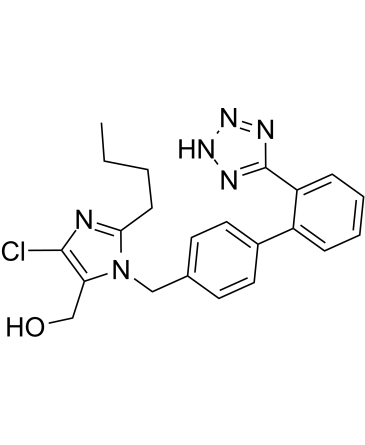
Losartan (DUP 89)

别名: DUP 89; DUP-89; DUP89 洛沙坦; 2-丁基-4-氯-5-(羟甲基)-1-[[2'-(1H-四氮唑-5-)联苯基-4-]甲基]咪唑; 氯沙坦; 氯沙坦-D9; 洛沙坦 标准品;洛沙坦钾; 2-丁基-4-氯-1-[[2'(-(1H-四唑-5-基)[1,1'(-联苯]-4-基]甲基]-1H-咪唑-5-甲醇; 科索亚;络沙坦;氯沙坦(氯沙坦钾中间体
目录号: V24404 纯度: ≥98%
Losartan (DuP-753) 是一种有效的、选择性的、非肽类血管紧张素 II 受体拮抗剂,它与血管紧张素 II 竞争与 AT1 受体的结合,IC50 为 20 nM。
Losartan (DUP 89) CAS号: 114798-26-4
产品类别: Angiotensin Receptor
产品仅用于科学研究,不针对患者销售
规格 价格 库存 数量
1g
2g
5g
10g
50g
100g
200g
Other Sizes

Other Forms of Losartan (DUP 89):

  • Losartan-d3 Carboxylic Acid (Losartan Carboxylic Acid d3)
  • Losartan carboxylic acid-d4 HCl
  • 氯沙坦酸
  • 氯沙坦-d4羧酸
  • 氯沙坦钾
  • 氯沙坦D4
  • Losartan-d2 (Losartan-d2; DuP-753-d2)
  • Losartan-d9 (Losartan-d9; DuP-753-d9)
点击了解更多
InvivoChem产品被CNS等顶刊论文引用
产品描述
Losartan (DuP-753) 是一种有效的、选择性的、非肽类血管紧张素 II 受体拮抗剂,它与血管紧张素 II 竞争与 AT1 受体的结合,IC50 为 20 nM。氯沙坦抑制血管紧张素 II 对兔主动脉和颈静脉的收缩作用 (pA2 = 8.27)。它被用作口服活性抗高血压药。氯沙坦 (180 mg/d) 会导致患有饮食诱发的高胆固醇血症的猴子血浆血管紧张素 II 和血管紧张素-(1-7) 显着增加。
生物活性&实验参考方法
靶点
AT1 Receptor
体外研究 (In Vitro)
氯沙坦与血管紧张素 II 竞争与 AT1 受体的结合。抑制 50% 血管紧张素 II 结合的浓度 (IC50) 为 20 nM[1]。氯沙坦 (40 μM) 会影响 ISC,但会阻止 ANGII 对 ISC 的影响[2]。氯沙坦显着降低子宫内膜癌细胞中血管紧张素II介导的细胞增殖。与单独使用每种药物相比,氯沙坦和抗 miR-155 的组合具有显着更强的抗增殖作用[3]。
体内研究 (In Vivo)
相对于安慰剂治疗的 Fbn1C1039G/+ 动物,氯沙坦(0.6 g/L,口服)治疗的 Fbn1C1039G/+ 小鼠显示远端空域口径减小。调整氯沙坦和普萘洛尔的剂量以达到可比较的血流动力学效果。 pSmad2 核染色分析表明,氯沙坦拮抗 Fbn1C1039G/+ 小鼠主动脉壁中的 TGF-β 信号传导。氯沙坦可以改善肺部疾病表现,但这一事件似乎与血流动力学改善无关[4]。氯沙坦(10 mg/kg,动脉内注射)可使血液血管紧张素水平增加四到六倍。氯沙坦(10 mg/kg,腹腔注射)使血浆肾素水平增加 100 倍;血浆血管紧张素原水平降低至对照的 24%;血浆醛固酮水平没有变化[5]。
酶活实验
1型(AT1)血管紧张素II(Ang II)受体的拮抗剂增加肾素分泌和血浆Ang II水平,Ang II水平的增加可能会抵消拮抗剂的作用。此外,其他研究人员提出,Ang II水平的反应性增加可能通过刺激2型Ang II受体(AT2)来增加缓激肽(BK)水平。我们通过在6、12和24小时测量循环血管紧张素和BK肽,研究了AT1受体拮抗剂氯沙坦(每12小时动脉内注射10mg/kg)对雄性Sprague-Dawley大鼠的急性影响。急性氯沙坦给药使血液血管紧张素水平增加了四至六倍,但血液BK水平没有变化。我们还研究了氯沙坦给药8天(每12小时腹腔注射10mg/kg)对循环和组织中血管紧张素和BK肽以及血管紧张素转换酶(ACE)水平的影响。氯沙坦使血浆肾素水平增加了100倍;血浆血管紧张素原水平降至对照组的24%;血浆醛固酮水平无变化。氯沙坦给药后,血浆、肾上腺、肺、心脏和主动脉中的Ang II水平分别增加了25倍、8倍、3.5倍、2.4倍和14倍。相比之下,肾脏Ang II水平降至对照组的71%,同时肾脏BK-(1-7)和BK-(1-9)水平降低。除了血液中BK-(1-8)水平降低到对照组的43%外,没有其他组织显示BK肽水平的变化。血浆ACE升高13-50%,但组织ACE水平不变。这些数据表明,氯沙坦对内源性血管紧张素和BK肽的水平具有组织特异性作用,并表明BK水平的增加对氯沙坦的作用没有贡献。内源性肾脏Ang II水平没有反应性增加,表明该组织可能对AT1受体拮抗作用最敏感[5]。
细胞实验
MTT 测定用于量化细胞的活力和增殖。在 96 孔板中,每孔接种 5000 个细胞,并用 200 μL 培养基进行测定。让细胞贴壁过夜后,吸出培养基。将 MTT 以 1 mg/mL 的浓度添加到无血清培养基中后,将混合物在 37°C 下孵育 4 小时。为了溶解甲臜晶体,除去 MTT 溶液后加入 100 μL DMSO。然后,使用酶标仪测量 570 nm 和 600 nm 处的吸光度作为参考。因此,吸光度的变化与细胞存活的程度有关。
动物实验
野生型小鼠与雌性Fbn1C1039G/+小鼠在预定时间交配。交配后14.5天,对妊娠的雌性Fbn1C1039G/+小鼠分别给予眼用氯沙坦(饮用水中浓度为0.6 g/L;n = 10)、普萘洛尔(0.5 g/L;n = 6)或安慰剂(n = 12)。在小鼠10月龄之前,哺乳期和断奶后均持续进行治疗。这些方法也适用于小鼠的处死和检查。在马凡综合征(MFS)中,目前尽管存在争议,但调节主动脉根部异常生长的标准治疗方法是β-肾上腺素能受体阻滞剂;普萘洛尔和氯沙坦是对照药物。在7周龄时,分别给野生型和Fbn1C1039G/+小鼠口服氯沙坦(饮用水中浓度为0.6 g/L;n = 5)、普萘洛尔(0.5 g/L;n = 7)或安慰剂(n = 10)。口服治疗6个月后,处死小鼠。
药代性质 (ADME/PK)
吸收、分布和排泄
氯沙坦的口服生物利用度约为33%。氯沙坦的达峰时间(Tmax)为1小时,其活性代谢物的达峰时间(Tmax)为3-4小时。与食物同服会降低氯沙坦的血药浓度峰值(Cmax),但仅导致氯沙坦及其活性代谢物的药时曲线下面积(AUC)降低10%。口服50-80毫克氯沙坦后,其血药浓度峰值(Cmax)为200-250纳克/毫升。
单次口服氯沙坦后,尿液中回收的氯沙坦原药占4%,活性代谢物占6%。口服放射性标记的氯沙坦后,尿液中回收的氯沙坦占35%,粪便中回收的氯沙坦占60%。静脉注射放射性标记的氯沙坦后,45%经尿液回收,50%经粪便回收。
氯沙坦的分布容积为34.4±17.9L,其活性代谢物(E-3174)的分布容积为10.3±1.1L。
氯沙坦的总血浆清除率为600mL/min,肾清除率为75mL/min。活性代谢物E-3174的总血浆清除率为50mL/min,肾清除率为25mL/min。
尚不清楚氯沙坦是否会分泌到人乳中,但已证实大鼠乳汁中存在显著水平的氯沙坦及其活性代谢物。
口服后,氯沙坦吸收良好(基于放射性标记氯沙坦的吸收情况),并经历显著的首过代谢;氯沙坦的系统生物利用度约为33%。口服氯沙坦后,约14%会转化为活性代谢物。氯沙坦及其活性代谢物的平均峰浓度分别在1小时和3-4小时达到。虽然氯沙坦及其活性代谢物的血浆峰浓度大致相等,但代谢物的AUC约为氯沙坦的4倍。进食会减缓氯沙坦的吸收并降低其Cmax,但对氯沙坦的AUC或代谢物的AUC影响甚微(约降低10%)。
大鼠研究表明,氯沙坦几乎无法穿过血脑屏障。
氯沙坦及其活性代谢物均与血浆蛋白(主要是白蛋白)高度结合,其血浆游离分数分别为1.3%和0.2%。在推荐剂量下达到的浓度范围内,血浆蛋白结合率保持恒定。
有关氯沙坦(共8项)的更多吸收、分布和排泄(完整)数据,请访问HSDB记录页面。
代谢/代谢物
氯沙坦代谢为醛中间体E-3179,后者经细胞色素P450(如CYP2C9)进一步代谢为羧酸E-3174。氯沙坦也可羟基化为无活性代谢物P1。约14%的氯沙坦代谢为E-3174。氯沙坦可由CYP3A4、CYP2C9和CYP2C10代谢。氯沙坦也可被 UGT1A1、UGT1A3、UGT1A10、UGT2B7 和 UGT2B17 进行葡萄糖醛酸化。
氯沙坦是一种口服活性药物,经细胞色素 P450 酶进行大量首过代谢。它部分转化为一种活性羧酸代谢物,该代谢物是氯沙坦治疗后大部分血管紧张素 II 受体拮抗作用的来源。已在人血浆和尿液中检测到氯沙坦代谢物。除活性羧酸代谢物外,还会生成几种非活性代谢物。口服和静脉注射14C 标记的氯沙坦钾后,循环血浆中的放射性主要归因于氯沙坦及其活性代谢物。体外研究表明,细胞色素 P450 2C9 和 3A4 参与了氯沙坦向其代谢物的生物转化。在约 1% 的研究对象中观察到氯沙坦向活性代谢物的转化率极低(不足剂量的 1%,而正常受试者为剂量的 14%)。
氯沙坦已知的人体代谢物包括氯沙坦羧酸和 2-[5-[2-[4-[[2-丁基-5-氯-4-(羟甲基)-1H-咪唑-3-鎓-3-基]甲基]苯基]苯基]-1,5-二氢四唑-2-基]-6-(二羟甲基)氧杂环己烷-3,4,5-三醇。
生物半衰期
氯沙坦的末端消除半衰期为 1.5-2.5 小时,而活性代谢物的半衰期为 6-9 小时。
氯沙坦的末端半衰期约为 2 小时,其代谢物的末端半衰期约为 6-9 小时。
毒性/毒理 (Toxicokinetics/TK)
毒性概述
识别和用途:氯沙坦是一种浅黄色固体,制成口服片剂。氯沙坦是一种血管紧张素II 1型(AT1)受体拮抗剂。它可单独使用或与其他类别的降压药联合使用,用于治疗高血压。它还用于降低高血压合并左心室肥厚患者的卒中风险,以及治疗2型糖尿病合并高血压病史患者的糖尿病肾病。人体暴露和毒性:氯沙坦过量最可能的表现包括低血压和心动过速;如果发生副交感神经(迷走神经)兴奋,则可能出现心动过缓。妊娠期间禁用氯沙坦。虽然在妊娠早期使用氯沙坦不提示存在严重畸形的风险,但在妊娠中晚期使用氯沙坦可能导致致畸性以及严重的胎儿和新生儿毒性。
胎儿毒性作用可能包括无尿、羊水过少、胎儿颅盖骨发育不全、宫内生长受限、早产和动脉导管未闭。无尿相关的羊水过少可能导致胎儿肢体挛缩、颅面畸形和肺发育不全。新生儿在子宫内暴露于氯沙坦后可能出现严重的无尿和低血压,且对升压药和扩容治疗均无效。动物研究:在给予大鼠和小鼠最大耐受剂量时,氯沙坦钾未显示致癌性。服用氯沙坦的雌性大鼠胰腺腺泡瘤的发生率略高。此外,在给予雄性大鼠口服氯沙坦的研究中,其生育能力和生殖功能未受影响。在雌性动物中给予毒性剂量与剖宫产时黄体/雌性、着床/雌性以及活胎/雌性的数量显著减少相关。由于这些剂量水平对着床/妊娠雌性、着床后胚胎丢失率或分娩时每窝活胎数量均无影响,因此这些结果与药物治疗的关系尚不明确。氯沙坦已被证实会对大鼠胎儿和新生儿产生不良反应,包括体重下降、身体和行为发育迟缓、死亡和肾毒性。除新生儿体重增加外,与这些不良反应相关的剂量均超过25 mg/kg。这些结果归因于妊娠晚期和哺乳期的药物暴露。氯沙坦在微生物诱变试验、V-79哺乳动物细胞诱变试验、体外碱性洗脱试验以及体外和体内染色体畸变试验中均为阴性。此外,活性代谢物在微生物诱变试验、体外碱性洗脱试验和体外染色体畸变试验中均未显示出遗传毒性。
相互作用
……本研究旨在评估长期给予醋酸脱氧皮质酮 (DOCA) 如何影响氯沙坦对 N(G)-硝基-L-精氨酸甲酯 (L-NAME) 诱导的高血压大鼠的血压、肾损伤及其他指标的影响。实验分为以下几组:对照组、DOCA 组、L-NAME 组、L-NAME + 氯沙坦组、L-NAME + DOCA 组和 L-NAME + DOCA + 氯沙坦组。每周测量两次尾部收缩压。4 周后,测量平均动脉压以及代谢、形态和肾脏指标。最终平均动脉压值分别为:对照组 116 ± 6 mmHg,DOCA 组 107 ± 2 mmHg,L-NAME 组 151 ± 5 mmHg,L-NAME + 氯沙坦组 123 ± 2 mmHg,L-NAME + DOCA 组 170 ± 3 mmHg,以及 L-NAME + DOCA + 氯沙坦组 171 ± 5.5 mmHg。氯沙坦可预防 L-NAME 高血压引起的微量白蛋白尿、透明样动脉病和肾小球硬化,但对 L-NAME + DOCA 治疗组无效。……DOCA 组(0.55 ± 0.2)和 L-NAME + DOCA 组(0.60 ± 10.2)的血浆肾素活性受到抑制,而 L-NAME + DOCA + 氯沙坦组的血浆肾素活性未受抑制(5.8 ± 1)。结论是,DOCA阻断了氯沙坦对L-NAME高血压引起的血压升高和肾损伤的预防作用……这些数据还表明,氯沙坦通过阻断全身血管紧张素II的活性来预防L-NAME高血压。/未指定盐/
已知非甾体抗炎药会减弱某些降压药物的作用……一项评估吲哚美辛对氯沙坦和卡托普利降压作用影响的多中心研究已开展。经过4周的安慰剂洗脱期后,高血压患者接受了6周的活性降压治疗,每日一次服用50毫克氯沙坦(n=111)……随后,患者接受了为期1周的吲哚美辛联合治疗(每日75毫克)。主要终点指标是加用吲哚美辛后24小时动态舒张压平均值的变化。氯沙坦治疗6周后,动态舒张压显著降低(氯沙坦组降低5.3 mmHg,P<0.001)。吲哚美辛显著降低了24小时动态舒张压(氯沙坦组降低2.2 mmHg,P<0.05)。两组患者日间舒张压(上午7:00至晚上11:00)的变化与24小时舒张压的变化相似。夜间舒张压(晚上11:01至次日早上6:59)未受影响(氯沙坦组降低0.4 mmHg)。因此,吲哚美辛与氯沙坦同时治疗也会减弱氯沙坦的24小时降压反应……/未指定盐/
血管紧张素II受体拮抗剂与非甾体抗炎药(NSAIAs)(包括选择性环氧合酶-2 (COX-2) 抑制剂)合用时,可能存在潜在的药物相互作用(降压作用减弱)。老年患者、血容量不足患者(包括同时接受利尿剂治疗的患者)或肾功能受损患者可能出现肾功能恶化;接受氯沙坦联合非甾体抗炎药(NSAIDs,包括选择性COX-2抑制剂)治疗的患者应定期监测肾功能。
氯沙坦钾与利福平合用时,可观察到氯沙坦及其活性代谢物的血浆浓度降低。
有关氯沙坦的更多药物相互作用(完整)数据(共20项),请访问HSDB记录页面。
参考文献

[1]. Angiotensin II type 1 receptor blockers. Circulation, 2001. 103(6): p. 904-12.

[2]. Evidence for expression and function of angiotensin II receptor type 1 in pulmonary epithelial cells. Respir Physiol Neurobiol, 2014.

>

[3]. Angiotensin II type I receptor and miR-155 in endometrial cancers: synergistic antiproliferative effects of anti-miR-155 and losartan on endometrial cancer cells. Gynecol Oncol, 2012. 126(1): p. 124-31.

[4]. Losartan, an AT1 antagonist, prevents aortic aneurysm in a mouse model of Marfan syndrome. Science, 2006. 312(5770): p. 117-21.

[5]. Effects of losartan on angiotensin and bradykinin peptides and angiotensin-converting enzyme. J Cardiovasc Pharmacol, 1995. 26(2): p. 233-40.

其他信息
治疗用途
血管紧张素II 1型受体阻滞剂;抗心律失常药;抗高血压药
Cozarr适用于治疗高血压。可单独使用,也可与其他抗高血压药(包括利尿剂)联合使用。/美国产品标签包含/
Cozarr适用于降低高血压合并左心室肥厚患者的卒中风险,但有证据表明,这种益处不适用于黑人患者。/美国产品标签包含/
Cozarr适用于治疗伴有血清肌酐升高和蛋白尿(尿白蛋白/肌酐比值=300 mg/g)的2型糖尿病合并高血压病史患者的糖尿病肾病。在该人群中,Cozaar 可降低肾病进展速度,以血清肌酐倍增或终末期肾病(需要透析或肾移植)的发生率来衡量。/美国产品标签包含/
有关氯沙坦(共 6 种)的更多治疗用途(完整)数据,请访问 HSDB 记录页面。
药物警告
/黑框警告/ 警告:胎儿毒性。一旦发现怀孕,应尽快停用 Cozaar。直接作用于肾素-血管紧张素系统的药物可导致发育中的胎儿损伤甚至死亡。
在妊娠中晚期使用作用于肾素-血管紧张素系统的药物会降低肾功能,并增加胎儿和新生儿的发病率和死亡率。由此导致的羊水过少可能与胎儿肺发育不全和骨骼畸形有关。潜在的新生儿不良反应包括颅骨发育不全、无尿、低血压、肾功能衰竭和死亡。一旦确诊怀孕,应尽快停用氯沙坦。这些不良反应通常与妊娠中晚期使用此类药物有关。大多数流行病学研究在探讨妊娠早期使用降压药后胎儿畸形时,并未区分影响肾素-血管紧张素系统的药物与其他降压药。妊娠期间对孕妇高血压进行适当管理对于优化母婴结局至关重要。在极少数情况下,如果对于特定患者没有其他合适的替代疗法,应告知孕妇该药物对胎儿的潜在风险。进行系列超声检查以评估羊膜腔内环境。如果观察到羊水过少,应停用氯沙坦,除非认为停药对孕妇生命至关重要。根据妊娠周数,可能需要进行胎儿监护。然而,患者和医生应注意,羊水过少可能在胎儿遭受不可逆损伤后才会出现。
有宫内暴露于氯沙坦史的新生儿:如果出现少尿或低血压,应重点关注血压维持和肾灌注。可能需要换血或透析来逆转低血压和/或替代受损的肾功能。
FDA妊娠风险等级:D/有明确风险证据。人体研究、试验数据或上市后数据均已证实存在胎儿风险。尽管如此,使用该药物的潜在益处可能大于潜在风险。例如,在危及生命的情况下或患有严重疾病,而其他更安全的药物无法使用或无效时,该药物可能适用。/
有关氯沙坦(共 21 条)的更多药物警告(完整)数据,请访问 HSDB 记录页面。
药效学
氯沙坦是一种血管紧张素 II 受体阻滞剂,用于治疗高血压、糖尿病肾病,并降低中风风险。氯沙坦每日一次给药,因此具有较长的作用持续时间。服用氯沙坦的患者应定期监测低血压、肾功能和血钾水平。
*注: 文献方法仅供参考, InvivoChem并未独立验证这些方法的准确性
化学信息 & 存储运输条件
分子式
C22H23CLN6O
分子量
422.91
精确质量
422.162
元素分析
C, 62.48; H, 5.48; Cl, 8.38; N, 19.87; O, 3.78
CAS号
114798-26-4
相关CAS号
Losartan Carboxylic Acid; 124750-92-1; Losartan-d4 (carboxylic acid); 1246820-62-1; Losartan potassium; 124750-99-8; Losartan-d4; 1030937-27-9; Losartan-d3 Carboxylic Acid; 1189729-40-5; Losartan-d2; 1030936-22-1; Losartan-d9; 1030937-18-8
PubChem CID
3961
外观&性状
White to light yellow solid powder
密度
1.4±0.1 g/cm3
沸点
682.0±65.0 °C at 760 mmHg
熔点
183-184ºC
闪点
366.3±34.3 °C
蒸汽压
0.0±2.2 mmHg at 25°C
折射率
1.681
LogP
3.57
tPSA
92.51
氢键供体(HBD)数目
2
氢键受体(HBA)数目
5
可旋转键数目(RBC)
8
重原子数目
30
分子复杂度/Complexity
520
定义原子立体中心数目
0
SMILES
ClC1=C(C([H])([H])O[H])N(C([H])([H])C2C([H])=C([H])C(C3=C([H])C([H])=C([H])C([H])=C3C3N=NN([H])N=3)=C([H])C=2[H])C(C([H])([H])C([H])([H])C([H])([H])C([H])([H])[H])=N1
InChi Key
PSIFNNKUMBGKDQ-UHFFFAOYSA-N
InChi Code
InChI=1S/C22H23ClN6O/c1-2-3-8-20-24-21(23)19(14-30)29(20)13-15-9-11-16(12-10-15)17-6-4-5-7-18(17)22-25-27-28-26-22/h4-7,9-12,30H,2-3,8,13-14H2,1H3,(H,25,26,27,28)
化学名
[2-butyl-5-chloro-3-[[4-[2-(2H-tetrazol-5-yl)phenyl]phenyl]methyl]imidazol-4-yl]methanol
别名
DUP 89; DUP-89; DUP89
HS Tariff Code
2934.99.03.00
存储方式

Powder      -20°C    3 years

                     4°C     2 years

In solvent   -80°C    6 months

                  -20°C    1 month

运输条件
Room temperature (This product is stable at ambient temperature for a few days during ordinary shipping and time spent in Customs)
溶解度数据
溶解度 (体外实验)
DMSO: ≥ 100 mg/mL (~236.5 mM)
溶解度 (体内实验)
配方 1 中的溶解度: ≥ 2.08 mg/mL (4.92 mM) (饱和度未知) in 10% DMSO + 40% PEG300 + 5% Tween80 + 45% Saline (这些助溶剂从左到右依次添加,逐一添加), 澄清溶液。
例如,若需制备1 mL的工作液,可将100 μL 20.8 mg/mL澄清DMSO储备液加入400 μL PEG300中,混匀;然后向上述溶液中加入50 μL Tween-80,混匀;加入450 μL生理盐水定容至1 mL。
*生理盐水的制备:将 0.9 g 氯化钠溶解在 100 mL ddH₂O中,得到澄清溶液。

配方 2 中的溶解度: ≥ 2.08 mg/mL (4.92 mM) (饱和度未知) in 10% DMSO + 90% Corn Oil (这些助溶剂从左到右依次添加,逐一添加), 澄清溶液。
例如,若需制备1 mL的工作液,可将 100 μL 20.8 mg/mL 澄清 DMSO 储备液加入到 900 μL 玉米油中并混合均匀。

请根据您的实验动物和给药方式选择适当的溶解配方/方案:
1、请先配制澄清的储备液(如:用DMSO配置50 或 100 mg/mL母液(储备液));
2、取适量母液,按从左到右的顺序依次添加助溶剂,澄清后再加入下一助溶剂。以 下列配方为例说明 (注意此配方只用于说明,并不一定代表此产品 的实际溶解配方):
10% DMSO → 40% PEG300 → 5% Tween-80 → 45% ddH2O (或 saline);
假设最终工作液的体积为 1 mL, 浓度为5 mg/mL: 取 100 μL 50 mg/mL 的澄清 DMSO 储备液加到 400 μL PEG300 中,混合均匀/澄清;向上述体系中加入50 μL Tween-80,混合均匀/澄清;然后继续加入450 μL ddH2O (或 saline)定容至 1 mL;

3、溶剂前显示的百分比是指该溶剂在最终溶液/工作液中的体积所占比例;
4、 如产品在配制过程中出现沉淀/析出,可通过加热(≤50℃)或超声的方式助溶;
5、为保证最佳实验结果,工作液请现配现用!
6、如不确定怎么将母液配置成体内动物实验的工作液,请查看说明书或联系我们;
7、 以上所有助溶剂都可在 Invivochem.cn网站购买。
制备储备液 1 mg 5 mg 10 mg
1 mM 2.3646 mL 11.8228 mL 23.6457 mL
5 mM 0.4729 mL 2.3646 mL 4.7291 mL
10 mM 0.2365 mL 1.1823 mL 2.3646 mL

1、根据实验需要选择合适的溶剂配制储备液 (母液):对于大多数产品,InvivoChem推荐用DMSO配置母液 (比如:5、10、20mM或者10、20、50 mg/mL浓度),个别水溶性高的产品可直接溶于水。产品在DMSO 、水或其他溶剂中的具体溶解度详见上”溶解度 (体外)”部分;

2、如果您找不到您想要的溶解度信息,或者很难将产品溶解在溶液中,请联系我们;

3、建议使用下列计算器进行相关计算(摩尔浓度计算器、稀释计算器、分子量计算器、重组计算器等);

4、母液配好之后,将其分装到常规用量,并储存在-20°C或-80°C,尽量减少反复冻融循环。

计算器

摩尔浓度计算器可计算特定溶液所需的质量、体积/浓度,具体如下:

  • 计算制备已知体积和浓度的溶液所需的化合物的质量
  • 计算将已知质量的化合物溶解到所需浓度所需的溶液体积
  • 计算特定体积中已知质量的化合物产生的溶液的浓度
使用摩尔浓度计算器计算摩尔浓度的示例如下所示:
假如化合物的分子量为350.26 g/mol,在5mL DMSO中制备10mM储备液所需的化合物的质量是多少?
  • 在分子量(MW)框中输入350.26
  • 在“浓度”框中输入10,然后选择正确的单位(mM)
  • 在“体积”框中输入5,然后选择正确的单位(mL)
  • 单击“计算”按钮
  • 答案17.513 mg出现在“质量”框中。以类似的方式,您可以计算体积和浓度。

稀释计算器可计算如何稀释已知浓度的储备液。例如,可以输入C1、C2和V2来计算V1,具体如下:

制备25毫升25μM溶液需要多少体积的10 mM储备溶液?
使用方程式C1V1=C2V2,其中C1=10mM,C2=25μM,V2=25 ml,V1未知:
  • 在C1框中输入10,然后选择正确的单位(mM)
  • 在C2框中输入25,然后选择正确的单位(μM)
  • 在V2框中输入25,然后选择正确的单位(mL)
  • 单击“计算”按钮
  • 答案62.5μL(0.1 ml)出现在V1框中
g/mol

分子量计算器可计算化合物的分子量 (摩尔质量)和元素组成,具体如下:

注:化学分子式大小写敏感:C12H18N3O4  c12h18n3o4
计算化合物摩尔质量(分子量)的说明:
  • 要计算化合物的分子量 (摩尔质量),请输入化学/分子式,然后单击“计算”按钮。
分子质量、分子量、摩尔质量和摩尔量的定义:
  • 分子质量(或分子量)是一种物质的一个分子的质量,用统一的原子质量单位(u)表示。(1u等于碳-12中一个原子质量的1/12)
  • 摩尔质量(摩尔重量)是一摩尔物质的质量,以g/mol表示。
/

配液计算器可计算将特定质量的产品配成特定浓度所需的溶剂体积 (配液体积)

  • 输入试剂的质量、所需的配液浓度以及正确的单位
  • 单击“计算”按钮
  • 答案显示在体积框中
动物体内实验配方计算器(澄清溶液)
第一步:请输入基本实验信息(考虑到实验过程中的损耗,建议多配一只动物的药量)
第二步:请输入动物体内配方组成(配方适用于不溶/难溶于水的化合物),不同的产品和批次配方组成不同,如对配方有疑问,可先联系我们提供正确的体内实验配方。此外,请注意这只是一个配方计算器,而不是特定产品的确切配方。
+
+
+

计算结果:

工作液浓度 mg/mL;

DMSO母液配制方法 mg 药物溶于 μL DMSO溶液(母液浓度 mg/mL)。如该浓度超过该批次药物DMSO溶解度,请首先与我们联系。

体内配方配制方法μL DMSO母液,加入 μL PEG300,混匀澄清后加入μL Tween 80,混匀澄清后加入 μL ddH2O,混匀澄清。

(1) 请确保溶液澄清之后,再加入下一种溶剂 (助溶剂) 。可利用涡旋、超声或水浴加热等方法助溶;
            (2) 一定要按顺序加入溶剂 (助溶剂) 。

临床试验信息
Losartan + Sunitinib in Treatment of Osteosarcoma
CTID: NCT03900793
Phase: Phase 1    Status: Recruiting
Date: 2024-11-06
Pharmacokinetic Drug-drug Interaction Study of Encorafenib and Binimetinib on Probe Drugs in Patients With BRAF V600-mutant Melanoma or Other Advanced Solid Tumors
CTID: NCT03864042
Phase: Phase 1    Status: Completed
Date: 2024-09-27
ACES - ACE Inhibitors Combined With Exercise for Seniors With Hypertension
CTID: NCT03295734
Phase: Phase 2    Status: Completed
Date: 2024-09-24
Losartan Use to Mitigate Arthrofibrosis Following Total Joint Arthroplasty
CTID: NCT06333522
Phase: Phase 4    Status: Withdrawn
Date: 2024-09-23
Effect of Losartan in Cystic Fibrosis (CF)-NIH Grant #133240
CTID: NCT03435939
PhaseEarly Phase 1    Status: Active, not recruiting
Date: 2024-09-19
View More

Prevention of Paclitaxel-induced Peripheral Neuropathy in Breast Cancer Patients
CTID: NCT06135493
Phase: Phase 2    Status: Recruiting
Date: 2024-08-26


Losartan 100 mg Tablet in Healthy Subjects Under Non-Fasting Conditions
CTID: NCT01124175
Phase: Phase 1    Status: Completed
Date: 2024-08-19
Clinical Study Evaluating the Effect of Losartan
CTID: NCT06539806
Phase: N/A    Status: Recruiting
Date: 2024-08-06
Study of Open Label Losartan in COVID-19
CTID: NCT04335123
Phase: Phase 1    Status: Completed
Date: 2024-08-02
A Study of Angiotensin-II Receptor Blocker on Cardiovascular Remodeling (VALUE Trial)
CTID: NCT06150560
Phase: Phase 3    Status: Recruiting
Date: 2024-07-29
Secondhand Tobacco Smoke and Cardiovascular Disease
CTID: NCT04715568
Phase: Phase 4    Status: Recruiting
Date: 2024-07-12
Comparison of the Role of Losartan Alone vs Hydrochlorothiazide Plus Losartan
CTID: NCT06491940
Phase: N/A    Status: Not yet recruiting
Date: 2024-07-09
FOLFIRINOX + 9-Ing-41 + Losartan In Pancreatic Cancer
CTID: NCT05077800
Phase: Phase 2    Status: Recruiting
Date: 2024-06-25
A Study of Losartan Compared to Losartan/HCTZ in Pediatric Patients With Hypertension (0954A-327)
CTID: NCT00447603
Phase: Phase 3    Status: Terminated
Date: 2024-06-18
Targeting Inflammation With Losartan to Improve Response to Modulator Therapy in Cystic Fibrosis.
CTID: NCT06364176
Phase: Phase 2    Status: Recruiting
Date: 2024-06-05
Losartan and Hypofractionated Rx After Chemo for Tx of Borderline Resectable or Locally Advanced Unresectable Pancreatic Cancer (SHAPER)
CTID: NCT04106856
Phase: Phase 1    Status: Recruiting
Date: 2024-05-29
Efficacy and Safety of Telmisartan Compared With Losartan
CTID: NCT06431477
Phase: Phase 4    Status: Recruiting
Date: 2024-05-28
MK-0954A in Japanese Patients With Essential Hypertension Not Adequately Controlled With Losartan (MK-0954A-352)
CTID: NCT01307046
Phase: Phase 3    Status: Completed
Date: 2024-05-17
Study to Evaluate Potential Decrease in Hospitalization Events, Time Between Events, and Increasing Longevity in Patients With Symptomatic Heart Failure (0954-948)
CTID: NCT00090259
Phase: Phase 3    Status: Completed
Date: 2024-05-16
The ENRGISE (ENabling Reduction of Low-Grade Inflammation in SEniors) Pilot Study
CTID: NCT02676466
Phase: Phase 2    Status: Completed
Date: 2024-05-07
Phase 1/2 Prospective Double-Blind Placebo-Controlled Randomized Clinical Trial of Losartan to Treat Grade II & III Hamstring Strains
CTID: NCT02263729
Phase: Phase 1/Phase 2    Status: Terminated
Date: 2024-05-02
Use of Senolytic and Anti-Fibrotic Agents to Improve the Beneficial Effect of Bone Marrow Stem Cells for Osteoarthritis
CTID: NCT04815902
Phase: Phase 1/Phase 2    Status: Active, not recruiting
Date: 2024-04-16
The Effects of Losartan on Attention Control: An Eye-tracking Study
CTID: NCT06329050
Phase: N/A    Status: Recruiting
Date: 2024-04-11
Losartan Modulates Neural Responses to Looming Visual Stimuli: An Eye-tracking Study
CTID: NCT06329076
Phase: N/A    Status: Recruiting
Date: 2024-04-11
Efficacy and Safety of Losartan/Chlorthalidone vs Losartan/Hydrochlorothiazide in Essential Arterial Hypertension
CTID: NCT04927299
Phase: Phase 3    Status: Completed
Date: 2024-04-05
Preventing Sickle Cell Kidney Disease
CTID: NCT02373241
Phase: Phase 2    Status: Terminated
Date: 2024-04-03
Hearing Outcomes Using Fractionated Proton Radiation Therapy for Vestibular Schwannoma
CTID: NCT01199978
Phase: Phase 2    Status: Active, not recruiting
Date: 2024-03-26
Mitigation of Arthrofibrosis After Total Knee Arthroplasty Using Losartan
CTID: NCT06108063
Phase: Phase 1/Phase 2    Status: Recruiting
Date: 2024-03-12
Serial Measurements of Molecular and Architectural Responses to Therapy (SMMART) PRIME Trial
CTID: NCT03878524
Phase: Phase 1    Status: Terminated
Date: 2024-03-04
Prevention of Diabetes and Hypertension
CTID: NCT00456963
Phase: Phase 4    Status: Terminated
Date: 2024-02-20
Role of Sympathetic Overactivity and Angiotensin II in PTSD and CV
CTID: NCT02560805
Phase: Phase 2    Status: Suspended
Date: 2024-02-14
Losartan, Pembrolizumab and Stereotactic Body Radiation Therapy for the Treatment of Patients With Locally Recurrent, Refractory or Oligometastatic Head and Neck Squamous Cell Carcinoma
CTID: NCT06211335
Phase: Phase 1    Status: Recruiting
Date: 2024-01-18
Losartan in Prevention of Radiation-Induced Heart Failure
CTID: NCT05607017
PhaseEarly Phase 1    Status: Recruiting
Date: 2024-01-12
GEM+Nab-Paclitaxel Plus Losartan Followed by Stereotactic Radiotherapy for Locally Advanced Pancreatic Cancer
CTID: NCT05861336
Phase: Phase 2    Status: Recruiting
Date: 2024-01-05
A Prospective, Randomised, Double-blind, Double-dummy, Forced-titration, Multicentre, Parallel Group, One Year Treatment Trial to Compare Telmisartan (MICARDIS) 80 mg Versus Losartan (COZAAR) 100 mg, in Hypertensive Type 2 Diabetic Patients With Overt Nephropathy (AMADEO Study)
CTID: NCT00168857
Phase: Phase 4    Status: Completed
Date: 2023-12-08
Losartan Use to Mitigate Arthrofibrosis Following Total Join Arthroplasty
CTID: NCT05157464
Phase: Phase 4    Status: Withdrawn
Date: 2023-12-01
Imaging Perfusion Restrictions From Extracellular Solid Stress - An Open-label Losartan Study
CTID: NCT03951142
Phase: Phase 2    Status: Enrolling by invitation
Date: 2023-11-01
Losartan to Improve Hip Microfracture
CTID: NCT04212650
Phase: Phase 1/Phase 2    Status: Terminated
Date: 2023-10-30
Myocardial Protection in Patients With Post-acute Inflammatory Cardiac Involvement Due to COVID-19
CTID: NCT05619653
Phase: Phase 3    Status: Recruiting
Date: 2023-09-21
Sex Differences in the Dilatory Response of Compound 21
CTID: NCT05576155
PhaseEarly Phase 1    Status: Active, not recruiting
Date: 2023-09-14
Effect of Losartan on the Incidence and Severity of Chemotherapy-Induced Mucositis in Gastrointestinal Cancer Patients
CTID: NCT05871333
Phase: Phase 2    Status: Recruiting
Date: 2023-07-19
The Effect of Combined Use of Anti-fibrotic Agent With Platelet Rich Plasma on Skeletal Muscle Healing After Acute Injuries
CTID: NCT05827484
Phase: Phase 4    Status: Completed
Date: 2023-07-14
Bariatric Surgery and Pharmacokinetics of Losartan
CTID: NCT03519893
Phase:    Status: Recruiting
Date: 2023-06-01
A Clinical Trial to Evaluate the Blood Pressure Control of Telmisartan or Losartan in Essential Hypertensive Patients With Metabolic Syndrome
CTID: NCT05843162
Phase: Phase 4    Status: Not yet recruiting
Date: 2023-05-06
Losartan for Diffuse Myocardial Fibrosis in Sickle Cell Disease
CTID: NCT05012631
Phase: Phase 2    Status: Recruiting
Date: 2023-03-13
Effects of Amlodipine and Other Blood Pressure Lowering Agents on Microvascular Function
CTID: NCT03082014
Phase: Phase 3    Status: Terminated
Date: 2023-03-09
Azilsartan in Patients With Diabetic Kidney
Losartan and spironolactone treatment for COVID-19 patients with acute respiratory failure in intensive care unit
CTID: null
Phase: Phase 2    Status: Ongoing
Date: 2020-04-29
Randomized Evaluation of Beta Blocker and ACE-Inhibitor/Angiotensin Receptor Blocker Treatment in MINOCA patients - MINOCA-BAT
CTID: null
Phase: Phase 4    Status: Prematurely Ended, Ongoing
Date: 2019-06-24
TREAT-SVDs:
CTID: null
Phase: Phase 3    Status: Prematurely Ended, GB - no longer in EU/EEA, Ongoing
Date: 2016-09-14
A randomised controlled pilot trial of the feasibility and safety of therapy withdrawal in asymptomatic patients with a prior diagnosis of dilated cardiomyopathy & recovered cardiac function.
CTID: null
Phase: Phase 4    Status: GB - no longer in EU/EEA
Date: 2016-02-17
The effect of single-dose losartan on the basic effects of cognitive-behaviour therapy for panic disorder - a randomized double blind placebo-controlled trial
CTID: null
Phase: Phase 4    Status: GB - no longer in EU/EEA
Date: 2016-01-27
NT-proBNP selected prevention of cardiac events in a population of diabetic patients without a history of cardiac disease (Pontiac II); a prospective randomized trial
CTID: null
Phase: Phase 4    Status: GB - no longer in EU/EEA, Ongoing
Date: 2015-12-30
A Randomized, Double-Blind, Efficacy and Safety Study of AR 14 (AZILSARTAN MEDOXOMIL) Treatment and Withdrawal, Followed by an Open-Label Extension, in Children 6 to Less Than 18 Years of Age With Hypertension.
CTID: null
Phase: Phase 3    Status: Completed
Date: 2015-05-26
Right vEntricular Dysfunction in tEtralogy of Fallot: INhibition of the rEnin-angiotensin-aldosterone system
CTID: null
Phase: Phase 2, Phase 3, Phase 4    Status: Ongoing
Date: 2014-10-09
Reducing pathology in Alzheimer’s Disease through Angiotensin taRgeting. The RADAR Trial. A phase II, two arm, double-blind, placebo-controlled, randomised trial to evaluate the effect of losartan on brain tissue changes in patients diagnosed with Alzheimer’s disease.
CTID: null
Phase: Phase 2    Status: Completed
Date: 2013-07-04
Cardiac effects of inhibition of the renin angiotensin system with losartan in patients with hypertrophic cardiomyopathy.
CTID: null
Phase: Phase 4    Status: Completed
Date: 2011-10-26
Treatment trial of stiff skin syndrome with Losartan
CTID: null
Phase: Phase 4    Status: Ongoing
Date: 2011-08-15
Ensayo aleatorizado controlado sobre la terapia guiada por el antígeno carbohidrato 125 en los pacientes dados de alta por insuficiencia cardiaca aguda: efecto sobre la mortalidad a 1 año.
CTID: null
Phase: Phase 4    Status: Ongoing
Date: 2011-08-02
Comparison of two treatment options for hypertension in heart transplant recipients
CTID: null
Phase: Phase 4    Status: Completed
Date: 2011-06-30
Role of renal and systemic vascular resistance for progression of chronic kidney disease
CTID: null
Phase: Phase 4    Status: Completed
Date: 2011-01-03
A randomised controlled trial of Losartan as an anti-fibrotic agent in non-alcoholic steatohepatitis.
CTID: null
Phase: Phase 3    Status: Completed
Date: 2010-11-16
Effects of 6 months intensive vasodilating treatment on vascular resistance and coronary flow reserve in hypertensive patients
CTID: null
Phase: Phase 2    Status: Completed
Date: 2010-07-15
EFFECTS OF LOSARTAN ON AORTIC ROOT AND ASCENDING AORTA REMODELING IN PATIENTS WITH BICUSPID AORTIC VALVE.
CTID: null
Phase: Phase 2    Status: Ongoing
Date: 2010-06-01
Estudio de los efectos de ALiskiren o Losartán sobre los bioMARKadores del remodelado miocárdico. Estudio ALLMARK
CTID: null
Phase: Phase 4    Status: Completed
Date: 2010-03-22
The AT1 receptor antagonist losartan for the prevention of excessive aortic root dilatation in children and adolescents with Marfan syndrom
CTID: null
Phase: Phase 2    Status: Ongoing
Date: 2009-12-28
Targeting microvascular dysfunction in young hypertensive patients.
CTID: null
Phase: Phase 4    Status: Completed
Date: 2009-11-09
Monotherapy vs Dual Therapy for Initial Treatment for hypertension
CTID: null
Phase: Phase 4    Status: Completed
Date: 2009-09-02
Randomized, double-blind study for the evaluation of the effect of losartan versus placebo on aortic root dilatation in patients with Marfan syndrome under treatment with beta-blockers.
CTID: null
Phase: Phase 3    Status: Completed
Date: 2009-05-29
TS HYPE - Turner syndrome and Hypertension; a double-blinded randomised interventional trial.
CTID: null
Phase: Phase 4    Status: Ongoing
Date: 2009-04-17
Effects of Losartan versus Nebivolol versus the association of both on the progression of aortic root dilation in Marfan Syndrome (MFS) with FBN1 gene mutations
CTID: null
Phase: Phase 3    Status: Prematurely Ended
Date: 2008-10-27
Etude multicentrique, randomisée, en double aveugle, évaluant l'efficacité du losartan versus placebo sur la dilatation de l'aorte chez des patients présentant un syndrome de Marfan
CTID: null
Phase: Phase 3    Status: Ongoing
Date: 2008-07-09
A PROSPECTIVE, RANDOMIZED, OPEN LABEL BLINDED END POINT (PROBE), CROSS-OVER STUDY TO COMPARE THE EFFECTS OF TELMISARTAN AND LOSARTAN ON METABOLIC PROFILE OF RENAL TRANSPLANT PATIENTS
CTID: null
Phase: Phase 2    Status: Completed
Date: 2008-06-12
Impact of Losartan in hypertensive men with obstructive sleep apnea
CTID: null
Phase: Phase 4    Status: Ongoing
Date: 2008-06-02
A Randomised, Placebo Controlled, Double-Blinded Comparative Study Evaluating the Effect of Ramipril on Urinary Protein Excretion in Maintenance Renal Translplant Patients Converted to Sirolimus
CTID: null
Phase: Phase 4    Status: Prematurely Ended, Completed
Date: 2008-02-27
Therapeutic Strategies of Prevention of Diabetes and Hypertension in Subjects with Metabolic Syndrome and High-Normal Blood Pressure.
CTID: null
Phase: Phase 4    Status: Prematurely Ended
Date: 2008-02-18
PREvention of atrial fibrillation in patientS undergoing thorAcic surGEry for lung cance
CTID: null
Phase: Phase 3    Status: Ongoing
Date: 2007-12-11
A Randomized, Double-Blind, Active Comparator Study to Evaluate the Antihypertensive Efficacy and Safety of Losartan/HCTZ Combination as Compared to Losartan Monotherapy in Pediatric Patients With Essential Hypertension
CTID: null
Phase: Phase 3    Status: Prematurely Ended, Completed
Date: 2007-05-29
Cardiovascular and functional consquences of chronic kidney disease in older people
CTID: null
Phase: Phase 4    Status: Completed
Date: 2007-03-15
Trial of beta blocker therapy (atenolol) vs. angiotensin II receptor blocker therapy (losartan) in individuals with Marfan syndrome
CTID: null
Phase: Phase 4    Status: Completed
Date: 2006-12-13
Randomized, open label, multicenter ABPM study to evaluate the effects of barnidipine as add-on therapy in patients with hypertension not adequately controlled on therapy with losartan
CTID: null
Phase: Phase 4    Status: Completed
Date: 2006-08-11
Can Angiotensin II type 1 Receptor Inhibitor Be Used to Lower the Amount of Lipase and Amylase Level after Endoscopic Retrograde Cholangio-Pancreatography?
CTID: null
Phase: Phase 3    Status: Completed
Date: 2006-02-20
A 36 week, randomized, double-blind, multi-center, parallel group study comparing the efficacy and safety of aliskiren in combination with losartan compared to losartan on the regression of left ventricular hypertrophy in overweight patients with essential hypertension
CTID: null
Phase: Phase 3    Status: Completed
Date: 2005-08-26
Efficacy and safety of Lorista and Lorista H in the treatment of mild to moderate arterial hypertension
CTID: null
Phase: Phase 4    Status: Completed
Date: 2005-03-04
Phänotypisierung und Genotypisierung von Cytochrom P450-Enzymen
CTID: null
Phase: Phase 4    Status: Ongoing
Date: 2004-12-06
na
CTID: null
Phase: Phase 2    Status: Prematurely Ended
Date: 2004-03-23
The influence of rifampicin discontinuation on rifampicin-induced cytochrome P450 enzyme activity
CTID: UMIN000004083
PhaseNot applicable    Status: Complete: follow-up complete
Date: 2010-08-23
Effects of Different Losartan Combination Antihypertensive Therapy in CKD Patients
CTID: UMIN000004062
Phase: Phase IV    Status: Complete: follow-up continuing
Date: 2010-08-18
Efficacy of combination therapy of angiotensin II receptor blocker (ARB) and diuretic in hypertensive patients with chronic kidney disease (CKD)
CTID: UMIN000003919
Phase: Phase IV    Status: Complete: follow-up complete
Date: 2010-07-16
Evaluation of renal protection by irbesartan and losartan in renal transplanted patients
CTID: UMIN000003359
Phase: Phase IV    Status: Complete: follow-up complete
Date: 2010-04-01
Prospective, randomized, open-label, clinical trial comparing the effects of losartan (regular dose) /hydrochlorothiazide combination and losartan alone (high-dose) on blood pressure, endothelial function and markers for obesity/oxidative stress/chronic kidney diseases
CTID: UMIN000002961
Phase:    Status: Complete: follow-up complete
Date: 2010-01-03
A multicenter study to examine renal protection by a combination of an HMG-CoA reductase inhibitor and losartan in patients with dyslipidemia associated with IgA nephropathy
CTID: UMIN000002887
Phase:    Status: Recruiting
Date: 2009-12-14
The effect of aggressive antihypertensive therapy in hypertensive patients with left ventricular diastolic dysfunction
CTID: UMIN000002487
Phase: Phase IV    Status: Complete: follow-up complete
Date: 2009-11-01
Assessment of pleiotropic and proteinuria reducing effect of irbesartan and losartan in chronic kidney disease patients
CTID: UMIN000002424
Phase:    Status: Complete: follow-up complete
Date: 2009-09-07
Investigation of effective treatment of nocturnal hypertension in diabetes
CTID: UMIN000001802
Phase: Phase IV    Status: Complete: follow-up complete
Date: 2009-07-01
Multi-center open labeled trial on effects of candesartan on heart rate and blood pressure in the early morning in patients with hypertension
CTID: UMIN000002079
PhaseNot applicable    Status: Complete: follow-up complete
Date: 2009-07-01
Combination of Antihypertensive therapy in the elderly, Multicenter Investigation Multi-center randomized controlled study on efficacy of ARB/Diuretic mixture versus ARB/Ca channel blocker combination therapy to blood pressure or cognitive function in the elderly patients who have insufficient controlled hypertension in ARB monotherapy
CTID: UMIN000001688
Phase: Phase IV    Status: Complete: follow-up complete
Date: 2009-02-05
Randomized controlled trail on efficacy and safety of Losartan 50 mg/HCTZ 12.5 mg and Titrated Angiotensin Receptor Blockers (ARBs) in Patients who have Hypertension with Diabetes mellitus
CTID: UMIN000001563
Phase: Phase IV    Status: Complete: follow-up complete
Date: 2008-12-10
Effect of ARB on ambulatory blood pressure and cardiovascular remodeling in hypertensives on hemodialysis
CTID: UMIN000000659
Phase: Phase IV    Status: Complete: follow-up complete
Date: 2008-11-01
Effects of ARBs on ambulatory blood pressure, glucose and lipid metabolism, and autonomic nerve function in hypertensive diabetic nephropathy patients
CTID: UMIN000000666
Phase: Phase IV    Status: Complete: follow-up complete
Date: 2008-11-01
Randomized controlled trail on efficacy and safety of Losartan 50 mg/HCTZ 12.5 mg and Titrated Angiotensin Receptor Blockers (ARBs) in Patients who have Hypertension with Diabetes mellitus
CTID: UMIN000001436
Phase:    Status: Complete: follow-up continuing
Date: 2008-10-20
A comparison of a combination drug of an angiotensin II receptor antagonist and a low-dose diuretic vs. a high-dose angiotensin II receptor antagonist in hypertensive patients
CTID: UMIN000001279
Phase: Phase IV    Status:
Date: 2008-08-01
A comparison of a combination drug of an angiotensin II receptor antagonist and a low-dose diuretic vs combination therapy with an angiotensin II receptor antagonist and a calcium channel blocker in hypertensive patients with metabolic syndrome
CTID: UMIN000001238
Phase: Phase IV    Status:
Date: 2008-07-10

生物数据图片
  • Prenatal treatment with losartan and propranolol. Science . 2006 Apr 7;312(5770):117-21.
  • Postnatal treatment with losartan and propranolol. Science . 2006 Apr 7;312(5770):117-21.
相关产品
联系我们