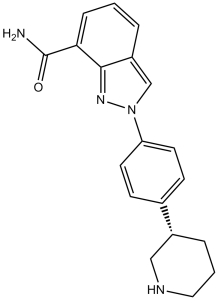
Niraparib (MK-4827)

别名: MK-4827; 1038915-60-4; (S)-2-(4-(piperidin-3-yl)phenyl)-2H-indazole-7-carboxamide; UNII-HMC2H89N35; MK 4827 (Base); Niraparib [USAN]; MK 4827; Niraparib free base; Zejula; MK4827; 尼拉帕尼; 尼拉帕尼API; 2-[4-((3S)-3-哌啶基)苯基]-2H-吲唑-7-甲酰胺; 尼拉帕布; 尼若帕布; 尼拉帕布2-[4-((3S)-3-哌啶基)苯基]-2H-吲唑-7-甲酰胺; MK4827尼拉帕尼;-[4-((3S)-3-哌啶基)苯基]-2H-吲唑-7-甲酰胺; (S)-2-(4-(哌啶-3-基)苯基)-2H-吲唑-7-羧酰胺
目录号: V2570 纯度: ≥98%
Niraparib(以前称为 MK4827;MK-4827;Zejula)是一种有效的、口服生物可利用的、选择性的 PARP1/2 抑制剂,具有抗癌活性。
Niraparib (MK-4827) CAS号: 1038915-60-4
产品类别: PARP
产品仅用于科学研究,不针对患者销售
规格 价格 库存 数量
10 mM * 1 mL in DMSO
1mg
5mg
10mg
25mg
50mg
100mg
250mg
Other Sizes

Other Forms of Niraparib (MK-4827):

  • 尼拉帕尼对苯甲磺酸盐
  • 尼拉帕尼盐酸盐
  • 甲苯磺酸尼拉帕尼一水物
  • 尼拉帕尼代谢物 M1
  • 尼拉帕尼R-对映体
点击了解更多
InvivoChem产品被CNS等顶刊论文引用
纯度/质量控制文件

纯度: ≥98%

产品描述
Niraparib(以前称为 MK4827;MK-4827;Zejula)是一种有效的、口服生物可利用的 PARP1/2 选择性抑制剂,具有抗癌活性。它抑制 PARP1/2,对 PARP 1 和 2 的 IC50 值分别为 3.8 nM 和 2.1 nM。 Niraparib于2017年3月27日获得美国FDA批准,用于对铂类化疗完全或部分缓解的复发性上皮性卵巢癌、输卵管癌或原发性腹膜癌成人患者的维持治疗。 Niraparib 在具有突变 BRCA-1 和 BRCA-2 的癌细胞中表现出高活性,IC50 在 10−100 nM 范围内。它对 PARP3、V-PARP 和 Tank1 的选择性超过 330 倍。在全细胞测定中,MK-4827 抑制 PARP 活性,EC50 为 4 nM。 MK-4827 还抑制突变 BRCA-1 和 BRCA-2 癌细胞的增殖,CC50 在 10-100 nM 范围内。 MK-4827 强烈增强了辐射对多种人类肿瘤异种移植物(包括 p53 野生型和 p53 突变体)的作用。
生物活性&实验参考方法
靶点
PARP-2 ( IC50 = 2.1 nM ); PARP-1 ( IC50 = 3.8 nM ); V-PARP ( IC50 = 330 nM ); TANK-1 ( IC50 = 570 nM ); PARP-3 ( IC50 = 1300 nM )
体外研究 (In Vitro)
体外活性:在全细胞测定中,MK-4827 抑制 PARP 活性,EC50 = 4 nM,并抑制突变 BRCA-1 和 BRCA-2 癌细胞的增殖,CC50 在 10-100 nM 范围内。它被证明是一种有效的选择性 PARP-1 和 PARP-2 抑制剂,IC50 分别为 3.8 和 2.1 nM。此外,它的选择性比 PARP-3、V-PARP 和 tankyrase-1 至少高 100 倍,IC50 分别为 1300、330 和 570 nM。 MK-4827 不仅能抑制因 RNA 干扰而沉默而缺乏 BRCA-1 的 HeLa 细胞的生长,还能抑制携带天然 BRCA-1 或 BRCA-2 突变的癌细胞系的增殖。在携带 BRCA-1 突变的 MDA-MB-436 人乳腺腺癌细胞中,MK-4827 显示 CC50 = 18 nM,而在 BRCA-2 突变的 CAPAN-1 人胰腺腺癌细胞中,MK-4827 显示 CC50 = 90纳米。相比之下,正常人前列腺和乳腺上皮细胞对 MK-4827 具有抗性,在微摩尔范围内表现出抗增殖作用,从而证明与周围组织相比,这些 PARP 抑制剂对 BRCA-1 和 -2 突变癌细胞具有非常高的选择性细胞毒性。激酶测定:MK-4827 表现出出色的 PARP 1 和 2 抑制作用,IC(50) = 3.8 和 2.1 nM,分别,在全细胞测定中,它抑制 PARP 活性,EC(50) = 4 nM,并抑制癌症增殖具有 CC(50) 在 10-100 nM 范围内的突变 BRCA-1 和 BRCA-2 的细胞。细胞测定:在 96 孔黑色观察板中进行增殖测定,培养基为 300 个细胞/孔(BRCA-1 wt 为 250 个细胞/孔),培养基为 190 μL/孔(含有 10% FCS、0.1 mg/mL 青霉素的 DMEM) -链霉素和2 mM L-谷氨酰胺),在37℃、5% CO2气氛下接种并孵育4小时。然后以 10 μL/孔的浓度连续稀释添加抑制剂,以获得 0.5% DMSO 中所需的最终化合物浓度。然后将细胞在 37℃、5% CO2 中孵育 7 天,然后评估活力。简而言之,将 CellTiter-Blue 溶液在培养基中按 1:10 预稀释,加入 100 μL/孔,将细胞在 37℃、5% CO2 下放置 45 分钟,然后在室温下避光放置 15 分钟。通过在荧光计上读取平板、在 550 nm 处激发并在 590 nm 处发射来确定活细胞的数量。细胞生长表示为相对于媒介物处理的细胞的生长百分比。确定抑制细胞生长 50% (CC50) 所需的浓度。
体内研究 (In Vivo)
MK-4827 是一种新型口服生物可利用的 PARP-1 和 PARP-2 抑制剂,可强烈增强辐射对多种人类肿瘤异种移植物(包括 p53 野生型和 p53 突变体)的作用。它在体内具有良好的耐受性,并且在 BRCA-1 缺陷癌症的异种移植模型中证明了作为单一药物的有效性。
niraparib(MK-4827)的体内疗效在BRCA-1突变MDA-MB-436异种移植物模型中得到了临床前证明(图4),并在6周龄裸CD1雌性小鼠的右侧皮下注射了2×10⁶个细胞。当肿瘤达到150 mm3的平均体积时,将小鼠随机分成同质组,用尼拉普(MK-4827)治疗,口服剂量为100 mg/kg q.d或50 mg/kg b.i.d。两种给药方案均观察到肿瘤消退,且均耐受良好,无死亡。在实验过程中,体重减轻了不到10%。[1]
聚(ADP-核糖)聚合酶(PARP)抑制剂MK-4827是一种新型口服有效的PARP-1和PARP-2抑制剂,目前正在癌症治疗的I期临床试验中。目前还没有关于MK-4827与放疗联合使用的临床前数据。目前的研究检查了MK-4827和分次放疗的联合治疗效果,使用了各种不同p53状态的人类肿瘤异种移植物:Calu-6(p53缺失)、A549(p53野生型[wt])和H-460(p53 wt)肺癌以及三阴性MDA-MB-231人类乳腺癌。为了模拟放射治疗的临床应用,使用了分次放射治疗(每分次2 Gy)方案,每天一次或两次,持续1至2周,联合MK-4827,50 mg/kg每日一次或25 mg/kg每日两次。发现MK-4827在两种辐射方案中都具有高度相似的有效性,但当MK-4827以50mg/kg的剂量每天一次给药时,观察到最大的辐射增强(EF=2.2)。MK-4827对所有四种肿瘤进行了放射增敏研究,无论其p53状态如何。MK-4827在给药后1小时降低了肿瘤中的标准杆数水平,并持续了24小时。这种长时间的PARP抑制可能增加了未来临床试验设计的灵活性。因此,MK-4827显示出提高放射治疗疗效的巨大潜力[3]。
酶活实验
PARP-1 SPA检测[1]
酶测定在含有25 mM Tris、pH 8.0、1 mM DTT、1 mM精胺、50 mM KCl、0.01%Nonidet P-40和1 mM MgCl2的缓冲液中进行。PARP反应含有0.1μCi[3H]NAD+(200 000 DPM)、1.5μM NAD+、150 nM生物素化NAD+、1μg/mL活化的小牛胸腺和1−5 nM PARP-1。在白色96孔板中,在50μL体积内进行了基于SPA珠检测的自动反应。 化合物在96孔板中以5μL/孔在5%DMSO/H2O(10×浓缩)中以11点连续稀释制备。首先在缓冲液中加入35μL PARP-1酶,在室温下孵育5分钟,然后加入10μL NAD+和DNA底物混合物,引发反应。在室温下放置3小时后,通过加入50μL链霉抗生物素蛋白SPA珠(在200 mM EDTA中为2.5 mg/mL,pH 8)终止这些反应。5分钟后,使用TopCount微孔板闪烁计数器对其进行计数。IC50数据由不同底物浓度下的抑制曲线确定。
PARP亚型TCA测定[1]
酶促反应在25 mM Tris-HCl pH 8.0、1 mM MgCl2、50 mM KCl、1 mM精胺、0.01%Nonidet P-40和1 mM DTT的存在下进行。PARP反应含有0.1μCi[3H]NAD(200000 DPM)、1.5μM NAD+、1μg/mL活化的小牛胸腺和0.2−1 nM人PARP-1酶。在白色96孔聚丙烯微孔板中以50μL的体积进行测定
制备96孔板,在0.1-50 nM浓度范围内连续稀释10个点,5%DMSO/H2O,5μL。首先在缓冲液中加入35μL PARP-1酶,在室温下孵育5分钟,然后加入10μL NAD+和DNA底物混合物,引发反应。在室温下孵育2小时后,通过加入TCA(50μL/孔,20%在20mM NaPPi溶液中)停止反应,并在冰上孵育10分钟。将所得沉淀物在Unifilter GF/B微孔板上过滤,并用2.5%TCA洗涤四次。添加50μL/孔闪烁液后,使用TopCount微板闪烁计数器测定标准杆数聚合物中的放射性含量。IC50数据由不同底物浓度下的抑制曲线确定。其他PARP家族成员的协议非常相似,但有细微的变化,如支持信息所述。
PAR酰化分析[1]
将HeLa细胞以10000个细胞/孔的初始浓度接种到96孔Viewplate黑色微孔板中的培养基中(100μL含有10%FCS、0.1mg/mL青霉素-链霉素和2mM L-谷氨酰胺的DMEM)。将平板在37°C、5%CO2气氛下孵育4小时,然后在5%DMSO/H2O、10μL/孔中以0.3-100 nM的浓度范围在9个点上连续稀释化合物。然后将平板在37°C的5%CO2中孵育18小时,然后加入5μL的H2O2水溶液(终浓度200μM)引起DNA损伤。作为阴性对照,使用未经H2O2处理的细胞。将平板在37°C下保持5分钟。然后通过平板倒置轻轻取出培养基,通过加入冰冷的甲醇(100μL/孔)固定细胞,并在-20°C下维持20分钟。
通过平板倒置去除固定剂并用PBS(300μL)洗涤10次后,加入检测缓冲液(100μL/孔,含有PBS、Tween(0.05%)和BSA(1mg/mL))以及初级标准杆数mAb(1:2000)、次级抗小鼠Alexa Fluor 488抗体(1:3000)和核染料Draq5(5μM)。在室温下在黑暗中孵育3小时后,取出溶液,用PBS(300μL)洗涤10次,在InCell1000上读取平板读数。标准杆数聚合物的监测是通过在Ex.S475_20X,Em.HQ535_50检测Alexa488,暴露时间为600ms,细胞核的鉴定是通过用Ex.HQ620_60X,Em-HQ700_75M跟踪Draq5,暴露时间300ms。通过测量PAR-阳性细胞核数与Draq5-标记细胞核总数之比来计算%PAR-阳性细胞。IC50是根据PARPi浓度增加时的残留酶活性确定的。
在全细胞测定中,MK-4827 抑制 PARP 活性,EC(50) = 4 nM,并阻止表达突变型 BRCA-1 和 BRCA-2 的癌细胞生长,CC(50) 范围在 10-100 nM。它还对 PARP 1 和 2 具有出色的抑制作用,IC(50) 分别为 3.8 和 2.1 nM。
细胞实验
BRCA-1沉默和野生型HeLa细胞的增殖试验[1]
HeLa BRCA1沉默细胞是通过以100的MOI用慢病毒转导HeLa细胞而产生的,慢病毒含有针对BRCA-1的shRNA的H1衍生表达盒和GFP的表达盒(GFP在EF1-a启动子的控制下)。Taqman分析评估,BRCA1的沉默率超过80%。对照BRCA野生型HeLa细胞是通过用仅表达GFP的慢病毒转导而产生的
在96孔黑色观察板中进行增殖试验,在190μL/孔的培养基(含10%FCS、0.1 mg/mL青霉素-链霉素和2 mM L-谷氨酰胺的DMEM)中培养300个细胞/孔(BRCA-1-wt为250个细胞/孔),在37°C和5%CO2气氛下培养4小时。然后以10μL/孔的连续稀释液加入抑制剂,以在0.5%DMSO中获得所需的最终化合物浓度。然后将细胞在37°C的5%CO2中孵育7天,然后评估存活时间。简而言之,在培养基中用1:10的CellTiter Blue 溶液预稀释,加入100μL/孔,将细胞在37°C、5%CO2下静置45分钟,然后在室温下在黑暗中静置15分钟。通过在荧光计上读取平板,在550 nm下激发,在590 nm下发射来确定活细胞的数量。细胞生长表示为相对于载体处理细胞的生长百分比。测定抑制细胞生长50%所需的浓度(CC50)。其他细胞系的方案非常相似,并在支持信息中进行了描述。
在 96 孔黑色观察板中进行增殖测定。将 300 个细胞/孔(BRCA-1 wt 为 250 个细胞/孔)置于培养基中,190 μL/孔(含有 10% FCS、0.1 mg/mL 青霉素-链霉素和 2 mM L-谷氨酰胺的 DMEM),并将细胞在 37°C、5% CO2 气氛下孵育 4 小时。接下来,在 0.5% DMSO 中,以 10 μL/孔的连续稀释液添加抑制剂,直至最终化合物浓度达到所需的浓度。将细胞在 37°C、5% CO2 中培养 7 天后评估其活力。简而言之,向培养基中添加 100 μL/孔预稀释的 1:10 CellTiter-Blue 溶液后,将细胞在 37°C、5% CO2 下孵育 45 分钟,然后在室温、黑暗中再孵育 15 分钟。通过荧光计读数、550 nm 激发和 590 nm 发射,确定活细胞的数量。与媒介物处理的细胞相比,细胞的生长百分比用于表达细胞生长。确定了使细胞生长停止 50% 所需的浓度 (CC50)。
动物实验
MDA-MB-436 人乳腺癌细胞 (ATCC) 在添加了 10% FCS、青霉素 (100 U/mL) 和链霉素 (100 μg/mL) 的 RPMI 1640 培养基中,于 37 °C 和 5% CO2 的标准贴壁培养条件下培养。为了建立异种移植瘤模型,使用EDTA/胰蛋白酶从亚融合培养物中收集细胞,用无血清培养基洗涤,并将细胞悬液(2 × 10⁶ 个细胞)以100 μL的总体积皮下注射到6周龄CD1雌性裸鼠的右侧腹部。细胞悬液由无血清培养基和RGF-Matrigel按1:1的比例混合而成。当肿瘤平均体积达到150 mm³时,将小鼠随机分组,形成同质组,并开始口服给药。小鼠每日一次口服100 mg/kg的药物,或每日两次口服50 mg/kg的药物,持续33天,每周至少测量一次肿瘤生长情况和体重。[1]
配制于 0.5% 的 Methocel 去离子水中;每日两次,每次 25 mg/kg,或每日一次,每次 50 mg/kg;口服灌胃
雌性裸鼠
药代性质 (ADME/PK)
吸收、分布和排泄
单次服用300 mg尼拉帕尼后,平均(±SD)血浆峰浓度(Cmax)为804 (±403) ng/mL。尼拉帕尼的暴露量(Cmax和AUC)随每日剂量从30 mg(批准推荐剂量的0.1倍)到400 mg(批准推荐剂量的1.3倍)呈剂量比例增加。每日重复给药21天后,尼拉帕尼暴露量的累积比率在30至400 mg剂量范围内约为2倍。达峰时间(Tmax)约为3小时。尼拉帕尼的绝对生物利用度约为73%。食物似乎不影响药物暴露量。
尼拉帕尼通过多种途径消除,包括肝脏代谢、肝胆排泄和肾脏排泄。单次口服 300 毫克放射性标记的尼拉帕尼后,21 天内给药剂量的平均回收率为:尿液中 47.5%(范围:33.4% 至 60.2%),粪便中 38.8%(范围:28.3% 至 47.0%)。在6天内收集的混合样本中,尿液和粪便中回收的未代谢尼拉帕尼分别占给药剂量的11%和19%。
平均(±SD)表观分布容积(Vd/F)为1220(±1114)L。在群体药代动力学分析中,癌症患者的尼拉帕尼Vd/F为1074L。
在群体药代动力学分析中,癌症患者的尼拉帕尼表观总清除率(CL/F)为16.2 L/h。
代谢/代谢物
尼拉帕尼主要通过羧酸酯酶(CEs)代谢生成M1,M1是一种主要的非活性代谢物。 M1代谢物随后可在UDP-葡萄糖醛酸转移酶(UGTs)介导下发生葡萄糖醛酸化,生成M10代谢物。在质量平衡研究中,M1和M10是主要的循环代谢物。M1代谢物还可发生甲基化、单加氧和氢化,生成其他次要代谢物。
生物半衰期
每日多次服用300 mg尼拉帕尼后,平均半衰期(t1/2)为36小时。
毒性/毒理 (Toxicokinetics/TK)
肝毒性
在尼拉帕尼的预注册随机对照临床试验中,常规肝功能检查异常较为常见,但大多为轻度且可自行消退。28%的患者出现血清ALT升高(对照组为15%),但仅有1%的患者ALT值超过正常值上限(ULN)的5倍(对照组为2%)。尽管临床试验中治疗期间血清酶升高较为常见,但未见出现伴有黄疸或肝功能衰竭的肝炎病例报告。尼拉帕尼获批并广泛应用后,尚未有已发表的临床上明显的肝损伤病例报告,但其使用范围和持续时间均受到限制。因此,尼拉帕尼是已知的轻度血清酶升高原因,但尚未发现与显著肝毒性相关。
可能性评分:E(未经证实但怀疑是临床上明显的肝损伤原因)。
妊娠和哺乳期影响
◉ 哺乳期用药概述
目前尚无关于尼拉帕尼在哺乳期临床应用的信息。由于尼拉帕尼与血浆蛋白的结合率为83%,因此其在乳汁中的含量可能很低。制造商建议在尼拉帕尼治疗期间以及治疗结束后1个月内停止母乳喂养。
◉ 对母乳喂养婴儿的影响
截至修订日期,未找到相关的已发表信息。
◉ 对泌乳和母乳的影响
截至修订日期,未找到相关的已发表信息。
蛋白结合
尼拉帕尼与人血浆蛋白的结合率为83%。
参考文献

[1]. Discovery of 2-{4-[(3S)-piperidin-3-yl]phenyl}-2H-indazole-7-carboxamide (MK-4827): a novel oral poly(ADP-ribose)polymerase (PARP) inhibitor efficacious in BRCA-1 and -2 mutant tumors. J Med Chem. 2009 Nov 26;52(22):7170-85.

[2]. Niraparib (MK-4827), a novel poly(ADP-Ribose) polymerase inhibitor, radiosensitizes human lung and breast cancer cells. Oncotarget. 2014 Jul 15;5(13):5076-86.

[3]. MK-4827, a PARP-1/-2 inhibitor, strongly enhances response of human lung and breast cancer xenografts to radiation. Invest New Drugs. 2012 Dec;30(6):2113-20.

[4]. Niraparib Maintenance Therapy in Platinum-Sensitive, Recurrent Ovarian Cancer. N Engl J Med. 2016 Dec 1;375(22):2154-2164.

其他信息
药效学
尼拉帕尼对存在或不存在 _BRCA1/2_ 缺陷的肿瘤细胞系均具有细胞毒性作用。在 _BRCA1/2_ 缺陷的人类癌细胞系的小鼠异种移植模型以及具有同源重组缺陷 (HRD) 的人类患者来源的异种移植肿瘤模型(无论 _BRCA1/2_ 为突变型还是野生型)中均观察到肿瘤生长减缓。体外研究表明,尼拉帕尼抑制多巴胺、去甲肾上腺素和血清素转运蛋白,这可能解释了其脱靶心血管效应,例如心率和血压升高。
我们公开了一系列新型 2-苯基-2H-吲唑-7-甲酰胺类化合物作为聚(ADP-核糖)聚合酶 (PARP) 1 和 2 抑制剂的开发。本系列化合物经过优化以提高酶活性和细胞活性,所得PARP抑制剂对BRCA-1和BRCA-2缺陷型癌细胞表现出抗增殖活性,且对BRCA功能正常的细胞具有高度选择性。研究发现,CYP450 1A1和1A2介导的肝外氧化是代谢方面的问题,并报道了改善药代动力学性质的策略。这些努力最终发现了2-{4-[(3S)-哌啶-3-基]苯基}-2H-吲唑-7-甲酰胺56 (MK-4827),该化合物具有良好的药代动力学性质,目前正在进行I期临床试验。该化合物对PARP 1和2表现出优异的抑制活性,IC50值分别为3.8 nM和2.1 nM。在全细胞实验中,其对PARP活性的抑制EC50值为4 nM,对携带突变型BRCA-1和BRCA-2的癌细胞增殖的抑制CC50值在10-100 nM范围内。化合物56在体内耐受性良好,并在BRCA-1缺陷型癌症的异种移植模型中作为单药显示出疗效。[1]
本研究旨在评估新型聚(ADP-核糖)聚合酶(PARP)抑制剂尼拉帕尼(MK-4827)对人肿瘤细胞的放射增敏作用。采用克隆形成存活实验,检测了尼拉帕尼对肺癌、乳腺癌和前列腺癌来源的人肿瘤细胞的放射增敏作用。实验包括p53野生型和p53缺陷型细胞系。本研究利用γ-H2AX和RAD51灶的检测,确定了尼拉帕尼改变辐射诱导的DNA双链断裂(DSB)修复的能力。克隆形成存活分析表明,微摩尔浓度的尼拉帕尼可使肺癌、乳腺癌和前列腺癌来源的肿瘤细胞系对辐射更加敏感,且该作用与p53状态无关,但对正常组织来源的细胞系则无此作用。尼拉帕尼还能使肿瘤细胞对H2O2更加敏感,并在DNA复制过程中将H2O2诱导的单链断裂(SSB)转化为DSB。这些结果表明,在体外实验中,强效且选择性的PARP-1抑制剂尼拉帕尼可显著增强人肿瘤细胞的放射敏感性。这种作用机制似乎与药物抑制碱基切除修复有关,从而在DNA复制过程中将亚致死性SSB转化为致死性DSB。综上所述,我们的研究结果有力地支持对尼拉帕尼联合放射治疗进行临床评估。 [2]
背景:尼拉帕尼是一种口服聚(腺苷二磷酸[ADP]-核糖)聚合酶(PARP)1/2抑制剂,已在卵巢癌患者中显示出临床活性。我们旨在评估尼拉帕尼与安慰剂相比,作为铂敏感复发性卵巢癌患者维持治疗的疗效。
方法:在这项随机、双盲、3期临床试验中,根据是否存在生殖系BRCA突变(gBRCA组和非gBRCA组)以及非gBRCA突变的类型,将患者分为两组,并以2:1的比例随机分配接受尼拉帕尼(300 mg)或安慰剂,每日一次。主要终点是无进展生存期。
结果:在 553 名入组患者中,203 名属于 gBRCA 队列(其中 138 名分配至尼拉帕尼组,65 名分配至安慰剂组),350 名患者属于非 gBRCA 队列(其中 234 名分配至尼拉帕尼组,116 名分配至安慰剂组)。与安慰剂组相比,尼拉帕尼组患者的中位无进展生存期显著延长,其中 gBRCA 队列为 21.0 个月 vs. 5.5 个月(风险比,0.27;95% 置信区间 [CI],0.17 至 0.41),非 gBRCA 队列中同源重组缺陷 (HRD) 肿瘤患者的中位无进展生存期为 12.9 个月 vs. 3.8 个月(风险比,0.38;95% CI,0.24 至 0.59),非 gBRCA 队列患者的中位无进展生存期为 9.3 个月 vs. 3.9 个月(风险比,0.45;95% CI,0.34 至 0.61;所有三项比较的 P 值均 < 0.001)。尼拉帕尼组中最常见的3级或4级不良事件为血小板减少症(33.8%)、贫血(25.3%)和中性粒细胞减少症(19.6%),这些不良事件均通过调整剂量进行控制。
结论:在铂敏感复发性卵巢癌患者中,无论是否存在gBRCA突变或HRD状态,接受尼拉帕尼治疗的患者的中位无进展生存期均显著长于接受安慰剂治疗的患者,且骨髓毒性中等。(由Tesaro公司资助;ClinicalTrials.gov注册号:NCT01847274)。[4]
*注: 文献方法仅供参考, InvivoChem并未独立验证这些方法的准确性
化学信息 & 存储运输条件
分子式
C19H20N4O
分子量
320.39
精确质量
320.163
元素分析
C, 71.23; H, 6.29; N, 17.49; O, 4.99
CAS号
1038915-60-4
相关CAS号
1038915-60-4; 1038915-73-9; 1038915-64-8 (HCl); 1613220-15-7 (tosylate hydrate); 1476777-06-6 (Niraparib metabolite M1); 1038915-58-0 (Niraparib R-enantiomer)
PubChem CID
24958200
外观&性状
Light yellow solid powder
密度
1.3±0.1 g/cm3
沸点
463.6±45.0 °C at 760 mmHg
闪点
234.2±28.7 °C
蒸汽压
0.0±1.1 mmHg at 25°C
折射率
1.705
LogP
2.85
tPSA
73.93
氢键供体(HBD)数目
2
氢键受体(HBA)数目
3
可旋转键数目(RBC)
3
重原子数目
24
分子复杂度/Complexity
449
定义原子立体中心数目
1
SMILES
O=C(C1=C([H])C([H])=C([H])C2C1=NN(C=2[H])C1C([H])=C([H])C(=C([H])C=1[H])[C@@]1([H])C([H])([H])N([H])C([H])([H])C([H])([H])C1([H])[H])N([H])[H]
InChi Key
PCHKPVIQAHNQLW-CQSZACIVSA-N
InChi Code
InChI=1S/C19H20N4O/c20-19(24)17-5-1-3-15-12-23(22-18(15)17)16-8-6-13(7-9-16)14-4-2-10-21-11-14/h1,3,5-9,12,14,21H,2,4,10-11H2,(H2,20,24)/t14-/m1/s1
化学名
2-[4-[(3S)-piperidin-3-yl]phenyl]indazole-7-carboxamide
别名
MK-4827; 1038915-60-4; (S)-2-(4-(piperidin-3-yl)phenyl)-2H-indazole-7-carboxamide; UNII-HMC2H89N35; MK 4827 (Base); Niraparib [USAN]; MK 4827; Niraparib free base; Zejula; MK4827;
HS Tariff Code
2934.99.9001
存储方式

Powder      -20°C    3 years

                     4°C     2 years

In solvent   -80°C    6 months

                  -20°C    1 month

运输条件
Room temperature (This product is stable at ambient temperature for a few days during ordinary shipping and time spent in Customs)
溶解度数据
溶解度 (体外实验)
DMSO: 25~64 mg/mL (78.0~199.8 mM)
Water: <1 mg/mL
Ethanol: ~64 mg/mL (~199.8 mM)
溶解度 (体内实验)
配方 1 中的溶解度: ≥ 2.08 mg/mL (6.49 mM) (饱和度未知) in 10% DMSO + 40% PEG300 + 5% Tween80 + 45% Saline (这些助溶剂从左到右依次添加,逐一添加), 澄清溶液。
例如,若需制备1 mL的工作液,可将100 μL 20.8 mg/mL澄清DMSO储备液加入400 μL PEG300中,混匀;然后向上述溶液中加入50 μL Tween-80,混匀;加入450 μL生理盐水定容至1 mL。
*生理盐水的制备:将 0.9 g 氯化钠溶解在 100 mL ddH₂O中,得到澄清溶液。

配方 2 中的溶解度: ≥ 2.08 mg/mL (6.49 mM) (饱和度未知) in 10% DMSO + 90% (20% SBE-β-CD in Saline) (这些助溶剂从左到右依次添加,逐一添加), 澄清溶液。
例如,若需制备1 mL的工作液,可将 100 μL 20.8 mg/mL澄清DMSO储备液加入900 μL 20% SBE-β-CD生理盐水溶液中,混匀。
*20% SBE-β-CD 生理盐水溶液的制备(4°C,1 周):将 2 g SBE-β-CD 溶解于 10 mL 生理盐水中,得到澄清溶液。

View More

配方 3 中的溶解度: ≥ 2.08 mg/mL (6.49 mM) (饱和度未知) in 10% DMSO + 90% Corn Oil (这些助溶剂从左到右依次添加,逐一添加), 澄清溶液。
例如,若需制备1 mL的工作液,可将 100 μL 20.8 mg/mL 澄清 DMSO 储备液加入到 900 μL 玉米油中并混合均匀。


请根据您的实验动物和给药方式选择适当的溶解配方/方案:
1、请先配制澄清的储备液(如:用DMSO配置50 或 100 mg/mL母液(储备液));
2、取适量母液,按从左到右的顺序依次添加助溶剂,澄清后再加入下一助溶剂。以 下列配方为例说明 (注意此配方只用于说明,并不一定代表此产品 的实际溶解配方):
10% DMSO → 40% PEG300 → 5% Tween-80 → 45% ddH2O (或 saline);
假设最终工作液的体积为 1 mL, 浓度为5 mg/mL: 取 100 μL 50 mg/mL 的澄清 DMSO 储备液加到 400 μL PEG300 中,混合均匀/澄清;向上述体系中加入50 μL Tween-80,混合均匀/澄清;然后继续加入450 μL ddH2O (或 saline)定容至 1 mL;

3、溶剂前显示的百分比是指该溶剂在最终溶液/工作液中的体积所占比例;
4、 如产品在配制过程中出现沉淀/析出,可通过加热(≤50℃)或超声的方式助溶;
5、为保证最佳实验结果,工作液请现配现用!
6、如不确定怎么将母液配置成体内动物实验的工作液,请查看说明书或联系我们;
7、 以上所有助溶剂都可在 Invivochem.cn网站购买。
制备储备液 1 mg 5 mg 10 mg
1 mM 3.1212 mL 15.6060 mL 31.2120 mL
5 mM 0.6242 mL 3.1212 mL 6.2424 mL
10 mM 0.3121 mL 1.5606 mL 3.1212 mL

1、根据实验需要选择合适的溶剂配制储备液 (母液):对于大多数产品,InvivoChem推荐用DMSO配置母液 (比如:5、10、20mM或者10、20、50 mg/mL浓度),个别水溶性高的产品可直接溶于水。产品在DMSO 、水或其他溶剂中的具体溶解度详见上”溶解度 (体外)”部分;

2、如果您找不到您想要的溶解度信息,或者很难将产品溶解在溶液中,请联系我们;

3、建议使用下列计算器进行相关计算(摩尔浓度计算器、稀释计算器、分子量计算器、重组计算器等);

4、母液配好之后,将其分装到常规用量,并储存在-20°C或-80°C,尽量减少反复冻融循环。

计算器

摩尔浓度计算器可计算特定溶液所需的质量、体积/浓度,具体如下:

  • 计算制备已知体积和浓度的溶液所需的化合物的质量
  • 计算将已知质量的化合物溶解到所需浓度所需的溶液体积
  • 计算特定体积中已知质量的化合物产生的溶液的浓度
使用摩尔浓度计算器计算摩尔浓度的示例如下所示:
假如化合物的分子量为350.26 g/mol,在5mL DMSO中制备10mM储备液所需的化合物的质量是多少?
  • 在分子量(MW)框中输入350.26
  • 在“浓度”框中输入10,然后选择正确的单位(mM)
  • 在“体积”框中输入5,然后选择正确的单位(mL)
  • 单击“计算”按钮
  • 答案17.513 mg出现在“质量”框中。以类似的方式,您可以计算体积和浓度。

稀释计算器可计算如何稀释已知浓度的储备液。例如,可以输入C1、C2和V2来计算V1,具体如下:

制备25毫升25μM溶液需要多少体积的10 mM储备溶液?
使用方程式C1V1=C2V2,其中C1=10mM,C2=25μM,V2=25 ml,V1未知:
  • 在C1框中输入10,然后选择正确的单位(mM)
  • 在C2框中输入25,然后选择正确的单位(μM)
  • 在V2框中输入25,然后选择正确的单位(mL)
  • 单击“计算”按钮
  • 答案62.5μL(0.1 ml)出现在V1框中
g/mol

分子量计算器可计算化合物的分子量 (摩尔质量)和元素组成,具体如下:

注:化学分子式大小写敏感:C12H18N3O4  c12h18n3o4
计算化合物摩尔质量(分子量)的说明:
  • 要计算化合物的分子量 (摩尔质量),请输入化学/分子式,然后单击“计算”按钮。
分子质量、分子量、摩尔质量和摩尔量的定义:
  • 分子质量(或分子量)是一种物质的一个分子的质量,用统一的原子质量单位(u)表示。(1u等于碳-12中一个原子质量的1/12)
  • 摩尔质量(摩尔重量)是一摩尔物质的质量,以g/mol表示。
/

配液计算器可计算将特定质量的产品配成特定浓度所需的溶剂体积 (配液体积)

  • 输入试剂的质量、所需的配液浓度以及正确的单位
  • 单击“计算”按钮
  • 答案显示在体积框中
动物体内实验配方计算器(澄清溶液)
第一步:请输入基本实验信息(考虑到实验过程中的损耗,建议多配一只动物的药量)
第二步:请输入动物体内配方组成(配方适用于不溶/难溶于水的化合物),不同的产品和批次配方组成不同,如对配方有疑问,可先联系我们提供正确的体内实验配方。此外,请注意这只是一个配方计算器,而不是特定产品的确切配方。
+
+
+

计算结果:

工作液浓度 mg/mL;

DMSO母液配制方法 mg 药物溶于 μL DMSO溶液(母液浓度 mg/mL)。如该浓度超过该批次药物DMSO溶解度,请首先与我们联系。

体内配方配制方法μL DMSO母液,加入 μL PEG300,混匀澄清后加入μL Tween 80,混匀澄清后加入 μL ddH2O,混匀澄清。

(1) 请确保溶液澄清之后,再加入下一种溶剂 (助溶剂) 。可利用涡旋、超声或水浴加热等方法助溶;
            (2) 一定要按顺序加入溶剂 (助溶剂) 。

临床试验信息
Niraparib + Ipilimumab or Nivolumab in Progression Free Pancreatic Adenocarcinoma After Platinum-Based Chemotherapy
CTID: NCT03404960
Phase: Phase 1/Phase 2    Status: Completed
Date: 2024-12-02
Study of the Combination Dostarlimab With Niraparib In Patients With Penile Carcinoma
CTID: NCT05526989
Phase: Phase 2    Status: Recruiting
Date: 2024-11-29
Niraparib With Standard Combination Radiation Therapy and Androgen Deprivation Therapy in Treating Patients With High Risk Prostate Cancer
CTID: NCT04037254
Phase: Phase 2    Status: Active, not recruiting
Date: 2024-11-29
A Study to Evaluate Dostarlimab Plus Carboplatin-paclitaxel Versus Placebo Plus Carboplatin-paclitaxel in Participants With Recurrent or Primary Advanced Endometrial Cancer
CTID: NCT03981796
Phase: Phase 3    Status: Active, not recruiting
Date: 2024-11-27
Personalized Medicine for Advanced Biliary Cancer Patients
CTID: NCT05615818
Phase: Phase 3    Status: Recruiting
Date: 2024-11-26
View More

Tuvusertib (M1774) in Participants With Metastatic or Locally Advanced Unresectable Solid Tumors (DDRiver Solid Tumors 301)
CTID: NCT04170153
Phase: Phase 1    Status: Active, not recruiting
Date: 2024-11-26


Tuvusertib Combined With Niraparib or Lartesertib in Participants With Epithelial Ovarian Cancer (DDRiver EOC 302)
CTID: NCT06433219
Phase: Phase 2    Status: Recruiting
Date: 2024-11-26
Niraparib and Selenium for the Treatment of Recurrent BRCA Negative Platinum Resistant Ovarian Cancer
CTID: NCT05672095
Phase: Phase 1/Phase 2    Status: Not yet recruiting
Date: 2024-11-21
A Study in Patients Previously Enrolled in a Genentech and/or F. Hoffmann-La Roche Ltd Sponsored Atezolizumab Study
CTID: NCT03768063
Phase: Phase 3    Status: Recruiting
Date: 2024-11-20
Phase II Trial of the PARP Inhibitor Niraparib and PD-1 Inhibitor Dostarlimab in Patients With Advanced Cancers With Active Progressing Brain Metastases (STARLET)
CTID: NCT05700721
Phase: Phase 2    Status: Recruiting
Date: 2024-11-20
Cabazitaxel, Carboplatin, and Cetrelimab Followed by Niraparib With or Without Cetrelimab for the Treatment of Aggressive Variant Metastatic Prostate Cancer
CTID: NCT04592237
Phase: Phase 2    Status: Active, not recruiting
Date: 2024-11-20
A Safety Study Adding Niraparib and Dostarlimab to Radiation Therapy for Rectal Cancers
CTID: NCT04926324
Phase: Phase 1/Phase 2    Status: Suspended
Date: 2024-11-19
A Study of Niraparib in Patients with Ovarian Cancer in Clinical Practice
CTID: NCT05021562
Phase:    Status: Recruiting
Date: 2024-11-13
A Phase I/II Study of LM-2417 in Subjects With Advanced Solid Tumours
CTID: NCT06682780
Phase: Phase 1/Phase 2    Status: Not yet recruiting
Date: 2024-11-12
Niraparib and TSR-042 for the Treatment of BRCA-Mutated Unresectable or Metastatic Breast, Pancreas, Ovary, Fallopian Tube, or Primary Peritoneal Cancer
CTID: NCT04673448
Phase: Phase 1    Status: Recruiting
Date: 2024-11-08
A Multi-Center Trial of Androgen Suppression With Abiraterone Acetate, Leuprolide, PARP Inhibition and Stereotactic Body Radiotherapy in Prostate Cancer
CTID: NCT04194554
Phase: Phase 1/Phase 2    Status: Active, not recruiting
Date: 2024-11-06
PARP Inhibition for Gliomas (PI-4G or π4g)
CTID: NCT05297864
Phase: Phase 2    Status: Terminated
Date: 2024-11-06
A Study of Niraparib in People With Soft Tissue Sarcoma Who Have Changes in Their Tumor DNA
CTID: NCT05515575
Phase: Phase 2    Status: Active, not recruiting
Date: 2024-11-05
Niraparib Added to Anti-PD-L1 Antibody Maintenance in SLFN11-positive, Extensive-disease SCLC
CTID: NCT05718323
Phase: Phase 2    Status: Recruiting
Date: 2024-11-01
Niraparib and Neratinib in Advanced Solid Tumors With Expansion Cohort in Advanced Ovarian Cancer
CTID: NCT04502602
Phase: Phase 1    Status: Recruiting
Date: 2024-10-29
Study of ART6043 in Advanced/Metastatic Solid Tumors Patients
CTID: NCT05898399
Phase: Phase 1/Phase 2    Status: Recruiting
Date: 2024-10-29
A Study of Niraparib in Combination With Abiraterone Acetate and Prednisone Versus Abiraterone Acetate and Prednisone for the Treatment of Participants With Deleterious Germline or Somatic Homologous Recombination Repair (HRR) Gene-Mutated Metastatic Castration-Sensitive Prostate Cancer (mCSPC)
CTID: NCT04497844
Phase: Phase 3    Status: Active, not recruiting
Date: 2024-10-24
Niraparib and Dostarlimab for the Treatment of Small Cell Lung Cancer and Other High-Grade Neuroendocrine Carcinomas
CTID: NCT04701307
Phase: Phase 2    Status: Active, not recruiting
Date: 2024-10-24
A Study of Niraparib in Combination With Abiraterone Acetate and Prednisone Versus Abiraterone Acetate and Prednisone for Treatment of Participants With Metastatic Prostate Cancer
CTID: NCT03748641
Phase: Phase 3    Status: Active, not recruiting
Date: 2024-10-24
Niraparib Maintenance Treatment in Patients With Newly Diagnosed Advanced Platinum- Sensitive, OC. The First Poland RWE Study.
CTID: NCT06614790
Phase:    Status: Recruiting
Date: 2024-10-23
I-SPY TRIAL: Neoadjuvant and Personalized Adaptive Novel Agents to Treat Breast Cancer
CTID: NCT01042379
Phase: Phase 2    Status: Recruiting
Date: 2024-10-22
Niraparib in Patients With Pancreatic Cancer
CTID: NCT03601923
Phase: Phase 2    Status: Active, not recruiting
Date: 2024-10-22
Liquid-biopsy Informed Platform Trial to Evaluate CDK4/6-inhibitor Resistant ER+/HER2- Metastatic Breast Cancer
CTID: NCT05601440
Phase: Phase 2    Status: Recruiting
Date: 2024-10-18
SBRT Alone or Followed by Niraparib for Oligometastases or Oligoprogression in Ovarian Cancer Following PARPi Therapy
CTID: NCT05990192
Phase: Phase 2    Status: Recruiting
Date: 2024-10-18
Niraparib with BeVAcizumab After Complete CytoreductioN in Patients with OvArian Cancer
CTID: NCT05183984
Phase: Phase 2    Status: Recruiting
Date: 2024-10-16
ZEN003694 Combined With Niraparib in Patients With Metastatic or Recurrent Solid Tumors
CTID: NCT06161493
Phase: Phase 1    Status: Withdrawn
Date: 2024-10-15
A Study of Niraparib Combination Therapies for the Treatment of Metastatic Castration-Resistant Prostate Cancer
CTID: NCT03431350
Phase: Phase 1/Phase 2    Status: Active, not recruiting
Date: 2024-10-10
Study Evaluating Safety, Tolerability, and Metabolism of Niraparib
CTID: NCT06412120
Phase: Phase 4    Status: Not yet recruiting
Date: 2024-10-09
A Study of Comparative Formulations of Niraparib and Abiraterone Acetate (AA) in Men With Prostate Cancer
CTID: NCT04577833
Phase: Phase 1    Status: Active, not recruiting
Date: 2024-10-09
Dose Escalation and Cohort Expansion Study of Niraparib and Dostarlimab in Paediatric Participants With Solid Tumors (SCOOP)
CTID: NCT04544995
Phase: Phase 1    Status: Recruiting
Date: 2024-10-08
A Study of Niraparib (GSK3985771) Maintenance Treatment in Participants With Advanced Ovarian Cancer Following Response on Front-Line Platinum-Based Chemotherapy
CTID: NCT02655016
Phase: Phase 3    Status: Active, not recruiting
Date: 2024-10-02
Niraparib in the Treatment of Patients with Advanced PALB2 Mutated Tumors
CTID: NCT05169437
Phase: Phase 2    Status: Terminated
Date: 2024-10-01
Niraparib Rechallenge After Surgery in Ovarian Cancer Patients With Oligometastatic Progression
CTID: NCT06180356
Phase: Phase 2    Status: Recruiting
Date: 2024-09-25
Study Evaluating the Efficacy and Safety of Multiple Immunotherapy-Based Treatments and Combinations in Patients With Urothelial Carcinoma (MORPHEUS-UC)
CTID: NCT03869190
Phase: Phase 1/Phase 2    Status: Active, not recruiting
Date: 2024-09-24
A Phase I Study of Niraparib Administered Concurrently with Postoperative RT in Triple Negative Breast Cancer Patients
CTID: NCT03945721
Phase: Phase 1    Status: Active, not recruiting
Date: 2024-09-23
Radiation, Immunotherapy and PARP Inhibitor in Triple Negative Breast Cancer
CTID: NCT04837209
Phase: Phase 2    Status: Recruiting
Date: 2024-09-23
Niraparib As First Line Therapy with Metastatic Homologous Repair-deficient Pancreatic Cancer
CTID: NCT05442749
Phase: Phase 2    Status: Withdrawn
Date: 2024-09-19
Niraparib + Dostarlimab in BRCA Mutated Breast Cancer
CTID: NCT04584255
Phase: Phase 2    Status: Recruiting
Date: 2024-09-19
An Efficacy and Safety Study of Niraparib in Men With Metastatic Castration-Resistant Prostate Cancer and DNA-Repair Anomalies
CTID: NCT02854436
Phase: Phase 2    Status: Completed
Date: 2024-09-05
A Study of Niraparib Combined With Bevacizumab Maintenance Treatment in Participants With Advanced Ovarian Cancer Following Response on Front-Line Platinum-Based Chemotherapy
CTID: NCT03326193
Phase: Phase 2    Status: Completed
Date: 2024-09-04
Niraparib and Temozolomide in Patients Glioblastoma
CTID: NCT06258018
Phase: Phase 1/Phase 2    Status: Not yet recruiting
Date: 2024-08-30
Platinum-based Chemotherapy With Atezolizumab and Niraparib in Patients With Recurrent Ovarian Cancer
CTID: NCT03598270
Phase: Phase 3    Status: Completed
Date: 2024-08-30
A MolEcularly Guided Anti-Cancer Drug Off-Label Trial
CTID: NCT04185831
Phase: Phase 2    Status: Active, not recruiting
Date: 2024-08-22
Recurrent Ovarian CarcinoSarcoma Anti-pd-1 Niraparib
CTID: NCT03651206
Phase: Phase 2/Phase 3    Status: Active, not recruiting
Date: 2024-08-21
A Comparison of Platinum-based Therapy With TSR-042 and Niraparib Versus Standard of Care (SOC) Platinum-based Therapy as First-line Treatment of Stage III or IV Nonmucinous Epithelial Ovarian Cancer
CTID: NCT03602859
Phase: Phase 3    Status: Active, not recruiting
Date: 2024-08-16
Niraparib for the Neoadjuvant Treatment of Unresectable Ovarian Cancer
CTID: NCT04507841
Phase: Phase 2    Status: Completed
Date: 2024-08-13
A Study to Evaluate the Efficacy and Safety of Novel Treatment Combinations in Participants With Ovarian Cancer
CTID: NCT03574779
Phase: Phase 2    Status: Active, not recruiting
Date: 2024-08-12
Genomic Biomarker-Selected Umbrella Neoadjuvant Study for High Risk Localized Prostate Cancer
CTID: NCT04812366
Phase: Phase 2    Status: Recruiting
Date: 2024-08-09
Niraparib and Dostarlimab for Patients With MMR-D/MSI-H Colorectal Cancers
CTID: NCT06365970
Phase: Phase 2    Status: Not yet recruiting
Date: 2024-08-07
Study Evaluating the Efficacy of Niraparib and Dostarlimab (TSR-042) in Recurrent/Metastatic HNSCC
CTID: NCT04313504
Phase: Phase 2    Status: Active, not recruiting
Date: 2024-08-01
Evaluation of the Safety and Tolerability of Niraparib With Everolimus in Advanced Gynecologic Malignancies and Breast
CTID: NCT03154281
Phase: Phase 1    Status: Completed
Date: 2024-08-01
Crossover Study to Assess the Relative Bioavailability and Bioequivalence of Niraparib Tablet Compared to Niraparib Capsule
CTID: NCT03329001
Phase: Phase 1    Status: Completed
Date: 2024-07-25
Efficacy and Safety Comparison of Nirapar
A Randomized Study of Paclitaxel – Carboplatin followed by maintenance Niraparib compared to Paclitaxel – Carboplatin – Bevacizumab followed by maintenance Niraparib + Bevacizumab in Patients With Advanced Ovarian Cancer Following a Front-Line Complete Cytoreductive Surgery
CTID: null
Phase: Phase 2    Status: Trial now transitioned, Ongoing
Date: 2021-11-22
An Open-Label, Multicenter, Long-term Treatment Extension Study in Subjects Who Have Completed a Prior GlaxoSmithKline/TESARO-Sponsored Niraparib Study and are Judged by the Investigator to Benefit from Continued Treatment with Niraparib (3000-04-003)
CTID: null
Phase: Phase 2    Status: Ongoing, Trial now transitioned, Completed
Date: 2021-08-23
A Randomized Phase 3 Double-Blinded Study Comparing the Efficacy and Safety of Niraparib to Placebo in Participants with Either HER2-Negative BRCA-Mutated or Triple-Negative Breast Cancer with Molecular Disease Based on Presence of Circulating Tumor DNA After Definitive Therapy (ZEST)
CTID: null
Phase: Phase 3    Status: Ongoing, Prematurely Ended, Completed
Date: 2021-06-29
A randomized phase II trial of Mirvetuximab soravtansine (IMGN853), in folate receptor alpha (FRα) high recurrent ovarian cancer eligible for platinum-based chemotherapy.
CTID: null
Phase: Phase 2    Status: Trial now transitioned
Date: 2021-06-07
Study of how patient pharmacocinetic covariates influence toxicological events of niraparib as ovarian cancer treatment NIRAPK
CTID: null
Phase: Phase 4    Status: Trial now transitioned
Date: 2021-03-30
A Phase 3, Randomized, Double-Blind, Placebo-Controlled, Multicenter Study Comparing Niraparib Plus Pembrolizumab Versus Placebo Plus Pembrolizumab as Maintenance Therapy in Participants Whose Disease has Remained Stable or Responded to First-Line Platinum-Based Chemotherapy with Pembrolizumab forStage IIIB or IV Non-Small Cell Lung Cancer
CTID: null
Phase: Phase 3    Status: Trial now transitioned, GB - no longer in EU/EEA, Ongoing
Date: 2020-12-07
The induction and maintenance treatment with PARP inhibitor and immunotherapy in HPV-negative Head and Neck Squamous Cell Carcinoma (HNSCC)
CTID: null
Phase: Phase 2    Status: Ongoing
Date: 2020-11-12
An open label phase II basket trial exploring the efficacy and safety of the combination of Niraparib and Dostarlimab in patients with DNA repair-deficient or platinum-sensitive solid tumors
CTID: null
Phase: Phase 2    Status: Trial now transitioned
Date: 2020-10-26
A Phase 3 Randomized, Placebo-controlled, Double-blind Study of Niraparib in Combination with Abiraterone Acetate and Prednisone Versus Abiraterone Acetate and Prednisone for the Treatment of Participants with Deleterious Germline or Somatic Homologous Recombination Repair (HRR) Gene-Mutated Metastatic Castration-Sensitive Prostate Cancer (mCSPC)
CTID: null
Phase: Phase 3    Status: Trial now transitioned, GB - no longer in EU/EEA, Ongoing
Date: 2020-10-12
Randomized phase III trial on NIraparib-TSR-042 (dostarlimab) vs physician’s choice CHEmotherapy in recurrent, ovarian, fallopian tube or primary peritoneal cancer patients not candidate for platinum retreatment: NItCHE trial (MITO 33)
CTID: null
Phase: Phase 3    Status: Trial now transitioned, Ongoing, Prematurely Ended
Date: 2020-10-09
A Phase II, Open-Label, Single Arm, prospective, multicenter study of niraparib plus dostarlimab in patients with advanced non-small cell lung cancer and malignant pleural mesothelioma, positive for PD-L1 expression and germline or somatic mutations in the DNA repair genes
CTID: null
Phase: Phase 2    Status: Ongoing
Date: 2020-09-30
PHASE II PROSPECTIVE STUDY OF NIRAPARIB IN THE SALVAGE TREATMENT OF PATIENTS WITH METASTATIC/RECURRENT/PERSISTENT UTERINE CERVICAL CARCINOMA: PROOF OF CONCEPT (Translational substudy: Evaluation of molecular markers associated with Niraparib response)
CTID: null
Phase: Phase 2    Status: Prematurely Ended
Date: 2020-09-29
A PHASE 1, MULTICENTRE, OPEN-LABEL, DOSE-ESCALATION AND COHORT EXPANSION STUDY OF NIRAPARIB AND DOSTARLIMAB IN PAEDIATRIC PATIENTS WITH RECURRENT OR REFRACTORY SOLID TUMOURS
CTID: null
Phase: Phase 1, Phase 2    Status: Trial now transitioned, Ongoing, GB - no longer in EU/EEA
Date: 2020-09-18
A multicenter, open-label phase II trial of a new customized dosing (Rational Adjustment of Dose to reduce Adverse Reactions “RADAR” dosing) of niraparib as maintenance therapy in platinum sensitive ovarian, fallopian tube or primary peritoneal recurrent cancer patients.
CTID: null
Phase: Phase 2    Status: Ongoing
Date: 2020-06-10
ProTarget
CTID: null
Phase: Phase 2    Status: Trial now transitioned
Date: 2020-04-28
Multicenter, Open-label, Phase II Clinical Trial to Evaluate the Efficacy and Safety of Niraparib plus Aromatase Inhibitors for Hormone Receptor (HR)-positive/Human Epidermal Growth Factor Receptor 2 (HER2)-negative Metastatic Breast Cancers with either Germline BRCA-mutated or Germinal BRCA-wild-type and Homologous Recombination Deficiency (HRD) – The LUZERN Strategy –
CTID: null
Phase: Phase 2    Status: Ongoing
Date: 2020-02-05
A multicentric randomized phase II/III evaluating TSR-042 (anti-PD-1 mAb) in combination with Niraparib (parpi) versus Niraparib alone compared to chemotherapy in the treatment of metastatic or recurrent endometrial or ovarian carcinosarcoma after at least one line of chemotherapy
CTID: null
Phase: Phase 2, Phase 3    Status: Ongoing
Date: 2020-01-16
A MolEcularly Guided Anti-Cancer Drug Off-Label Trial
CTID: null
Phase: Phase 2    Status: Completed
Date: 2019-11-29
A phase I-II study to evaluate the efficacy and safety of niraparib in combination with cabozantinib (XL184) in patients with advanced urothelial cancer after failure to first-line platinum-based chemotherapy.
CTID: null
Phase: Phase 1, Phase 2    Status: Ongoing
Date: 2019-10-02
A Phase II, Randomized, Trial of Niraparib Versus Best Supportive Care as Maintenance Treatment In Patients With Locally Advanced Or Metastatic Urothelial Cancer Whose Disease Did Not Progress After Completion Of First-line Platinum-containing Chemotherapy- MEET URO 12
CTID: null
Phase: Phase 2    Status: Ongoing
Date: 2019-07-11
A PHASE Ib/II, OPEN-LABEL, MULTICENTER, RANDOMIZED UMBRELLA STUDY EVALUATING THE EFFICACY AND SAFETY OF MULTIPLE IMMUNOTHERAPY-BASED TREATMENT COMBINATIONS IN PATIENTS WITH LOCALLY ADVANCED OR METASTATIC UROTHELIAL CARCINOMA AFTER FAILURE WITH
CTID: null
Phase: Phase 2    Status: Trial now transitioned, GB - no longer in EU/EEA, Ongoing
Date: 2019-07-11
A Phase 3 Randomized, Placebo-controlled, Double-blind Study of Niraparib in Combination with Abiraterone Acetate and Prednisone Versus Abiraterone Acetate and Prednisone for Treatment of Subjects with Metastatic Prostate Cancer
CTID: null
Phase: Phase 3    Status: Ongoing, Trial now transitioned, GB - no longer in EU/EEA, Completed
Date: 2019-04-17
A Randomized, Double-Blind, Phase 3 Comparison of Platinum-Based Therapy with TSR-042 and Niraparib Versus Standard of Care Platinum-Based Therapy as First-line Treatment of Stage III or IV Non-mucinous Epithelial Ovarian Cancer
CTID: null
Phase: Phase 3    Status: Trial now transitioned, GB - no longer in EU/EEA, Ongoing
Date: 2018-11-07
A phase III randomized, double-blinded trial of platinum-based chemotherapy with or without atezolizumab followed by niraparib maintenance with or without atezolizumab in patients with recurrent ovarian, tubal or peritoneal cancer and platinum treatment-free interval (TFIp) >6 months.
CTID: null
Phase: Phase 3    Status: Restarted, Ongoing, Completed
Date: 2018-10-31
ProBio: An outcome adaptive and randomised multi-arm biomarker driven
CTID: null
Phase: Phase 3    Status: Trial now transitioned
Date: 2018-10-22
A multicentre, open-label, three-arm randomised Phase II trial assessing the safety and efficacy of the HSP90 inhibitor Ganetespib in combination with Carboplatin followed by maintenance treatment with Niraparib versus Ganetespib plus Carboplatin followed by Ganetespib and Niraparib versus Carboplatin in combination with standard chemotherapy followed by Niraparib maintenance treatment in platinum-sensitive ovarian cancer patients
CTID: null
Phase: Phase 2    Status: Completed
Date: 2018-10-16
A Phase 1b/2, Open-label, Multicenter Dose-ranging Trial to Assess the Safety, Tolerability, Pharmacokinetics, and Preliminary Antitumor Activity of SRA737 in Combination With Niraparib in Subjects With Metastatic Castration-resistant Prostate Cancer
CTID: null
Phase: Phase 1, Phase 2    Status: Prematurely Ended
Date: 2018-08-10
Mesothelioma Stratified Therapy (MiST):
CTID: null
Phase: Phase 2    Status: GB - no longer in EU/EEA
Date: 2018-07-05
A Phase 1b-2 Study of Niraparib Combination Therapies for the Treatment of Metastatic Castration-Resistant Prostate Cancer
CTID: null
Phase: Phase 1, Phase 2    Status: Ongoing, GB - no longer in EU/EEA, Completed
Date: 2018-05-10
A pilot study of personalized biomarker-based treatment strategy or immunotherapy in patients with recurrent/metastatic squamous cell carcinoma of the head and neck 'UPSTREAM'
CTID: null
Phase: Phase 2    Status: Ongoing, GB - no longer in EU/EEA, Completed
Date: 2017-10-05
A feasibility study of niraparib for advanced, BRCA1-like, HER2-negative breast cancer patients
CTID: null
Phase: Phase 2    Status: Ongoing
Date: 2017-09-29
Exploratory study of neo-adjuvant treatment with carboplatin, paclitaxel and pembrolizumab in primary stage IV serous ovarian cancer
CTID: null
Phase: Phase 2    Status: Completed
Date: 2017-06-30
A Phase 2 Efficacy and Safety Study of Niraparib in Men with Metastatic Castration-Resistant Prostate Cancer and DNA-Repair Anomalies
CTID: null
Phase: Phase 2    Status: Ongoing, GB - no longer in EU/EEA, Prematurely Ended, Completed
Date: 2016-09-26
ESP1/SARC025 Global Collaboration: A Phase I Study of a Combination of the PARP inhibitor, Niraparib and Temozolomide and/or Irinotecan in Patients with Previously Treated, incurable Ewing Sarcoma
CTID: null
Phase: Phase 1    Status: GB - no longer in EU/EEA, Completed
Date: 2016-09-13
A Phase 3, Randomized, Double-Blind, Placebo-Controlled, Multicenter Study of Niraparib Maintenance Treatment in Patients with Advanced Ovarian Cancer Following Response on Front-Line Platinum-Based Chemotherapy
CTID: null
Phase: Phase 3    Status: Trial now transitioned, GB - no longer in EU/EEA
Date: 2016-07-01
Niraparib versus niraparib-bevacizumab combination in Women with platinum-sensitive epithelial ovarian, fallopian tube, or peritoneal cancer.
CTID: null
Phase: Phase 1, Phase 2    Status: Ongoing, Completed
Date: 2015-05-22
A phase III, randomized, open label, multicenter, controlled trial of niraparib versus physician’s choice in previously-treated, HER2 negative, germline BRCA mutation-positive breast cancer patients
CTID: null
Phase: Phase 3    Status: Ongoing, GB - no longer in EU/EEA, Completed
Date: 2014-01-14
A Phase 3 Randomized Double-Blind Trial of Maintenance with Niraparib Versus Placebo in Patients with Platinum Sensitive Ovarian Cancer
CTID: null
Phase: Phase 3    Status: Ongoing, GB - no longer in EU/EEA, Completed
Date: 2013-09-29
A Study of Niraparib as Single Agent in Participants With Advanced Solid Tumors
CTID: jRCT2080223855
Phase:    Status: completed
Date: 2018-04-03

生物数据图片
  • MK-4827 (Niraparib)

    2009 Nov 26;52(22):7170-85.

    MK-4827 (Niraparib)

    Differential biochemical trapping of PARP1 by clinical PARP inhibitors.2012 Nov 1;72(21):5588-99.

  • MK-4827 (Niraparib)

    Three clinical PARP inhibitors differ in their potency to poison PARP1 and PARP2 irrespective of their potency to inhibit PARP catalytic activity.2012 Nov 1;72(21):5588-99.

  • MK-4827 (Niraparib)

    Differential cellular trapping of PARP1 and PARP2 by clinical PARP inhibitors.2012 Nov 1;72(21):5588-99.

相关产品
联系我们