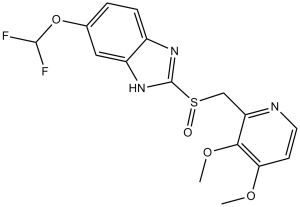
Pantoprazole (BY1023)

别名:
目录号: V1637 纯度: ≥98%
泮托拉唑(BY1023;SKF96022;BY-1023;SKF-96022;Protonix)是一种批准的抗溃疡药物,是一种质子泵抑制剂(PPI),用于短期治疗 GERD(胃食管反流病)引起的食管糜烂和溃疡。反流病)。
Pantoprazole (BY1023) CAS号: 102625-70-7
产品类别: Proton Pump
产品仅用于科学研究,不针对患者销售
规格 价格 库存 数量
50mg
100mg
250mg
500mg
1g
2g
Other Sizes

Other Forms of Pantoprazole (BY1023):

  • S-Pantoprazole sodium trihydrate
  • 泮托拉唑钠
  • 泮托拉唑钠水合物
  • (R)-(+)-Pantoprazole-d6
  • (S)-Pantoprazole-d6
  • [ 2H6 ] - 泮托拉唑标准品
  • Pantoprazole-d3
点击了解更多
InvivoChem产品被CNS等顶刊论文引用
纯度/质量控制文件

纯度: ≥98%

产品描述
泮托拉唑(BY1023;SKF96022;BY-1023;SKF-96022;Protonix)是一种批准的抗溃疡药物,是一种质子泵抑制剂(PPI),用于短期治疗胃食管反流病引起的食管糜烂和溃疡(胃食管反流病)。泮托拉唑通过抑制胃粘膜壁细胞中H+/K+-ATP酶质子泵的活性发挥作用。这种抑制影响酸分泌,因此,泮托拉唑被用作治疗各种酸相关疾病的药物。泮托拉唑缓慢激活。泮托拉唑的活化磺酰胺与泵的Cys813和Cys822结合并选择性地抑制酸分泌。
生物活性&实验参考方法
靶点
Proton pump; H+/K+-ATPase
Pantoprazole (BY1023) specifically targets gastric parietal cell H+/K+-ATPase, with an IC50 of 2.3 μM for inhibiting H+/K+-ATPase activity [3]
体外研究 (In Vitro)
在 EMT-6 和 MCF7 细胞中,泮托拉唑(BY1023;1–10,000 μM)会导致内体 pH 值呈浓度依赖性升高[1]。 BY10232,泮托拉唑,可以阻止外泌体的释放。泮托拉唑 (BY10232) 通过阻断 V-H+-ATP 酶活性来降低肿瘤细胞(黑色素瘤、腺癌和淋巴瘤细胞系)酸化细胞外介质的能力 [2]。
在猪胃微粒体 H+/K+-ATP 酶制剂中,Pantoprazole(0.5-20 μM)剂量依赖性抑制酶活性:2.3 μM 时实现 50% 抑制,10 μM 时在 37°C 孵育 60 分钟抑制 88% 活性;它比奥美拉唑和兰索拉唑具有更高的 pH 稳定性,在 pH 5.0-7.0 时保留 90% 抑制活性(奥美拉唑和兰索拉唑分别为 65% 和 72%)[3]
- 在人胃腺原代培养物中,Pantoprazole(1-10 μM)抑制胃酸分泌:5 μM 时 24 小时 H+ 释放减少 75%,作用持续时间(≥12 小时)长于奥美拉唑(8 小时)[4]
- 在人乳腺癌 MCF-7 和肺癌 A549 细胞中,Pantoprazole(20 μM)增强多柔比星诱导的细胞毒性:与 1 μM 多柔比星联用时,72 小时细胞活力降低 68%(多柔比星单药组为 32%);通过改变溶酶体 pH(溶酶体 pH 从 4.5 升至 6.2),使细胞内多柔比星蓄积增加 2.1 倍 [1]
- 50 μM Pantoprazole 抑制多种癌细胞系的外泌体释放达 53%,可能通过破坏内体分选转运复合体(ESCRT)功能实现 [2]
- 在体外十二指肠上皮细胞模型中,5 μM Pantoprazole 使前列腺素 E2(PGE2)降解减少 40%,48 小时上皮细胞增殖增加 35%,有助于溃疡愈合 [4]
体内研究 (In Vivo)
当与阿霉素联合使用时,泮托拉唑(BY1023;200 mg/kg;IP;每周一次,持续三周)可显着延长 MCF-7 异种移植物的肿瘤发育延迟[1]。在幽门结扎的大鼠中,泮托拉唑(0.3-3 mg/kg,口服)剂量依赖性地减少基础酸分泌,而在急性瘘管大鼠中,美吡唑刺激的酸分泌减少[4]。
在裸鼠 MCF-7 乳腺癌异种移植模型中,口服 Pantoprazole(40 mg/kg/天)联合静脉注射多柔比星(2 mg/kg/周,连续 4 周)的肿瘤生长抑制率(TGI)达 76%,而多柔比星单药组为 45%;肿瘤组织中多柔比星浓度增加 2.3 倍,凋亡细胞(TUNEL 阳性)增加 62% [1]
- 在吲哚美辛诱导十二指肠溃疡的 SD 大鼠中,口服 Pantoprazole(10-40 mg/kg/天,连续 14 天)剂量依赖性促进溃疡愈合:40 mg/kg 组溃疡面积减少 85%(奥美拉唑 40 mg/kg 组为 68%,兰索拉唑 40 mg/kg 组为 72%);给药 24 小时后胃酸分泌抑制 82% [4]
- 接受 Pantoprazole(40 mg/kg/天)处理的大鼠,十二指肠黏膜血流量增加 38%,黏膜屏障功能增强(黏蛋白含量增加 42%)[4]
酶活实验
在不同的体外试验系统中比较了H+/K(+)-ATP酶抑制剂泮托拉唑和奥美拉唑的作用。在导致胃膜囊泡内部酸化的条件下,泮托拉唑和奥美拉唑抑制H+/K(+)-ATP酶活性,IC50值分别为6.8和2.4微M。当通过加入咪唑(5 mM)(一种可渗透膜的弱碱)来减少脊髓内酸化时,奥美拉唑的抑制作用部分丧失(IC50 30 microM),泮托拉唑的抑制效果几乎完全丧失。在用泵膜囊泡孵育40分钟后,泮托拉唑和奥美拉唑浓度分别为1.1和0.6微M时,膀胱内H+浓度出现了最大的一半降低。同样,当通过加入咪唑(2.5 mM)降低了血管内H+浓度时,泮托拉唑(20和60微M)没有降低剩余的血管内质子浓度,而奥美拉唑(10和30微M)却降低了。这两种药物在pH 3.0时以相似的效力抑制木瓜蛋白酶活性,并以相似的时间依赖方式灭活酶;在pH 5.0时,奥美拉唑(IC50 17微M)比泮托拉唑(IC50 37微M)更有效,酶抑制速度比泮美拉唑快。这些结果表明,泮托拉唑在高酸性条件下是H+/K(+)-ATP酶的强效抑制剂,在pH 5.0等微酸性pH值下比奥美拉唑更稳定[3]。
H+/K+-ATP 酶活性抑制实验:富集 H+/K+-ATP 酶的猪胃微粒体与系列浓度的 Pantoprazole(0.5-20 μM)、ATP(2 mM)在反应缓冲液中 37°C 孵育 60 分钟。比色法检测释放的无机磷酸盐,从酶活性抑制的剂量 - 反应曲线计算 IC50 值 [3]
- pH 稳定性实验:将 Pantoprazole、奥美拉唑和兰索拉唑(各 10 μM)在 pH 3.0-7.0 的缓冲液中 37°C 孵育 2 小时。检测对 H+/K+-ATP 酶的残余抑制活性,根据活性保留率比较相对稳定性 [3]
细胞实验
用泮托拉唑处理小鼠EMT-6和人MCF-7细胞,使用荧光光谱评估内体pH值的变化,并使用流式细胞术评估阿霉素的摄取。在多层细胞培养(MCC)中评估了泮托拉唑对阿霉素组织穿透的影响。泮托拉唑(>200μmol/L)增加了细胞内的内体pH值,也增加了阿霉素的核摄取。泮托拉唑预处理增加了阿霉素在MCC中的组织渗透[1]。
胃酸分泌抑制实验:原代培养的猪胃腺接种于胶原包被板,加入 Pantoprazole(1-10 μM),通过 pH 敏感荧光探针监测培养基 pH 变化,计算相对于溶媒对照组的抑制率 [3][4]
- 细胞毒性协同实验:MCF-7/A549 细胞接种于 96 孔板(3×10³ 个细胞 / 孔),用 Pantoprazole(5-40 μM)单药或与多柔比星(1 μM)联用处理 72 小时。MTT 法评估细胞活力,Chou-Talalay 法计算协同指数 [1]
- 细胞内多柔比星蓄积实验:MCF-7 细胞用 20 μM Pantoprazole 处理 24 小时后,与 1 μM 多柔比星孵育 4 小时。流式细胞术检测细胞内多柔比星荧光强度,计算相对于多柔比星单药的蓄积倍数 [1]
- 外泌体释放抑制实验:癌细胞接种于 6 孔板,用 50 μM Pantoprazole 处理 24 小时。收集培养上清,差速超速离心分离外泌体,纳米颗粒追踪分析定量外泌体浓度,对比溶媒组计算抑制率 [2]
- 上皮增殖实验:十二指肠上皮细胞接种于 24 孔板,用 Pantoprazole(1-10 μM)处理 48 小时。BrdU 掺入法检测细胞增殖,ELISA 定量 PGE2 含量 [4]
动物实验
Animal/Disease Models: Mice bearing MCF-7 or A431 xenografts[1]
Doses: 200 mg/kg
Route of Administration: IP; once a week for 3 weeks; alone or 2 hrs (hours) before Doxorubicin (6 mg/kg iv)
Experimental Results: demonstrated even greater growth delay of MCF-7 xenografts with Doxorubicin compared with the single-dose combination. Dramatically increased tumor growth delay with a single dose with Doxorubicin. There is no effect on growth delay alone.
Breast cancer xenograft combination therapy model: Female nude mice (6-8 weeks old) were subcutaneously implanted with 5×10⁶ MCF-7 cells. When tumors reached 100-150 mm3, mice were randomized (n=8/group) and treated with: (1) vehicle (DMSO + saline) oral + doxorubicin 2 mg/kg i.v. weekly; (2) Pantoprazole 40 mg/kg/day oral + doxorubicin 2 mg/kg i.v. weekly. Treatment lasted 4 weeks, with tumor volume measured every 3 days. Tumor tissues were collected for doxorubicin concentration detection and TUNEL staining [1]
- Duodenal ulcer healing rat model: Sprague-Dawley rats (200-250 g) were induced with indomethacin (40 mg/kg i.p.) to form duodenal ulcers. Rats were randomized (n=10/group) and treated with: (1) vehicle (0.5% CMC-Na) oral; (2) Pantoprazole 10/20/40 mg/kg/day oral; (3) omeprazole 40 mg/kg/day oral; (4) lansoprazole 40 mg/kg/day oral. Treatment lasted 14 days, with ulcer area measured by planimetry. Gastric acid secretion was assessed by pyloric ligation [4]
- Pantoprazole was dissolved in 0.5% carboxymethylcellulose sodium (CMC-Na) for oral administration in animals [1][4]
药代性质 (ADME/PK)
Absorption, Distribution and Excretion
Pantoprazole is absorbed after oral administration as an enteric-coated tablet with maximum plasma concentrations attained within 2 – 3 hours and a bioavailability of 77% that does not change with multiple dosing. Following an oral dose of 40mg, the Cmax is approximately 2.5 μg/mL with a tmax of 2 to 3 hours. The AUC is approximately 5 μg.h/mL. There is no food effect on AUC (bioavailability) and Cmax. Delayed-release tablets are prepared as enteric-coated tablets so that absorption of pantoprazole begins only after the tablet leaves the stomach.
After a single oral or intravenous (IV) dose of 14C-labeled pantoprazole to healthy, normal metabolizing subjects, about 71% of the dose was excreted in the urine, with 18% excreted in the feces by biliary excretion. There was no kidney excretion of unchanged pantoprazole.
The apparent volume of distribution of pantoprazole is approximately 11.0-23.6 L, distributing mainly in the extracellular fluid.
Adults: With intravenous administration of pantoprazole to extensive metabolizers, total clearance is 7.6-14.0 L/h. In a population pharmacokinetic analysis, the total clearance increased with increasing body weight in a non-linear fashion. Children: clearance values in the children 1 to 5 years old with endoscopically proven GERD had a median value of 2.4 L/h.
Time to peak concentration: Following an oral dose of 40 mg in extensive metabolizers with normal hepatic function: 2.4 hours. When pantoprazole is taken with food, the time to peak concentration is variable and may be significantly increased. /Pantoprazole sodium/
Peak serum concentration: Following an oral dose of 40 mg in extensive metabolizers with normal hepatic function: 2.4 ug/mL. Following an intravenous dose of 40 mg administered over 15 minutes to extensive metabolizers with normal hepatic function: 5.51 ug/mL. /Pantoprazole sodium/
Elimination: Renal: 71%. Fecal: 18% (biliary excretion). Dialysis removes insignificant amounts of pantoprazole. /Pantoprazole sodium/
Rapidly absorbed. However, absorption maybe delayed up to 2 hours or more if pantoprazole is taken with food. Bioavailability (oral): 77%. /Pantoprazole sodium/
For more Absorption, Distribution and Excretion (Complete) data for PANTOPRAZOLE (6 total), please visit the HSDB record page.
Metabolism / Metabolites
Pantoprazole is heavily metabolized in the liver by the cytochrome P450 (CYP) system. Pantoprazole metabolism is independent of the route of administration (intravenous or oral). The main metabolic pathway is _demethylation_, by _CYP2C19_ hepatic cytochrome enzyme, followed by sulfation; other metabolic pathways include oxidation by CYP3A4. There is no evidence that any of the pantoprazole metabolites are pharmacologically active. After hepatic metabolism, almost 80% of an oral or intravenous dose is excreted as metabolites in urine; the remainder is found in feces and originates from biliary secretion.
Pantoprazole is extensively metabolized in the liver through the cytochrome P450 (CYP) system. Pantoprazole metabolism is independant of route of administration (intravenous or oral). The main metabolic pathway is demethylation,by CYP2C19, with subsequent sulfation; other metabolic pathways include oxidation by CYP3A4. ... CYP2C19 displays a known genetic polymorphism due to its deficiency in some sub-populations (eg 3% of Caucasians and African-Americans and 17 to 23% of Asians). /Pantoprazole sodium/
Biological Half-Life
About 1 hour
Elimination: Following oral or intravenous administration: 1 hour. The half-life of pantoprazole is prolonged (7 to 9 hours) in patients with cirrhosis of the liver and in genetically determined slow metabolizers (3.5 to 10 hours). /Pantoprazole sodium/
Human oral bioavailability of Pantoprazole is approximately 77%, with a peak plasma concentration (Cmax) of 2.8 μM achieved 2 hours after 40 mg oral administration [1]
- Pantoprazole is metabolized by hepatic cytochrome P450 enzymes (CYP2C19, CYP3A4), with a terminal half-life (t1/2) of 1.9 hours in humans [1]
- Human plasma protein binding rate of Pantoprazole is 98% at therapeutic concentrations [1]
毒性/毒理 (Toxicokinetics/TK)
Hepatotoxicity
Despite its wide use, pantoprazole has only rarely been associated with hepatic injury. In large scale, long term trials of pantoprazole, serum ALT elevations have occurred in less than 1% of patients and at rates similar to those that occur with placebo or comparator drugs. Only a small number of cases of clinically apparent liver disease attributed to pantoprazole have been published, but the clinical pattern of injury has resembled acute hepatic necrosis which has been described with other proton pump inhibitors. Clinically apparent liver injury due to proton pump inhibitors generally arises within the first 4 weeks of therapy and is characterized by an acute hepatocellular pattern of injury with rapid recovery upon withdrawal. Rash, fever and eosinophilia are rare, as is autoantibody formation. In large case series of drug induced liver injury, pantoprazole has accounted for few instances of symptomatic acute liver injury.
Likelihood score: C (probable rare cause of clinically apparent liver injury).
Effects During Pregnancy and Lactation
◉ Summary of Use during Lactation
Maternal pantoprazole doses of 40 mg daily produce low levels in milk and would not be expected to cause any adverse effects in breastfed infants.
◉ Effects in Breastfed Infants
Relevant published information was not found as of the revision date.
◉ Effects on Lactation and Breastmilk
A retrospective claims database study in the United States found that users of proton pump inhibitors had an increased risk of gynecomastia.
A review article reported that a search of database from the European Pharmacovigilance Centre found 48 cases of gynecomastia, 3 cases of galactorrhea, 14 cases of breast pain and 4 cases of breast enlargement associated with pantoprazole. A search of the WHO global pharmacovigilance database found 97 cases of gynecomastia, 13 cases of galactorrhea, 35 cases of breast pain and 16 cases of breast enlargement associated with pantoprazole.
Protein Binding
Approximately 98%
In vitro, Pantoprazole (1-50 μM) showed low cytotoxicity to normal human gastric epithelial cells (GES-1) and foreskin fibroblasts (NHF), with cell viability >85% at 50 μM after 72 hours [1][4]
- In rats treated with Pantoprazole (40 mg/kg/day for 14 days), no body weight loss (<3%) or histopathological abnormalities were detected in liver, kidney, heart, or gastrointestinal tract; hematological parameters and liver/kidney function indices remained within normal ranges [4]
- In nude mice treated with Pantoprazole (40 mg/kg/day + doxorubicin) for 4 weeks, no enhanced toxicity (e.g., myelosuppression, gastrointestinal toxicity) was observed compared to doxorubicin alone [1]
参考文献

[1]. Use of the proton pump inhibitor pantoprazole to modify the distribution and activity of doxorubicin: a potential strategy to improve the therapy of solid tumors. Clin Cancer Res. 2013 Dec 15;19(24):6766-76.

[2]. Advances in the discovery of exosome inhibitors in cancer. J Enzyme Inhib Med Chem. 2020 Dec;35(1):1322-1330.

[3]. Pantoprazole: a novel H+/K(+)-ATPase inhibitor with an improved pH stability. Eur J Pharmacol. 1992 Aug 6;218(2-3):265-71.

[4]. Effects of pantoprazole, a novel H+/K+-ATPase inhibitor, on duodenal ulcerogenic and healing responses in rats: a comparative study with omeprazole and lansoprazole. J Gastroenterol Hepatol. 1999 Mar;14(3):251-7.

其他信息
Pantoprazole is a member of the class of benzimidazoles that is 1H-benzimidazole substituted by a difluoromethoxy group at position 5 and a [(3,4-dimethoxypyridin-2-yl)methyl]sulfinyl group at position 2. It has a role as an anti-ulcer drug, an EC 3.6.3.10 (H(+)/K(+)-exchanging ATPase) inhibitor, a xenobiotic and an environmental contaminant. It is a member of benzimidazoles, a member of pyridines, an aromatic ether, an organofluorine compound and a sulfoxide. It is a conjugate acid of a pantoprazole(1-).
Pantoprazole is a first-generation proton pump inhibitor (PPI) used for the management of gastroesophageal reflux disease (GERD), for gastric protection to prevent recurrence of stomach ulcers or gastric damage from chronic use of NSAIDs, and for the treatment of pathological hypersecretory conditions including Zollinger-Ellison (ZE) Syndrome. It can also be found in quadruple regimens for the treatment of H. pylori infections along with other antibiotics including [amoxicillin], [clarithromycin], and [metronidazole], for example. Its efficacy is considered similar to other medications within the PPI class including [omeprazole], [esomeprazole], [lansoprazole], [dexlansoprazole], and [rabeprazole]. Pantoprazole exerts its stomach acid-suppressing effects by preventing the final step in gastric acid production by covalently binding to sulfhydryl groups of cysteines found on the (H+, K+)-ATPase enzyme at the secretory surface of gastric parietal cell. This effect leads to inhibition of both basal and stimulated gastric acid secretion, irrespective of the stimulus. As the binding of pantoprazole to the (H+, K+)-ATPase enzyme is irreversible and new enzyme needs to be expressed in order to resume acid secretion, pantoprazole's duration of antisecretory effect persists longer than 24 hours. Due to their good safety profile and as several PPIs are available over the counter without a prescription, their current use in North America is widespread. Long term use of PPIs such as pantoprazole have been associated with possible adverse effects, however, including increased susceptibility to bacterial infections (including gastrointestinal C. difficile), reduced absorption of micronutrients including iron and B12, and an increased risk of developing hypomagnesemia and hypocalcemia which may contribute to osteoporosis and bone fractures later in life. PPIs such as pantoprazole have also been shown to inhibit the activity of dimethylarginine dimethylaminohydrolase (DDAH), an enzyme necessary for cardiovascular health. DDAH inhibition causes a consequent accumulation of the nitric oxide synthase inhibitor asymmetric dimethylarginie (ADMA), which is thought to cause the association of PPIs with increased risk of cardiovascular events in patients with unstable coronary syndromes. Pantoprazole doses should be slowly lowered, or tapered, before discontinuing as rapid discontinuation of PPIs such as pantoprazole may cause a rebound effect and a short term increase in hypersecretion.
Pantoprazole is a Proton Pump Inhibitor. The mechanism of action of pantoprazole is as a Proton Pump Inhibitor.
Pantoprazole is a proton pump inhibitor (PPI) and a potent inhibitor of gastric acidity which is widely used in the therapy of gastroesophageal reflux and peptic ulcer disease. Pantoprazole therapy is associated with a low rate of transient and asymptomatic serum aminotransferase elevations and is a rare cause of clinically apparent liver injury.
Pantoprazole is a substituted benzimidazole and proton pump inhibitor with antacid activity. Pantoprazole is a lipophilic weak base that crosses the parietal cell membrane and enters the acidic parietal cell canaliculus where it becomes protonated, producing the active metabolite sulphenamide, which forms an irreversible covalent bond with two sites of the H+/K+-ATPase enzyme located on the gastric parietal cell, thereby inhibiting both basal and stimulated gastric acid production.
2-pyridinylmethylsulfinylbenzimidazole proton pump inhibitor that is used in the treatment of GASTROESOPHAGEAL REFLUX and PEPTIC ULCER.
See also: Pantoprazole Sodium (has salt form).
Drug Indication
Pantoprazole Injection: Treatment of gastroesophageal reflux disease associated with a history of erosive esophagitis Pantoprazole for injection is indicated for short-term treatment (7-10 days) of patients having gastroesophageal reflux disease (GERD) with a history of erosive esophagitis, as an alternative to oral medication in patients who are unable to continue taking pantoprazole delayed-release tablets. _Safety and efficacy of pantoprazole injection as the initial treatment of patients having GERD with a history of erosive esophagitis have not been demonstrated at this time_. Pathological Hypersecretion Associated with Zollinger-Ellison Syndrome Pantoprazole for injection is indicated for the treatment of pathological hypersecretory conditions associated with Zollinger-Ellison Syndrome or other neoplastic conditions. Pantoprazole delayed-release oral suspension: Short-Term Treatment of erosive esophagitis associated with gastroesophageal reflux disease (GERD) Indicated in adults and pediatric patients five years of age and above for the short-term treatment (up to 8 weeks) in the healing and symptomatic relief of erosive esophagitis. For adult patients who have not healed after 8 weeks of treatment, an additional 8-week course of pantoprazole may be considered. Safety of treatment beyond 8 weeks in pediatric patients has not been determined. Maintenance of healing of erosive esophagitis Indicated for maintenance of healing of erosive esophagitis and reduction in relapse rates of daytime and nighttime heartburn symptoms in adult patients with GERD. Pathological hypersecretory conditions including Zollinger-Ellison syndrome Indicated for the long-term treatment of the above conditions.
FDA Label
Short-term treatment of reflux symptoms (e. g. heartburn, acid regurgitation) in adults.
Treatment of Helicobacter spp. infections
Mechanism of Action
Hydrochloric acid (HCl) secretion into the gastric lumen is a process regulated mainly by the H(+)/K(+)-ATPase of the proton pump, expressed in high quantities by the parietal cells of the stomach. ATPase is an enzyme on the parietal cell membrane that facilitates hydrogen and potassium exchange through the cell, which normally results in the extrusion of potassium and formation of HCl (gastric acid). Proton pump inhibitors such as pantoprazole are substituted _benzimidazole_ derivatives, weak bases, which accumulate in the acidic space of the parietal cell before being converted in the _canaliculi_ (small canal) of the gastric parietal cell, an acidic environment, to active _sulfenamide_ derivatives. This active form then makes disulfide bonds with important cysteines on the gastric acid pump, inhibiting its function. Specifically, pantoprazole binds to the _sulfhydryl group_ of H+, K+-ATPase, which is an enzyme implicated in accelerating the final step in the acid secretion pathway. The enzyme is inactivated, inhibiting gastric acid secretion. The inhibition of gastric acid secretion is stronger with proton pump inhibitors such as pantoprazole and lasts longer than with the H(2) antagonists.
Pantoprazole is a proton pump inhibitor. It accumulates in the acidic compartment of parietal cells and is converted to the active form, a sulfanilamide, which binds to hydrogen-potassium-ATP-ase at the secretory surface of gastric parietal cells. Inhibition of hydrogen-potassium-ATPase blocks the final step of gastric acid production, leading to inhibition of both basal and stimulated acid secretion. The duration of inhibition of acid secretion does not correlate with the much shorter elimination half-life of pantoprazole. /Pantoprazole sodium/
Pantoprazole is a proton pump inhibitor (PPI) with improved pH stability compared to first/second-generation PPIs (omeprazole, lansoprazole) [3][4]
Its core mechanism is irreversible binding to gastric parietal cell H+/K+-ATPase, blocking H+ secretion and suppressing gastric acid production, which underpins its clinical use for acid-related diseases (duodenal ulcer, gastric ulcer, GERD, Helicobacter pylori infection) [3][4]
Additional activities include: enhancing the antitumor efficacy of doxorubicin by increasing its intracellular accumulation (via lysosomal pH modulation); inhibiting cancer cell exosome release; and promoting duodenal ulcer healing via reducing acid secretion, protecting PGE2, and enhancing epithelial proliferation [1][2][4]
It exhibits favorable safety profiles with low toxicity to normal cells and no significant drug-drug interactions with doxorubicin [1][4]
*注: 文献方法仅供参考, InvivoChem并未独立验证这些方法的准确性
化学信息 & 存储运输条件
分子式
C16H15F2N3O4S
分子量
383.37
精确质量
383.075
元素分析
C, 50.13; H, 3.94; F, 9.91; N, 10.96; O, 16.69; S, 8.36
CAS号
102625-70-7
相关CAS号
Pantoprazole sodium;138786-67-1;Pantoprazole sodium hydrate;164579-32-2;S-Pantoprazole sodium trihydrate;1416988-58-3;Pantoprazole-d6;922727-65-9;Pantoprazole-d3;922727-37-5
PubChem CID
4679
外观&性状
Off-white solid
密度
1.5±0.1 g/cm3
沸点
586.9±60.0 °C at 760 mmHg
熔点
139-140ºC, decomposes
闪点
308.7±32.9 °C
蒸汽压
0.0±1.6 mmHg at 25°C
折射率
1.643
LogP
1.69
tPSA
105.54
氢键供体(HBD)数目
1
氢键受体(HBA)数目
9
可旋转键数目(RBC)
7
重原子数目
26
分子复杂度/Complexity
490
定义原子立体中心数目
0
SMILES
O=S(C1=NC2=CC=C(OC(F)F)C=C2N1)CC3=NC=CC(OC)=C3OC
InChi Key
IQPSEEYGBUAQFF-UHFFFAOYSA-N
InChi Code
InChI=1S/C16H15F2N3O4S/c1-23-13-5-6-19-12(14(13)24-2)8-26(22)16-20-10-4-3-9(25-15(17)18)7-11(10)21-16/h3-7,15H,8H2,1-2H3,(H,20,21)
化学名
1H-Benzimidazole, 5-(difluoromethoxy)-2-(((3,4-dimethoxy-2-pyridinyl)methyl)sulfinyl)-
别名

BY1023; SKF96022;Protonix; BY 1023; SKF 96022;BY-1023; Pantozol; Protonix; Pantoprazolum; Pantoprazol; Pantoloc; BY-1023;SKF-96022

HS Tariff Code
2934.99.9001
存储方式

Powder      -20°C    3 years

                     4°C     2 years

In solvent   -80°C    6 months

                  -20°C    1 month

运输条件
Room temperature (This product is stable at ambient temperature for a few days during ordinary shipping and time spent in Customs)
溶解度数据
溶解度 (体外实验)
DMSO: 76 mg/mL (198.2 mM)
Water:<1 mg/mL
Ethanol:76 mg/mL (198.2 mM)
溶解度 (体内实验)
配方 1 中的溶解度: ≥ 2.5 mg/mL (6.52 mM) (饱和度未知) in 10% DMSO + 40% PEG300 + 5% Tween80 + 45% Saline (这些助溶剂从左到右依次添加,逐一添加), 澄清溶液。
例如,若需制备1 mL的工作液,可将100 μL 25.0 mg/mL澄清DMSO储备液加入到400 μL PEG300中,混匀;然后向上述溶液中加入50 μL Tween-80,混匀;加入450 μL生理盐水定容至1 mL。
*生理盐水的制备:将 0.9 g 氯化钠溶解在 100 mL ddH₂O中,得到澄清溶液。

配方 2 中的溶解度: ≥ 2.5 mg/mL (6.52 mM) (饱和度未知) in 10% DMSO + 90% (20% SBE-β-CD in Saline) (这些助溶剂从左到右依次添加,逐一添加), 澄清溶液。
例如,若需制备1 mL的工作液,可将 100 μL 25.0 mg/mL澄清DMSO储备液加入900 μL 20% SBE-β-CD生理盐水溶液中,混匀。
*20% SBE-β-CD 生理盐水溶液的制备(4°C,1 周):将 2 g SBE-β-CD 溶解于 10 mL 生理盐水中,得到澄清溶液。

View More

配方 3 中的溶解度: ≥ 2.5 mg/mL (6.52 mM) (饱和度未知) in 10% DMSO + 90% Corn Oil (这些助溶剂从左到右依次添加,逐一添加), 澄清溶液。
例如,若需制备1 mL的工作液,可将 100 μL 25.0 mg/mL 澄清 DMSO 储备液加入到 900 μL 玉米油中并混合均匀。


请根据您的实验动物和给药方式选择适当的溶解配方/方案:
1、请先配制澄清的储备液(如:用DMSO配置50 或 100 mg/mL母液(储备液));
2、取适量母液,按从左到右的顺序依次添加助溶剂,澄清后再加入下一助溶剂。以 下列配方为例说明 (注意此配方只用于说明,并不一定代表此产品 的实际溶解配方):
10% DMSO → 40% PEG300 → 5% Tween-80 → 45% ddH2O (或 saline);
假设最终工作液的体积为 1 mL, 浓度为5 mg/mL: 取 100 μL 50 mg/mL 的澄清 DMSO 储备液加到 400 μL PEG300 中,混合均匀/澄清;向上述体系中加入50 μL Tween-80,混合均匀/澄清;然后继续加入450 μL ddH2O (或 saline)定容至 1 mL;

3、溶剂前显示的百分比是指该溶剂在最终溶液/工作液中的体积所占比例;
4、 如产品在配制过程中出现沉淀/析出,可通过加热(≤50℃)或超声的方式助溶;
5、为保证最佳实验结果,工作液请现配现用!
6、如不确定怎么将母液配置成体内动物实验的工作液,请查看说明书或联系我们;
7、 以上所有助溶剂都可在 Invivochem.cn网站购买。
制备储备液 1 mg 5 mg 10 mg
1 mM 2.6084 mL 13.0422 mL 26.0845 mL
5 mM 0.5217 mL 2.6084 mL 5.2169 mL
10 mM 0.2608 mL 1.3042 mL 2.6084 mL

1、根据实验需要选择合适的溶剂配制储备液 (母液):对于大多数产品,InvivoChem推荐用DMSO配置母液 (比如:5、10、20mM或者10、20、50 mg/mL浓度),个别水溶性高的产品可直接溶于水。产品在DMSO 、水或其他溶剂中的具体溶解度详见上”溶解度 (体外)”部分;

2、如果您找不到您想要的溶解度信息,或者很难将产品溶解在溶液中,请联系我们;

3、建议使用下列计算器进行相关计算(摩尔浓度计算器、稀释计算器、分子量计算器、重组计算器等);

4、母液配好之后,将其分装到常规用量,并储存在-20°C或-80°C,尽量减少反复冻融循环。

计算器

摩尔浓度计算器可计算特定溶液所需的质量、体积/浓度,具体如下:

  • 计算制备已知体积和浓度的溶液所需的化合物的质量
  • 计算将已知质量的化合物溶解到所需浓度所需的溶液体积
  • 计算特定体积中已知质量的化合物产生的溶液的浓度
使用摩尔浓度计算器计算摩尔浓度的示例如下所示:
假如化合物的分子量为350.26 g/mol,在5mL DMSO中制备10mM储备液所需的化合物的质量是多少?
  • 在分子量(MW)框中输入350.26
  • 在“浓度”框中输入10,然后选择正确的单位(mM)
  • 在“体积”框中输入5,然后选择正确的单位(mL)
  • 单击“计算”按钮
  • 答案17.513 mg出现在“质量”框中。以类似的方式,您可以计算体积和浓度。

稀释计算器可计算如何稀释已知浓度的储备液。例如,可以输入C1、C2和V2来计算V1,具体如下:

制备25毫升25μM溶液需要多少体积的10 mM储备溶液?
使用方程式C1V1=C2V2,其中C1=10mM,C2=25μM,V2=25 ml,V1未知:
  • 在C1框中输入10,然后选择正确的单位(mM)
  • 在C2框中输入25,然后选择正确的单位(μM)
  • 在V2框中输入25,然后选择正确的单位(mL)
  • 单击“计算”按钮
  • 答案62.5μL(0.1 ml)出现在V1框中
g/mol

分子量计算器可计算化合物的分子量 (摩尔质量)和元素组成,具体如下:

注:化学分子式大小写敏感:C12H18N3O4  c12h18n3o4
计算化合物摩尔质量(分子量)的说明:
  • 要计算化合物的分子量 (摩尔质量),请输入化学/分子式,然后单击“计算”按钮。
分子质量、分子量、摩尔质量和摩尔量的定义:
  • 分子质量(或分子量)是一种物质的一个分子的质量,用统一的原子质量单位(u)表示。(1u等于碳-12中一个原子质量的1/12)
  • 摩尔质量(摩尔重量)是一摩尔物质的质量,以g/mol表示。
/

配液计算器可计算将特定质量的产品配成特定浓度所需的溶剂体积 (配液体积)

  • 输入试剂的质量、所需的配液浓度以及正确的单位
  • 单击“计算”按钮
  • 答案显示在体积框中
动物体内实验配方计算器(澄清溶液)
第一步:请输入基本实验信息(考虑到实验过程中的损耗,建议多配一只动物的药量)
第二步:请输入动物体内配方组成(配方适用于不溶/难溶于水的化合物),不同的产品和批次配方组成不同,如对配方有疑问,可先联系我们提供正确的体内实验配方。此外,请注意这只是一个配方计算器,而不是特定产品的确切配方。
+
+
+

计算结果:

工作液浓度 mg/mL;

DMSO母液配制方法 mg 药物溶于 μL DMSO溶液(母液浓度 mg/mL)。如该浓度超过该批次药物DMSO溶解度,请首先与我们联系。

体内配方配制方法μL DMSO母液,加入 μL PEG300,混匀澄清后加入μL Tween 80,混匀澄清后加入 μL ddH2O,混匀澄清。

(1) 请确保溶液澄清之后,再加入下一种溶剂 (助溶剂) 。可利用涡旋、超声或水浴加热等方法助溶;
            (2) 一定要按顺序加入溶剂 (助溶剂) 。

临床试验信息
Preoperative Use of Pantoprazole for Prevention of Post Operative Nausea and Vomiting in Gynecologic Surgery
CTID: NCT06488001
Phase: Phase 2
Status: Recruiting
Date: 2024-07-05
Role of Proton Pump Inhibitors on the Postoperative Course Following Pancreaticoduodenectomy
CTID: NCT05251233
Phase: Phase 2
Status: Terminated
Date: 2024-07-03
Neuro-immune Interactions and PPI
CTID: NCT04713969
Phase: Phase 4
Status: Recruiting
Date: 2024-06-28
Re-EValuating the Inhibition of Stress Erosions (REVISE) Trial
CTID: NCT03374800
Phase: Phase 3
Status: Completed
Date: 2024-04-17
Effect of Obesity on Proton Pump Inhibitors
CTID: NCT04248335
Phase: Phase 4
Status: Recruiting
Date: 2024-01-31
相关产品
联系我们