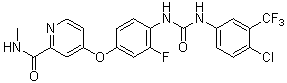
Regorafenib (BAY73-4506)

别名: BAY-734506; BAY734506; 755037-03-7; BAY 73-4506; Stivarga; 4-(4-(3-(4-Chloro-3-(trifluoromethyl)phenyl)ureido)-3-fluorophenoxy)-N-methylpicolinamide; Regorafenibum; Regorafenib (BAY 73-4506); BAY-73-4506; BAY 734506; Regorafenib. Brand name: Stivarga 瑞格菲尼;瑞格非尼;瑞戈非尼;4-[4-({[4-氯-3-(三氟甲基)苯基]氨基甲酰}氨基)-3-氟苯氧基]-N-甲基吡啶-2-甲酰胺; 4-[4-({[4-氯-3-(三氟甲基)苯基]氨甲酰基}氨基)-3-氟苯氧基]-N-甲基吡啶-2-甲酰胺;Regorafenib(BAY73-4506) ;科研实验瑞格非尼;瑞戈非尼-13C-D3;瑞格非尼靶向药;瑞格非尼标准品;瑞格非尼固体状;瑞格非尼无水物;瑞格非尼杂质;瑞格菲尼杂质; 瑞格菲尼无水物;瑞格菲尼及中间体;BAY 73-4506/ 瑞格非尼/ 4-[4-({[4-氯-3-(三氟甲基)苯基]氨基甲酰}氨基)-3-氟苯氧基]-N-甲基吡啶-2-甲酰胺;REGORAFENIB 瑞格非尼;4-{4-[({[4-氯-3-(三氟甲基)苯基]氨基 }羰基)氨基]苯氧基}-N-甲基吡啶-2-甲酰胺;4-[4-({[4-氯-3-(三氟甲基)苯基]氨基甲酰}氨
目录号: V0048 纯度: ≥98%
Regorafenib(也称为 BAY 73-4506;BAY-73-4506)是一种有效的口服生物可利用的 VEGFR1、VEGFR2、VEGFR3、PDGFRβ、Kit、RET 和 Raf-1 多激酶抑制剂,IC50 值为 13 nM/4.2 nM无细胞测定中分别为 /46 nM、22 nM、7 nM、1.5 nM 和 2.5 nM。
Regorafenib (BAY73-4506) CAS号: 755037-03-7
产品类别: c-RET
产品仅用于科学研究,不针对患者销售
规格 价格 库存 数量
10 mM * 1 mL in DMSO
1mg
5mg
25mg
50mg
100mg
250mg
500mg
1g
5g
Other Sizes

Other Forms of Regorafenib (BAY73-4506):

  • 瑞格非尼(水合物)
  • N-Desmethyl Regorafenib-d3
  • 瑞格非尼-d3
  • 瑞戈非尼盐酸盐
  • 瑞戈非尼甲磺酸盐
  • Regorafenib-13C,d3
点击了解更多
InvivoChem产品被CNS等顶刊论文引用
纯度/质量控制文件

纯度: ≥98%

产品描述
Regorafenib(也称为 BAY 73-4506;BAY-73-4506)是一种有效的口服生物可利用的 VEGFR1、VEGFR2、VEGFR3、PDGFRβ、Kit、RET 和 Raf-1 多激酶抑制剂,IC50 值为 13 nM无细胞测定中分别为 /4.2 nM/46 nM、22 nM、7 nM、1.5 nM 和 2.5 nM。它具有抗肿瘤特性,并已获得 FDA 批准用于治疗肝癌。
生物活性&实验参考方法
靶点
Raf-1 (IC50 = 2.5 nM); Tie2 (IC50 = 311 ± 46 nM); VEGFR2 (IC50 = 4.2 nM); VEGFR1 (IC50 = 13 nM); VEGFR2 (IC50 = 4.2 nM); BRafV600E (IC50 = 19 nM); PDGFRβ (IC50 = 22 nM); Braf (IC50 = 28 nM); VEGFR3 (IC50 = 46 nM)
体外研究 (In Vitro)
Regorafenib(0-10 μM,96 小时)在 GIST 882、甲状腺 TT、MDA-MB-231、HepG2、A375 和 SW620 细胞中表现出抗增殖活性[1]。
Regorafenib(BAY 73-4506)是一种新型口服多激酶抑制剂,在生化和细胞激酶磷酸化测定中能有效抑制这些内皮细胞激酶。此外,瑞格非尼还能抑制其他血管生成激酶(VEGFR1/3、血小板衍生生长因子受体β和成纤维细胞生长因子受体1)以及突变致癌激酶KIT、RET和B-RAF。
雷戈非尼以浓度和时间依赖的方式抑制人Hep3B、PLC/PRF/5和HepG2细胞的生长。多种信号通路发生了改变,包括MAP激酶磷酸化ERK和磷酸化JNK及其靶点磷酸化c-Jun。有证据表明FACS导致细胞凋亡、胱天蛋白酶切割和Bax水平升高;以及通过增加Beclin-1和LC3(II)水平来判断自噬的诱导。长时间接触药物会导致细胞静止。与阿霉素化疗不同,药物去除后生长完全恢复。雷戈非尼是一种强效的细胞生长抑制剂。在雷戈非尼治疗中存活的细胞仍然存活,但处于静止状态,在药物去除后能够再生。药物去除后肿瘤细胞生长抑制的可逆性可能具有临床意义。[3]
Regorafenib(0–3000 nM,30 分钟)抑制 FGFR 和 pERK1/2 以及 VEGFR2、TIE2 和 PDGFR-β 的自身磷酸化。 Regorafenib 的 IC50 为 5 μM,以浓度依赖性方式抑制 Hep3B 细胞生长。然后,瑞戈非尼会提高 Hep3B 细胞(JNK 靶标)中的磷酸化 c-Jun 水平,但不会提高总 c-Jun 水平[3]。
体内研究 (In Vivo)
Regorafenib(10 mg/kg,口服,每天一次或两次,持续 4 天)可抑制大鼠 GS9L 胶质母细胞瘤模型中的肿瘤生长和肿瘤血管系统[1]。 Regorafenib(0-100 mg/kg,口服,qd × 9)在 Colo-205、MDA-MB-231 和 786-O 模型中表现出抗肿瘤和抗血管生成作用[1]。
动态增强磁共振成像在体内证明了瑞格非尼的抗血管生成作用。雷戈非尼以10mg/kg的剂量口服一次,显著减少了Gadomer在大鼠GS9L胶质母细胞瘤异种移植物血管系统中的外渗。在每日(qd)×4次给药研究中,药效作用在最后一次给药后持续48小时,并与肿瘤生长抑制(TGI)相关。在10和30 mg/kg的qd×5给药后,在人类结直肠异种移植物中观察到肿瘤微血管面积的显著减少。雷戈非尼在小鼠的各种临床前人类异种移植物模型中表现出强烈的剂量依赖性TGI,在乳腺MDA-MB-231和肾786-O癌模型中观察到了肿瘤缩小。乳腺模型的药效学分析显示,增殖标志物Ki-67和磷酸化细胞外调节激酶1/2的染色显著减少。这些数据表明,瑞格非尼是一种耐受性良好、口服活性的多激酶抑制剂,具有独特的靶点特征,可能对人类恶性肿瘤具有治疗益处[1]。
酶活实验
使用重组 VEGFR2(鼠类 aa785-aa1367)、VEGFR3(鼠类 aa818-aa1363)、PDGFRβ(aa561-aa1106)、Raf-1(aa305-aa648)和 BRafV600E(aa409-aa765)激酶结构域进行体外测定。在恒定的 1 μM 瑞戈非尼浓度下,进行初始体外激酶抑制分析。选择响应激酶,例如 VEGFR1 和 RET,用于计算 50% 抑制浓度 (IC50) 值。使用谷胱甘肽-S-转移酶的重组融合蛋白、TIE2 的胞内结构域和肽生物素-Ahx-EPKDDAYPLYSDFG 作为底物,使用均相时间分辨荧光 (HTRF) 测定来测量 TIE2 激酶抑制。
细胞实验
对于增殖测试,GIST 882 和 TT 细胞在含有 L-谷氨酰胺的 RPMI 培养基中生长,而 MDA-MB-231、HepG2 和 A375 细胞在始终补充有 10% 高脂肪 b-酪蛋白硫酸盐的 DMEM 中生长。胰蛋白酶处理的细胞以每孔 5×10⁴ 个细胞接种于 96 孔板中,并使用含有 10% FBS 的完全培养基,并在 37 °C 下生长过夜。添加媒介物或瑞格非尼(在完全生长培养基中连续稀释至终浓度在 10 μM 至 5 nM 之间)和 0.2% DMSO,继续孵育 96 小时。您可以测量细胞增殖。[1]
通过酶联免疫吸附试验(ELISA)和蛋白质印迹分析VEGFR2磷酸化[1]
将转染有人VEGFR2的NIH-3T3细胞以30000个细胞/孔的速度接种在含有10%FBS的Dulbecco改良Eagle培养基的96孔板中;接种后6小时,将培养基换成0.1%BSA/DMEM,继续孵育24小时。细胞在37°C下用0.1%BSA/DMEM/0.1%二甲亚砜(DMSO)中的载体或不同浓度的雷戈非尼处理1小时,然后用终浓度为30 ng/mL的重组VEGF165刺激5分钟。细胞用冷磷酸盐缓冲盐水(PBS)洗涤,并在100μL裂解缓冲液(50 mM HEPES,pH 7.2,1%Triton X-100,1 mM Na3VO4,150 mM NaCl,10%甘油,1.5 mM乙二醇四乙酸和完全蛋白酶抑制剂混合物)中裂解。这是因为。
雷戈非尼治疗[3]
每株细胞系以0.3×10⁵个细胞/2ml含10%FBS的DMEM接种在35mm组织培养皿中。将细胞孵育24小时以允许附着,然后用含有浓度逐渐增加(1μM、2.5μM、5μM、7.5μM和10μM)的雷戈非尼的新鲜培养基替换培养基。在这些实验条件下,允许细胞生长72或96小时。 在Hep3B细胞上进行短期(15、60、180分钟)、中期(24、48、72和96小时)或长期(长达7天)的7.5μMRegorafenib时间过程实验。当细胞被长时间处理时,药物被替换为新鲜的。每个实验都包括一个对照组,其DMSO浓度(溶剂对照组)与用于添加雷戈非尼的浓度相等。每个实验进行三次,重复3次。在特定浓度和孵育时间下进行后续分析。
恢复/可逆性[3]
为了研究停药后细胞增殖的恢复,Hep3B细胞用雷戈非尼5或7.5μM处理3-7天,然后取出培养基,用不含药物的新鲜培养基替换。在不同的后续时间点通过MTT试验评估细胞恢复率。 以0.01、0.05或0.1μM的阿霉素治疗作为阳性对照,研究凋亡过程。
细胞凋亡的FACS分析[3]
按照供应商的规定,使用FITC膜联蛋白V试剂盒检测细胞凋亡。简而言之,收获用不同浓度的雷戈非尼处理48小时的1×10⁶个细胞,并用PBS洗涤。将细胞重新悬浮在结合缓冲液中,然后在5μl AnnexinV-FITC和10μl 7-氨基放线菌素D(7AAD)插入DNA后,在室温下在黑暗中孵育5分钟。将完整细胞与凋亡细胞区分开来。
动物实验
雌性无胸腺NCr nu/nu小鼠,接种Colo-205、MDA-MB-231或786-O细胞
\n3 mg/kg、10 mg/kg、30 mg/kg、100 mg/kg
\n口服
\n\n动态对比增强磁共振成像[1]
\n在DCE-MRI实验中,将3×10⁶个GS9L细胞肌内注射到Fischer 344大鼠的左大腿。当肿瘤体积达到300至700 mm³时开始治疗。使用配备专用动物接收线圈的西门子1.5T Avanto磁共振成像系统进行MRI扫描。瑞戈非尼以10 mg/kg体重的剂量口服给药,单次给药(每日一次)或每日四次给药。在治疗前以及末次瑞戈非尼给药后4、8、24、48小时和4天,使用对比剂Gadomer-17进行DCE-MRI检查。MRI检查前,动物使用1.5%异氟烷/O₂/N₂O混合气体进行麻醉。使用自动注射装置,以0.5 mL/s的速率经尾静脉静脉注射Gadomer-17,剂量为50 μmol Gd/kg体重。DCE-MRI数据采集采用二维快速饱和恢复脉冲序列,参数设置为:回波时间(TE):1.63 ms,重复时间(TR):350 ms,反转时间(TI):180 ms,翻转角(FL):10°,平均次数:4次,层厚5 mm,平面分辨率为0.8 × 0.8 mm²。单幅图像采集时间为1.4秒,约6分钟内共采集254幅图像。注射造影剂前,采集6幅图像作为基线。数据评估时,在采集的切片上定义一个覆盖整个肿瘤的感兴趣区域(ROI)。分析ROI内信号强度随时间的变化。将每只动物肿瘤内MRI信号强度随时间变化曲线下面积(IAUC360,注射Gadomer-17后最初360秒)以肌肉组织(作为未受影响的参考组织)进行标准化,并用于数据评估。在不同时间点测定肿瘤体积:分期时(给药前)、口服给药 qd×4 时(治疗后第 4 天)以及分期后第 6 天和第 8 天。采用 MRI 脉冲序列进行测定,参数设置为:3D 梯度回波序列,TE:9 ms,TR:16 ms,FL:40°,单次平均,60 层,层厚 0.7 mm,平面分辨率 0.35 × 0.35 mm²。通过逐层评估肿瘤面积计算体积。统计分析采用非配对双侧 Student's t 检验。\n
\n\n肿瘤异种移植模型中微血管面积、Ki-67 和 MAPK 的检测[1]
\n肿瘤体积约为 200 mg 的动物接受瑞戈非尼口服治疗,剂量分别为 10 mg/kg 和 30 mg/kg,qd×5 给药方案。随后,收集肿瘤组织,进行石蜡包埋,并采用免疫组织化学(IHC)进行分析。使用抗CD-31抗体(#M-20,1:750)检测肿瘤内皮细胞。使用抗pERK1/2抗体(#9101L,1:100)评估细胞信号传导抑制情况,并使用抗Ki-67抗体分析肿瘤细胞增殖情况,方法如前所述。\n
\n为了测定肿瘤的MVA值,在分析前对CD-31染色切片进行编码。使用10倍物镜(每个视野0.644 mm²)观察组织切片。每个切片随机选取四个视野进行分析,排除周围结缔组织和中心坏死组织。使用Image-Pro Plus 3.0版软件和SIS图像分析软件对CD-31阳性区域进行定量。数据以MVA(%)表示。采用 Kruskal-Wallis 检验进行单因素方差分析,并使用 Dunnett 法与载体组进行比较;p < 0.05 被认为具有统计学意义。\n
\n肿瘤异种移植实验[1]
\n按照联邦指南饲养的雌性无胸腺 NCr nu/nu 小鼠,皮下接种 5×10⁶ 个 Colo-205 或 MDA-MB-231 细胞,或植入 1 mm³ 786-O 肿瘤碎片。当肿瘤体积达到约 100 mm³ 时,分别以 100、30、10 和 3 mg/kg 的剂量,在 786-O 模型中每日一次 (qd×21) 口服瑞戈非尼或载体对照,在 Colo-205 和 MDA-MB-231 模型中每日一次 (qd×9) 口服。紫杉醇以10 mg/kg的剂量,溶于乙醇/Cremophor EL®/生理盐水(12.5%/12.5%/75%)中,每2天静脉注射一次,共5次。每周两次评估肿瘤大小(体积),计算公式为(l×w²)/2,肿瘤生长抑制率(TGI)由终末肿瘤重量计算得出(1-T/C×100)。从治疗第一天开始,每隔一天称量小鼠体重。每日监测小鼠的一般健康状况。
药代性质 (ADME/PK)
吸收、分布和排泄
Cmax = 2.5 μg/mL;Tmax = 4 小时;AUC = 70.4 μgh/mL;稳态 Cmax = 3.9 μg/mL;稳态 AUC = 58.3 μgh/mL;与口服溶液相比,片剂的平均相对生物利用度为 69% 至 83%。
服用 120 mg 放射性标记口服溶液后 12 天内,约 71% 的放射性标记剂量经粪便排出(47% 为母体化合物,24% 为代谢物),19% 的剂量经尿液排出(17% 为葡萄糖醛酸苷)。
瑞戈非尼经肠肝循环,在 24 小时给药间隔内观察到多个血浆浓度峰值。
代谢/代谢物
瑞戈非尼由 CYP3A4 和 UGT1A9 代谢。在人血浆中稳态测定的瑞戈非尼主要循环代谢物为M-2(N-氧化物)和M-5(N-氧化物和N-去甲基),二者均具有与瑞戈非尼相似的体外药理活性和稳态浓度。M-2和M-5的蛋白结合率很高(分别为99.8%和99.95%)。瑞戈非尼是P-糖蛋白抑制剂,而其活性代谢物M-2(N-氧化物)和M-5(N-氧化物和N-去甲基)是P-糖蛋白的底物。
生物半衰期
瑞戈非尼,口服160 mg = 28小时(14-58小时);M-2代谢物,口服160 mg = 25小时(14-32小时);M-5代谢物,口服160 mg = 51小时(32-72小时);
毒性/毒理 (Toxicokinetics/TK)
肝毒性
在瑞戈非尼的大型临床试验中,血清转氨酶水平升高较为常见,发生率达39%至45%,其中3%至6%的患者转氨酶水平超过正常值上限(ULN)的5倍以上。此外,已有数例瑞戈非尼治疗期间出现临床表现明显的肝损伤的报道,这些损伤通常较为严重,偶有致命性,估计发生率约为0.3%。因此,建议常规监测肝酶。瑞戈非尼引起的肝损伤可表现为多种不同的模式或表型。部分患者在开始服用瑞戈非尼后数日内出现急性肝坏死,血清转氨酶和乳酸脱氢酶水平升高,伴有轻度黄疸,但INR延长并出现肝功能衰竭的体征。这种损伤可能较为严重,但通常具有自限性,且恢复迅速且完全。其他患者表现为类似急性病毒性肝炎的临床模式,伴有肝细胞性(或混合性)血清酶升高和黄疸,黄疸可持续较长时间,且在一些病例中甚至导致死亡。自身免疫和免疫过敏反应并不常见。此外,罕见的瑞戈非尼相关肝损伤病例表现为类似肝窦阻塞综合征或假性肝硬化,伴有明显的肝脏结节和腹水,但最终可改善或消退。最后,瑞戈非尼与其他多激酶抑制剂(舒尼替尼、伊马替尼、索拉非尼)一样,也与高氨血症昏迷发作有关,通常在开始用药后的几天或几周内出现,停药后可迅速逆转。
可能性评分:B(极有可能引起临床上明显的肝损伤)。
妊娠和哺乳期影响
◉ 哺乳期用药概述
目前尚无瑞戈非尼在哺乳期临床应用的信息。由于瑞戈非尼与血浆蛋白的结合率高达99.5%,因此其在乳汁中的含量可能很低。然而,其一种代谢物的半衰期长达70小时,可能会在婴儿体内蓄积。制造商建议在瑞戈非尼治疗期间以及末次给药后 2 周内停止母乳喂养。
◉ 对母乳喂养婴儿的影响
截至修订日期,未找到相关的已发表信息。
◉ 对泌乳和母乳的影响
截至修订日期,未找到相关的已发表信息。
蛋白结合
瑞戈非尼与人血浆蛋白的结合率很高 (99.5%)。
参考文献

[1]. Int J Cancer . 2011 Jul 1;129(1):245-55.

[2]. Ther Adv Med Oncol . 2010 Jan;2(1):39-49.

[3]. J Cell Physiol . 2013 Feb;228(2):292-7.

其他信息
瑞戈非尼是一种吡啶甲酰胺类化合物,由4-[4-({[4-氯-3-(三氟甲基)苯基]氨基甲酰基}氨基)-3-氟苯氧基]吡啶-2-羧酸与甲胺缩合而成。用于治疗既往接受过化疗、抗EGFR或抗VEGF治疗的转移性结直肠癌患者。它具有抗肿瘤、酪氨酸激酶抑制和肝毒性等作用。它是一种芳香醚、吡啶甲酰胺、单氯苯类、(三氟甲基)苯类、单氟苯类和苯脲类化合物。
瑞戈非尼是一种口服的多激酶抑制剂,用于治疗转移性结直肠癌、晚期胃肠道间质瘤和肝细胞癌。瑞戈非尼于2012年9月27日获得FDA批准。2017年4月,瑞戈非尼的适应症扩展至治疗肝细胞癌。
无水瑞戈非尼是一种激酶抑制剂。其作用机制包括作为激酶抑制剂、细胞色素P450 2C9抑制剂、乳腺癌耐药蛋白抑制剂、UGT1A9抑制剂和UGT1A1抑制剂。
瑞戈非尼是一种口服多激酶抑制剂,用于治疗难治性转移性结直肠癌、肝细胞癌和胃肠道间质瘤。瑞戈非尼治疗期间常伴有血清转氨酶升高,并有罕见但有时严重甚至致命的临床表现明显的肝损伤病例。
无水瑞戈非尼是瑞戈非尼的无水形式,瑞戈非尼是一种口服生物利用度高的小分子药物,具有潜在的抗血管生成和抗肿瘤活性。瑞戈非尼可与血管内皮生长因子受体(VEGFR)2和3以及Ret、Kit、PDGFR和Raf激酶结合并抑制其活性,从而抑制肿瘤血管生成和肿瘤细胞增殖。VEGFR是受体酪氨酸激酶,在肿瘤血管生成中发挥重要作用;受体酪氨酸激酶RET、KIT和PDGFR以及丝氨酸/苏氨酸特异性Raf激酶参与肿瘤细胞信号传导。
瑞戈非尼是瑞戈非尼的水合物形式,是一种口服生物利用度高的小分子药物,具有潜在的抗血管生成和抗肿瘤活性。瑞戈非尼可与血管内皮生长因子受体(VEGFR)2和3以及Ret、Kit、PDGFR和Raf激酶结合并抑制其活性,从而抑制肿瘤血管生成和肿瘤细胞增殖。VEGFR是受体酪氨酸激酶,在肿瘤血管生成中发挥重要作用;受体酪氨酸激酶RET、KIT和PDGFR以及丝氨酸/苏氨酸特异性Raf激酶参与肿瘤细胞信号传导。
另见:瑞戈非尼一水合物(活性成分)。
药物适应症
瑞戈非尼适用于治疗既往接受过氟尿嘧啶、奥沙利铂和伊立替康类化疗、抗VEGF治疗以及(如果KRAS野生型)抗EGFR治疗的转移性结直肠癌(CRC)患者。瑞戈非尼也适用于治疗既往接受过甲磺酸伊马替尼和苹果酸舒尼替尼治疗的局部晚期、不可切除或转移性胃肠道间质瘤(GIST)患者。瑞戈非尼也适用于治疗既往接受过索拉非尼治疗的肝细胞癌 (HCC) 患者。
FDA 标签
Stivarga 适用于以下成年患者的单药治疗:既往接受过或不适合接受现有疗法(包括氟尿嘧啶类化疗、抗 VEGF 疗法和抗 EGFR 疗法)治疗的转移性结直肠癌 (CRC) 患者;既往接受过伊马替尼和舒尼替尼治疗后病情进展或不耐受的不可切除或转移性胃肠道间质瘤 (GIST) 患者;既往接受过索拉非尼治疗的肝细胞癌 (HCC) 患者。
治疗所有恶性肿瘤(造血和淋巴组织肿瘤除外)
作用机制
瑞戈非尼是一种小分子抑制剂,可抑制多种膜结合和细胞内激酶,这些激酶参与正常的细胞功能以及肿瘤发生、肿瘤血管生成和肿瘤微环境维持等病理过程。在体外生化或细胞实验中,瑞戈非尼及其主要的人源活性代谢物M-2和M-5在临床应用浓度下可抑制RET、VEGFR1、VEGFR2、VEGFR3、KIT、PDGFR-α、PDGFR-β、FGFR1、FGFR2、TIE2、DDR2、TrkA、Eph2A、RAF-1、BRAF、BRAFV600E、SAPK2、PTK5和Abl的活性。在体内模型中,瑞戈非尼在大鼠肿瘤模型中表现出抗血管生成活性,并在包括一些人类结直肠癌在内的多种小鼠异种移植模型中表现出抑制肿瘤生长和抗转移活性。
*注: 文献方法仅供参考, InvivoChem并未独立验证这些方法的准确性
化学信息 & 存储运输条件
分子式
C21H15CLF4N4O3
分子量
482.82
精确质量
482.076
元素分析
C, 52.24; H, 3.13; Cl, 7.34; F, 15.74; N, 11.60; O, 9.94
CAS号
755037-03-7
相关CAS号
Regorafenib monohydrate;1019206-88-2;Regorafenib-d3;1255386-16-3;Regorafenib Hydrochloride;835621-07-3;Regorafenib mesylate;835621-08-4;Regorafenib-13C,d3
PubChem CID
11167602
外观&性状
Off-white to light pink solid powder
密度
1.5±0.1 g/cm3
沸点
513.4±50.0 °C at 760 mmHg
熔点
206.0 to 210.0 °C
闪点
264.3±30.1 °C
蒸汽压
0.0±1.3 mmHg at 25°C
折射率
1.616
LogP
5.26
tPSA
92.35
氢键供体(HBD)数目
3
氢键受体(HBA)数目
8
可旋转键数目(RBC)
5
重原子数目
33
分子复杂度/Complexity
686
定义原子立体中心数目
0
SMILES
O=C(NC1=CC=C(C(C(F)(F)F)=C1)Cl)NC2=CC=C(OC3=CC(C(NC)=O)=NC=C3)C=C2F
InChi Key
FNHKPVJBJVTLMP-UHFFFAOYSA-N
InChi Code
InChI=1S/C21H15ClF4N4O3/c1-27-19(31)18-10-13(6-7-28-18)33-12-3-5-17(16(23)9-12)30-20(32)29-11-2-4-15(22)14(8-11)21(24,25)26/h2-10H,1H3,(H,27,31)(H2,29,30,32)
化学名
4-[4-[[4-chloro-3-(trifluoromethyl)phenyl]carbamoylamino]-3-fluorophenoxy]-N-methylpyridine-2-carboxamide
别名
BAY-734506; BAY734506; 755037-03-7; BAY 73-4506; Stivarga; 4-(4-(3-(4-Chloro-3-(trifluoromethyl)phenyl)ureido)-3-fluorophenoxy)-N-methylpicolinamide; Regorafenibum; Regorafenib (BAY 73-4506); BAY-73-4506; BAY 734506; Regorafenib. Brand name: Stivarga
HS Tariff Code
2934.99.9001
存储方式

Powder      -20°C    3 years

                     4°C     2 years

In solvent   -80°C    6 months

                  -20°C    1 month

运输条件
Room temperature (This product is stable at ambient temperature for a few days during ordinary shipping and time spent in Customs)
溶解度数据
溶解度 (体外实验)
DMSO: ~97 mg/mL (~200.9 mM)
Water: <1 mg/mL (slightly soluble or insoluble)
Ethanol: N/A
溶解度 (体内实验)
配方 1 中的溶解度: ≥ 7.5 mg/mL (15.53 mM) (饱和度未知) in 10% DMSO + 90% Corn Oil (这些助溶剂从左到右依次添加,逐一添加), 澄清溶液。
例如,若需制备1 mL的工作液,可将100 μL 75.0 mg/mL 澄清 DMSO 储备液加入到 900 μL 玉米油中并混合均匀。

配方 2 中的溶解度: 2.75 mg/mL (5.70 mM) in 5% DMSO + 40% PEG300 + 5% Tween80 + 50% Saline (这些助溶剂从左到右依次添加,逐一添加), 悬浊液; 超声助溶。
*生理盐水的制备:将 0.9 g 氯化钠溶解在 100 mL ddH₂O中,得到澄清溶液。

View More

配方 3 中的溶解度: ≥ 2.5 mg/mL (5.18 mM) (饱和度未知) in 10% DMSO + 40% PEG300 + 5% Tween80 + 45% Saline (这些助溶剂从左到右依次添加,逐一添加), 澄清溶液。
例如,若需制备1 mL的工作液,可将 100 μL 25.0 mg/mL澄清DMSO储备液加入到400 μL PEG300中,混匀;然后向上述溶液中加入50 μL Tween-80,混匀;加入450 μL生理盐水定容至1 mL。
*生理盐水的制备:将 0.9 g 氯化钠溶解在 100 mL ddH₂O中,得到澄清溶液。


配方 4 中的溶解度: 30% PEG400+0.5% Tween80+5% Propylene glycol : 30mg/mL

请根据您的实验动物和给药方式选择适当的溶解配方/方案:
1、请先配制澄清的储备液(如:用DMSO配置50 或 100 mg/mL母液(储备液));
2、取适量母液,按从左到右的顺序依次添加助溶剂,澄清后再加入下一助溶剂。以 下列配方为例说明 (注意此配方只用于说明,并不一定代表此产品 的实际溶解配方):
10% DMSO → 40% PEG300 → 5% Tween-80 → 45% ddH2O (或 saline);
假设最终工作液的体积为 1 mL, 浓度为5 mg/mL: 取 100 μL 50 mg/mL 的澄清 DMSO 储备液加到 400 μL PEG300 中,混合均匀/澄清;向上述体系中加入50 μL Tween-80,混合均匀/澄清;然后继续加入450 μL ddH2O (或 saline)定容至 1 mL;

3、溶剂前显示的百分比是指该溶剂在最终溶液/工作液中的体积所占比例;
4、 如产品在配制过程中出现沉淀/析出,可通过加热(≤50℃)或超声的方式助溶;
5、为保证最佳实验结果,工作液请现配现用!
6、如不确定怎么将母液配置成体内动物实验的工作液,请查看说明书或联系我们;
7、 以上所有助溶剂都可在 Invivochem.cn网站购买。
制备储备液 1 mg 5 mg 10 mg
1 mM 2.0712 mL 10.3558 mL 20.7117 mL
5 mM 0.4142 mL 2.0712 mL 4.1423 mL
10 mM 0.2071 mL 1.0356 mL 2.0712 mL

1、根据实验需要选择合适的溶剂配制储备液 (母液):对于大多数产品,InvivoChem推荐用DMSO配置母液 (比如:5、10、20mM或者10、20、50 mg/mL浓度),个别水溶性高的产品可直接溶于水。产品在DMSO 、水或其他溶剂中的具体溶解度详见上”溶解度 (体外)”部分;

2、如果您找不到您想要的溶解度信息,或者很难将产品溶解在溶液中,请联系我们;

3、建议使用下列计算器进行相关计算(摩尔浓度计算器、稀释计算器、分子量计算器、重组计算器等);

4、母液配好之后,将其分装到常规用量,并储存在-20°C或-80°C,尽量减少反复冻融循环。

计算器

摩尔浓度计算器可计算特定溶液所需的质量、体积/浓度,具体如下:

  • 计算制备已知体积和浓度的溶液所需的化合物的质量
  • 计算将已知质量的化合物溶解到所需浓度所需的溶液体积
  • 计算特定体积中已知质量的化合物产生的溶液的浓度
使用摩尔浓度计算器计算摩尔浓度的示例如下所示:
假如化合物的分子量为350.26 g/mol,在5mL DMSO中制备10mM储备液所需的化合物的质量是多少?
  • 在分子量(MW)框中输入350.26
  • 在“浓度”框中输入10,然后选择正确的单位(mM)
  • 在“体积”框中输入5,然后选择正确的单位(mL)
  • 单击“计算”按钮
  • 答案17.513 mg出现在“质量”框中。以类似的方式,您可以计算体积和浓度。

稀释计算器可计算如何稀释已知浓度的储备液。例如,可以输入C1、C2和V2来计算V1,具体如下:

制备25毫升25μM溶液需要多少体积的10 mM储备溶液?
使用方程式C1V1=C2V2,其中C1=10mM,C2=25μM,V2=25 ml,V1未知:
  • 在C1框中输入10,然后选择正确的单位(mM)
  • 在C2框中输入25,然后选择正确的单位(μM)
  • 在V2框中输入25,然后选择正确的单位(mL)
  • 单击“计算”按钮
  • 答案62.5μL(0.1 ml)出现在V1框中
g/mol

分子量计算器可计算化合物的分子量 (摩尔质量)和元素组成,具体如下:

注:化学分子式大小写敏感:C12H18N3O4  c12h18n3o4
计算化合物摩尔质量(分子量)的说明:
  • 要计算化合物的分子量 (摩尔质量),请输入化学/分子式,然后单击“计算”按钮。
分子质量、分子量、摩尔质量和摩尔量的定义:
  • 分子质量(或分子量)是一种物质的一个分子的质量,用统一的原子质量单位(u)表示。(1u等于碳-12中一个原子质量的1/12)
  • 摩尔质量(摩尔重量)是一摩尔物质的质量,以g/mol表示。
/

配液计算器可计算将特定质量的产品配成特定浓度所需的溶剂体积 (配液体积)

  • 输入试剂的质量、所需的配液浓度以及正确的单位
  • 单击“计算”按钮
  • 答案显示在体积框中
动物体内实验配方计算器(澄清溶液)
第一步:请输入基本实验信息(考虑到实验过程中的损耗,建议多配一只动物的药量)
第二步:请输入动物体内配方组成(配方适用于不溶/难溶于水的化合物),不同的产品和批次配方组成不同,如对配方有疑问,可先联系我们提供正确的体内实验配方。此外,请注意这只是一个配方计算器,而不是特定产品的确切配方。
+
+
+

计算结果:

工作液浓度 mg/mL;

DMSO母液配制方法 mg 药物溶于 μL DMSO溶液(母液浓度 mg/mL)。如该浓度超过该批次药物DMSO溶解度,请首先与我们联系。

体内配方配制方法μL DMSO母液,加入 μL PEG300,混匀澄清后加入μL Tween 80,混匀澄清后加入 μL ddH2O,混匀澄清。

(1) 请确保溶液澄清之后,再加入下一种溶剂 (助溶剂) 。可利用涡旋、超声或水浴加热等方法助溶;
            (2) 一定要按顺序加入溶剂 (助溶剂) 。

临床试验信息
A Trial to Evaluate Multiple Regimens in Newly Diagnosed and Recurrent Glioblastoma
CTID: NCT03970447
Phase: Phase 2/Phase 3    Status: Recruiting
Date: 2024-12-02
Regorafenib for Recurrent Grade 2 and 3 Meningioma (MIRAGE Trial)
CTID: NCT06275919
Phase: Phase 2    Status: Recruiting
Date: 2024-11-29
Phase Ib / Regorafenib With Conventional Chemotherapy/Newly Diagnosed Patients/ Multimetastatic Ewing Sarcoma
CTID: NCT05830084
Phase: Phase 1    Status: Recruiting
Date: 2024-11-29
An Open Label Study Evaluating the Efficacy and Safety of Etrumadenant (AB928) Based Treatment Combinations in Participants With Metastatic Colorectal Cancer.
CTID: NCT04660812
Phase: Phase 1/Phase 2    Status: Active, not recruiting
Date: 2024-11-25
Botensilimab, Balstilimab and Regorafenib or Botensilimab and Balstilimab for the Treatment of Advanced or Metastatic Microsatellite Stable Colorectal Cancer
CTID: NCT06575725
Phase: Phase 2    Status: Withdrawn
Date: 2024-11-21
View More

A Study of Continued Treatment With Regorafenib in Participants With Solid Tumors Who Have Participated in Other Bayer Studies
CTID: NCT06246643
Phase: Phase 2    Status: Active, not recruiting
Date: 2024-11-20


Evaluation of Treatment PERSOnalization Based on Its Therapeutic Monitoring in Patients with Metastatic Colorectal Cancer Treated with REgorafenib
CTID: NCT04874207
Phase: Phase 4    Status: Active, not recruiting
Date: 2024-11-15
Regorafenib in Patients with Progressive, Recurrent/Metastatic Adenoid Cystic Carcinoma
CTID: NCT02098538
Phase: Phase 2    Status: Completed
Date: 2024-11-12
Safety and Efficacy of SYHA1813 Single Agent or in Combination With Different Regimens in Unresectable Locally Advanced or Metastatic Solid Tumors.
CTID: NCT06682611
Phase: Phase 1/Phase 2    Status: Not yet recruiting
Date: 2024-11-12
A Study Using Regorafenib as Second or Third Line Therapy in Metastatic Medullary Thyroid Cancer
CTID: NCT02657551
Phase: Phase 2    Status: Active, not recruiting
Date: 2024-11-12
TAPUR: Testing the Use of Food and Drug Administration (FDA) Approved Drugs That Target a Specific Abnormality in a Tumor Gene in People With Advanced Stage Cancer
CTID: NCT02693535
Phase: Phase 2    Status: Recruiting
Date: 2024-11-12
An Observational Study Called STAR-T to Learn More About the Sequential Treatment With Regorafenib and TAS-102 in Adults With Metastatic Colorectal Cancer Under Real World Conditions
CTID: NCT05839951
Phase:    Status: Active, not recruiting
Date: 2024-11-12
An Open-Label Study to Enable Continued Treatment Access for Subjects Previously Enrolled in Studies of Ruxolitinib
CTID: NCT02955940
Phase: Phase 2    Status: Active, not recruiting
Date: 2024-11-06
A Real-World Study to Learn More About the Order of Different Treatments and Their Effects in People With Metastatic Colorectal Cancer Receiving Their Third and Fourth Line of Treatment
CTID: NCT06137170
Phase:    Status: Active, not recruiting
Date: 2024-11-01
A Study of Coformulated Favezelimab/Pembrolizumab (MK-4280A) Versus Standard of Care in Subjects With Previously Treated Metastatic PD-L1 Positive Colorectal Cancer (MK-4280A-007)-China Extension Study
CTID: NCT05600309
Phase: Phase 3    Status: Active, not recruiting
Date: 2024-10-30
A Study of Coformulated Favezelimab/Pembrolizumab (MK-4280A) Versus Standard of Care in Subjects With Previously Treated Metastatic PD-L1 Positive Colorectal Cancer (MK-4280A-007)
CTID: NCT05064059
Phase: Phase 3    Status: Active, not recruiting
Date: 2024-10-30
Study of Lenvatinib (MK-7902/E7080) in Combination With Pembrolizumab (MK-3475) Versus Standard of Care in Participants With Metastatic Colorectal Cancer (MK-7902-017/E7080-G000-325/LEAP-017)
CTID: NCT04776148
Phase: Phase 3    Status: Completed
Date: 2024-10-29
ctDNA-Guided Sunitinib And Regorafenib Therapy for GIST
CTID: NCT05366816
Phase: Phase 2    Status: Recruiting
Date: 2024-10-26
Safety and Efficacy of NEO212 in Patients with Astrocytoma IDH-mutant, Glioblastoma IDH-wildtype or Brain Metastasis
CTID: NCT06047379
Phase: Phase 1/Phase 2    Status: Recruiting
Date: 2024-10-16
A Study Evaluating the Activity of Anti-cancer Treatments Targeting Tumor Molecular Alterations/characteristics in Advanced / Metastatic Tumors.
CTID: NCT04116541
Phase: Phase 2    Status: Recruiting
Date: 2024-10-16
An Observational Study to Learn More About the Long-Term Responses to Treatment With Regorafenib in Patients With Metastatic Colorectal Cancer in the United States
CTID: NCT06029010
Phase:    Status: Active, not recruiting
Date: 2024-10-15
A Phase 2 Randomized, Open-Label Study of RRx-001 vs Regorafenib in Subjects With Metastatic Colorectal Cancer
CTID: NCT02096354
Phase: Phase 2    Status: Completed
Date: 2024-10-15
Sotorasib and Panitumumab Versus Investigator's Choice for Participants With Kirsten Rat Sarcoma (KRAS) p.G12C Mutation
CTID: NCT05198934
Phase: Phase 3    Status: Active, not recruiting
Date: 2024-10-15
Regorafenib and Pembrolizumab in Treating Participants With Advanced or Metastatic Colorectal Cancer
CTID: NCT03657641
Phase: Phase 1/Phase 2    Status: Active, not recruiting
Date: 2024-10-10
An Investigational Immunotherapy Study of BMS-986288 Alone and in Combination With Nivolumab in Advanced Solid Cancers
CTID: NCT03994601
Phase: Phase 1/Phase 2    Status: Completed
Date: 2024-10-08
[18F]FLT-PET as a Predictive Imaging Biomaker of Treatment Responses to Regorafenib
CTID: NCT02175095
Phase: N/A    Status: Completed
Date: 2024-10-04
Regorafenib in Combination with Pembrolizumab or Pembrolizumab for MSI-H Colorectal Cancer
CTID: NCT06006923
Phase: Phase 2    Status: Recruiting
Date: 2024-10-02
Regorafenib, With Cetuximab or Panitumumab, for the Treatment of Unresectable, Locally Advanced, or Metastatic Colorectal Cancer
CTID: NCT04117945
Phase: Phase 2    Status: Active, not recruiting
Date: 2024-09-27
Botensilimab, Balstilimab and Regorafenib for the Treatment of Patients with Microsatellite Stable Metastatic Colorectal Cancer Who Have Progressed on Prior Chemotherapy
CTID: NCT05672316
Phase: Phase 1/Phase 2    Status: Active, not recruiting
Date: 2024-09-25
Regorafenib Alone or in Combination With Hypofractionated/Low-dose Radiotherapy Plus Toripalimab for Metastatic Colorectal Cancer
CTID: NCT05963490
Phase: Phase 2    Status: Recruiting
Date: 2024-09-24
Assessing a Regorafenib-irinotecan Combination Versus Regorafenib Alone in Metastatic Colorectal Cancer Patients
CTID: NCT03829462
Phase: Phase 3    Status: Active, not recruiting
Date: 2024-09-20
Regorafenib and Nivolumab in Mismatch Repair (MMR) Refractory Colorectal Cancer
CTID: NCT03712943
Phase: Phase 1    Status: Completed
Date: 2024-09-19
Study Of Intrabucally Administered Electromagnetic Fields and Regorafenib
CTID: NCT04327700
Phase: Phase 2    Status: Terminated
Date: 2024-09-19
Regorafenib in Metastatic Colorectal Cancer
CTID: NCT02466009
Phase: Phase 2    Status: Completed
Date: 2024-09-04
Regorafenib Followed by Nivolumab in Patients With Hepatocellular Carcinoma (GOING)
CTID: NCT04170556
Phase: Phase 1/Phase 2    Status: Completed
Date: 2024-09-03
GSL Synthetase Inhibitor Plus Immune Checkpoint Inhibitor and/or Regorafenib in Previously Treated pMMR/MSS CRC.
CTID: NCT06558773
Phase: Phase 2    Status: Not yet recruiting
Date: 2024-08-21
An Investigational Immuno-therapy Study Of Nivolumab In Combination With Trametinib With Or Without Ipilimumab In Participants With Previously Treated Cancer of the Colon or Rectum That Has Spread
CTID: NCT03377361
Phase: Phase 1/Phase 2    Status: Active, not recruiting
Date: 2024-08-19
Neoadjuvant Regorafenib in Combination With Nivolumab and Short-course Radiotherapy in Stage II-III Rectal Cancer
CTID: NCT04503694
Phase: Phase 2    Status: Recruiting
Date: 2024-08-13
Regorafenib, Ipilimumab and Nivolumab for the Treatment of Chemotherapy Resistant Microsatellite Stable Metastatic Colorectal Cancer
CTID: NCT04362839
Phase: Phase 1    Status: Active, not recruiting
Date: 2024-08-05
Regorafenib and Durvalumab for the Treatment of High-Risk Liver Cancer
CTID: NCT05194293
Phase: Phase 2    Status: Recruiting
Date: 2024-07-30
Cadonilimab Combined With Regorafenib as A Third-line Treatment in Patients With MSS CRLM
CTID: NCT06455254
Phase: Phase 2    Status: Recruiting
Date: 2024-07-30
A Trial to Learn Whether Regorafenib in Combination With Nivolumab Can Improve Tumor Responses and How Safe it is for Participants With Solid Tumors
CTID: NCT04704154
Phase: Phase 2    Status: Completed
Date: 2024-07-23
The Finnish National Study to Facilitate Patient Access to Targeted Anti-cancer Drugs
CTID: NCT05159245
Phase: Phase 2    Status: Recruiting
Date: 2024-07-15
Clinical Study of Regorafenib and Nivolumab Plus Chemotherapy
CTID: NCT05394740
Phase: Phase 1/Phase 2    Status: Active, not recruiting
Date: 2024-07-08
Study of XL092 + Atezolizumab vs Regorafenib in Subjects With Metastatic Colorectal Cancer
CTID: NCT05425940
Phase: Phase 3    Status: Active, not recruiting
Date: 2024-07-05
Circulating Cell-Free Tumor DNA Testing in Guiding Treatment for Patients With Advanced or Metastatic Colorectal Cancer
CTID: NCT03844620
Phase: Phase 2    Status: Active, not recruiting
Date: 2024-06-28
Efficacy of Ginseng for Patients on Regorafenib
CTID: NCT02581059
Phase: Phase 2    Status: Terminated
Date: 2024-06-26
Phase 2 Study to Evaluate the Efficacy of Regorafenib in Specific GIST Mutation Subsets (KIT Exon 17, 18, or 14 Mutation and SDHB Deficient GIST) in the Post-imatinib Second-line Setting.
CTID: NCT06087263
Phase: Phase 2    Status: Recruiting
Date: 2024-06-21
Combined TACE, TKI/Anti-VEGF and ICIs as Conversion Therapy for Advanced Hepatocellular Carcinoma
CTID: NCT05717738
Phase:    Status: Recruiting
Date: 2024-06-13
Regorafenib in Combination With Venetoclax and Azacitidine for the Treatment of Patients With Relapsed or Refractory Acute Myeloid Leukemia
CTID: NCT06454409
Phase: Phase 1    Status: Not yet recruiting
Date: 2024-06-12
Phase II Study of Regorafenib as Maintenance Therapy
CTID: NCT03793361
Phase: Phase 2    Status: Active, not recruiting
Date: 2024-06-04
An Observational Study to Learn More About Treatment With Regorafenib in People With Advanced Gastrointestinal Stromal Tumors in the United States
CTID: NCT06321055
Phase:    Status: Completed
Date: 2024-05-31
Regorafenib in Combination With Multimodal Metronomic Chemotherapy for Chemo-resistant Metastatic Colorectal Cancers
CTID: NCT06425133
Phase: Phase 2    Status: Not yet recruiting
Date: 2024-05-24
FaR-RMS: An Overarching Study for Children and Adults With Frontline and Relapsed RhabdoMyoSarcoma
CTID: NCT04625907
Phase: Phase 1/Phase 2    Status: Recruiting
Date: 2024-05-23
Panitumumab, Regorafenib, or TAS-102, in Treating Patients With Metastatic and/or Unresectable RAS Wild-Type Colorectal Cancer
CTID: NCT03992456
Phase: Phase 2    Status: Active, not recruiting
Date: 2024-05-21
RegoNivo vs Standard of Care Chemotherapy in AGOC
CTID: NCT04879368
Phase: Phase 3    Status: Active, not recruiting
Date: 2024-05-16
T-Cell Therapy (ECT204) in Adults With Advanced HCC
CTID: NCT04864054
Phase: Phase 2    Status: Recruiting
Date: 2024-05-06
Regorafenib Plus Pembrolizumab in Patients With Advanced or Spreading Liver Cancer Who Have Been Previously Treated With PD-1/PD-L1 Immune Checkpoint Inhibitors
CTID: NCT04696055
Phase: Phase 2    Status: Completed
Date: 2024-05-01
Regorafenib and XmAb20717 in Treatment of High-risk Patients With Colorectal Cancer With Radiographic Occult Molecular Residual Disease After End of Established Definitive Therapy (RX-CROME)
CTID: NCT05900648
Phase: Phase 2    Status: Withdrawn
Date: 2024-04-29
A Phase I Dose Finding Study in Children With Solid Tumors Recurrent or Refractory to Standard Therapy
CTID: NCT02085148
Phase: Phase 1    Status: Completed
Date: 2024-04-22
Regorafenib Combined With Fulvestrant in Recurrent Low-Grade Serous Ovarian Cancer
CTID: NCT05113368
Phase: Phase 2    Status: Recruiting
Date: 2024-04-11
A Clinical Study of Regorafenib in Participants Who Have Been Treated in Previous Bayer-sponsored Regorafenib Studies That Have Been Completed
CTID: NCT03890731
Phase: Phase 2    Status: Completed
Date: 2024-04-02
HAIC Combined With Cadonilimab and Regorafenib as 2nd-line Treatment for ICC
CTID: NCT06335927
Phase: Phase 2    Status: Recruiting
Date: 2024-03-28
Combination of LTC004 and Regorafenib to Treat Patients With Advanced/Metastatic CRC
CTID: NCT06322563
Phase: Phase 2    Status: Not yet recruiting
Date: 2024-03-21
A Study of Nivolumab Combined With FOLFOX and Regorafenib in People Who Have HER2-Negative Esophagogastric Cancer
CTID: NCT04757363
Phase: Phase 2    Status: Active, not recruiting
Date: 2024-03-19
Study of Regorafenib in Patients With Advanced Myeloid Malignancies
CTID: NCT03042689
Phase: Phase 1    Status: Completed
Date: 2024-03-08
Serial Measurements of Molecular and Architectural Responses to Therapy (SMMART) PRIME Trial
CTID: NCT03878524
Phase: Phase 1    Status: Terminated
Date: 2024-03-04
A Study of Nivolumab-relatlimab Fixed-dose Combination Versus Regorafenib or TAS-102 in Participants With Later-lines of Metastatic Colorectal Cancer
CTID: NCT05328908
Phase: Phase 3    Status: Active, not recruiting
Date: 2024-03-01
A Clinical Study of BioTTT001 in Combination With Toripalimab and Regorafenib in Patients With Colorectal Cancer
CTID: NCT06283134
Phase: Phase 1    Status: Not yet recruiting
Date: 2024-02-29
A Clinical Study of T3011 in Combination With Toripalimab and Regorafenib in Patients With Colorectal Cancer
CTID: NCT06283303
Phase: Phase 1    Status: Not yet recruiting
Date: 2024-02-29
A Trial of Cadonilimab Plus Regorafenib in Patients With Hepatocellular Carcinoma Who Failed Camrelizumab Combined With Apatinib
CTID: NCT06280105
Phase: Phase 2    Status: Not yet recruiting
Date: 2024-02-28
Immune Checkpoint Therapy vs Target Therapy in Reducing Serum HBsAg Levels in Patients With HBsAg+ Advanced Stage HCC
CTID: NCT03899428
Phase: Phase 2    Status: Recruiting
Date: 2024-02-28
Chidamide + Regorafenib in Hepatocellular Carcinoma (HCC)
CTID: NCT05770882
Phase: Phase 1/Phase 2    Status: Recruiting
Date: 2024-02-23
Efficacy and the Safety of Regorafenib in Patients Aged More Than 70 Years With a Metastatic Colorectal Adenocarcinoma .
CTID: NCT02788006
Phase: Phase 2    Status: Completed
Date: 2024-02-23
The Purpose of This Trial is to Determine if Regorafenib Plus Durvalumab (MEDI4736) is Safe and Effective in Treatment of Chemo Refractory Advanced Biliary Tract Cancers
CTID: NCT04781192
Phase: Phase 1/Phase 2    Status: Recruiting
Date: 2024-02-23
Regorafenib With Temozolomide With or Without RT in MGMT-Methylated, IDH Wild-type GBM Patients
CTID: NCT06095375
Phase: Phase 1    Status: Recruiting
Date: 2024-02-12
Regorafenib in Patients With Relapsed Glioblastoma. IOV-GB-1-2020 REGOMA-OSS
CTID: NCT04810182
Phase:    Status: Completed
Date: 2024-02-08
The Drug Rediscovery Protocol (DRUP Trial)
CTID: NCT02925234
Phase: Phase 2    Status: Recruiting
Date: 2024-01-24
Regorafenib in Good Performance Status Patients With Newly Diagnosed Metastatic Colorectal Adenocarcinoma
CTID: NCT02023333
Phase: Phase 2    Status: Active, not recruiting
Date: 2024-01-22
Regorafenib in Patients With Refractory Primary Bone
A Phase 3 Multicenter, Randomized, Open-label, Active-controlled Study of Sotorasib and Panitumumab Versus Investigator’s Choice (Trifluridine and Tipiracil, or Regorafenib) for the Treatment of Previously Treated Metastatic Colorectal Cancer Subjects with KRAS p.G12C Mutation
CTID: null
Phase: Phase 3    Status: Restarted, Trial now transitioned, Ongoing
Date: 2022-01-26
GCAR-7213: GBM AGILE Global Adaptive Trial Master Protocol: An International, Seamless Phase II/III Response Adaptive Randomization Platform Trial Designed To Evaluate Multiple Regimens In Newly Diagnosed and Recurrent Glioblastoma (GBM), Version 3.2, Amendment 2.2, 14Apr2021
CTID: null
Phase: Phase 2, Phase 3    Status: Trial now transitioned, Completed
Date: 2021-12-07
A Phase 3 study of MK-4280A (coformulated favezelimab [MK-4280] plus
CTID: null
Phase: Phase 3    Status: Trial now transitioned, Temporarily Halted, Completed
Date: 2021-10-08
The Finnish National Study to Facilitate Patient Access to Targeted Anti-cancer Drugs to determine the Efficacy in Treatment of Advanced Cancers with a Known Molecular Profile
CTID: null
Phase: Phase 2    Status: Trial now transitioned
Date: 2021-10-06
A randomized, phase IIb study of adjuvant durvalumab (MEDI4736)
CTID: null
Phase: Phase 2    Status: Trial now transitioned
Date: 2021-09-27
Evaluation of treatment PERSOnalization based on its therapeutic monitoring in patients with metastatic colorectal cancer treated with regorafenib
CTID: null
Phase: Phase 2    Status: Trial now transitioned
Date: 2021-04-27
A Phase 3 Randomized Study of Lenvatinib in Combination with Pembrolizumab Versus Standard of Care in Participants with Metastatic Colorectal Cancer Who Have Received and Progressed On or After or Became Intolerant to Prior Treatment
CTID: null
Phase: Phase 3    Status: Ongoing, Completed
Date: 2021-04-14
A Study Of Nivolumab In Combination With Trametinib With Or Without Ipilimumab In Participants With Previously Treated Metastatic Colorectal Cancers
CTID: null
Phase: Phase 1, Phase 2    Status: Restarted, Ongoing, Completed
Date: 2021-04-12
A phase II trial of neoadjuvant REGorafenib in combination with nIvolumab and short-course radiotherapy iN stage II-III rectAl cancer
CTID: null
Phase: Phase 2    Status: Trial now transitioned
Date: 2021-03-09
REGOMAIN – A randomized, placebo-controlled, double-blinded, multicentre, comparative phase II study of the efficacy of regorafenib as maintenance treatment in patients with high grade bone sarcomas (HGBS) at diagnosis or relapse and without complete remission after standard treatment
CTID: null
Phase: Phase 2    Status: Trial now transitioned
Date: 2021-01-07
A Multi-indication, Single-treatment Arm, Open-label Phase 2 Study of Regorafenib and Nivolumab in Combination with dose in Patients with Recurrent or Metastatic Solid Tumors
CTID: null
Phase: Phase 2    Status: Ongoing, GB - no longer in EU/EEA, Completed
Date: 2020-12-16
An Open-Label Study of Regorafenib in Combination with Pembrolizumab in Patients with Advanced or Metastatic Hepatocellular Carcinoma (HCC) after PD-1/PD-L1 Immune Checkpoint Inhibitors
CTID: null
Phase: Phase 2    Status: Temporarily Halted, Completed
Date: 2020-12-11
Randomized phase II study of PAnitumumab REchallenge followed by REgorafenib versus the reverse sequence in RAS and BRAF WILD-TYPE chemorefractory metastatic colorectal cancer patients.
CTID: null
Phase: Phase 2    Status: Trial now transitioned
Date: 2020-09-24
Regorafenib in combination with metronomic cyclophosphamide, capecitabine, and low-dose aspirin in metastatic colorectal cancer carcinoma
CTID: null
Phase: Phase 2    Status: Completed
Date: 2020-08-19
A randomized, phase II study comparing the sequences of regorafenib and trifluridine/tipiracil, after failure of standard therapies in patients with metastatic colorectal cancer
CTID: null
Phase: Phase 2    Status: Ongoing, Prematurely Ended
Date: 2020-07-23
A PHASE Ib/II, OPEN-LABEL, MULTICENTER, RANDOMIZED UMBRELLA STUDY EVALUATING THE EFFICACY AND SAFETY OF MULTIPLE IMMUNOTHERAPY-BASED TREATMENT COMBINATIONS IN PATIENTS WITH METASTATIC COLORECTAL CANCER (MORPHEUS-CRC)
CTID: null
Phase: Phase 1, Phase 2    Status: GB - no longer in EU/EEA, Prematurely Ended
Date: 2020-03-27
Gender-related response to Tyrosine Kinase-Inhibitor drugs in hepatocellular carcinoma
CTID: null
Phase: Phase 4    Status: Prematurely Ended
Date: 2020-03-20
The GOING Study: Regorafenib followed by Nivolumab in patients with Hepatocellular Carcinoma progressing under sorafenib
CTID: null
Phase: Phase 2    Status: Ongoing
Date: 2020-01-14
REGOSTA – A randomized, placebo-controlled, double-blinded, multicentre study evaluating the efficacy and safety of regorafenib as maintenance therapy after first-line treatment in patients with bone sarcomas
CTID: null
Phase: Phase 3    Status: Trial now transitioned
Date: 2019-03-14
A single arm, open-label, multicenter Phase 2 study of regorafenib in participants who have been treated in a previous Bayer-sponsored regorafenib study (monotherapy or combination treatment) that has reached the primary completion endpoint or the main data analysis, or has been stopped prematurely.
CTID: null
Phase: Phase 2    Status: GB - no longer in EU/EEA, Completed
Date: 2019-02-20
Safety, tolerability and efficacy of regorafenib in combination with FOLFIRINOX in patients with RAS-mutated metastatic colorectal cancer: a dose-escalation, phase I/II trial - FOLFIRINOX-R
CTID: null
Phase: Phase 1, Phase 2    Status: Ongoing
Date: 2018-12-04
A randomised phase II trial assessing REGorafenib combined with IRInotecan as second-line treatment in patients with metastatic gastro-oesophageal adenocarcinomas.
CTID: null
Phase: Phase 2    Status: Prematurely Ended
Date: 2018-11-09
Efficacy of regorafenib as maintenance therapy in non-adipocytic soft tissue sarcoma having received first-line doxorubicin-based chemotherapy
CTID: null
Phase: Phase 2    Status: Completed
Date: 2018-08-14
A randomized phase III trial assessing a regorafenib-irinotecan combination (REGIRI) versus regorafenib alone in metastatic colorectal cancer patients after failure of standard therapies, according to the A/A genotype of Cyclin D1
CTID: null
Phase: Phase 3    Status: Trial now transitioned
Date: 2018-08-06
An International, Multicenter, Open-label, Randomized, Phase 3 Study of BLU-285 vs Regorafenib in Patients with Locally Advanced Unresectable or Metastatic Gastrointestinal Stromal Tumor (GIST)
CTID: null
Phase: Phase 3    Status: GB - no longer in EU/EEA, Completed
Date: 2018-04-23
A phase I/II study of Regorafenib plus Avelumab in digestive tumors
CTID: null
Phase: Phase 1, Phase 2    Status: Ongoing
Date: 2018-03-14
A multi-center, open-label, non-randomized, phase I dose escalation study of regorafenib (BAY 73-4506) in pediatric subjects with solid malignant tumors that are recurrent or refractory to standard therapy.
CTID: null
Phase: Phase 1    Status: Ongoing, Completed
Date: 2018-01-15
Predictive value of in-vitro testing anti-cancer therapy sensitivity on tumorspheres from patients with metastatic colorectal cancer
CTID: null
Phase: Phase 2    Status: Completed
Date: 2017-07-10
Phase II randomized study of maintenance Regorafenib vs Placebo in no progression patients after first-line platinum and fluoropyrimidines based chemotherapy in HER2 negative locally advanced/metastatic gastric or gastroesophagel junction cancer (a-MANTRA Study)
CTID: null
Phase: Phase 2    Status: Completed
Date: 2017-04-04
A randomized phase II study between regorafenib and continuing biologic treatment to multi treated patients with colorectal cancer.
CTID: null
Phase: Phase 2    Status: Prematurely Ended
Date: 2016-09-07
A Phase III, open-label, multicenter, three-arm, randomized study to investigate the efficacy and safety of cobimetinib plus atezolizumab and atezolizumab monotherapy vs. regorafenib in patients with previously treated unresectable locally advanced or metastatic colorectal adenocarcinoma
CTID: null
Phase: Phase 3    Status: Prematurely Ended, Completed
Date: 2016-08-18
A randomized phase 2 study comparing different dose-approaches of induction treatment (first cycle) of regorafenib in metastatic colorectal cancer (mCRC) patients
CTID: null
Phase: Phase 2    Status: Completed
Date: 2016-06-09
The effects of the proton pump inhibitor esomeprazole on the bioavailability of regorafenib in patients with a metastatic colorectal cancer (mCRC) or gastrointestinal stromal tumour (GIST).
CTID: null
Phase: Phase 4    Status: Completed
Date: 2016-05-19
A randomised phase II trial of imatinib alternating with
CTID: null
Phase: Phase 2    Status: Ongoing, GB - no longer in EU/EEA, Prematurely Ended, Completed
Date: 2016-01-19
Phase II, single arm, non-randomized and multicenter clinical trial of regorafenib as a single agent in the first-line setting for patients with metastatic and/or unresectable KIT/PDGFR Wild Type GIST
CTID: null
Phase: Phase 2    Status: Ongoing, Completed
Date: 2015-10-13
PHASE II STUDY EVALUATION OF EFFICACITY AND TOLERANCE OF REGORAFENIB FOR 70 YEARS OLD AND MORE PATIENTS WITH A METASTATIC COLORECTAL ADENOCARCIMA
CTID: null
Phase: Phase 2    Status: Completed
Date: 2015-09-04
Phase II study on Regorafenib in advanced Solitary Fibrous Tumor
CTID: null
Phase: Phase 2    Status: Completed
Date: 2015-07-28
Regorafenib monotherapy as second-line treatment of patients with RAS-mutant advanced colorectal cancer: a multicentre, single-arm, two-stage, phase 2 study.
CTID: null
Phase: Phase 2    Status: Completed
Date: 2015-06-19
Molecular-biological tumor profiling for drug treatment selection in patients with advanced and refractory carcinoma
CTID: null
Phase: Phase 2    Status: Completed
Date: 2015-05-04
Regorafenib in relapsed glioblastoma. REGOMA study Randomized, controlled open‐label phase II clinical trial
CTID: null
Phase: Phase 2    Status: Completed
Date: 2015-04-24
A Randomized, Double-Blind Study of Ruxolitinib or Placebo in
CTID: null
Phase: Phase 2    Status: Completed, Prematurely Ended
Date: 2015-04-21
Phase II randomized study of maintenance regorafenib vs placebo in no progression patients after first-line platinum and fluoropyrimidines based chemotherapy in HER2 negative locally advanced/metastatic gastric or gastroesophagel junction cancer.
CTID: null
Phase: Phase 2    Status: Prematurely Ended
Date: 2014-12-24
REgorafenib’s Liquid BiopsY (RELY): A multicenter translational biomarker phase II trial of regorafenib in patients with non-resectable pretreated colorectal cancer.
CTID: null
Phase: Phase 2    Status: Completed
Date: 2014-12-17
Phase III study of RegorAfenib VErsus placebo as maintenance therapy in RAS wiLd type metastatic coLOrectal cancer
CTID: null
Phase: Phase 3    Status: Ongoing, Prematurely Ended
Date: 2014-12-01
An Open-Label Phase II Study of regorafenib In Patients With Metastatic Solid Tumors Who Have Progressed After Standard Therapy - RESOUND
CTID: null
Phase: Phase 2    Status: Ongoing
Date: 2014-11-25
A combined Phase IIa / IIb study of the efficacy, safety, and tolerability of repeated topical doses of regorafenib eye drops, in treatment-naïve subjects with neovascular age related macular degeneration
CTID: null
Phase: Phase 2    Status: Prematurely Ended
Date: 2014-07-02
Phase II study of Regorafenib as single agent for the treatment of patients with metastatic colorectal cancer (mCRC) with any RAS or BRAF mutation previously treated with FOLFOXIRI plus bevacizumab.
CTID: null
Phase: Phase 2    Status: Completed
Date: 2014-06-11
Activity of Regorafenib in combination with modified Gemcitabine - Oxaliplatin Chemotherapy (mGEMOX) in patients with advanced Biliary Tract Cancer (BTC): A Phase Ib-II trial
CTID: null
Phase: Phase 1, Phase 2    Status: Ongoing
Date: 2014-05-27
A Randomized Phase II, placebo-controlled , multicenter study evaluating efficacy and safety of regorafenib in patients with metastatic bone sarcomas.
CTID: null
Phase: Phase 2    Status: Trial now transitionelse if(down_display === 'none' || down_display === '') { icon_angle_up.style.

生物数据图片
  • Regorafenib (BAY 73-4506)

    Regorafenib inhibits growth-factor-stimulated VEGFR2 and VEGFR3 autophosphorylation in human umbilical vascular endothelialcells (HuVECs) and intracellular signaling and migration in lymphatic endothelial cells (LECs).
  • Regorafenib (BAY 73-4506)

    Regorafenib inhibits key kinase targets in cells expressing VEGFR2, TIE2, PDGFR‐β, or FGFR.2011 Jul 1;129(1):245-55.

  • Regorafenib (BAY 73-4506)

    Regorafenib inhibits tumor vasculature and tumor growth in a rat GS9L glioblastoma model: time‐course analysis by DCE‐MRI.2011 Jul 1;129(1):245-55.

  • Regorafenib (BAY 73-4506)

    Regorafenib significantly reduces tumor MVA in the Colo‐205 CRC xenograft model.2011 Jul 1;129(1):245-55.

  • Regorafenib (BAY 73-4506)

    Regorafenib exhibits antitumorigenic and antiangiogenic effects in the MDA‐MB‐231 breast xenograft model.2011 Jul 1;129(1):245-55.

  • Regorafenib (BAY 73-4506)


    In vivoantitumor efficacy of regorafenib.2011 Jul 1;129(1):245-55.

相关产品
联系我们