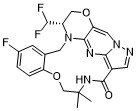
| 规格 | 价格 | 库存 | 数量 |
|---|---|---|---|
| 5mg |
|
||
| 10mg |
|
||
| 25mg |
|
||
| 50mg |
|
||
| 100mg |
|
||
| 250mg |
|
||
| 500mg |
|
||
| Other Sizes |
|

| 靶点 |
Wild-typr AKT (IC50 = 1.4 nM); mutant ALK variants (IC50 = 0.2-6.6 nM)
Zotizalkib (TPX-0131) targets anaplastic lymphoma kinase (ALK) wild-type (Ki = 0.23 nM; IC50 = 0.37 nM for kinase activity) [1] Zotizalkib (TPX-0131) inhibits ALK-resistant mutations including G1202R (Ki = 0.41 nM), F1174L (Ki = 0.19 nM), L1196M (Ki = 0.28 nM), C1156Y (Ki = 0.33 nM), and I1171N (Ki = 0.25 nM) [1] Zotizalkib (TPX-0131) shows minimal activity against EGFR (IC50 > 1000 nM), ROS1 (IC50 = 45 nM), and MET (IC50 = 62 nM), demonstrating high ALK selectivity [1] |
|---|---|
| 体外研究 (In Vitro) |
zoletilkib 的 IC50 为 1.4 nM,可有效抑制 26 种 ALK 变异体以及野生型 ALK。 ALK 突变 C1156Y、E1210K/S1206C、L1198F/C1156Y、L1196M/L1198F、E1210K、L1196M、T1151M、取消 G1202、S 1206R、G1202R/ L1198F、F1174L、F1245C、R12 75 Q 和 G1202R 的 IC50 值小于 1 nM使用zolitizalkib。 L1198F、L1152R、F1174S、T1151-L1152 insT、V1180L、G126 9A 和 F1174C 是 ozotizalkib 的 IC50 值为 1-2 nM 的 ALK 突变。 2-7 nM 的 IC50 值表明 zoletizalkib 对 ALK 突变(包括 I1171N、L1152P、D1203N、D1203N/E1210K 和 G1269S)表现出有限的作用[1]。当应用于携带 EML4-ALK G1202R、EML4-ALK G1202R/L1196M 或 EML4-ALK G1202R/L1198F 突变的 Ba/F3 细胞时,zoltizalkib 有效取代 ALK 自磷酸化;其 IC50 值大约为 3-10 nM [1]。
在ALK阳性非小细胞肺癌(NSCLC)细胞系(H3122、H2228、DFCI032,表达野生型ALK)中,Zotizalkib (TPX-0131) 抑制细胞增殖,IC50值分别为0.8 nM、1.2 nM和1.5 nM[1] - 在携带ALK耐药突变的细胞系(H3122-G1202R、H2228-F1174L、Ba/F3-L1196M)中,该药物具有抗增殖活性,IC50值范围为1.1 nM至2.3 nM,优于克唑替尼(在G1202R突变细胞中IC50 > 100 nM)[1] - Western blot分析显示,在H3122细胞中以剂量依赖性方式抑制ALK磷酸化(IC50 = 0.5 nM)及下游信号分子(STAT3、ERK1/2、AKT);5 nM浓度下实现最大抑制率(>90%)[1] - 诱导ALK阳性细胞发生半胱天冬酶依赖性凋亡(Annexin V/PI染色显示,10 nM浓度处理72小时后,45–55%的细胞发生凋亡)并导致G1期细胞周期阻滞[1] - 在ALK阴性细胞系(A549、H1975)中无显著抗增殖活性,IC50 > 1000 nM[1] |
| 体内研究 (In Vivo) |
zolofilkib(2-10 mg/kg;2-10 mg/kg;2 mg/kg;5 mg/kg;10 mg/kg)的肿瘤生长抑制(TGI)分别为 64%、120% 和 200%。侧向;每天两次;持续 2 周)。
在H3122(ALK野生型)皮下异种移植小鼠模型中,口服给予Zotizalkib (TPX-0131)(10 mg/kg,每日一次,连续21天),与溶媒对照组相比,肿瘤生长抑制率达86%;肿瘤组织中磷酸化ALK和磷酸化STAT3水平降低[1] - 在H3122-G1202R(ALK耐药)皮下异种移植模型中,Zotizalkib (TPX-0131)(15 mg/kg,口服,每日一次)实现82%的肿瘤生长抑制,而克唑替尼(50 mg/kg)仅为23%[1] - 在颅内(CNS)异种移植模型(H3122细胞立体定向注射至小鼠右侧纹状体)中,Zotizalkib (TPX-0131)(20 mg/kg,口服,每日一次)抑制脑肿瘤生长79%,并将中位生存期从28天延长至52天[1] - 在携带L1196M突变的ALK阳性NSCLC患者来源异种移植(PDX)模型中,Zotizalkib (TPX-0131)(12 mg/kg,口服,每日一次)实现75%的肿瘤生长抑制[1] |
| 酶活实验 |
ALK激酶活性测定:将重组ALK激酶结构域(野生型或突变体)与ATP(5 μM)和荧光标记肽底物在系列稀释的Zotizalkib (TPX-0131)存在下共同孵育。30°C孵育60分钟后,通过荧光共振能量转移(FRET)检测磷酸化底物,采用非线性回归计算IC50值[1]
- 表面等离子体共振(SPR)结合实验:将ALK蛋白固定在传感器芯片上,向芯片上注射系列稀释的Zotizalkib (TPX-0131)。通过测量折射率变化确定结合亲和力(Ki),数据采用1:1结合模型分析[1] - 激酶选择性面板测定:将Zotizalkib (TPX-0131)(100 nM)对468种激酶进行筛选;仅ALK及密切相关的ALK融合变体显示>90%的抑制率,证实其高靶点选择性[1] |
| 细胞实验 |
细胞增殖实验:将ALK阳性或ALK阴性癌细胞接种于96孔板(4 × 10³个细胞/孔),用Zotizalkib (TPX-0131)(0.01–1000 nM)处理72小时。使用四唑盐类试剂评估细胞活力,在490 nm波长下读取吸光度值。从剂量-反应曲线推导IC50值[1]
- 信号抑制Western blot检测:用Zotizalkib (TPX-0131)(0.1–50 nM)处理H3122或携带突变ALK的细胞2小时后,用冰浴裂解缓冲液裂解细胞。裂解物经SDS-PAGE分离后转移至PVDF膜,用磷酸化ALK、总ALK、磷酸化STAT3、磷酸化ERK1/2及GAPDH抗体进行免疫印迹。通过光密度法量化条带强度[1] - 凋亡与细胞周期实验:用Zotizalkib (TPX-0131)(10 nM)处理ALK阳性细胞72小时后,收集细胞,分别用Annexin V-FITC/PI(凋亡检测)或碘化丙啶(细胞周期检测)染色。通过流式细胞术分析凋亡细胞比例和细胞周期分布[1] |
| 动物实验 |
动物/疾病模型:雌性SCID/beige小鼠(5-8周龄),接种Ba/F3细胞[1]
剂量:2 mg/kg、5 mg/kg和10 mg/kg 给药途径:(消退)[1]。Bao;每日两次;持续2周 实验结果:在ALK突变依赖性异种移植模型中引起肿瘤完全消退。 皮下异种移植模型:将5 × 10⁶个ALK阳性癌细胞(H3122、H3122-G1202R或PDX组织碎片)皮下注射到雌性裸鼠(6-8周龄)右侧腹部。当肿瘤体积达到 100–150 mm³ 时,将小鼠随机分为载体组和治疗组(每组 n = 6)。Zotizalkib (TPX-0131) 溶于 PEG400/乙醇/水 (30:10:60 v/v/v) 混合溶剂中,每日一次口服给药,剂量为 10–15 mg/kg,持续 21–28 天。每 3 天测量一次肿瘤体积 [1] - 颅内异种移植模型:将裸鼠麻醉后,通过立体定位注射将 1 × 10⁵ 个 H3122 细胞植入右侧纹状体。植入后 7 天,给予 Zotizalkib (TPX-0131)(20 mg/kg,每日一次口服)或载体,持续 28 天。对小鼠进行存活率监测,并在死后分析脑肿瘤的大小和磷酸化ALK表达[1] - 药代动力学研究:小鼠、大鼠和犬单次口服Zotizalkib (TPX-0131)(小鼠10 mg/kg,大鼠和犬5 mg/kg)。在预定时间点采集血样,并使用LC-MS/MS测定血浆药物浓度以计算药代动力学参数[1] |
| 药代性质 (ADME/PK) |
在小鼠中,口服Zotizalkib (TPX-0131)(10 mg/kg)显示生物利用度为68 ± 7%,给药后1小时达到血浆峰浓度(Cmax)为2.4 ± 0.3 μM[1]
- 血浆半衰期(t1/2)为5.2 ± 0.8小时(小鼠)、7.5 ± 1.2小时(大鼠)和10.3 ± 1.5小时(狗); AUC0–24h 为 14.6 ± 2.1 μM·h(小鼠)[1] - 中枢神经系统渗透性:在小鼠中,Zotizalkib (TPX-0131) 的脑/血浆比值分别为 0.87 ± 0.12(给药后 2 小时)和 0.93 ± 0.15(给药后 4 小时),表明其能有效穿过血脑屏障[1] - 组织分布分析显示,该药物在肝脏(组织/血浆比值 = 4.6 ± 0.7)、肺(3.2 ± 0.5)和肿瘤(2.9 ± 0.4)中高度蓄积,在肾脏中分布中等(2.1 ± 0.3)[1] - 人肝微粒体代谢研究表明,Zotizalkib (TPX-0131) 主要通过 CYP3A4 代谢,未发现显著的代谢途径。抑制CYP1A2、CYP2C9、CYP2C19或CYP2D6[1] |
| 毒性/毒理 (Toxicokinetics/TK) |
在对大鼠进行的 28 天重复剂量毒性研究中(口服剂量为 5、15、50 mg/kg/天),Zotizalkib (TPX-0131) 不会引起明显的体重减轻、死亡或血液学参数的变化。在 50 mg/kg 剂量下观察到 ALT 轻度升高(≤1.3 倍正常值上限)[1]
- 在犬类(28 天研究,剂量分别为 2、10 和 30 mg/kg/天)中,剂量高达 30 mg/kg/天时,未观察到对肾功能(BUN、肌酐)或组织病理学的不良影响[1] - 通过平衡透析法测定,Zotizalkib (TPX-0131) 的血浆蛋白结合率分别为 95 ± 2%(人血浆)、93 ± 3%(大鼠血浆)和 94 ± 2%(犬血浆)[1] - 在犬类中,剂量高达 30 mg/kg/天时,未观察到明显的 QT 间期延长[1] |
| 参考文献 | |
| 其他信息 |
佐替沙基是一种口服有效的、结构紧凑的大环类受体酪氨酸激酶(RTK)抑制剂,属于间变性淋巴瘤激酶(ALK)抑制剂,具有潜在的抗肿瘤活性。口服后,佐替沙基与ATP结合位点结合,抑制ALK野生型酪氨酸激酶、ALK融合蛋白以及多种ALK点突变,包括获得性耐药突变,例如溶剂前沿突变(SFM)G1202R和复合突变L1196M/G1202R、L1198F/G1202R、L1196M/L1198F和C1156Y/G1202R。ALK抑制可阻断ALK介导的信号通路,并抑制表达ALK的肿瘤细胞的生长。ALK属于胰岛素受体超家族,在神经系统发育中发挥重要作用。 ALK 在健康成人人体组织中不表达,但 ALK 失调和基因重排与多种肿瘤细胞类型相关。与其他ALK抑制剂相比,佐替沙基能够抑制与获得性耐药相关的ALK耐药突变。
佐替沙基 (TPX-0131)是一种新一代中枢神经系统穿透性ALK抑制剂,旨在克服ALK阳性非小细胞肺癌(NSCLC)对第一代和第二代ALK抑制剂的耐药性[1]。 - 该药物与ALK的ATP结合口袋竞争性结合,抑制激酶活性和下游信号通路(JAK/STAT、RAS/ERK、PI3K/AKT),这些通路对肿瘤细胞的存活和增殖至关重要[1]。 - 其高中枢神经系统穿透性满足了ALK阳性NSCLC合并脑转移患者的未满足医疗需求,脑转移是现有ALK抑制剂常见的疾病进展部位[1]。 - 佐替沙基 (TPX-0131)覆盖所有主要靶点。具有临床意义的ALK耐药突变,包括G1202R(第二代抑制剂最常见的耐药突变)[1] |
| 分子式 |
C21H20F3N5O3
|
|---|---|
| 分子量 |
447.4104
|
| 精确质量 |
447.15
|
| 元素分析 |
C, 56.37; H, 4.51; F, 12.74; N, 15.65; O, 10.73
|
| CAS号 |
2648641-36-3
|
| 相关CAS号 |
2648641-36-3
|
| PubChem CID |
156024486
|
| 外观&性状 |
White to off-white solid powder
|
| LogP |
2.7
|
| tPSA |
81
|
| 氢键供体(HBD)数目 |
1
|
| 氢键受体(HBA)数目 |
9
|
| 可旋转键数目(RBC) |
1
|
| 重原子数目 |
32
|
| 分子复杂度/Complexity |
716
|
| 定义原子立体中心数目 |
1
|
| SMILES |
CC1(COC2=C(CN3[C@@H](COC4=CN5C(=C(C=N5)C(=O)N1)N=C43)C(F)F)C=C(C=C2)F)C
|
| InChi Key |
ILAMRXVQSGVCJX-AWEZNQCLSA-N
|
| InChi Code |
InChI=1S/C21H20F3N5O3/c1-21(2)10-32-15-4-3-12(22)5-11(15)7-28-14(17(23)24)9-31-16-8-29-18(26-19(16)28)13(6-25-29)20(30)27-21/h3-6,8,14,17H,7,9-10H2,1-2H3,(H,27,30)/t14-/m0/s1
|
| 化学名 |
(18S)-18-(difluoromethyl)-13-fluoro-7,7-dimethyl-9,20-dioxa-1,2,6,17,23-pentazapentacyclo[19.3.1.04,24.010,15.017,22]pentacosa-2,4(24),10(15),11,13,21(25),22-heptaen-5-one
|
| 别名 |
TPX 0131; Zotizalkib; TPX-0131; TPX0131
|
| HS Tariff Code |
2934.99.9001
|
| 存储方式 |
Powder -20°C 3 years 4°C 2 years In solvent -80°C 6 months -20°C 1 month |
| 运输条件 |
Room temperature (This product is stable at ambient temperature for a few days during ordinary shipping and time spent in Customs)
|
| 溶解度 (体外实验) |
DMSO: ~62.5 mg/mL (~139.7 mM)
|
|---|---|
| 溶解度 (体内实验) |
配方 1 中的溶解度: ≥ 2.08 mg/mL (4.65 mM) (饱和度未知) in 10% DMSO + 40% PEG300 + 5% Tween80 + 45% Saline (这些助溶剂从左到右依次添加,逐一添加), 澄清溶液。
例如,若需制备1 mL的工作液,可将100 μL 20.8 mg/mL澄清DMSO储备液加入400 μL PEG300中,混匀;然后向上述溶液中加入50 μL Tween-80,混匀;加入450 μL生理盐水定容至1 mL。 *生理盐水的制备:将 0.9 g 氯化钠溶解在 100 mL ddH₂O中,得到澄清溶液。 配方 2 中的溶解度: 2.08 mg/mL (4.65 mM) in 10% DMSO + 90% (20% SBE-β-CD in Saline) (这些助溶剂从左到右依次添加,逐一添加), 悬浊液; 超声助溶。 例如,若需制备1 mL的工作液,可将 100 μL 20.8 mg/mL澄清DMSO储备液加入900 μL 20% SBE-β-CD生理盐水溶液中,混匀。 *20% SBE-β-CD 生理盐水溶液的制备(4°C,1 周):将 2 g SBE-β-CD 溶解于 10 mL 生理盐水中,得到澄清溶液。 View More
配方 3 中的溶解度: ≥ 2.08 mg/mL (4.65 mM) (饱和度未知) in 10% DMSO + 90% Corn Oil (这些助溶剂从左到右依次添加,逐一添加), 澄清溶液。 1、请先配制澄清的储备液(如:用DMSO配置50 或 100 mg/mL母液(储备液)); 2、取适量母液,按从左到右的顺序依次添加助溶剂,澄清后再加入下一助溶剂。以 下列配方为例说明 (注意此配方只用于说明,并不一定代表此产品 的实际溶解配方): 10% DMSO → 40% PEG300 → 5% Tween-80 → 45% ddH2O (或 saline); 假设最终工作液的体积为 1 mL, 浓度为5 mg/mL: 取 100 μL 50 mg/mL 的澄清 DMSO 储备液加到 400 μL PEG300 中,混合均匀/澄清;向上述体系中加入50 μL Tween-80,混合均匀/澄清;然后继续加入450 μL ddH2O (或 saline)定容至 1 mL; 3、溶剂前显示的百分比是指该溶剂在最终溶液/工作液中的体积所占比例; 4、 如产品在配制过程中出现沉淀/析出,可通过加热(≤50℃)或超声的方式助溶; 5、为保证最佳实验结果,工作液请现配现用! 6、如不确定怎么将母液配置成体内动物实验的工作液,请查看说明书或联系我们; 7、 以上所有助溶剂都可在 Invivochem.cn网站购买。 |
| 制备储备液 | 1 mg | 5 mg | 10 mg | |
| 1 mM | 2.2351 mL | 11.1754 mL | 22.3509 mL | |
| 5 mM | 0.4470 mL | 2.2351 mL | 4.4702 mL | |
| 10 mM | 0.2235 mL | 1.1175 mL | 2.2351 mL |
1、根据实验需要选择合适的溶剂配制储备液 (母液):对于大多数产品,InvivoChem推荐用DMSO配置母液 (比如:5、10、20mM或者10、20、50 mg/mL浓度),个别水溶性高的产品可直接溶于水。产品在DMSO 、水或其他溶剂中的具体溶解度详见上”溶解度 (体外)”部分;
2、如果您找不到您想要的溶解度信息,或者很难将产品溶解在溶液中,请联系我们;
3、建议使用下列计算器进行相关计算(摩尔浓度计算器、稀释计算器、分子量计算器、重组计算器等);
4、母液配好之后,将其分装到常规用量,并储存在-20°C或-80°C,尽量减少反复冻融循环。
计算结果:
工作液浓度: mg/mL;
DMSO母液配制方法: mg 药物溶于 μL DMSO溶液(母液浓度 mg/mL)。如该浓度超过该批次药物DMSO溶解度,请首先与我们联系。
体内配方配制方法:取 μL DMSO母液,加入 μL PEG300,混匀澄清后加入μL Tween 80,混匀澄清后加入 μL ddH2O,混匀澄清。
(1) 请确保溶液澄清之后,再加入下一种溶剂 (助溶剂) 。可利用涡旋、超声或水浴加热等方法助溶;
(2) 一定要按顺序加入溶剂 (助溶剂) 。
| NCT Number | Recruitment | interventions | Conditions | Sponsor/Collaborators | Start Date | Phases |
| NCT04849273 | Terminated | Drug: TPX-0131 | NSCLC Advanced Solid Tumor |
Turning Point Therapeutics, Inc. | July 28, 2021 | Phase 1 |
|
|
|
|
InvivoChem的所有产品仅用于作科学研究,不面向患者销售
Copyright 2020 InvivoChem LLC | All Rights Reserved 粤ICP备20063088号-1


 粤公网安备 44011102003439号
 463611831
