| 规格 | 价格 | 库存 | 数量 |
|---|---|---|---|
| 100mg |
|
||
| 250mg |
|
||
| 500mg |
|
||
| Other Sizes |
|
| 药代性质 (ADME/PK) |
Absorption, Distribution and Excretion
Trazodone is rapidly absorbed in the gastrointestinal tract after oral administration, with a bioavailability of 63-91% and an AUC0-t of 18193.0 ng·h/mL. The effect of food on absorption varies from person to person and can sometimes lead to a decrease in the Cmax of trazodone. In 8 healthy volunteers, the Cmax was 1.47 ± 0.16 μg/mL after eating and 1.88 ± 0.42 μg/mL after fasting. The mean Tmax after a single 300 mg dose was 8 hours. Food can increase absorption by up to 20%. Less than 1% of the oral dose is excreted unchanged in the urine. In a pharmacokinetic study, approximately 60-70% of the radiolabeled drug was excreted in the urine within 48 hours. Approximately 9-29% of the drug was excreted in the feces within 60 to 100 hours. According to FDA medical review, the kidneys are responsible for 70% to 75% of trazodone excretion. Approximately 21% of trazodone is excreted in feces, and 0.13% of the unchanged drug is excreted unchanged in urine. A single-dose pharmacokinetic study in eight volunteers taking trazodone determined its volume of distribution to be 0.84 ± 0.16 L/kg. The FDA's medical review report on trazodone indicates a volume of distribution ranging from 0.47 to 0.84 L/kg. Compared to younger volunteers, older volunteers showed a lower total apparent clearance in a fasting state (5.1 L/h vs. 10.8 L/h). Another pharmacokinetic study determined that the total clearance of trazodone after a single dose in eight healthy subjects was 5.3 ± 0.9 L/h. In another study, the mean peak plasma concentrations of trazodone after oral administration of 25, 50, or 100 mg in healthy fasting adults were 490, 860, and 1620 ng/mL, respectively. The areas under the plasma concentration-time curve (AUC) for the 25 mg, 50 mg, and 100 mg dose groups were 3.44, 5.95, and 11.19 μg·hr/mL, respectively. Currently, cross-correlation data on AUC in fasting and non-fasting patients are limited; however, the presence of food appears to slightly increase the AUC of trazodone. In one study, after a single oral dose of 25 mg radiolabeled trazodone in healthy adults, the mean peak plasma drug concentrations were reached at 1.5 hours and 2.5 hours post-administration, respectively, in fasting and non-fasting states, at 650 ng/mL and 480 ng/mL. /Breast Milk/ A study investigated breast milk excretion after oral administration of a single trazodone tablet (50 mg) in six lactating women. Based on the areas under the plasma and breast milk concentration curves, the breast milk/plasma ratio of trazodone was small: 0.142 ± 0.045 (mean ± standard deviation). Assuming an infant drinks 500 mL of breast milk every 12 hours, the amount of trazodone ingested through breast milk is less than 0.005 mg/kg, while the mother's intake is 0.77 mg/kg. Therefore, it can be concluded that the amount of trazodone ingested by the infant through breast milk is very small. After oral administration of trazodone on an empty stomach, peak plasma concentrations occur approximately 1 hour after administration; when taken with food, peak plasma concentrations occur approximately 2 hours after administration. Steady-state plasma drug concentrations are typically reached within 4 days after oral administration of trazodone (25 mg each time, 2 or 3 times daily), but there is considerable inter-individual variability. For more complete data on the absorption, distribution, and excretion of trazodone (8 types), please visit the HSDB record page. Metabolism/Metabolites Trazodone is primarily metabolized and activated in the liver by the enzyme CYP3A4 to the active metabolite m-chlorophenylpiperazine (mCPP). The complete metabolic process of trazodone has not been fully elucidated. Other identified metabolites include dihydrodiol metabolites and carboxylic acids. Trazodone is extensively metabolized in the liver via hydroxylation, oxidation, N-oxidation, and pyridine ring cleavage. The hydroxylated metabolite and oxotriazopyridinepropionic acid (an inactive metabolite excreted in urine) are conjugated with glucuronic acid. In vitro studies indicate that the metabolism of trazodone to the active metabolite m-chlorophenylpiperazine is mediated by cytochrome P-450 (CYP) 3A4 isoenzymes. The manufacturer states that other metabolic pathways involved in trazodone metabolism are not fully elucidated. Animal studies indicate that trazodone does not induce its own metabolism. In vitro human liver microsomal studies show that trazodone is oxidatively cleaved by CYP3A4 to the active metabolite m-chlorophenylpiperazine (mCPP). Other metabolic pathways that may be involved in trazodone metabolism are not fully elucidated. Trazodone is extensively metabolized; less than 1% of the oral dose is excreted unchanged in the urine. Following oral administration of trazodone, approximately 70-75% of the dose is excreted in the urine within 72 hours, primarily as metabolites. About 20% of the oral trazodone is excreted in the urine as oxotriazopyridine propionic acid and its conjugates, and about 10% as dihydrodiol metabolites; less than 1% is excreted unchanged. The remaining portion of the oral drug is excreted primarily as metabolites via bile and in feces. Known metabolites of trazodone include p-hydroxytrazodone, epoxide trazodone, and 1-(3-chlorophenyl)piperazine. Trazodone is metabolized in the liver primarily through hydroxylation, N-dealkylation, N-oxidation, and pyridine ring cleavage. Cytochrome P450 (CYP) 3A4 catalyzes the formation of the major active metabolite, m-chlorophenylpiperazine (m-CPP). The metabolite can further bind with glucuronic acid or glutathione. CYP2D6 is responsible for the 4'-hydroxylation of m-CPP, generating at least one glutathione conjugate of m-CPP, namely a quinone imine-thiol adduct. The inactive metabolite oxotriazopyridine propionic acid and its conjugates account for approximately 20% of the total oral excretion. Less than 1% of the oral dose is excreted unchanged. Approximately 70-75% of the dose is excreted in the urine, with the remainder excreted in the bile. Half-life: Biphasic elimination, with an initial phase t1/2 α of 3-6 hours and a terminal phase t1/2 β of 5-9 hours. Biological half-life: Compared with younger volunteers, the plasma elimination half-life in elderly volunteers under fasting conditions was significantly prolonged (13.6 hours vs. 6 hours). Another study involving 8 healthy subjects with a single dose of trazodone showed a terminal elimination half-life of 7.3 ± 0.8 hours. Trazodone elimination has been reported to follow a biphasic pattern. The initial phase half-life is 3 to 6 hours, and the second phase half-life is 5 to 9 hours. The initial phase half-life of trazodone is approximately 3-6 hours, and the terminal phase half-life is approximately 5-9 hours. …After intravenous administration of trazodone hydrochloride to dogs, the mean elimination half-life ± standard deviation was 169 ± 53 minutes…After oral administration, the mean elimination half-life was 166 ± 47 minutes. After intravenous administration of 8 mg/kg in dogs, the volume of distribution (all values are averages) was 2.53 L/kg, the elimination half-life was 169 minutes, and the total plasma clearance was 11.15 mL/min/kg. After oral administration of 8 mg/kg, the bioavailability was 85%, the elimination half-life was 166 minutes, and the peak plasma concentration occurred at 445 minutes (mean), but there was significant inter-individual variability (± 271 minutes). |
|---|---|
| 毒性/毒理 (Toxicokinetics/TK) |
Toxicity Summary
Identification and Uses: Trazodone is a crystalline solid. Trazodone hydrochloride tablets (USP) are indicated for the treatment of major depressive disorder (MDD) in adults. Trazodone has also been used to treat anxiety-induced events in dogs. Human Exposure and Toxicity: The most serious reactions reported from overdose of trazodone alone include priapism, respiratory arrest, seizures, and ECG changes. The most common reactions are somnolence and vomiting. Trazodone is known to prolong the QT/QTc interval. Some drugs that prolong the QT/QTc interval can cause torsades de pointes and may lead to sudden death. A study of pregnant women who had previously taken trazodone showed that the drug did not increase the incidence of serious fetal malformations. Animal Studies: Oral administration for one month to dogs at doses of 50 and 100 mg/kg/day resulted in tremors, vomiting, and clonic seizures. Rats were fed a diet supplemented with approximately 250 mg/kg/day for 6 months. Results showed a significant increase in liver weight and a slight decrease in body weight gain in male rats. Rats were used in a two-year carcinogenicity study. The number of deaths in female rats was higher in both treatment groups than in the control group; most deaths were related to pituitary tumors. The incidence of palpable masses (mammary tumors, cysts, etc.) was also increased at 12, 13, and 14 months of age in both treatment groups. Two rat developmental studies were conducted: in one study, rats were orally administered 100 mg/kg/day on days 10–15 of gestation and 210 mg/kg/day on days 6–15 of gestation, respectively; in the other study, rats were orally administered 150–450 mg/kg/day on days 9–14 of gestation. Sedation was observed in maternal rats only at a dose of 100 mg/kg. At doses of 150 mg/kg and above, enhanced sedation, decreased maternal and fetal weight, and delayed ossification were observed. At doses of 300 and 450 mg/kg, in addition to fetal growth retardation, a significant increase in embryo resorption and stillbirth rates was observed. Trazodone binds to 5-HT2 receptors, acting as a serotonin agonist at high doses and a serotonin antagonist at low doses. Similar to fluoxetine, trazodone's antidepressant activity may stem from its inhibition of the serotonin reuptake pump on the presynaptic neuronal membrane, blocking serotonin reuptake. Long-term use may affect postsynaptic neuronal receptor binding sites. Trazodone's sedative effect may be due to its α-adrenergic blocking effect and mild histamine-blocking effect on H1 receptors. It has a weaker blocking effect on presynaptic α2-adrenergic receptors but a stronger inhibitory effect on postsynaptic α1 receptors. Trazodone does not affect the reuptake of norepinephrine or dopamine in the central nervous system. Toxicity Data LD50: 96 mg/kg (intravenous injection, mice) (A308) Interactions Concomitant use of trazodone with CYP3A4 inhibitors can lead to a significant increase in trazodone plasma concentrations and increase the risk of adverse reactions. One study showed that in healthy subjects, concomitant administration of ritonavir (200 mg twice daily for 2 days) and trazodone (50 mg single dose) increased peak plasma concentrations of trazodone by 34%, decreased clearance by 52%, and more than doubled the area under the plasma concentration-time curve (AUC) and half-life. Adverse reactions (e.g., nausea, hypotension, syncope) were also observed with both ritonavir and trazodone. The trazodone manufacturer notes that a dose reduction of trazodone should be considered in patients concurrently taking potent CYP3A4 isoenzyme inhibitors (e.g., indinavir, itraconazole, ketoconazole, nefazodone, ritonavir). A retrospective review of medical records identified three clinically significant cases of suspected trazodone-warfarin interaction, all presenting with changes in prothrombin time (PT) and international normalized ratio (INR) that could not be explained by other factors. In each case, the INR changed by ≥1.0 after initiation or discontinuation of trazodone. Patients initiating trazodone subsequently experienced a decrease in PT and INR; conversely, patients discontinuing trazodone experienced an increase in PT and INR. Although no adverse events occurred in any of the patients due to the significant changes in PT and INR, the warfarin dose had to be adjusted accordingly upon initiation and discontinuation of trazodone. These cases suggest that a clinically significant interaction may exist between trazodone and warfarin. The timing of this interaction varies from person to person; the mechanism is unclear, but may involve substrate or protein binding competition. Due to the difficulty in achieving therapeutic PT and INR values, it is strongly advised that patients taking warfarin do not use trazodone as needed for sleep. Patients and clinicians should be informed of this potential interaction before further information is available, and changes in anticoagulation should be monitored when trazodone is started or discontinued. …Understanding the potential interactions between psychotropic medications and drugs used to treat HIV infection and its sequelae can lead to more effective optimization of pharmacological treatment for mood disorders in HIV-infected individuals. This study investigated the bioconversion of the antidepressant trazodone to its major metabolite, m-chlorophenylpiperazine (mCPP), in vitro using human liver microsomes and heterologously expressed human cytochrome. Simultaneously, the interactions of trazodone with the azole antifungal drug ketoconazole and human immunodeficiency virus protease inhibitors (HIVPIs) were investigated in the same system. …In liver microsomes, the mean (± SE) Km value for trazodone-to-mCPP conversion was 163 (± 21) μmol/L. Ketoconazole is a relatively specific CYP3A inhibitor that competitively inhibits the formation of mCPP, with an inhibition constant (Ki) of 0.12 (± 0.01) μmol/L. In heterologously expressed human cytochrome P450, only CYP3A4 mediates trazodone-to-mCPP formation. The K(m) value is 180 μmol/L, consistent with the value in microsomes. Ritonavir, an HIV protease inhibitor, is a potent inhibitor of mCPP formation in hepatic microsomes (K(i) = 0.14 ± 0.04 μmol/L). Indinavir, another HIV protease inhibitor, is also a potent inhibitor, while saquinavir and nelfinavir have weaker inhibitory effects. …Ketoconazole, ritonavir, and indinavir inhibit CYP3A-mediated trazodone clearance, suggesting a possible pharmacokinetic interaction in vivo. In a double-blind trial, researchers compared the effects of trazodone and placebo on subjective and objective sleep parameters in seven patients who experienced insomnia while receiving the selective reversible MAO-A inhibitor brofaridine. Results showed that trazodone significantly increased deep sleep and altered sleep structure in these patients. Patients reported improvements in both sleep quality and depth. No adverse interactions were observed between brofaridine and trazodone, and side effects were minimal. Low-dose trazodone may be a safe and effective treatment for MAO-I-induced insomnia. More complete interaction data (out of 18) for trazodone can be found on the HSDB record page. Non-human toxicity values Oral LD50 in rats: 690 mg/kg Intravenous LD50 in rats: 91 mg/kg Intraperitoneal LD50 in rats: 178 mg/kg Oral LD50 in mice: 610 mg/kg Intravenous LD50 in mice: 91 mg/kg |
| 参考文献 | |
| 其他信息 |
Therapeutic Uses
Anti-anxiety medication; second-generation antidepressant; serotonin reuptake inhibitor. /Clinical Trials/ ClinicalTrials.gov is a registry and results database that lists human clinical studies funded by public and private institutions worldwide. The website is maintained by the National Library of Medicine (NLM) and the National Institutes of Health (NIH). Each record on ClinicalTrials.gov includes a summary of the study protocol, including: the disease or condition; the intervention (e.g., the medical product, behavior, or procedure under investigation); the title, description, and design of the study; participation requirements (eligibility criteria); the location of the study; contact information for the study location; and links to relevant information from other health websites, such as the NLM's MedlinePlus (for providing patient health information) and PubMed (for providing citations and abstracts of academic articles in the medical field). Trazodone is listed in the database. Trazodone hydrochloride tablets (USP) are indicated for the treatment of major depressive disorder (MDD) in adults. The efficacy of trazodone hydrochloride tablets has been demonstrated in clinical trials with immediate-release trazodone formulations. /Listed on the US Drug Label/ Although trazodone has been used to treat schizophrenia, its efficacy is less than that of chlorpromazine. Depressive symptoms may improve during trazodone treatment, but the drug does not appear to alleviate psychotic symptoms in most patients with schizophrenia. Based on limited data, trazodone alone is of little efficacy in patients with chronic schizophrenia without depression; however, for patients with chronic schizophrenia with depression, trazodone may be used as adjunctive therapy to antipsychotic drugs (such as phenothiazines). Unlike tricyclic antidepressants, trazodone does not appear to worsen psychotic symptoms in these patients. /Not included on the US Product Label/ For more complete data on the therapeutic uses of trazodone (11 in total), please visit the HSDB record page. Drug Warning /Black Box Warning/ Warning: Suicidal tendencies and antidepressants. In short-term studies of major depressive disorder (MDD) and other mental illnesses, antidepressants increased the risk of suicidal ideation and behavior (suicidal tendencies) in children, adolescents, and young adults compared to placebo. Anyone considering the use of trazodone hydrochloride tablets or any other antidepressant in children, adolescents, or young adults must weigh this risk against clinical need. Short-term studies showed no increased suicide risk in adults aged 24 and older taking antidepressants compared to placebo; however, a decreased suicide risk was observed in adults aged 65 and older taking antidepressants compared to placebo. Depression and some other mental illnesses are themselves associated with an increased risk of suicide. Patients of all ages starting antidepressants should be appropriately monitored for worsening clinical symptoms, suicidal tendencies, or unusual behavioral changes. Family members and caregivers should be informed of the need for close monitoring and communication with the prescribing physician. Trazodone hydrochloride tablets are not approved for use in children. All patients taking antidepressants for any indication should be appropriately monitored and closely observed for worsening clinical symptoms, suicidal tendencies, or abnormal behavioral changes, especially during the first few months of treatment or during dose adjustments (increases or decreases). The following symptoms have been reported in adult and pediatric patients receiving antidepressants for major depressive disorder and other indications (including psychiatric and non-psychiatric disorders): anxiety, agitation, panic attacks, insomnia, irritability, hostility, aggression, impulsivity, akathisia (psychomotor agitation), hypomania, and mania. Although a causal relationship between the appearance of these symptoms and exacerbations of depression and/or suicidal impulses has not been established, there is concern that these symptoms may be a precursor to suicidal tendencies. It has been reported that life-threatening serotonin syndrome or neuroleptic malignant syndrome (NMS)-like reactions can occur with the use of antidepressants alone, and this can also happen with trazodone treatment, especially when used concurrently with other serotonergic drugs (including selective serotonin reuptake inhibitors (SSRIs), serotonin and norepinephrine reuptake inhibitors (SNRIs), and triptans) as well as drugs that impair serotonin metabolism (including monoamine oxidase inhibitors (MAOIs)) or antipsychotics or other dopamine antagonists. Symptoms of serotonin syndrome may include altered mental status (e.g., agitation, hallucinations, and coma), autonomic dysfunction (e.g., tachycardia, blood pressure fluctuations, and high fever), neuromuscular abnormalities (e.g., hyperreflexia, motor incoordination), and/or gastrointestinal symptoms (e.g., nausea, vomiting, and diarrhea). At its most severe, serotonin syndrome can resemble neuroleptic malignant syndrome, including high fever, muscle rigidity, autonomic dysfunction (possibly accompanied by rapid fluctuations in vital signs), and altered mental status. Major depressive episodes may be the initial presentation of bipolar disorder. It is generally believed (although not confirmed in controlled trials) that treatment of such episodes with antidepressants alone may increase the likelihood of mixed/manic episodes in patients at risk for bipolar disorder. It is currently unclear whether any of the aforementioned clinical exacerbations and suicidal risk symptoms represent this conversion. However, patients with depressive symptoms should be thoroughly screened to determine their risk for bipolar disorder before initiating antidepressant treatment; such screening should include a detailed psychiatric history, including a family history of suicide, bipolar disorder, and depression. It is important to note that trazodone hydrochloride tablets are not approved for the treatment of bipolar depression. For more complete data on trazodone (32 of them), please visit the HSDB records page. Pharmacodynamics Trazodone treats depressive mood and other depression-related symptoms and is beneficial for the treatment of insomnia due to its sedative effects. Trazodone is known to prolong the QT interval in the heart. Due to its inhibitory effects on the central nervous system, trazodone may impair memory, alertness, and cognitive abilities, especially in older patients. Important note regarding priapism: Trazodone is associated with the occurrence of priapism, a painful and persistent erection of the penis that is difficult to relieve and can lead to permanent nerve damage if left untreated. Patients who suspect they are experiencing priapism should seek immediate medical attention. |
| 分子式 |
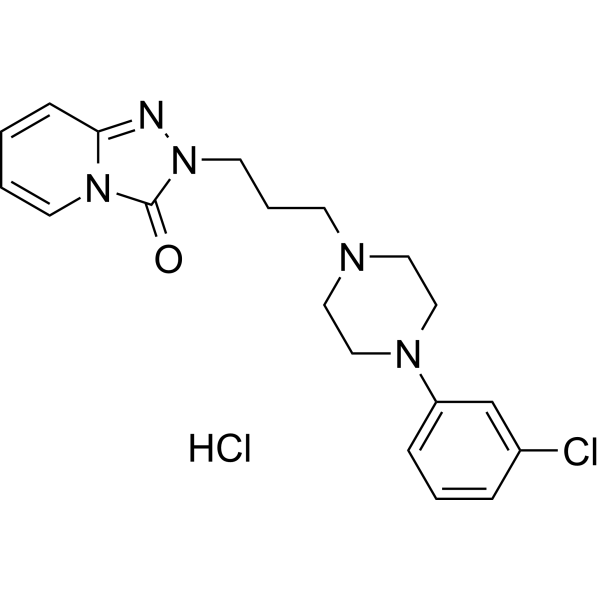
C19H23CL2N5O
|
|---|---|
| 分子量 |
408.3248
|
| 精确质量 |
407.127
|
| CAS号 |
25332-39-2
|
| 相关CAS号 |
Trazodone-d6 hydrochloride;1181578-71-1;Trazodone;19794-93-5
|
| PubChem CID |
5533
|
| 外观&性状 |
White to off-white solid powder
|
| 沸点 |
528.5ºC at 760 mmHg
|
| 熔点 |
223ºC
|
| 闪点 |
273.4ºC
|
| 蒸汽压 |
2.94E-11mmHg at 25°C
|
| LogP |
3.166
|
| tPSA |
45.78
|
| 氢键供体(HBD)数目 |
0
|
| 氢键受体(HBA)数目 |
4
|
| 可旋转键数目(RBC) |
5
|
| 重原子数目 |
26
|
| 分子复杂度/Complexity |
611
|
| 定义原子立体中心数目 |
0
|
| SMILES |
0
|
| HS Tariff Code |
2934.99.9001
|
| 存储方式 |
Powder -20°C 3 years 4°C 2 years In solvent -80°C 6 months -20°C 1 month 注意: 请将本产品存放在密封且受保护的环境中,避免吸湿/受潮。 |
| 运输条件 |
Room temperature (This product is stable at ambient temperature for a few days during ordinary shipping and time spent in Customs)
|
| 溶解度 (体外实验) |
DMSO : ~16.67 mg/mL (~40.83 mM)
H2O : ~16.67 mg/mL (~40.83 mM) |
|---|---|
| 溶解度 (体内实验) |
配方 1 中的溶解度: ≥ 1.67 mg/mL (4.09 mM) (饱和度未知) in 10% DMSO + 40% PEG300 + 5% Tween80 + 45% Saline (这些助溶剂从左到右依次添加,逐一添加), 澄清溶液。
例如,若需制备1 mL的工作液,可将100 μL 16.7 mg/mL澄清的DMSO储备液加入到400 μL PEG300中,混匀;再向上述溶液中加入50 μL Tween-80,混匀;然后加入450 μL生理盐水定容至1 mL。 *生理盐水的制备:将 0.9 g 氯化钠溶解在 100 mL ddH₂O中,得到澄清溶液。 配方 2 中的溶解度: ≥ 1.67 mg/mL (4.09 mM) (饱和度未知) in 10% DMSO + 90% (20% SBE-β-CD in Saline) (这些助溶剂从左到右依次添加,逐一添加), 澄清溶液。 例如,若需制备1 mL的工作液,可将 100 μL 16.7mg/mL澄清的DMSO储备液加入到900μL 20%SBE-β-CD生理盐水中,混匀。 *20% SBE-β-CD 生理盐水溶液的制备(4°C,1 周):将 2 g SBE-β-CD 溶解于 10 mL 生理盐水中,得到澄清溶液。 View More
配方 3 中的溶解度: ≥ 1.67 mg/mL (4.09 mM) (饱和度未知) in 10% DMSO + 90% Corn Oil (这些助溶剂从左到右依次添加,逐一添加), 澄清溶液。 1、请先配制澄清的储备液(如:用DMSO配置50 或 100 mg/mL母液(储备液)); 2、取适量母液,按从左到右的顺序依次添加助溶剂,澄清后再加入下一助溶剂。以 下列配方为例说明 (注意此配方只用于说明,并不一定代表此产品 的实际溶解配方): 10% DMSO → 40% PEG300 → 5% Tween-80 → 45% ddH2O (或 saline); 假设最终工作液的体积为 1 mL, 浓度为5 mg/mL: 取 100 μL 50 mg/mL 的澄清 DMSO 储备液加到 400 μL PEG300 中,混合均匀/澄清;向上述体系中加入50 μL Tween-80,混合均匀/澄清;然后继续加入450 μL ddH2O (或 saline)定容至 1 mL; 3、溶剂前显示的百分比是指该溶剂在最终溶液/工作液中的体积所占比例; 4、 如产品在配制过程中出现沉淀/析出,可通过加热(≤50℃)或超声的方式助溶; 5、为保证最佳实验结果,工作液请现配现用! 6、如不确定怎么将母液配置成体内动物实验的工作液,请查看说明书或联系我们; 7、 以上所有助溶剂都可在 Invivochem.cn网站购买。 |
| 制备储备液 | 1 mg | 5 mg | 10 mg | |
| 1 mM | 2.4491 mL | 12.2453 mL | 24.4906 mL | |
| 5 mM | 0.4898 mL | 2.4491 mL | 4.8981 mL | |
| 10 mM | 0.2449 mL | 1.2245 mL | 2.4491 mL |
1、根据实验需要选择合适的溶剂配制储备液 (母液):对于大多数产品,InvivoChem推荐用DMSO配置母液 (比如:5、10、20mM或者10、20、50 mg/mL浓度),个别水溶性高的产品可直接溶于水。产品在DMSO 、水或其他溶剂中的具体溶解度详见上”溶解度 (体外)”部分;
2、如果您找不到您想要的溶解度信息,或者很难将产品溶解在溶液中,请联系我们;
3、建议使用下列计算器进行相关计算(摩尔浓度计算器、稀释计算器、分子量计算器、重组计算器等);
4、母液配好之后,将其分装到常规用量,并储存在-20°C或-80°C,尽量减少反复冻融循环。
计算结果:
工作液浓度: mg/mL;
DMSO母液配制方法: mg 药物溶于 μL DMSO溶液(母液浓度 mg/mL)。如该浓度超过该批次药物DMSO溶解度,请首先与我们联系。
体内配方配制方法:取 μL DMSO母液,加入 μL PEG300,混匀澄清后加入μL Tween 80,混匀澄清后加入 μL ddH2O,混匀澄清。
(1) 请确保溶液澄清之后,再加入下一种溶剂 (助溶剂) 。可利用涡旋、超声或水浴加热等方法助溶;
(2) 一定要按顺序加入溶剂 (助溶剂) 。