| 规格 | 价格 | 库存 | 数量 |
|---|---|---|---|
| 50mg |
|
||
| 500mg |
|
||
| Other Sizes |
|

| 靶点 |
alpha 2-adrenergic receptor
In vitro activity: Yohimbine(Antagonil) has been used as a mydriatic and in the treatment of impotence. It is also alleged to be an aphrodisiac. Yohimbine is a pre-synaptic alpha 2-adrenergic blocking agent. Yohimbine may exert its beneficial effect on erectile ability through blockade of central alpha 2-adrenergic receptors producing an increase in sympathetic drive secondary to an increase in norepinephrine release and in firing rate of cells in the brain noradrenergic nuclei. |
|---|---|
| 体外研究 (In Vitro) |
体外活性:育亨宾(Antagonil)已被用作散瞳剂并用于治疗阳痿。它也被认为是一种春药。育亨宾是一种突触前 α2-肾上腺素能阻断剂。育亨宾可能通过阻断中枢α2-肾上腺素能受体,产生继发于去甲肾上腺素释放和大脑去甲肾上腺素能核细胞放电率增加的交感神经驱动力的增加,从而对勃起能力发挥有益作用。
Yohimbine 抑制了由亚阈值浓度的肾上腺素(1 μmol/L)和花生四烯酸(0.2 mmol/L)在人富血小板血浆中诱导的协同血小板聚集。 抑制作用呈浓度依赖性,计算得出的IC50值为0.6 μmol/L。[1] |
| 体内研究 (In Vivo) |
育亨宾可用于创建心脏增强、高血压和神经系统症状的动物模型。
|
| 细胞实验 |
使用双通道发光聚集仪在37°C下监测血小板聚集。
用yohimbine预处理富血小板血浆1分钟。 随后向PRP中加入亚阈值浓度的肾上腺素(1 μmol/L)和花生四烯酸(0.2 mmol/L)以诱导协同聚集。 通过测量透光率的变化,记录5分钟内的聚集过程。 通过构建剂量反应曲线来计算yohimbine的50%抑制浓度(IC50)。[1] |
| 动物实验 |
在每次实验前,将育亨宾 (YO) 用无菌 0.15 mol/L NaCl 溶液在室温下涡旋振荡 5 分钟新鲜溶解,然后用 0.45 μm 针筒式过滤器过滤以去除颗粒残留物。大鼠腹腔注射 2.0 ml 0.15 mol/L NaCl 溶液(不含溶剂)或含有 5.0 mg/kg 体重的 YO 的溶剂。注射体积根据每只大鼠的平均注射量进行调整,以弥补每个实验组内动物间体重的微小差异。选择 5.0 mg/kg 体重的 YO 剂量是基于最近的研究结果,该研究表明较低剂量的 YO(即 1.0 mg/kg 体重)不会对食物摄入量、完全弗氏佐剂 (CFA) 或中枢 Fos 激活产生显著影响 (Myers 等,2005)。[J Neurosci. 2006年11月1日;26(44):11442-53.] 下午3:30(即天黑前3.5小时)将笼中的食物移除。第二天下午3:00(即23.5小时后),对禁食大鼠(DSAP组n=8;假手术对照组n=8)进行腹腔注射,分别注射YO(DSAP组n=4;假手术对照组n=4)或载体(DSAP组n=4;假手术对照组n=4)。30分钟后,即下午3:30,给予大鼠一定量的颗粒饲料。分别在喂食30分钟、60分钟和18小时后,测定每只大鼠的累积食物摄入量(已校正食物洒落量)。之后,大鼠恢复自由采食48小时。在平衡设计中重复进行24小时食物剥夺和摄食试验,其中先前腹腔注射YO的大鼠随后腹腔注射赋形剂,反之亦然。因此,每只大鼠都作为自身的对照,以确定YO对食物剥夺诱导摄食的影响。[J Neurosci. 2006年11月1日;26(44):11442-53.]
|
| 药代性质 (ADME/PK) |
吸收、分布和排泄
口服后迅速吸收。生物利用度差异很大,范围为7%至87%(平均33%)。 代谢/代谢物 育亨宾似乎在肝脏或肾脏等高流量器官中广泛代谢,然而,育亨宾的确切代谢途径尚未完全确定。 生物半衰期 消除半衰期约为36分钟。 |
| 毒性/毒理 (Toxicokinetics/TK) |
肝毒性
在小型临床试验和病例系列研究中,育亨宾治疗与血清酶升高或临床肝病无关。尽管育亨宾常用于减肥和增肌草药组合中,但尚未发现与临床上明显的急性肝损伤病例相关。 可能性评分:E(不太可能是临床上明显的肝损伤的原因)。 药物类别:草药和膳食补充剂 |
| 参考文献 |
[1]. Saeed SA, et al. Signaling mechanisms mediated by G-protein coupled receptors in human platelets. Acta Pharmacol Sin. 2004 Jul;25(7):887-892.
[2]. Blanchard RJ, et al. Yohimbine potentiates active defensive responses to threatening stimuli in Swiss-Webster mice. Pharmacol Biochem Behav. 1993 Mar;44(3):673-681. [3]. Fuller BB, et al. Downregulation of tyrosinase activity in human melanocyte cell cultures by yohimbine. J Invest Dermatol. 2000 Feb;114(2):268-276. |
| 其他信息 |
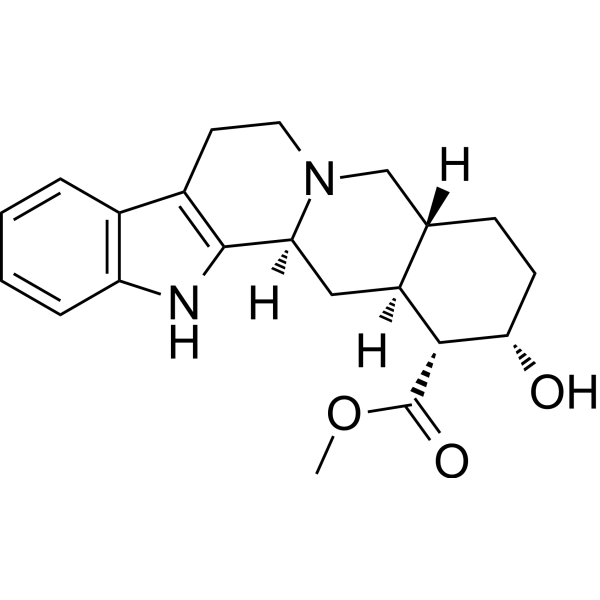
育亨宾是一种吲哚生物碱,具有α2-肾上腺素受体拮抗活性。它由非洲楝树(Corynanthe johimbe)和蛇根木(Rauwolfia serpentina)产生。它可作为α-肾上腺素能拮抗剂、5-羟色胺能拮抗剂和多巴胺D2受体拮抗剂发挥作用。其功能与育亨宾酸相关。
育亨宾是一种具有α2-肾上腺素能阻断活性的植物生物碱。它曾被用作散瞳剂和治疗阳痿。它也被认为具有催情作用。 育亨宾是一种吲哚生物碱,提取自中非育亨宾树(Pausinystalia yohimbe)的树皮,广泛用于治疗勃起功能障碍。育亨宾的使用与偶发的严重不良事件相关,但尚未发现与血清酶升高或临床上明显的急性肝损伤有关。 据报道,育亨宾存在于云南萝芙木(Rauvolfia yunnanensis)、蛇根萝芙木(Rauvolfia serpentina)和其他有相关数据的生物体中。 育亨宾是一种具有α2-肾上腺素能阻断活性的植物生物碱。它曾被用作散瞳剂和治疗勃起功能障碍。 另见:盐酸育亨宾(有盐形式)……查看更多…… 药物适应症 用作拟交感神经药和散瞳剂。育亨宾已成功用于治疗血管性、糖尿病性或心理性男性阳痿患者。 作用机制 育亨宾是一种突触前α2-肾上腺素能阻滞剂。其治疗阳痿的确切机制尚未完全阐明。然而,育亨宾可能通过阻断中枢α2-肾上腺素能受体,进而增加去甲肾上腺素释放和脑内去甲肾上腺素能核团细胞放电频率,从而增强交感神经兴奋,进而改善勃起功能。育亨宾介导的阴茎海绵体组织去甲肾上腺素释放也可能参与其中。此外,其有益作用可能还涉及其他神经递质,例如多巴胺和血清素以及胆碱能受体。 药效学 育亨宾是一种吲哚烷基胺生物碱,其化学结构与利血平相似。育亨宾可阻断突触前α2肾上腺素能受体。它对周围血管的作用类似于利血平,但作用较弱且持续时间较短。育亨宾对周围自主神经系统的作用是增强副交感神经(胆碱能)活性并降低交感神经(肾上腺素能)活性。值得注意的是,在男性性功能方面,勃起与胆碱能活性和α2肾上腺素能受体阻滞有关,理论上这可能导致阴茎血流量增加、阴茎血流量减少或两者兼有。育亨宾对情绪有兴奋作用,并可能加剧焦虑。尽管这些作用似乎需要高剂量的药物,但尚未对其进行充分研究或与剂量相关的研究。育亨宾具有轻微的抗利尿作用,可能是通过刺激下丘脑中枢和释放垂体后叶激素实现的。据报道,育亨宾对心脏刺激和其他由β-肾上腺素能受体介导的作用没有显著影响。它对血压的影响(如果有的话)是降低血压;然而,目前尚无充分的研究来量化育亨宾剂量对血压的影响。 在本研究中,育亨宾被用作药理学工具来阻断人血小板上的α2-肾上腺素能受体。 其抑制作用表明,肾上腺素和花生四烯酸之间的协同血小板聚集是通过α2-肾上腺素能受体激活介导的。[1] |
| 分子式 |
C21H26N2O3
|
|---|---|
| 分子量 |
354.45
|
| 精确质量 |
354.194
|
| 元素分析 |
C, 71.16; H, 7.39; N, 7.90; O, 13.54
|
| CAS号 |
146-48-5
|
| 相关CAS号 |
Yohimbine-13C,d3;1261254-59-4;Yohimbine-d3;133146-00-6;Yohimbine Hydrochloride;65-19-0
|
| PubChem CID |
8969
|
| 外观&性状 |
Typically exists as solid at room temperature
|
| 密度 |
1.3±0.1 g/cm3
|
| 沸点 |
543.0±50.0 °C at 760 mmHg
|
| 熔点 |
231-233 °C(lit.)
|
| 闪点 |
282.2±30.1 °C
|
| 蒸汽压 |
0.0±1.5 mmHg at 25°C
|
| 折射率 |
1.661
|
| LogP |
2.2
|
| tPSA |
65.56
|
| 氢键供体(HBD)数目 |
2
|
| 氢键受体(HBA)数目 |
4
|
| 可旋转键数目(RBC) |
2
|
| 重原子数目 |
26
|
| 分子复杂度/Complexity |
555
|
| 定义原子立体中心数目 |
5
|
| SMILES |
[H][C@]12C(NC3=C4C=CC=C3)=C4CCN1C[C@@]5(CC[C@H](O)[C@H](C(OC)=O)[C@]5(C2)[H])[H]
|
| InChi Key |
BLGXFZZNTVWLAY-SCYLSFHTSA-N
|
| InChi Code |
InChI=1S/C21H26N2O3/c1-26-21(25)19-15-10-17-20-14(13-4-2-3-5-16(13)22-20)8-9-23(17)11-12(15)6-7-18(19)24/h2-5,12,15,17-19,22,24H,6-11H2,1H3/t12-,15-,17-,18-,19+/m0/s1
|
| 化学名 |
methyl (1S,15R,18S,19R,20S)-18-hydroxy-1,3,11,12,14,15,16,17,18,19,20,21-dodecahydroyohimban-19-carboxylate
|
| HS Tariff Code |
2934.99.9001
|
| 存储方式 |
Powder -20°C 3 years 4°C 2 years In solvent -80°C 6 months -20°C 1 month |
| 运输条件 |
Room temperature (This product is stable at ambient temperature for a few days during ordinary shipping and time spent in Customs)
|
| 溶解度 (体外实验) |
DMSO : ~5 mg/mL (~14.11 mM)
H2O : ~1 mg/mL (~2.82 mM) |
|---|---|
| 溶解度 (体内实验) |
配方 1 中的溶解度: ≥ 0.5 mg/mL (1.41 mM) (饱和度未知) in 10% DMSO + 40% PEG300 + 5% Tween80 + 45% Saline (这些助溶剂从左到右依次添加,逐一添加), 澄清溶液。
例如,若需制备1 mL的工作液,可将100 μL 5.0 mg/mL澄清DMSO储备液加入400 μL PEG300中,混匀;然后向上述溶液中加入50 μL Tween-80,混匀;加入450 μL生理盐水定容至1 mL。 *生理盐水的制备:将 0.9 g 氯化钠溶解在 100 mL ddH₂O中,得到澄清溶液。 配方 2 中的溶解度: ≥ 0.5 mg/mL (1.41 mM) (饱和度未知) in 10% DMSO + 90% (20% SBE-β-CD in Saline) (这些助溶剂从左到右依次添加,逐一添加), 澄清溶液。 例如,若需制备1 mL的工作液,可将 100 μL 5.0 mg/mL 澄清 DMSO 储备液加入 900 μL 20% SBE-β-CD 生理盐水溶液中,混匀。 *20% SBE-β-CD 生理盐水溶液的制备(4°C,1 周):将 2 g SBE-β-CD 溶解于 10 mL 生理盐水中,得到澄清溶液。 View More
配方 3 中的溶解度: ≥ 0.5 mg/mL (1.41 mM) (饱和度未知) in 10% DMSO + 90% Corn Oil (这些助溶剂从左到右依次添加,逐一添加), 澄清溶液。 1、请先配制澄清的储备液(如:用DMSO配置50 或 100 mg/mL母液(储备液)); 2、取适量母液,按从左到右的顺序依次添加助溶剂,澄清后再加入下一助溶剂。以 下列配方为例说明 (注意此配方只用于说明,并不一定代表此产品 的实际溶解配方): 10% DMSO → 40% PEG300 → 5% Tween-80 → 45% ddH2O (或 saline); 假设最终工作液的体积为 1 mL, 浓度为5 mg/mL: 取 100 μL 50 mg/mL 的澄清 DMSO 储备液加到 400 μL PEG300 中,混合均匀/澄清;向上述体系中加入50 μL Tween-80,混合均匀/澄清;然后继续加入450 μL ddH2O (或 saline)定容至 1 mL; 3、溶剂前显示的百分比是指该溶剂在最终溶液/工作液中的体积所占比例; 4、 如产品在配制过程中出现沉淀/析出,可通过加热(≤50℃)或超声的方式助溶; 5、为保证最佳实验结果,工作液请现配现用! 6、如不确定怎么将母液配置成体内动物实验的工作液,请查看说明书或联系我们; 7、 以上所有助溶剂都可在 Invivochem.cn网站购买。 |
| 制备储备液 | 1 mg | 5 mg | 10 mg | |
| 1 mM | 2.8213 mL | 14.1064 mL | 28.2127 mL | |
| 5 mM | 0.5643 mL | 2.8213 mL | 5.6425 mL | |
| 10 mM | 0.2821 mL | 1.4106 mL | 2.8213 mL |
1、根据实验需要选择合适的溶剂配制储备液 (母液):对于大多数产品,InvivoChem推荐用DMSO配置母液 (比如:5、10、20mM或者10、20、50 mg/mL浓度),个别水溶性高的产品可直接溶于水。产品在DMSO 、水或其他溶剂中的具体溶解度详见上”溶解度 (体外)”部分;
2、如果您找不到您想要的溶解度信息,或者很难将产品溶解在溶液中,请联系我们;
3、建议使用下列计算器进行相关计算(摩尔浓度计算器、稀释计算器、分子量计算器、重组计算器等);
4、母液配好之后,将其分装到常规用量,并储存在-20°C或-80°C,尽量减少反复冻融循环。
计算结果:
工作液浓度: mg/mL;
DMSO母液配制方法: mg 药物溶于 μL DMSO溶液(母液浓度 mg/mL)。如该浓度超过该批次药物DMSO溶解度,请首先与我们联系。
体内配方配制方法:取 μL DMSO母液,加入 μL PEG300,混匀澄清后加入μL Tween 80,混匀澄清后加入 μL ddH2O,混匀澄清。
(1) 请确保溶液澄清之后,再加入下一种溶剂 (助溶剂) 。可利用涡旋、超声或水浴加热等方法助溶;
(2) 一定要按顺序加入溶剂 (助溶剂) 。
| NCT Number | Recruitment | interventions | Conditions | Sponsor/Collaborators | Start Date | Phases |
| NCT06018727 | Not yet recruiting | Dietary Supplement: Yohimbine Drug: Hydrocortisone |
Borderline Personality Disorder | University of North Carolina, Chapel Hill |
March 2024 | Phase 4 |
| NCT00958880 | Completed | Drug: Yohimbine Hydrochloride Drug: Sugar Pill |
Social Anxiety Disorder | Southern Methodist University | March 2009 | Phase 3 |
| NCT00078715 | Completed | Drug: Yohimbine hydrochloride Drug: Placebo |
Depression, Involutional Major Depresssion |
National Institute of Mental Health (NIMH) |
March 2004 | Phase 2 |
InvivoChem的所有产品仅用于作科学研究,不面向患者销售
Copyright 2020 InvivoChem LLC | All Rights Reserved 粤ICP备20063088号-1


 粤公网安备 44011102003439号
 463611831
