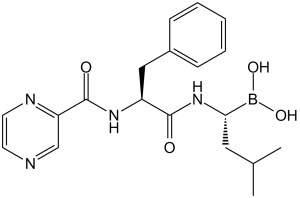
Bortezomib (PS-341; Velcade)

别名: NSC 681239; PS-341; PS341; MLN-341; PS 341; LDP-341; LDP 341; LDP341; MLN341; PS-341; Bortezomib (PS-341); Ps 341; Bortezomib accord; MLN 341. Brand name: VELCADE 硼替佐米;保特佐米;[(1R)-3-甲基-1-[[(2S)-1-氧-3-苯基-2-[(吡嗪甲酰)氨基]丙基]氨基]丁基]-硼酸; 包特左米;保特佐米,硼替佐米;Bortezomib (PS-341) ;硼替佐米 保特佐米;硼替佐米Bortezomib;硼替佐米Bortezomib万珂;硼替佐米标准品;硼替佐米杂质;硼替佐米杂质及标准品;N-(2-吡嗪羰基)-L-苯丙氨酸-L-亮氨酸硼酸
目录号: V0684 纯度: ≥98%
Bortezomib(以前也称为 PS-341;商品名 Velcade 等)是一种二肽硼酸衍生物,是一种细胞渗透性、可逆性、强效、高选择性的 20S 蛋白酶体抑制剂,具有潜在的抗肿瘤活性。
Bortezomib (PS-341; Velcade) CAS号: 179324-69-7
产品类别: Proteasome
产品仅用于科学研究,不针对患者销售
规格 价格 库存 数量
10 mM * 1 mL in DMSO
1mg
5mg
10mg
50mg
100mg
250mg
500mg
1g
Other Sizes

Other Forms of Bortezomib (PS-341; Velcade):

  • Bortezomib-d8 (PS-341-d8; LDP-341-d8; NSC 681239-d8)
点击了解更多
InvivoChem产品被CNS等顶刊论文引用
纯度/质量控制文件

纯度: ≥98%

纯度: ≥98%

产品描述
硼替佐米(以前也称为 PS-341;商品名 Velcade 等)是一种二肽硼酸衍生物,是一种细胞渗透性、可逆性、强效、高选择性的 20S 蛋白酶体抑制剂,具有潜在的抗肿瘤活性。在无细胞测定中,它抑制 20S 蛋白酶体,Ki 为 0.6 nM。泛素-蛋白酶体途径在参与细胞周期控制和肿瘤生长的蛋白质的调节降解中发挥着关键作用。这些蛋白质的降解失调会对肿瘤生长产生深远的影响,并导致细胞凋亡。作为一种有效的20S蛋白酶体抑制剂,硼替佐米具有潜在的抗肿瘤活性,并于2003年在美国和欧洲被批准用于治疗复发性多发性骨髓瘤和套细胞淋巴瘤。硼替佐米可逆地抑制 26S 蛋白酶体,这是一种降解泛素化蛋白质的大型蛋白酶复合物。在体内,硼替佐米可延缓肿瘤生长并增强放疗和化疗的细胞毒性作用。
生物活性&实验参考方法
靶点
NF-κB; 20S proteasome (Ki = 0.6 nM)
26S proteasome (chymotrypsin-like activity, β5 subunit): IC₅₀ ≈ 10 nM (purified bovine 26S proteasome);
- 26S proteasome (trypsin-like activity, β2 subunit): IC₅₀ > 1000 nM (no significant inhibition);
- 26S proteasome (caspase-like activity, β1 subunit): IC₅₀ ≈ 1000 nM (weak inhibition);
- High selectivity for the β5 subunit over other proteasome subunits and non-proteasomal proteases (e.g., calpain, cathepsin B: IC₅₀ > 10,000 nM) [4]
体外研究 (In Vitro)
硼替佐米是一种硼酸二肽,是 26S 蛋白酶体的高选择性、可逆抑制剂,其主要功能是降解错误折叠的蛋白质,对于细胞周期的调节至关重要。研究表明,接触硼替佐米可以稳定 p21、p27 和 p53,以及促凋亡 Bid 和 Bax 蛋白、caveolin-1 和抑制剂 κB-α,从而防止核因子 κB 诱导的细胞存活途径的激活。 Bortezomib 还促进促凋亡 c-Jun-NH2 末端激酶的激活以及内质网应激反应。这些细胞蛋白水平的改变会抑制癌细胞的增殖、迁移和促进细胞凋亡。硼替佐米可渗透到细胞中,抑制蛋白酶体介导的长寿命蛋白质的细胞内蛋白水解,浓度约为 0.1 μM,可抑制 50% 的蛋白水解。在来自美国国家癌症研究所 (NCI) 的多种人类肿瘤的整个 60 个癌细胞系中,硼替佐米的 50% 平均生长抑制值为 7 nM。用 Bortezomib (100 nM) 处理 PC-3 细胞 8 小时,导致 G2-M 细胞积累,G1 细胞数量相应减少。 Bortezomib 在 24 小时和 48 小时杀死 PC-3 细胞,IC50 分别为 100 和 20 nM。硼替佐米在治疗后 16-24 小时诱导核凝结。 Bortezomib 处理导致 PARP 以时间依赖性方式裂解,浓度低至 100 nM 在 24 小时内有效。激酶测定:典型的动力学运行,将 2.00 mL 测定缓冲液(20 mM HEPES、0.5 mM EDTA、0.035% SDS、pH 7.8)和 DMSO 中的 Suc-Leu-Leu-Val-Tyr-AMC 添加到 3 mL 荧光管中比色皿,将比色皿置于荧光分光光度计的带夹套的比色池支架中。通过循环水浴将反应温度维持在37℃。反应液达到热平衡后(5分钟),将1 μL−10 μL酶原液加入比色皿中。通过伴随 AMC 从肽-AMC 底物上裂解而产生的 440 nm (λex= 380 nm) 荧光发射的增加来监测反应进度。细胞测定:通过测量细胞的MTT染料吸光度来评估硼替佐米对细胞生长的抑制作用。在 48 小时培养的最后 4 小时,将来自 48 小时培养的细胞(人多发性骨髓瘤细胞系 U266)用 10 µL 5 mg/mL MTT 脉冲到每个孔中,然后加入 100 µL 含有 0.04 N HCl 的异丙醇。使用分光光度计在 570 nm 处测量吸光度。
血液系统癌细胞抗增殖活性:
1. 多发性骨髓瘤(MM)细胞系(RPMI 8226、U266):Bortezomib(0.1 nM–100 nM,72小时MTT法)浓度依赖性抑制增殖。IC₅₀:RPMI 8226约5 nM,U266约8 nM。20 nM浓度下,RPMI 8226细胞活力较溶剂对照组降低~70%[1]
2. 套细胞淋巴瘤(MCL)细胞系(Granta-519):IC₅₀≈12 nM(72小时MTT法);10 nM Bortezomib使软琼脂克隆形成率降低~80%[1]
- 实体瘤细胞抗增殖活性:
1. 非小细胞肺癌(A549)、结肠癌(HT29)、乳腺癌(MDA-MB-231)细胞:Bortezomib IC₅₀:A549约20 nM,HT29约25 nM,MDA-MB-231约18 nM(72小时MTT法)[3]
- 凋亡诱导(文献[1]、[5]):
1. RPMI 8226细胞:10 nM Bortezomib处理48小时后,凋亡率从对照组的~5%升至~40%(Annexin V-FITC/PI染色,流式细胞术)。Western blot显示活化caspase-3和活化PARP分别上调约3倍和2.5倍[1]
2. A549细胞:20 nM Bortezomib处理72小时,~35%细胞发生凋亡;TUNEL染色证实DNA片段化[3]
- NF-κB通路抑制:
1. HT29细胞:15 nM Bortezomib处理6小时可阻断TNF-α诱导的NF-κB激活。Western blot显示,由于蛋白酶体降解减少,IκBα(NF-κB抑制剂)蛋白水平上调约4倍[5]
- 对正常细胞的选择性:
1. 正常人外周血单核细胞(PBMC):50 nM Bortezomib处理72小时,活力降低<15%;而相同浓度下MM细胞(RPMI 8226)活力降低~60%[6]
体内研究 (In Vivo)
硼替佐米作为单药的抗癌作用已在多发性骨髓瘤、成人 T 细胞白血病、肺癌、乳腺癌、前列腺癌、胰腺癌、头颈癌、结肠癌以及黑色素瘤的异种移植模型中得到证实。每天口服硼替佐米 1.0 mg/kg,持续 18 天会导致肿瘤生长延迟,并减少 Lewis 肺癌模型中的转移数量。单剂量高达 5 mg/kg 的硼替佐米显着降低了乳腺肿瘤细胞的存活率。在前列腺癌小鼠异种移植模型中,每周给予硼替佐米 1.0 mg/kg,持续 4 周,可使肿瘤生长减少 60%。 1.0 mg/kg Bortezomib 给药 4 周可导致胰腺癌小鼠异种移植物生长减少 72% 或 84%,并增加肿瘤细胞凋亡。 1.0 mg/kg Bortezomib 治疗可显着抑制人浆细胞瘤异种移植物的生长,增加肿瘤细胞凋亡和总体存活率,并减少肿瘤血管生成。
裸鼠RPMI 8226多发性骨髓瘤异种移植模型:
1. 分组:小鼠(n=6/组)随机分为3组:(1)对照组(静脉注射5% DMSO+95%生理盐水);(2)Bortezomib 0.5 mg/kg组;(3)Bortezomib 1.0 mg/kg组[1]
2. 给药方案:每3天静脉注射1次,持续4周(共8次给药)[1]
3. 疗效:
- 肿瘤体积:第28天较对照组分别减少~60%(0.5 mg/kg)和~80%(1.0 mg/kg);
- 肿瘤重量:处死时较对照组分别降低~55%(0.5 mg/kg)和~75%(1.0 mg/kg);
- 肿瘤蛋白酶体活性:β5亚基活性分别降低~45%(0.5 mg/kg)和~65%(1.0 mg/kg)(荧光底物法)[1]
- CD-1裸鼠A549肺癌异种移植模型:
1. 给药方案:Bortezomib 0.8 mg/kg(腹腔注射,每周2次,持续3周)[3]
2. 疗效:第21天肿瘤体积较对照组减少~50%,无显著体重下降[3]
- 小鼠套细胞淋巴瘤(MCL)异种移植模型:
1. 给药方案:Bortezomib 1.0 mg/kg(静脉注射,每4天1次,持续3周)[6]
2. 疗效:肿瘤生长延迟约14天;肿瘤凋亡指数(TUNEL染色)上调约3倍[6]
酶活实验
在典型的动力学运行中,将 DMSO 中的 Suc-Leu-Leu-Val-Tyr-AMC 和 2.00 mL 测定缓冲液(20 mM HEPES、0.5 mM EDTA、0.035% SDS,pH 7.8)添加到 3 mL 荧光比色皿中。然后将比色皿放置在荧光分光光度计的带夹套的样品池支架中。循环水浴将反应温度保持在37°C。一旦反应溶液达到热平衡,就将一微升到十微升的储备酶溶液添加到比色皿中,这需要五分钟。当 AMC 从肽-AMC 底物上裂解时,在 440 nm (λex= 380 nm) 处荧光发射的程度增加表明反应的进展情况。
26S蛋白酶体活性抑制实验:
1. 蛋白制备:通过超速离心和离子交换层析从牛红细胞中纯化26S蛋白酶体,重悬于实验缓冲液(25 mM Tris-HCl,pH7.5,5 mM MgCl₂,1 mM DTT)[4]
2. 反应体系:100 μL反应混合物含26S蛋白酶体(0.5 μg)、荧光底物(β5亚基:Suc-LLVY-AMC;β2亚基:Z-ARR-AMC;β1亚基:Z-nLPnLD-AMC)及Bortezomib(0.1 nM–10,000 nM,溶剂为对照)[4]
3. 检测:37℃孵育60分钟,测定荧光强度(激发光380 nm,发射光460 nm)。抑制率=(1–药物组荧光强度/对照组荧光强度)×100%[4]
4. 数据分析:将抑制率拟合至四参数逻辑斯蒂曲线,计算IC₅₀值[4]
- 非蛋白酶体蛋白酶抑制实验:
1. 对牛脑钙蛋白酶和大鼠肝组织蛋白酶B的抑制实验,使用各自荧光底物(钙蛋白酶:Suc-LLVY-AMC;组织蛋白酶B:Z-Arg-Arg-AMC)及Bortezomib(1 nM–10,000 nM)[4]
细胞实验
细胞的MTT染料吸光度用于测量硼替佐米对细胞生长的抑制作用。在 48 小时培养的最后 4 小时,每孔中用 10 μL 5 mg/mL MTT 脉冲细胞。随后加入 100 μL 含有 0.04 N HCl 的异丙醇。用分光光度计在 570 nm 处测定吸光度。
硼替佐米预处理使多发性骨髓瘤、髓性白血病和肾癌细胞敏感,但对TRAIL/ apo2l诱导的细胞凋亡没有作用。在体内实验中,将骨髓和肾癌细胞混合物(含或不含硼替佐米和/或TRAIL/Apo2L)移植到小鼠骨髓中。所有接受TRAIL/Apo2L治疗的小鼠在35天内死于白血病,而接受硼替佐米治疗的小鼠中有50%的细胞存活超过100天,而同时接受TRAIL/Apo2L和硼替佐米治疗的小鼠中有90%的细胞存活超过100天。[2]
硼替佐米通过抑制NF-κB,不仅促进癌细胞凋亡,而且使这些细胞对化疗、放疗或免疫治疗敏感。然而,由于仅通过PS-1145特异性抑制NF-κB只能部分抑制肿瘤细胞的增殖,硼替佐米的细胞毒活性还必须依赖于对其他信号转导途径靶点的改变调节。[2]
有趣的是,对蛋白酶体抑制的敏感性部分依赖于体外乳腺癌和肺癌的p53状态,但硼替佐米诱导的凋亡和/或化疗增敏在前列腺、多发性骨髓瘤和结肠癌细胞中是p53独立的。因此,与p53状态相关的硼替佐米敏感性的变化程度似乎依赖于细胞类型。[2]
最近发表的一项研究发现,硼替佐米可阻止多发性骨髓瘤细胞中caveolin-1的活化。[2]
MTT抗增殖实验(文献[1]、[3]):
1. 细胞接种:RPMI 8226/A549/HT29细胞以5×10³个细胞/孔接种于96孔板,使用含10% FBS的RPMI 1640完全培养基[1][3]
2. 药物处理:加入Bortezomib(0.1 nM–100 nM,每个浓度6个复孔),37℃、5% CO₂孵育72小时[1][3]
3. 活力检测:每孔加入20 μL MTT溶液(5 mg/mL PBS配制),孵育4小时。吸弃上清,加入150 μL DMSO溶解甲臜结晶,测定570 nm处吸光度,通过GraphPad Prism计算IC₅₀[1][3]
- 凋亡实验(Annexin V-FITC/PI法,文献[1]):
1. 细胞处理:RPMI 8226细胞(2×10⁵个细胞/孔,6孔板)用Bortezomib(0 nM–20 nM)处理48小时[1]
2. 染色:收集细胞,冷PBS洗涤,重悬于结合缓冲液,加入5 μL Annexin V-FITC和5 μL PI,避光染色15分钟[1]
3. 分析:流式细胞术量化凋亡细胞(Annexin V+/PI-:早期凋亡;Annexin V+/PI+:晚期凋亡)[1]
- NF-κB通路Western blot实验:
1. 细胞处理:HT29细胞血清饥饿过夜,用Bortezomib(0 nM–20 nM)处理6小时,再用TNF-α(10 ng/mL)刺激30分钟[5]
2. 裂解液制备:用含蛋白酶抑制剂的RIPA缓冲液裂解细胞,BCA法测定蛋白浓度[5]
3. 免疫印迹:每泳道上样30 μg蛋白,SDS-PAGE分离后转印至PVDF膜,用抗IκBα、抗磷酸化IκBα及β-actin抗体孵育,ECL化学发光显影[5]
动物实验
人浆细胞瘤异种移植模型 RPMI 8226
1 mg/kg
静脉注射,每周两次,持续4周,之后每周一次
对携带PC-3肿瘤的小鼠进行每周一次的PS-341静脉注射治疗后,体内观察到肿瘤负荷显著降低(60%)。将PS-341直接注射到肿瘤内也导致肿瘤体积显著缩小(70%),40%的药物治疗小鼠在研究结束时未检测到肿瘤。研究还表明,静脉注射PS-341可使其快速广泛分布,在肝脏和胃肠道中的浓度最高,在皮肤和肌肉中的浓度最低。在前列腺中检测到少量药物,而未观察到药物明显渗透到中枢神经系统。建立了一种追踪PS-341生物活性的检测方法,并用其测定了药物的瞬时活性及其组织渗透能力。因此,PS-341 被证实能够穿透 PC-3 肿瘤细胞,并在静脉给药 1 小时后抑制细胞内蛋白酶体的活性。这些数据表明,PS-341 不仅能够到达其生物靶点,而且能够直接作用于其生化靶点——蛋白酶体。重要的是,数据表明,PS-341 对该靶点的抑制作用能够降低小鼠肿瘤模型中的肿瘤生长。综上所述,这些结果强调了蛋白酶体是一种新型的生化靶点,而像 PS-341 这样的抑制剂代表了一类独特的抗肿瘤药物。 PS-341 目前正在进行晚期癌症的临床评估。[1]
裸鼠 RPMI 8226 多发性骨髓瘤异种移植方案:
1. 动物饲养:雌性裸鼠(6-8 周龄,18-22 克),饲养于 SPF 级动物房(22-25°C,12 小时光照/黑暗循环)[1]
2. 肿瘤植入:将 RPMI 8226 细胞(5×10⁶ 个细胞/只小鼠)重悬于 100 μL PBS/Matrigel (1:1) 混合液中,皮下注射至小鼠右侧腹部[1]
3. 分组/治疗:肿瘤体积达到约 100 mm³(第 0 天)时,随机分为 3 组:(1)对照组:静脉注射溶剂(10 μL/g 体重);(2)硼替佐米组:0.5 mg/kg; (3) 硼替佐米 1.0 mg/kg,每 3 天给药一次,持续 4 周 [1]
4. 监测:每 3 天测量一次肿瘤体积(体积 = 长 × 宽² / 2)。小鼠用二氧化碳处死;切除肿瘤进行蛋白酶体活性测定 [1]
- 裸鼠 A549 肺癌模型:
1. 肿瘤植入:将 A549 细胞(2×10⁶ 个细胞/只小鼠)重悬于 100 μL PBS/Matrigel (1:1) 混合液中,皮下注射 [3]
2. 治疗:硼替佐米 0.8 mg/kg(溶于 5% DMSO + 95% 生理盐水),每周两次腹腔注射,持续 3 周 [3]
3. 监测:每周测量一次肿瘤体积和体重 [3]
药代性质 (ADME/PK)
吸收、分布和排泄
静脉注射1 mg/m2和1.3 mg/m2剂量后,硼替佐米的平均Cmax分别为57 ng/mL和112 ng/mL。在每周两次的给药方案中,1 mg/m2剂量下的Cmax范围为67至106 ng/mL,1.3 mg/m2剂量下的Cmax范围为89至120 ng/mL。在多发性骨髓瘤患者中,皮下注射硼替佐米后的Cmax低于静脉注射;然而,两种给药途径的药物总全身暴露量相当。药物血浆浓度存在显著的个体差异。
硼替佐米主要通过肾脏和肝脏途径清除。
在接受单次或重复给药1 mg/m²或1.3 mg/m²的多发性骨髓瘤患者中,硼替佐米的平均分布容积约为498至1884 L/m²。硼替佐米几乎分布于所有组织,脂肪组织和脑组织除外。
首次给药1 mg/m²和1.3 mg/m²后,平均全身清除率分别为102 L/h和112 L/h。在分别给予1 mg/m²和1.3 mg/m²剂量后,清除率分别为15 L/h和32 L/h。
对24例多发性骨髓瘤患者(每剂量组12例)静脉注射1 mg/m²和1.3 mg/m²剂量后,首次给药(第1天)后硼替佐米的平均最大血浆浓度(Cmax)分别为57 ng/mL和112 ng/mL。
在后续每周两次给药的情况下,1 mg/m²剂量组的平均最大血浆浓度范围为67至106 ng/mL,1.3 mg/m²剂量组为89至120 ng/mL。多次给药后,硼替佐米的平均消除半衰期在1 mg/m²剂量后为40至193小时,在1.3 mg/m²剂量后为76至108小时。首次给药后,1 mg/m²和1.3 mg/m²剂量组的平均全身清除率分别为102 L/hr和112 L/hr;后续给药后,1 mg/m²和1.3 mg/m²剂量组的平均全身清除率分别为15至32 L/hr。
对多发性骨髓瘤患者单次或多次给药1 mg/m²或1.3 mg/m²后,硼替佐米的平均分布容积约为498至1884 L/m²。这表明硼替佐米广泛分布于外周组织。在 100 至 1000 ng/mL 的浓度范围内,硼替佐米与人血浆蛋白的平均结合率为 83%。
目前尚不清楚硼替佐米是否会分泌到人乳中。
如需了解更多关于硼替佐米(共 6 项)的吸收、分布和排泄(完整)数据,请访问 HSDB 记录页面。
代谢/代谢物
硼替佐米主要通过 CYP3A4、CYP2C19 和 CYP1A2 代谢。CYP2D6 和 CYP2C9 也参与药物代谢,但程度较小。氧化脱硼(即从母体化合物中去除硼酸)是主要的代谢途径。硼替佐米的代谢产物不具有药理活性,在人体和动物研究中已鉴定出30多种代谢产物。
体外研究表明,硼替佐米主要通过细胞色素P450酶3A4、2C19和1A2进行氧化代谢,而CYP 2D6和2C9酶的代谢作用较弱。主要的代谢途径是脱硼,生成两种脱硼代谢产物,随后羟基化生成多种代谢产物。脱硼的硼替佐米代谢产物不具有26S蛋白酶体抑制剂的活性。汇总8例患者给药后10分钟和30分钟的血浆数据显示,代谢物的血浆浓度与母体药物相比较低。
……在人肝微粒体中,对硼替佐米及其主要脱硼代谢物M1和M2以及它们的脱烷基代谢物M3和M4抑制主要P450同工酶1A2、2C9、2C19、2D6和3A4/5的潜力进行了评估。结果发现,硼替佐米、M1和M2是CYP2C19的弱抑制剂(IC50分别约为18.0、10.0和13.2 μM),M1也是CYP2C9的弱抑制剂(IC50约为11.5 μM)。然而,硼替佐米及其代谢物M1、M2、M3和M4均不抑制其他P450酶(IC50值>30 μM)。硼替佐米及其主要代谢物对CYP3A4/5也无时间依赖性抑制作用。……
……硼替佐米通过硼酸部分与蛋白酶体结合,因此,该部分的存在是实现蛋白酶体抑制的必要条件。采用液相色谱/质谱联用(LC/MS)和液相色谱/串联质谱(LC/MS/MS)对单次静脉注射硼替佐米的患者血浆中的代谢物进行鉴定和表征。使用经LC/MS/MS和高场核磁共振波谱(NMR)表征的合成代谢物标准品来确认代谢物结构。观察到的主要生物转化途径是氧化脱硼,最显著的是生成一对非对映异构的氨基甲酰胺代谢物。亮氨酸和苯丙氨酸部分的进一步代谢分别产生叔羟基化代谢物和苄位羟基化代谢物。此外,还观察到氨基甲酰胺转化为相应的酰胺和羧酸。人肝微粒体能够很好地模拟硼替佐米的体内代谢,因为在体外观察到了主要的循环代谢物。利用cDNA表达的细胞色素P450同工酶,确定了多种同工酶参与硼替佐米的代谢,包括CYP3A4、CYP2C19、CYP1A2、CYP2D6和CYP2C9。 ...
生物半衰期
在以 1 mg/m 2 剂量进行多次给药方案后,硼替佐米的平均消除半衰期为 40 至 193 小时。多次给予1.3 mg/m²硼替佐米后,其半衰期为76至108小时。
多次给药后,1 mg/m²剂量组的平均消除半衰期为40至193小时,1.3 mg/m²剂量组的平均消除半衰期为76至108小时。
血浆蛋白结合率:~95%(人血浆,37°C平衡透析)[6]
- 小鼠静脉注射药代动力学:
1. Cmax:~80 ng/mL(1.0 mg/kg静脉注射,给药后5分钟);
2. 末端半衰期(t₁/₂):~1.2小时;
3. 清除率(CL):~15 mL/min/kg [1]
毒性/毒理 (Toxicokinetics/TK)
肝毒性
在硼替佐米的大型临床试验中,血清转氨酶水平升高很常见,约 10% 的患者出现这种情况。然而,超过正常值上限 (ULN) 5 倍以上的数值很少见,仅在以下情况下出现:
硼替佐米通常与其他化疗药物(包括环磷酰胺和地塞米松)联合使用,这些药物可能导致乙型肝炎病毒再激活。然而,目前尚无单独使用硼替佐米导致乙型肝炎病毒再激活的报道。
可能性评分:C(可能是临床上明显的药物性肝损伤的原因)。
蛋白结合
在 100 至 1000 ng/mL 的浓度范围内,硼替佐米与人血浆蛋白的结合率约为 83%。
药物相互作用
据报道,接受硼替佐米治疗的糖尿病患者在同时服用口服降糖药时会出现低血糖和高血糖。如果硼替佐米与口服降糖药合用,应密切监测血糖浓度,并根据需要调整降糖药的剂量。
硼替佐米与可引起周围神经病变的其他药物(例如胺碘酮、抗病毒药物、异烟肼、呋喃妥因、羟甲基戊二酰辅酶A [HMG-CoA] 还原酶抑制剂[他汀类药物])合用时,可能存在相互作用(增加周围神经病变的风险)。
硼替佐米与可引起低血压的药物合用时,可能存在相互作用(增加低血压的风险)。可能需要调整降压药的剂量。
……在一项临床前毒理学研究中,硼替佐米治疗的大鼠出现肝脏肿大(35%)。离体肝脏样本分析显示,细胞色素P450 (P450) 含量下降18%,棕榈酰辅酶A β-氧化活性增加60%,CYP3A蛋白表达和活性分别下降41%和23%。此外,硼替佐米治疗大鼠的肝脏样本中CYP2B和CYP4A蛋白水平和活性几乎没有变化。为了评估临床药物相互作用的可能性,本研究在人肝微粒体中评估了硼替佐米及其主要脱硼代谢物M1和M2以及它们的脱烷基代谢物M3和M4对主要P450同工酶1A2、2C9、2C19、2D6和3A4/5的抑制潜力。研究发现,硼替佐米、M1 和 M2 是 CYP2C19 的弱抑制剂(IC50 值分别约为 18.0、10.0 和 13.2 μM),M1 也是 CYP2C9 的弱抑制剂(IC50 值约为 11.5 μM)。然而,硼替佐米、M1、M2、M3 和 M4 对其他 P450 酶没有抑制作用(IC50 值 > 30 μM)。硼替佐米及其主要代谢物对 CYP3A4/5 也无时间依赖性抑制作用。基于这些结果,预计硼替佐米及其主要代谢物不会引起严重的 P450 介导的临床药物相互作用。 ...
体外毒性:
1.正常人外周血单核细胞:50 nM硼替佐米处理72小时后,细胞活力降低<15%;未见明显细胞凋亡(Annexin V染色)[6]
-小鼠体内毒性(文献[1],[2]):
1.急性毒性:单次静脉注射2.0 mg/kg硼替佐米未导致死亡;短暂性体重下降(<5% vs. 基线)在3天内恢复[1]
2.亚急性毒性:1.0 mg/kg硼替佐米(静脉注射,每3天一次,持续4周):
-血清ALT、AST、肌酐和BUN均在正常范围内;
- 肝脏、肾脏或心脏未见组织病理学病变[2]
参考文献

[1]. Cancer Res . 1999 Jun 1;59(11):2615-22.

[2]. Cancer Cell Int . 2005 Jun 1;5(1):18.

[3]. Cancer Res . 2002 Sep 1;62(17):4996-5000.

[4]. Biochemistry . 1996 Apr 2;35(13):3899-908.

[5]. Cancer Res . 2001 Apr 1;61(7):3071-6.

[6]. Am J Cancer Res . 2011;1(7):913-24. Epub 2011 Aug 23.

其他信息
治疗用途
抗肿瘤药;蛋白酶抑制剂
硼替佐米注射液适用于治疗至少接受过一种既往治疗的多发性骨髓瘤患者。/美国产品标签包含/
硼替佐米注射液适用于治疗至少接受过一种既往治疗的套细胞淋巴瘤患者。/美国产品标签包含/
药物警告
已知对硼替佐米、硼或甘露醇过敏者禁用。
硼替佐米主要引起感觉性周围神经病变,但也曾有严重运动性周围神经病变的报道。在III期临床试验中,接受硼替佐米治疗的患者中有36%发生周围神经病变,而接受地塞米松治疗的患者中这一比例为9%。接受硼替佐米治疗的患者中,分别有7%和不到1%的患者出现3级或4级周围神经病变。调整剂量后,51%的2级或以上周围神经病变患者在发病后平均3.5个月内症状得到缓解或消失。约8%的患者因周围神经病变而停止硼替佐米治疗。接受硼替佐米治疗的患者应监测神经病变的表现(例如,灼烧感、感觉过敏、感觉减退、感觉异常、不适、神经性疼痛)。对于出现新发或加重周围神经病变的患者,应调整硼替佐米的剂量和/或给药频率。
在 III 期试验中,接受硼替佐米治疗的患者中有 61% 报告出现乏力(即疲倦、不适、虚弱),而接受地塞米松治疗的患者中有 45% 报告出现乏力。接受硼替佐米治疗的患者中有 12% 出现 3 级乏力,而接受地塞米松治疗的患者中仅有 6% 出现 3 级乏力。接受硼替佐米治疗的患者中约有 3% 因乏力而停止治疗,接受地塞米松治疗的患者中约有 2% 因乏力而停止治疗。
有关硼替佐米(共 26 条)的更多药物警告(完整)数据,请访问 HSDB 记录页面。
药效学
硼替佐米的作用机制是靶向泛素-蛋白酶体通路,该通路是调节细胞内蛋白质浓度并促进蛋白质降解的重要分子通路。泛素-蛋白酶体通路在病理条件下常常失调,导致异常的通路信号传导和恶性细胞的形成。一项研究发现,患者来源的慢性淋巴细胞白血病 (CLL) 细胞中胰凝乳蛋白酶样蛋白酶体的活性水平比正常淋巴细胞高 3 倍。硼替佐米通过可逆性抑制蛋白酶体来阻止蛋白酶体介导的蛋白水解。硼替佐米在体外对多种癌细胞类型具有细胞毒性作用,并在非临床肿瘤模型中延缓体内肿瘤生长。硼替佐米以剂量依赖的方式抑制蛋白酶体活性。在一项药效学研究中,给药后一小时内,全血样本中观察到超过75%的蛋白酶体抑制率。作用机制:硼替佐米是一种首创的蛋白酶体抑制剂,可选择性地与26S蛋白酶体的β5亚基结合,从而阻断泛素化蛋白(例如IκBα、p53)的降解。这会导致促凋亡蛋白的积累和NF-κB(癌症中的一种促生存通路)的抑制,从而诱导癌细胞凋亡[4][5]
- 临床前疗效重点:早期研究针对多发性骨髓瘤和套细胞淋巴瘤(NF-κB活性高),由于其广泛的抗增殖活性,研究范围已扩展到实体瘤(例如肺癌、结肠癌)[1][3][6]
- 临床潜力:文献[2]和[6]指出,硼替佐米具有良好的临床前安全性(正常细胞毒性低)和肿瘤选择性,支持其进入难治性血液系统恶性肿瘤的临床试验[2][6]
- 未提及FDA批准状态(参考文献发表于1996-2011年;硼替佐米于2003年获得FDA批准用于治疗多发性骨髓瘤)[1][2][3][4][5][6]
*注: 文献方法仅供参考, InvivoChem并未独立验证这些方法的准确性
化学信息 & 存储运输条件
分子式
C19H25BN4O4
分子量
384.24
精确质量
384.196
元素分析
C, 59.39; H, 6.56; B, 2.81; N, 14.58; O, 16.66
CAS号
179324-69-7
相关CAS号
Bortezomib-d8
PubChem CID
387447
外观&性状
White solid powder
密度
1.2±0.1 g/cm3
熔点
122-124°C
折射率
1.564
LogP
2.45
tPSA
124.44
氢键供体(HBD)数目
4
氢键受体(HBA)数目
6
可旋转键数目(RBC)
9
重原子数目
28
分子复杂度/Complexity
500
定义原子立体中心数目
2
SMILES
CC(C[C@H](NC([C@@H](NC(C1=CN=CC=N1)=O)CC1=CC=CC=C1)=O)B(O)O)C
InChi Key
GXJABQQUPOEUTA-RDJZCZTQSA-N
InChi Code
InChI=1S/C19H25BN4O4/c1-13(2)10-17(20(27)28)24-18(25)15(11-14-6-4-3-5-7-14)23-19(26)16-12-21-8-9-22-16/h3-9,12-13,15,17,27-28H,10-11H2,1-2H3,(H,23,26)(H,24,25)/t15-,17-/m0/s1
化学名
[(1R)-3-methyl-1-[[(2S)-3-phenyl-2-(pyrazine-2-carbonylamino)propanoyl]amino]butyl]boronic acid
别名
NSC 681239; PS-341; PS341; MLN-341; PS 341; LDP-341; LDP 341; LDP341; MLN341; PS-341; Bortezomib (PS-341); Ps 341; Bortezomib accord; MLN 341. Brand name: VELCADE
HS Tariff Code
2934.99.9001
存储方式

Powder      -20°C    3 years

                     4°C     2 years

In solvent   -80°C    6 months

                  -20°C    1 month

注意: 本产品在运输和储存过程中需避光。
运输条件
Room temperature (This product is stable at ambient temperature for a few days during ordinary shipping and time spent in Customs)
溶解度数据
溶解度 (体外实验)
DMSO: ~76 mg/mL (~197.8 mM)
Water: <1 mg/mL
Ethanol: <1 mg/mL
溶解度 (体内实验)
配方 1 中的溶解度: ≥ 4 mg/mL (10.41 mM) (饱和度未知) in 10% EtOH + 40% PEG300 + 5% Tween80 + 45% Saline (这些助溶剂从左到右依次添加,逐一添加), 澄清溶液。
例如,若需制备1 mL的工作液,可将100 μL 40.0 mg/mL 澄清 EtOH 储备液加入到400 μL PEG300中,混匀;再向上述溶液中加入50 μL Tween-80,混匀;然后加入450 μL 生理盐水定容至1 mL。
*生理盐水的制备:将 0.9 g 氯化钠溶解在 100 mL ddH₂O中,得到澄清溶液。

配方 2 中的溶解度: ≥ 4 mg/mL (10.41 mM) (饱和度未知) in 10% EtOH + 90% (20% SBE-β-CD in Saline) (这些助溶剂从左到右依次添加,逐一添加), 澄清溶液。
例如,若需制备1 mL的工作液,可将 100 μL 40.0mg/mL澄清EtOH储备液加入到900μL 20%SBE-β-CD生理盐水中,混匀。
*20% SBE-β-CD 生理盐水溶液的制备(4°C,1 周):将 2 g SBE-β-CD 溶解于 10 mL 生理盐水中,得到澄清溶液。

View More

配方 3 中的溶解度: ≥ 4 mg/mL (10.41 mM) (饱和度未知) in 10% EtOH + 90% Corn Oil (这些助溶剂从左到右依次添加,逐一添加), 澄清溶液。
例如,若需制备1 mL的工作液,可将 100 μL 40.0 mg/mL 澄清乙醇储备液加入到 900 μL 玉米油中并混合均匀。


配方 4 中的溶解度: ≥ 2.5 mg/mL (6.51 mM) (饱和度未知) in 5% DMSO + 40% PEG300 + 5% Tween80 + 50% Saline (这些助溶剂从左到右依次添加,逐一添加), 澄清溶液。
*生理盐水的制备:将 0.9 g 氯化钠溶解在 100 mL ddH₂O中,得到澄清溶液。

配方 5 中的溶解度: ≥ 2.5 mg/mL (6.51 mM) (饱和度未知) in 5% DMSO + 95% (20% SBE-β-CD in Saline) (这些助溶剂从左到右依次添加,逐一添加), 澄清溶液。

配方 6 中的溶解度: ≥ 2.08 mg/mL (5.41 mM) (饱和度未知) in 10% DMSO + 40% PEG300 + 5% Tween80 + 45% Saline (这些助溶剂从左到右依次添加,逐一添加), 澄清溶液。
例如,若需制备1 mL的工作液,将100 μL 20.8 mg/mL澄清DMSO储备液加入400 μL PEG300中,混匀;然后向上述溶液中加入50 μL Tween-80,混匀;加入450 μL生理盐水定容至1 mL。
*生理盐水的制备:将 0.9 g 氯化钠溶解在 100 mL ddH₂O中,得到澄清溶液。

配方 7 中的溶解度: ≥ 2.08 mg/mL (5.41 mM) (饱和度未知) in 10% DMSO + 90% (20% SBE-β-CD in Saline) (这些助溶剂从左到右依次添加,逐一添加), 澄清溶液。
例如,要配制1 mL工作液,可将100 μL 20.8 mg/mL的澄清DMSO储备液加入到900 μL 20% SBE-β-CD生理盐水溶液中, 混合均匀。
*20% SBE-β-CD 生理盐水溶液的制备(4°C,1 周):将 2 g SBE-β-CD 溶解于 10 mL 生理盐水中,得到澄清溶液。

配方 8 中的溶解度: ≥ 2.08 mg/mL (5.41 mM) (饱和度未知) in 10% DMSO + 90% Corn Oil (这些助溶剂从左到右依次添加,逐一添加), 澄清溶液。
例如,要配制1 mL工作液,可将100 μL 20.8 mg/mL 澄清DMSO 储备液加入900 μL 玉米油中,混匀。

配方 9 中的溶解度: ≥ 0.5 mg/mL (1.30 mM) (饱和度未知) in 1% DMSO 99% Saline (这些助溶剂从左到右依次添加,逐一添加), 澄清溶液。

请根据您的实验动物和给药方式选择适当的溶解配方/方案:
1、请先配制澄清的储备液(如:用DMSO配置50 或 100 mg/mL母液(储备液));
2、取适量母液,按从左到右的顺序依次添加助溶剂,澄清后再加入下一助溶剂。以 下列配方为例说明 (注意此配方只用于说明,并不一定代表此产品 的实际溶解配方):
10% DMSO → 40% PEG300 → 5% Tween-80 → 45% ddH2O (或 saline);
假设最终工作液的体积为 1 mL, 浓度为5 mg/mL: 取 100 μL 50 mg/mL 的澄清 DMSO 储备液加到 400 μL PEG300 中,混合均匀/澄清;向上述体系中加入50 μL Tween-80,混合均匀/澄清;然后继续加入450 μL ddH2O (或 saline)定容至 1 mL;

3、溶剂前显示的百分比是指该溶剂在最终溶液/工作液中的体积所占比例;
4、 如产品在配制过程中出现沉淀/析出,可通过加热(≤50℃)或超声的方式助溶;
5、为保证最佳实验结果,工作液请现配现用!
6、如不确定怎么将母液配置成体内动物实验的工作液,请查看说明书或联系我们;
7、 以上所有助溶剂都可在 Invivochem.cn网站购买。
制备储备液 1 mg 5 mg 10 mg
1 mM 2.6025 mL 13.0127 mL 26.0254 mL
5 mM 0.5205 mL 2.6025 mL 5.2051 mL
10 mM 0.2603 mL 1.3013 mL 2.6025 mL

1、根据实验需要选择合适的溶剂配制储备液 (母液):对于大多数产品,InvivoChem推荐用DMSO配置母液 (比如:5、10、20mM或者10、20、50 mg/mL浓度),个别水溶性高的产品可直接溶于水。产品在DMSO 、水或其他溶剂中的具体溶解度详见上”溶解度 (体外)”部分;

2、如果您找不到您想要的溶解度信息,或者很难将产品溶解在溶液中,请联系我们;

3、建议使用下列计算器进行相关计算(摩尔浓度计算器、稀释计算器、分子量计算器、重组计算器等);

4、母液配好之后,将其分装到常规用量,并储存在-20°C或-80°C,尽量减少反复冻融循环。

计算器

摩尔浓度计算器可计算特定溶液所需的质量、体积/浓度,具体如下:

  • 计算制备已知体积和浓度的溶液所需的化合物的质量
  • 计算将已知质量的化合物溶解到所需浓度所需的溶液体积
  • 计算特定体积中已知质量的化合物产生的溶液的浓度
使用摩尔浓度计算器计算摩尔浓度的示例如下所示:
假如化合物的分子量为350.26 g/mol,在5mL DMSO中制备10mM储备液所需的化合物的质量是多少?
  • 在分子量(MW)框中输入350.26
  • 在“浓度”框中输入10,然后选择正确的单位(mM)
  • 在“体积”框中输入5,然后选择正确的单位(mL)
  • 单击“计算”按钮
  • 答案17.513 mg出现在“质量”框中。以类似的方式,您可以计算体积和浓度。

稀释计算器可计算如何稀释已知浓度的储备液。例如,可以输入C1、C2和V2来计算V1,具体如下:

制备25毫升25μM溶液需要多少体积的10 mM储备溶液?
使用方程式C1V1=C2V2,其中C1=10mM,C2=25μM,V2=25 ml,V1未知:
  • 在C1框中输入10,然后选择正确的单位(mM)
  • 在C2框中输入25,然后选择正确的单位(μM)
  • 在V2框中输入25,然后选择正确的单位(mL)
  • 单击“计算”按钮
  • 答案62.5μL(0.1 ml)出现在V1框中
g/mol

分子量计算器可计算化合物的分子量 (摩尔质量)和元素组成,具体如下:

注:化学分子式大小写敏感:C12H18N3O4  c12h18n3o4
计算化合物摩尔质量(分子量)的说明:
  • 要计算化合物的分子量 (摩尔质量),请输入化学/分子式,然后单击“计算”按钮。
分子质量、分子量、摩尔质量和摩尔量的定义:
  • 分子质量(或分子量)是一种物质的一个分子的质量,用统一的原子质量单位(u)表示。(1u等于碳-12中一个原子质量的1/12)
  • 摩尔质量(摩尔重量)是一摩尔物质的质量,以g/mol表示。
/

配液计算器可计算将特定质量的产品配成特定浓度所需的溶剂体积 (配液体积)

  • 输入试剂的质量、所需的配液浓度以及正确的单位
  • 单击“计算”按钮
  • 答案显示在体积框中
动物体内实验配方计算器(澄清溶液)
第一步:请输入基本实验信息(考虑到实验过程中的损耗,建议多配一只动物的药量)
第二步:请输入动物体内配方组成(配方适用于不溶/难溶于水的化合物),不同的产品和批次配方组成不同,如对配方有疑问,可先联系我们提供正确的体内实验配方。此外,请注意这只是一个配方计算器,而不是特定产品的确切配方。
+
+
+

计算结果:

工作液浓度 mg/mL;

DMSO母液配制方法 mg 药物溶于 μL DMSO溶液(母液浓度 mg/mL)。如该浓度超过该批次药物DMSO溶解度,请首先与我们联系。

体内配方配制方法μL DMSO母液,加入 μL PEG300,混匀澄清后加入μL Tween 80,混匀澄清后加入 μL ddH2O,混匀澄清。

(1) 请确保溶液澄清之后,再加入下一种溶剂 (助溶剂) 。可利用涡旋、超声或水浴加热等方法助溶;
            (2) 一定要按顺序加入溶剂 (助溶剂) 。

临床试验信息
Bortezomib or Carfilzomib With Lenalidomide and Dexamethasone in Treating Patients With Newly Diagnosed Multiple Myeloma
CTID: NCT01863550
Phase: Phase 3    Status: Active, not recruiting
Date: 2024-11-29
A Study to Determine the Recommended Dose and Regimen and to Evaluate the Safety and Preliminary Efficacy of CC-92480 in Combination With Standard Treatments in Participants With Relapsed or Refractory Multiple Myeloma (RRMM) and Newly Diagnosed Multiple Myeloma (NDMM)
CTID: NCT03989414
Phase: Phase 1/Phase 2    Status: Active, not recruiting
Date: 2024-11-29
A Study to Investigate the Clinical Benefit of Isatuximab in Combination With Bortezomib, Lenalidomide and Dexamethasone in Adults With Newly Diagnosed Multiple Myeloma Not Eligible for Transplant
CTID: NCT03319667
Phase: Phase 3    Status: Active, not recruiting
Date: 2024-11-27
Bortezomib, Lenalidomide and Dexamethasone Combination Therapy in Patients With Newly Diagnosed Multiple Myeloma
CTID: NCT00378105
Phase: Phase 1/Phase 2    Status: Active, not recruiting
Date: 2024-11-27
Total Therapy XVII for Newly Diagnosed Patients With Acute Lymphoblastic Leukemia and Lymphoma
CTID: NCT03117751
Phase: Phase 2/Phase 3    Status: Active, not recruiting
Date: 2024-11-26
View More

Virotherapy and Natural History Study of KHSV-Associated Multricentric Castleman s Disease With Correlates of Disease Activity
CTID: NCT00092222
Phase: Phase 2    Status: Active, not recruiting
Date: 2024-11-25


A Study Comparing Anitocabtagene Autoleucel to Standard of Care Therapy in Participants With Relapsed/ Refractory Multiple Myeloma
CTID: NCT06413498
Phase: Phase 3    Status: Recruiting
Date: 2024-11-25
TINI 2: Total Therapy for Infants With Acute Lymphoblastic Leukemia II
CTID: NCT05848687
Phase: Phase 1/Phase 2    Status: Recruiting
Date: 2024-11-25
S1211 Bortezomib, Dexamethasone, and Lenalidomide With or Without Elotuzumab in Treating Patients With Newly Diagnosed High-Risk Multiple Myeloma
CTID: NCT01668719
Phase: Phase 1/Phase 2    Status: Active, not recruiting
Date: 2024-11-22
A Rollover Study for Subjects That Have Participated in an Astellas Sponsored Linsitinib Trial
CTID: NCT02057380
Phase: Phase 2    Status: Completed
Date: 2024-11-20
A Prospective, Single-Center Study Evaluating the Efficacy and Safety of Glofitamab Combined With Orelabrutinib and Bortezomib in Patients With High-Risk Mantle Cell Lymphoma
CTID: NCT06656221
Phase: Phase 2    Status: Not yet recruiting
Date: 2024-11-19
Open-label Study Comparing Iberdomide, Daratumumab and Dexamethasone (IberDd) Versus Daratumumab, Bortezomib, and Dexamethasone (DVd) in Participants With Relapsed or Refractory Multiple Myeloma (RRMM)
CTID: NCT04975997
Phase: Phase 3    Status: Recruiting
Date: 2024-11-19
A Study to Examine the Effects of Novel Therapy Linvoseltamab in Combination With Other Cancer Treatments for Adult Patients With Multiple Myeloma That is Resistant to Current Standard of Care Treatments
CTID: NCT05137054
Phase: Phase 1    Status: Recruiting
Date: 2024-11-15
A Study to Evaluate Mezigdomide, Bortezomib and Dexamethasone (MEZIVd) Versus Pomalidomide, Bortezomib and Dexamethasone (PVd) in Participants With Relapsed or Refractory Multiple Myeloma (RRMM)
CTID: NCT05519085
Phase: Phase 3    Status: Recruiting
Date: 2024-11-15
A Study of Daratumumab, Bortezomib, Lenalidomide and Dexamethasone (DVRd) Followed by Ciltacabtagene Autoleucel Versus Daratumumab, Bortezomib, Lenalidomide and Dexamethasone (DVRd) Followed by Autologous Stem Cell Transplant (ASCT) in Participants With Newly Diagnosed Multiple Myeloma
CTID: NCT05257083
Phase: Phase 3    Status: Recruiting
Date: 2024-11-14
Bortezomib in Patients with Metastatic Castration-Resistant Prostate Cancer with PTEN Deletion
CTID: NCT06029998
Phase: Phase 2    Status: Recruiting
Date: 2024-11-14
Combination Chemotherapy With or Without Bortezomib in Treating Younger Patients With Newly Diagnosed T-Cell Acute Lymphoblastic Leukemia or Stage II-IV T-Cell Lymphoblastic Lymphoma
CTID: NCT02112916
Phase: Phase 3    Status: Active, not recruiting
Date: 2024-11-13
MagnetisMM-32: A Study to Learn About the Study Medicine Called Elranatamab in People With Multiple Myeloma (MM) That Has Come Back After Taking Other Treatments (Including Prior Treatment With an Anti-CD38 Antibody and Lenalidomide)
CTID: NCT06152575
Phase: Phase 3    Status: Recruiting
Date: 2024-11-13
Ofatumumab and Bendamustine Hydrochloride With or Without Bortezomib in Treating Patients With Untreated Follicular Non-Hodgkin Lymphoma
CTID: NCT01286272
Phase: Phase 2    Status: Active, not recruiting
Date: 2024-11-13
Isatuximab, Lenalidomide, Bortezomib, and Dexamethasone in NDMM
CTID: NCT04653246
Phase: Phase 2    Status: Recruiting
Date: 2024-11-12
Adding Dasatinib Or Venetoclax To Improve Responses In Children With Newly Diagnosed T-Cell Acute Lymphoblastic Leukemia (ALL) Or Lymphoma (T-LLY) Or Mixed Phenotype Acute Leukemia (MPAL)
CTID: NCT06390319
Phase: Phase 2    Status: Not yet recruiting
Date: 2024-11-08
Mitigate Immune-Mediated Loss of Therapeutic Response to Asfotase Alfa (STRENSIQ®) for Hypophosphatasia
CTID: NCT06015750
Phase: Phase 4    Status: Not yet recruiting
Date: 2024-11-06
Study Assessing Activity of Intravenous (IV) ABBV-383 Monotherapy Versus Standard Available Therapies in Adult Participants With Relapsed or Refractory Multiple Myeloma
CTID: NCT06158841
Phase: Phase 3    Status: Recruiting
Date: 2024-11-04
Study of Magrolimab Combinations in Patients With Relapsed/Refractory Multiple Myeloma
CTID: NCT04892446
Phase: Phase 2    Status: Completed
Date: 2024-11-01
Rapid DFLC Response Predict CHR in AL Amyloidosis
CTID: NCT06627309
Phase:    Status: Recruiting
Date: 2024-10-30
A Study Comparing Teclistamab Monotherapy Versus Pomalidomide, Bortezomib, Dexamethasone (PVd) or Carfilzomib, Dexamethasone (Kd) in Participants With Relapsed or Refractory Multiple Myeloma
CTID: NCT05572515
Phase: Phase 3    Status: Recruiting
Date: 2024-10-29
A Study of Different Sequences of Cilta-cel, Talquetamab in Combination With Daratumumab and Teclistamab in Combination With Daratumumab Following Induction With Daratumumab, Bortezomib, Lenalidomide and Dexamethasone in Participants With Standard-risk Newly Diagnosed Multiple Myeloma
CTID: NCT06577025
Phase: Phase 2    Status: Recruiting
Date: 2024-10-26
Bortezomib with Gemcitabine/Doxorubicin in Patients with Urothelial Cancer and Other Solid Tumors
CTID: NCT00479128
Phase: Phase 1    Status: Active, not recruiting
Date: 2024-10-26
A Study to Evaluate the Efficacy and Safety of Daratumumab in Combination With Cyclophosphamide, Bortezomib and Dexamethasone (CyBorD) Compared to CyBorD Alone in Newly Diagnosed Systemic Amyloid Light-chain (AL) Amyloidosis
CTID: NCT03201965
Phase: Phase 3    Status: Active, not recruiting
Date: 2024-10-26
Pre-transplant Immunosuppression and Donor Stem Cell Transplant for the Treatment of Severe Hemoglobinopathies
CTID: NCT04776850
PhaseEarly Phase 1    Status: Withdrawn
Date: 2024-10-24
A Study of Teclistamab in Combination With Daratumumab Subcutaneously (SC) (Tec-Dara) Versus Daratumumab SC, Pomalidomide, and Dexamethasone (DPd) or Daratumumab SC, Bortezomib, and Dexamethasone (DVd) in Participants With Relapsed or Refractory Multiple Myeloma
CTID: NCT05083169
Phase: Phase 3    Status: Active, not recruiting
Date: 2024-10-24
A Study of Bortezomib, Lenalidomide and Dexamethasone (VRd) Followed by Cilta-cel, a CAR-T Therapy Directed Against BCMA Versus VRd Followed by Lenalidomide and Dexamethasone (Rd) Therapy in Participants With Newly Diagnosed Multiple Myeloma for Whom ASCT is Not Planned as Initial Therapy
CTID: NCT04923893
Phase: Phase 3    Status: Active, not recruiting
Date: 2024-10-24
A Study Comparing Daratumumab, VELCADE (Bortezomib), Lenalidomide, and Dexamethasone (D-VRd) With VELCADE, Lenalidomide, and Dexamethasone (VRd) in Participants With Untreated Multiple Myeloma and for Whom Hematopoietic Stem Cell Transplant is Not Planned as Initial Therapy
CTID: NCT03652064
Phase: Phase 3    Status: Active, not recruiting
Date: 2024-10-24
A Study Comparing Talquetamab Plus Pomalidomide, Talquetamab Plus Teclistamab, and Elotuzumab, Pomalidomide, and Dexamethasone or Pomalidomide, Bortezomib, and Dexamethasone in Participants With Relapsed or Refractory Myeloma Who Have Received an Anti-CD38 Antibody and Lenalidomide
CTID: NCT06208150
Phase: Phase 3    Status: Recruiting
Date: 2024-10-24
A Study of JNJ-68284528, a Chimeric Antigen Receptor T Cell (CAR-T) Therapy Directed Against B-cell Maturation Antigen (BCMA) in Participants With Multiple Myeloma
CTID: NCT04133636
Phase: Phase 2    Status: Recruiting
Date: 2024-10-24
Evaluation of Efficacy and Safety of Belantamab Mafodotin, Bortezomib and Dexamethasone Versus Daratumumab, Bortezomib and Dexamethasone in Participants With Relapsed/Refractory Multiple Myeloma
CTID: NCT04246047
Phase: Phase 3    Status: Active, not recruiting
Date: 2024-10-24
GMMG-HD10 / DSMM-XX / 64007957MMY2003, MajesTEC-5
CTID: NCT05695508
Phase: Phase 2    Status: Recruiting
Date: 2024-10-23
Comparing the Combination of Selinexor-Daratumumab-Velcade-Dexamethasone (Dara-SVD) With the Usual Treatment (Dara-RVD) for High-Risk Newly Diagnosed Multiple Myeloma
CTID: NCT06169215
Phase: Phase 2    Status: Recruiting
Date: 2024-10-23
Bortezomib and Sorafenib Tosylate in Treating Patients With Newly Diagnosed Acute Myeloid Leukemia
CTID: NCT01371981
Phase: Phase 3    Status: Active, not recruiting
Date: 2024-10-22
DARA RVD for High Risk SMM
CTID: NCT04775550
Phase: Phase 2    Status: Recruiting
Date: 2024-10-18
A Study of Daratumumab Monotherapy in Previously Untreated Patients With Stage 3B Light Chain (AL) Amyloidosis
CTID: NCT04131309
Phase: Phase 2    Status: Active, not recruiting
Date: 2024-10-18
Trial to Evaluate Efficacy and Safety of Bortezomib in Patients with Severe Autoimmune Encephalitis
CTID: NCT03993262
Phase: Phase 2    Status: Recruiting
Date: 2024-10-15
Natural Killer Cells and Bortezomib to Treat Cancer
CTID: NCT00720785
Phase: Phase 1    Status: Completed
Date: 2024-10-15
Dara-RVd Induction for Newly Diagnosed Multiple Myeloma With Autologous Stem Cell Transplantation
CTID: NCT06348147
Phase: Phase 2    Status: Not yet recruiting
Date: 2024-10-15
Bortezomib and Rituximab for Patients With Waldenstrom's Macroglobulinemia
CTID: NCT00492050
Phase: Phase 2    Status: Active, not recruiting
Date: 2024-10-15
A Study of Ibrutinib With Rituximab in Relapsed or Refractory Mantle Cell Lymphoma
CTID: NCT05564052
Phase: Phase 2    Status: Completed
Date: 2024-10-15
Daratumumab, Bortezomib, and Dexamethasone Followed by Daratumumab, Ixazomib, and Dexamethasone in Treating Patients With Relapsed or Refractory Multiple Myeloma
CTID: NCT03763162
Phase: Phase 2    Status: Active, not recruiting
Date: 2024-10-10
A Study of Teclistamab With Other Anticancer Therapies in Participants With Multiple Myeloma
CTID: NCT04722146
Phase: Phase 1    Status: Active, not recruiting
Date: 2024-10-09
Phase 2 Study With Minimal Residual Disease (MRD) Driven Adaptive Strategy in Treatment for Newly Diagnosed Multiple Myeloma (MM) With Upfront Daratumumab-based Therapy
CTID: NCT04140162
Phase: Phase 2    Status: Active, not recruiting
Date: 2024-10-09
2015-12: a Study Exploring the Use of Early and Late Consolidation/Maintenance Therapy
CTID: NCT03004287
Phase: Phase 2    Status: Active, not recruiting
Date: 2024-10-09
A Study Comparing JNJ-68284528, a CAR-T Therapy Directed Against B-cell Maturation Antigen (BCMA), Versus Pomalidomide, Bortezomib and Dexamethasone (PVd) or Daratumumab, Pomalidomide and Dexamethasone (DPd) in Participants With Relapsed and Lenalidomide-Refractory Multiple Myeloma
CTID: NCT04181827
Phase: Phase 3    Status: Active, not recruiting
Date: 2024-10-09
A Study of Daratumumab-Based Therapies in Participants With Amyloid Light Chain (AL) Amyloidosis
CTID: NCT05250973
Phase: Phase 2    Status: Recruiting
Date: 2024-10-09
A Study of Combination of Daratumumab and Velcade (Bortezomib) Melphalan-Prednisone (DVMP) Compared to Velcade Melphalan-Prednisone (VMP) in Participants With Previously Untreated Multiple Myeloma
CTID: NCT02195479
Phase: Phase 3    Status: Completed
Date: 2024-10-08
A Multicentre, Non-Blinded Study Exploring Self-Administration of Chemotherapy in the Home Environment
CTID: NCT04268199
Phase: Phase 2    Status: Recruiting
Date: 2024-10-08
Phase II Study of Efficacy and Safety of Lenalidomide, Subcutaneous Bortezomib and Dexamethasone Therapy for Newly Diagnosed Multiple Myeloma
CTID: NCT02441686
Phase: Phase 2    Status: Active, not recruiting
Date: 2024-10-04
Two Schemes Response in Multiple Myeloma
CTID: NCT06284395
Phase:    Status: Recruiting
Date: 2024-10-02
Study of Bortezomib,Lenalidomide,Dexamethasone & Elotuzumab in Newly Diagnosed MM
CTID: NCT02375555
Phase: Phase 2    Status: Completed
Date: 2024-10-01
Isa-RVD Study in Patients With Newly Diagnosed Multiple Myeloma
CTID: NCT05123131
Phase: Phase 2    Status: Recruiting
Date: 2024-09-25
Selinexor and Backbone Treatments of Multiple Myeloma Patients
CTID: NCT02343042
Phase: Phase 1/Phase 2    Status: Recruiting
Date: 2024-09-19
Bortezomib, Sorafenib Tosylate, and Decitabine in Treating Patients With Acute Myeloid Leukemia
CTID: NCT01861314
Phase: Phase 1    Status: Active, not recruiting
Date: 2024-09-19
Alisertib, Bortezomib, and Rituximab in Treating Patients With Relapsed or Refractory Mantle Cell Lymphoma or B-cell Low Grade Non-Hodgkin Lymphoma
CTID: NCT01695941
Phase: Phase 1    Status: Active, not recruiting
Date: 2024-09-19
WT1 Vaccine Treatment of Patients With Multiple Myeloma After Autologous Stem Cell Transplantation
CTID: NCT01827137
Phase: Phase 1/Phase 2    Status: Completed
Date: 2024-09-19
2015-09: a Phase II Randomized, Open-label Study of Anti-signaling Lymphocytic Activation Molecule Monoclonal Antibody During Maintenance Therapy
CTID: NCT03000634
Phase: Phase 2    Status: Withdrawn
Date: 2024-09-05
Bortezomib Combined With PD-1 mAb and mFOLFIRINOX for Metastatic Pancreatic Cancer
CTID: NCT06572813
Phase: Phase 1/Phase 2    Status: Not yet recruiting
Date: 2024-08-27
Metformin, Nelfinavir, and Bortezomib in Treating Patients With Relapsed and/or Refractory Multiple Myeloma
CTID: NCT03829020
Phase: Phase 1    Status: Completed
Date: 2024-08-22
Bortezomib, Selinexor, and Dexamethasone in Patients With Multiple Myeloma
CTID: NCT03110562
Phase: Phase 3    Status: Completed
Date: 2024-08-21
Lenalidomide and Dexamethasone With or Without Bortezomib in Treating Patients With Previously Untreated Multiple Myeloma
CTID: NCT00644228
Phase: Phase 3    Status: Active, not recruiting
Date: 2024-08-16
Carfilzomib, Lenalidomide, and Dexamethasone Versus Bortezomib, Lenalidomide and Dexamethasone (KRd vs. VRd) in Patients With Newly Diagnosed Multiple Myeloma (COBRA)
CTID: NCT03729804
Phase: Phase 3    Status: Active, not recruiting
Date: 2024-08-15
Study to Determine Recommended Phase 2 Dose of Intravenous (IV) Eftozanermin Alfa in Combination With IV or Subcutaneous (SC) Bortezomib and Oral Dexamethasone Tablet and to Assess Change in Disease Symptoms in Adult Participants With Relapsed or Refractory Multiple Myeloma
CTID: NCT04570631
Phase: Phase 1    Status: Active, not recruiting
Date: 2024-08-14
Testing the Use of Combination Therapy in Adult Patients With Newly Diagnosed Multiple Myeloma, the EQUATE Trial
CTID: NCT04566328
Phase: Phase 3    Status: Recruiting
Date: 2024-08-09
Study of Difluoromethylornithine (DFMO) in Combination With Bortezomib for Relapsed or Refractory Neuroblastoma
CTID: NCT02139397
Phase: Phase 1/Phase 2    Status: Completed
Date: 2024-08-06
Effect of AT7519M Alone and AT7519M Plus Bortezomib in Patients With Previously Treated Multiple Myeloma
CTID: NCT01183949
Phase: Phase 1/Phase 2    Status: Completed
Date: 2024-08-02
A Study of CyBorD (Cyclophosphamide, Bortezomib, Dexamethasone) Plus Daratumumab in People With Monoclonal Gammopathy of Renal Significance (MGRS)
CTID: NCT06083922
Phase: Phase 2    Status: Recruiting
Date: 2024-07-30
Continuing Treatment for Participants Who Have Participated in a Prior Protocol Investigating Elotuzumab
CTID: NCT02719613
Phase: Phase 2    Status: Active, not recruiting
Date: 2024-07-26
Trial for Patients Not Qualifying for TT4 and TT5 Protocols Because of Prior Therapy
CTID: NCT00871013
Phase: Phase 2    Status: Active, not recruiting
Date: 2024-07-25
Study of Iberdomide, Bortezomib, Dexamethasone With Isatuximab Added on Demand for ND-NTE MM Patients
CTID: NCT05272826
Phase: Phase 2    Status: Not yet recruiting
Date: 2024-07-24
A Study of Modakafusp Alfa in Adult Participants With Multiple Myeloma
CTID: NCT05556616
Phase: Phase 1    Status: Completed
Date: 2024-07-19
Bispecific T-cell Redirectors as Part of First Line Treatment in Transplant Eligible Multiple Myeloma Patients
CTID: NCT06505369
Phase: Phase 2    Status: Recruiting
Date: 2024-07-17
Panobinostat/Bortezomib/Dexamethasone in Relapsed or Relapsed-and-refractory Multiple Myeloma
CTID: NCT02654990
Phase: Phase 2    Status: Completed
Date: 2024-07-12
Daratumumab Based Response Adapted Therapy for Older Adults With Newly Diagnosed Multiple Myeloma
CTID: NCT04151667
Phase: Phase 2    Status: Active, not recruiting
Date: 2024-07-10
Comparing Dara-VCD Chemotherapy Plus Stem Cell Transplant to Dara-VCD Chemotherapy Alone for People Who Have Newly Diagnosed AL Amyloidosis
CTID: NCT06022939
Phase: Phase 3    Status: Recruiting
Date: 2024-07-08
UARK 2008-02 A Trial for High-risk Myeloma Evaluating Accelerating and Sustaining Complete Remission
CTID: NCT00869232
Phase: Phase 2    Status: Active, not recruiting
Date: 2024-07-03
Trial of Duvelisib in Combination With Either Romidepsin or Bortezomib in Relapsed/Refractory T-cell Lymphomas
CTID: NCT02783625
Phase: Phase 1    Status: Active, not recruiting
Date: 2024-07-03
Daratumumab-Based Therapy for the Treatment of Newly Diagnosed Multiple Myeloma With Kidney Failure
CTID: NCT04352205
Phase: Phase 2    Status: Terminated
Date: 2024-07-01
Isatuximab as Upfront Therapy for the Treatment of High Risk AL Amyloidosis
CTID: NCT04754945
Phase: Phase 1    Status: Active, not recruiting
Date: 2024-06-26
A Study to Determine Dose, Safety, Tolerability, Drug Levels, and Efficacy of CC-220 Monotherapy, and in Combination With Other Treatments in Participants With Multiple Myeloma
CTID: NCT02773030
Phase: Phase 1/Phase 2    Status: Active, not recruiting
Date: 2024-06-25
Daratumumab, Ixazomib, & Dexamethasone or Daratumumab, Bortezomib, & Dexamethasone in Patients With Newly Diagnosed Multiple Myeloma
CTID: NCT03942224
Phase: Phase 2    Status: Active, not recruiting
Date: 2024-06-21
A Phase III Study of Eque-cel in Subjects With Len-refractory RRMM (FUMANBA-03)
CTID: NCT06464991
Phase: Phase 3    Status: Recruiting
Date: 2024-06-18
A Study of Combination Therapy With Venetoclax, Daratumumab and Dexamethasone (With and Without Bortezomib) in Participants With Relapsed or Refractory Multiple Myeloma
CTID: NCT03314181
Phase: Phase 2    Status: Active, not recruiting
Date: 2024-06-17
Selinexor Plus VRd in High Risk Newly Diagnosed Multiple Myeloma
CTID: NCT05422027
Phase: Phase 1/Phase 2    Status: Recruiting
Date: 2024-06-17
A Study of Daratumumab, Carfilzomib, Lenalidomide, and Dexamethasone in Patients With Newly-Diagnosed Multiple Myeloma
CTID: NCT04268498
Phase: Phase 2    Status: Recruiting
Date: 2024-06-14
Panobinostat in Combination With Daratumumab, Bortezomib and Dexamethasone for the Treatment of Relapsed/Refractory Multiple Myeloma
CTID: NCT04956302
Phase: Phase 1    Status: Terminated
Date: 2024-06-06
Chemotherapy Combined With Radiotherapy Versus Radiotherapy Alone for Solitary Plasmacytoma
CTID: NCT05248633
Phase: Phase 2    Status: Recruiting
Date: 2024-06-05
Study to Evaluate Combined Treatment of Daratumumab, Bortezomib and Dexamethasone in PBL Patients.
CTID: NCT04915248
Phase: Phase 2    Status: Recruiting
Date: 2024-06-04
Bortezomib, Total Marrow Irradiation, Fludarabine Phosphate, and Melphalan in Treating Patients Undergoing Donor Peripheral Blood Stem Cell Transplant For High-Risk Stage I or II Multiple Myeloma
CTID: NCT01163357
Phase: Phase 1    Status: Active, not recruiting
Date: 2024-05-29
A Study to Compare Daratumumab, Bortezomib, and Dexamethasone (DVd) vs Bortezomib and Dexamethasone (Vd) in Chinese Participants With Relapsed or Refractory Multiple Myeloma
CTID: NCT03234972
Phase: Phase 3    Status: Completed
Date: 2024-05-29
Lenalidomide, Bortezomib and Dexamethasone Induction Therapy With Either Intravenous or Subcutaneous Isatuximab in Patients With Newly Diagnosed Multiple Myeloma
CTID: NCT05804032
Phase: Phase 3    Status: Recruiting
Date: 2024-05-29
Belantamab Mafodotin Plus Pomalidomide and Dexamethasone (Pd) Versus Bortezomib Plus Pd in Relapsed/Refractory Multiple Myeloma
CTID: NCT04484623
Phase: Phase 3    Status: Recruiting
Date: 2024-05-28
A Study to Evaluate Subcutaneous Daratumumab in Combination With Standard Multiple Myeloma Treatment Regimens
CTID: NCT03412565
Phase: Phase 2    Status: Completed
Date: 2024-05-24
Response Adapted Therapy With Bortezomib/Dexamethasone Followed by Addition of Lenalidomide in Non Responders as Initial Treatment for Patients With Multiple Myeloma
CTID: NCT01919086
Phase: Phase 2    Status: Completed
Date: 2024-05-22
To Evaluate Safety, Tolerability, and Clinical Activity of the Antibody-drug Conjugate, GSK2857916 Administered in Combination With Lenalidomide Plus Dexamethasone (Arm A), or in Combination With Bortezomib Plus Dexamethasone (Arm B) in Participants With Relapsed/Refractory Multiple Myeloma (RRMM)
CTID: NCT03544281
Phase: Phase 1/Phase 2    Status: Completed
Date: 2024-05-20
Study of Belantamab Mafodotin Plus Standard of Care (SoC) in Newly Diagnosed Multiple Myeloma
CTID: NCT04091126
Phase: Phase 1    Status: Recruiting
Date: 2024-05-17
MUK Nine b: OPTIMUM Treatment Protocol
CTID: NCT03188172
Phase: Phase 2    Status: Active, not recruiting
Date: 2024-05-14
Bortezomib, Pomalidomide, Dexamethasone For Systemic AL Amyloidosis
CTID: NCT06342466
Phase: Phase 2    Status: Recruiting
Date: 2024-05-14
A Study of Immune Suppression Treatment for People With Sickle Cell Disease or β-Thalassemia Who Are Going to Receive an Allogeneic Hematopoietic Cell Transplantation (HCT)
CTID: NCT05736419
Phase: Phase 2    Status: Recruiting
Date: 2024-05-09
STUDY COMPARING TWO STANDARD TREATMENTS IN AUTOLOGOUS STEM CELL TRANSPLANTATION INELIGIBLE POPULATION AFFECTED BY MULTIPLE MYELOMA
CTID: NCT03829371
Phase: Phase 4    Status: Recruiting
Date: 2024-05-08
Comparing Combinations of Drugs to Treat Newly Diagnosed Multiple Myeloma (NDMM) When a Stem Cell Transplant is Not a Medically Suitable Treatment
CTID: NCT05561387
Phase: Phase 3    Status: Recruiting
Date: 2024-05-06
A Study to Evaluate Subcutaneous TAK-079 Added to Standard of Care Regimens in Participants With Newly Diagnosed Multiple Myeloma (NDMM)
CTID: NCT03984097
Phase: Phase 1    Status: Active, not recruiting
Date: 2024-04-30
High-Dose Post-Transplant Cyclophosphamide, Bortezomib, and Sitagliptin for the Prevention of GVHD
CTID: NCT05895201
Phase: Phase 1/Phase 2    Status: Withdrawn
Date: 2024-04-29
A Study of KW-2478 in Combination With Bortezomib in Subjects With Relapsed and/or Refractory Multiple Myeloma
CTID: NCT01063907
Phase: Phase 1/Phase 2    Status: Completed
Date: 2024-04-25
A Study of VELCADE (Bortezomib) Melphalan-Prednisone (VMP) Compared to Daratumumab in Combination With VMP (D-VMP), in Participants With Previously Untreated Multiple Myeloma Who Are Ineligible for High-Dose Therapy (Asia Pacific Region)
CTID: NCT03217812
Phase: Phase 3    Status: Completed
Date: 2024-04-25
Phase 2 Study Applying MRD Techniques for Participants With Previously Untreated Multiple Myeloma Treated With D-VRd Prior To and After High-dose Therapy Followed by ASCT - TAURUS
CTID: NCT06189833
Phase: Phase 2    Status: Recruiting
Date: 2024-04-23
Selinexor With Alternating Bortezomib or Lenalidomide Plus Dexamethasone in TIE Newly Diagnosed MM Patients
CTID: NCT04717700
Phase: Phase 2    Status: Active, not recruiting
Date: 2024-04-22
Bortezomib-based Regimen for Refractory or Relapsed Acute Lymphoblastic Leukemia
CTID: NCT06034561
Phase: Phase 2    Status: Recruiting
Date: 2024-04-18
Palbociclib in Combination With Chemotherapy in Pediatric Patients With Relapsed or Refractory Acute Lymphoblastic Leukemia (RELPALL2)
CTID: NCT04996160
Phase: Phase 1    Status: Recruiting
Date: 2024-04-16
A Study of Elotuzumab With Pomalidomide, Bortezomib, and Dexamethasone in Relapsed Multiple Myeloma
CTID: NCT02718833
Phase: Phase 2    Status: Active, not recruiting
Date: 2024-04-16
Efficacy and Safety of Bortezomib as add-on Treatment in Relapsing Neuromyelitis Optica Spectrum Disorder
CTID: NCT02893111
Phase: Phase 2    Status: Completed
Date: 2024-04-11
UARK 2006-66, Total Therapy 3B: An Extension of UARK 2003-33 Total Therapy
CTID: NCT00572169
Phase: Phase 3    Status: Active, not recruiting
Date: 2024-04-10
Minimal Residual Disease-based Strategy With T-Cell Redirector After Treatment With Daratumumab, Bortezomib, Lenalidomide, and Dexamethasone (D-VRd) in Newly Diagnosed Multiple Myeloma
CTID: NCT06353022
Phase: Phase 2    Status: Not yet recruiting
Date: 2024-04-08
Combination Chemotherapy in Treating Patients With Relapsed or Refractory Acute Lymphoblastic Leukemia, Lymphoblastic Lymphoma, Burkitt Lymphoma/Leukemia, or Double-Hit Lymphoma/Leukemia
CTID: NCT03136146
Phase: Phase 2    Status: Recruiting
Date: 2024-03-29
Study of SubQ Dara With Dose-Attenuated Bortezomib, Lenalidomide, Dexamethasone in Elderly NDMM
CTID: NCT04052880
Phase: Phase 2    Status: Recruiting
Date: 2024-03-28
A Study of JNJ-54767414 (HuMax CD38) (Anti-CD38 Monoclonal Antibody) in Combination With Backbone Treatments for the Treatment of Patients With Multiple Myeloma
CTID: NCT01998971
Phase: Phase 1    Status: Completed
Date: 2024-03-27
Bortezomib and Gemcitabine in Treating Patients With Relapsed B-Cell Non-Hodgkin Lymphoma
CTID: NCT00863369
Phase: Phase 1/Phase 2    Status: Completed
Date: 2024-03-20
Velcade and Lenalidomide in Patients With Relapsed AML and MDS After Allogeneic Stem Cell Transplantation
CTID: NCT02312102
Phase: Phase 1    Status: Active, not recruiting
Date: 2024-03-15
Addition of Daratumumab to Combination of Bortezomib and Dexamethasone in Participants With Relapsed or Refractory Multiple Myeloma
CTID: NCT02136134
Phase: Phase 3    Status: Completed
Date: 2024-03-13
Modified VR-CAP and Acalabrutinib as First Line Therapy for the Treatment of Transplant-Eligible Patients With Mantle Cell Lymphoma
CTID: NCT04626791
Phase: Phase 2    Status: Recruiting
Date: 2024-03-12
Combination of Daratumumab and BD Regimen and Dapagliflozin in the Treatment of M-protein Related Cardiac Disease
CTID: NCT06297681
Phase:    Status: Not yet recruiting
Date: 2024-03-07
High-Dose Post-Transplant Cyclophosphamide and Bortezomib (CyBor) for the Prevention of Graft-versus-Host Disease Following Allogeneic Hematopoietic Stem Cell Transplantation (HSCT)
CTID: NCT03945591
Phase: Phase 2    Status: Completed
Date: 2024-03-07
A Study of Selinexor (Seli) + Low-dose Dexamethasone (LDD) in Penta-refractory Multiple Myellse if(down_display === 'none' || down_display === '') { icon_angle_up.style.d

生物数据图片
  • Bortezomib (PS-341)

    PS-341 induces apoptosis in PC-3 cells.Cancer Res.1999 Jun 1;59(11):2615-22.
  • Bortezomib (PS-341)

    Effect on PC-3 tumor growth in mice after four weekly i.v. injections of vehicle or PS-341 (a) or after direct injection of PS-341 or vehicle (b) into the PC-3 tumor on 4 consecutive days.Cancer Res.1999 Jun 1;59(11):2615-22.
  • Bortezomib (PS-341)

    Effect on 20S proteasome activity in murine WBCs (a) and in PC-3 tumors (b), 1.0 h after i.v. dosing of PS-341.Cancer Res.1999 Jun 1;59(11):2615-22.
  • Bortezomib (PS-341)

  • Bortezomib (PS-341)

  • Bortezomib (PS-341)

相关产品
联系我们