| 规格 | 价格 | 库存 | 数量 |
|---|---|---|---|
| 10 mM * 1 mL in DMSO |
|
||
| 1mg |
|
||
| 5mg |
|
||
| 10mg |
|
||
| 25mg |
|
||
| 50mg |
|
||
| 100mg |
|
||
| 250mg |
|
||
| 500mg |
|
||
| Other Sizes |
|

| 靶点 |
Bcr-Abl protein (degradation via ubiquitin-proteasome pathway): No explicit IC₅₀/Ki values for direct kinase inhibition (drug acts by promoting protein degradation rather than inhibiting kinase activity);
- Other oncoproteins (c-Myc, Bcl-2): Also promotes their degradation, - No significant activity against non-oncogenic proteins (e.g., STAT5, CrkL, β-actin) as their total protein levels remain unchanged [1] |
|---|---|
| 体外研究 (In Vitro) |
Degrasyn 是一种微小分子,在慢性粒细胞白血病 (CML) 细胞中,可选择性地快速下调野生型和突变型 Bcr/Abl 蛋白,而不改变 bcr/abl 基因的表达。由于其降低 Bcr/Abl 蛋白水平的独特机制,degrasyn 在诱导骨髓和淋巴肿瘤细胞凋亡方面更有效。该机制不受干扰甲磺酸伊马替尼结合的突变的影响。 Degrasyn 可防止 Bcr/Abl 蛋白(野生型和 T315I 突变体)的磷酸化。 BV173 和 BV173R 细胞中磷酸酪氨酰-Bcr/Abl 在一小时内迅速消失表明了这一点。 Degrasyn 引起的 Bcr/Abl 下调导致 CML 细胞发生凋亡[1]。应用 Degrasyn 治疗对所有测试的细胞系都具有剂量依赖性的抗增殖作用。值得注意的是,用 Degrasyn 处理的 NCH644 和 NCH421K 神经胶质瘤干细胞样细胞表现出强大的抗增殖活性以及形态学改变。 6 小时后,Degrasyn 治疗导致 Mcl-1 mRNA 水平出现剂量依赖性且可能补偿性增加,24 小时后仅略有下降。 Usp9X 浓度具有可比较的结果。这些发现表明 Degrasyn 使用转录后机制下调 Mcl-1 和 Usp9X[2]。
慢性粒细胞白血病(CML)细胞增殖抑制: 1. 人CML细胞系(K562、KU812)及伊马替尼耐药K562(K562-R)细胞:Degrasyn(WP-1130)(0.1 μM–5 μM)浓度依赖性抑制增殖。MTT法(处理72小时)测得IC₅₀:K562约1.2 μM、KU812约1.5 μM、K562-R约1.8 μM。2 μM浓度下,细胞活力较溶剂对照组分别降低~65%(K562)、~60%(KU812)、~55%(K562-R)[1] - 凋亡诱导: 1. K562细胞用Degrasyn(WP-1130)(1 μM、2 μM)处理48小时:Annexin V-FITC/PI染色(流式细胞术)显示,凋亡率从对照组的~5%升至1 μM时的~25%、2 μM时的~45%。Western blot显示,活化caspase-3和活化PARP分别上调约3倍和4倍[1] - Bcr-Abl蛋白降解: 1. K562细胞用2 μM Degrasyn(WP-1130)处理的Western blot结果:6小时时Bcr-Abl蛋白水平降低~70%,12小时时降低~80%。用蛋白酶体抑制剂MG132(10 μM)预处理可逆转Bcr-Abl降解,证实其依赖泛素-蛋白酶体通路[1] - 下游信号抑制: 1. K562细胞用2 μM Degrasyn(WP-1130)处理6小时后:Bcr-Abl下游分子磷酸化水平降低,p-STAT5(Tyr694)降低~65%,p-CrkL(Tyr207)降低~70%,总STAT5和CrkL蛋白水平无变化[1] - 对正常细胞的选择性: 1. 人外周血单核细胞(PBMC,正常细胞)用2 μM Degrasyn(WP-1130)处理72小时:细胞活力降低<15%,表明对癌细胞具有高选择性[1] |
| 体内研究 (In Vivo) |
Degrasyn 可以抑制 K562 异种移植肿瘤以及移植到裸鼠体内的 Bcr/Abl 野生型和 T315I 突变型 Bcr/Abl 表达 BaF/3 细胞的生长。接受皮下移植 K562 细胞的裸鼠在出现可触及的肿瘤(10 天)后每隔一天给予 30 mg/kg Degrasyn,持续 9 天,以评估 Degrasyn 对 CML 的潜在治疗效果。在其他肿瘤模型中,这种剂量和时机是有效且耐受性良好的。抗肿瘤活性与每日 50 mg/kg 剂量甲磺酸伊马替尼治疗的结果进行对比。对照组的肿瘤在肿瘤接种后十九天达到最大允许尺寸,并评估治疗的有效性。使用 Degrasyn 治疗可抑制 K562 肿瘤的生长,其程度与使用甲磺酸伊马替尼治疗的小鼠相似,表明 Degrasyn 可有效减缓已生长的 K562 肿瘤的生长[1]。
裸鼠(nu/nu,6–8周龄)K562异种移植模型: 1. 分组:小鼠随机分为3组(n=6/组):(1)对照组(腹腔注射5% DMSO+95%生理盐水);(2)Degrasyn(WP-1130) 20 mg/kg组;(3)Degrasyn(WP-1130) 40 mg/kg组[1] 2. 给药方案:肿瘤体积达~100 mm³时(第0天),药物通过腹腔注射给药,每日1次,持续14天。Degrasyn(WP-1130)溶解于5% DMSO+95%生理盐水(按10 μL/g体重给药)[1] 3. 疗效结果: - 肿瘤体积:第14天较对照组分别减少~55%(20 mg/kg)和~75%(40 mg/kg); - 肿瘤重量:处死时较对照组分别降低~50%(20 mg/kg)和~70%(40 mg/kg); - 肿瘤裂解液(Western blot):Bcr-Abl蛋白水平分别降低~50%(20 mg/kg)和~65%(40 mg/kg);40 mg/kg组p-STAT5水平降低~55%[1] |
| 细胞实验 |
细胞增殖实验(MTT法):
1. 细胞接种:K562/KU812/K562-R细胞以5×10³个细胞/孔接种于96孔板,在含10% FBS的RPMI 1640培养基中(37℃、5% CO₂)过夜培养[1] 2. 药物处理:加入Degrasyn(WP-1130),浓度为0 μM、0.1 μM、0.5 μM、1 μM、2 μM、5 μM(每个浓度6个复孔),继续孵育72小时[1] 3. 活力检测:每孔加入20 μL MTT溶液(5 mg/mL PBS配制),孵育4小时后吸弃上清,加入150 μL DMSO溶解甲臜结晶,测定570 nm处吸光度,通过GraphPad Prism计算IC₅₀值[1] - 凋亡检测(Annexin V-FITC/PI法): 1. 细胞接种:K562细胞以2×10⁵个细胞/孔接种于6孔板,过夜培养[1] 2. 药物处理:加入Degrasyn(WP-1130)(0 μM、1 μM、2 μM),继续孵育48小时[1] 3. 染色与分析:收集细胞,冷PBS洗涤2次,重悬于100 μL结合缓冲液,加入5 μL Annexin V-FITC和5 μL PI避光染色15分钟,流式细胞术分析[1] - Bcr-Abl降解及信号通路Western blot实验: 1. 时间梯度实验:K562细胞用2 μM Degrasyn(WP-1130)处理,分别在0、3、6、12小时取样[1] 2. 蛋白酶体抑制实验:细胞用10 μM MG132预处理2小时,再用2 μM Degrasyn(WP-1130)处理6小时[1] 3. 裂解液制备与免疫印迹:用含蛋白酶/磷酸酶抑制剂的RIPA缓冲液裂解细胞,BCA法测定蛋白浓度。每泳道上样30 μg蛋白,经SDS-PAGE分离后转印至PVDF膜,5%脱脂牛奶封闭,加入一抗(Bcr-Abl、p-STAT5 Tyr694、p-CrkL Tyr207、活化caspase-3、活化PARP、β-actin),ECL化学发光显影[1] |
| 动物实验 |
配制成二甲基亚砜与聚乙二醇 300 的 1:1 溶液;40 mg/kg/天;腹腔注射
瑞士Nu/Nu小鼠移植K562肿瘤细胞、BaF/3wt细胞或BaF/3/T315I细胞 裸鼠K562异种移植方案: 1.动物饲养:雌性裸鼠(6-8周龄,18-22克)饲养于SPF级动物房(22-25℃,12小时光照/黑暗循环),自由摄取食物和水[1] 2.肿瘤植入:将K562细胞(5×10⁶个细胞/只小鼠)重悬于100 μL PBS中,皮下注射至小鼠右侧腹部[1] 3.分组和治疗:当肿瘤体积达到约100 mm³(第0天)时,将小鼠随机分为3组:(1)对照组:腹腔注射溶剂(5% DMSO + 95%生理盐水, (1)10 μL/g 体重);(2)20 mg/kg 地塞米松(WP-1130);(3)40 mg/kg 地塞米松(WP-1130)。药物每日给药一次,持续 14 天 [1] 4. 肿瘤监测和分析:每 2 天测量一次肿瘤体积(体积 = 长 × 宽² / 2)。第 14 天,小鼠通过吸入 CO₂ 安乐死。切除肿瘤并称重;取部分肿瘤组织进行裂解,用于 Bcr-Abl 和 p-STAT5 的 Western blot 分析 [1] |
| 毒性/毒理 (Toxicokinetics/TK) |
急性毒性:裸鼠单次腹腔注射 40 mg/kg 的 Degrasyn (WP-1130) 后,7 天内未出现死亡或临床毒性症状(例如嗜睡、腹泻)。体重变化小于基线值的 5% [1]
- 亚急性毒性:小鼠每日腹腔注射 20 mg/kg 或 40 mg/kg 的 Degrasyn (WP-1130)(连续 14 天): 1. 血清生化指标(ALT、AST、肌酐、BUN)均在正常范围内; 2. 肝脏、肾脏和脾脏的组织病理学检查未发现异常病变 [1] - 血浆蛋白结合率、LD₅₀ 和药物相互作用数据 [1] |
| 参考文献 | |
| 其他信息 |
Degrasyn (WP-1130) 是一种首创的小分子药物,它通过激活泛素-蛋白酶体通路促进 Bcr-Abl 蛋白降解,从而发挥抗慢性粒细胞白血病 (CML) 的活性。这与传统的 ATP 竞争性 Bcr-Abl 抑制剂(例如伊马替尼)不同,后者靶向激酶活性 [1]。其独特的机制使其能够克服 CML 细胞的伊马替尼耐药性(耐药性通常由破坏 ATP 抑制剂结合的 Bcr-Abl 突变引起),因为蛋白质降解并不依赖于 Bcr-Abl 激酶活性 [1]。除了 Bcr-Abl 之外,Degrasyn (WP-1130) 还能降解其他癌蛋白(例如 c-Myc、Bcl-2),这表明其在 CML 以外的其他癌症(例如淋巴瘤、实体瘤)中具有潜在的治疗应用价值,尽管文献中尚未对此进行深入研究 [1]。
|
| 分子式 |
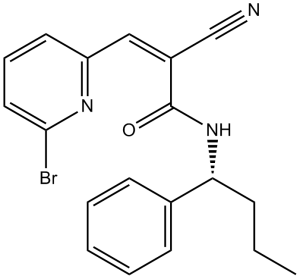
C19H18BRN3O
|
|
|---|---|---|
| 分子量 |
384.27
|
|
| 精确质量 |
383.063
|
|
| CAS号 |
856243-80-6
|
|
| 相关CAS号 |
|
|
| PubChem CID |
11222830
|
|
| 外观&性状 |
Light yellow to yellow solid powder
|
|
| 密度 |
1.4±0.1 g/cm3
|
|
| 沸点 |
582.1±50.0 °C at 760 mmHg
|
|
| 闪点 |
305.9±30.1 °C
|
|
| 蒸汽压 |
0.0±1.6 mmHg at 25°C
|
|
| 折射率 |
1.617
|
|
| LogP |
4.01
|
|
| tPSA |
69.27
|
|
| 氢键供体(HBD)数目 |
1
|
|
| 氢键受体(HBA)数目 |
3
|
|
| 可旋转键数目(RBC) |
6
|
|
| 重原子数目 |
24
|
|
| 分子复杂度/Complexity |
490
|
|
| 定义原子立体中心数目 |
1
|
|
| SMILES |
CCC[C@@H](C1=CC=CC=C1)NC(=O)/C(=C/C2=NC(=CC=C2)Br)/C#N
|
|
| InChi Key |
LIDOPKHSVQTSJY-VMEIHUARSA-N
|
|
| InChi Code |
InChI=1S/C19H18BrN3O/c1-2-7-17(14-8-4-3-5-9-14)23-19(24)15(13-21)12-16-10-6-11-18(20)22-16/h3-6,8-12,17H,2,7H2,1H3,(H,23,24)/b15-12+/t17-/m0/s1
|
|
| 化学名 |
(E)-3-(6-bromopyridin-2-yl)-2-cyano-N-[(1S)-1-phenylbutyl]prop-2-enamide
|
|
| 别名 |
|
|
| HS Tariff Code |
2934.99.9001
|
|
| 存储方式 |
Powder -20°C 3 years 4°C 2 years In solvent -80°C 6 months -20°C 1 month |
|
| 运输条件 |
Room temperature (This product is stable at ambient temperature for a few days during ordinary shipping and time spent in Customs)
|
| 溶解度 (体外实验) |
|
|||
|---|---|---|---|---|
| 溶解度 (体内实验) |
配方 1 中的溶解度: ≥ 2.5 mg/mL (6.51 mM) (饱和度未知) in 10% DMSO + 40% PEG300 + 5% Tween80 + 45% Saline (这些助溶剂从左到右依次添加,逐一添加), 澄清溶液。
例如,若需制备1 mL的工作液,可将100 μL 25.0 mg/mL澄清DMSO储备液加入到400 μL PEG300中,混匀;然后向上述溶液中加入50 μL Tween-80,混匀;加入450 μL生理盐水定容至1 mL。 *生理盐水的制备:将 0.9 g 氯化钠溶解在 100 mL ddH₂O中,得到澄清溶液。 配方 2 中的溶解度: ≥ 2.5 mg/mL (6.51 mM) (饱和度未知) in 10% DMSO + 90% Corn Oil (这些助溶剂从左到右依次添加,逐一添加), 澄清溶液。 例如,若需制备1 mL的工作液,可将 100 μL 25.0 mg/mL 澄清 DMSO 储备液加入到 900 μL 玉米油中并混合均匀。 请根据您的实验动物和给药方式选择适当的溶解配方/方案: 1、请先配制澄清的储备液(如:用DMSO配置50 或 100 mg/mL母液(储备液)); 2、取适量母液,按从左到右的顺序依次添加助溶剂,澄清后再加入下一助溶剂。以 下列配方为例说明 (注意此配方只用于说明,并不一定代表此产品 的实际溶解配方): 10% DMSO → 40% PEG300 → 5% Tween-80 → 45% ddH2O (或 saline); 假设最终工作液的体积为 1 mL, 浓度为5 mg/mL: 取 100 μL 50 mg/mL 的澄清 DMSO 储备液加到 400 μL PEG300 中,混合均匀/澄清;向上述体系中加入50 μL Tween-80,混合均匀/澄清;然后继续加入450 μL ddH2O (或 saline)定容至 1 mL; 3、溶剂前显示的百分比是指该溶剂在最终溶液/工作液中的体积所占比例; 4、 如产品在配制过程中出现沉淀/析出,可通过加热(≤50℃)或超声的方式助溶; 5、为保证最佳实验结果,工作液请现配现用! 6、如不确定怎么将母液配置成体内动物实验的工作液,请查看说明书或联系我们; 7、 以上所有助溶剂都可在 Invivochem.cn网站购买。 |
| 制备储备液 | 1 mg | 5 mg | 10 mg | |
| 1 mM | 2.6023 mL | 13.0117 mL | 26.0234 mL | |
| 5 mM | 0.5205 mL | 2.6023 mL | 5.2047 mL | |
| 10 mM | 0.2602 mL | 1.3012 mL | 2.6023 mL |
1、根据实验需要选择合适的溶剂配制储备液 (母液):对于大多数产品,InvivoChem推荐用DMSO配置母液 (比如:5、10、20mM或者10、20、50 mg/mL浓度),个别水溶性高的产品可直接溶于水。产品在DMSO 、水或其他溶剂中的具体溶解度详见上”溶解度 (体外)”部分;
2、如果您找不到您想要的溶解度信息,或者很难将产品溶解在溶液中,请联系我们;
3、建议使用下列计算器进行相关计算(摩尔浓度计算器、稀释计算器、分子量计算器、重组计算器等);
4、母液配好之后,将其分装到常规用量,并储存在-20°C或-80°C,尽量减少反复冻融循环。
计算结果:
工作液浓度: mg/mL;
DMSO母液配制方法: mg 药物溶于 μL DMSO溶液(母液浓度 mg/mL)。如该浓度超过该批次药物DMSO溶解度,请首先与我们联系。
体内配方配制方法:取 μL DMSO母液,加入 μL PEG300,混匀澄清后加入μL Tween 80,混匀澄清后加入 μL ddH2O,混匀澄清。
(1) 请确保溶液澄清之后,再加入下一种溶剂 (助溶剂) 。可利用涡旋、超声或水浴加热等方法助溶;
(2) 一定要按顺序加入溶剂 (助溶剂) 。
WP1130 reduces the growth of CML tumors and Bcr/Abl-expressing cells in nude mice.Blood.2007 Apr 15;109(8):3470-8. |
Down-regulation of Bcr/Abl protein by WP1130 is not associated with changes in Hsp70 and is not suppressed by protease inhibition.Blood.2007 Apr 15;109(8):3470-8. |
WP1130 reduces the viability of cells expressing wild-type and mutant Bcr/Abl.Blood.2007 Apr 15;109(8):3470-8. |
InvivoChem的所有产品仅用于作科学研究,不面向患者销售
Copyright 2020 InvivoChem LLC | All Rights Reserved 粤ICP备20063088号-1


 COA
COA


 粤公网安备 44011102003439号
 463611831
