| 规格 | 价格 | 库存 | 数量 |
|---|---|---|---|
| 100mg |
|
||
| 250mg |
|
||
| 500mg |
|
||
| Other Sizes |
|

| 靶点 |
SARS-CoV-2 main protease (Mpro); natural flavone
|
|---|---|
| 体外研究 (In Vitro) |
水飞蓟素(0-120 μg/mL;24 小时)可抑制 AGS 细胞的活力。 AGS 细胞活力在 20 μg/mL、40 μg/mL 和 60 μg/mL 时分别为 71.5% 和 59.8%。在 80 μg/mL 时,检测结果为 44.5%、35.3% 和 33.9% [1]。稀释后,水飞蓟素(40–80 μg/mL;24 小时)可抑制 AGS 细胞。在 40 μg/mL 和 80 μg/mL 时,它分别抑制 AGS 细胞迁移 59.4% 和 21.7% [1]。
细胞凋亡被认为是一种治疗靶点,因为它在人类癌症中通常受到干扰。据报道,水飞蓟中的水飞蓟素(Silybum marianum)通过调节细胞凋亡、抗炎、抗氧化和保护肝脏而表现出抗癌特性。本研究考察水飞蓟素对人胃癌细胞增殖和凋亡的抑制作用。MTT法测定AGS人胃癌细胞的生存能力。采用伤口愈合实验研究AGS细胞的迁移情况。水飞蓟素能显著降低AGS细胞的活力和迁移能力,且呈浓度依赖性。DAPI染色和Annexin V/碘化丙啶双染色结果显示,凋亡小体数量和凋亡率呈剂量依赖性增加。采用western blotting方法研究水飞蓟素诱导的人胃癌细胞凋亡蛋白的表达变化。水飞蓟素增加Bax的表达,磷酸化(p) JNK和p - p38,切割聚ADP核糖聚合酶,并以浓度依赖的方式降低Bcl - 2和p - ERK1/2的水平。[2] 2019年底,发生了一场全球大流行。病原体被确定为冠状病毒科的一员,称为严重急性呼吸综合征冠状病毒2 (SARS-CoV-2)。在这项研究中,我们对人类代谢组中鉴定的能够结合SARS-CoV-2主要蛋白酶(Mpro)活性位点的物质进行了分析。存在于人体代谢组中的物质既有内源性的,也有外源性的。这项研究的目的是找到已知的生物化学和毒理学特征的分子,这可能是开发抗病毒疗法的起点。我们的分析揭示了许多代谢产物——包括外源物——与这种蛋白酶结合,这对病毒的生命周期至关重要。其中,特别值得注意的是水飞蓟素的主要活性成分、黄烷脂素类化合物水飞蓟宾。水飞蓟素是水飞蓟(Silybum marianum)的标准提取物,已被证明具有抗氧化、保护肝脏、抗肿瘤和抗病毒活性。我们在硅和体外获得的结果分别证明水飞蓟宾和水飞蓟素能够抑制Mpro,这代表了一种可能的食物来源的天然化合物,可用于治疗COVID-19。[4] |
| 体内研究 (In Vivo) |
在强迫游泳测试 (FST) 期间,水飞蓟素(口服灌胃;10、20、50、100 和 200 毫克/千克)可缩短舞蹈模式的停止时间。此外,它还降低了尾悬试验(TST)中水飞蓟素的 ED50,大约为 10 mg/kg。在这两项试验中,发现 100 mg/kg 的剂量是最有效的剂量 [3]。
水飞蓟素Silymarin (SM)有效剂量为10、20、50和100 mg/kg时,FST中静止时间呈剂量依赖性减少(p < 0.01, p < 0.05, p < 0.05和p < 0.001)。SM(10、20、50和100 mg/kg)也呈剂量依赖性地降低了TST的静止度(分别为p < 0.01、p < 0.05、p < 0.01和p < 0.001)。此外,SM的50%的最大响应(ED50)在10 mg/kg左右。在两次试验中,100 mg/kg的剂量被证明是最有效的剂量。此外,这种影响与运动活动的变化无关。此外,L-NAME逆转了SM(20和100 mg/kg)对FST和SM (100 mg/kg)对TST的作用。然而,AG并没有影响这种影响。 结论:水飞蓟素(SM)的抗抑郁样作用可能至少部分通过NO介导,SM可增加NO的调节。[3] |
| 酶活实验 |
体外分析[4]
酶分析基本上按照我们以前的工作进行。简单地说,我们在制造商提供的反应缓冲液中使用纯化的SARS-CoV-2 Mpro Untagged,终浓度为0.5 ng/µL。水飞蓟素(SM)和杉木素。实验在Tecan微孔板阅读器中进行,室温下使用内淬荧光FRET底物(DABCYL-KTSAVLQSGFRKME-EDANS)作为底物,浓度为40µM。据报道,该肽在Mpro上的Km为17µM, Kcat为1.9 s−1。以实验兽药GC376为阳性对照,浓度为100µM。后者能够抑制SARS-CoV-2 Mpro, IC50约为0.42µM。实验在制造商提供的反应缓冲液中进行,在从酶的储存溶液中提取的0.1µM DTT(无DTT条件)或存在1mm DTT的情况下进行。 |
| 细胞实验 |
细胞活力测定[2]
细胞类型: AGS 细胞 测试浓度: 20 µg/ml,迁移 40 µg。 /ml、80 µg/ml、100 µg/ml 和 120 µg/ml 孵育时间: 24 小时 实验结果: 从 20 µg/ml 开始,对 AGS 细胞表现出显着的浓度依赖性抑制作用。 细胞活力测定[2] MTT法研究水飞蓟素(SM)对AGS人胃癌细胞增殖的影响。将AGS细胞接种于96孔板,密度为2×10⁴ cells/ml,在rpm -1640培养基中,37℃,5% CO2培养箱内培养~24 h。然后用浓度为0、20、40、60、80、100和120µg/ml的Silymarin (SM)处理细胞。24 h后,将MTT[3-(4,5-二甲基噻唑-2-酰基)-2,5-二苯基溴化四唑]溶液加入到含有AGS细胞的96孔板中,体积为40µl/孔,培养2 h。去除MTT溶液后,加入100µl/孔的二甲基亚砜(DMSO)溶解孔中形成的所有甲醛,用ELISA-reader在595 nm处测定吸光度。与未处理的对照细胞相比,估计活细胞的百分比。 伤口愈合实验 [2] 将AGS人胃癌细胞接种于60毫米培养皿中,培养24小时。使用无菌1毫升蓝色移液枪头划痕形成均匀伤口。更换含水飞蓟素(SM)的培养基(浓度分别为0、40和80 µg/ml),继续培养24小时。分别在划痕后0小时和24小时,通过相差显微镜(×200)拍摄图像,检测40和80 µg/ml 水飞蓟素(SM)处理组与未处理组的细胞伤口愈合率。 DAPI染色 [2] 采用4′,6-二脒基-2-苯基吲哚(DAPI)染色观察细胞核凋亡特征性形态变化。将AGS人胃癌细胞以1×10⁵个细胞/毫升密度接种于60毫米培养皿,稳定24小时后,分别用0、40和80 µg/ml的水飞蓟素(SM)处理,并在培养箱中孵育24小时。PBS冲洗细胞两次,4%多聚甲醛溶液固定15分钟,再次PBS冲洗后,加入1:10稀释的DAPI溶液(2毫升),于暗室环境中通过荧光显微镜(×200)观察。 流式细胞分析[2] 采用FITC-Annexin V细胞凋亡检测试剂盒检测细胞凋亡。在膜联蛋白v -碘化丙啶(PI)染色中,AGS人胃癌细胞分别用浓度为0、40和80µg/ml的Silymarin (SM)/水水蓟素 处理。培养24 h的细胞用PBS洗涤,悬浮于胰蛋白酶- edta中,离心(260 × g, 5 min, 4°C)得到细胞颗粒。然后用冷PBS洗涤两次,离心得到细胞颗粒。然后,将它们悬浮在1X结合缓冲液中,浓度为1×10⁶ cells/ml。然后加入异硫氰酸荧光素(FITC)偶联的膜联蛋白V和藻红蛋白(PE)偶联的PI,反应15分钟后进行流式细胞术检测。 Western blot分析[2] Western blot检测Silymarin (SM)处理后 蛋白表达的变化。AGS人胃癌细胞培养于175 cm2的瓶中,37℃,5% CO2培养箱中,用浓度为0、40和80µg/ml的Silymarin (SM)处理,培养24 h,加入胰蛋白酶- edta,悬浮,离心(260 × g, 5 min, 4℃)。将细胞裂解缓冲液加入细胞球中,4℃反应20 min, 15000 × g离心5 min得到的上清作为细胞裂解液。用Bradford蛋白法测定提取蛋白的浓度。蛋白质通过12%十二烷基硫酸钠-聚丙烯酰胺凝胶电泳(SDS-PAGE)分离,并转移到硝化纤维素膜上。用5%脱脂牛奶阻断膜2小时,然后加入一抗。 |
| 动物实验 |
体内异种移植瘤模型[2]
10只BALB/c裸鼠(4周龄,雄性,20 g)饲养于独立通风笼中(每笼≤3只)。小鼠在12小时光照/12小时黑暗循环条件下饲养,饲养温度(23±3°C)和湿度(40±10%)均受控。小鼠可自由摄取实验室颗粒饲料和水。采用颈椎脱臼法处死小鼠。AGS人胃癌细胞在含5%胎牛血清的RPMI-1640培养基中,于37°C、5% CO2培养箱中培养。当细胞密度达到约80-90%时,将细胞转移至175 cm²培养瓶中,加入胰蛋白酶-EDTA消化悬浮,然后离心(260 × g,5分钟,4°C)。随后用PBS缓冲液洗涤细胞,再次离心(260 × g,3分钟,4℃)收集细胞沉淀,并将其分装于培养基中,细胞浓度为1×10⁷个/ml。将200 µl AGS细胞悬液(1:1 Matrigel混合物)注射到雄性BALB/c裸鼠背部。一周后,待肿瘤形成,用乙醚麻醉小鼠,取出肿瘤组织,切成约1 mm³的块状,然后重新注射到裸鼠体内。麻醉过程中使用乙醚吸入。根据肿瘤大小将小鼠分组。注射组每周五次口服100 mg/kg水飞蓟素(溶于乙醇),每次给药时间相同,持续两周。对照组每周五次口服乙醇和蒸馏水的混合物,持续两周。在给药期间,检查小鼠的一般状况,并使用游标卡尺每周两次测量肿瘤大小,计算公式如下:大小 (mm³) = [0.5 × (长度 + 宽度)]³。 动物和实验分组 [3] 本研究全程使用体重 20–27 g 的雄性 NMRI(国家医学研究所)小鼠。动物可自由摄取食物和水。所有行为学实验均在上午 10:00 至下午 2:00 之间进行,光照条件为正常室内光照(12 小时光照/黑暗循环),温度为 22 ± 1 °C。我们按照《实验动物饲养和使用指南》(美国国立卫生研究院出版物,编号23-86,1985年修订版)中规定的标准处理小鼠。 288只小鼠被随机分为36组,每组8只。随机分配18组进行强迫游泳试验(FST),18组进行悬尾试验(TST)。对照组仅接受溶剂(生理盐水;腹腔注射和口服)。氟西汀(20 mg/kg,腹腔注射)(Owolabi等人,2014年引用)作为参考药物。为了评估水飞蓟素(SM)/SM的抗抑郁样作用,另设6个治疗组,在行为学测试前60分钟口服水飞蓟素(SM)/SM(5、10、20、50、100和200 mg/kg;口服)。本研究将受试者分为十组,分别给予拮抗剂,并探讨NO合成对水飞蓟素(SM)抗抑郁样活性的潜在影响。每组受试者口服两种有效剂量的水飞蓟素(SM)(20和100 mg/kg),同时腹腔注射无效剂量的L-NAME(10 mg/kg)(Sadaghiani等,2011年)或无效剂量的AG(50 mg/kg)(Sadaghiani等,2011年)。L-NAME和AG均在测试前90分钟给药。此外,另设一组受试者仅接受L-NAME或AG给药。所有药物均溶于生理盐水,并在实验前立即配制。 水飞蓟素 (SM) 毒理学 [3] 水飞蓟素 (SM) 的半数致死剂量 (LD50) 值在小鼠中为 400 mg/kg,在大鼠中为 385 mg/kg。然而,这些值仅为近似值,因为它们取决于输注速率。当以缓慢输注(2-3 小时)的方式给药时,大鼠的 LD50 值可能达到 2000 mg/kg。口服给药后的耐受性更高,LD50 值可超过 10000 mg/kg(Lecomte,1975 年)。Vogel 等人也获得了类似的结果(1975 年)。雄性小鼠和雌性小鼠的LD50分别为1050和970 mg/kg,雄性大鼠和雌性大鼠的LD50分别为825和920 mg/kg(Desplaces等,1975)。近期动物研究表明,SM在2500和5000 mg/kg的最大口服剂量下无毒且无不良反应。此外,研究还表明SM不具有致畸性,且无死后毒性(Rana等,2006)。 |
| 药代性质 (ADME/PK) |
代谢/代谢物
水飞蓟宾已知的代谢物包括 O-去甲基水飞蓟宾。 |
| 毒性/毒理 (Toxicokinetics/TK) |
妊娠期和哺乳期影响
◉ 哺乳期使用概述 水飞蓟(Silybum marianum)含有水飞蓟素,它是一种黄酮木脂素混合物,主要成分是水飞蓟宾(也称水飞蓟宾),此外还含有水飞蓟亭、水飞蓟宁、槲皮素和紫杉叶素。水飞蓟素是从水飞蓟的果实(种子)中提取的标准化制剂。水飞蓟被认为是一种催乳剂,并被添加到一些宣称可以增加乳汁分泌的专利配方中;然而,目前尚无科学有效的临床试验支持这种用途。虽然一项针对高纯度水飞蓟成分水飞蓟素及其磷脂酰结合物的研究表明它们具有一定的催乳活性,但这并不一定意味着水飞蓟本身具有这种活性。催乳剂绝不能取代对影响乳汁分泌的可控因素的评估和咨询。有限的数据表明,水飞蓟素成分不会以可测量的量分泌到母乳中。此外,由于水飞蓟素成分口服吸收率低,因此水飞蓟不太可能对母乳喂养的婴儿产生不良影响。成人通常对水飞蓟和水飞蓟素耐受性良好,仅出现轻微副作用,例如腹泻、头痛和皮肤反应。服用水飞蓟增加乳汁分泌的母亲偶尔会出现体重增加、恶心、口干和烦躁等症状。水飞蓟可能会加速某些药物的代谢。极少数情况下,有严重过敏和过敏性休克的报道。已知对菊科(Compositea 或 Asteraceae)植物(如雏菊、洋蓟、蓟和猕猴桃)过敏的患者应避免使用,因为可能存在交叉过敏反应。膳食补充剂无需获得美国食品药品监督管理局 (FDA) 的广泛上市前批准。制造商有责任确保产品安全,但无需在上市前证明膳食补充剂的安全性和有效性。膳食补充剂可能含有多种成分,标签所示成分与实际成分或含量往往存在差异。制造商可以委托独立机构验证产品或其成分的质量,但这并不代表产品安全有效。鉴于上述问题,针对某一产品的临床试验结果可能不适用于其他产品。关于膳食补充剂的更多详细信息,请访问 LactMed 网站的其他页面。 ◉ 对母乳喂养婴儿的影响 一项研究比较了早产儿(<32 周)母亲每 12 小时服用含有 252 毫克水飞蓟素的商业产品(BIO-C)与安慰剂的效果。所有婴儿均未观察到不良反应。 在一项关于含有 5 克水飞蓟素、磷脂酰丝氨酸和山羊豆(山羊豆)混合物(比例和来源均未说明)的催乳剂的研究中,母乳喂养的婴儿未观察到水飞蓟素的典型不良反应。 ◉ 对泌乳和母乳的影响 目前尚无关于水飞蓟或其成分对血清催乳素影响的人体数据。一项针对母猪的研究发现,妊娠和哺乳期每天两次服用4克水飞蓟素可使母猪血清催乳素水平高于服用安慰剂的母猪。催乳素的轻微升高对乳腺发育以及血浆孕酮或雌二醇水平均无影响。 一项研究在秘鲁利马一家医院进行,研究对象为50名产后泌乳量低于正常水平的、医学上正常的产妇。这些产妇被非随机分为两组,每组25人,两组年龄、体重、子女数量和新生儿年龄均相同(尽管未报告具体年龄)。服用微粉化水飞蓟素(BIO-C品牌)420毫克/天,持续63天的组,其基线日泌乳量为602毫升。两组婴儿在第0天的乳汁量和成分(水分、脂肪、碳水化合物和蛋白质)均无显著差异。服用相同安慰剂的婴儿组基线日产奶量为530毫升。分别于第30天和第63天测量婴儿的产奶量,方法是在哺乳前后称量婴儿体重,然后用吸奶器吸空乳房。同时测定乳汁成分。结果显示,第30天(水飞蓟素组990克,安慰剂组650克)和第63天(水飞蓟素组1119克,安慰剂组701克)两组婴儿的平均产奶量存在统计学显著差异。两组婴儿在两个时间点的乳汁成分均无差异。本研究的不足之处包括缺乏随机分组、研究者未采用盲法以及在入组前未对母乳喂养技巧进行优化。此外,母乳喂养持续时间和婴儿长期生长发育情况也未进行研究。 在一项随机、双盲研究中,早产儿母亲每天服用一次安慰剂(5克乳糖)或含有5克水飞蓟素、磷脂酰丝氨酸和山羊豆混合物的市售产品(Piùlatte Plus,Milte)。据称,磷脂酰丝氨酸可以提高水飞蓟素的生物利用度。从产后第3天到第28天,母亲们服用药物或安慰剂。白天每2至3小时使用吸奶器吸奶,晚上根据需要吸奶。分别在产后第7、14和28天测量乳汁产量。治疗组的日均乳汁产量为200毫升,对照组为115毫升。在研究期间,治疗组的总产奶量以及第7天和第28天每日产奶量超过200毫升的女性比例均高于对照组。研究人员在产后3个月和6个月时联系了产妇,了解其母乳喂养情况。在产后3个月时,89位回复满意的母亲中,接受水飞蓟素-山羊豆治疗的母亲纯母乳喂养的比例高于接受安慰剂的母亲(22/50 vs 12/50)。此外,治疗组中母乳喂养比例超过50%的母亲比例也高于安慰剂组(29/50 vs 18/50)。产后6个月时,治疗组中母乳喂养比例超过50%的母亲比例仍然高于安慰剂组(22/50 vs 12/50)。这些差异具有统计学意义。 一项随机研究比较了早产(<32周)婴儿母亲从产后10天开始,每12小时服用一次含有252毫克微粉化水飞蓟素的商业产品(BIO-C)与安慰剂的效果。母亲们每天使用吸奶器6次,并在开始治疗前、治疗期间的28天中分别测量5次以及第36天和第45天的乳汁分泌量。在任何时间点,两组的乳汁分泌量均无差异。母亲们对服用的是安慰剂还是水飞蓟素的猜测与随机猜测无异。 一项针对来自27个州(52%来自路易斯安那州)的188名哺乳期妇女的调查显示,其中24人曾使用水飞蓟作为催乳剂。在服用过该药物的人中,52%不确定它是否增加了她们的乳汁分泌量,4人报告了未指明的副作用。 在澳大利亚一项针对哺乳期母亲的调查中,40位母亲服用水飞蓟作为催乳剂。平均而言,母亲们根据李克特量表将水飞蓟的疗效评为“略微有效”到“中等有效”。10%服用水飞蓟的母亲报告出现了不良反应,最常见的是体重增加、恶心、口干和易怒。 一项在希腊医院进行的回顾性研究纳入了161位母亲,她们每天服用5克Silitidil(一种标准化提取物,由33%的水飞蓟素、33%的卵磷脂和33%的磷脂酰丝氨酸组成,由Humana公司以Piùlatte的名称提供),持续14天。接受西替利嗪治疗的母亲所生的婴儿为双胞胎或早产儿,或新生儿体重下降超过体重的10%,或需要光疗,或需要转入三级重症监护病房,以及因其他原因无法母乳喂养的母亲均被排除在外。分别在产后10天、1个月、4个月和6个月进行电话随访。母乳喂养率(纯母乳喂养和非纯母乳喂养)在出生后第一周为100%,第一个月为98.8%,前四个月为87%,6个月为56.5%,1岁时为41%,1岁以上为19.3%。这项研究的回顾性性质、缺乏对照组、盲法以及对母乳喂养特征的描述等问题,使得本文难以解读。 一项双盲安慰剂对照试验将早产儿(孕周≤32周)的母亲随机分配至含有120毫克水飞蓟素和120毫克磷脂酰丝氨酸的产品(Silitidil,荷兰)组或安慰剂组。在91对随机分组的母婴中,68对(Silitidil组35对,安慰剂组46对)按方案完成了研究。21天时,Silitidil组的平均日产奶量为506毫升,安慰剂组为523毫升,差异无统计学意义。在任何一次访视中,两组的吸奶频率和持续时间均无差异。吸奶前后尿催乳素/肌酐比值无差异,且与产奶量无相关性。作者得出结论,与安慰剂相比,水飞蓟素产品不会增加妊娠 32 周或更短时间内早产儿母亲的平均每日乳汁量。 |
| 参考文献 |
|
| 其他信息 |
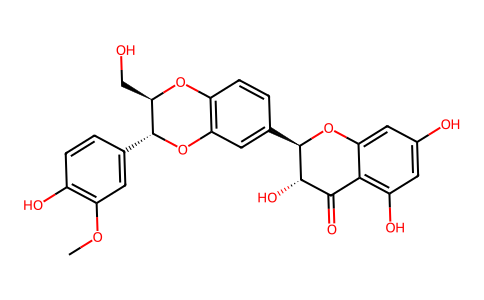
水飞蓟宾是从水飞蓟(Silybum marianum)中分离得到的一种黄酮木脂素,已被证实具有抗氧化和抗肿瘤活性。它具有抗氧化、抗肿瘤、保肝和植物代谢等多种功能。水飞蓟宾是一种黄酮木脂素、多酚、芳香醚、苯并二恶英和仲α-羟基酮。水飞蓟宾是水飞蓟素的主要活性成分,水飞蓟素是水飞蓟种子的标准化提取物,含有多种黄酮木脂素,包括水飞蓟宾、异水飞蓟宾、水飞蓟亭、水飞蓟宁等。水飞蓟宾以两种非对映异构体——水飞蓟宾A和水飞蓟宾B的混合物形式存在,二者的摩尔比大致相等。体外和动物研究均表明,水飞蓟宾具有保肝(抗肝毒性)特性,能够保护肝细胞免受毒素侵害。水飞蓟宾还被证实具有体外抗癌作用,可抑制人前列腺腺癌细胞、雌激素依赖性和非依赖性乳腺癌细胞、人宫颈外口癌细胞、人结肠癌细胞以及小细胞和非小细胞肺癌细胞。
据报道,水飞蓟宾存在于伊氏曲霉(Aspergillus iizukae)、水飞蓟(Silybum eburneum)和其他一些有相关数据的生物体中。 水飞蓟素是从水飞蓟(Silybum marianum)中分离得到的黄酮木脂素混合物。水飞蓟素可能具有抗氧化作用,保护肝细胞免受化疗相关的自由基损伤。该物质还可能促进新肝细胞的生长。 (NCI04) 水飞蓟素是从水飞蓟(Silybum marianum)种子中提取的主要活性成分,属于黄酮类化合物;用于治疗肝炎、肝硬化、化学和药物引起的肝损伤,并具有抗肿瘤活性;水飞蓟宾A和B是非对映异构体。 药物适应症 目前正在测试其作为治疗严重肝毒性物质中毒(例如毒鹅膏(Amanita phalloides)中毒)的药物。 对于氧化应激引起的慢性肝病(酒精性和非酒精性脂肪肝、药物和化学物质引起的肝毒性),水飞蓟素等抗氧化药物可能具有有益作用。肝硬化、非酒精性脂肪肝和脂肪性肝炎是肝细胞癌(HCC)的危险因素。胰岛素抵抗和氧化应激是导致这些患者肝细胞损伤的主要致病机制。水飞蓟素具有膜稳定和抗氧化活性,能够促进肝细胞再生;此外,它还能减轻炎症反应,抑制肝脏纤维化。这些结果已通过实验和临床试验得到证实。开放性研究表明,长期服用水飞蓟素可显著延长酒精性肝硬化患者的生存期。基于分子生物学方法的研究结果,水飞蓟素能够显著降低肿瘤细胞增殖、血管生成以及胰岛素抵抗。此外,它还具有抗动脉粥样硬化作用,并能抑制肿瘤坏死因子-α诱导的黏附分子蛋白生成和mRNA表达。多项体外和体内研究已证实水飞蓟素对肝细胞癌(HCC)具有化学预防作用;它可通过干扰细胞因子,对细胞存活和凋亡的平衡产生有益影响。此外,水飞蓟素还具有抗炎活性,并能抑制肿瘤转移的发生发展。在某些肿瘤性疾病中,水飞蓟素也可作为辅助治疗药物。 [1] 背景:水飞蓟素 (SM) 提取自水飞蓟 (Silybum marianum L.) [菊科],以其抗氧化和抗炎作用而闻名。 目的:本研究旨在探讨急性给予 SM 后雄性小鼠潜在的抗抑郁样作用及其与一氧化氮 (NO) 的可能关联。 材料与方法:在实验前 60 分钟,分别以口服方式给予小鼠 SM(5、10、20、50、100 和 200 mg/kg;po)。评估小鼠的运动活性后,分别在强迫游泳实验 (FST) 和悬尾实验 (TST) 中测量小鼠的静止不动时间。为了评估NO的可能参与,分别在给予SM(20和100 mg/kg)前30分钟腹腔注射非特异性NO合酶抑制剂L-NAME(10 mg/kg)和特异性iNOS抑制剂氨基胍(AG)(50 mg/kg)。 结果:SM在有效剂量10、20、50和100 mg/kg下均呈剂量依赖性地降低了强迫游泳试验(FST)中的不动时间(p < 0.01、p < 0.05、p < 0.05和p < 0.001)。SM(10、20、50和100 mg/kg)也呈剂量依赖性地降低了悬尾试验(TST)中的不动时间(p < 0.01、p < 0.05、p < 0.01和p < 0.001)。此外,SM 的半数最大反应剂量 (ED50) 约为 10 mg/kg。在两项测试中,100 mg/kg 的剂量均被证明是最有效的剂量。此外,这种效应与运动活性的变化无关。而且,L-NAME 逆转了 SM(20 和 100 mg/kg)在强迫游泳试验 (FST) 中的作用以及 SM(100 mg/kg)在悬尾试验 (TST) 中的作用。然而,AG 对此没有影响。 结论:SM 的抗抑郁样作用可能至少部分是通过 NO 介导的,SM 可能增加 NO 水平。[3] 近年来(特别是 2020 年),一些研究集中于研究具有抗病毒活性的天然食物来源化合物,这些化合物在计算机模拟和体外实验中均表现出抗病毒活性。在这些物质中,黄酮类化合物尤其值得关注。最早探索黄酮类化合物对冠状病毒抗病毒作用的论文之一发表于1990年。该研究表明,浓度为60 μg/mL的槲皮素可使人冠状病毒、牛冠状病毒、OC43和NCDCV的感染性降低50%。槲皮素能够影响SARS-CoV-2 Mpro的热稳定性,并与其相互作用,还能结合到其活性位点,因此被认为是一种有前景的候选药物,值得进一步开展临床前研究。基于计算机模拟的结果,我们课题组决定通过一系列体外实验,测试一种名为水飞蓟素的天然化合物对SARS-CoV-2 Mpro的影响。水飞蓟素表现出显著的抑制作用,我们课题组观察到的EC50值在微摩尔范围内。此外,Mpro的残余活性也是一个值得关注的参数,因为其数值非常低。我们还分析了水飞蓟素复合物的组成成分紫杉叶素的潜在作用。分子对接结果表明,紫杉叶素并非优良的蛋白酶配体(计算结合能为-7.7 kcal mol⁻¹),实验分析也进一步证实了这一点(见图4)。这些数据证实了我们的假设,即水飞蓟素的活性成分是水飞蓟宾。 之所以选择使用水飞蓟素复合物而非水飞蓟宾(通过计算机模拟研究),是因为前者更容易被临床医生和患者获取,因为它以含有51-78%(w/w)水飞蓟素的补充剂形式在市场上销售。 然而,一项采用计算和实验方法的研究表明,水飞蓟宾能够通过靶向RdRp/nsp12(多亚基RNA合成复合物的核心成分)来抑制病毒复制机制。水飞蓟素及其衍生物水飞蓟宾具有清除活性氧(ROS)和调节多种器官中谷胱甘肽水平的显著特性。因此,尽管我们的分析表明,在二硫苏糖醇(DTT)存在的情况下,水飞蓟素的抑制作用会降低,但在谷胱甘肽浓度较高的细胞或组织中,其疗效可能不会降低。 最后,药代动力学研究表明,水飞蓟素可通过口服吸收并分布于消化道。它经历肠肝循环,因此低剂量摄入即可达到预期效果。其急性、亚急性和慢性毒性均极低。由于水飞蓟素不具有胚胎毒性,因此孕妇也可服用。此外,水飞蓟素在治疗剂量下安全,且在高剂量下耐受性良好。基于以上原因,我们推测水飞蓟素不仅可以作为一种治疗策略,还可以作为一种预防SARS-CoV-2感染的措施,因为它可能维持其循环水平。当然,为了证实这一假设,还需要进行未来的临床试验。 总之,我们的研究证明,水飞蓟素作为一种天然食物来源的化合物,其药理学、毒理学和治疗特性均已明确,可以被视为一种有前景且安全的COVID-19治疗策略。显然,这些通过计算机模拟和体外实验获得的数据需要通过进一步的体内研究来验证,以确定最佳剂量,并评估该化合物在人体内抑制SARS-CoV-2 Mpro的疗效。 |
| 分子式 |
C25H22O10
|
|---|---|
| 分子量 |
482.44
|
| 精确质量 |
482.121
|
| 元素分析 |
C, 62.24; H, 4.60; O, 33.16
|
| CAS号 |
65666-07-1
|
| 相关CAS号 |
Silybin A;22888-70-6;Silybin B;142797-34-0
|
| PubChem CID |
31553
|
| 外观&性状 |
Light yellow to yellow solid powder
|
| 密度 |
1.5±0.1 g/cm3
|
| 沸点 |
793.0±60.0 °C at 760 mmHg
|
| 熔点 |
167 °C
|
| 闪点 |
274.5±26.4 °C
|
| 蒸汽压 |
0.0±2.9 mmHg at 25°C
|
| 折射率 |
1.684
|
| LogP |
2.59
|
| tPSA |
155.14
|
| 氢键供体(HBD)数目 |
5
|
| 氢键受体(HBA)数目 |
10
|
| 可旋转键数目(RBC) |
4
|
| 重原子数目 |
35
|
| 分子复杂度/Complexity |
750
|
| 定义原子立体中心数目 |
4
|
| SMILES |
COC1=C(C=CC(=C1)[C@@H]2[C@H](OC3=C(O2)C=C(C=C3)[C@@H]4[C@H](C(=O)C5=C(C=C(C=C5O4)O)O)O)CO)O
|
| InChi Key |
SEBFKMXJBCUCAI-HKTJVKLFSA-N
|
| InChi Code |
InChI=1S/C25H22O10/c1-32-17-6-11(2-4-14(17)28)24-20(10-26)33-16-5-3-12(7-18(16)34-24)25-23(31)22(30)21-15(29)8-13(27)9-19(21)35-25/h2-9,20,23-29,31H,10H2,1H3/t20-,23+,24-,25-/m1/s1
|
| 化学名 |
(2R,3R)-3,5,7-trihydroxy-2-[(2R,3R)-3-(4-hydroxy-3-methoxyphenyl)-2-(hydroxymethyl)-2,3-dihydro-1,4-benzodioxin-6-yl]-2,3-dihydrochromen-4-one
|
| 别名 |
Legalon 70; Milk thistle; SILYMARIN; 65666-07-1; Legalon; 84604-20-6; (2R,3R)-3,5,7-trihydroxy-2-[(2R)-2-(4-hydroxy-3-methoxyphenyl)-3-(hydroxymethyl)-2,3-dihydro-1,4-benzodioxin-6-yl]-2,3-dihydrochromen-4-one; 142796-20-1; Apihepar; Silimarin; Silymarin
|
| HS Tariff Code |
2934.99.9001
|
| 存储方式 |
Powder -20°C 3 years 4°C 2 years In solvent -80°C 6 months -20°C 1 month |
| 运输条件 |
Room temperature (This product is stable at ambient temperature for a few days during ordinary shipping and time spent in Customs)
|
| 溶解度 (体外实验) |
DMSO : ~100 mg/mL
|
|---|---|
| 溶解度 (体内实验) |
配方 1 中的溶解度: ≥ 3 mg/mL (Infinity mM) (饱和度未知) in 10% DMSO + 40% PEG300 +5% Tween-80 + 45% Saline (这些助溶剂从左到右依次添加,逐一添加), 澄清溶液。
例如,若需制备1 mL的工作液,可将100 μL 30.0 mg/mL 澄清的 DMSO 储备液加入到400 μL PEG300中,混匀;再向上述溶液中加入50 μL Tween-80 +,混匀;然后加入450 μL 生理盐水定容至1 mL。 *生理盐水的制备:将 0.9 g 氯化钠溶解在 100 mL ddH₂O中,得到澄清溶液。 请根据您的实验动物和给药方式选择适当的溶解配方/方案: 1、请先配制澄清的储备液(如:用DMSO配置50 或 100 mg/mL母液(储备液)); 2、取适量母液,按从左到右的顺序依次添加助溶剂,澄清后再加入下一助溶剂。以 下列配方为例说明 (注意此配方只用于说明,并不一定代表此产品 的实际溶解配方): 10% DMSO → 40% PEG300 → 5% Tween-80 → 45% ddH2O (或 saline); 假设最终工作液的体积为 1 mL, 浓度为5 mg/mL: 取 100 μL 50 mg/mL 的澄清 DMSO 储备液加到 400 μL PEG300 中,混合均匀/澄清;向上述体系中加入50 μL Tween-80,混合均匀/澄清;然后继续加入450 μL ddH2O (或 saline)定容至 1 mL; 3、溶剂前显示的百分比是指该溶剂在最终溶液/工作液中的体积所占比例; 4、 如产品在配制过程中出现沉淀/析出,可通过加热(≤50℃)或超声的方式助溶; 5、为保证最佳实验结果,工作液请现配现用! 6、如不确定怎么将母液配置成体内动物实验的工作液,请查看说明书或联系我们; 7、 以上所有助溶剂都可在 Invivochem.cn网站购买。 |
| 制备储备液 | 1 mg | 5 mg | 10 mg | |
| 1 mM | 2.0728 mL | 10.3640 mL | 20.7280 mL | |
| 5 mM | 0.4146 mL | 2.0728 mL | 4.1456 mL | |
| 10 mM | 0.2073 mL | 1.0364 mL | 2.0728 mL |
1、根据实验需要选择合适的溶剂配制储备液 (母液):对于大多数产品,InvivoChem推荐用DMSO配置母液 (比如:5、10、20mM或者10、20、50 mg/mL浓度),个别水溶性高的产品可直接溶于水。产品在DMSO 、水或其他溶剂中的具体溶解度详见上”溶解度 (体外)”部分;
2、如果您找不到您想要的溶解度信息,或者很难将产品溶解在溶液中,请联系我们;
3、建议使用下列计算器进行相关计算(摩尔浓度计算器、稀释计算器、分子量计算器、重组计算器等);
4、母液配好之后,将其分装到常规用量,并储存在-20°C或-80°C,尽量减少反复冻融循环。
计算结果:
工作液浓度: mg/mL;
DMSO母液配制方法: mg 药物溶于 μL DMSO溶液(母液浓度 mg/mL)。如该浓度超过该批次药物DMSO溶解度,请首先与我们联系。
体内配方配制方法:取 μL DMSO母液,加入 μL PEG300,混匀澄清后加入μL Tween 80,混匀澄清后加入 μL ddH2O,混匀澄清。
(1) 请确保溶液澄清之后,再加入下一种溶剂 (助溶剂) 。可利用涡旋、超声或水浴加热等方法助溶;
(2) 一定要按顺序加入溶剂 (助溶剂) 。
Link: https://clinicaltrials.gov/ct2/show/NCT07572552
Conditions:SepsisLink: https://clinicaltrials.gov/ct2/show/NCT05042245
Conditions:Non-alcoholic Fatty Liver DiseaseLink: https://clinicaltrials.gov/ct2/show/NCT07293767
Conditions:Fibromyalgia (FM)
Title:Glucocorticoids for Acute Drug Induced Liver Injury With Hyperbilirubinemia
Status:Recruiting
updateDate:2025-12-18
Ctid:NCT06922669
Link: https://clinicaltrials.gov/ct2/show/NCT06922669
Conditions:Drug Induced Liver InjuryLink: https://clinicaltrials.gov/ct2/show/NCT07001150
Conditions:Parkinson DiseaseLink: https://clinicaltrials.gov/ct2/show/NCT07123922
Conditions:COPD (Chronic Obstructive Pulmonary Disease)Link: https://clinicaltrials.gov/ct2/show/NCT07058090
Conditions:Drug Induced Liver Injury|Tuberculosis (TB)Link: https://clinicaltrials.gov/ct2/show/NCT06213857
Conditions:Ulcerative ColitisLink: https://clinicaltrials.gov/ct2/show/NCT06114719
Conditions:Atrial Fibrillation New OnsetLink: https://clinicaltrials.gov/ct2/show/NCT06425705
Conditions:Type 2 Diabetes MellitusLink: https://clinicaltrials.gov/ct2/show/NCT06277635
Conditions:Rheumatoid Arthritis|Psoriatic Arthritis|PsoriasisLink: https://clinicaltrials.gov/ct2/show/NCT05631041
Conditions:Metastatic Colorectal CancerLink: https://clinicaltrials.gov/ct2/show/NCT05595109
Conditions:Breast Cancer|Peripheral Neuropathy|Cardiac Toxicities|Hepatic Toxicity|Cognitive ImpairmentLink: https://clinicaltrials.gov/ct2/show/NCT04816682
Conditions:Covid19|Liver DiseasesLink: https://clinicaltrials.gov/ct2/show/NCT03749070
Conditions:Non-Alcoholic Fatty Liver DiseaseLink: https://clinicaltrials.gov/ct2/show/NCT05099601
Conditions:MelasmaLink: https://clinicaltrials.gov/ct2/show/NCT03687073
Conditions:SmokingLink: https://clinicaltrials.gov/ct2/show/NCT00412763
Conditions:HepatitisLink: https://clinicaltrials.gov/ct2/show/NCT00755950
Conditions:Acute Hepatitis A|Acute Hepatitis B|Acute Hepatitis C|Acute Hepatitis E|Acute EBV Hepatitis|Acute CMV HepatitisLink: https://clinicaltrials.gov/ct2/show/NCT04490967
Conditions:Acne VulgarisLink: https://clinicaltrials.gov/ct2/show/NCT02973295
Conditions:Non-Alcoholic Fatty Liver DiseaseLink: https://clinicaltrials.gov/ct2/show/NCT04394208
Conditions:COVID-19|Viral Pneumonia Human CoronavirusLink: https://clinicaltrials.gov/ct2/show/NCT03130634
Conditions:Metastatic Colorectal CancerLink: https://clinicaltrials.gov/ct2/show/NCT03982849
Conditions:MelasmaLink: https://clinicaltrials.gov/ct2/show/NCT00680407
Conditions:Non-alcoholic SteatohepatitisLink: https://clinicaltrials.gov/ct2/show/NCT03659058
Conditions:Fibrosis, LiverLink: https://clinicaltrials.gov/ct2/show/NCT03538327
Conditions:HypertensionLink: https://clinicaltrials.gov/ct2/show/NCT01018615
Conditions:Chronic Hepatitis C|Oxidative StressLink: https://clinicaltrials.gov/ct2/show/NCT00915200
Conditions:Diabetic Nephropathies|Proteinuria|Oxidative StressLink: https://clinicaltrials.gov/ct2/show/NCT01829178
Conditions:Upper GI Cancer|Cisplatin Adverse ReactionLink: https://clinicaltrials.gov/ct2/show/NCT01049178
Conditions:Atopic AsthmaLink: https://clinicaltrials.gov/ct2/show/NCT01800487
Conditions:TuberculosisLink: https://clinicaltrials.gov/ct2/show/NCT00055718
Conditions:Drug/Agent Toxicity by Tissue/Organ|LeukemiaLink: https://clinicaltrials.gov/ct2/show/NCT01129570
Conditions:Advanced Hepatocellular CarcinomaLink: https://clinicaltrials.gov/ct2/show/NCT01258686
Conditions:Hepatitis CLink: https://clinicaltrials.gov/ct2/show/NCT01957319
Conditions:Work Ability|DepressionLink: https://clinicaltrials.gov/ct2/show/NCT01935817
Conditions:Liver FibrosisLink: https://clinicaltrials.gov/ct2/show/NCT00680342
Conditions:Chronic Hepatitis CLink: https://clinicaltrials.gov/ct2/show/NCT01752153
Conditions:Immune AbnormalitiesLink: https://clinicaltrials.gov/ct2/show/NCT01436929
Conditions:TuberculosisLink: https://clinicaltrials.gov/ct2/show/NCT00246363
Conditions:HIV Infections|Hepatitis CLink: https://clinicaltrials.gov/ct2/show/NCT01292161
Conditions:Hepatitis CLink: https://clinicaltrials.gov/ct2/show/NCT01091324
Conditions:ProteinuriaLink: https://clinicaltrials.gov/ct2/show/NCT00999349
Conditions:Beta-thalassemia Major|Iron OverloadLink: https://clinicaltrials.gov/ct2/show/NCT00011635
Conditions:HIV Infection|HealthyLink: https://clinicaltrials.gov/ct2/show/NCT00389376
Conditions:Hepatitis C|Non-Alcoholic Fatty Liver DiseaseLink: https://clinicaltrials.gov/ct2/show/NCT00065741
Conditions:HIV SeronegativityLink: https://clinicaltrials.gov/ct2/show/NCT00030030
Conditions:Hepatitis C, ChronicInvivoChem的所有产品仅用于作科学研究,不面向患者销售
Copyright 2020 InvivoChem LLC | All Rights Reserved 粤ICP备20063088号-1


 粤公网安备 44011102003439号
 463611831
