| 规格 | 价格 | 库存 | 数量 |
|---|---|---|---|
| 10 mM * 1 mL in DMSO |
|
||
| 2mg |
|
||
| 5mg |
|
||
| 10mg |
|
||
| 25mg |
|
||
| 50mg |
|
||
| 100mg |
|
||
| 250mg |
|
||
| 500mg |
|
||
| Other Sizes |
|

| 靶点 |
The target of SSD114 HCl is the γ-aminobutyric acid type B (GABAB) receptor, and it acts as a positive allosteric modulator (PAM) of this receptor.
- In cAMP inhibition assay using CHO cells expressing human GABAB1b/GABAB2 receptors (in the presence of 1 μM GABA, a submaximal concentration): EC₅₀ = 0.32 μM [1] - In [³⁵S]GTPγS binding assay using rat brain membranes (in the presence of 1 μM GABA): EC₅₀ = 0.45 μM [1] - No significant binding to other receptors (e.g., GABA-A, 5-HT₁A, D₂, M₁ receptors): Ki > 10 μM for all tested non-target receptors [1] |
|---|---|
| 体外研究 (In Vitro) |
在 10 µM GABA 存在的情况下,25 µM SSD114 盐酸盐可极大地放大仅由 GABA 引起的 [35S]GTPγS 刺激(比基础水平高出约 170%)。添加15和30 µM SSD114盐酸盐后,GABA浓度-反应曲线左移,最高剂量下的最大GABA刺激略有增加。在 15 µM 和 30 µM SSD114 盐酸盐存在下,GABA 的 EC50 分别降低了 2 倍和 2.5 倍;然而,最大刺激 (Emax) 仅在 30 µM 浓度时增加,达到基础值的 161±5.09% [1]。
1. 增强GABAB受体介导的CHO细胞cAMP抑制:向稳定表达人GABAB1b/GABAB2受体的CHO细胞中,加入SSD114 HCl(0.01–10 μM)及1 μM GABA(亚有效浓度)。SSD114 HCl可剂量依赖性抑制毛喉素诱导的cAMP生成:10 μM SSD114 HCl抑制率达85%,EC₅₀为0.32 μM;单独使用SSD114 HCl(无GABA)时无cAMP抑制效应 [1] 2. 增强大鼠脑膜中GABAB受体的[³⁵S]GTPγS结合:将大鼠脑膜匀浆与SSD114 HCl(0.01–10 μM)及1 μM GABA共孵育。SSD114 HCl可剂量依赖性增加[³⁵S]GTPγS结合(G蛋白激活标志物):最大结合水平较单独GABA组高60%,EC₅₀为0.45 μM;单独使用SSD114 HCl无显著[³⁵S]GTPγS结合诱导作用 [1] 3. 抑制大鼠海马神经元的兴奋性突触传递:对原代培养14–21天的大鼠海马神经元进行全细胞膜片钳记录。SSD114 HCl(0.1–10 μM)可剂量依赖性降低锥体细胞的兴奋性突触后电流(EPSC)振幅:10 μM SSD114 HCl使EPSC振幅抑制55%。该效应可被GABAB受体拮抗剂SCH50911(10 μM)完全逆转,证实由GABAB受体介导 [1] |
| 体内研究 (In Vivo) |
SSD114盐酸盐预处理已被证明可以降低翻正反射丧失(LORR)的发生率[F(5,30)=4.55,P<0.005]。事后分析显示,用赋形剂治疗的小鼠和用至少 10 mg/kg 水平的 SSD114 盐酸盐预处理的小鼠之间 LORR 的发生率存在显着差异。通过SSD114盐酸盐预处理可以实现更长的LORR持续时间[F(5,30)=4.81, P<0.005]。根据事后分析,用 10 和 100 mg/kg SSD114 盐酸盐预处理的小鼠组中 LORR 的持续时间明显长于用载体处理的小鼠 [1]。
1. 小鼠抗焦虑效应(高架十字迷宫实验):雄性ICR小鼠(20–25 g,6–8周龄)口服SSD114 HCl(3、10、30 mg/kg),给药后60分钟进行高架十字迷宫(EPM,臂长30 cm,高50 cm)测试。30 mg/kg组开放臂停留时间较溶媒对照组增加45%,开放臂进入次数增加30%;总臂进入次数(运动活性指标)无变化,表明无运动抑制 [1] 2. 小鼠抗惊厥效应(戊四氮诱导惊厥):雄性ICR小鼠腹腔注射SSD114 HCl(10、30、100 mg/kg),30分钟后腹腔注射戊四氮(PTZ,85 mg/kg)诱导惊厥。30 mg/kg组惊厥潜伏期从溶媒组的2.5分钟延长至5.8分钟;100 mg/kg组惊厥发生率从溶媒组的100%降至40%,且30分钟内无死亡 [1] 3. 小鼠镇痛效应(热板实验):采用雌性ICR小鼠(对热痛更敏感),先测定热板(55±0.5°C)基线潜伏期(排除潜伏期<3秒或>30秒的小鼠)。口服SSD114 HCl(10、30、100 mg/kg)后,于30、60、120分钟测定潜伏期:30 mg/kg组潜伏期从基线5.2秒延长至给药后30分钟的8.5秒;100 mg/kg组延长至12.1秒,效应持续4小时 [1] |
| 酶活实验 |
1. GABAB受体CHO细胞cAMP抑制实验:将稳定表达人GABAB1b/GABAB2受体的CHO细胞接种于24孔板,培养至80%汇合度。换用无血清DMEM饥饿1小时后,加入SSD114 HCl(0.01–10 μM)+1 μM GABA(或溶媒+GABA)孵育30分钟,再加入毛喉素(10 μM,cAMP诱导剂)孵育15分钟。用0.1 M HCl提取细胞内cAMP,通过竞争性ELISA试剂盒检测浓度。以毛喉素单独组为对照计算抑制率,采用四参数逻辑模型拟合EC₅₀ [1]
2. 大鼠脑膜[³⁵S]GTPγS结合实验:将大鼠脑在冰浴Tris-HCl缓冲液(50 mM,pH7.4,含3 mM MgCl₂、0.2 mM GDP)中匀浆,离心(10,000×g,10分钟,4°C)制备粗制膜。每孔加入膜蛋白(50 μg)、SSD114 HCl(0.01–10 μM)+1 μM GABA+[³⁵S]GTPγS(0.1 nM),总体积200 μL,30°C孵育60分钟。用100 μM GTPγS测定非特异性结合,混合物通过预浸0.5%聚乙烯亚胺的玻璃纤维滤膜过滤,冰浴缓冲液洗涤3次。液体闪烁计数器计数放射性,基于结合增强比计算EC₅₀ [1] |
| 细胞实验 |
大鼠原代海马神经元培养与电生理记录:取E18–E19大鼠胚胎海马,用0.25%胰酶37°C消化15分钟,吹打制成单细胞悬液。细胞接种于多聚赖氨酸包被的盖玻片(密度5×10⁴细胞/cm²),用含10%胎牛血清、2 mM谷氨酰胺、2% B27的Neurobasal培养基培养。在37°C、5% CO₂条件下培养14–21天后,采用全细胞膜片钳技术在电压钳模式(钳制电位-70 mV)下记录。通过玻璃电极(0.1 ms脉冲,0.1 Hz)刺激Schaffer侧支诱发兴奋性突触后电流(EPSC),稳定记录5分钟后,向记录槽中加入SSD114 HCl(0.1–10 μM),监测EPSC振幅10分钟;随后加入SCH50911(10 μM)验证效应可逆性 [1]
|
| 动物实验 |
1. 小鼠高架十字迷宫 (EPM) 实验:雄性 ICR 小鼠(20–25 g)在实验室(12 小时光照/黑暗循环,22±2°C)适应 24 小时。SSD114 HCl 溶于 0.5% 甲基纤维素溶液中,分别以 3、10 和 30 mg/kg 的剂量进行口服给药(注射体积:10 μL/g 体重);对照组给予 0.5% 甲基纤维素溶液。给药 60 分钟后,将每只小鼠置于 EPM 的中心(开放臂:宽 5 cm;封闭臂:高 15 cm),并进行 5 分钟的视频记录。分析的参数包括:开放臂停留时间 (%)、进入开放臂的频率 (%) 和总臂进入次数 [1]
2. 小鼠戊四唑 (PTZ) 诱导癫痫实验:雄性 ICR 小鼠随机分为 4 组(每组 n=8)。将SSD114 HCl溶于生理盐水中,腹腔注射给药(10、30、100 mg/kg);对照组注射生理盐水。30分钟后,腹腔注射戊四唑(PTZ,85 mg/kg,溶于生理盐水)。观察小鼠30分钟,记录的参数包括:癫痫发作潜伏期(首次出现伴有后肢伸展的全身性阵挛性发作的时间)、癫痫发作发生率(%)和死亡率(%)[1] 3. 小鼠热板镇痛试验:筛选雌性ICR小鼠的热板基线潜伏期(55±0.5°C)(截止时间:30秒)。基线潜伏期<3秒或>30秒的小鼠被排除。SSD114 HCl(10、30、100 mg/kg)口服给药;对照组口服0.5%甲基纤维素。给药后 30、60、120 和 240 分钟测量热板潜伏期(截止时间:60 秒,以避免组织损伤)。潜伏期延长百分比计算公式为:[(给药后潜伏期 - 基线潜伏期)/基线潜伏期] × 100% [1] 4. 小鼠转棒试验(运动协调性测试):雄性 ICR 小鼠口服 SSD114 HCl(30、100、300 mg/kg)或载体。60 分钟后,将小鼠置于转棒(10 rpm,直径:3 cm)上。记录小鼠从转棒上跌落的潜伏期(截止时间:180 秒),以评估运动协调性 [1] |
| 药代性质 (ADME/PK) |
1. 小鼠口服药代动力学:雄性ICR小鼠(每时间点n=3)口服SSD114 HCl(30 mg/kg)。分别于给药后0.25、0.5、1、2、4、6、8和12小时从尾静脉采集血样(0.2 mL)。血浆经离心(3000×g,10分钟,4°C)分离后,储存于-80°C。SSD114 HCl浓度采用LC-MS/MS法测定。采用非房室模型分析计算药代动力学参数:口服生物利用度 (F) = 42%,Cmax = 2.8 μM,Tmax = 1 小时,末端半衰期 (t₁/₂) = 3.5 小时 [1]
2. 血浆蛋白结合率:将 500 μL 人血浆与 SSD114 HCl (0.1–10 μM) 混合,并使用透析膜(截留分子量:12–14 kDa)在 37°C 下孵育 4 小时。采用 LC-MS/MS 法测定透析液中游离药物浓度。血浆蛋白结合率计算公式为[(总药物浓度 - 游离药物浓度)/总药物浓度] × 100% = 92% [1] 3. 脑渗透:雄性ICR小鼠口服SSD114 HCl(30 mg/kg)。给药1小时后处死小鼠,取脑组织在生理盐水中匀浆(1:1,w/v)。采用LC-MS/MS测定血浆和脑匀浆中的药物浓度。脑/血浆浓度比为0.8,表明药物能有效穿透血脑屏障[1] |
| 毒性/毒理 (Toxicokinetics/TK) |
1. 小鼠急性毒性:雄性ICR小鼠(n=6)单次口服SSD114 HCl(300 mg/kg,最大测试剂量)。观察小鼠7天,记录死亡率、异常行为(如镇静、共济失调)和体重变化。未观察到死亡或异常行为;体重正常增加(与溶剂对照组相似)。转棒试验显示,300 mg/kg组和溶剂对照组的跌倒潜伏期无显著差异(P > 0.05)[1]
2. 肝肾功能:雄性ICR小鼠每日一次口服SSD114 HCl(30、100 mg/kg)或溶剂,连续7天。在第 8 天,采集血清样本,检测丙氨酸氨基转移酶 (ALT)、天冬氨酸氨基转移酶 (AST)(肝功能指标)、血尿素氮 (BUN) 和肌酐(肾功能指标)。SSD114 HCl 组与溶剂对照组之间,这些指标均无显著差异 (P > 0.05) [1] 3. CYP450 酶抑制:将人肝微粒体与 SSD114 HCl (0.1–100 μM) 以及 CYP1A2、2C9、2C19、2D6 和 3A4 的特异性底物孵育。采用 LC-MS/MS 法测定底物的代谢速率。所有受试 CYP 酶的 IC₅₀ > 100 μM,表明无显著的药物相互作用风险 [1] |
| 参考文献 | |
| 其他信息 |
1. 背景:SSD114 HCl是一种新型的、选择性的GABAB受体正向变构调节剂(PAM)。与直接激活受体的传统GABAB激动剂(例如巴氯芬)不同,PAM(例如SSD114 HCl)仅在内源性GABA存在的情况下增强受体激活,从而降低过度刺激和副作用的风险[1]。
2. 作用机制:SSD114 HCl与GABAB受体上的变构位点(不同于激动剂结合位点)结合。这种结合诱导受体构象变化,增加其对GABA的亲和力,并增强GABA介导的G蛋白激活(例如,抑制腺苷酸环化酶,激活GIRK通道)。其结果是中枢神经系统中抑制性神经传递增强[1] 3. 潜在适应症:临床前数据表明,SSD114 HCl 具有治疗焦虑症、癫痫(发作)和慢性疼痛的潜力。其抗焦虑作用不伴随运动抑制(EPM 总臂进入次数不变,转棒试验表现正常),这是其优于苯二氮卓类药物(GABA-A 调节剂)的关键优势[1] 4. 受体选择性:SSD114 HCl 对 GABAB 受体具有高度选择性。体外结合试验表明,其对其他神经递质受体(GABA-A、5-HT₁A、D₂、M₁)或离子通道无显著亲和力,从而最大限度地减少了脱靶效应[1] |
| 分子式 |
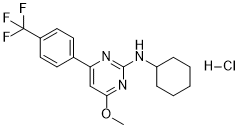
C18H21CLF3N3O
|
|---|---|
| 分子量 |
387.827053785324
|
| 精确质量 |
387.132
|
| 元素分析 |
C, 55.75; H, 5.46; Cl, 9.14; F, 14.70; N, 10.83; O, 4.13
|
| CAS号 |
2319790-02-6
|
| 相关CAS号 |
2319790-02-6
|
| PubChem CID |
131839612
|
| 外观&性状 |
White to off-white solid powder
|
| tPSA |
47
|
| 氢键供体(HBD)数目 |
2
|
| 氢键受体(HBA)数目 |
7
|
| 可旋转键数目(RBC) |
4
|
| 重原子数目 |
26
|
| 分子复杂度/Complexity |
407
|
| 定义原子立体中心数目 |
0
|
| SMILES |
Cl.FC(C1C=CC(=CC=1)C1=CC(=NC(=N1)NC1CCCCC1)OC)(F)F
|
| InChi Key |
YXQSTPASDICGCA-UHFFFAOYSA-N
|
| InChi Code |
InChI=1S/C18H20F3N3O.ClH/c1-25-16-11-15(12-7-9-13(10-8-12)18(19,20)21)23-17(24-16)22-14-5-3-2-4-6-14;/h7-11,14H,2-6H2,1H3,(H,22,23,24);1H
|
| 化学名 |
C18H21ClF3N3OMolecular Weight
|
| 别名 |
SSD114 HCl SSD114 SSD-114 SSD 114 SSD114 hydrochloride
|
| HS Tariff Code |
2934.99.9001
|
| 存储方式 |
Powder -20°C 3 years 4°C 2 years In solvent -80°C 6 months -20°C 1 month 注意: 请将本产品存放在密封且受保护的环境中,避免吸湿/受潮。 |
| 运输条件 |
Room temperature (This product is stable at ambient temperature for a few days during ordinary shipping and time spent in Customs)
|
| 溶解度 (体外实验) |
DMSO : ~130 mg/mL (~335.20 mM)
H2O : ~2 mg/mL (~5.16 mM) |
|---|---|
| 溶解度 (体内实验) |
配方 1 中的溶解度: ≥ 3.25 mg/mL (8.38 mM) (饱和度未知) in 10% DMSO + 40% PEG300 + 5% Tween80 + 45% Saline (这些助溶剂从左到右依次添加,逐一添加), 澄清溶液。
例如,若需制备1 mL的工作液,可将100 μL 32.5 mg/mL澄清DMSO储备液加入到400 μL PEG300中,混匀;然后向上述溶液中加入50 μL Tween-80,混匀;加入450 μL生理盐水定容至1 mL。 *生理盐水的制备:将 0.9 g 氯化钠溶解在 100 mL ddH₂O中,得到澄清溶液。 配方 2 中的溶解度: 3.25 mg/mL (8.38 mM) in 10% DMSO + 90% (20% SBE-β-CD in Saline) (这些助溶剂从左到右依次添加,逐一添加), 悬浊液; 超声助溶。 例如,若需制备1 mL的工作液,可将 100 μL 32.5 mg/mL 澄清 DMSO 储备液加入 900 μL 20% SBE-β-CD 生理盐水溶液中,混匀。 *20% SBE-β-CD 生理盐水溶液的制备(4°C,1 周):将 2 g SBE-β-CD 溶解于 10 mL 生理盐水中,得到澄清溶液。 View More
配方 3 中的溶解度: ≥ 3.25 mg/mL (8.38 mM) (饱和度未知) in 10% DMSO + 90% Corn Oil (这些助溶剂从左到右依次添加,逐一添加), 澄清溶液。 1、请先配制澄清的储备液(如:用DMSO配置50 或 100 mg/mL母液(储备液)); 2、取适量母液,按从左到右的顺序依次添加助溶剂,澄清后再加入下一助溶剂。以 下列配方为例说明 (注意此配方只用于说明,并不一定代表此产品 的实际溶解配方): 10% DMSO → 40% PEG300 → 5% Tween-80 → 45% ddH2O (或 saline); 假设最终工作液的体积为 1 mL, 浓度为5 mg/mL: 取 100 μL 50 mg/mL 的澄清 DMSO 储备液加到 400 μL PEG300 中,混合均匀/澄清;向上述体系中加入50 μL Tween-80,混合均匀/澄清;然后继续加入450 μL ddH2O (或 saline)定容至 1 mL; 3、溶剂前显示的百分比是指该溶剂在最终溶液/工作液中的体积所占比例; 4、 如产品在配制过程中出现沉淀/析出,可通过加热(≤50℃)或超声的方式助溶; 5、为保证最佳实验结果,工作液请现配现用! 6、如不确定怎么将母液配置成体内动物实验的工作液,请查看说明书或联系我们; 7、 以上所有助溶剂都可在 Invivochem.cn网站购买。 |
| 制备储备液 | 1 mg | 5 mg | 10 mg | |
| 1 mM | 2.5784 mL | 12.8922 mL | 25.7845 mL | |
| 5 mM | 0.5157 mL | 2.5784 mL | 5.1569 mL | |
| 10 mM | 0.2578 mL | 1.2892 mL | 2.5784 mL |
1、根据实验需要选择合适的溶剂配制储备液 (母液):对于大多数产品,InvivoChem推荐用DMSO配置母液 (比如:5、10、20mM或者10、20、50 mg/mL浓度),个别水溶性高的产品可直接溶于水。产品在DMSO 、水或其他溶剂中的具体溶解度详见上”溶解度 (体外)”部分;
2、如果您找不到您想要的溶解度信息,或者很难将产品溶解在溶液中,请联系我们;
3、建议使用下列计算器进行相关计算(摩尔浓度计算器、稀释计算器、分子量计算器、重组计算器等);
4、母液配好之后,将其分装到常规用量,并储存在-20°C或-80°C,尽量减少反复冻融循环。
计算结果:
工作液浓度: mg/mL;
DMSO母液配制方法: mg 药物溶于 μL DMSO溶液(母液浓度 mg/mL)。如该浓度超过该批次药物DMSO溶解度,请首先与我们联系。
体内配方配制方法:取 μL DMSO母液,加入 μL PEG300,混匀澄清后加入μL Tween 80,混匀澄清后加入 μL ddH2O,混匀澄清。
(1) 请确保溶液澄清之后,再加入下一种溶剂 (助溶剂) 。可利用涡旋、超声或水浴加热等方法助溶;
(2) 一定要按顺序加入溶剂 (助溶剂) 。
InvivoChem的所有产品仅用于作科学研究,不面向患者销售
Copyright 2020 InvivoChem LLC | All Rights Reserved 粤ICP备20063088号-1


 粤公网安备 44011102003439号
 463611831
