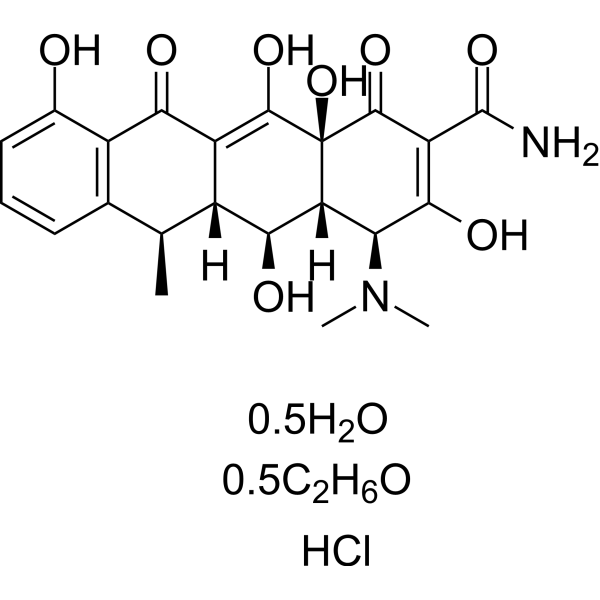
Doxycycline Hyclate

别名: Doxy-Lemmon; Vivox; DTXSID80992212; 4-(Dimethylamino)-1,5,10,11,12a-pentahydroxy-6-methyl-3,12-dioxo-3,4,4a,5,5a,6,12,12a-octahydrotetracene-2-carboximidic acid; 7164-70-7; RefChem:1070088; ...; 24390-14-5; Doxycycline Hyclate 盐酸强力霉素; 脱氧土霉素盐酸盐;盐酸多西环素; 6-甲基-4-(二甲氨基)-3,5,10,12,12a-五羟基-1,11-二氧代-1,4,4a,5,5a,6,11,12a-八氢-2-并四苯甲酰胺盐酸盐;Doxycycline Hyclate 盐酸强力霉素; 盐酸多西环素标准品;多西环素 EP标准品; 强力霉素; 盐酸多西环素(盐酸强力霉素);盐酸多西环素标准品;盐酸强力霉素 USP标准品;盐酸强力霉素 标准品;盐酸强力霉素
目录号: V20211 纯度: ≥98%
Doxycycline hyclate 是一种口服生物活性四环素抗生素和广谱(宽范围)金属蛋白酶 (MMP) 抑制剂(拮抗剂),具有抗菌作用和抗癌/肿瘤细胞生长/增殖活性。
Doxycycline Hyclate CAS号: 24390-14-5
产品类别: New1
产品仅用于科学研究,不针对患者销售
规格 价格 库存 数量
100mg
1g
5g
50g
100g
Other Sizes

Other Forms of Doxycycline Hyclate:

  • Doxycycline hyclate-d5
  • Doxycycline-d3 (hyclate) (major)
  • 4-Epidoxycycline
  • Doxycycline-d3 hydrochloride
  • Doxycycline-13C,d3
  • 强力霉素
  • 9-tert-Butyldoxycycline hydrochloride
  • 盐酸多西环素
  • 多西环素一水物
  • 多西环素钙
点击了解更多
InvivoChem产品被CNS等顶刊论文引用
产品描述
Doxycycline hyclate 是一种口服生物活性四环素抗生素和广谱(宽范围)金属蛋白酶 (MMP) 抑制剂(拮抗剂),具有抗菌作用和抗癌/肿瘤细胞生长/增殖活性。
生物活性&实验参考方法
靶点
- Bacterial 30S Ribosomal Subunit: Inhibits bacterial protein synthesis by binding to the 30S subunit, with a minimum inhibitory concentration (MIC) of 0.06–2 μg/mL against Helicobacter pylori [8]
- Mitochondrial Respiratory Chain Enzymes: Inhibits complex I and III of the mitochondrial electron transport chain (no IC₅₀ reported) [2]
- Matrix Metalloproteinases (MMPs): Downregulates MMP-2 and MMP-9 expression in breast cancer cells (no Ki value reported) [5]
- Tetracycline-Responsive Transcriptional Regulator (TetR): Binds to TetR to modulate gene expression in inducible systems (no binding affinity value reported) [6,7]
体外研究 (In Vitro)
1. KRAS突变肺癌细胞的抗增殖活性 - 细胞系:A549(KRAS G12S突变)和H460(KRAS Q61H突变)肺癌细胞。 - 处理方式:多西环素(Doxycycline)(1–10 μg/mL)单独处理或与司美替尼(MEK抑制剂,1 μM)联合处理72小时。 - 结果: - 单独处理:10 μg/mL 多西环素 使细胞活力降低35–40%(MTT法) [1]
- 联合处理:协同抑制增殖,联合指数(CI)为0.6–0.8;凋亡率较单药组升高2.5倍(TUNEL法) [1]
2. 胶质瘤细胞缺氧诱导细胞死亡的保护作用 - 细胞系:U87和U251人胶质瘤细胞。 - 处理方式:多西环素(5–20 μg/mL)预处理24小时,随后在缺氧环境(1% O₂)中培养48小时。 - 结果: - 缺氧诱导的细胞死亡减少40–50%(Annexin V/PI染色) [2]
- 线粒体膜电位(ΔΨₘ)升高30%(JC-1染色),ATP水平升高25%(荧光素酶法) [2]
- 缺氧诱导因子1α(HIF-1α)蛋白表达下调60%(Western blot) [2]
3. 乳腺癌干细胞(CSC)表型及上皮-间质转化(EMT)的抑制 - 细胞系:MDA-MB-231和MCF-7乳腺癌细胞。 - 处理方式:多西环素(2–8 μg/mL)处理5–7天。 - 结果: - CSC球形成能力降低50–70%(球形成实验) [5]
- CSC标志物(CD44⁺/CD24⁻比例降低45%)和EMT标志物(波形蛋白降低55%,E-钙黏蛋白升高40%)下调(流式细胞术和Western blot) [5]
- 细胞迁移能力降低60%(划痕实验) [5]
4. 对幽门螺杆菌的抗菌活性 - 实验方法:肉汤微量稀释法检测临床分离的幽门螺杆菌菌株(n=120)。 - 结果:多西环素 的MIC值范围为0.06–2 μg/mL,92%的菌株对其敏感(MIC ≤ 1 μg/mL) [8]
- 药物协同作用:与阿莫西林和克拉霉素联合使用时,幽门螺杆菌根除率较双药治疗提高20%(体外棋盘法) [8]
胶质瘤细胞生长仅受高浓度盐酸多西环素(0.01–10 µg/mL,4 d)的影响[2]。当以 1 µg/mL 及以上的浓度添加到 SVG 细胞中时,盐酸多西环素(0.01–10 µg/mL,24 小时)会减少 MT-CO1 蛋白的量 [2]。盐酸多西环素(100 ng/mL,1 µg/mL;24 小时)可抑制人细胞系增殖[4]。盐酸多西环素(0-250 μM,72 小时)可抑制乳腺癌细胞的细胞活力[5]。
体内研究 (In Vivo)
1. KRAS突变肺癌小鼠模型的抗肿瘤疗效 - 动物模型:裸鼠(6周龄雌性)接种A549(KRAS G12S)细胞构建异种移植模型(肿瘤体积约100 mm³)。 - 处理方式: - 组1:溶媒(0.5%羧甲基纤维素,口服,每日1次) [1]
- 组2:多西环素(50 mg/kg,口服,每日1次) [1]
- 组3:司美替尼(25 mg/kg,口服,每日2次) [1]
- 组4:多西环素 + 司美替尼(剂量同上) [1]
- 处理时长:21天。 - 结果: - 组2:肿瘤生长抑制率(TGI)为28% [1]
- 组3:TGI为45% [1]
- 组4:TGI为72%;肿瘤重量较溶媒组降低65% [1]
2. 血管型埃勒斯-当洛斯综合征(EDS)小鼠主动脉病变的改善 - 动物模型:Col3a1⁺/⁻小鼠(血管型EDS,8周龄雄性)。 - 处理方式:多西环素(10 mg/kg,口服,每日1次)处理12周。 - 结果: - 主动脉扩张程度降低30%(超声心动图) [3]
- 主动脉壁弹性改善(杨氏模量升高25%)(拉伸试验) [3]
- 主动脉MMP-9活性降低40%(酶谱法) [3]
3. 大鼠黑质纹状体GDNF表达的调控 - 动物模型:雄性Wistar大鼠(250–300 g),黑质区注射rAAV-Tet-On-GDNF载体。 - 处理方式:多西环素(0.1–1 mg/mL,溶于饮用水)处理4周。 - 结果: - 1 mg/mL 多西环素 使黑质区GDNF mRNA表达升高8倍(qPCR) [6]
- GDNF蛋白水平呈剂量依赖性升高;1 mg/mL组较溶媒组升高5倍(Western blot) [6]
在未接受治疗的 HT 小鼠中,盐酸多西环素(口服灌胃;200 或 800 mg/kg;每天一次;3 个月)以剂量依赖性方式降低 MMP-9 活性 [3]。
酶活实验
1. 线粒体呼吸链酶活性检测 - 试剂:U87胶质瘤细胞分离的线粒体组分、NADH(复合物I底物)、琥珀酸(复合物II底物)、细胞色素c(复合物IV底物)。 - 流程: 1. 差速离心法(4°C下800×g离心10分钟,随后10,000×g离心20分钟)分离经多西环素(10 μg/mL)处理24小时的细胞线粒体 [2]
2. 线粒体重悬于检测缓冲液(25 mM Tris-HCl,pH 7.4,5 mM MgCl₂);通过监测340 nm处NADH氧化速率5分钟,检测复合物I活性 [2]
3. 通过监测550 nm处细胞色素c还原速率3分钟,检测复合物III活性 [2]
- 结果:多西环素 使复合物I活性降低35%,复合物III活性降低28%(与溶媒组相比) [2]
2. MMP-9酶谱法检测 - 试剂:Col3a1⁺/⁻小鼠主动脉平滑肌细胞(ASMCs)的条件培养基、含0.1%明胶的10% SDS-PAGE凝胶。 - 流程: 1. 多西环素(5 μg/mL)处理ASMCs 48小时,收集条件培养基 [3]
2. 上样培养基(20 μg蛋白)至明胶-SDS-PAGE凝胶,100 V电泳90分钟 [3]
3. 凝胶在复性缓冲液(2.5% Triton X-100)中孵育1小时,随后在发育缓冲液(50 mM Tris-HCl,pH 7.5,5 mM CaCl₂)中37°C孵育过夜 [3]
4. 考马斯亮蓝R-250染色凝胶;通过密度法量化透明带(MMP-9活性) [3]
- 结果:多西环素 使MMP-9活性降低40%(与溶媒组相比) [3]
细胞实验
细胞活力测定[2]
细胞类型: LNT-229、G55 和 U343 胶质瘤细胞
测试浓度: 0.01、0.1、1 或 10 µg/ mL
孵育时间:4 天
实验结果:仅在高浓度(10 µg)神经胶质瘤细胞生长/ml 时受影响。

细胞活力测定[2]
细胞类型: SVG 细胞
测试浓度: 0.01、0.1、1 或 10 µg/mL
孵育持续时间:24 小时
实验结果:MT-CO1 蛋白含量在浓度为 1 µg/mL 及更高时减少。

细胞增殖测定 [4]
细胞类型: MCF 12A、293T 细胞
测试浓度: 100 ng/mL,1 µg /mL
孵育持续时间:96 小时
实验结果:1 µg/mL 导致 MCF 12A 和 293T 细胞增殖减弱。

细胞活力测定[5]
细胞类型: MCF-7、MDA-MB-468 细胞
测试浓度: 0- 250 μM
孵育时间:72小时
实验结果:对乳腺癌细胞MCF-7和MCF-7的抑制作用MDA-MB-468的IC50值分别为11.39μM和7.13μM,呈剂量依赖性。
1. 缺氧诱导胶质瘤细胞死亡检测 - 流程: 1. 96孔板接种U87胶质瘤细胞(5×10³细胞/孔);37°C、5% CO₂培养24小时 [2]
2. 更换为含多西环素(0、5、10、20 μg/mL)的新鲜培养基,继续培养24小时 [2]
3. 平板转移至缺氧培养箱(1% O₂、5% CO₂、94% N₂)培养48小时 [2]
4. MTT法检测细胞活力(加入20 μL MTT溶液,孵育4小时;DMSO溶解甲瓒,570 nm处测吸光度) [2]
5. Annexin V-FITC/PI染色检测凋亡(细胞与Annexin V和PI孵育15分钟;流式细胞术分析) [2]
- 结果:20 μg/mL 多西环素 使缺氧环境下细胞活力升高50%,凋亡率降低45% [2]
2. 乳腺癌干细胞球形成实验 - 流程: 1. MDA-MB-231细胞在含EGF(20 ng/mL)和bFGF(10 ng/mL)的无血清培养基(SFM)中培养7天,形成原代球 [5]
2. 球解离为单细胞;接种于6孔板(1×10³细胞/孔),培养基为含多西环素(0、2、4、8 μg/mL)的SFM [5]
3. 孵育10天;计数直径>50 μm的球 [5]
4. 流式细胞术分析CSC标志物(CD44/CD24)(细胞用抗CD44-PE和抗CD24-FITC抗体染色;流式细胞仪检测) [5]
- 结果:8 μg/mL 多西环素 使球数量减少70%,CD44⁺/CD24⁻细胞比例降低45% [5]
动物实验
1. KRAS突变肺癌异种移植小鼠模型 - 方案: 1. 制备A549细胞(1×10⁷个细胞/mL PBS); 1. 将 0.1 mL 溶液皮下注射到裸鼠(6 周龄雌性)右侧腹部 [1]
2. 当肿瘤体积达到约 100 mm³ 时,将小鼠随机分为 4 组(每组 n=6)[1]
3. 每日给药,持续 21 天: - 赋形剂:0.5% 羧甲基纤维素(100 μL,灌胃)[1]
- 多西环素:50 mg/kg,溶于赋形剂(100 μL,灌胃)[1]
- 塞鲁米替尼:25 mg/kg,溶于 DMSO(100 μL,灌胃,每日两次)[1]
- 联合用药:多西环素(50 mg/kg)+ 塞鲁米替尼(25 mg/kg,每日两次)[1]
4. 每隔 3 天测量一次肿瘤体积(V = 长 × 宽² / 2)。天;安乐死后称量肿瘤[1]
5. 收集肿瘤组织进行蛋白质印迹分析(分析 Ki67、cleaved caspase-3)[1]
2. 血管型 EDS 小鼠模型 - 实验方案:1. 使用 8 周龄雄性 Col3a1⁺/⁻ 小鼠(每组 n=8);分为载体组和强力霉素组[3]
2. 强力霉素组:将 10 mg/kg 强力霉素溶于饮用水中(自由饮用),持续 12 周[3]
3. 载体组:普通饮用水[3]
4. 在基线和第 12 周进行腹主动脉超声检查,测量主动脉直径[3]
5. 安乐死小鼠;分离主动脉进行拉伸试验(测量杨氏模量)和酶谱分析(检测 MMP-9 活性)[3]
动物/疾病模型: 6 月龄雌性杂合子 Col3a1 缺陷 (HT) 小鼠 [3]
剂量: 200 或 800 mg/kg
给药途径: 口服(灌胃);200 或 800 mg/kg;每日一次;持续 3 个月
实验结果: MMP-9 活性呈剂量依赖性降低。
药代性质 (ADME/PK)
吸收、分布和排泄
口服多西环素后几乎完全吸收,生物利用度为73-95%。口服500 mg后,4小时达到血药浓度峰值(Cmax),为15.3 mg/L。正常成年志愿者口服200 mg后,2小时血药浓度峰值平均为2.6 mcg/mL,24小时降至1.45 mcg/mL。虽然高脂饮食会降低血药浓度峰值和吸收率,但这种影响在临床上并不显著。
包括多西环素在内的四环素类药物在肝脏中被胆汁浓缩,并以高浓度和生物活性形式经尿液和粪便排出。肌酐清除率约为75 mL/min的个体,多西环素经肾脏排泄的比例约为40%/72小时。对于肌酐清除率低于 10 mL/min 的个体,该百分比可能低至 1-5%/72 小时。
目前相关信息有限。
对 44 名 2 至 18 岁儿科患者接受标准静脉和口服给药后,多西环素的稀疏浓度-时间数据进行群体药代动力学分析,结果显示异速缩放清除率 (CL) 为 3.27 至 3.58 L/h/70 kg。
已证实多西环素药代动力学对肾功能不全相对不敏感,这似乎与药物扩散到小肠腔内导致粪便排泄增加有关。活性抗生素的肾清除率为……多西环素为20毫升/分钟……。
无论静脉注射还是口服,多西环素的血清浓度均相同。每日多次静脉注射200毫克后,血清浓度在5-6微克/毫升和1-2微克/毫升之间波动,高于大多数易感病原体的最低抑制浓度。
尿液pH值较高时,多西环素的尿排泄量增加。与酸性治疗相比,碱性治疗使受试者尿中四环素的累积排泄量增加了 24%(P< 0.05),多西环素的累积排泄量增加了 54%(P < 0.05)。肾清除率……碱性治疗期间增加……。
……口服后吸收比其他四环素类药物更完全……在血浆中,其蛋白结合率约为90%,是所有四环素类药物中最高的。
有关多西环素(共20项)的更多吸收、分布和排泄(完整)数据,请访问HSDB记录页面。
代谢/代谢物
相关信息有限。
多西环素主要以无活性结合物或螯合物的形式经粪便排泄(高达90%)。
虽然之前有研究表明多西环素部分在肝脏代谢,但最近的研究表明该药物并不在肝脏代谢。但在肠道中会通过螯合作用部分失活。
生物半衰期
目前信息有限。
多西环素:排泄途径:肝脏、肾脏;正常半衰期:20 小时;维持剂量间隔:12-24 小时。
多西环素为长效药物,首次给药后血清半衰期为 15-17 小时,治疗第 4 天后约为 22 小时。
肾功能正常的患者单次服用多西环素后血清半衰期为 14-17 小时,多次给药后为 22-24 小时。在严重肾功能损害的患者中,单次服用多西环素后,其血清半衰期据报道为 18-26 小时,多次服用后为 20-30 小时。血液透析患者的多西环素血清半衰期似乎没有改变。肾功能正常的患者,单次口服或静脉注射多西环素后,约 20-26% 的药物在 48 小时内以活性药物的形式经尿液排出,20-40% 的药物经粪便排出。肌酐清除率低于 10 ml/分钟的患者,72 小时内经尿液排出的多西环素比例可能降至约 1-5%。吸收:多西环素的口服生物利用度约为 90%(在人体中)。口服100 mg后,2-3小时达到血浆峰浓度(Cₘₐₓ) 2-4 μg/mL [4,8]
- 食物摄入会略微降低吸收(约10%),但无需调整剂量 [8]
- 分布: - 分布容积(Vd)为0.7-1.0 L/kg;广泛分布于组织(肺、肝、肾、肿瘤)[4]
- 血浆蛋白结合率约为80-90% [4]
- 代谢: - 肝脏代谢极少;大部分药物以原形排出 [4]
- 排泄: - 主要经粪便(40-50%)和尿液(30-40%)排泄;末端半衰期(t₁/₂)为12-22小时 [4,8]
毒性/毒理 (Toxicokinetics/TK)
肝毒性
多西环素与罕见的肝损伤病例相关,通常在开始治疗后 1 至 2 周内出现,有时既往服用该药未出现肝损伤。肝损伤类型从肝细胞性到胆汁淤积性不等,最常见的可能是混合型。起病通常突然,并可能伴有超敏反应症状,例如发热、皮疹和嗜酸性粒细胞增多(药物反应伴嗜酸性粒细胞增多和全身症状综合征,DRESS 综合征)。恢复通常迅速,通常在 4 至 6 周内完全恢复。然而,已有口服多西环素导致严重且持续性胆汁淤积性肝损伤的报道。尽管化学结构相似,适应症和用途也相似,但与米诺环素相关的自身免疫样肝炎尚未与多西环素联系起来,这可能是因为多西环素的使用频率较低,且通常采用低剂量、长期治疗方案。大剂量静脉注射多西环素可引起急性脂肪肝,其症状与静脉注射四环素引起的脂肪肝相似,尤其是在孕妇等易感人群中。然而,这种损伤非常罕见。尽管如此,鉴于上述原因,应尽量减少肠外多西环素治疗的疗程和剂量。
可能性评分:B(极有可能但罕见地引起临床上明显的肝损伤)。
妊娠期和哺乳期的影响
◉ 哺乳期用药概述
一些综述指出,由于四环素类药物可能导致婴儿牙釉质染色或沉积于骨骼,因此哺乳期禁用。然而,仔细查阅现有文献表明,哺乳期短期使用多西环素不太可能造成危害,因为乳汁中的药物浓度较低,且婴儿对药物的吸收会受到母乳中钙的抑制。目前认为,8岁以下儿童使用多西环素疗程不超过21天是可以接受的。但作为一项理论上的预防措施,哺乳期妇女应避免疗程过长(超过21天)或重复疗程。监测婴儿皮疹情况以及可能对胃肠道菌群产生的影响,例如腹泻或念珠菌病(鹅口疮、尿布疹)。
◉ 对母乳喂养婴儿的影响
截至修订日期,未找到相关的已发表信息。
◉ 对哺乳和母乳的影响
截至修订日期,未找到相关的已发表信息。
蛋白质结合
虽然现有信息有限,但四环素类药物与血浆蛋白的结合程度各不相同。
相互作用
口服硫酸亚铁(200-600毫克)会干扰胃肠道对多西环素的吸收,反之亦然,导致抗生素和铁盐的血清浓度分别降低。如果必须同时给药,患者应在服用铁剂后 3 小时或服用铁剂前 2 小时服用多西环素。
据报道,多西环素与氢氧化铝存在相互作用。
同时服用卡马西平(得理通)、苯妥英钠(大仑丁)或巴比妥类药物会加速多西环素的肝脏代谢,从而缩短其半衰期。
同时使用四环素类药物和皮质类固醇可能导致二重感染。……服用四环素类药物和利尿剂的患者血尿素氮水平升高。四环素类药物不应与其他可能具有肝毒性的药物同时服用。 /四环素类/
有关多西环素(共11项)的更多相互作用(完整)数据,请访问HSDB记录页面。
非人类毒性值
小鼠口服LD50:1007.45 mg/kg
小鼠静脉注射LD50:204-222.5 mg/kg
- 体外毒性:- 多西环素(浓度高达20 μg/mL)不会对正常人成纤维细胞产生显著的细胞毒性(MTT法检测细胞活力>90%)[4]
- 高浓度(>50 μg/mL)可抑制正常肺上皮细胞(BEAS-2B)增殖达30%[1]
- 体内毒性:- 小鼠接受多西环素治疗(50 mg/kg/天,持续21天)后,未见显著变化观察了体重、肝功能(ALT、AST)或肾功能(BUN、肌酐)的变化[1]
- 在用多西环素(饮用水中浓度为1 mg/mL,持续4周)治疗的大鼠中,观察到轻度胃肠道刺激(食物摄入量减少10%),但停药后症状消退[6]
- 人体副作用: - 常见副作用包括恶心(15%)、腹泻(10%)和光敏性(5%)[8]
- 罕见副作用:肝功能障碍(发生率<0.1%)和超敏反应[8]
参考文献

[1]. A combinatorial strategy for treating KRAS-mutant lung cancer. Nature. 2016 Jun 30;534(7609):647-51.

[2]. Doxycycline Impairs Mitochondrial Function and Protects Human Glioma Cells from Hypoxia-Induced Cell Death: Implications of Using Tet-Inducible Systems. Int J Mol Sci. 2018 May 17;19(5):1504.

[3]. Doxycycline ameliorates the susceptibility to aortic lesions in a mouse model for the vascular type of Ehlers-Danlos syndrome. J Pharmacol Exp Ther. 2011 Jun;337(3):621-7.

[4]. Doxycycline alters metabolism and proliferation of human cell lines. PLoS One. 2013 May 31;8(5):e64561.

[5]. Doxycycline inhibits the cancer stem cell phenotype and epithelial-to-mesenchymal transition in breast cancer. Cell Cycle. 2017 Apr 18;16(8):737-745.

[6]. Tight Long-term dynamic doxycycline responsive nigrostriatal GDNF using a single rAAV vector. Mol Ther. 2009 Nov;17(11):1857-67.

[7]. Doxycycline-mediated quantitative and tissue-specific control of gene expression in transgenic mice. Proc Natl Acad Sci U S A. 1996 Oct 1;93(20):10933-8.

[8]. Niv Y. Doxycycline in Eradication Therapy of Helicobacter pylori--a Systematic Review and Meta-Analysis. Digestion. 2016;93(2):167-73.

其他信息
治疗用途
抗生素,四环素
对革兰氏阳性菌的抗菌效力约为四环素的两倍,但对草绿色链球菌的抗菌效力可达四环素的十倍。此外,对其他四环素类药物耐药的粪链球菌菌株可能对多西环素敏感。
成人多西环素的剂量为:最初24小时内每12小时服用100毫克,之后每日一次,或在严重感染时每日两次。 8岁以上儿童应每日服用4-5毫克/公斤体重,分两次服用,间隔12小时,第一天服用两次;之后,每日服用一半剂量。
由于多西环素可与食物或牛奶同服,不会显著降低其活性或影响吸收,因此其对金属离子的亲和力可能不如其他四环素类药物。
有关多西环素(共27种)的更多治疗用途(完整)数据,请访问HSDB记录页面。
药物警告
孕妇或哺乳期妇女禁用四环素类药物。除非有充分的理由,否则妇女和 8 岁以下儿童禁用。
孕妇用药可能导致其后代牙齿变色。8 岁以下儿童可能易感。四环素类药物在妊娠期间沉积于骨骼中。早产儿用此类药物治疗后,骨骼生长抑制率达 40%。四环素类药物对孕妇构成特殊危险,可能导致肝损伤,尤其是在用于治疗肾盂肾炎时,这种情况在孕妇中较为常见,甚至已有死亡病例发生。四环素类药物之间交叉致敏现象很常见。有关多西环素(共12条)的更多药物警告(完整)数据,请访问HSDB记录页面。药效学:多西环素和其他四环素类药物主要为抑菌剂,其抗菌作用被认为是通过抑制蛋白质合成实现的。它们抑制细菌生长或使其处于静止期。四环素类药物对多种革兰氏阳性菌和革兰氏阴性菌具有抗菌谱。这些微生物对四环素类药物的交叉耐药性很常见。由于多西环素是一种高度亲脂性药物,因此可以穿过靶分子的多层膜。多西环素具有良好的细胞内渗透性,对多种细菌具有抑菌活性。多西环素还具有抗寄生虫和抗炎作用。其抗炎作用已在多种炎症性皮肤病(如大疱性皮炎和酒渣鼻)中得到研究。
- 作用机制: - 抗菌:与细菌 30S 核糖体亚基结合,阻断氨酰 tRNA 与 A 位点的结合,从而抑制蛋白质合成 [8]
- 抗肿瘤:抑制线粒体功能,减少癌症干细胞的自我更新,并下调 MMPs 以抑制肿瘤生长和转移 [1,5]
- 基因调控:作为 TetR 的配体,诱导或抑制 Tet 诱导系统中的基因表达(例如,调节大脑中的 GDNF 表达)[6,7]
- 临床疗效: - 幽门螺杆菌根除:与阿莫西林和质子泵抑制剂 (PPI) 联合使用,以多西环素为基础的三联疗法可达到 80-85% 的根除率(优于克拉霉素耐药菌株的克拉霉素疗法) [8]
- 癌症治疗:多西环素(50 mg/kg/天)可增强 MEK 抑制剂在 KRAS 突变型肺癌中的疗效,且不增加毒性[1]
- 研究应用: - 用于四环素诱导型转基因小鼠模型,以实现组织特异性和时间依赖性基因表达控制[7]
*注: 文献方法仅供参考, InvivoChem并未独立验证这些方法的准确性
化学信息 & 存储运输条件
分子式
C24H32CL2N2O10
分子量
579.42
精确质量
444.153
元素分析
C, 53.86; H, 5.70; Cl, 6.91; N, 5.46; O, 28.07
CAS号
24390-14-5
相关CAS号
Doxycycline;564-25-0;Doxycycline hydrochloride;10592-13-9;Doxycycline monohydrate;17086-28-1;Doxycycline calcium;94088-85-4
PubChem CID
54671203
外观&性状
White to yellow solid powder
沸点
685.2ºC at 760 mmHg
熔点
206-209?C (dec.)
闪点
368.2ºC
蒸汽压
1.03E-19mmHg at 25°C
LogP
2.243
tPSA
392.7
氢键供体(HBD)数目
6
氢键受体(HBA)数目
9
可旋转键数目(RBC)
2
重原子数目
32
分子复杂度/Complexity
956
定义原子立体中心数目
6
SMILES
C[C@@H]1[C@H]2[C@@H]([C@H]3[C@@H](C(=O)C(=C([C@]3(C(=O)C2=C(C4=C1C=CC=C4O)O)O)O)C(=O)N)N(C)C)O
InChi Key
SGKRLCUYIXIAHR-AKNGSSGZSA-N
InChi Code
InChI=1S/C22H24N2O8/c1-7-8-5-4-6-9(25)11(8)16(26)12-10(7)17(27)14-15(24(2)3)18(28)13(21(23)31)20(30)22(14,32)19(12)29/h4-7,10,14-15,17,25-27,30,32H,1-3H3,(H2,23,31)/t7-,10+,14+,15-,17-,22-/m0/s1
化学名
(4S,4aR,5S,5aR,6R,12aR)-4-(dimethylamino)-1,5,10,11,12a-pentahydroxy-6-methyl-3,12-dioxo-4a,5,5a,6-tetrahydro-4H-tetracene-2-carboxamide
别名
Doxy-Lemmon; Vivox; DTXSID80992212; 4-(Dimethylamino)-1,5,10,11,12a-pentahydroxy-6-methyl-3,12-dioxo-3,4,4a,5,5a,6,12,12a-octahydrotetracene-2-carboximidic acid; 7164-70-7; RefChem:1070088; ...; 24390-14-5; Doxycycline Hyclate
HS Tariff Code
2934.99.9001
存储方式

Powder      -20°C    3 years

                     4°C     2 years

In solvent   -80°C    6 months

                  -20°C    1 month

注意: 请将本产品存放在密封且受保护的环境中(例如氮气保护),避免吸湿/受潮和光照。
运输条件
Room temperature (This product is stable at ambient temperature for a few days during ordinary shipping and time spent in Customs)
溶解度数据
溶解度 (体外实验)
DMSO : ~240 mg/mL (~467.89 mM)
H2O : ~125 mg/mL (~243.69 mM)
溶解度 (体内实验)
配方 1 中的溶解度: ≥ 3 mg/mL (5.85 mM) (饱和度未知) in 5% DMSO + 40% PEG300 + 5% Tween80 + 50% Saline (这些助溶剂从左到右依次添加,逐一添加), 澄清溶液。
*生理盐水的制备:将 0.9 g 氯化钠溶解在 100 mL ddH₂O中,得到澄清溶液。

配方 2 中的溶解度: ≥ 3 mg/mL (5.85 mM) (饱和度未知) in 5% DMSO + 95% (20% SBE-β-CD in Saline) (这些助溶剂从左到右依次添加,逐一添加), 澄清溶液。
*20% SBE-β-CD 生理盐水溶液的制备(4°C,1 周):将 2 g SBE-β-CD 溶解于 10 mL 生理盐水中,得到澄清溶液。

View More

配方 3 中的溶解度: 20 mg/mL (38.99 mM) in PBS (这些助溶剂从左到右依次添加,逐一添加), 澄清溶液; 超声助溶.


请根据您的实验动物和给药方式选择适当的溶解配方/方案:
1、请先配制澄清的储备液(如:用DMSO配置50 或 100 mg/mL母液(储备液));
2、取适量母液,按从左到右的顺序依次添加助溶剂,澄清后再加入下一助溶剂。以 下列配方为例说明 (注意此配方只用于说明,并不一定代表此产品 的实际溶解配方):
10% DMSO → 40% PEG300 → 5% Tween-80 → 45% ddH2O (或 saline);
假设最终工作液的体积为 1 mL, 浓度为5 mg/mL: 取 100 μL 50 mg/mL 的澄清 DMSO 储备液加到 400 μL PEG300 中,混合均匀/澄清;向上述体系中加入50 μL Tween-80,混合均匀/澄清;然后继续加入450 μL ddH2O (或 saline)定容至 1 mL;

3、溶剂前显示的百分比是指该溶剂在最终溶液/工作液中的体积所占比例;
4、 如产品在配制过程中出现沉淀/析出,可通过加热(≤50℃)或超声的方式助溶;
5、为保证最佳实验结果,工作液请现配现用!
6、如不确定怎么将母液配置成体内动物实验的工作液,请查看说明书或联系我们;
7、 以上所有助溶剂都可在 Invivochem.cn网站购买。
制备储备液 1 mg 5 mg 10 mg
1 mM 1.7259 mL 8.6293 mL 17.2586 mL
5 mM 0.3452 mL 1.7259 mL 3.4517 mL
10 mM 0.1726 mL 0.8629 mL 1.7259 mL

1、根据实验需要选择合适的溶剂配制储备液 (母液):对于大多数产品,InvivoChem推荐用DMSO配置母液 (比如:5、10、20mM或者10、20、50 mg/mL浓度),个别水溶性高的产品可直接溶于水。产品在DMSO 、水或其他溶剂中的具体溶解度详见上”溶解度 (体外)”部分;

2、如果您找不到您想要的溶解度信息,或者很难将产品溶解在溶液中,请联系我们;

3、建议使用下列计算器进行相关计算(摩尔浓度计算器、稀释计算器、分子量计算器、重组计算器等);

4、母液配好之后,将其分装到常规用量,并储存在-20°C或-80°C,尽量减少反复冻融循环。

计算器

摩尔浓度计算器可计算特定溶液所需的质量、体积/浓度,具体如下:

  • 计算制备已知体积和浓度的溶液所需的化合物的质量
  • 计算将已知质量的化合物溶解到所需浓度所需的溶液体积
  • 计算特定体积中已知质量的化合物产生的溶液的浓度
使用摩尔浓度计算器计算摩尔浓度的示例如下所示:
假如化合物的分子量为350.26 g/mol,在5mL DMSO中制备10mM储备液所需的化合物的质量是多少?
  • 在分子量(MW)框中输入350.26
  • 在“浓度”框中输入10,然后选择正确的单位(mM)
  • 在“体积”框中输入5,然后选择正确的单位(mL)
  • 单击“计算”按钮
  • 答案17.513 mg出现在“质量”框中。以类似的方式,您可以计算体积和浓度。

稀释计算器可计算如何稀释已知浓度的储备液。例如,可以输入C1、C2和V2来计算V1,具体如下:

制备25毫升25μM溶液需要多少体积的10 mM储备溶液?
使用方程式C1V1=C2V2,其中C1=10mM,C2=25μM,V2=25 ml,V1未知:
  • 在C1框中输入10,然后选择正确的单位(mM)
  • 在C2框中输入25,然后选择正确的单位(μM)
  • 在V2框中输入25,然后选择正确的单位(mL)
  • 单击“计算”按钮
  • 答案62.5μL(0.1 ml)出现在V1框中
g/mol

分子量计算器可计算化合物的分子量 (摩尔质量)和元素组成,具体如下:

注:化学分子式大小写敏感:C12H18N3O4  c12h18n3o4
计算化合物摩尔质量(分子量)的说明:
  • 要计算化合物的分子量 (摩尔质量),请输入化学/分子式,然后单击“计算”按钮。
分子质量、分子量、摩尔质量和摩尔量的定义:
  • 分子质量(或分子量)是一种物质的一个分子的质量,用统一的原子质量单位(u)表示。(1u等于碳-12中一个原子质量的1/12)
  • 摩尔质量(摩尔重量)是一摩尔物质的质量,以g/mol表示。
/

配液计算器可计算将特定质量的产品配成特定浓度所需的溶剂体积 (配液体积)

  • 输入试剂的质量、所需的配液浓度以及正确的单位
  • 单击“计算”按钮
  • 答案显示在体积框中
动物体内实验配方计算器(澄清溶液)
第一步:请输入基本实验信息(考虑到实验过程中的损耗,建议多配一只动物的药量)
第二步:请输入动物体内配方组成(配方适用于不溶/难溶于水的化合物),不同的产品和批次配方组成不同,如对配方有疑问,可先联系我们提供正确的体内实验配方。此外,请注意这只是一个配方计算器,而不是特定产品的确切配方。
+
+
+

计算结果:

工作液浓度 mg/mL;

DMSO母液配制方法 mg 药物溶于 μL DMSO溶液(母液浓度 mg/mL)。如该浓度超过该批次药物DMSO溶解度,请首先与我们联系。

体内配方配制方法μL DMSO母液,加入 μL PEG300,混匀澄清后加入μL Tween 80,混匀澄清后加入 μL ddH2O,混匀澄清。

(1) 请确保溶液澄清之后,再加入下一种溶剂 (助溶剂) 。可利用涡旋、超声或水浴加热等方法助溶;
            (2) 一定要按顺序加入溶剂 (助溶剂) 。

临床试验信息
Effects of Treatments on Atopic Dermatitis
CTID: NCT01631617
Phase: Phase 2    Status: Recruiting
Date: 2024-12-02
A Study of Doxycycline to Treat Chlamydial Infection
CTID: NCT05840159
Phase: Phase 4    Status: Recruiting
Date: 2024-11-29
A Pilot of Pediatric/Adult Study of Gene Expression Profiling and Clinical Characterization of Phototoxicity
CTID: NCT00353158
Phase: Phase 1    Status: Completed
Date: 2024-11-19
Doxy-Post-exposure Prophylaxis
CTID: NCT05853120
Phase: Phase 4    Status: Active, not recruiting
Date: 2024-11-08
Pembrolizumab with Intratumoral Injection of Clostridium Novyi-NT
CTID: NCT03435952
Phase: Phase 1    Status: Active, not recruiting
Date: 2024-10-31
View More

Enhanced Dermatological Care to Reduce Rash and Paronychia in Epidermal Growth Factor Receptor (EGRF)-Mutated Non-Small Cell Lung Cancer (NSCLC) Treated First-line With Amivantamab Plus Lazertinib
CTID: NCT06120140
Phase: Phase 2    Status: Recruiting
Date: 2024-10-26


Lefamulin for M. Genitalium Treatment Failures
CTID: NCT05111002
Phase: Phase 1/Phase 2    Status: Terminated
Date: 2024-10-26
Rickettsia Clearance Study
CTID: NCT05972772
Phase: Phase 2/Phase 3    Status: Not yet recruiting
Date: 2024-10-15
Indwelling Pleural Catheters with or Without Doxycycline in Treating Patients with Malignant Pleural Effusions
CTID: NCT03465774
Phase:    Status: Recruiting
Date: 2024-10-01
Daily Doxycycline to Inform Sexually Transmitted Infection Prophylaxis Regimens
CTID: NCT06545656
Phase: Phase 4    Status: Recruiting
Date: 2024-10-01
NEODOXy: Targeting Breast Cancer Stem Cells With Doxycycline
CTID: NCT06452394
Phase: Phase 2    Status: Not yet recruiting
Date: 2024-09-26
Comparisons of Treatment Responses of Early Syphilis to Benzathine Penicillin G With or Without Doxycycline
CTID: NCT06069141
Phase: N/A    Status: Recruiting
Date: 2024-09-23
Treatment Responses of Early Syphilis to Ceftriaxone Plus Doxycycline
CTID: NCT05980871
Phase: Phase 4    Status: Active, not recruiting
Date: 2024-09-23
Weekly Doxycycline DOT for STI Prevention Among Cisgender Women Taking HIV PrEP in Kisumu, Kenya
CTID: NCT06582966
Phase: Phase 4    Status: Recruiting
Date: 2024-09-03
Doxycycline Host-directed Therapy to Improve Lung Function and Decrease Tissue Destruction in Pulmonary Tuberculosis
CTID: NCT05473520
Phase: Phase 3    Status: Recruiting
Date: 2024-08-20
Role of Doxycycline in Chronic Rhinosinusitis With Nasal Polyps
CTID: NCT05157412
Phase: Phase 3    Status: Completed
Date: 2024-08-13
Comparative Effectiveness Study of Spironolactone Versus Doxycycline for Acne
CTID: NCT04582383
Phase: Phase 4    Status: Recruiting
Date: 2024-08-09
Doxycycline Intervention for Bacterial STI ChemoprOphylaxis (DISCO)
CTID: NCT04762134
Phase: N/A    Status: Recruiting
Date: 2024-08-05
Oral Doxycycline for the Prevention of Syphilis in Men Who Have Sex With Men (DaDHS)
CTID: NCT02864550
Phase: Phase 4    Status: Active, not recruiting
Date: 2024-08-02
Comparison Between Continuous and Pulsed Oral Doxycycline Treatment Protocols for Refractory Meibomian Gland Dysfunction
CTID: NCT06520007
Phase:    Status: Completed
Date: 2024-07-25
Pharmacokinetics and Safety of Commonly Used Drugs in Lactating Women and Breastfed Infants
CTID: NCT03511118
Phase:    Status: Recruiting
Date: 2024-07-24
Doxycycline in Type II Diabetes
CTID: NCT06329882
Phase: Phase 1/Phase 2    Status: Recruiting
Date: 2024-07-16
A Trial of Doxycycline vs. Standard Supportive Therapy in Newly-diagnosed Cardiac AL Amyloidosis Patients Undergoing Bortezomib-based Therapy
CTID: NCT03474458
Phase: Phase 2/Phase 3    Status: Terminated
Date: 2024-07-11
Doxycycline PEP for Prevention of Sexually Transmitted Infections Among Kenyan Women Using HIV PrEP
CTID: NCT04050540
Phase: Phase 4    Status: Completed
Date: 2024-07-10
Antibiotic Prophylaxis in High-Risk Arthroplasty Patients
CTID: NCT04297592
Phase: Phase 4    Status: Enrolling by invitation
Date: 2024-06-27
Characterization of Tuberculosis Associated Lung Fibrosis and Respiratory Impairment, and Prevention Using Doxycycline
CTID: NCT06477185
Phase: Phase 2    Status: Not yet recruiting
Date: 2024-06-27
Dual Therapy With Vonoprazan Plus Amoxicillin or Doxycycline Versus Bismuth Quadruple Therapy for Helicobacter Pylori Eradication:A Prospective, Multicenter, Open-label Randomized Controlled Study.
CTID: NCT06412588
Phase: N/A    Status: Not yet recruiting
Date: 2024-06-25
Doxycycline for Emphysema in People Living With HIV (The DEPTH Trial)
CTID: NCT05382208
Phase: Phase 2    Status: Recruiting
Date: 2024-06-21
An Oral Doxycycline Regimen to Prevent Bacteremia Following Dental Procedures
CTID: NCT06422221
Phase: Phase 4    Status: Not yet recruiting
Date: 2024-06-17
Analysis of the Microbiome in Rosacea
CTID: NCT04108897
PhaseEarly Phase 1    Status: Recruiting
Date: 2024-06-06
Adjunctive Doxycycline for Central Nervous System Tuberculosis
CTID: NCT06446245
Phase: Phase 2    Status: Not yet recruiting
Date: 2024-06-06
Phase II Trial of First-line Doxycycline for Ocular Adnexal Marginal Zone Lymphoma Treatment
CTID: NCT01820910
Phase: Phase 2    Status: Active, not recruiting
Date: 2024-05-01
Fasting Study of Doxycycline Monohydrate Tablets 150 mg and Adoxa Tablets 150 mg
CTID: NCT00647959
Phase: Phase 1    Status: Completed
Date: 2024-04-24
Doxycycline for the Prevention of Spontaneous Bacterial Peritonitis
CTID: NCT04153604
Phase:    Status: Completed
Date: 2024-03-27
Velocity 2: An Anthrax Vaccine and Antibiotics Clinical Study
CTID: NCT04067011
Phase: Phase 2    Status: Completed
Date: 2024-03-21
Postexposure Prophylaxis With Single Dose Doxycycline for the Prevention of Tick-borne Relapsing Fever
CTID: NCT06045481
Phase: N/A    Status: Not yet recruiting
Date: 2024-03-13
Doxycycline for Hereditary Hemorrhagic Telangiectasia
CTID: NCT03397004
Phase: Phase 2    Status: Active, not recruiting
Date: 2024-03-05
Ocular Rosacea Biome Study
CTID: NCT05296837
Phase: Phase 4    Status: Recruiting
Date: 2024-02-26
Collaborative Urological Prosthetics Investigation Directive Research Group
CTID: NCT05100654
PhaseEarly Phase 1    Status: Active, not recruiting
Date: 2024-02-07
Doxycycline to Protect Heart Muscle After Heart Attacks
CTID: NCT03508232
Phase: Phase 2    Status: Recruiting
Date: 2024-01-31
Six Versus Two Weeks Treatment With Doxycycline in Lyme Neuroborreliosis
CTID: NCT02553473
Phase: Phase 3    Status: Completed
Date: 2024-01-23
Intra-articular Doxycycline: A Novel Treatment of Adhesive Capsulitis
CTID: NCT03479502
Phase: Phase 4    Status: Completed
Date: 2024-01-18
Lipidome and Microbiome Profile of Acne
CTID: NCT02713607
Phase: Phase 1/Phase 2    Status: Active, not recruiting
Date: 2024-01-02
Doxycycline for Elbow Tendinopathy
CTID: NCT04686799
Phase: Phase 1    Status: Active, not recruiting
Date: 2023-12-13
Tick-borne Encephalitis and Borrelial Antibodies in Serum
CTID: NCT03956446
Phase: N/A    Status: Recruiting
Date: 2023-11-29
Multi-model Image of Doxycycline in TAO
CTID: NCT05112211
Phase: N/A    Status: Recruiting
Date: 2023-11-22
Cefixime Plus Doxycycline Compared to Ceftriaxone Plus Azithromycin for Treatment of Gonorrhoea
CTID: NCT06090565
Phase: Phase 4    Status: Completed
Date: 2023-10-23
Doxycycline in Cutaneous Schwannoma (NF2)
CTID: NCT05521048
Phase: Phase 1/Phase 2    Status: Recruiting
Date: 2023-10-19
Impact of the Daily Doxycycline Pre-exposure Prophylaxis (PrEP) on the Incidence of Syphilis, Gonorrhoea and Chlamydia
CTID: NCT03709459
Phase:    Status: Active, not recruiting
Date: 2023-10-05
Doxycycline for Helicobacter Pylori Rescue Treatment
CTID: NCT05874570
Phase: Phase 4    Status: Recruiting
Date: 2023-09-25
Lipidome and Microbiome Profile of the Eye in Rosacea
CTID: NCT03655197
PhaseEarly Phase 1    Status: Completed
Date: 2023-09-18
Effects of Low-Dose Doxycycline on Oral Bone Loss
CTID: NCT00066027
Phase: Phase 3    Status: Completed
Date: 2023-09-06
Intralesional Voriconazole, or Intralesional Cryotherapy, or Oral Doxycycline in the Treatment of Cutaneous Leishmaniasis
CTID: NCT05708625
Phase: Phase 3    Status: Recruiting
Date: 2023-08-29
Finding the Optimal Regimen for Mycobacterium Abscessus Treatment
CTID: NCT04310930
Phase: Phase 2/Phase 3    Status: Recruiting
Date: 2023-08-08
A Study to Assess the Safety, Efficacy and Tolerability of Oral DFD-29 Capsules for the Treatment of Rosacea (MVOR-2)
CTID: NCT05343455
Phase: Phase 3    Status: Completed
Date: 2023-08-02
A Randomized, Double-Blind Study to Assess the Safety, Efficacy and Tolerability of Oral DFD-29 Capsules for the Treatment of Rosacea.
CTID: NCT05296629
Phase: Phase 3    Status: Completed
Date: 2023-08-02
Randomized Double-blind Study on the Benefit of Spironolactone for Treating Acne of Adult Woman.
CTID: NCT03334682
Phase: Phase 3    Status: Completed
Date: 2023-07-18
Efficacy of Doxycycline on Metakaryote Cell Death in Patients With Resectable Pancreatic Cancer
CTID: NCT02775695
Phase: Phase 2    Status: Completed
Date: 2023-07-03
Bleomycin, Doxycycline, or Talc in Treating Patients With Malignant Pleural Effusions
CTID: NCT00002872
Phase: Phase 3    Status: Completed
Date: 2023-06-22
Combination Therapy Between Doxycycline, Pentoxifylline, and Nitazoxanide in Sexually Active Men
CTID: NCT05897034
Phase: Phase 2/Phase 3    Status: Not yet recruiting
Date: 2023-06-12
Combo-PEP: Multipurpose Prevention of Post-Exposure Prophylaxis Regimens
CTID: NCT04860505
Phase: Phase 4    Status: Completed
Date: 2023-05-23
Effect of Intravenous Ceftriaxone and Oral Doxycycline for Lyme Neuroborreliosis
CTID: NCT00138801
Phase: Phase 3    Status: Completed
Date: 2023-05-06
Subantimicrobial Doxycycline in Acne
CTID: NCT05399290
Phase: Phase 4    Status: Completed
Date: 2023-04-03
MMP-9 Inhibition for Recalcitrant Wet AMD
CTID: NCT04504123
Phase: Phase 2    Status: Recruiting
Date: 2023-03-07
Metformin Hydrochloride and Doxycycline in Treating Patients With Localized Breast or Uterine Cancer
CTID: NCT02874430
Phase: Phase 2    Status: Unknown status
Date: 2022-12-15
A Treatment for Severe Inflammatory Acne Subjects
CTID: NCT02899000
Phase: Phase 4    Status: Completed
Date: 2022-12-09
Skin Rash Study Before Chemotherapy in Colorectal & Head and Neck Cancer Patients
CTID: NCT01874860
Phase: Phase 2    Status: Completed
Date: 2022-12-01
Clinical Trial of Doxycycline VS BPG for Early Syphilis (SY-DOXY)
CTID: NCT04838717
Phase: Phase 3    Status: Unknown status
Date: 2022-10-31
Comparison Of Doxycycline And Common Salt For Treatment Of Umbilical Granul
Phase III, Prospective, Multinational, Multicenter, Randomized, Controlled, Two‐arm, Double Blind Study to assess Efficacy and Safety of D‐PLEX Administered Concomitantly with the Standard of Care (SoC), compared to a SoC treated control arm, in prevention of post abdominal surgery incisional infection.
CTID: null
Phase: Phase 3    Status: Ongoing, Completed
Date: 2020-09-23
A Phase II Open-Label Randomized COntrolled Pre-Surgical Feasibility Study of Antibiotic COmbinations in Early Breast Cancer
CTID: null
Phase: Phase 2    Status: Ongoing
Date: 2020-08-12
A Phase III, Prospective, Multinational, Multicenter, Randomized, Parallel Controlled, Two arms, Single Blind, Study to Assess the Efficacy and Safety of D-PLEX Administered Concomitantly with the Standard of Care IV Prophylactic Antibiotic Treatment (SOC) vs. SOC only, in Prevention of Post-Cardiac Surgery Sternal Infections.
CTID: null
Phase: Phase 3    Status: Prematurely Ended
Date: 2020-07-14
Use of repeated Multiple Breath Washout to detect and treat pulmonary exacerbation in children with Cystic Fibrosis, a multicenter randomized controlled study.
CTID: null
Phase: Phase 4    Status: Ongoing, Prematurely Ended
Date: 2020-04-08
Platform Randomised trial of INterventions against COVID-19 In older peoPLE
CTID: null
Phase: Phase 3    Status: GB - no longer in EU/EEA
Date: 2020-03-26
Beyond Allergic Th2 Severe Asthma
CTID: null
Phase: Phase 2    Status: GB - no longer in EU/EEA
Date: 2020-03-02
Study on the relationship between periodontal disease and serum levels of ultrasensitive Reactive C-Protein and fibrinogen
CTID: null
Phase: Phase 4    Status: Ongoing
Date: 2019-09-24
Chronic Endometritis and Recurrent Miscarriage - The CERM trial
CTID: null
Phase: Phase 2    Status: GB - no longer in EU/EEA
Date: 2019-08-20
A randomized phase II/III trial of doxycycline vs. standard supportive therapy in newly-diagnosed cardiac AL amyloidosis patients undergoing bortezomib-based therapy
CTID: null
Phase: Phase 2, Phase 3    Status: Ongoing, Prematurely Ended
Date: 2019-05-31
“Phase II clinical trial of doxycycline 50 mg or 100 mg daily for the prevention of skin toxicity in patients with metastatic colorectal cancer treated with panitumumab and chemotherapy'
CTID: null
Phase: Phase 2    Status: Completed
Date: 2018-03-27
A phase III randomized study of doxycycline and tauroursodeoxycholic acid (Doxy/TUDCA) plus standard supportive therapy versus standard supportive therapy alone in cardiac amyloidosis caused by transthyretin
CTID: null
Phase: Phase 3    Status: Completed
Date: 2017-11-30
Randomized double-blind study on the benefit of spironolactone for treating acne of adult woman
CTID: null
Phase: Phase 3    Status: Prematurely Ended
Date: 2017-09-27
A NON RANDOMISED, NON BLINDED REAL WORLD STUDY OF THE SAFETY, TOLERABILITY AND EFFECTIVENESS OF METABOLIC MEDICINES FOR THE TREATMENT OF CANCER COMPARED AGAINST HISTORICAL CONTROLS
CTID: null
Phase: Phase 3    Status: GB - no longer in EU/EEA
Date: 2017-05-19
Studio di Fase II, randomizzato, in aperto, controllato di fattibilit¿ dell¿impiego di doxiciclina nel tumore mammario in stadio precoce
CTID: null
Phase: Phase 2    Status: Ongoing
Date: 2016-06-16
Human intestinal ischemia and reperfusion
CTID: null
Phase: Phase 4    Status: Ongoing
Date: 2016-06-06
Biomarker guided antibiotic treatment in Community-Acquired Pneumoni (BIO-CAP)
CTID: null
Phase: Phase 4    Status: Completed
Date: 2016-04-01
Manipulating the microbiome in IBD by antibiotics and fecal microbiota transplantation (FMT): a randomized controlled trial
CTID: null
Phase: Phase 3    Status: Ongoing
Date: 2015-08-25
THE ROLE OF PHAGES IN MICROBIAL GUT ECOLOGY
CTID: null
Phase: Phase 1, Phase 4    Status: Completed
Date: 2014-04-09
A Phase III double-blind, randomised, placebo controlled trial of long term therapy on Exacerbation Rate in patients with stable COPD using Doxycycline
CTID: null
Phase: Phase 3    Status: Completed
Date: 2013-09-26
International prospective Phase 2 trial addressing the efficacy of first-line
CTID: null
Phase: Phase 2    Status: Ongoing
Date: 2013-03-17
A randomised, double-blind, placebo-controlled pilot trial of irbesartan, doxycycline and a combination on markers of vascular dysfunction in the Marfan syndrome, using cardiovascular magnetic resonance imaging
CTID: null
Phase: Phase 2    Status: Prematurely Ended
Date: 2013-03-08
A randomised control trial to determine whether a 5 day course of antibiotics is more clinically and cost effective than a 24 hour prophylactic course for the prevention of surgical site infection following lower limb amputation surgery
CTID: null
Phase: Phase 4    Status: Completed
Date: 2013-03-04
Neuroborrelioosin epidemiologia, taudinkuva, diagnostiikka ja hoito
CTID: null
Phase: Phase 4    Status: Completed
Date: 2012-06-07
Matrix metalloproteinaasien inhibitio doksisykliinillä vaikeassa sepsiksessä
CTID: null
Phase: Phase 2    Status: Completed
Date: 2012-04-02
A Phase III single-blind, randomised, placebo controlled trial of long term therapy in patients with stable COPD using Moxifloxacin, Azithromycin, and Doxycycline: a Bayesian decision analysis, including other criteria, will be used to distinguish the optimal antibiotic treatment.
CTID: null
Phase: Phase 3    Status: Prematurely Ended
Date: 2011-09-09
A prospective single blind randomised controlled study to compare the outcomes of patients with diabetes and clinically non-infected ischaemic and neuropathic foot ulcers treated with and without oral antibiotics
CTID: null
Phase: Phase 4    Status: Prematurely Ended
Date: 2011-07-13
Fatal familial insomnia: preventive treatment with doxycycline of at risk individuals
CTID: null
Phase: Phase 3    Status: Ongoing
Date: 2011-06-20
A Double-blind Placebo-controlled Randomized Multicenter Phase II Trial of Skin Toxicity Treatment in Subjects with Metastatic Colorectal Carcinoma Receiving Panitumumab
CTID: null
Phase: Phase 2    Status: Prematurely Ended
Date: 2011-05-02
Comparison of two preemptive treatment strategies of panitumumab mediated skin toxicity and assessment of quality of life in patients with Ras-wildtype colorectal cancer
CTID: null
Phase: Phase 2    Status: Completed
Date: 2011-04-27
The Qure study: Q-fever fatigue syndrome - response to treatment
CTID: null
Phase: Phase 4    Status: Completed
Date: 2011-04-19
The role of doxycycline in the management of diastolic dysfunction
CTID: null
Phase: Phase 2    Status: Completed
Date: 2010-11-04
Doxycycline versus minocycline in the treatment of rosacea: a randomised controlled trial.
CTID: null
Phase: Phase 3    Status: Ongoing
Date: 2010-10-05
A single center, twelve-month, open-label, prospective study followed by a six-month withdrawal period to evaluate the efficacy, tolerability, safety and pharmacokinetics (PK) of doxycycline in combination with tauroursodeoxycholic acid (TUDCA) in adults with transthyretin amyloidosis (ATTR
CTID: null
Phase: Phase 2    Status: Completed
Date: 2010-06-18
PLEASE Persistent Lyme Empiric Antibiotic Study Europe. A prospective, randomised study comparing two prolonged oral antibiotic strategies after initial intravenous ceftriaxone therapy for patients with symptoms of proven or possible persistent Lyme disease
CTID: null
Phase: Phase 4    Status: Completed
Date: 2010-04-29
Intraveneous induction theraphy followed by oral theraphy against exclusive oral theraphy: randomized trial for the treatment of Whipple's disease
CTID: null
Phase: Phase 3    Status: Completed
Date: 2010-01-05
CHANGE TO:
CTID: null
Phase: Phase 2    Status: Completed
Date: 2009-04-28
A randomised controlled trial to compare the safety and effectiveness of doxycycline (200 mg/day) with prednisolone (0.5 mg/kg/day)
CTID: null
Phase: Phase 4    Status: Completed
Date: 2009-03-05
A randomised, double blind, placebo controlled trial of doxycycline in lymphangioleiomyomatosis.
CTID: null
Phase: Phase 4    Status: Completed
Date: 2008-12-12
Efficacité et tolérance de la doxycycline dans le traitement des maladies humaines à prions : un essai randomisé en double aveugle versus placebo
CTID: null
Phase: Phase 3    Status: Ongoing
Date: 2008-10-10
Proof–of–concept study 1 (POC1):
CTID: null
Phase: Phase 2    Status: Completed
Date: 2008-03-27
A Phase II Multicenter Pilot Study of the Safety and Efficacy of Doxycycline on disease progression in early to moderate ATTR amyloidosis
CTID: null
Phase: Phase 2    Status: Prematurely Ended
Date: 2007-10-15
Doxycycline for Stabilization of Abdominal Aortic Aneurysms
CTID: null
Phase: Phase 3    Status: Prematurely Ended
Date: 2007-10-10
Placebo controlled trial to evaluate the effect on pain and function of six months treatment doxycycline in established knee osteoarthritis
CTID: null
Phase: Phase 2    Status: Completed
Date: 2007-08-21
Etude clinique ouverte randomisée évaluant le traitement préventif par doxycycline sur la survenue d’éruption type folliculite lors du traitement par erlotinib chez les patients atteints d’un cancer bronchique non à petites cellules localement avancé ou métastatique en rechute après une première ligne de chimiothérapie
CTID: null
Phase: Phase 2    Status: Completed
Date: 2007-07-27
Double-blind, double-dummy, randomized, placebo-controlled, five-armed, multi-centre phase II/III study to evaluate the efficacy and safety of different concentrations of isotretinoin versus doxycycline in the treatment of rosacea, subtype II and III
CTID: null
Phase: Phase 2, Phase 3    Status: Completed
Date: 2006-12-11
Benefit of adjunctive systemic postsurgical doxycycline in regenerative periodontal surgery
CTID: null
Phase: Phase 4    Status: Completed
Date: 2006-12-05
INTESTINAL MICRO-ORGANISMS IN THE PATHOGENESIS OF NASH AND THE ROLE OF MODULATION OF ENTERIC BACTERIA IN TREATMENT.
CTID: null
Phase: Phase 2    Status: GB - no longer in EU/EEA
Date: 2006-09-13
A CLINICO-PATHOLOGICAL PHASE II STUDY WITH TRANSLATIONAL ELEMENTS TO
CTID: null
Phase: Phase 2    Status: Completed
Date: 2006-09-12
A randomized, double-blind pilot study vs placebo for the evaluation of efficacy and tolerability of doxycline administered by oral route in patients affected by Creutzfeldt-Jakob disease.
CTID: null
Phase: Phase 2    Status: Ongoing
Date: 2006-06-21
A phase II study of the safety and efficacy of doxycycline administered cyclically in patients suffering from Transthyretin Amiloidosis ATTR
CTID: null
Phase: Phase 2    Status: Prematurely Ended
Date: 2006-01-24
AN INVESTIGATION INTO THE ROLE OF MATRIX METALLOPROTEINASES (MMP’s) IN LOWER LIMB VASCULAR RESTENOSIS
CTID: null
Phase: Phase 4    Status: Completed
Date: 2005-04-15
„Eine randomisierte, placebokontrollierte Doppelblindstudie zur Evaluation der Effektivität oral verabreichten Doxycyclins bei Patienten mit Creutzfeldt-Jakob-Krankheit“
CTID: null
Phase: Phase 2    Status: Completed
Date:

相关产品
联系我们