| 规格 | 价格 | 库存 | 数量 |
|---|---|---|---|
| 10 mM * 1 mL in DMSO |
|
||
| 100mg |
|
||
| 250mg |
|
||
| 500mg |
|
||
| 1g |
|
||
| 5g |
|
||
| 10g |
|
||
| Other Sizes |
|
| 靶点 |
- PI3K/Akt/mTOR signaling pathway: Inhibits phosphorylation of PI3K, Akt, and mTOR in AGS gastric cancer cells [2]
- MAPK signaling pathway (ERK, JNK, p38): Activates phosphorylation of ERK, JNK, and p38 in AGS cells [2] - Nuclear factor erythroid 2-related factor 2 (Nrf2): Activates Nrf2 nuclear translocation and upregulates its downstream target genes (HO-1, NQO1) in PC12 cells [3] - Zinc finger E-box-binding homeobox 1 (Zeb1): Downregulates Zeb1 protein expression in osteosarcoma cells (MG-63, U2OS) [5] - Oxidative stress/inflammatory mediators (ROS, TNF-α, IL-6, NF-κB): Inhibits ROS production and NF-κB activation, reduces TNF-α/IL-6 secretion [1,3]. |
|---|---|
| 体外研究 (In Vitro) |
柚皮苷抑制 NF-κ B 信号通路的激活。在 HBZY-1 细胞中,柚皮素可防止高糖引起的氧化应激损伤、炎症反应和增殖[1]。柚皮苷以时间和剂量依赖性方式抑制 AGS 癌细胞生长。在柚皮苷处理的 AGS 细胞中,PI3K 及其激活的下游靶标 p-Akt 和 p-mTOR 的磷酸化在 2 mM 时显着降低。在 AGS 细胞中,柚皮苷会导致自噬性细胞死亡。在 AGS 细胞中,柚皮苷触发自噬相关蛋白[2]。柚皮苷可保护 PC12 细胞免受 3-NP 神经毒性的影响。当 3-NP 诱导的 PC12 细胞用柚皮苷处理时,乳酸脱氢酶的释放减少。通过提高还原型谷胱甘肽的量和酶抗氧化剂的活性,柚皮苷疗法可以改善抗氧化防御[3]。
1. 对高糖诱导足细胞损伤的保护作用(糖尿病肾病模型): - 小鼠足细胞在高糖培养基(30 mM葡萄糖)中培养,并用Naringin(25、50、100 μM)处理48小时。与高糖组相比: - 细胞内ROS水平(DCFH-DA探针)分别降低28.3%±3.1%(25 μM)、45.6%±2.8%(50 μM)、62.1%±3.5%(100 μM)[1] - 炎症因子分泌(ELISA)降低:TNF-α降低24.5%(50 μM)、41.2%(100 μM),IL-6降低21.8%(50 μM)、38.7%(100 μM)[1] - 足细胞标志蛋白(nephrin)表达(Western blot)升高1.4倍(50 μM)、1.8倍(100 μM)[1] 2. 对AGS胃癌细胞的增殖抑制及自噬诱导作用: - Naringin以剂量依赖性抑制AGS细胞增殖(MTT法):48小时IC50=85.7 μM,72小时IC50=62.3 μM[2] - Naringin(50、100 μM)处理48小时: - 诱导自噬:LC3-II/LC3-I比值升高1.9倍(50 μM)、2.7倍(100 μM),p62蛋白降低42%(50 μM)、65%(100 μM)(Western blot)[2] - 抑制PI3K/Akt/mTOR通路:p-PI3K、p-Akt、p-mTOR降低35%-60%(100 μM)[2] - 激活MAPK通路:p-ERK、p-JNK、p-p38升高1.5-2.2倍(100 μM)[2] 3. 对3-NP诱导PC12细胞损伤的神经保护作用: - PC12细胞用3-硝基丙酸(3-NP,5 mM)+Naringin(25、50、100 μM)处理24小时: - 线粒体功能改善:ATP含量升高1.3倍(50 μM)、1.7倍(100 μM),线粒体膜电位(ΔΨm,JC-1染色)升高40%(50 μM)、65%(100 μM)[3] - Nrf2信号激活:Nrf2核转位升高2.1倍(100 μM),下游抗氧化酶(SOD、CAT、GSH-Px)活性升高1.4-1.8倍(100 μM)[3] - ROS水平(DCFH-DA)降低38%(50 μM)、55%(100 μM)[3] 4. 对骨肉瘤细胞(MG-63、U2OS)的抗转移作用: - Naringin(20、40、80 μM)抑制MG-63细胞迁移(Transwell法):40 μM抑制32%,80 μM抑制58%;侵袭抑制:40 μM抑制28%,80 μM抑制52%[5] - 下调Zeb1(促进EMT的转录因子):Zeb1蛋白表达降低45%(40 μM)、70%(80 μM)(Western blot),导致EMT标志蛋白vimentin降低、E-钙黏蛋白升高[5]。 |
| 体内研究 (In Vivo) |
柚皮苷治疗可显着减少糖尿病大鼠的肾损伤并导致体重大幅增加。在糖尿病大鼠中,柚皮苷成功减少胶原沉积和肾间质纤维化。柚皮苷治疗可能会导致 ROS 和 MDA 水平下降,而 SOD 和 GSH-Px 活性上升[1]。口服柚皮苷可显着增强记忆和学习能力。柚皮苷显着增强胰岛素信号通路[3]。
1. 对STZ诱导糖尿病肾病(DKD)大鼠的保护作用: - 雄性SD大鼠通过链脲佐菌素(STZ,60 mg/kg,腹腔注射)建立DKD模型。Naringin以50、100 mg/kg/天灌胃给药,连续8周: - 肾功能改善:血清肌酐从模型组的158 μmol/L降至50 mg/kg组112 μmol/L、100 mg/kg组85 μmol/L;尿白蛋白/肌酐比值(UACR)从模型组385 mg/g降至50 mg/kg组242 mg/g、100 mg/kg组156 mg/g[1] - 氧化应激降低:肾组织MDA含量降低35%(50 mg/kg)、52%(100 mg/kg);SOD活性升高1.4倍(50 mg/kg)、1.7倍(100 mg/kg)[1] - 炎症抑制:肾组织TNF-α、IL-6 mRNA降低40%-65%(100 mg/kg)(RT-PCR)[1] 2. 对高脂饮食(HFD)诱导肥胖小鼠的神经保护作用: - C57BL/6小鼠喂食HFD(60%脂肪)16周,诱导肥胖及认知障碍。Naringin(100 mg/kg/天,灌胃)在最后8周给药: - 认知功能改善:Morris水迷宫测试显示逃避潜伏期从HFD组58秒降至32秒;目标象限停留时间从22%升至45%[4] - 脑线粒体功能增强:海马ATP含量升高1.5倍;线粒体复合物I/IV活性升高1.3-1.4倍[4] - 神经元胰岛素信号激活:海马p-IRS-1(Tyr632)升高1.6倍;p-Akt升高1.8倍(Western blot)[4] - 体重及糖代谢:体重增长降低20%;空腹血糖从HFD组8.7 mmol/L降至6.2 mmol/L[4]。 |
| 酶活实验 |
1. 抗氧化酶(SOD、CAT、GSH-Px)活性检测:
- 组织匀浆(肾、海马)或细胞裂解液用冰浴0.1 M磷酸缓冲液(pH 7.4)制备。SOD检测:0.1 mL匀浆/裂解液与2.9 mL反应缓冲液(黄嘌呤、黄嘌呤氧化酶、NBT)混合,37℃孵育40分钟,550 nm测吸光度;活性定义为抑制50% NBT还原所需酶量(U/mg蛋白)[1,3,4] - CAT检测:0.2 mL匀浆与1.8 mL磷酸缓冲液+1 mL 0.03 M H₂O₂混合,记录1分钟内240 nm吸光度下降值;活性=每分钟分解μmol H₂O₂/ mg蛋白[1,3] - GSH-Px检测:0.1 mL匀浆与GSH、H₂O₂、DTNB混合,37℃孵育5分钟,412 nm测吸光度;活性=每分钟氧化μmol GSH/ mg蛋白[3] 2. ROS检测(DCFH-DA探针): - 细胞(足细胞、PC12)接种于96孔板,用Naringin+应激源(高糖、3-NP)处理24小时。37℃孵育10 μM DCFH-DA 30分钟,PBS洗涤;酶标仪在激发波长488 nm、发射波长525 nm测荧光强度;ROS水平以相对荧光单位(RFU)表示[1,3] 3. 炎症因子ELISA检测(TNF-α、IL-6): - 收集细胞上清(足细胞)或血清/肾匀浆(大鼠)。100 μL样本加入包被抗TNF-α/IL-6抗体的ELISA孔,37℃孵育1小时;加入生物素标记二抗孵育30分钟,再加入链霉亲和素-HRP;加入TMB底物孵育15分钟,H₂SO₄终止反应;450 nm测吸光度,标准曲线计算细胞因子浓度[1]。 |
| 细胞实验 |
1. AGS胃癌细胞增殖与自噬实验:
- 增殖(MTT):AGS细胞以5×10³个/孔接种于96孔板,用Naringin(0-200 μM)处理48/72小时;加入20 μL MTT(5 mg/mL),37℃孵育4小时;DMSO溶解甲臜,570 nm测吸光度;细胞活力=(药物组OD/对照组OD)×100%[2] - 自噬(Western blot):细胞以2×10⁶个/孔接种于6孔板,用Naringin(50、100 μM)处理48小时;含蛋白酶抑制剂的RIPA裂解液裂解细胞,30 μg蛋白经SDS-PAGE分离后转移至PVDF膜;用抗LC3、p62、p-PI3K、p-Akt、p-mTOR抗体孵育;ImageJ定量条带强度[2] - 克隆形成:细胞以2×10³个/孔接种于6孔板,用Naringin(50、100 μM)处理14天;甲醇固定,结晶紫染色;计数>50个细胞的克隆[2] 2. PC12细胞线粒体功能实验: - 细胞以1×10⁵个/孔接种于24孔板,用3-NP(5 mM)+Naringin(25-100 μM)处理24小时。线粒体膜电位(ΔΨm):5 μM JC-1孵育20分钟,PBS洗涤;酶标仪测红色(聚集态JC-1,高ΔΨm)和绿色(单体JC-1,低ΔΨm)荧光;ΔΨm=红/绿荧光比值[3] - ATP含量:细胞用ATP裂解液裂解,100 μL裂解液与ATP检测试剂混合; luminometer测发光强度,标准曲线计算ATP含量[3,4] 3. 骨肉瘤细胞迁移与侵袭实验(Transwell): - 迁移:MG-63细胞(5×10⁴个)悬浮于含Naringin(20-80 μM)的无血清培养基,加入Transwell上室;下室加10% FBS培养基;37℃孵育24小时;擦去上室细胞,下室细胞固定、结晶紫染色;显微镜下计数(每孔5个视野)[5] - 侵袭:上室预涂Matrigel(1:8稀释),其余步骤同迁移实验[5]; |
| 动物实验 |
大鼠:将大鼠随机分为六组:对照组、柚皮苷组(80 mg/kg)、STZ组、STZ+柚皮苷组(20 mg/kg)、STZ+柚皮苷组(40 mg/kg)和STZ+柚皮苷组(80 mg/kg)。STZ组和STZ+柚皮苷组大鼠腹腔注射STZ(65 mg/kg)。对照组和柚皮苷组大鼠腹腔注射等体积的0.1 M柠檬酸缓冲液。STZ注射后第3天和第5天,通过尾静脉穿刺采血测定血糖水平。 小鼠:将60只4周龄雄性小鼠随机分为四组,分别喂以对照饲料或高脂饲料,持续20周。小鼠每日接受100 mg/kg的柚皮苷治疗。每周测量小鼠的体重和食物摄入量。行为学评估后,小鼠禁食至少5小时,然后用异氟烷深度麻醉,并断头处死。收集血浆进行进一步分析。
大鼠和小鼠 1. STZ诱导的糖尿病肾病大鼠模型: - 动物:雄性SD大鼠(200-220 g,8周龄)随机分为4组(n=6):正常对照组(NC)、DKD模型组(STZ)、柚皮苷低剂量组(50 mg/kg)、柚皮苷高剂量组(100 mg/kg)[1] - DKD诱导:大鼠禁食12小时后,腹腔注射STZ(60 mg/kg,溶于0.1 M柠檬酸缓冲液,pH 4.5)。正常对照组注射柠檬酸缓冲液。72小时后空腹血糖(FBG)>16.7 mmol/L确诊为糖尿病[1] - 给药:柚皮苷溶于0.5%羧甲基纤维素(CMC)中,配制成5 mg/mL和10 mg/mL的混悬液。每日一次,通过灌胃法(10 mL/kg 体重)给药,持续 8 周。NC 组和 STZ 组接受 0.5% CMC [1] - 样本采集:大鼠禁食 12 小时,用戊巴比妥麻醉。通过腹主动脉采集血液,用于检测血清肌酐、TNF-α/IL-6。肾脏切除:一部分用 4% 福尔马林固定(HE/PAS 染色),一部分匀浆(SOD、CAT、MDA),一部分储存在 -80°C(Western blot/RT-PCR)[1] 2. 高脂饮食诱导的肥胖小鼠模型: - 动物:雄性 C57BL/6 小鼠(18-20 g,6 周龄)随机分为 3 组(n=8):正常饮食组 (ND)、高脂饮食组 (HFD)、高脂饮食 + 柚皮苷组 (HFD + 柚皮苷)(100 mg/kg)[4] - 肥胖诱导:ND 组喂食标准饮食(10% 脂肪);HFD 组和 HFD + 柚皮苷组喂食高脂饮食(60% 脂肪),持续 16 周。 柚皮苷(溶于0.5%羧甲基纤维素钠溶液)通过灌胃法(10 mL/kg)每日一次,持续8周[4] - 认知测试(莫里斯水迷宫):第1-5天(训练期),训练小鼠寻找隐藏平台。第6天(探针试验期),移除平台;记录逃避潜伏期和在目标象限停留的时间[4] - 样本采集:处死小鼠,取出脑组织。解剖海马体,用于检测线粒体功能(ATP、复合物活性)和蛋白质印迹(胰岛素信号蛋白)。采集血液样本,用于检测空腹血糖和胰岛素水平[4] |
| 毒性/毒理 (Toxicokinetics/TK) |
1. 体外细胞毒性:
- 在正常细胞(小鼠足细胞、PC12细胞)中,浓度高达200 μM的柚皮苷对细胞活力无显著影响(MTT法:活力>90% vs. 对照组)[1,3] - 在AGS细胞和骨肉瘤细胞中,柚皮苷显示出选择性细胞毒性(IC50 62.3-85.7 μM),且不影响正常细胞活力[2,5] 2. 体内毒性: - 在STZ诱导的DKD大鼠中(50-100 mg/kg柚皮苷,8周):与正常对照组相比,体重、食物/水摄入量无显著变化。血清ALT、AST(肝功能)和BUN(肾功能)均在正常范围内;肝脏/肾脏未见组织病理学病变[1] - 在高脂饮食诱导的肥胖小鼠(100 mg/kg 柚皮苷,8 周)中:无死亡或异常行为。肝脏重量/体重比、血清脂质谱(TC、TG、LDL-C)未见毒性变化;肝脏组织学(HE 染色)未见脂肪变性或炎症[4]; |
| 参考文献 |
|
| 其他信息 |
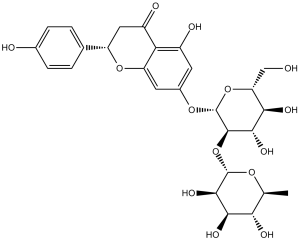
柚皮苷是一种二糖衍生物,是(S)-柚皮素在7位通过糖苷键被2-O-(α-L-鼠李糖基)-β-D-吡喃葡萄糖基取代而形成的。它具有代谢产物、抗肿瘤和抗炎活性。柚皮苷是一种二糖衍生物,属于二羟基黄烷酮类、4'-羟基黄烷酮类、(2S)-黄烷-4-酮类和新橙皮苷类。其功能与(S)-柚皮素相关。
据报道,柚皮苷存在于鼠尾草、柑橘以及其他有相关数据的生物体中。 另见:柚皮素(亚类); Drynaria fortunei 根(部分)。 1. 背景和来源: - 柚皮苷 是一种天然黄烷酮糖苷,主要从柑橘类水果(例如葡萄柚、橙子、柠檬)和草药(例如槐花)的果皮中分离得到。它是一种主要活性成分,具有抗氧化、抗炎、抗癌和神经保护作用[1-5] 2. 作用机制: - 抗氧化:激活 Nrf2 信号通路,上调抗氧化酶(SOD、CAT、GSH-Px)并直接清除 ROS[1,3,4] - 抗炎:抑制 NF-κB 通路,减少促炎细胞因子(TNF-α、IL-6)[1] - 抗癌:抑制 PI3K/Akt/mTOR 通路,激活 MAPK,诱导自噬介导的癌细胞生长抑制;下调 Zeb1 以抑制 EMT 和转移 [2,5] - 神经保护作用:改善脑线粒体功能,激活神经元胰岛素信号传导,并减少氧化应激以增强认知功能 [4] - 抗糖尿病肾脏保护作用:减少肾脏氧化应激、炎症和足细胞损伤以改善糖尿病肾病 (DKD) [1] 3. 治疗潜力: - 柚皮苷 显示出治疗慢性疾病的潜力:(1) 代谢紊乱(糖尿病、肥胖症、DKD);(2) 癌症(胃癌、骨肉瘤);(3) 神经退行性疾病(认知障碍、帕金森病样线粒体功能障碍)[1-5] - 其低毒性(在动物模型中未观察到明显的肝肾毒性)和天然来源使其成为功能性食品或药物开发的理想候选药物 [1,4] ; |
| 分子式 |
C27H32O14
|
|
|---|---|---|
| 分子量 |
580.53
|
|
| 精确质量 |
580.179
|
|
| CAS号 |
10236-47-2
|
|
| 相关CAS号 |
Naringin Dihydrochalcone;18916-17-1
|
|
| PubChem CID |
442428
|
|
| 外观&性状 |
White to light yellow solid powder
|
|
| 密度 |
1.2±0.1 g/cm3
|
|
| 沸点 |
928.1±65.0 °C at 760 mmHg
|
|
| 熔点 |
166 °C
|
|
| 闪点 |
308.5±27.8 °C
|
|
| 蒸汽压 |
0.0±0.3 mmHg at 25°C
|
|
| 折射率 |
1.564
|
|
| LogP |
-0.18
|
|
| tPSA |
225.06
|
|
| 氢键供体(HBD)数目 |
8
|
|
| 氢键受体(HBA)数目 |
14
|
|
| 可旋转键数目(RBC) |
6
|
|
| 重原子数目 |
41
|
|
| 分子复杂度/Complexity |
884
|
|
| 定义原子立体中心数目 |
11
|
|
| SMILES |
C[C@H]1[C@@H]([C@H]([C@H]([C@@H](O1)O[C@@H]2[C@H]([C@@H]([C@H](O[C@H]2OC3=CC(=C4C(=O)C[C@H](OC4=C3)C5=CC=C(C=C5)O)O)CO)O)O)O)O)O
|
|
| InChi Key |
DFPMSGMNTNDNHN-JJLSSNRUSA-N
|
|
| InChi Code |
InChI=1S/C27H32O14/c1-10-20(32)22(34)24(36)26(37-10)41-25-23(35)21(33)18(9-28)40-27(25)38-13-6-14(30)19-15(31)8-16(39-17(19)7-13)11-2-4-12(29)5-3-11/h2-7,10,16,18,20-30,32-36H,8-9H2,1H3/t10-,16?,18+,20-,21+,22+,23-,24+,25+,26-,27+/m0/s1
|
|
| 化学名 |
7-(((2S,3R,4S,5S,6R)-4,5-dihydroxy-6-(hydroxymethyl)-3-(((2S,3R,4R,5R,6S)-3,4,5-trihydroxy-6-methyltetrahydro-2H-pyran-2-yl)oxy)tetrahydro-2H-pyran-2-yl)oxy)-5-hydroxy-2-(4-hydroxyphenyl)chroman-4-one
|
|
| 别名 |
|
|
| HS Tariff Code |
2934.99.9001
|
|
| 存储方式 |
Powder -20°C 3 years 4°C 2 years In solvent -80°C 6 months -20°C 1 month |
|
| 运输条件 |
Room temperature (This product is stable at ambient temperature for a few days during ordinary shipping and time spent in Customs)
|
| 溶解度 (体外实验) |
|
|||
|---|---|---|---|---|
| 溶解度 (体内实验) |
配方 1 中的溶解度: 2.08 mg/mL (3.58 mM) in 10% DMSO + 40% PEG300 + 5% Tween80 + 45% Saline (这些助溶剂从左到右依次添加,逐一添加), 悬浮液;超声助溶。
例如,若需制备1 mL的工作液,可将100 μL 20.8 mg/mL澄清DMSO储备液加入400 μL PEG300中,混匀;然后向上述溶液中加入50 μL Tween-80,混匀;加入450 μL生理盐水定容至1 mL。 *生理盐水的制备:将 0.9 g 氯化钠溶解在 100 mL ddH₂O中,得到澄清溶液。 配方 2 中的溶解度: ≥ 2.08 mg/mL (3.58 mM) (饱和度未知) in 10% DMSO + 90% (20% SBE-β-CD in Saline) (这些助溶剂从左到右依次添加,逐一添加), 澄清溶液。 例如,若需制备1 mL的工作液,可将 100 μL 20.8 mg/mL澄清DMSO储备液加入900 μL 20% SBE-β-CD生理盐水溶液中,混匀。 *20% SBE-β-CD 生理盐水溶液的制备(4°C,1 周):将 2 g SBE-β-CD 溶解于 10 mL 生理盐水中,得到澄清溶液。 View More
配方 3 中的溶解度: ≥ 2.08 mg/mL (3.58 mM) (饱和度未知) in 10% DMSO + 90% Corn Oil (这些助溶剂从左到右依次添加,逐一添加), 澄清溶液。 配方 4 中的溶解度: 40 mg/mL (68.90 mM) in 50% PEG300 50% Saline (这些助溶剂从左到右依次添加,逐一添加), 澄清溶液; 超声助溶 (<60°C). *生理盐水的制备:将 0.9 g 氯化钠溶解在 100 mL ddH₂O中,得到澄清溶液。 1、请先配制澄清的储备液(如:用DMSO配置50 或 100 mg/mL母液(储备液)); 2、取适量母液,按从左到右的顺序依次添加助溶剂,澄清后再加入下一助溶剂。以 下列配方为例说明 (注意此配方只用于说明,并不一定代表此产品 的实际溶解配方): 10% DMSO → 40% PEG300 → 5% Tween-80 → 45% ddH2O (或 saline); 假设最终工作液的体积为 1 mL, 浓度为5 mg/mL: 取 100 μL 50 mg/mL 的澄清 DMSO 储备液加到 400 μL PEG300 中,混合均匀/澄清;向上述体系中加入50 μL Tween-80,混合均匀/澄清;然后继续加入450 μL ddH2O (或 saline)定容至 1 mL; 3、溶剂前显示的百分比是指该溶剂在最终溶液/工作液中的体积所占比例; 4、 如产品在配制过程中出现沉淀/析出,可通过加热(≤50℃)或超声的方式助溶; 5、为保证最佳实验结果,工作液请现配现用! 6、如不确定怎么将母液配置成体内动物实验的工作液,请查看说明书或联系我们; 7、 以上所有助溶剂都可在 Invivochem.cn网站购买。 |
| 制备储备液 | 1 mg | 5 mg | 10 mg | |
| 1 mM | 1.7226 mL | 8.6128 mL | 17.2256 mL | |
| 5 mM | 0.3445 mL | 1.7226 mL | 3.4451 mL | |
| 10 mM | 0.1723 mL | 0.8613 mL | 1.7226 mL |
1、根据实验需要选择合适的溶剂配制储备液 (母液):对于大多数产品,InvivoChem推荐用DMSO配置母液 (比如:5、10、20mM或者10、20、50 mg/mL浓度),个别水溶性高的产品可直接溶于水。产品在DMSO 、水或其他溶剂中的具体溶解度详见上”溶解度 (体外)”部分;
2、如果您找不到您想要的溶解度信息,或者很难将产品溶解在溶液中,请联系我们;
3、建议使用下列计算器进行相关计算(摩尔浓度计算器、稀释计算器、分子量计算器、重组计算器等);
4、母液配好之后,将其分装到常规用量,并储存在-20°C或-80°C,尽量减少反复冻融循环。
计算结果:
工作液浓度: mg/mL;
DMSO母液配制方法: mg 药物溶于 μL DMSO溶液(母液浓度 mg/mL)。如该浓度超过该批次药物DMSO溶解度,请首先与我们联系。
体内配方配制方法:取 μL DMSO母液,加入 μL PEG300,混匀澄清后加入μL Tween 80,混匀澄清后加入 μL ddH2O,混匀澄清。
(1) 请确保溶液澄清之后,再加入下一种溶剂 (助溶剂) 。可利用涡旋、超声或水浴加热等方法助溶;
(2) 一定要按顺序加入溶剂 (助溶剂) 。
| NCT Number | Recruitment | interventions | Conditions | Sponsor/Collaborators | Start Date | Phases |
| NCT01272167 | Completed | Behavioral: Long-term grapefruit juice consumption |
Post-menopausal Status | University Hospital, Clermont-Ferrand | March 2010 | Not Applicable |
| NCT01423019 | Completed | Dietary Supplement: Advantra Z + Naringin + Hesperiden |
Weight Loss | Integrative Health Technologies, Inc. | October 2011 | Not Applicable |
| NCT03582553 | Completed Has Results | Dietary Supplement: Naringenin Other: Placebo |
Safety Issues Pharmacokinetics |
Pennington Biomedical Research Center | May 25, 2018 | Early Phase 1 |
| NCT03928249 | Completed | Dietary Supplement: Eriocitrin | Pre Diabetes | São Paulo State University | December 1, 2019 | Not Applicable |
|
|
|
InvivoChem的所有产品仅用于作科学研究,不面向患者销售
Copyright 2020 InvivoChem LLC | All Rights Reserved 粤ICP备20063088号-1


 粤公网安备 44011102003439号
 463611831
