| 规格 | 价格 | |
|---|---|---|
| 500mg | ||
| 1g | ||
| Other Sizes |
| 靶点 |
Quinolone
|
|---|---|
| 体外研究 (In Vitro) |
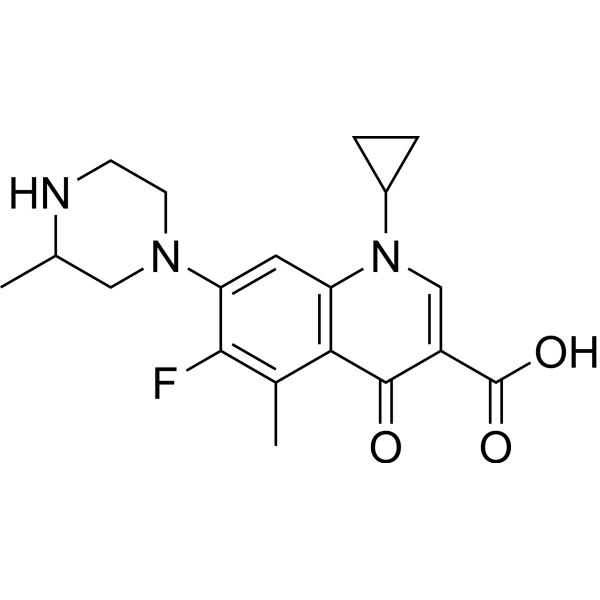
OPC-17116(格帕沙星)对大肠杆菌菌株 [14-21 天] 表现出 < 0.006 mg/L 的抗生素活性,MIC 值为 0-1 mg/L。鸟分枝杆菌的 MIC 值为 0.5 mg/L,证明了格帕沙星(0–1 mg/L;3 小时)对巨噬细胞中分枝杆菌的抗菌活性[1]。格帕沙星对所研究的革兰氏阳性菌和阴性菌引起的实验性全身感染具有较高的体内疗效,对肺炎链球菌等革兰氏阳性菌也具有很强的体外抗菌活性[4]。
|
| 体内研究 (In Vivo) |
就光毒性而言,格帕沙星(OPC-17116;200 mg/kg;po;Balb/c 小鼠)表现出良好的安全性[2]。在鼻内 (IN) 和静脉内 (IV) 鸟分枝杆菌感染模型中,格帕沙星(25–200 mg/kg;口服;每周 5 天,持续 4 周;雌性 C57BL6/J-Lyst bg-J/ 小鼠/米色小鼠)表现出适度的活动[3]。
|
| 动物实验 |
动物/疾病模型:雌性 balb/c (Bagg ALBino) 小鼠:(5-6 周龄)[2]
剂量: 200 mg/kg 给药途径: 口服;一次 实验结果: 出现轻微且短暂的红斑,耳廓厚度无变化。 动物/疾病模型:雌性 C57BL6/J-Lyst bg-J/小鼠/米色小鼠,感染鸟分枝杆菌[3] 剂量: 25、50、100 和 200 mg/kg 给药途径: 口服;每周 5 天,持续 4 周 实验结果: 具有杀菌活性,并限制了细菌的生长。 |
| 药代性质 (ADME/PK) |
吸收、分布和排泄
口服后迅速且广泛吸收。绝对生物利用度约为70%。 代谢/代谢物 主要经肝脏,通过CYP1A2和CYP3A4代谢。主要代谢物为葡萄糖醛酸苷结合物;次要代谢物包括硫酸盐结合物和氧化代谢物。氧化代谢物主要由细胞色素P450酶CYP1A2生成,而细胞色素P450酶CYP3A4的作用较小。与母体药物相比,非结合代谢物的抗菌活性很低,而结合代谢物则无抗菌活性。 生物半衰期 15±3小时 |
| 毒性/毒理 (Toxicokinetics/TK) |
蛋白质结合
50% |
| 参考文献 |
[1]. Vacher S, et, al. Comparative antimycobacterial activities of ofloxacin, ciprofloxacin and grepafloxacin. J Antimicrob Chemother. 1999 Nov;44(5):647-52.
[2]. Owen K. Comparative grepafloxacin phototoxicity in mouse skin. J Antimicrob Chemother. 1998 Aug;42(2):261-4. [3]. Cynamon MH, et, al. The activity of grepafloxacin in two murine models of Mycobacterium avium infection. J Infect Chemother. 2004 Jun;10(3):185-8. [4]. Miyamoto H, et al. Synthesis and biological properties of substituted 1,4-dihydro-5-methyl-4-oxo-3-quinolinecarboxylic acids. Bioorg Med Chem. 1995;3(12):1699-1706. |
| 其他信息 |
格雷帕沙星属于喹诺酮类抗生素,也属于氟喹诺酮类抗生素。
格雷帕沙星是一种口服广谱喹诺酮类抗菌药物,用于治疗细菌感染。由于其可能延长QTc间期(心电图QT间期变化可证实),以及存在心血管不良事件风险,格雷帕沙星已在美国撤市。 药物适应症 用于治疗由对格雷帕沙星敏感的流感嗜血杆菌、肺炎链球菌或卡他莫拉菌菌株引起的轻度至中度成人感染。 作用机制 格雷帕沙星通过抑制细菌拓扑异构酶II(DNA促旋酶)和拓扑异构酶IV发挥抗菌活性,这两种酶是细菌DNA复制、转录和修复所必需的。 药效学 体外研究表明,格雷帕沙星对多种革兰氏阳性菌和革兰氏阴性需氧菌以及一些非典型微生物具有活性。 |
| 分子式 |
C19H22N3O3F
|
|---|---|
| 分子量 |
359.39
|
| 精确质量 |
359.165
|
| CAS号 |
119914-60-2
|
| 相关CAS号 |
Grepafloxacin hydrochloride;161967-81-3
|
| PubChem CID |
72474
|
| 外观&性状 |
Typically exists as solid at room temperature
|
| 密度 |
1.366
|
| 沸点 |
610ºC at 760mmHg
|
| 熔点 |
189-192ºC
|
| 闪点 |
322.7ºC
|
| LogP |
2.674
|
| tPSA |
74.57
|
| 氢键供体(HBD)数目 |
2
|
| 氢键受体(HBA)数目 |
7
|
| 可旋转键数目(RBC) |
3
|
| 重原子数目 |
26
|
| 分子复杂度/Complexity |
636
|
| 定义原子立体中心数目 |
0
|
| SMILES |
CC1CN(CCN1)C2=C(C(=C3C(=C2)N(C=C(C3=O)C(=O)O)C4CC4)C)F
|
| InChi Key |
AIJTTZAVMXIJGM-UHFFFAOYSA-N
|
| InChi Code |
InChI=1S/C19H22FN3O3/c1-10-8-22(6-5-21-10)15-7-14-16(11(2)17(15)20)18(24)13(19(25)26)9-23(14)12-3-4-12/h7,9-10,12,21H,3-6,8H2,1-2H3,(H,25,26)
|
| 化学名 |
1-cyclopropyl-6-fluoro-5-methyl-7-(3-methylpiperazin-1-yl)-4-oxoquinoline-3-carboxylic acid
|
| HS Tariff Code |
2934.99.9001
|
| 存储方式 |
Powder -20°C 3 years 4°C 2 years In solvent -80°C 6 months -20°C 1 month |
| 运输条件 |
Room temperature (This product is stable at ambient temperature for a few days during ordinary shipping and time spent in Customs)
|
| 溶解度 (体外实验) |
May dissolve in DMSO (in most cases), if not, try other solvents such as H2O, Ethanol, or DMF with a minute amount of products to avoid loss of samples
|
|---|---|
| 溶解度 (体内实验) |
注意: 如下所列的是一些常用的体内动物实验溶解配方,主要用于溶解难溶或不溶于水的产品(水溶度<1 mg/mL)。 建议您先取少量样品进行尝试,如该配方可行,再根据实验需求增加样品量。
注射用配方
注射用配方1: DMSO : Tween 80: Saline = 10 : 5 : 85 (如: 100 μL DMSO → 50 μL Tween 80 → 850 μL Saline)(IP/IV/IM/SC等) *生理盐水/Saline的制备:将0.9g氯化钠/NaCl溶解在100 mL ddH ₂ O中,得到澄清溶液。 注射用配方 2: DMSO : PEG300 :Tween 80 : Saline = 10 : 40 : 5 : 45 (如: 100 μL DMSO → 400 μL PEG300 → 50 μL Tween 80 → 450 μL Saline) 注射用配方 3: DMSO : Corn oil = 10 : 90 (如: 100 μL DMSO → 900 μL Corn oil) 示例: 以注射用配方 3 (DMSO : Corn oil = 10 : 90) 为例说明, 如果要配制 1 mL 2.5 mg/mL的工作液, 您可以取 100 μL 25 mg/mL 澄清的 DMSO 储备液,加到 900 μL Corn oil/玉米油中, 混合均匀。 View More
注射用配方 4: DMSO : 20% SBE-β-CD in Saline = 10 : 90 [如:100 μL DMSO → 900 μL (20% SBE-β-CD in Saline)] 口服配方
口服配方 1: 悬浮于0.5% CMC Na (羧甲基纤维素钠) 口服配方 2: 悬浮于0.5% Carboxymethyl cellulose (羧甲基纤维素) 示例: 以口服配方 1 (悬浮于 0.5% CMC Na)为例说明, 如果要配制 100 mL 2.5 mg/mL 的工作液, 您可以先取0.5g CMC Na并将其溶解于100mL ddH2O中,得到0.5%CMC-Na澄清溶液;然后将250 mg待测化合物加到100 mL前述 0.5%CMC Na溶液中,得到悬浮液。 View More
口服配方 3: 溶解于 PEG400 (聚乙二醇400) 请根据您的实验动物和给药方式选择适当的溶解配方/方案: 1、请先配制澄清的储备液(如:用DMSO配置50 或 100 mg/mL母液(储备液)); 2、取适量母液,按从左到右的顺序依次添加助溶剂,澄清后再加入下一助溶剂。以 下列配方为例说明 (注意此配方只用于说明,并不一定代表此产品 的实际溶解配方): 10% DMSO → 40% PEG300 → 5% Tween-80 → 45% ddH2O (或 saline); 假设最终工作液的体积为 1 mL, 浓度为5 mg/mL: 取 100 μL 50 mg/mL 的澄清 DMSO 储备液加到 400 μL PEG300 中,混合均匀/澄清;向上述体系中加入50 μL Tween-80,混合均匀/澄清;然后继续加入450 μL ddH2O (或 saline)定容至 1 mL; 3、溶剂前显示的百分比是指该溶剂在最终溶液/工作液中的体积所占比例; 4、 如产品在配制过程中出现沉淀/析出,可通过加热(≤50℃)或超声的方式助溶; 5、为保证最佳实验结果,工作液请现配现用! 6、如不确定怎么将母液配置成体内动物实验的工作液,请查看说明书或联系我们; 7、 以上所有助溶剂都可在 Invivochem.cn网站购买。 |
| 制备储备液 | 1 mg | 5 mg | 10 mg | |
| 1 mM | 2.7825 mL | 13.9125 mL | 27.8249 mL | |
| 5 mM | 0.5565 mL | 2.7825 mL | 5.5650 mL | |
| 10 mM | 0.2782 mL | 1.3912 mL | 2.7825 mL |
1、根据实验需要选择合适的溶剂配制储备液 (母液):对于大多数产品,InvivoChem推荐用DMSO配置母液 (比如:5、10、20mM或者10、20、50 mg/mL浓度),个别水溶性高的产品可直接溶于水。产品在DMSO 、水或其他溶剂中的具体溶解度详见上”溶解度 (体外)”部分;
2、如果您找不到您想要的溶解度信息,或者很难将产品溶解在溶液中,请联系我们;
3、建议使用下列计算器进行相关计算(摩尔浓度计算器、稀释计算器、分子量计算器、重组计算器等);
4、母液配好之后,将其分装到常规用量,并储存在-20°C或-80°C,尽量减少反复冻融循环。
计算结果:
工作液浓度: mg/mL;
DMSO母液配制方法: mg 药物溶于 μL DMSO溶液(母液浓度 mg/mL)。如该浓度超过该批次药物DMSO溶解度,请首先与我们联系。
体内配方配制方法:取 μL DMSO母液,加入 μL PEG300,混匀澄清后加入μL Tween 80,混匀澄清后加入 μL ddH2O,混匀澄清。
(1) 请确保溶液澄清之后,再加入下一种溶剂 (助溶剂) 。可利用涡旋、超声或水浴加热等方法助溶;
(2) 一定要按顺序加入溶剂 (助溶剂) 。
 Antibacterial agent 166
 LasB-IN-1
 Ticarcillin monosodium
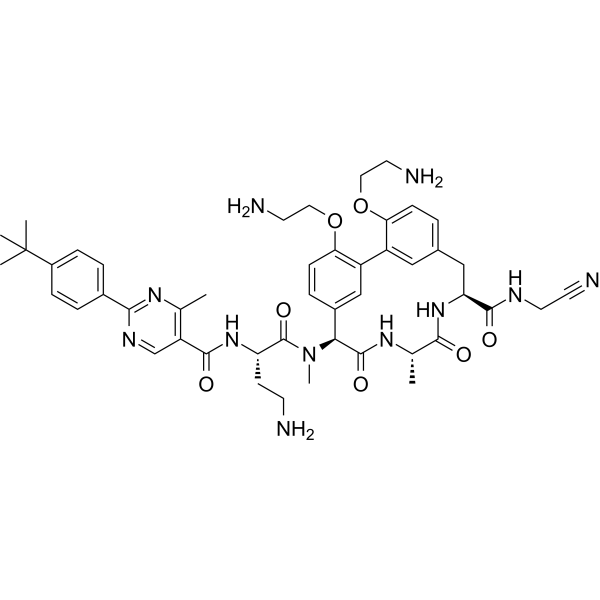 G0775
G0775
InvivoChem的所有产品仅用于作科学研究,不面向患者销售
Copyright 2020 InvivoChem LLC | All Rights Reserved 粤ICP备20063088号-1


 粤公网安备 44011102003439号
 463611831
