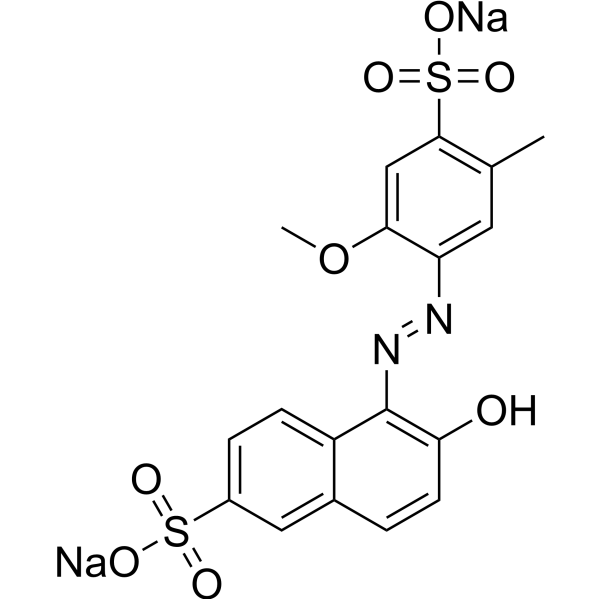
Allura Red AC dye

别名: 食品红17;诱惑红;6-羟基-5-[(2-甲氧基-5-甲基-4-磺酸苯基)偶氮]-2-萘磺酸二钠盐;食品红No.40;诱惑红AC;Allura Red AC 诱惑红AC;Food Red No. 40 食品红No.40;红色40号(诱惑红);诱惑红溶液标准物质; 6-羟基-5-[(2-甲氧基-5-甲基-4-磺本基)偶氮]2-萘磺酸二钠盐,Allura Red AC; 6-羟基-5-[(2-甲氧基-5-甲基-4-磺苯基)偶氮]2-萘磺酸二钠盐;阿洛拉红;冰染重氮组分13;咖喱红;食用赤色40号;诱惑红(E129,CI16035) 标准品;诱惑红AC,6-羟基-5-[(2-甲氧基-5-甲基-4-磺本基)偶氮]2-萘磺酸二钠盐;FD和C红No.40
目录号: V10822 纯度: ≥98%
Allura Red AC 是一种食用色素,是一种深红色水溶性(H2O 溶性)粉末或颗粒,用于饮料、糖浆、糖果和谷物等多种应用。
Allura Red AC dye CAS号: 25956-17-6
产品类别: New1
产品仅用于科学研究,不针对患者销售
规格 价格 库存 数量
50mg
100mg
Other Sizes
点击了解更多
  • 与全球5000+客户建立关系
  • 覆盖全球主要大学、医院、科研院所、生物/制药公司等
  • 产品被大量CNS顶刊文章引用
InvivoChem产品被CNS等顶刊论文引用
产品描述
Allura Red AC 是一种食用色素,是一种深红色水溶性(H2O 溶性)粉末或颗粒,用于饮料、糖浆、糖果和谷物等多种应用。 Allura Red AC 静态猝灭 HSA 内在荧光。
生物活性&实验参考方法
药代性质 (ADME/PK)
Absorption, Distribution and Excretion
Rats were fed a diet containing 5.19% of Allura Red. It was observed that 0.1% and 29% of the intact dye was excreted in the urine and feces respectively. In later studies, rats and dogs were pretreated daily with nonradioactive Allura Red. Subsequently, the animals were dosed with the 35S labelled compound and studied for up to 72 hours for excretion and distribution patterns of the color. Both species showed limited absorption of the compound with the major route of excretion being via the feces. In the dog 92-95% of the recovered radioactivity appeared in the feces within 72 hours while in the rat 76-92% of the recovered radioactivity appeared in the feces within this time period. Urinary recoveries of the color in rats and dogs, respectively varied between 5.7 and 19.8% and 2.7 and 3.6%. After sacrifice, significant retention of radioactivity was located in the intestinal contents of both species and in the washed intestines of the rats. This was thought to be due to adhesion of the compound to the intestinal wall, since the total carcass and viscera of these animals contained <0.4% of the administered dose.
Metabolism / Metabolites
Several metabolites, possibly resulting from azo-reduction in the gastrointestinal tract (two identified as aromatic amines, p-cresidine sulfonic acid being the major one), were also found in the feces and urine. Finally, significant retention in the washed intestines of rat was observed, probably due to adhesion to the intestinal wall.
Cresidinesulfonic acid was found to be the major metabolite of Allura Red in the urine of these two species, whereas the parent compound was not measurable. In addition, two other unidentifiable metabolites were found in the urine of the rats. In the rat fecal extracts, cresidinesulfonic acid was a major metabolite along with two unknowns and the parent compound. The dog fecal sample revealed an identical metabolite pattern as seen in the rat, and in addition, a third unknown was discovered. One of the urinary unknowns demonstrated an Rf value which was identical to that of the one of the fecal unknowns suggesting that they were one and the same. The other unknowns exhibited distinctive Rf values which indicated that these metabolites were different. It has been postulated that azo reduction by gut flora of the dye will yield the two components of the parent compound: 2-methoxy-5-methyl-aniline-4-sulfonic acid (cresidine-4-sulfonic acid) and 1-amino-2-naphthol-6-sulfonic acid. It appears that negligible quantities of intact Red are absorbed and excreted in the urine, and that the major portion of the color is excreted as metabolites in the feces.
毒性/毒理 (Toxicokinetics/TK)
Interactions
In this study, the color and its alumina lake were applied to the subjects volvar forearms (200 subjects) as an aqueous solution for 10 alternate days, for 24-hr periods, followed by a 14-day rest period. Challenge batches were then applied under occlusion to fresh skin sites on the subjects scapular backs for 24 hours. The color did not produce either irritation or allergic responses during the induction phase nor contact dermatitis in the challenge period. ... Allura Red and its lake were evaluated on sites under occlusion for five 48-hr, alternate-day periods. These sites had been previously irradiated for 5 min with Xenon light which had been filtered through a window-glass equivalent to limit the exposure to non-erythema-producing, long-wave radiation. A 10-day rest period followed this induction exposure, and then the color was applied to fresh skin sites, irradiated for 5 min with Xenon and subsequently removed and the sites were evaluated. Allura Red was shown not to produce photosensitization on the 25 subjects studied.
In 2006, the Korea Food and Drug Administration reported that combinations of dietary colors such as allura red AC, tartrazine, sunset yellow FCF, amaranth, and brilliant blue FCF are widely used in food manufacturing. Although individual tar food colors are controlled based on acceptable daily intake (ADI), there is no apparent information available for how combinations of these additives affect food safety. In the current study, the potencies of single and combination use of /dyes/ were examined on neural progenitor cell (NPC) toxicity, a biomarker for developmental stage, and neurogenesis, indicative of adult central nervous system (CNS) functions. /allura red AC/ and /amaranth/ reduced NPC proliferation and viability in mouse multipotent NPC, in the developing CNS model. Among several combinations tested in mouse model, combination of /tartrazine/ and /brilliant blue FCF/ at 1000-fold higher than average daily intake in Korea significantly decreased numbers of newly generated cells in adult mouse hippocampus, indicating potent adverse actions on hippocampal neurogenesis. However, other combinations including /allura red AC/ and /amaranth/ did not affect adult hippocampal neurogenesis in the dentate gyrus. Evidence indicates that single and combination use of most tar food colors may be safe with respect to risk using developmental NPC and adult hippocampal neurogenesis...
Non-Human Toxicity Values
LD50 Dog oral (male) > 5,000 mg/kg bw[EPA/Office of Pollution Prevention and Toxics; High Production Volume (HPV) Challenge Program's Robust Summaries and Test Plans for: 2-Naphthalenesulfonic acid, 6-hydroxy-5-
LD50 Rat oral >10,000 mg/kg bw[EPA/Office of Pollution Prevention and Toxics; High Production Volume (HPV) Challenge Program's Robust Summaries and Test Plans for: 2-Naphthalenesulfonic acid, 6-hydroxy-5-
LD50 Rabbit dermal 10,000 mg/kg bw
参考文献

[1]. Characterisation of Interaction Between Food Colourant Allura Red AC and Human Serum Albumin: Multispectroscopic Analyses and Docking Simulations. Food Chem. 2015 Mar 1;170:423-9.

其他信息
Allura red AC is a naphthalenesulfonic acid.
*注: 文献方法仅供参考, InvivoChem并未独立验证这些方法的准确性
化学信息 & 存储运输条件
分子式
C18H14N2NA2O8S2
分子量
496.4219
精确质量
495.998
CAS号
25956-17-6
PubChem CID
33258
外观&性状
Brown to reddish brown solid powder
熔点
300ºC
LogP
5.247
tPSA
185.34
氢键供体(HBD)数目
1
氢键受体(HBA)数目
10
可旋转键数目(RBC)
3
重原子数目
32
分子复杂度/Complexity
809
定义原子立体中心数目
0
InChi Key
CEZCCHQBSQPRMU-UHFFFAOYSA-L
InChi Code
InChI=1S/C18H16N2O8S2.2Na/c1-10-7-14(16(28-2)9-17(10)30(25,26)27)19-20-18-13-5-4-12(29(22,23)24)8-11(13)3-6-15(18)21;;/h3-9,21H,1-2H3,(H,22,23,24)(H,25,26,27);;/q;2*+1/p-2
化学名
disodium;6-hydroxy-5-[(2-methoxy-5-methyl-4-sulfonatophenyl)diazenyl]naphthalene-2-sulfonate
HS Tariff Code
2934.99.9001
存储方式

Powder      -20°C    3 years

                     4°C     2 years

In solvent   -80°C    6 months

                  -20°C    1 month

注意: 请将本产品存放在密封且受保护的环境中(例如氮气保护),避免吸湿/受潮和光照。
运输条件
Room temperature (This product is stable at ambient temperature for a few days during ordinary shipping and time spent in Customs)
溶解度数据
溶解度 (体外实验)
H2O : ~100 mg/mL (~201.44 mM)
DMSO : ~62.5 mg/mL (~125.90 mM)
溶解度 (体内实验)
注意: 如下所列的是一些常用的体内动物实验溶解配方,主要用于溶解难溶或不溶于水的产品(水溶度<1 mg/mL)。 建议您先取少量样品进行尝试,如该配方可行,再根据实验需求增加样品量。

注射用配方
(IP/IV/IM/SC等)
注射用配方1: DMSO : Tween 80: Saline = 10 : 5 : 85 (如: 100 μL DMSO 50 μL Tween 80 850 μL Saline)
*生理盐水/Saline的制备:将0.9g氯化钠/NaCl溶解在100 mL ddH ₂ O中,得到澄清溶液。
注射用配方 2: DMSO : PEG300Tween 80 : Saline = 10 : 40 : 5 : 45 (如: 100 μL DMSO 400 μL PEG300 50 μL Tween 80 450 μL Saline)
注射用配方 3: DMSO : Corn oil = 10 : 90 (如: 100 μL DMSO 900 μL Corn oil)
示例: 注射用配方 3 (DMSO : Corn oil = 10 : 90) 为例说明, 如果要配制 1 mL 2.5 mg/mL的工作液, 您可以取 100 μL 25 mg/mL 澄清的 DMSO 储备液,加到 900 μL Corn oil/玉米油中, 混合均匀。
View More

注射用配方 4: DMSO : 20% SBE-β-CD in Saline = 10 : 90 [如:100 μL DMSO 900 μL (20% SBE-β-CD in Saline)]
*20% SBE-β-CD in Saline的制备(4°C,储存1周):将2g SBE-β-CD (磺丁基-β-环糊精) 溶解于10mL生理盐水中,得到澄清溶液。
注射用配方 5: 2-Hydroxypropyl-β-cyclodextrin : Saline = 50 : 50 (如: 500 μL 2-Hydroxypropyl-β-cyclodextrin (羟丙基环胡精) 500 μL Saline)
注射用配方 6: DMSO : PEG300 : Castor oil : Saline = 5 : 10 : 20 : 65 (如: 50 μL DMSO 100 μL PEG300 200 μL Castor oil 650 μL Saline)
注射用配方 7: Ethanol : Cremophor : Saline = 10: 10 : 80 (如: 100 μL Ethanol 100 μL Cremophor 800 μL Saline)
注射用配方 8: 溶解于Cremophor/Ethanol (50 : 50), 然后用生理盐水稀释。
注射用配方 9: EtOH : Corn oil = 10 : 90 (如: 100 μL EtOH 900 μL Corn oil)
注射用配方 10: EtOH : PEG300Tween 80 : Saline = 10 : 40 : 5 : 45 (如: 100 μL EtOH 400 μL PEG300 50 μL Tween 80 450 μL Saline)


口服配方
口服配方 1: 悬浮于0.5% CMC Na (羧甲基纤维素钠)
口服配方 2: 悬浮于0.5% Carboxymethyl cellulose (羧甲基纤维素)
示例: 口服配方 1 (悬浮于 0.5% CMC Na)为例说明, 如果要配制 100 mL 2.5 mg/mL 的工作液, 您可以先取0.5g CMC Na并将其溶解于100mL ddH2O中,得到0.5%CMC-Na澄清溶液;然后将250 mg待测化合物加到100 mL前述 0.5%CMC Na溶液中,得到悬浮液。
View More

口服配方 3: 溶解于 PEG400 (聚乙二醇400)
口服配方 4: 悬浮于0.2% Carboxymethyl cellulose (羧甲基纤维素)
口服配方 5: 溶解于0.25% Tween 80 and 0.5% Carboxymethyl cellulose (羧甲基纤维素)
口服配方 6: 做成粉末与食物混合


注意: 以上为较为常见方法,仅供参考, InvivoChem并未独立验证这些配方的准确性。具体溶剂的选择首先应参照文献已报道溶解方法、配方或剂型,对于某些尚未有文献报道溶解方法的化合物,需通过前期实验来确定(建议先取少量样品进行尝试),包括产品的溶解情况、梯度设置、动物的耐受性等。

请根据您的实验动物和给药方式选择适当的溶解配方/方案:
1、请先配制澄清的储备液(如:用DMSO配置50 或 100 mg/mL母液(储备液));
2、取适量母液,按从左到右的顺序依次添加助溶剂,澄清后再加入下一助溶剂。以 下列配方为例说明 (注意此配方只用于说明,并不一定代表此产品 的实际溶解配方):
10% DMSO → 40% PEG300 → 5% Tween-80 → 45% ddH2O (或 saline);
假设最终工作液的体积为 1 mL, 浓度为5 mg/mL: 取 100 μL 50 mg/mL 的澄清 DMSO 储备液加到 400 μL PEG300 中,混合均匀/澄清;向上述体系中加入50 μL Tween-80,混合均匀/澄清;然后继续加入450 μL ddH2O (或 saline)定容至 1 mL;

3、溶剂前显示的百分比是指该溶剂在最终溶液/工作液中的体积所占比例;
4、 如产品在配制过程中出现沉淀/析出,可通过加热(≤50℃)或超声的方式助溶;
5、为保证最佳实验结果,工作液请现配现用!
6、如不确定怎么将母液配置成体内动物实验的工作液,请查看说明书或联系我们;
7、 以上所有助溶剂都可在 Invivochem.cn网站购买。
制备储备液 1 mg 5 mg 10 mg
1 mM 2.0144 mL 10.0721 mL 20.1442 mL
5 mM 0.4029 mL 2.0144 mL 4.0288 mL
10 mM 0.2014 mL 1.0072 mL 2.0144 mL

1、根据实验需要选择合适的溶剂配制储备液 (母液):对于大多数产品,InvivoChem推荐用DMSO配置母液 (比如:5、10、20mM或者10、20、50 mg/mL浓度),个别水溶性高的产品可直接溶于水。产品在DMSO 、水或其他溶剂中的具体溶解度详见上”溶解度 (体外)”部分;

2、如果您找不到您想要的溶解度信息,或者很难将产品溶解在溶液中,请联系我们;

3、建议使用下列计算器进行相关计算(摩尔浓度计算器、稀释计算器、分子量计算器、重组计算器等);

4、母液配好之后,将其分装到常规用量,并储存在-20°C或-80°C,尽量减少反复冻融循环。

计算器

摩尔浓度计算器可计算特定溶液所需的质量、体积/浓度,具体如下:

  • 计算制备已知体积和浓度的溶液所需的化合物的质量
  • 计算将已知质量的化合物溶解到所需浓度所需的溶液体积
  • 计算特定体积中已知质量的化合物产生的溶液的浓度
使用摩尔浓度计算器计算摩尔浓度的示例如下所示:
假如化合物的分子量为350.26 g/mol,在5mL DMSO中制备10mM储备液所需的化合物的质量是多少?
  • 在分子量(MW)框中输入350.26
  • 在“浓度”框中输入10,然后选择正确的单位(mM)
  • 在“体积”框中输入5,然后选择正确的单位(mL)
  • 单击“计算”按钮
  • 答案17.513 mg出现在“质量”框中。以类似的方式,您可以计算体积和浓度。

稀释计算器可计算如何稀释已知浓度的储备液。例如,可以输入C1、C2和V2来计算V1,具体如下:

制备25毫升25μM溶液需要多少体积的10 mM储备溶液?
使用方程式C1V1=C2V2,其中C1=10mM,C2=25μM,V2=25 ml,V1未知:
  • 在C1框中输入10,然后选择正确的单位(mM)
  • 在C2框中输入25,然后选择正确的单位(μM)
  • 在V2框中输入25,然后选择正确的单位(mL)
  • 单击“计算”按钮
  • 答案62.5μL(0.1 ml)出现在V1框中
g/mol

分子量计算器可计算化合物的分子量 (摩尔质量)和元素组成,具体如下:

注:化学分子式大小写敏感:C12H18N3O4  c12h18n3o4
计算化合物摩尔质量(分子量)的说明:
  • 要计算化合物的分子量 (摩尔质量),请输入化学/分子式,然后单击“计算”按钮。
分子质量、分子量、摩尔质量和摩尔量的定义:
  • 分子质量(或分子量)是一种物质的一个分子的质量,用统一的原子质量单位(u)表示。(1u等于碳-12中一个原子质量的1/12)
  • 摩尔质量(摩尔重量)是一摩尔物质的质量,以g/mol表示。
/

配液计算器可计算将特定质量的产品配成特定浓度所需的溶剂体积 (配液体积)

  • 输入试剂的质量、所需的配液浓度以及正确的单位
  • 单击“计算”按钮
  • 答案显示在体积框中
动物体内实验配方计算器(澄清溶液)
第一步:请输入基本实验信息(考虑到实验过程中的损耗,建议多配一只动物的药量)
第二步:请输入动物体内配方组成(配方适用于不溶/难溶于水的化合物),不同的产品和批次配方组成不同,如对配方有疑问,可先联系我们提供正确的体内实验配方。此外,请注意这只是一个配方计算器,而不是特定产品的确切配方。
+
+
+

计算结果:

工作液浓度 mg/mL;

DMSO母液配制方法 mg 药物溶于 μL DMSO溶液(母液浓度 mg/mL)。如该浓度超过该批次药物DMSO溶解度,请首先与我们联系。

体内配方配制方法μL DMSO母液,加入 μL PEG300,混匀澄清后加入μL Tween 80,混匀澄清后加入 μL ddH2O,混匀澄清。

(1) 请确保溶液澄清之后,再加入下一种溶剂 (助溶剂) 。可利用涡旋、超声或水浴加热等方法助溶;
            (2) 一定要按顺序加入溶剂 (助溶剂) 。

临床试验信息
NCT Number Recruitment interventions Conditions Sponsor/Collaborators Start Date Phases
NCT01901705 Completed Drug: Indigo naturalis ointment
Drug: Placebo
Psoriasis China Medical University Hospital 2013-02 Phase 2
联系我们