| 规格 | 价格 | 库存 | 数量 |
|---|---|---|---|
| 100mg |
|
||
| 250mg |
|
||
| 500mg |
|
||
| 1g |
|
||
| 5g |
|
||
| 10g |
|
||
| Other Sizes |
|

| 靶点 |
Precursor for creatine
Glycocyamine functions primarily as an endogenous metabolite and creatine precursor. It activates the Akt/mTOR/S6K signaling pathway via miR-133a-3p and miR-1a-3p, and stimulates the mRNA expression of myogenic differentiation factor 1 (MyoD) and myogenin (MyoG). The creatine phosphate/creatine kinase system maintains ATP homeostasis in muscle cells. |
|---|---|
| 体外研究 (In Vitro) |
GAA以剂量依赖的方式影响成肌细胞的肌源性分化。
GAA通过microRNA调控网络调节肌生成 胍基乙酸(GAA)是一种存在于包括肌肉和神经在内的动物组织中的内源性氨基酸衍生物,据报道可增强肌肉功能。MicroRNA(miRNA)是一种转录后调控因子,在营养介导的肌生成中发挥关键作用。然而,GAA对肌源性分化和骨骼肌生长的影响,以及miRNA在这些过程中的潜在调控机制尚未阐明。本研究探讨了GAA对C2C12细胞和小鼠增殖、分化和生长的影响。结果表明,GAA显著抑制成肌细胞增殖,同时下调细胞周期蛋白D1 (CCND1) 和细胞周期蛋白依赖性激酶4 (CDK4) mRNA表达,并上调细胞周期蛋白依赖性激酶抑制剂1A (P21) mRNA表达。我们还证实,GAA处理刺激了肌源性分化因子1 (MyoD) 和肌生成素 (MyoG) mRNA表达,从而提高了肌管融合率。此外,GAA补充通过增加肌球蛋白重链 (MyHC) 总蛋白水平、肌管厚度和腓肠肌横截面积促进肌管生长。小RNA测序结果显示,GAA补充后共有8个miRNA表达发生差异,其中包括miR-133a-3p和miR-1a-3p簇。为了进一步研究miR-133a-3p和miR-1a-3p在GAA诱导的骨骼肌生长中的作用,我们将miR-133a-3p和miR-1a-3p的模拟物转染到肌管细胞中,结果显示肌管细胞也发生了生长。通过生物信息学分析和双荧光素酶报告系统,我们确定了miR-133a-3p和miR-1a-3p的靶基因。结果表明,这两种miRNA通过抑制靶基因的表达来调控Akt/mTOR/S6K信号通路。综上所述,这些研究结果表明,GAA补充剂可通过miR-133a-3p和miR-1a-3p诱导的AKT/mTOR/S6K信号通路激活促进成肌细胞分化和骨骼肌生长[2]。 体外实验表明,甘氨酰胺可通过miRNA介导的AKT/mTOR/S6K信号通路激活促进小鼠C2C12细胞的成肌细胞分化和骨骼肌发育。它以剂量依赖的方式影响成肌细胞的成肌分化。甘氨酰胺可通过磷酸肌酸/肌酸激酶系统增加肌肉肌酸浓度并维持ATP稳态。 |
| 体内研究 (In Vivo) |
胍基乙酸 (GAA) 由精氨酸 (Arg) 和甘氨酸 (Gly) 在肝脏和肾脏中合成,随后经 S-腺苷甲硫氨酸甲基化生成肌酸。本研究进行了四项生物测定,以确定 GAA 作为生长雏鸡日粮中精氨酸的替代品的能力。在为期 9 天的笼养试验中,肉鸡雏鸡分别饲喂缺乏精氨酸的葡萄糖-酪蛋白(0.88% 精氨酸)或玉米-玉米副产品-豆粕(1.0% 精氨酸)基础日粮,每个处理组设置 5 个鸡舍,每个处理组 4 只雏鸡。结果表明,葡萄糖-酪蛋白日粮中的精氨酸含量明显不足,因为添加精氨酸、GAA 或肌酸后,雏鸡的体重增加和料重比均显著提高 (P < 0.01)。添加GAA的最佳水平为日粮的0.12%,但当添加到精氨酸充足的日粮中时,该水平的GAA或1.0%的肌酸水均未改善生长性能。第二次试验在2×2析因设计中证实了L-精氨酸和GAA补充的最佳水平。使用以玉米、玉米蛋白粉、酒糟及其可溶物和豆粕为基础的实用型日粮,添加0.25%的精氨酸、0.12%的GAA或0.15%的肌酸水均能显著提高料肉比(P < 0.05)。这些结果表明,与肌酸类似,0.12%的GAA补充能使饲喂精氨酸缺乏日粮的雏鸡产生稳定的生长反应。为了进一步验证GAA作为膳食精氨酸替代品的能力,本研究在葡萄糖-酪蛋白日粮中添加了7个不同剂量的精氨酸,并分别在有或无0.12% GAA的条件下进行(共14种日粮)。结果显示,补充精氨酸对增重和料重比(G:F)的影响呈二次曲线关系(P < 0.01)。在有或无0.12% GAA的情况下,估计的补充精氨酸需求量相似,但与精氨酸充足的日粮相比,在精氨酸缺乏的日粮中添加GAA能更显著地提高料重比(P < 0.05)。综上所述,这些数据表明GAA可以作为雏鸡日粮中精氨酸的有效替代品[1]。
在体内,甘氨酰胺(0.6-1.2 g/kg;口服;自由采食)已被用于家禽养殖,作为饲料添加剂以提高生长性能和肌肉能量代谢。它可以作为膳食精氨酸的替代品,为鸟类提供维持体内平衡所需的能量。该化合物能提高肌肉肌酸浓度,并维持ATP稳态。 |
| 酶活实验 |
在体外研究中,C2C12成肌细胞在含有不同浓度(通常为0.1-10 mM)甘氨酸的分化培养基中培养。通过qRT-PCR或Western blot检测MyoD和肌生成素等肌源性标志物的表达来评估肌源性分化。AKT/mTOR/S6K通路激活通过检测AKT、mTOR和S6K蛋白的磷酸化水平来确认。
|
| 细胞实验 |
小鼠骨骼肌细胞系C2C12在含有高糖DMEM的生长培养基(GM)中培养,并添加10%胎牛血清、100,000单位/升青霉素钠和100毫克/升硫酸链霉素,置于37℃、5% CO2的湿润培养箱中培养。C2C12成肌细胞在含有高糖DMEM和2%马血清的分化培养基(DM)中诱导8天。GAA溶于GM或DM中,终浓度为20 mmol/L。雷帕霉素(Rap)溶于DMSO中,终浓度为100 nmol/L。培养基中DMSO的最终浓度低于0.1%[2]。
细胞增殖率检测[2] 采用CCK-8法和EdU细胞增殖检测试剂盒检测C2C12细胞的增殖率。将C2C12细胞接种于96孔细胞培养板中,并在含有0 mM、5 mM、10 mM或20 mM GAA的GM培养基中培养48小时;每12小时更换一次培养基。CCK-8检测中,向培养基中加入10 μL CCK-8试剂,1小时后在450 nm处测定光密度值。EdU细胞增殖检测中,用不同浓度的GAA处理细胞,当细胞汇合度达到约80%时,向培养基中加入10 μM EdU,孵育2小时。 EdU染色按照制造商说明进行;细胞核用DAPI染色。染色后的细胞用Olympus IX53显微镜成像。 蛋白质印迹分析。[2] 简而言之,将细胞接种于六孔细胞培养板中。分化4天后,按照所述方法用Rap或GAA处理细胞48小时。然后用PBS洗涤细胞三次,并在含有1 mM PMSF和0.02%蛋白酶/磷酸酶抑制剂的200 μL RIPA裂解缓冲液中裂解细胞。对于组织,将25 mg腓肠肌在含有1 mM PMSF和0.02%蛋白酶/磷酸酶抑制剂的500 μL RIPA裂解缓冲液中匀浆。随后,将均质液在4℃下振荡30分钟,并通过12,000×g离心15分钟去除悬浮液中的不溶物。使用BCA蛋白测定法定量总蛋白浓度。取50 μg蛋白悬浮液进行10%十二烷基硫酸钠(SDS)聚丙烯酰胺凝胶电泳分离后,使用Trans-Blot Turbo转印系统将蛋白转移至聚偏二氟乙烯(PVDF)膜上,然后在室温下用含0.1% Tween 20的5%(w/v)脱脂奶粉的Tris缓冲盐溶液封闭2小时。之后,将PVDF膜与指定的抗体在4℃下孵育过夜,再与二抗在室温下孵育1小时。使用 ChemiDoc MP 成像系统测定蛋白质表达,并以微管蛋白表达进行标准化。 肌母细胞系(如 C2C12)在添加 10% FBS 的 DMEM 培养基中,于 37°C、5% CO₂ 条件下培养。在分化研究中,将细胞转移至含有特定浓度甘氨酸的分化培养基(含 2% 马血清的 DMEM)中。分化 3-7 天后,收集细胞用于 RNA 或蛋白质提取。使用 qRT-PCR 进行 MyoD 和肌生成素基因表达分析。通过 Western blot 分析蛋白质表达和信号通路激活情况。 |
| 动物实验 |
动物和肌肉样本采集[2]
昆明雄性小鼠(n = 30)购自大硕医学实验动物中心,3周龄。实验期间,小鼠在12小时光照/12小时黑暗循环、温度23 °C ± 3 °C、相对湿度70% ± 10%的条件下自由摄食饮水。适应环境一周后,将小鼠随机分为三组(每组n = 10),分别在饮用水中添加不同浓度的GAA(0%、1%和2%),持续8周。实验结束时,采集血清并取腓肠肌进行后续检测。血清保存于−80 °C,肌肉组织保存于液氮中。 在动物实验中,甘氨酸胺通常以0.6-1.2 g/kg的剂量通过饲料或饮用水灌胃给家禽或啮齿动物。监测动物的体重增长、饲料转化率和肌肉肌酸浓度。采集血液样本分析肌酸和ATP水平。采集肌肉组织进行生化分析和组织学检查。 |
| 药代性质 (ADME/PK) |
代谢/代谢物
胍基乙酸 (GAA) 由精氨酸 (Arg) 和甘氨酸 (Gly) 在肝脏和肾脏中合成,随后经 S-腺苷甲硫氨酸甲基化生成肌酸。肝脏中胍基乙酸转化为肌酐会导致甲基消耗。这会导致同型半胱氨酸水平升高,而同型半胱氨酸水平升高已被证实与心血管和骨骼问题有关。 甘氨酸亚胺(分子量 117.11,分子式 C₃H₇N₃O₂)微溶于 DMF 和 DMSO,在 PBS(pH 7.2)中的溶解度为 10 mg/mL。作为一种内源性代谢物,它是体内天然存在的化合物。该化合物具有口服活性,并已被研究作为家禽养殖的饲料添加剂。它既是肌酸的直接前体,也是能量代谢调节剂。 |
| 毒性/毒理 (Toxicokinetics/TK) |
毒性概述
尿毒症毒素,例如胍基乙酸,可通过有机离子转运蛋白(尤其是OAT3)主动转运至肾脏。尿毒症毒素水平升高可刺激活性氧(ROS)的产生。这似乎是通过尿毒症毒素直接结合或抑制NADPH氧化酶(尤其是肾脏和心脏中含量丰富的NOX4)介导的(A7868)。ROS可诱导多种不同的DNA甲基转移酶(DNMTs),这些酶参与KLOTHO蛋白的沉默。KLOTHO已被证实对抗衰老、矿物质代谢和维生素D代谢起着重要作用。多项研究表明,在急性或慢性肾脏疾病中,由于局部ROS水平升高,KLOTHO mRNA和蛋白水平降低(A7869)。 |
| 参考文献 | |
| 其他信息 |
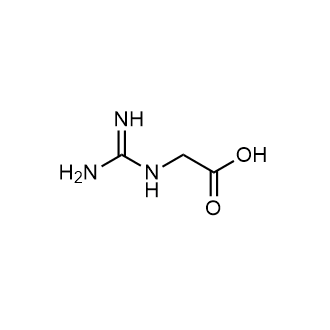
胍基乙酸 (GAA) 是甘氨酸的 N-脒基衍生物。它存在于人体、小鼠、营养补充剂、大鼠和细菌中。它是胍基乙酸酯的共轭酸,也是胍基乙酸的两性离子互变异构体。据报道,柑橘类水果、桃子和其他具有相关数据的生物体中都含有甘氨酸。甘氨酸是甘氨酸的天然衍生物,也是肌酸的代谢前体。甘氨酸,也称为胍基乙酸 (GAA),在胍基乙酸 N-甲基转移酶的催化下转化为肌酸。磷酸肌酸为肌肉细胞提供能量并促进肌肉收缩。剧烈运动后,当三磷酸腺苷 (ATP) 储备耗尽时,磷酸肌酸提供磷酸基团,用于快速合成 ATP。膳食补充胍基乙酸 (GAA) 可能改善癌症和其他慢性疾病相关的肌肉萎缩。胍基乙酸是一种尿毒症毒素。根据其化学和物理性质,尿毒症毒素可分为三大类:1) 小分子、水溶性、非蛋白结合化合物,例如尿素;2) 小分子、脂溶性和/或蛋白结合化合物,例如酚类;3) 较大的所谓中分子化合物,例如β2-微球蛋白。长期接触尿毒症毒素可导致多种疾病,包括肾损伤、慢性肾病和心血管疾病。胍基乙酸是尿素循环和氨基酸代谢的代谢产物,也是许多氨基酸代谢途径的组成部分,包括甘氨酸、丝氨酸、苏氨酸、精氨酸和脯氨酸的代谢。胍基乙酸也是肌酸的前体,肌酸是肌肉能量代谢的重要底物。
胍基乙酸(甘氨酰乙酸)是肾衰竭、肾移植和肾脏代谢活性的重要标志物。它是胍的代谢产物。该化合物已被研究用于通过促进肌酸生物合成来提高运动成绩,并作为动物饲料添加剂。它可能为鸟类能量稳态提供一种替代膳食精氨酸的方案。 |
| 分子式 |
C3H7N3O2
|
|---|---|
| 分子量 |
117.12
|
| 精确质量 |
117.053
|
| 元素分析 |
C, 30.77; H, 6.03; N, 35.88; O, 27.32
|
| CAS号 |
352-97-6
|
| PubChem CID |
763
|
| 外观&性状 |
Typically exists as white to off-white solids at room temperature
|
| 密度 |
1.6±0.1 g/cm3
|
| 沸点 |
294.2±42.0 °C at 760 mmHg
|
| 熔点 |
300 °C(lit.)
|
| 闪点 |
131.7±27.9 °C
|
| 蒸汽压 |
0.0±1.3 mmHg at 25°C
|
| 折射率 |
1.596
|
| LogP |
-1.85
|
| tPSA |
99.2
|
| 氢键供体(HBD)数目 |
3
|
| 氢键受体(HBA)数目 |
3
|
| 可旋转键数目(RBC) |
2
|
| 重原子数目 |
8
|
| 分子复杂度/Complexity |
116
|
| 定义原子立体中心数目 |
0
|
| SMILES |
O([H])C(C([H])([H])/N=C(\N([H])[H])/N([H])[H])=O
|
| InChi Key |
BPMFZUMJYQTVII-UHFFFAOYSA-N
|
| InChi Code |
InChI=1S/C3H7N3O2/c4-3(5)6-1-2(7)8/h1H2,(H,7,8)(H4,4,5,6)
|
| 化学名 |
2-(diaminomethylideneamino)acetic acid
|
| 别名 |
AI3 17119; AI3-17119; glycocyamine; 352-97-6; guanidinoacetic acid; Guanidineacetic acid; 2-Guanidinoacetic acid; Guanidoacetic acid; N-amidinoglycine; Betacyamine; Glycocyamine
|
| HS Tariff Code |
2934.99.9001
|
| 存储方式 |
Powder -20°C 3 years 4°C 2 years In solvent -80°C 6 months -20°C 1 month |
| 运输条件 |
Room temperature (This product is stable at ambient temperature for a few days during ordinary shipping and time spent in Customs)
|
| 溶解度 (体外实验) |
1M HCl : 50 mg/mL (~426.95 mM)
H2O : ~5 mg/mL (~42.69 mM) |
|---|---|
| 溶解度 (体内实验) |
注意: 如下所列的是一些常用的体内动物实验溶解配方,主要用于溶解难溶或不溶于水的产品(水溶度<1 mg/mL)。 建议您先取少量样品进行尝试,如该配方可行,再根据实验需求增加样品量。
注射用配方
注射用配方1: DMSO : Tween 80: Saline = 10 : 5 : 85 (如: 100 μL DMSO → 50 μL Tween 80 → 850 μL Saline)(IP/IV/IM/SC等) *生理盐水/Saline的制备:将0.9g氯化钠/NaCl溶解在100 mL ddH ₂ O中,得到澄清溶液。 注射用配方 2: DMSO : PEG300 :Tween 80 : Saline = 10 : 40 : 5 : 45 (如: 100 μL DMSO → 400 μL PEG300 → 50 μL Tween 80 → 450 μL Saline) 注射用配方 3: DMSO : Corn oil = 10 : 90 (如: 100 μL DMSO → 900 μL Corn oil) 示例: 以注射用配方 3 (DMSO : Corn oil = 10 : 90) 为例说明, 如果要配制 1 mL 2.5 mg/mL的工作液, 您可以取 100 μL 25 mg/mL 澄清的 DMSO 储备液,加到 900 μL Corn oil/玉米油中, 混合均匀。 View More
注射用配方 4: DMSO : 20% SBE-β-CD in Saline = 10 : 90 [如:100 μL DMSO → 900 μL (20% SBE-β-CD in Saline)] 口服配方
口服配方 1: 悬浮于0.5% CMC Na (羧甲基纤维素钠) 口服配方 2: 悬浮于0.5% Carboxymethyl cellulose (羧甲基纤维素) 示例: 以口服配方 1 (悬浮于 0.5% CMC Na)为例说明, 如果要配制 100 mL 2.5 mg/mL 的工作液, 您可以先取0.5g CMC Na并将其溶解于100mL ddH2O中,得到0.5%CMC-Na澄清溶液;然后将250 mg待测化合物加到100 mL前述 0.5%CMC Na溶液中,得到悬浮液。 View More
口服配方 3: 溶解于 PEG400 (聚乙二醇400) 请根据您的实验动物和给药方式选择适当的溶解配方/方案: 1、请先配制澄清的储备液(如:用DMSO配置50 或 100 mg/mL母液(储备液)); 2、取适量母液,按从左到右的顺序依次添加助溶剂,澄清后再加入下一助溶剂。以 下列配方为例说明 (注意此配方只用于说明,并不一定代表此产品 的实际溶解配方): 10% DMSO → 40% PEG300 → 5% Tween-80 → 45% ddH2O (或 saline); 假设最终工作液的体积为 1 mL, 浓度为5 mg/mL: 取 100 μL 50 mg/mL 的澄清 DMSO 储备液加到 400 μL PEG300 中,混合均匀/澄清;向上述体系中加入50 μL Tween-80,混合均匀/澄清;然后继续加入450 μL ddH2O (或 saline)定容至 1 mL; 3、溶剂前显示的百分比是指该溶剂在最终溶液/工作液中的体积所占比例; 4、 如产品在配制过程中出现沉淀/析出,可通过加热(≤50℃)或超声的方式助溶; 5、为保证最佳实验结果,工作液请现配现用! 6、如不确定怎么将母液配置成体内动物实验的工作液,请查看说明书或联系我们; 7、 以上所有助溶剂都可在 Invivochem.cn网站购买。 |
| 制备储备液 | 1 mg | 5 mg | 10 mg | |
| 1 mM | 8.5383 mL | 42.6913 mL | 85.3825 mL | |
| 5 mM | 1.7077 mL | 8.5383 mL | 17.0765 mL | |
| 10 mM | 0.8538 mL | 4.2691 mL | 8.5383 mL |
1、根据实验需要选择合适的溶剂配制储备液 (母液):对于大多数产品,InvivoChem推荐用DMSO配置母液 (比如:5、10、20mM或者10、20、50 mg/mL浓度),个别水溶性高的产品可直接溶于水。产品在DMSO 、水或其他溶剂中的具体溶解度详见上”溶解度 (体外)”部分;
2、如果您找不到您想要的溶解度信息,或者很难将产品溶解在溶液中,请联系我们;
3、建议使用下列计算器进行相关计算(摩尔浓度计算器、稀释计算器、分子量计算器、重组计算器等);
4、母液配好之后,将其分装到常规用量,并储存在-20°C或-80°C,尽量减少反复冻融循环。
计算结果:
工作液浓度: mg/mL;
DMSO母液配制方法: mg 药物溶于 μL DMSO溶液(母液浓度 mg/mL)。如该浓度超过该批次药物DMSO溶解度,请首先与我们联系。
体内配方配制方法:取 μL DMSO母液,加入 μL PEG300,混匀澄清后加入μL Tween 80,混匀澄清后加入 μL ddH2O,混匀澄清。
(1) 请确保溶液澄清之后,再加入下一种溶剂 (助溶剂) 。可利用涡旋、超声或水浴加热等方法助溶;
(2) 一定要按顺序加入溶剂 (助溶剂) 。
InvivoChem的所有产品仅用于作科学研究,不面向患者销售
Copyright 2020 InvivoChem LLC | All Rights Reserved 粤ICP备20063088号-1


 COA
COA
 粤公网安备 44011102003439号
 463611831
