| 规格 | 价格 | ||
|---|---|---|---|
| 500mg | |||
| 1g | |||
| Other Sizes |

| 毒性/毒理 (Toxicokinetics/TK) |
Toxicity Summary
IDENTIFICATION AND USE: Cybutryne is used as a booster algicide in antifouling paint. HUMAN STUDIES: Cybutryne induces HepG2 cell apoptosis through mitochondrial dysfunction and oxidative stress. ANIMAL STUDIES: Cybutryne inhibits the ATP synthesis. The analysis of the various steps involved in the ATP synthesis suggests that the inhibition is due to the opening of small-size pores. ECOTOXICITY STUDIES: When tested on early developmental stages of marine invertebrates cybutryne was found to be the least toxic among other commonly used 'booster'' biocides. However, it was more toxic when tested on the growth of autotrophic species. The toxicity of cybutryne towards periphyton and phytoplankton was shown to be higher than that of atrazine. It induced spermiotoxicity and embryotoxicity at environmentally relevant concentrations in Pacific oyster (Crassostrea gigas) gametes or embryos. It had a significant impact on meiofauna abundance, even at the lowest concentrations, causing a drastic decline in the abundance of nematodes (the dominant meiofaunal taxon) and an increase of the relative importance of oligochaetes. Other study evaluated the effects of cybutryne toxicity on the exoskeleton of Metanephrops japonicus, which is the outer layer facing the environment. Ecdysteroid receptor (Mj-EcR), trypsin (Mj-Tryp), and serine proteinase (Mj-SP) in the hepatopancreas were upregulated in response to different exposure levels of the biocide at day 1, 4, or 7. In contrast, gill Mj-chi5, Mj-Tryp, and Mj-SP exhibited late upregulated responses to 10 ug/L compared to the control at day 7. Mj-chi1 showed early upregulation upon exposure to 10 ug/L and Mj-chi4 showed no changes in transcription in the gill. Gill Mj-EcR presented generally downregulated expression patterns. In addition, decreased survival and change of exoskeleton surface roughness were observed in M. japonicus exposed to the three concentrations of the biocide. Separate studies have shown that cybutryne inhibits coral photosynthesis at environmentally relevant concentrations, consistent with its mode of action as a photosystem II inhibitor. Interactions Three of the most commonly used antifouling booster biocides that are usually combined with copper or copper compounds are Irgarol 1051, Diuron, and Zn pyrithione. This study represents an assessment of the interactive effects of the antifouling biocides combined with each other, and with three heavy metals (Cu, Cd, and Zn) in binary mixtures, on the marine algae Chaetoceros gracilis. Seventy-two hour growth inhibition tests were carried out, and the IC50 values of the chemicals were determined along with growth inhibition (%) for several concentrations. The joint effect of the binary mixtures of all the chemicals was assessed by using two models, concentration addition model and the model of probabilities. The following increasing order of toxicity was obtained: Cd < Zn < Cu < Diuron < Zn pyrithione < Irgarol 1051. The interactive effects of the organic chemicals combined with each other on the growth of Ch. gracilis were firmly synergistic. Irgarol 1051 combined with Cd performed synergistic effects, and Zn pyrithione with copper and cadmium action was strictly antagonistic, and the results of the two models were in agreement in almost all mixtures. Single and joint effects of two antifouling booster biocides, Irgarol 1051 (2-methylthio-4-tert-butylamino-6-cyclopropylamino-s-triazine) and diuron (1-(3,4 dichlorophenyl)-3,3 dimethyl urea), their metabolites, M1 (2-methylthio-4-tert-butylamino-s-triazine), DCPMU (1-(3,4-dichlorophenyl)-3 methyl urea), DCPU (1-(3,4 dichlorophenyl urea) and DCA (3,4-dichloroaniline), respectively, as well as copper were examined. Two phytoplanktonic microorganisms, the green alga Dunaliella tertiolecta and the diatom Navicula forcipata were exposed to various concentrations of the aforementioned compounds both alone and in binary mixtures during a period of 96 hr. Estimation of EC(50) values was performed by daily cell number counting of the tested microorganisms. The toxicity of the six compounds and the metal, applied singly, was found to be, in decreasing order, Irgarol 1051>diuron>M1>DCPMU>DCA>Cu>DCPU and Irgarol 1051>diuron>M1>DCA for the green alga and the diatom, respectively. Diatoms were found to be more sensitive in the presence of all the tested compounds, except diuron. Co-existence of irgarol 1051 and M1 revealed additive effects on both microorganisms. Same results were observed owing to the joint action of copper with either Irgarol 1051 or M1 for almost all the examined mixtures. Combined effects of diuron with its metabolites DCPMU and DCA resulted in synergism in almost all cases, for both species of phytoplankton. On the contrary, antagonistic effects were observed owing to the joint action of copper with either diuron or one of its metabolites. Tides and freshwater inflow which influence water movement in estuarine areas govern the exposure-regime of pollutants. In this experiment, we examined the in situ impact of double pulses of copper and the herbicide Irgarol 1051 on the photosynthesis of the seagrass, Zostera capricorni. Despite a 4-day recovery period between the two 10 hr pulses of toxicant, the effective quantum yield of photosystem II (DeltaF/Fm') and total chlorophyll concentrations indicated that multiple-pulses had a greater impact than a single pulse. During the first exposure period, samples exposed to Irgarol 1051 had DeltaF/Fm' values as low as zero while controls remained around 0.6 relative units. After the second exposure period, treated samples recovered to only 0.4 relative units. Samples exposed to copper had DeltaF/Fm' values around 0.3 relative units during the first exposure period and while these samples recovered before the second dose, they remained below 0.2 relative units after the second exposure period. Alternate samples were also exposed to one toxicant, allowed to recover and then exposed to the other toxicant. DeltaF/Fm' values indicated that copper exposure followed by Irgarol 1051 exposure was more toxic than Irgarol 1051 exposure followed by copper exposure. The herbicides Irgarol 1051 (2-(tert-butylamino)-4-cyclopropylamino)-6-(methylthio)-1,3,5-triazine) and Diuron (3-(3',4'-dichlorophenyl)-1,1-dimethylurea) are commonly incorporated into antifouling paints to boost the efficacy of the compound towards algae. Previous investigations have identified environmental concentrations of these herbicides as being a threat to non-target organisms, such as seagrasses. Their individual toxicity has been assessed, but they can co-occur and interact, potentially increasing their toxicity and the threat posed to seagrass meadows. Chlorophyll fluorescence (Fv:Fm) and leaf specific biomass ratio (representing plant growth) were examined in Zostera marina L. after a 10-day exposure to the individual herbicides. The EC20 for each herbicide was determined and these then used in herbicide mixtures to assess their interactive effects. Irgarol 1051 was found to be more toxic than Diuron with lowest observable effect concentrations for Fv:Fm reduction of 0.5 and 1.0 +/- ug/L and 10-day EC50 values of 1.1 and 3.2 ug/L, respectively. Plants exposed to Irgarol 1051 and Diuron showed a significant reduction in growth at concentrations of 1.0 and 5.0 ug/L, respectively. When Z. marina was exposed to mixtures, the herbicides commonly interacted additively or antagonistically, and no significant further reduction in photosynthetic efficiency was found at any concentration when compared to plants exposed to the individual herbicides. However, on addition of the Diuron EC20 to varying Irgarol 1051 concentrations and the Irgarol 1051 EC20 to varying Diuron concentrations, significant reductions in Fv:Fm were noted at an earlier stage. The growth of plants exposed to Diuron plus the Irgarol 1051 EC20 were significantly reduced when compared to plants exposed to Diuron alone, but only at the lower concentrations. Growth of plants exposed to Irgarol 1051 and the Diuron EC20 showed no significant reduction when compared to the growth of plants exposed to Irgarol 1051 alone. Despite the addition of the EC20 not eliciting a further significant reduction when compared to the herbicides acting alone for most of the mixtures, the lowest observable significant effect concentration for growth and photosynthetic efficiency decreased to 0.5 ug/L for both herbicides. Irgarol 1051 and Diuron have been shown to occur together in concentrations above 0.5 ug/L, suggesting that seagrasses may be experiencing reduced photosynthetic efficiency and growth as a result. For more Interactions (Complete) data for 1,3,5-Triazine-2,4-diamine, N-cyclopropyl-N'-(1,1-dimethylethyl)-6-(methylthio)- (6 total), please visit the HSDB record page. |
|---|---|
| 其他信息 |
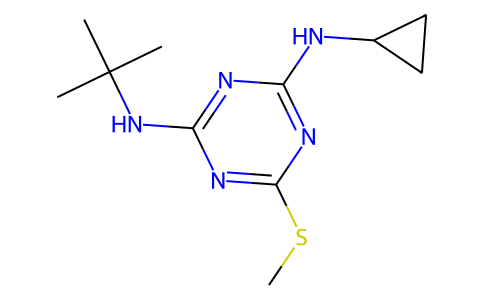
Irgarol 1051 is a diamino-1,3,5-triazine that is 1,3,5-triazine-2,4-diamine carrying a N-tert-butyl, N'-cyclopropyl and a methylsulfanyl group at position 6. It has a role as an antifouling biocide, a xenobiotic and an environmental contaminant. It is an aryl sulfide, a member of cyclopropanes and a diamino-1,3,5-triazine. It is functionally related to a 1,3,5-triazine-2,4-diamine. It derives from a hydride of a 1,3,5-triazine.
|
| 分子式 |
C11H19N5S
|
|---|---|
| 分子量 |
253.3671
|
| 精确质量 |
253.136
|
| CAS号 |
28159-98-0
|
| PubChem CID |
91590
|
| 外观&性状 |
Crystals from water
|
| 密度 |
1.3±0.1 g/cm3
|
| 沸点 |
347.2±25.0 °C at 760 mmHg
|
| 熔点 |
130-133ºC
|
| 闪点 |
163.8±23.2 °C
|
| 蒸汽压 |
0.0±0.8 mmHg at 25°C
|
| 折射率 |
1.659
|
| LogP |
1.12
|
| tPSA |
88.03
|
| 氢键供体(HBD)数目 |
2
|
| 氢键受体(HBA)数目 |
6
|
| 可旋转键数目(RBC) |
5
|
| 重原子数目 |
17
|
| 分子复杂度/Complexity |
251
|
| 定义原子立体中心数目 |
0
|
| SMILES |
S(C([H])([H])[H])C1N=C(N=C(N=1)N([H])C1([H])C([H])([H])C1([H])[H])N([H])C(C([H])([H])[H])(C([H])([H])[H])C([H])([H])[H]
|
| InChi Key |
HDHLIWCXDDZUFH-UHFFFAOYSA-N
|
| InChi Code |
InChI=1S/C11H19N5S/c1-11(2,3)16-9-13-8(12-7-5-6-7)14-10(15-9)17-4/h7H,5-6H2,1-4H3,(H2,12,13,14,15,16)
|
| 化学名 |
2-N-tert-butyl-4-N-cyclopropyl-6-methylsulfanyl-1,3,5-triazine-2,4-diamine
|
| HS Tariff Code |
2934.99.9001
|
| 存储方式 |
Powder -20°C 3 years 4°C 2 years In solvent -80°C 6 months -20°C 1 month |
| 运输条件 |
Room temperature (This product is stable at ambient temperature for a few days during ordinary shipping and time spent in Customs)
|
| 溶解度 (体外实验) |
May dissolve in DMSO (in most cases), if not, try other solvents such as H2O, Ethanol, or DMF with a minute amount of products to avoid loss of samples
|
|---|---|
| 溶解度 (体内实验) |
注意: 如下所列的是一些常用的体内动物实验溶解配方,主要用于溶解难溶或不溶于水的产品(水溶度<1 mg/mL)。 建议您先取少量样品进行尝试,如该配方可行,再根据实验需求增加样品量。
注射用配方
注射用配方1: DMSO : Tween 80: Saline = 10 : 5 : 85 (如: 100 μL DMSO → 50 μL Tween 80 → 850 μL Saline)(IP/IV/IM/SC等) *生理盐水/Saline的制备:将0.9g氯化钠/NaCl溶解在100 mL ddH ₂ O中,得到澄清溶液。 注射用配方 2: DMSO : PEG300 :Tween 80 : Saline = 10 : 40 : 5 : 45 (如: 100 μL DMSO → 400 μL PEG300 → 50 μL Tween 80 → 450 μL Saline) 注射用配方 3: DMSO : Corn oil = 10 : 90 (如: 100 μL DMSO → 900 μL Corn oil) 示例: 以注射用配方 3 (DMSO : Corn oil = 10 : 90) 为例说明, 如果要配制 1 mL 2.5 mg/mL的工作液, 您可以取 100 μL 25 mg/mL 澄清的 DMSO 储备液,加到 900 μL Corn oil/玉米油中, 混合均匀。 View More
注射用配方 4: DMSO : 20% SBE-β-CD in Saline = 10 : 90 [如:100 μL DMSO → 900 μL (20% SBE-β-CD in Saline)] 口服配方
口服配方 1: 悬浮于0.5% CMC Na (羧甲基纤维素钠) 口服配方 2: 悬浮于0.5% Carboxymethyl cellulose (羧甲基纤维素) 示例: 以口服配方 1 (悬浮于 0.5% CMC Na)为例说明, 如果要配制 100 mL 2.5 mg/mL 的工作液, 您可以先取0.5g CMC Na并将其溶解于100mL ddH2O中,得到0.5%CMC-Na澄清溶液;然后将250 mg待测化合物加到100 mL前述 0.5%CMC Na溶液中,得到悬浮液。 View More
口服配方 3: 溶解于 PEG400 (聚乙二醇400) 请根据您的实验动物和给药方式选择适当的溶解配方/方案: 1、请先配制澄清的储备液(如:用DMSO配置50 或 100 mg/mL母液(储备液)); 2、取适量母液,按从左到右的顺序依次添加助溶剂,澄清后再加入下一助溶剂。以 下列配方为例说明 (注意此配方只用于说明,并不一定代表此产品 的实际溶解配方): 10% DMSO → 40% PEG300 → 5% Tween-80 → 45% ddH2O (或 saline); 假设最终工作液的体积为 1 mL, 浓度为5 mg/mL: 取 100 μL 50 mg/mL 的澄清 DMSO 储备液加到 400 μL PEG300 中,混合均匀/澄清;向上述体系中加入50 μL Tween-80,混合均匀/澄清;然后继续加入450 μL ddH2O (或 saline)定容至 1 mL; 3、溶剂前显示的百分比是指该溶剂在最终溶液/工作液中的体积所占比例; 4、 如产品在配制过程中出现沉淀/析出,可通过加热(≤50℃)或超声的方式助溶; 5、为保证最佳实验结果,工作液请现配现用! 6、如不确定怎么将母液配置成体内动物实验的工作液,请查看说明书或联系我们; 7、 以上所有助溶剂都可在 Invivochem.cn网站购买。 |
| 制备储备液 | 1 mg | 5 mg | 10 mg | |
| 1 mM | 3.9468 mL | 19.7340 mL | 39.4680 mL | |
| 5 mM | 0.7894 mL | 3.9468 mL | 7.8936 mL | |
| 10 mM | 0.3947 mL | 1.9734 mL | 3.9468 mL |
1、根据实验需要选择合适的溶剂配制储备液 (母液):对于大多数产品,InvivoChem推荐用DMSO配置母液 (比如:5、10、20mM或者10、20、50 mg/mL浓度),个别水溶性高的产品可直接溶于水。产品在DMSO 、水或其他溶剂中的具体溶解度详见上”溶解度 (体外)”部分;
2、如果您找不到您想要的溶解度信息,或者很难将产品溶解在溶液中,请联系我们;
3、建议使用下列计算器进行相关计算(摩尔浓度计算器、稀释计算器、分子量计算器、重组计算器等);
4、母液配好之后,将其分装到常规用量,并储存在-20°C或-80°C,尽量减少反复冻融循环。
计算结果:
工作液浓度: mg/mL;
DMSO母液配制方法: mg 药物溶于 μL DMSO溶液(母液浓度 mg/mL)。如该浓度超过该批次药物DMSO溶解度,请首先与我们联系。
体内配方配制方法:取 μL DMSO母液,加入 μL PEG300,混匀澄清后加入μL Tween 80,混匀澄清后加入 μL ddH2O,混匀澄清。
(1) 请确保溶液澄清之后,再加入下一种溶剂 (助溶剂) 。可利用涡旋、超声或水浴加热等方法助溶;
(2) 一定要按顺序加入溶剂 (助溶剂) 。
InvivoChem的所有产品仅用于作科学研究,不面向患者销售
Copyright 2020 InvivoChem LLC | All Rights Reserved 粤ICP备20063088号-1


 粤公网安备 44011102003439号
 463611831
