| 规格 | 价格 | ||
|---|---|---|---|
| 500mg | |||
| 1g | |||
| Other Sizes |

| 靶点 |
P2Y1 receptor (Ki = 0.78 nM)
|
|---|---|
| 体外研究 (In Vitro) |
在人水洗染色中,MRS2500 四氢胺四铵染色剂可染色至 10 μM ADP,IC50 为 0.95 nM。在人 PRP 中,MRS2500 四铵四染色剂可染色至 10 μM ADP,IC50 为 0.49 μM[4]。
ADP激活血小板中的P2Y1核苷酸受体会导致形状和聚集的变化,这是由磷脂酶C(PLC)的激活介导的。最近,MRS2500(2-碘-N6-甲基-(N)-甲酰胺-2′-脱氧腺苷-3′,5′-二磷酸)被引入作为该受体的高效和选择性拮抗剂。我们研究了MRS2500在人类血小板中的作用,并将这些作用与两种无环核苷酸类似物(二磷酸盐MRS2298和二磷酸盐衍生物MRS2496)的作用进行了比较,这两种类似物作为P2Y1受体拮抗剂,尽管不如MRS2500有效。设计了MRS2500和MRS2496的改进合成方法。由于不可水解的C-P键,预计双膦酸盐在生物系统中通常比磷酸盐拮抗剂更稳定。MRS2500抑制ADP诱导的人血小板聚集,IC50值为0.95 nM。MRS2298和MRS2496均能抑制ADP诱导的人血小板聚集,IC50值分别为62.8 nM和1.5μM。在与重组人P2Y1受体结合以及抑制ADP诱导的形状变化和ADP诱导的细胞内Ca2+升高方面,观察到三种拮抗剂的效力顺序相似。核苷酸衍生物没有观察到与环AMP抑制相关的途径的实质性拮抗作用,表明这三种P2Y1受体拮抗剂与也被ADP激活的前聚集性P2Y12受体没有相互作用。因此,所有三种二磷酸盐衍生物都是血小板P2Y1受体的高选择性拮抗剂,MRS2500是迄今为止报道的最有效的拮抗剂[1]。 |
| 体内研究 (In Vivo) |
MRS2500 四胺(2 mg/kg;静脉注射)可抑制血液中的 P2Y1 捕获,以预防急性全身血栓栓塞 [3]。在猴ECAT模型中,MRS2500四铵具有抗血栓特性,可预防动脉血栓形成[4]。
二磷酸腺苷通过G蛋白偶联的P2Y1和P2Y12受体直接诱导血小板聚集。P2Y12受体拮抗剂在临床上可用,但P2Y1受体拮抗剂不可用。P2Y1受体作为抗血小板靶点的相关性已在啮齿动物中进行了研究,但在高等物种中尚未进行研究。因此,我们研究了P2Y1受体及其选择性拮抗剂MRS2500在电解介导的动脉血栓形成(ECAT)和肾出血时间(KBT)猴模型中的药理学阻断作用。使用GPIIb IIIa拮抗剂阿昔单抗和P2Y12拮抗剂坎格雷来验证这些猴子模型。在麻醉猴子血栓形成前15-60分钟静脉注射化合物。扫描电镜显示血栓形成动脉的管腔表面覆盖着血小板聚集物和纤维蛋白网络。静脉注射0.25和0.7 mg/kg阿昔单抗后,血栓重量分别显著降低了71±1%和100±0%,KBT分别增加了10.0±0.1倍和10.1±0倍(n=3/剂)。同样,静脉注射0.6和2 mg/kg/h的坎格雷分别显著降低了血栓重量72±9%和100±0%,并使KBT分别增加了2.1±0.1和9.8±0.2倍(n=3/剂量)。0.09+0.14和0.45+0.68的MRS2500[mg/kg+mg/kg/h IV]分别显著降低了血栓重量57±1%和88±1%,并使KBT增加了2.1±0.3和4.9±0.6倍(n=4/剂量)。总之,MRS2500以适度延长KBT的剂量预防闭塞性动脉血栓形成,表明P2Y1受体在猴子动脉血栓形成和止血中的作用。因此,P2Y1受体拮抗为药物发现提供了合适的靶点。[2] 血小板P2Y(1)ADP受体是新型抗血小板药物的一个有吸引力的靶点。然而,由于缺乏强而稳定的拮抗剂,只有少数研究表明,P2Y(1)受体的药理学抑制可以有效抑制体内实验性血栓形成。我们的目的是确定新描述的强效和选择性P2Y(1)受体拮抗剂MRS2500[2-碘-N(6)-甲基-(N)-甲氨基甲酸-2'-脱氧腺苷-3',5'-二磷酸盐]是否可以抑制小鼠离体血小板功能和体内实验性血栓形成。将MRS2500静脉注射到小鼠体内,并测定其对离体血小板聚集和体内几种血栓形成模型的影响。MRS2500在体外表现出高效、稳定和选择性的P2Y(1)受体抑制作用。尽管MRS2500注射仅导致出血时间适度延长,但它对胶原蛋白和肾上腺素混合物输注引起的全身血栓栓塞提供了强有力的保护。MRS2500在激光诱导的血管壁损伤模型中也能有效抑制局部动脉血栓形成,严重程度为两级。此外,与单独使用相比,MRS2500与氯吡格雷(ADP血小板P2Y(12)受体的不可逆抑制剂)联合使用可提高抗血栓疗效。这些结果为P2Y(1)受体在血栓形成中的作用提供了进一步的证据,并验证了靶向P21受体可能是当前抗血小板策略的相关替代或补充的概念[3]。 |
| 酶活实验 |
抑制ADP诱导的血小板反应[1]
使用血小板聚集测定法检测了三种核苷酸二磷酸类似物作为ADP诱导的人血小板聚集的抑制剂。化合物4,即(N)-甲烷卡巴衍生物,在抑制ADP(10μM)诱导的血小板聚集方面非常有效,IC50值为0.95 nM。化合物5,即无环二磷酸盐拮抗剂MRS2298,和化合物6,即双膦酸盐无环核苷酸,也以浓度依赖的方式抑制ADP(10μM)诱导的血小板聚集(表1),IC50值分别为62.8 nM和1.5μM。这三种P2Y1受体拮抗剂在ADP促进的Ca2+动员中的作用也在人血小板中进行了研究。所有三种拮抗剂都抑制了ADP(10μM)诱导的细胞内钙的增加,抑制效力的顺序(4>5>6)与ADP促进的聚集的抑制顺序相同(表1)。 所有三种拮抗剂也抑制ADP促进的形状变化,其效力顺序与观察到的聚集和Ca2+反应相同。与血小板聚集相反,在完全抑制ADP诱导的细胞内Ca2+升高的化合物浓度下,ADP(10μM)诱导的血小板形状变化的抑制是完全的(图3)。 |
| 细胞实验 |
抑制ADP诱导的血小板反应[1]
使用血小板聚集测定法检测了三种核苷酸二磷酸类似物作为ADP诱导的人血小板聚集的抑制剂。化合物4,即(N)-甲烷卡巴衍生物,在抑制ADP(10μM)诱导的血小板聚集方面非常有效,IC50值为0.95 nM。化合物5,即无环二磷酸盐拮抗剂MRS2298,和化合物6,即双膦酸盐无环核苷酸,也以浓度依赖的方式抑制ADP(10μM)诱导的血小板聚集(表1),IC50值分别为62.8 nM和1.5μM。这三种P2Y1受体拮抗剂在ADP促进的Ca2+动员中的作用也在人血小板中进行了研究。所有三种拮抗剂都抑制了ADP(10μM)诱导的细胞内钙的增加,抑制效力的顺序(4>5>6)与ADP促进的聚集的抑制顺序相同(表1)。 所有三种拮抗剂也抑制ADP促进的形状变化,其效力顺序与观察到的聚集和Ca2+反应相同。与血小板聚集相反,在完全抑制ADP诱导的细胞内Ca2+升高的化合物浓度下,ADP(10μM)诱导的血小板形状变化的抑制是完全的(图3)。 |
| 动物实验 |
Animal/Disease Models: 20-25 g WT male mice (acute vascular occlusion model) [3]
Doses: 2 mg/kg Route of Administration: intravenous (iv) (iv)injection Experimental Results: diminished platelet consumption. Ex Vivo Platelet Aggregation [3] Male mice weighing 20 to 25 g were anesthetized by injection of 150 μl i.p. of 0.2% xylazine base and 1% ketamine. The jugular vein was exposed surgically, and MRS2500 or saline was injected at the indicated dose within an infusion time frame of 3 to 4 s. At the time indicated, blood was drawn from the abdominal aorta into citrate (3.15%) as an anticoagulant and platelet-rich plasma (PRP) was prepared (Léon et al., 2001). Platelet count was adjusted to 500 × 103 platelets/μl. Aggregation was measured at 37°C by a turbidimetric method in a dualchannel aggregometer. The extent of aggregation was estimated quantitatively by measuring the maximal curve height above baseline. Bleeding Time[3] MRS2500 or physiological saline was injected into the jugular vein of 8-week-old anesthetized male mice, one minute before severing 3 mm from the distal end of the tail. The tail was immediately immersed in normal saline (37°C), and the time from severing to cessation of bleeding was recorded as the bleeding time. If the blood flow did not cease after 30 min, the tail was cauterized and the bleeding time was recorded as >1800 s. In Vivo Models of Thrombosis[3] A model of acute systemic vascular thromboembolism induced by infusion of a mixture of collagen and adrenaline was performed as described previously (DiMinno and Silver, 1983; Léon et al., 1999). Male mice (20–25 g) were anesthetized, and the jugular veins were exposed surgically. MRS2500 or physiological saline was injected into the left jugular vein 30 s before injecting a mixture of collagen (0.15 mg/kg) and adrenaline (60 μg/kg), which was injected into the right jugular vein. Two minutes later, blood was drawn from the abdominal aorta into EDTA anticoagulant (6 mM) and platelets were counted in an ACT Coulter Diff counter). For mortality experiments, mice were injected with a higher dose of collagen (0.21 mg/kg) and adrenaline (60 μg/kg). Mice were observed for 30 min, and the mice that recovered were killed thereafter. |
| 参考文献 |
|
| 其他信息 |
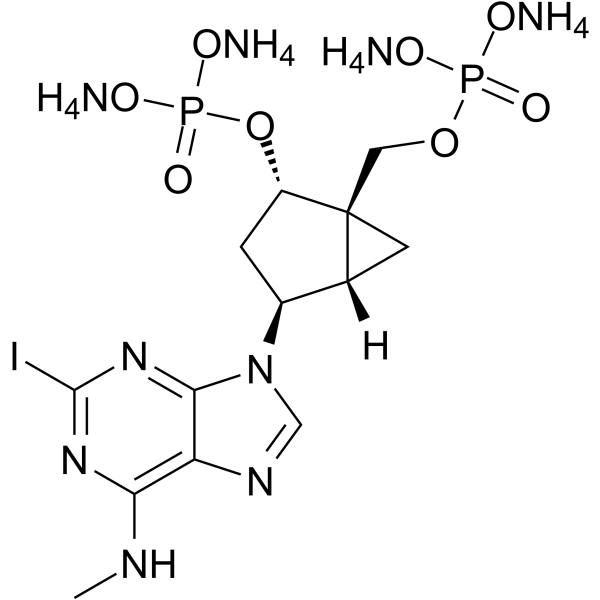
The aim of the present study was to evaluate the antithrombotic properties of a potent and stable competitive P2Y1 receptor antagonist MRS2500 to both obtain insight in the performance of the compound and to further validate the concept that targeting the P2Y1 receptor could be a relevant alternative or complement to other antiplatelet strategies. Previous studies with MRS2179 already indicated ex vivo inhibition of ADP-induced platelet aggregation and in vivo inhibition of systemic thromboembolism (Baurand et al., 2001; Léon et al., 2001; Baurand and Gachet, 2003). However, the lack of stability in vivo precluded the possibility to further evaluate this compound in animals. Therefore, MRS2500 was designed for optimized antagonism of the P2Y1 receptor (Jacobson et al., 2005). The presence of the rigid methanocarba (a bicyclo[3.1.0]hexane) ring constrains the nucleotide in a North conformation that is preferred by the P2Y1 receptor (Nandanan et al., 2000; Kim et al., 2003; Ohno et al., 2004). In addition to enhancing affinity as a P2Y1 receptor antagonist, this moiety as a ribose substitute also prolongs stability toward ectonucleotidases. Indeed, a 5′-monophosphate derivative in this chemical series was shown to be nearly resistant to the action of 5′-nucleotidase (Ravi et al., 2002). The high potency and selectivity of MRS2500 for P2Y1 receptor inhibition was demonstrated in vitro both in 1321N1 human astrocytoma cells expressing the recombinant human P2Y1 receptor and in human platelets (Kim et al., 2003; Cattaneo et al., 2004).
Here, we show that MRS2500 also displays high potency and stable and selective P2Y1 receptor inhibition in vivo. Injection of MRS2500 (2 mg/kg) into mice did not prolong the bleeding time in half of the mice. In the other half, one had mild prolongation and the others displayed bleeding time longer than 1800 s. The same was already observed and reported concerning the P2Y1−/− mice and is thought to be related to thrombus instability (Léon et al., 1999). One has to keep in mind that, in contrast, compounds targeting GPIIb-IIIa or P2Y12 induce a dramatic prolongation of the bleeding time in all of the animals tested (data not shown) (for review see Hodivala-Dilke et al., 1999; Foster et al., 2001). MRS2500 provided strong antithrombotic activity in systemic thromboembolism induced by infusion of a mixture of collagen and adrenaline, which is in agreement with the resistance of P2Y1−/− mice to thrombosis in this model (Fig. 4) (Léon et al., 1999). This compound was also found to be effective in a model of laser-induced vessel wall injury with two degrees of severity, the more severe injury being dependent on thrombin formation (Nonne et al., 2005). The P2Y1 receptor has already been shown to contribute to acute systemic thrombin-dependent thrombosis induced by infusion of tissue factor (Léon et al., 2001). This is consistent with the fact that the P2Y1 receptor is involved in the procoagulant activity of platelets, indirectly through platelet P-selectin exposure and formation of platelet-leukocyte conjugates, leading to leukocyte-tissue factor exposure (Léon et al., 2003).[3] |
| 分子式 |
C13H18N5O8P2I.4[H3N]
|
|---|---|
| 分子量 |
629.2844
|
| 精确质量 |
629.073
|
| 元素分析 |
C, 24.81; H, 4.81; I, 20.17; N, 20.03; O, 20.34; P, 9.84
|
| CAS号 |
630103-23-0
|
| 相关CAS号 |
779323-43-2;630103-23-0 (ammonium);
|
| PubChem CID |
90488745
|
| 外观&性状 |
White to off-white solid powder
|
| tPSA |
193
|
| 氢键供体(HBD)数目 |
9
|
| 氢键受体(HBA)数目 |
16
|
| 可旋转键数目(RBC) |
7
|
| 重原子数目 |
33
|
| 分子复杂度/Complexity |
740
|
| 定义原子立体中心数目 |
4
|
| SMILES |
CNC1=C2C(=NC(=N1)I)N(C=N2)[C@H]3C[C@@H]([C@]4([C@@H]3C4)COP(=O)(O)O)OP(=O)(O)O.N.N.N.N
|
| InChi Key |
FVTFHHDVLNQSME-AVAGOIHISA-N
|
| InChi Code |
InChI=1S/C13H18IN5O8P2.4H3N/c1-15-10-9-11(18-12(14)17-10)19(5-16-9)7-2-8(27-29(23,24)25)13(3-6(7)13)4-26-28(20,21)22;;;;/h5-8H,2-4H2,1H3,(H,15,17,18)(H2,20,21,22)(H2,23,24,25);4*1H3/t6-,7+,8+,13+;;;;/m1..../s1
|
| 化学名 |
azane;[(1R,2S,4S,5S)-4-[2-iodo-6-(methylamino)purin-9-yl]-2-phosphonooxy-1-bicyclo[3.1.0]hexanyl]methyl dihydrogen phosphate
|
| 别名 |
MRS 2500 tetraammonium salt; 630103-23-0; MRS-2500 tetraammonium; azane;[(1R,2S,4S,5S)-4-[2-iodo-6-(methylamino)purin-9-yl]-2-phosphonooxy-1-bicyclo[3.1.0]hexanyl]methyl dihydrogen phosphate; (1R,2S,4S,5S)-4-(2-iodo-6-(methylamino)-9H-purin-9-yl)-1-((phosphonooxy)methyl)bicyclo[3.1.0]hexan-2-yl dihydrogen phosphate, tetraammonia salt; MRS 2500; 779323-43-2;
|
| HS Tariff Code |
2934.99.9001
|
| 存储方式 |
Powder -20°C 3 years 4°C 2 years In solvent -80°C 6 months -20°C 1 month 注意: 请将本产品存放在密封且受保护的环境中,避免吸湿/受潮。 |
| 运输条件 |
Room temperature (This product is stable at ambient temperature for a few days during ordinary shipping and time spent in Customs)
|
| 溶解度 (体外实验) |
H2O : ~50 mg/mL (~79.46 mM)
|
|---|---|
| 溶解度 (体内实验) |
注意: 如下所列的是一些常用的体内动物实验溶解配方,主要用于溶解难溶或不溶于水的产品(水溶度<1 mg/mL)。 建议您先取少量样品进行尝试,如该配方可行,再根据实验需求增加样品量。
注射用配方
注射用配方1: DMSO : Tween 80: Saline = 10 : 5 : 85 (如: 100 μL DMSO → 50 μL Tween 80 → 850 μL Saline)(IP/IV/IM/SC等) *生理盐水/Saline的制备:将0.9g氯化钠/NaCl溶解在100 mL ddH ₂ O中,得到澄清溶液。 注射用配方 2: DMSO : PEG300 :Tween 80 : Saline = 10 : 40 : 5 : 45 (如: 100 μL DMSO → 400 μL PEG300 → 50 μL Tween 80 → 450 μL Saline) 注射用配方 3: DMSO : Corn oil = 10 : 90 (如: 100 μL DMSO → 900 μL Corn oil) 示例: 以注射用配方 3 (DMSO : Corn oil = 10 : 90) 为例说明, 如果要配制 1 mL 2.5 mg/mL的工作液, 您可以取 100 μL 25 mg/mL 澄清的 DMSO 储备液,加到 900 μL Corn oil/玉米油中, 混合均匀。 View More
注射用配方 4: DMSO : 20% SBE-β-CD in Saline = 10 : 90 [如:100 μL DMSO → 900 μL (20% SBE-β-CD in Saline)] 口服配方
口服配方 1: 悬浮于0.5% CMC Na (羧甲基纤维素钠) 口服配方 2: 悬浮于0.5% Carboxymethyl cellulose (羧甲基纤维素) 示例: 以口服配方 1 (悬浮于 0.5% CMC Na)为例说明, 如果要配制 100 mL 2.5 mg/mL 的工作液, 您可以先取0.5g CMC Na并将其溶解于100mL ddH2O中,得到0.5%CMC-Na澄清溶液;然后将250 mg待测化合物加到100 mL前述 0.5%CMC Na溶液中,得到悬浮液。 View More
口服配方 3: 溶解于 PEG400 (聚乙二醇400) 请根据您的实验动物和给药方式选择适当的溶解配方/方案: 1、请先配制澄清的储备液(如:用DMSO配置50 或 100 mg/mL母液(储备液)); 2、取适量母液,按从左到右的顺序依次添加助溶剂,澄清后再加入下一助溶剂。以 下列配方为例说明 (注意此配方只用于说明,并不一定代表此产品 的实际溶解配方): 10% DMSO → 40% PEG300 → 5% Tween-80 → 45% ddH2O (或 saline); 假设最终工作液的体积为 1 mL, 浓度为5 mg/mL: 取 100 μL 50 mg/mL 的澄清 DMSO 储备液加到 400 μL PEG300 中,混合均匀/澄清;向上述体系中加入50 μL Tween-80,混合均匀/澄清;然后继续加入450 μL ddH2O (或 saline)定容至 1 mL; 3、溶剂前显示的百分比是指该溶剂在最终溶液/工作液中的体积所占比例; 4、 如产品在配制过程中出现沉淀/析出,可通过加热(≤50℃)或超声的方式助溶; 5、为保证最佳实验结果,工作液请现配现用! 6、如不确定怎么将母液配置成体内动物实验的工作液,请查看说明书或联系我们; 7、 以上所有助溶剂都可在 Invivochem.cn网站购买。 |
| 制备储备液 | 1 mg | 5 mg | 10 mg | |
| 1 mM | 1.5891 mL | 7.9456 mL | 15.8912 mL | |
| 5 mM | 0.3178 mL | 1.5891 mL | 3.1782 mL | |
| 10 mM | 0.1589 mL | 0.7946 mL | 1.5891 mL |
1、根据实验需要选择合适的溶剂配制储备液 (母液):对于大多数产品,InvivoChem推荐用DMSO配置母液 (比如:5、10、20mM或者10、20、50 mg/mL浓度),个别水溶性高的产品可直接溶于水。产品在DMSO 、水或其他溶剂中的具体溶解度详见上”溶解度 (体外)”部分;
2、如果您找不到您想要的溶解度信息,或者很难将产品溶解在溶液中,请联系我们;
3、建议使用下列计算器进行相关计算(摩尔浓度计算器、稀释计算器、分子量计算器、重组计算器等);
4、母液配好之后,将其分装到常规用量,并储存在-20°C或-80°C,尽量减少反复冻融循环。
计算结果:
工作液浓度: mg/mL;
DMSO母液配制方法: mg 药物溶于 μL DMSO溶液(母液浓度 mg/mL)。如该浓度超过该批次药物DMSO溶解度,请首先与我们联系。
体内配方配制方法:取 μL DMSO母液,加入 μL PEG300,混匀澄清后加入μL Tween 80,混匀澄清后加入 μL ddH2O,混匀澄清。
(1) 请确保溶液澄清之后,再加入下一种溶剂 (助溶剂) 。可利用涡旋、超声或水浴加热等方法助溶;
(2) 一定要按顺序加入溶剂 (助溶剂) 。
InvivoChem的所有产品仅用于作科学研究,不面向患者销售
Copyright 2020 InvivoChem LLC | All Rights Reserved 粤ICP备20063088号-1


 粤公网安备 44011102003439号
 463611831
