| 规格 | 价格 | ||
|---|---|---|---|
| 500mg | |||
| 1g | |||
| Other Sizes |

| 毒性/毒理 (Toxicokinetics/TK) |
Effects During Pregnancy and Lactation
◉ Summary of Use during Lactation Lanolin is a yellow fat obtained from sheep's wool. It has traditionally been used topically to treat sore, cracked nipples during breastfeeding. Highly purified lanolin products (e.g., HPA lanolin, Lansinoh) have the pesticide and detergent residues removed and the natural free alcohols reduced to below 1.5% to improve safety and reduce the allergic potential. However, even highly-purified lanolin should be avoided in patients with a known allergy to wool. Lanolin appears to be effective for the prevention and treatment of nipple pain during breastfeeding, but not as a preventative initiated before delivery. Studies, most of which used Lansinoh, have not found lanolin to be consistently different in efficacy from application of breastmilk, hydrogel dressings, peppermint gel, aloe vera or warm compresses. A meta-analysis concluded that application of nothing or breastmilk may be superior to lanolin, but good studies are lacking. One small nonblinded study found olive oil to be superior to lanolin for prevention of sore nipples, and another small, single-blinded study found that lanolin application to painful nipples did not decrease nipple pain compared to usual care. A study in women with nipple trauma and pain comparing application of lanolin after each feeding to application of breastmilk plus a nipple shell found that the breastmilk and shell were more effective than lanolin. A randomized study comparing highly purified lanolin (Lansinoh) to expressed breastmilk in 180 mothers, found lanolin to be superior to breastmilk over a 7-day period in reducing pain and the nipple trauma score. Two studies of moderate quality found aloe vera and purslane to be more effective than lanolin in treating sore nipples during breastfeeding. A study comparing the various highly purified lanolin products found that HPA lanolin (Lansinoh Laboratories Inc.), Purelan (Medela AG) and two lanolin EU monograph compliant ingredients (Pharmalan PH EU-SO-(RB) and Corona-8 SO-(RB) (Croda, Goole, UK). The EU monograph compliant ingredients had the lowest level of contaminants. HPA lanolin contained an extremely low level of free lanolin alcohols, indicating a high level of purification, which was fourfold lower than Purelan. The HPA lanolin did not contain any detectable pesticide residues. Purelan contained a number of pesticide residues (diazinon, piperonyl butoxide, triflumuron); however, the levels were low and within the permitted limits. ◉ Effects in Breastfed Infants Relevant published information was not found as of the revision date. ◉ Effects on Lactation and Breastmilk In a randomized, double-bind trial, lanolin was compared to an all-purpose nipple ointment containing mupirocin 1%, betamethasone 0.05%, and miconazole 2% for painful nipples while nursing in the first 2 weeks postpartum. The two treatments were equally effective in reducing nipple pain, nipple healing time, breastfeeding duration, breastfeeding exclusivity rate, mastitis and nipple symptoms, side effects or maternal satisfaction with treatment. A randomized trial in nursing women with damaged, painful nipples compared lanolin application to usual care, which was a variable mix of education or assistance by health professional, application of warm or cool compresses, analgesics, air drying the nipples or the use of breast shields. A blinded observer assessed healing via telephone calls to the mothers several times after randomization. No differences were found in nipple pain between the groups 4 to 7 days after randomization. No difference was found in breastfeeding self-efficacy at 4 days post-randomization or in the breastfeeding rates of the two groups at 4 and 12 weeks postpartum. Patient satisfaction with care was higher in the women who received lanolin. |
|---|---|
| 其他信息 |
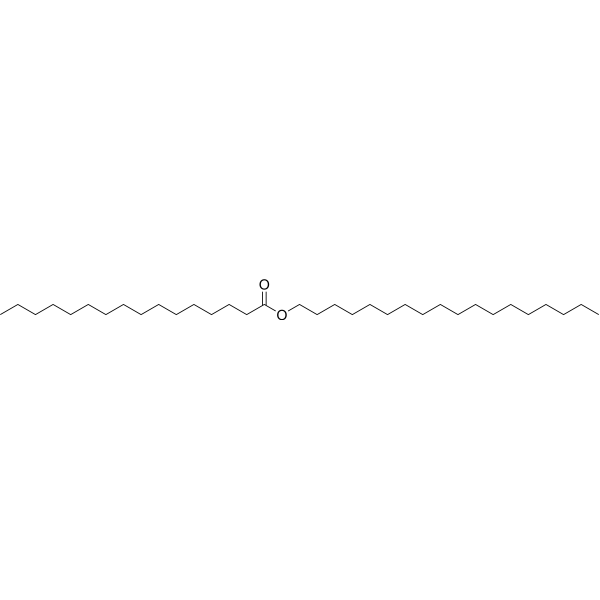
Stearyl palmitate appears as white crystals or flakes. (NTP, 1992)
Stearyl palmitate is a palmitate ester resulting from the formal condensation of the carboxy group of palmitic acid with the hydroxy group of stearyl alcohol. It has a role as a cosmetic and a coral metabolite. It is a hexadecanoate ester and a wax ester. It is functionally related to an octadecan-1-ol. Lanolin has been reported in Bombax ceiba and Triticum aestivum with data available. See also: Lanolin (annotation moved to). |
| 分子式 |
C34H68O2
|
|---|---|
| 精确质量 |
508.521
|
| CAS号 |
2598-99-4
|
| PubChem CID |
75778
|
| 外观&性状 |
Typically exists as solid at room temperature
|
| 密度 |
0.9±0.1 g/cm3
|
| 沸点 |
528.4±18.0 °C at 760 mmHg
|
| 熔点 |
131.9 to 133.3 °F (NTP, 1992)
|
| 闪点 |
283.6±11.1 °C
|
| 蒸汽压 |
0.0±1.4 mmHg at 25°C
|
| 折射率 |
1.456
|
| LogP |
16.65
|
| tPSA |
26.3
|
| 氢键供体(HBD)数目 |
0
|
| 氢键受体(HBA)数目 |
2
|
| 可旋转键数目(RBC) |
32
|
| 重原子数目 |
36
|
| 分子复杂度/Complexity |
406
|
| 定义原子立体中心数目 |
0
|
| SMILES |
CCCCCCCCCCCCCCCCCCOC(=O)CCCCCCCCCCCCCCC
|
| InChi Key |
BILPUZXRUDPOOF-UHFFFAOYSA-N
|
| InChi Code |
InChI=1S/C34H68O2/c1-3-5-7-9-11-13-15-17-18-19-21-23-25-27-29-31-33-36-34(35)32-30-28-26-24-22-20-16-14-12-10-8-6-4-2/h3-33H2,1-2H3
|
| 化学名 |
octadecyl hexadecanoate
|
| HS Tariff Code |
2934.99.9001
|
| 存储方式 |
Powder -20°C 3 years 4°C 2 years In solvent -80°C 6 months -20°C 1 month |
| 运输条件 |
Room temperature (This product is stable at ambient temperature for a few days during ordinary shipping and time spent in Customs)
|
| 溶解度 (体外实验) |
May dissolve in DMSO (in most cases), if not, try other solvents such as H2O, Ethanol, or DMF with a minute amount of products to avoid loss of samples
|
|---|---|
| 溶解度 (体内实验) |
注意: 如下所列的是一些常用的体内动物实验溶解配方,主要用于溶解难溶或不溶于水的产品(水溶度<1 mg/mL)。 建议您先取少量样品进行尝试,如该配方可行,再根据实验需求增加样品量。
注射用配方
注射用配方1: DMSO : Tween 80: Saline = 10 : 5 : 85 (如: 100 μL DMSO → 50 μL Tween 80 → 850 μL Saline)(IP/IV/IM/SC等) *生理盐水/Saline的制备:将0.9g氯化钠/NaCl溶解在100 mL ddH ₂ O中,得到澄清溶液。 注射用配方 2: DMSO : PEG300 :Tween 80 : Saline = 10 : 40 : 5 : 45 (如: 100 μL DMSO → 400 μL PEG300 → 50 μL Tween 80 → 450 μL Saline) 注射用配方 3: DMSO : Corn oil = 10 : 90 (如: 100 μL DMSO → 900 μL Corn oil) 示例: 以注射用配方 3 (DMSO : Corn oil = 10 : 90) 为例说明, 如果要配制 1 mL 2.5 mg/mL的工作液, 您可以取 100 μL 25 mg/mL 澄清的 DMSO 储备液,加到 900 μL Corn oil/玉米油中, 混合均匀。 View More
注射用配方 4: DMSO : 20% SBE-β-CD in Saline = 10 : 90 [如:100 μL DMSO → 900 μL (20% SBE-β-CD in Saline)] 口服配方
口服配方 1: 悬浮于0.5% CMC Na (羧甲基纤维素钠) 口服配方 2: 悬浮于0.5% Carboxymethyl cellulose (羧甲基纤维素) 示例: 以口服配方 1 (悬浮于 0.5% CMC Na)为例说明, 如果要配制 100 mL 2.5 mg/mL 的工作液, 您可以先取0.5g CMC Na并将其溶解于100mL ddH2O中,得到0.5%CMC-Na澄清溶液;然后将250 mg待测化合物加到100 mL前述 0.5%CMC Na溶液中,得到悬浮液。 View More
口服配方 3: 溶解于 PEG400 (聚乙二醇400) 请根据您的实验动物和给药方式选择适当的溶解配方/方案: 1、请先配制澄清的储备液(如:用DMSO配置50 或 100 mg/mL母液(储备液)); 2、取适量母液,按从左到右的顺序依次添加助溶剂,澄清后再加入下一助溶剂。以 下列配方为例说明 (注意此配方只用于说明,并不一定代表此产品 的实际溶解配方): 10% DMSO → 40% PEG300 → 5% Tween-80 → 45% ddH2O (或 saline); 假设最终工作液的体积为 1 mL, 浓度为5 mg/mL: 取 100 μL 50 mg/mL 的澄清 DMSO 储备液加到 400 μL PEG300 中,混合均匀/澄清;向上述体系中加入50 μL Tween-80,混合均匀/澄清;然后继续加入450 μL ddH2O (或 saline)定容至 1 mL; 3、溶剂前显示的百分比是指该溶剂在最终溶液/工作液中的体积所占比例; 4、 如产品在配制过程中出现沉淀/析出,可通过加热(≤50℃)或超声的方式助溶; 5、为保证最佳实验结果,工作液请现配现用! 6、如不确定怎么将母液配置成体内动物实验的工作液,请查看说明书或联系我们; 7、 以上所有助溶剂都可在 Invivochem.cn网站购买。 |
计算结果:
工作液浓度: mg/mL;
DMSO母液配制方法: mg 药物溶于 μL DMSO溶液(母液浓度 mg/mL)。如该浓度超过该批次药物DMSO溶解度,请首先与我们联系。
体内配方配制方法:取 μL DMSO母液,加入 μL PEG300,混匀澄清后加入μL Tween 80,混匀澄清后加入 μL ddH2O,混匀澄清。
(1) 请确保溶液澄清之后,再加入下一种溶剂 (助溶剂) 。可利用涡旋、超声或水浴加热等方法助溶;
(2) 一定要按顺序加入溶剂 (助溶剂) 。
InvivoChem的所有产品仅用于作科学研究,不面向患者销售
Copyright 2020 InvivoChem LLC | All Rights Reserved 粤ICP备20063088号-1


 粤公网安备 44011102003439号
 463611831
