| 规格 | 价格 | 库存 | 数量 |
|---|---|---|---|
| 1mg |
|
||
| 5mg |
|
||
| 10mg |
|
||
| Other Sizes |
|
| 靶点 |
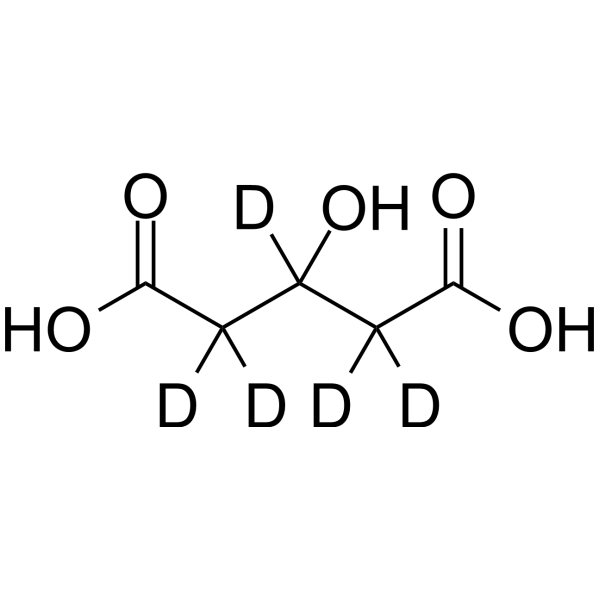
Deuterate form of 3-Hydroxyglutaric acid; NMDA receptors
|
|---|---|
| 体外研究 (In Vitro) |
药物化合物包括碳、氢和其他元素的稳定重同位素,在药物开发过程中主要作为定量示踪剂。由于氘化可能会影响药物的药代动力学和代谢特性,因此值得关注[1]。
|
| 体内研究 (In Vivo) |
神经系统症状在I型戊二酸血症(GA-I)患者中很常见。尽管这种疾病的病理生理学尚未完全确定,但最近已证明,在受影响患者体内积聚的3-羟基戊二酸(3-HGA)可能通过NMDA谷氨酸受体对胚胎鸡和新生大鼠神经元具有兴奋性毒性。在本研究中,我们研究了3-HGA对幼年大鼠大脑皮层大鼠突触质膜上[(3)H]谷氨酸和[(3”H]MK-801(地佐西平)结合的体外影响,以阐明3-HGA与谷氨酸受体的相互作用及其对3-HGA体外兴奋毒性特性的可能贡献。3-HGA(10-100微M)显著降低了Na(+)依赖性(高达62%)和Na(+,非依赖性)(高达30%)[(3)H]谷氨酸与突触膜的结合,反映了谷氨酸和3-HGA之间可能分别竞争谷氨酸转运体和受体位点。由于Na(+)非依赖性谷氨酸结合的减少可能代表3-HGA与谷氨酸受体的相互作用,我们接下来通过单独添加NMDA或与3-HGA联合添加NMDA并测量与突触膜的Na(+”非依赖性[(3)H]谷氨酸结合(与受体结合)来研究3-HGA是否与NMDA受体相互作用。我们验证了3-HGA和NMDA在10和100微M浓度下分别将谷氨酸结合降低了20%和45%,并且同时添加这两种物质不会引起相加效应,这意味着它们在同一位点与NMDA受体结合。此外,NMDA通道阻断剂[(3)H]MK-801的结合显著增加(约32-40%)10和100微M 3-HGA,这意味着3-HGA能够打开NMDA通道,允许MK-801结合,这是NMDA激动剂的一个特征。另一方面,谷氨酸对这种结合具有更高的刺激作用(增加180%),反映了其强烈的NMDA激动剂特性。此外,同时添加3-HGA和谷氨酸会对[(3)H]MK-801与NMDA受体的结合产生加性刺激作用。这些数据表明,相对于谷氨酸,3-HGA是NMDA受体的弱激动剂。最后,我们证明3-HGA引起大脑皮层切片细胞外钙摄取的显著增加,从而加强了3-HGA激活NMDA受体的观点。因此,本研究在分子水平上证明3-HGA调节谷氨酸能神经传递,并可能解释之前关于这种有机酸的神经毒性作用与兴奋毒性的发现[2]。
|
| 参考文献 | |
| 其他信息 |
目的:氢、碳和其他元素的稳定重同位素已被引入药物分子中,主要用作药物研发过程中定量分析的示踪剂。涉及氘标记药物人体应用的研究表明,与非氘代药物相比,这些化合物可能具有一些优势。氘代因其可能影响药物的药代动力学和代谢特征而备受关注。氘代丁苯那嗪(Austedo,梯瓦制药有限公司)是首个获得美国食品药品监督管理局(FDA)批准的氘代药物。这种氘代丁苯那嗪用于治疗亨廷顿舞蹈症以及迟发性运动障碍。正在进行的临床试验表明,许多其他氘代化合物正在被评估用于治疗人类疾病,而不仅仅是作为研究工具。数据来源:使用Ovid界面检索了MEDLINE数据库(1946年至今)。检索以“氘”为主题,并限定于“给药与剂量”、“不良反应”、“药代动力学”、“药理学”、“中毒”、“治疗用途”和“毒性”等关键词。研究筛选和数据提取:所有文章均经过审阅,纳入包含人体数据的文章。同时,也对综述文章进行了检索,以获取更多已发表的人体数据。结论:在某些情况下,氘代化合物可能比非氘代化合物更具优势,这通常是通过改变其清除率实现的。氘代作用也可能改变代谢途径,从而降低毒性。预计不久将有更多氘代化合物获得批准。临床医生需要熟悉这些新药的剂量、疗效、潜在副作用和独特的代谢特征。[1]
|
| 分子式 |
C5H3D5O5
|
|---|---|
| 分子量 |
153.14
|
| 精确质量 |
148.037
|
| CAS号 |
1219805-72-7
|
| 相关CAS号 |
3-Hydroxyglutaric acid;638-18-6
|
| PubChem CID |
118387770
|
| 外观&性状 |
White to off-white solid powder
|
| 密度 |
1.5±0.1 g/cm3
|
| 沸点 |
365.0±32.0 °C at 760 mmHg
|
| 闪点 |
188.7±21.6 °C
|
| 蒸汽压 |
0.0±1.8 mmHg at 25°C
|
| 折射率 |
1.520
|
| LogP |
-2.68
|
| tPSA |
94.8
|
| 氢键供体(HBD)数目 |
3
|
| 氢键受体(HBA)数目 |
5
|
| 可旋转键数目(RBC) |
4
|
| 重原子数目 |
10
|
| 分子复杂度/Complexity |
125
|
| 定义原子立体中心数目 |
0
|
| SMILES |
[2H]C([2H])(C(=O)O)C([2H])(C([2H])([2H])C(=O)O)O
|
| InChi Key |
ZQHYXNSQOIDNTL-UXXIZXEISA-N
|
| InChi Code |
InChI=1S/C5H8O5/c6-3(1-4(7)8)2-5(9)10/h3,6H,1-2H2,(H,7,8)(H,9,10)/i1D2,2D2,3D
|
| 化学名 |
2,2,3,4,4-pentadeuterio-3-hydroxypentanedioic acid
|
| 别名 |
3-Hydroxyglutaric acid-d5; 1219805-72-7; 3-Hydroxy-1,5-pentanedioic--d5 Acid; 3-hydroxy-1,5-pentanedioic-2,2,3,4,4-d5 acid; 3-Hydroxy-pentanedioic Acid-d5; 2,4-Dideoxypentaric Acid-d5; ss-Hydroxyglutaric Acid-d5;; 2,2,3,4,4-Pentadeuterio-3-hydroxypentanedioic acid; SCHEMBL17104443;
|
| HS Tariff Code |
2934.99.9001
|
| 存储方式 |
Powder -20°C 3 years 4°C 2 years In solvent -80°C 6 months -20°C 1 month |
| 运输条件 |
Room temperature (This product is stable at ambient temperature for a few days during ordinary shipping and time spent in Customs)
|
| 溶解度 (体外实验) |
H2O: 250 mg/mL (1632.49 mM)
|
|---|---|
| 溶解度 (体内实验) |
注意: 如下所列的是一些常用的体内动物实验溶解配方,主要用于溶解难溶或不溶于水的产品(水溶度<1 mg/mL)。 建议您先取少量样品进行尝试,如该配方可行,再根据实验需求增加样品量。
注射用配方
注射用配方1: DMSO : Tween 80: Saline = 10 : 5 : 85 (如: 100 μL DMSO → 50 μL Tween 80 → 850 μL Saline)(IP/IV/IM/SC等) *生理盐水/Saline的制备:将0.9g氯化钠/NaCl溶解在100 mL ddH ₂ O中,得到澄清溶液。 注射用配方 2: DMSO : PEG300 :Tween 80 : Saline = 10 : 40 : 5 : 45 (如: 100 μL DMSO → 400 μL PEG300 → 50 μL Tween 80 → 450 μL Saline) 注射用配方 3: DMSO : Corn oil = 10 : 90 (如: 100 μL DMSO → 900 μL Corn oil) 示例: 以注射用配方 3 (DMSO : Corn oil = 10 : 90) 为例说明, 如果要配制 1 mL 2.5 mg/mL的工作液, 您可以取 100 μL 25 mg/mL 澄清的 DMSO 储备液,加到 900 μL Corn oil/玉米油中, 混合均匀。 View More
注射用配方 4: DMSO : 20% SBE-β-CD in Saline = 10 : 90 [如:100 μL DMSO → 900 μL (20% SBE-β-CD in Saline)] 口服配方
口服配方 1: 悬浮于0.5% CMC Na (羧甲基纤维素钠) 口服配方 2: 悬浮于0.5% Carboxymethyl cellulose (羧甲基纤维素) 示例: 以口服配方 1 (悬浮于 0.5% CMC Na)为例说明, 如果要配制 100 mL 2.5 mg/mL 的工作液, 您可以先取0.5g CMC Na并将其溶解于100mL ddH2O中,得到0.5%CMC-Na澄清溶液;然后将250 mg待测化合物加到100 mL前述 0.5%CMC Na溶液中,得到悬浮液。 View More
口服配方 3: 溶解于 PEG400 (聚乙二醇400) 请根据您的实验动物和给药方式选择适当的溶解配方/方案: 1、请先配制澄清的储备液(如:用DMSO配置50 或 100 mg/mL母液(储备液)); 2、取适量母液,按从左到右的顺序依次添加助溶剂,澄清后再加入下一助溶剂。以 下列配方为例说明 (注意此配方只用于说明,并不一定代表此产品 的实际溶解配方): 10% DMSO → 40% PEG300 → 5% Tween-80 → 45% ddH2O (或 saline); 假设最终工作液的体积为 1 mL, 浓度为5 mg/mL: 取 100 μL 50 mg/mL 的澄清 DMSO 储备液加到 400 μL PEG300 中,混合均匀/澄清;向上述体系中加入50 μL Tween-80,混合均匀/澄清;然后继续加入450 μL ddH2O (或 saline)定容至 1 mL; 3、溶剂前显示的百分比是指该溶剂在最终溶液/工作液中的体积所占比例; 4、 如产品在配制过程中出现沉淀/析出,可通过加热(≤50℃)或超声的方式助溶; 5、为保证最佳实验结果,工作液请现配现用! 6、如不确定怎么将母液配置成体内动物实验的工作液,请查看说明书或联系我们; 7、 以上所有助溶剂都可在 Invivochem.cn网站购买。 |
| 制备储备液 | 1 mg | 5 mg | 10 mg | |
| 1 mM | 6.5300 mL | 32.6499 mL | 65.2997 mL | |
| 5 mM | 1.3060 mL | 6.5300 mL | 13.0599 mL | |
| 10 mM | 0.6530 mL | 3.2650 mL | 6.5300 mL |
1、根据实验需要选择合适的溶剂配制储备液 (母液):对于大多数产品,InvivoChem推荐用DMSO配置母液 (比如:5、10、20mM或者10、20、50 mg/mL浓度),个别水溶性高的产品可直接溶于水。产品在DMSO 、水或其他溶剂中的具体溶解度详见上”溶解度 (体外)”部分;
2、如果您找不到您想要的溶解度信息,或者很难将产品溶解在溶液中,请联系我们;
3、建议使用下列计算器进行相关计算(摩尔浓度计算器、稀释计算器、分子量计算器、重组计算器等);
4、母液配好之后,将其分装到常规用量,并储存在-20°C或-80°C,尽量减少反复冻融循环。
计算结果:
工作液浓度: mg/mL;
DMSO母液配制方法: mg 药物溶于 μL DMSO溶液(母液浓度 mg/mL)。如该浓度超过该批次药物DMSO溶解度,请首先与我们联系。
体内配方配制方法:取 μL DMSO母液,加入 μL PEG300,混匀澄清后加入μL Tween 80,混匀澄清后加入 μL ddH2O,混匀澄清。
(1) 请确保溶液澄清之后,再加入下一种溶剂 (助溶剂) 。可利用涡旋、超声或水浴加热等方法助溶;
(2) 一定要按顺序加入溶剂 (助溶剂) 。
InvivoChem的所有产品仅用于作科学研究,不面向患者销售
Copyright 2020 InvivoChem LLC | All Rights Reserved 粤ICP备20063088号-1


 COA
COA
 粤公网安备 44011102003439号
 463611831
