| 规格 | 价格 | 库存 | 数量 |
|---|---|---|---|
| 25mg |
|
||
| 50mg |
|
||
| 100mg |
|
||
| 250mg |
|
||
| Other Sizes |
|
| 靶点 |
Thrombin (binds to both active site and exosite 1 of thrombin) [1]
|
|---|---|
| 体内研究 (In Vivo) |
在 P2Y12+/+ 动脉中,比伐卢定(2 mg/kg)推迟了首次血栓的形成和血管闭塞的时间,但两种治疗均未能避免血管闭塞[2]。
在比伐卢定血管成形术试验 (BAT) 中,4312 例因不稳定型或心肌梗死后心绞痛接受冠状动脉球囊血管成形术的患者中,比伐卢定显著降低了 7 天(比值比 0.78,95% CI 0.62-0.99)和 90 天(比值比 0.82,95% CI 0.70-0.96)死亡、心肌梗死或再次血运重建的复合终点事件;与普通肝素(9.3%,p<0.001)相比,比伐卢定(3.5%)显著降低了大出血事件的发生率[1]。 在 REPLACE-2 试验中,6010 例接受经皮冠状动脉介入治疗的患者中,比伐卢定(0.75 mg/kg 推注,术中 1.75 mg/kg/h 输注)联合临时使用 GPIIb/IIIa 抑制剂,在死亡、心肌梗死、30 天内紧急血运重建和院内大出血这四个主要终点方面,不劣于肝素联合计划使用 GPIIb/IIIa 抑制剂(9.2% vs 10.0%);比伐卢定可显著降低大出血(2.4% vs 4.1%,p<0.001)和血小板减少症(0.7% vs 1.7%,p<0.001)的发生率; 12 个月时,比伐卢定组的死亡率为 1.9%,而肝素组为 2.4%,高危亚组的死亡率有显著降低的趋势,包括 >75 岁的患者(3.6% vs 6.9%,p=0.04)、糖尿病患者(2.3% vs 3.9%,p=0.07)、肾功能不全(肌酐清除率 <60 ml/min,4.5% vs 7.1%,p=0.09)和不稳定型心绞痛患者(1.4% vs 3.0%,p=0.02)[1]。 在 P2Y12-/- 小鼠中,比伐卢定 (2 mg/kg) 在 1700 s-1 时显著抑制了胶原涂层表面上的血栓体积;在野生型小鼠中,比伐卢定对胶原蛋白上的血栓体积没有显著影响,但在组织因子包被的表面上,比伐卢定在 871 s⁻¹ 时显著降低了野生型和 P2Y12-/- 小鼠的血栓体积 [2]。 在体内 FeCl₃ 诱导的小鼠肠系膜动脉损伤模型中,比伐卢定(2 mg/kg,静脉注射,损伤前 15 分钟)延迟了 P2Y12+/+ 动脉中首次血栓出现和闭塞的时间,但并未阻止血管闭塞;在 P2Y12+/- 小鼠中,比伐卢定抑制血栓形成约 40 分钟,之后血栓形成过程再次出现 [2]。 |
| 动物实验 |
在离体灌注室实验前1小时,向小鼠(P2Y12+/+、P2Y12+/- 和 P2Y12-/-)静脉注射比伐卢定(2 mg/kg)。从麻醉小鼠的下腔静脉采集血液,并直接灌注到涂有 III 型胶原蛋白或组织因子的毛细管腔室(直径分别为 282 μm 和 345 μm,流速分别为 1700 s⁻¹ 和 871 s⁻¹)中,持续 2.5 分钟 [2]。
对于活体显微镜观察,在 FeCl₃ 诱导血管壁损伤前 15 分钟,向小鼠静脉注射比伐卢定(2 mg/kg)。在观察肠系膜动脉(剪切速率 1000-1400 s⁻¹)前 10 分钟,经尾静脉注射罗丹明 6G(0.2 mg/mL)。将浸有 12.5% FeCl3 溶液的 2×1 mm 滤纸敷于血管壁 7 分钟,造成血管壁损伤,并记录血小板与血管壁的相互作用 40 分钟,或直至血管完全阻塞并持续 20 秒以上 [2]。 |
| 药代性质 (ADME/PK) |
吸收、分布和排泄
静脉注射后,比伐卢定呈线性药代动力学特征。1 mg/kg 的推注剂量后,以 2.5 mg/kg/hr 的速率持续静脉输注 4 小时,平均稳态浓度为 12.3 ± 1.7 mcg/mL。比伐卢定主要通过肾脏途径(20%)和蛋白水解作用从血浆中清除。 0.2 L/kg 3.4 mL/min/kg [肾功能正常] 3.4 mL/min/kg [轻度肾功能不全] 2.7 mL/min/kg [中度肾功能不全] 2.8 mL/min/kg [重度肾功能不全] 1 mL/min/kg [透析依赖患者] 代谢/代谢物 80% 蛋白质水解 生物半衰期 肾功能正常:25 分钟(正常情况下) 肌酐清除率 10-29 mL/min:57 分钟 透析依赖患者:3.5 小时 静脉给药可立即产生抗凝作用,停药后约 1 至 2 小时恢复至基线水平[1]. 比伐卢定具有线性药代动力学特征,血浆清除率快(约 3 ml/min/kg),分布容积小(0.2 L/kg)[1]. 比伐卢定的半衰期约为 25 分钟,中度肾功能损害(34 分钟)或重度肾功能损害(57 分钟)(肾小球滤过率分别为 30-59 ml/min 和 <30 ml/min)患者的半衰期会延长[1]. 该药物主要由血液中的肽酶降解,降解产物经肾脏清除;仅有 20% 的活性部分经肾脏排泄[1]. 比伐卢定的血浆浓度-剂量比例关系呈线性,剂量与抗凝效果(通过活化凝血时间和活化部分凝血活酶时间测定)呈正相关[1]. |
| 毒性/毒理 (Toxicokinetics/TK) |
妊娠期和哺乳期影响
◉ 哺乳期用药概述 目前尚无关于哺乳期使用比伐卢定的信息。由于该药物经口服吸收,建议使用其他替代药物。 ◉ 对母乳喂养婴儿的影响 截至修订日期,未找到相关的已发表信息。 ◉ 对泌乳和母乳的影响 截至修订日期,未找到相关的已发表信息。 蛋白质结合 除凝血酶和红细胞外,比伐卢定不与血浆蛋白结合。 急性毒性研究中观察到的比伐卢定毒性作用通常与该药物的药效学作用增强有关[1]。 大鼠皮下注射比伐卢定(剂量高达150 mg/kg/天)后,未观察到对生殖参数的显著不良影响;无致畸性或致突变性;试验动物未观察到抗原或免疫原性反应[1]。 与普通肝素相比,出血并发症减少;比伐卢定与血小板减少症无关[1]。 在REPLACE-2试验中,与肝素联合GPIIb/IIIa抑制剂相比,比伐卢定显著降低了大出血(2.4% vs 4.1%,p<0.001)和血小板减少症(0.7% vs 1.7%,p<0.001)的发生率[1]。 |
| 参考文献 | |
| 其他信息 |
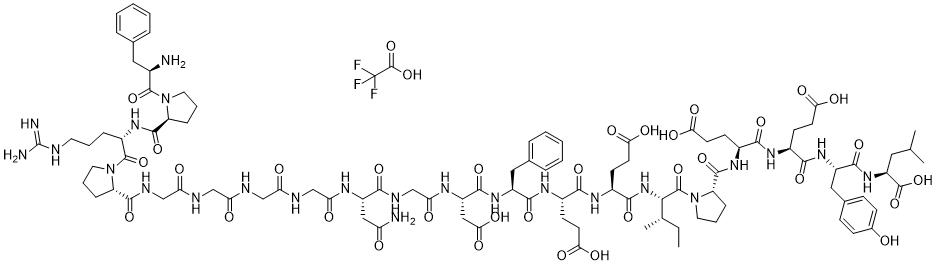
比伐卢定是一种由20个氨基酸组成的合成肽,其氨基酸序列如下:D-Phe、Pro、Arg、Pro、Gly、Gly、Gly、Gly、Asn、Gly、Asp、Phe、Glu、Glu、Ile、Pro、Glu、Glu、Tyr和Leu。它是水蛭素(一种存在于医用水蛭唾液中的天然药物)的同系物,是一种特异性可逆性凝血酶抑制剂,用作抗凝剂。它既是抗凝剂,也是EC 3.4.21.5(凝血酶)抑制剂。比伐卢定是一种由20个氨基酸残基组成的合成肽(凝血酶抑制剂),可逆性抑制凝血酶。一旦与活性位点结合,凝血酶就无法激活纤维蛋白原形成纤维蛋白,而纤维蛋白的形成是血栓形成的关键步骤。它通过静脉注射给药。由于比伐卢定可引起血液淤滞,因此监测血细胞比容、活化部分凝血酶原时间、国际标准化比值和血压的变化至关重要。比伐卢定是一种由20个氨基酸组成的合成肽,具有凝血酶特异性抗凝血特性。比伐卢定可逆地与凝血酶(包括游离凝血酶和血栓结合凝血酶)的催化位点和阴离子结合位点结合,从而阻止纤维蛋白、因子XIIIa和其他凝血因子的形成和活化。该药主要用于冠状动脉成形术,并常与阿司匹林联合用于治疗不稳定型心绞痛患者。比伐卢定三氟乙酸盐是比伐卢定的三氟乙酸盐形式,比伐卢定是一种由20个氨基酸组成的合成肽,具有凝血酶特异性抗凝血活性。静脉注射后,比伐卢定可逆性地与凝血酶(包括游离凝血酶和血栓结合凝血酶)的催化位点和阴离子结合位点结合,从而阻止纤维蛋白、因子XIIIa和其他凝血因子的形成和激活。比伐卢定主要用于冠状动脉成形术,常与阿司匹林联合用于不稳定型心绞痛患者。药物适应症:用于治疗肝素诱导的血小板减少症和预防血栓形成。比伐卢定适用于接受经皮冠状动脉介入治疗(PCI)的患者,以及因不稳定型心绞痛或非ST段抬高型心肌梗死而患有中高危急性冠脉综合征并计划接受PCI的患者。 FDA标签显示,Angiox适用于接受经皮冠状动脉介入治疗(PCI)的成年患者,包括接受急诊PCI的ST段抬高型心肌梗死(STEMI)患者。Angiox也适用于计划接受急诊或早期介入治疗的不稳定型心绞痛/非ST段抬高型心肌梗死(UA/NSTEMI)成年患者。Angiox应与阿司匹林和氯吡格雷联合使用。治疗动脉粥样硬化和血栓形成的作用机制:Angiox通过与凝血酶的催化位点和阴离子结合位点结合来抑制凝血酶活性。凝血酶是一种丝氨酸蛋白酶,在血栓形成过程中起着核心作用。它将纤维蛋白原裂解成纤维蛋白单体,并将因子XIII激活为因子XIIIa,使纤维蛋白形成共价交联框架,从而稳定血栓。凝血酶还能激活因子V和VIII,促进凝血酶的进一步生成并激活血小板,刺激其聚集和颗粒释放。
药效学 比伐卢定通过直接且特异性地结合循环和血栓结合凝血酶的催化位点和阴离子结合位点,发挥其对凝血酶的抑制作用。比伐卢定的作用是可逆的,因为凝血酶会缓慢地裂解凝血酶-比伐卢定键,从而恢复凝血酶的活性位点。 比伐卢定是一种由水蛭素设计的20个氨基酸的合成肽;它与凝血酶具有高亲和力,形成比伐卢定/凝血酶复合物;一旦结合,凝血酶就会裂解比伐卢定氨基末端的脯氨酰-精氨酰键,从而恢复凝血酶的活性位点功能;与水蛭素/凝血酶复合物相比,比伐卢定/凝血酶复合物的可逆性使其具有安全性优势[1]。 比伐卢定于2000年获得美国FDA批准,用于治疗接受经皮冠状动脉介入治疗的不稳定型心绞痛患者[1]。 比伐卢定无需抗凝血酶作为辅助因子,其抗凝反应可预测,因为它除了凝血酶外不与任何血浆蛋白结合,可抑制液相和纤维蛋白结合的凝血酶,抑制凝血酶介导的血小板活化,并且在富含血小板的血栓存在下仍保持活性,因为它不受血小板因子4的抑制[1]。 在REPLACE-2试验中,与普通肝素联合抗凝血酶原激活剂相比,比伐卢定使每位患者的住院费用降低了约400美元。 GPIIb/IIIa抑制剂主要可减少大出血和血小板减少症的发生[1]。 比伐卢定联合临时性GPIIb/IIIa抑制剂治疗,其对缺血事件的保护作用与普通肝素联合计划性GPIIb/IIIa抑制剂治疗相当,但出血并发症和血小板减少症的发生率显著降低[1]。 在小鼠模型中,比伐卢定与P2Y12拮抗剂协同抑制血栓形成;凝血酶抑制剂联合P2Y12缺陷可消除P2Y12+/-小鼠的血栓形成,表明其具有强大的协同抗血栓作用[2]。 |
| 分子式 |
C100H139F3N24O35
|
|---|---|
| 分子量 |
2294.3402
|
| 精确质量 |
2179.989
|
| CAS号 |
128270-60-0
|
| 相关CAS号 |
Bivalirudin TFA;1191386-55-6
|
| PubChem CID |
16129704
|
| 外观&性状 |
White to off-white solid powder
|
| 密度 |
1.5±0.1 g/cm3
|
| 折射率 |
1.675
|
| LogP |
-2.24
|
| tPSA |
901.57
|
| 氢键供体(HBD)数目 |
28
|
| 氢键受体(HBA)数目 |
35
|
| 可旋转键数目(RBC) |
67
|
| 重原子数目 |
155
|
| 分子复杂度/Complexity |
4950
|
| 定义原子立体中心数目 |
16
|
| SMILES |
CC[C@H](C)[C@@H](C(=O)N1CCC[C@H]1C(=O)N[C@@H](CCC(=O)O)C(=O)N[C@@H](CCC(=O)O)C(=O)N[C@@H](CC2=CC=C(C=C2)O)C(=O)N[C@@H](CC(C)C)C(=O)O)NC(=O)[C@H](CCC(=O)O)NC(=O)[C@H](CCC(=O)O)NC(=O)[C@H](CC3=CC=CC=C3)NC(=O)[C@H](CC(=O)O)NC(=O)CNC(=O)[C@H](CC(=O)N)NC(=O)CNC(=O)CNC(=O)CNC(=O)CNC(=O)[C@@H]4CCCN4C(=O)[C@H](CCCNC(=N)N)NC(=O)[C@@H]5CCCN5C(=O)[C@@H](CC6=CC=CC=C6)N
|
| InChi Key |
OIRCOABEOLEUMC-GEJPAHFPSA-N
|
| InChi Code |
InChI=1S/C98H138N24O33/c1-5-52(4)82(96(153)122-39-15-23-70(122)92(149)114-60(30-34-79(134)135)85(142)111-59(29-33-78(132)133)86(143)116-64(43-55-24-26-56(123)27-25-55)89(146)118-67(97(154)155)40-51(2)3)119-87(144)61(31-35-80(136)137)112-84(141)58(28-32-77(130)131)113-88(145)63(42-54-18-10-7-11-19-54)117-90(147)66(45-81(138)139)110-76(129)50-107-83(140)65(44-71(100)124)109-75(128)49-106-73(126)47-104-72(125)46-105-74(127)48-108-91(148)68-21-13-38-121(68)95(152)62(20-12-36-103-98(101)102)115-93(150)69-22-14-37-120(69)94(151)57(99)41-53-16-8-6-9-17-53/h6-11,16-19,24-27,51-52,57-70,82,123H,5,12-15,20-23,28-50,99H2,1-4H3,(H2,100,124)(H,104,125)(H,105,127)(H,106,126)(H,107,140)(H,108,148)(H,109,128)(H,110,129)(H,111,142)(H,112,141)(H,113,145)(H,114,149)(H,115,150)(H,116,143)(H,117,147)(H,118,146)(H,119,144)(H,130,131)(H,132,133)(H,134,135)(H,136,137)(H,138,139)(H,154,155)(H4,101,102,103)/t52-,57+,58-,59-,60-,61-,62-,63-,64-,65-,66-,67-,68-,69-,70-,82-/m0/s1
|
| 化学名 |
H-D-Phe-Pro-Arg-Pro-Gly-Gly-Gly-Gly-Asn-Gly-Asp-Phe-Glu-Glu-Ile-Pro-Glu-Glu-Tyr-Leu-OH
|
| 别名 |
Bivalirudin Trifluoroacetate; BG-8967; BG8967; BG 8967; Brand name: Angiomax Angiox.
|
| HS Tariff Code |
2934.99.9001
|
| 存储方式 |
Powder -20°C 3 years 4°C 2 years In solvent -80°C 6 months -20°C 1 month 注意: 请将本产品存放在密封且受保护的环境中,避免吸湿/受潮。 |
| 运输条件 |
Room temperature (This product is stable at ambient temperature for a few days during ordinary shipping and time spent in Customs)
|
| 溶解度 (体外实验) |
H2O : ~10 mg/mL (~4.59 mM)
|
|---|---|
| 溶解度 (体内实验) |
注意: 如下所列的是一些常用的体内动物实验溶解配方,主要用于溶解难溶或不溶于水的产品(水溶度<1 mg/mL)。 建议您先取少量样品进行尝试,如该配方可行,再根据实验需求增加样品量。
注射用配方
注射用配方1: DMSO : Tween 80: Saline = 10 : 5 : 85 (如: 100 μL DMSO → 50 μL Tween 80 → 850 μL Saline)(IP/IV/IM/SC等) *生理盐水/Saline的制备:将0.9g氯化钠/NaCl溶解在100 mL ddH ₂ O中,得到澄清溶液。 注射用配方 2: DMSO : PEG300 :Tween 80 : Saline = 10 : 40 : 5 : 45 (如: 100 μL DMSO → 400 μL PEG300 → 50 μL Tween 80 → 450 μL Saline) 注射用配方 3: DMSO : Corn oil = 10 : 90 (如: 100 μL DMSO → 900 μL Corn oil) 示例: 以注射用配方 3 (DMSO : Corn oil = 10 : 90) 为例说明, 如果要配制 1 mL 2.5 mg/mL的工作液, 您可以取 100 μL 25 mg/mL 澄清的 DMSO 储备液,加到 900 μL Corn oil/玉米油中, 混合均匀。 View More
注射用配方 4: DMSO : 20% SBE-β-CD in Saline = 10 : 90 [如:100 μL DMSO → 900 μL (20% SBE-β-CD in Saline)] 口服配方
口服配方 1: 悬浮于0.5% CMC Na (羧甲基纤维素钠) 口服配方 2: 悬浮于0.5% Carboxymethyl cellulose (羧甲基纤维素) 示例: 以口服配方 1 (悬浮于 0.5% CMC Na)为例说明, 如果要配制 100 mL 2.5 mg/mL 的工作液, 您可以先取0.5g CMC Na并将其溶解于100mL ddH2O中,得到0.5%CMC-Na澄清溶液;然后将250 mg待测化合物加到100 mL前述 0.5%CMC Na溶液中,得到悬浮液。 View More
口服配方 3: 溶解于 PEG400 (聚乙二醇400) 请根据您的实验动物和给药方式选择适当的溶解配方/方案: 1、请先配制澄清的储备液(如:用DMSO配置50 或 100 mg/mL母液(储备液)); 2、取适量母液,按从左到右的顺序依次添加助溶剂,澄清后再加入下一助溶剂。以 下列配方为例说明 (注意此配方只用于说明,并不一定代表此产品 的实际溶解配方): 10% DMSO → 40% PEG300 → 5% Tween-80 → 45% ddH2O (或 saline); 假设最终工作液的体积为 1 mL, 浓度为5 mg/mL: 取 100 μL 50 mg/mL 的澄清 DMSO 储备液加到 400 μL PEG300 中,混合均匀/澄清;向上述体系中加入50 μL Tween-80,混合均匀/澄清;然后继续加入450 μL ddH2O (或 saline)定容至 1 mL; 3、溶剂前显示的百分比是指该溶剂在最终溶液/工作液中的体积所占比例; 4、 如产品在配制过程中出现沉淀/析出,可通过加热(≤50℃)或超声的方式助溶; 5、为保证最佳实验结果,工作液请现配现用! 6、如不确定怎么将母液配置成体内动物实验的工作液,请查看说明书或联系我们; 7、 以上所有助溶剂都可在 Invivochem.cn网站购买。 |
| 制备储备液 | 1 mg | 5 mg | 10 mg | |
| 1 mM | 0.4359 mL | 2.1793 mL | 4.3586 mL | |
| 5 mM | 0.0872 mL | 0.4359 mL | 0.8717 mL | |
| 10 mM | 0.0436 mL | 0.2179 mL | 0.4359 mL |
1、根据实验需要选择合适的溶剂配制储备液 (母液):对于大多数产品,InvivoChem推荐用DMSO配置母液 (比如:5、10、20mM或者10、20、50 mg/mL浓度),个别水溶性高的产品可直接溶于水。产品在DMSO 、水或其他溶剂中的具体溶解度详见上”溶解度 (体外)”部分;
2、如果您找不到您想要的溶解度信息,或者很难将产品溶解在溶液中,请联系我们;
3、建议使用下列计算器进行相关计算(摩尔浓度计算器、稀释计算器、分子量计算器、重组计算器等);
4、母液配好之后,将其分装到常规用量,并储存在-20°C或-80°C,尽量减少反复冻融循环。
计算结果:
工作液浓度: mg/mL;
DMSO母液配制方法: mg 药物溶于 μL DMSO溶液(母液浓度 mg/mL)。如该浓度超过该批次药物DMSO溶解度,请首先与我们联系。
体内配方配制方法:取 μL DMSO母液,加入 μL PEG300,混匀澄清后加入μL Tween 80,混匀澄清后加入 μL ddH2O,混匀澄清。
(1) 请确保溶液澄清之后,再加入下一种溶剂 (助溶剂) 。可利用涡旋、超声或水浴加热等方法助溶;
(2) 一定要按顺序加入溶剂 (助溶剂) 。
Link: https://clinicaltrials.gov/ct2/show/NCT05959252
Conditions:Extracorporeal Membrane Oxygenation ComplicationLink: https://clinicaltrials.gov/ct2/show/NCT06275555
Conditions:Extracorporeal Membrane Oxygenation ComplicationLink: https://clinicaltrials.gov/ct2/show/NCT06080074
Conditions:Heart Failure|Cardiogenic Shock|Congenital Heart Disease|Cardiomyopathies
Title:A Single Center Diagnostic, Cross-sectional Study of Coronary Microvascular Dysfunction
Status:Active, not recruiting
updateDate:2025-11-28
Ctid:NCT03537586
Link: https://clinicaltrials.gov/ct2/show/NCT03537586
Conditions:Coronary Microvascular Disease|Ischemic Heart Disease|Myocardial IschemiaLink: https://clinicaltrials.gov/ct2/show/NCT03822975
Conditions:ST Elevation Myocardial InfarctionLink: https://clinicaltrials.gov/ct2/show/NCT05984537
Conditions:Coronary Microvascular DysfunctionLink: https://clinicaltrials.gov/ct2/show/NCT03532399
Conditions:Drug EffectLink: https://clinicaltrials.gov/ct2/show/NCT06861374
Conditions:ST-segment Elevation Myocardial Infarction (STEMI)Link: https://clinicaltrials.gov/ct2/show/NCT03664180
Conditions:STEMI - ST Elevation Myocardial InfarctionLink: https://clinicaltrials.gov/ct2/show/NCT03318393
Conditions:Extracorporeal Membrane Oxygenation Complication|Pediatric ALL|AnticoagulantsLink: https://clinicaltrials.gov/ct2/show/NCT05334654
Conditions:Acute Respiratory Failure|SARS CoV 2 Infection|AnticoagulantsLink: https://clinicaltrials.gov/ct2/show/NCT04475835
Conditions:STEMI With Multivessel Coronary DiseaseLink: https://clinicaltrials.gov/ct2/show/NCT03588611
Conditions:Acute Coronary SyndromeLink: https://clinicaltrials.gov/ct2/show/NCT03707418
Conditions:Extracorporeal Membrane Oxygenation ComplicationLink: https://clinicaltrials.gov/ct2/show/NCT00759083
Conditions:Heparin-Induced Thrombocytopenia|Heparin-induced Thrombocytopenia and Thrombosis SyndromeLink: https://clinicaltrials.gov/ct2/show/NCT04532333
Conditions:Subarachnoid Hemorrhage, AneurysmalLink: https://clinicaltrials.gov/ct2/show/NCT04445935
Conditions:Anticoagulation in COVID-19 ARDSLink: https://clinicaltrials.gov/ct2/show/NCT04195997
Conditions:Evaluate the Safety and Efficacy of Bivalirudin in Decreasing Bleeding RiskLink: https://clinicaltrials.gov/ct2/show/NCT04185077
Conditions:STEMI - ST Elevation Myocardial InfarctionLink: https://clinicaltrials.gov/ct2/show/NCT04046029
Conditions:Acute Coronary Syndrome|Percutaneous Coronary Intervention|Aging|Anticoagulants and Bleeding DisordersLink: https://clinicaltrials.gov/ct2/show/NCT03965208
Conditions:Extracorporeal Membrane Oxygenation Complication|AnticoagulantsLink: https://clinicaltrials.gov/ct2/show/NCT00669149
Conditions:Coronary Artery DiseaseLink: https://clinicaltrials.gov/ct2/show/NCT03882775
Conditions:STEMI|Percutaneous Coronary Intervention|AgedLink: https://clinicaltrials.gov/ct2/show/NCT02565147
Conditions:Acute Myocardial InfarctionLink: https://clinicaltrials.gov/ct2/show/NCT03567408
Conditions:Coronary Heart DiseaseLink: https://clinicaltrials.gov/ct2/show/NCT02448550
Conditions:Percutaneous Coronary InterventionLink: https://clinicaltrials.gov/ct2/show/NCT01084993
Conditions:Coronary Artery DiseaseLink: https://clinicaltrials.gov/ct2/show/NCT00433966
Conditions:Myocardial InfarctionLink: https://clinicaltrials.gov/ct2/show/NCT01913483
Conditions:Peripheral Endovascular Interventions|BleedingLink: https://clinicaltrials.gov/ct2/show/NCT02311231
Conditions:ST-segment Elevation Myocardial Infarction|Non ST-segment Elevation Myocardial InfarctionLink: https://clinicaltrials.gov/ct2/show/NCT01651780
Conditions:Severe Aortic Stenosis|Transcatheter Aortic Valve Replacement|Aortic Valve ReplacementLink: https://clinicaltrials.gov/ct2/show/NCT02384070
Conditions:Coronary Artery DiseaseLink: https://clinicaltrials.gov/ct2/show/NCT02897037
Conditions:Acute Myocardial InfarctionLink: https://clinicaltrials.gov/ct2/show/NCT00812370
Conditions:Deep Venous ThrombosisLink: https://clinicaltrials.gov/ct2/show/NCT01642238
Conditions:Acute Coronary SyndromeLink: https://clinicaltrials.gov/ct2/show/NCT02787317
Conditions:Coronary DiseaseLink: https://clinicaltrials.gov/ct2/show/NCT01848899
Conditions:Coronary Artery DiseaseLink: https://clinicaltrials.gov/ct2/show/NCT01087723
Conditions:Acute Coronary SyndromeLink: https://clinicaltrials.gov/ct2/show/NCT00616460
Conditions:Hematologic DiseasesLink: https://clinicaltrials.gov/ct2/show/NCT01519518
Conditions:Acute ST Elevation Myocardial InfarctionLink: https://clinicaltrials.gov/ct2/show/NCT01464671
Conditions:Coronary Artery DiseaseLink: https://clinicaltrials.gov/ct2/show/NCT01848106
Conditions:Coronary Artery DiseaseLink: https://clinicaltrials.gov/ct2/show/NCT01696110
Conditions:Acute Myocardial Infarction|Percutaneous Coronary InterventionLink: https://clinicaltrials.gov/ct2/show/NCT01465503
Conditions:BleedingLink: https://clinicaltrials.gov/ct2/show/NCT00976092
Conditions:Myocardial InfarctionLink: https://clinicaltrials.gov/ct2/show/NCT00373451
Conditions:Myocardial Infarction|Coronary DiseaseLink: https://clinicaltrials.gov/ct2/show/NCT00317343
Conditions:Coronary DiseaseLink: https://clinicaltrials.gov/ct2/show/NCT00290849
Conditions:Thrombin-specific Anticoagulant Bivalirudin During Percutaneous Coronary Intervention (PCI)Link: https://clinicaltrials.gov/ct2/show/NCT01555658
Conditions:Coronary Artery DiseaseLink: https://clinicaltrials.gov/ct2/show/NCT00079586
Conditions:Cardiovascular Disease|Coronary Artery Bypass SurgeryLink: https://clinicaltrials.gov/ct2/show/NCT00079508
Conditions:Cardiovascular Disease|Coronary Artery Bypass SurgeryLink: https://clinicaltrials.gov/ct2/show/NCT00503126
Conditions:CardiologyLink: https://clinicaltrials.gov/ct2/show/NCT00073593
Conditions:Cardiac Surgery|Coronary Artery Bypass SurgeryLink: https://clinicaltrials.gov/ct2/show/NCT00043940
Conditions:Heparin-Induced Thrombocytopenia|ThrombosisLink: https://clinicaltrials.gov/ct2/show/NCT00262054
Conditions:Coronary Disease|Angina PectorisLink: https://clinicaltrials.gov/ct2/show/NCT00448461
Conditions:Coronary Artery DiseaseLink: https://clinicaltrials.gov/ct2/show/NCT00043277
Conditions:ThrombosisLink: https://www.clinicaltrialsregister.eu/ctr-search/search?query=2011-005273-23
Condition:ST elevation myocardial infarctionLink: https://www.clinicaltrialsregister.eu/ctr-search/search?query=2011-000430-11
Condition:Real world ACS both Non-ST segment elevation and ST-segment elevation patients undergoing coronary angiography±PCI.Pazienti con sindrome coronarica acuta (ACS) con o senza elevazione del tratto ST che vengono sottoposti ad angiografia coronarica ± angioplastica (PCI).Link: https://www.clinicaltrialsregister.eu/ctr-search/search?query=2009-014343-36
Condition:Acute myocardial infarctionLink: https://www.clinicaltrialsregister.eu/ctr-search/search?query=2007-007142-36
Condition:Maladie coronaire athéromateuse nécessitant la réalisation d'une angioplastie coronaire transcutanée non urgente.Link: https://www.clinicaltrialsregister.eu/ctr-search/search?query=2005-003053-26
Condition:This trial will involve approximately 42 patients requiring coronary artery bypass graft surgery (CABG).Link: https://www.clinicaltrialsregister.eu/ctr-search/search?query=2005-003013-32
Condition:Coronary Artery DiseaseLink: https://www.clinicaltrialsregister.eu/ctr-search/search?query=2005-001514-41
Condition:The medical condition for this clinical trial is Acute Myocardial Infarction (AMI). AMI is defined as death or necrosis of myocardial cells. It is a diagnosis at the end of the spectrum of myocardial ischemia or acute coronary syndromes.The patients who suffer from AMI are a restricted subpopulation of patients undergoing primary percutaneous coronary intervention (PCI).Link: https://www.clinicaltrialsregister.eu/ctr-search/search?query=2006-002085-19
Condition:Acute Coronary SyndromeLink: https://www.clinicaltrialsregister.eu/ctr-search/search?query=2008-007290-20
Condition:Patients presenting with ST-Segment Elevation Acute Coronary Syndrome (STE-ACS) planned for a primary Percutaneous Coronary Intervention (PCI) management strategyInvivoChem的所有产品仅用于作科学研究,不面向患者销售
Copyright 2020 InvivoChem LLC | All Rights Reserved 粤ICP备20063088号-1


 粤公网安备 44011102003439号
 463611831
