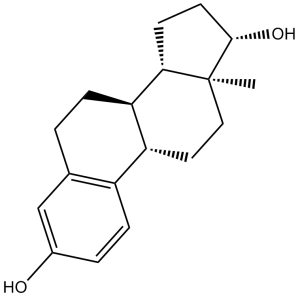
Estradiol (β-Estradiol)

别名:
目录号: V1724 纯度: ≥98%
雌二醇 (Oestradiol; Estrace; DiHydrofolliculin; β-Estradiol;17β-estradiol, β-Estradiol; E2; 17β-Oestradiol) 是雌二醇的 17-β-异构体,是一种内源性/天然存在的雌激素类固醇激素,也是女性的主要性别激素参与调节女性发情和月经生殖周期的激素。
Estradiol (β-Estradiol) CAS号: 50-28-2
产品类别: Estrogenprogestogen Receptor
产品仅用于科学研究,不针对患者销售
规格 价格 库存 数量
10 mM * 1 mL in DMSO
50mg
100mg
500mg
1g
2g
5g
10g
50g
Other Sizes

Other Forms of Estradiol (β-Estradiol):

  • Alpha-Estradiol-d3 (Alfatradiol-d3; Epiestradiol-d3; Epiestrol-d3)
  • 17a-雌二醇
  • Estradiol-d3 (β-Estradiol-d3; 17β-Estradiol-d3; 17β-Oestradiol-d3)
  • 9-Dihydroestradiol-d3
  • Estradiol-d4 (β-Estradiol-d4; 17β-Estradiol-d4; 17β-Oestradiol-d4)
  • Ethynyl Estradiol-d4 (17α-Ethynylestradiol-d4; Ethynylestradiol-d4)
  • 16-Keto 17β-Estradiol-d5 (Major)
  • 4-Methoxyestradiol-d5
  • 17β-雌二醇-2,4,16,16,17-d5
  • Estradiol-13C2
  • Ethynyl Estradiol-13C2
  • 环戊丙酸雌二醇
  • Estradiol benzoate-d3
  • 苯甲酸雌二醇
  • Estradiol enanthate
  • 雌二醇半水合物
  • Estradiol-d2 (β-Estradiol-d2; 17β-Estradiol-d2; 17β-Oestradiol-d2)
  • DL-4-Methoxyestradiol-13C6
  • rel-Estradiol-13C6 (estradiol-13C6)
  • 2-Hydroxyestradiol-13C6
  • 2-Methoxyestradiol-13C6
  • 17β-雌二醇-D2
  • 戊酸雌二醇
  • 3.17二丙酸17Β雌二酯
  • 乙炔雌二醇
  • Estradiol 3-sulfamate (BLE 00084)
  • 十一酸雌二醇
点击了解更多
InvivoChem产品被CNS等顶刊论文引用
顾客使用InvivoChem 产品雌二醇发表1篇科研文献
纯度/质量控制文件

纯度: ≥98%

产品描述
雌二醇(Oestradiol;Estrace;二氢卵泡素;β-Estradiol;17β-estradiol,β-Estradiol;E2;17β-Oestradiol)是雌二醇的 17-β-异构体,是一种内源性/天然存在的雌激素类固醇激素,也是一种主要的雌激素类固醇激素。女性性激素,参与调节女性生殖周期的动情和月经。
生物活性&实验参考方法
靶点
Endogenous Metabolite; steroid hormone
体外研究 (In Vitro)
雌二醇(10 nM,7 天)可刺激神经元发育并增强人子宫内膜干细胞 (hEnSC) 的轴突分支[1]。雌二醇(17β-雌二醇,10 nM,7 天)可增强 hEnSC 生成的神经元样细胞中神经元样细胞标记物(Tuj-1、巢蛋白和 NF-H)的表达 [1]。
人子宫内膜干细胞(hEnSCs)可以分化为各种神经细胞类型,被认为是神经组织工程和再生医学的合适细胞群。考虑到激素、生长因子和神经系统中其他因素之间的不同相互作用,已经提出了几种分化方案来引导hEnSCs向特定的神经细胞分化。17β-estradiol (E2)/17β-雌二醇(E2)在神经系统的发育、成熟和功能过程中起着重要作用。本研究首次基于神经基因和蛋白质的表达水平,研究了17β-雌二醇(雌激素,E2)对hEnSCs神经分化的影响。在这方面,在17β-雌二醇存在或不存在的情况下,hEnSCs在暴露于视黄酸(RA)、表皮生长因子(EGF)和成纤维细胞生长因子-2(FGF2)后分化为神经元样细胞。大多数细胞显示多极形态。在所有组中,巢蛋白、Tuj-1和NF-H(神经丝重多肽)(作为神经特异性标志物)的表达水平在14天内都有所增加。根据免疫荧光(IF)和实时PCR分析的结果,与无雌激素组相比,雌激素治疗组的神经元特异性标记物表达更多。这些发现表明,17β-雌二醇和其他生长因子可以在hEnSCs的神经元分化过程中刺激和上调神经标志物的表达。此外,我们的研究结果证实,hEnSCs可以成为神经退行性疾病和神经组织工程细胞治疗的合适细胞来源[1]。
体内研究 (In Vivo)
雌二醇(1 nM,来自 FBN-ARO-KO 小鼠的海马切片)可恢复 LTP 振幅 [1]。雌二醇(0.0167 mg,皮下植入)可纠正 FBN-ARO-KO 小鼠的分子和功能异常[1]。
神经元来源的17β-estradiol (E2)/17β-雌二醇(E2)的耗竭导致树突棘密度显著降低。 神经元来源的E2的缺失导致突触数量显著减少。 FBN-ARO-KO小鼠的功能性突触可塑性显著受损,并通过急性E2治疗得到挽救。 体内外源性E2替代可以挽救FBN-ARO-KO小鼠的分子和功能缺陷。 [2]
17β-雌二醇(E2)是由雄激素通过芳香化酶的作用产生的。众所周知,E2是在大脑的神经元中产生的,但它在大脑中的确切功能尚不清楚。在这里,我们使用前脑神经元特异性芳香化酶敲除(FBN-ARO-KO)小鼠模型来耗竭小鼠前脑中神经元衍生的E2,从而阐明其功能。与FLOX对照组相比,FBN-ARO-KO小鼠的芳香化酶和前脑E2水平降低了70-80%。雄性和雌性FBN-ARO-KO小鼠在前脑棘和突触密度以及海马依赖性空间参考记忆、识别记忆和情境恐惧记忆方面表现出明显的缺陷,但运动功能和焦虑水平正常。通过外源性体内E2给药恢复前脑E2水平能够挽救FBN-ARO-KO小鼠的分子和行为缺陷。此外,使用FBN-ARO-KO海马切片的体外研究表明,虽然长时程增强(LTP)的诱导是正常的,但振幅显著降低。有趣的是,体外急性E2治疗可以完全挽救LTP缺陷。机制研究表明,FBN-ARO-KO小鼠海马和大脑皮层中的快速激酶(AKT、ERK)和CREB-BDNF信号传导受损。此外,海马FBN-ARO-KO切片中LTP的急性E2救援可以通过施用MEK/ERK抑制剂来阻断,这进一步表明ERK快速信号传导在神经元E2效应中起着关键作用。总之,这些发现为神经元衍生的E2在调节男性和女性大脑的突触可塑性和认知功能方面发挥关键作用提供了证据。
酶活实验
对于体外17β-estradiol (E2)救援实验,将E2溶解在DMSO中,在含氧ACSF中稀释至工作浓度(1nm)(Di Mauro等人,2015)。实验中还包括DMSO(0.001%)载体对照。此外,MEK抑制剂U0126(Cell Signaling Technology,目录#9903S,10μm)也溶解在DMSO中,并在含氧ACSF中稀释至工作浓度。U0126与E2联合用药。在应用刺激方案前20分钟的所有记录期内应用药物。[2]
17β-estradiol (E2)水平的测量。[2]
如前所述,使用高灵敏度ELISA试剂盒测量海马CA1、皮质和血清中的17β-estradiol (E2)/17β-雌二醇(E2)水平(Zhang等人,2014)。简而言之,将100μl样品加入涂有驴抗羊多克隆抗体的适当孔的底部。随后,向E2中加入50μl E2偶联物,然后加入50μl绵羊多克隆抗体。然后将平板密封,在室温下以约500rpm的摇动速度孵育2小时。每次用400μl洗涤缓冲液洗涤3次后,将200μl pNpp底物加入每个孔中,在不摇动的情况下在室温下孵育1小时。然后,向每个孔中加入50μl终止溶液,在405nm处读取光密度。
细胞实验
细胞分化测定[1]
细胞类型:从人类子宫内膜组织中分离出人类子宫内膜干细胞 (hEnSC)
测试浓度: 10 nM
孵化持续时间:7天
实验结果:增加神经突数量,包括神经分化和神经突分支。

免疫荧光[1]
细胞类型:从人类子宫内膜组织中分离出的人类子宫内膜干细胞 (hEnSC)
测试浓度: 10 nM
孵育时间:7天
实验结果:神经标记物(Tuj-1、巢蛋白和NF-H)阳性细胞的百分比增加62.2分别为±1.3%、71.5±4%和51.2±1.5%。
hEnSCs的神经元分化[1]
为了诱导神经元分化,将约3×10~4个hEnSCs接种在24孔培养板的每个孔上,并在14天内与两种不同的分化培养基一起孵育。细胞最初在37°C下用含有1%Pen-Strep和10%FBS的DMEM/F12完整培养基孵育24小时。在第一组中,为了诱导hEnSCs的神经元分化,我们用第一步诱导培养基(含有EGF和FGF2的DMEM/F12[每种浓度为20ng/ml]和B27[1%])代替培养基7天。为了继续神经元分化,随后将细胞暴露于第二步诱导培养基(DMEM/F12,补充了1%ITS、0.5µM RA和20ng/ml FGF2)中7天。在第二组中,在初始孵育24小时后,用第一步诱导培养基(含有EGF和FGF2的DMEM/F12,每种培养基20 ng/ml浓度]和B27[1%])处理7天,20 ng/ml FGF2和10 nM17β-雌二醇(E2)[Kang等人,2007])直至第14天。对照组的细胞在添加了1%Pen-Strep和10%FBS的DMEM/F12存在下在TCP上培养14天。所有培养基每2天更换一次(图1)。
动物实验
Animal/Disease Models: FBN-ARO-KO Mice[2]
Doses: 1 nM
Route of Administration: Treated for the hippocampal slices
Experimental Results: Rescued long-term potentiation (LTP) amplitude of both male and female mice.

Animal/Disease Models: FBN-ARO-KO Mice [2]
Doses: 0.0167 mg
Route of Administration: Alzet minipumps with Estradiol (implanted sc), examined 7 days after minipump implantation.
Experimental Results: Restored hippocampal and cortical E2 levels to 93%, phosphorylation of AKT, ERK and CREB in the hippocampus and cortex to 90-95%, BDNF level to 80-90%, restored both synaptophysin and PSD95 in the forebrain. Rescued the spatial learning and memory defects.
n vivo 17β-estradiol (E2) rescue experiment. [2]
Three-month-old ovx female mice were used in this experiment, which were divided into four groups: FLOX + placebo, FLOX + E2, FBN-ARO-KO + placebo, and FBN-ARO-KO + E2. Alzet minipumps osmotic minipumps; model 1007D, 7 d release; Durect) with placebo or E2 (0.0167 mg) were implanted subcutaneously in the upper midback region at the time of ovariectomy. The dose of E2 used here yields stable serum levels of 26.52 ± 0.89 pg/ml, which represents a physiological diestrus II–proestrus level of E2 (Nelson et al., 1981). Molecular and functional endpoints were examined 7 d after minipump implantation.
Experimental design and statistical analyses. [2]
All quantitative analyses were performed on age-matched FLOX control and FBN-ARO-KO mice. Except for the in vivo 17β-estradiol (E2) rescue experiment, both male and female mice were used. Only female mice were used for in vivo E2 replacement. For behavioral tests, 8–10 mice were used for each group; otherwise, 4–6 samples from each group were analyzed. SigmaStat 3.5 software was used to analyze all data. Data represented in bar graphs were expressed as mean ± SE. A Student's t test was performed when only comparing two groups. Statistical data from the Barnes maze training trial, fear acquisition test, electrophysiological measurements, and part of the in vivo E2 replacement experiments requiring multiple groups comparisons were analyzed with two-way ANOVA followed by Tukey's all pairwise comparisons test to determine group differences. A value of p < 0.05 was considered statistically significant.
药代性质 (ADME/PK)
Absorption, Distribution and Excretion
The following describes the absorption of several estradiol formulations: Oral Tablets and Injections: Estradiol tablets undergo rapid first-pass metabolism in the gastrointestinal tract before entering systemic circulation. Due to the significant first-pass effect, the bioavailability of oral estrogens is reportedly only 2-10%. Esterification of estradiol can increase its lipophilicity, thereby improving the effect of administration (e.g., estradiol valerate) or prolonging the release of intramuscularly injected sustained-release formulations (including estradiol cyclopentylpropionate). After absorption, the ester group is cleaved, releasing endogenous estradiol or 17β-estradiol. Transdermal Formulations: Transdermal formulations slowly release estradiol through intact skin, thus maintaining circulating estradiol levels for up to one week. Notably, the bioavailability of estradiol after transdermal administration is approximately 20 times higher than that after oral administration. Transdermal administration avoids first-pass metabolism, thereby improving bioavailability. Peak plasma concentration (Cmax) after gluteal administration is approximately 174 pg/mL, while peak plasma concentration after abdominal administration is approximately 147 pg/mL. Spray: After daily use, estradiol spray reaches steady-state plasma concentrations within 7–8 days. After three daily sprays, the peak plasma concentration is approximately 54 pg/mL, with a time to peak concentration (Tmax) of 20 hours. The area under the curve (AUC) is approximately 471 pg·hr/mL. Vaginal ring and cream: Estradiol is effectively absorbed through the vaginal mucosa. Vaginal administration avoids first-pass metabolism. The time to peak concentration after vaginal ring administration is 0.5 to 1 hour. The peak plasma concentration is approximately 63 pg/mL. The peak plasma concentration (Cmax) of estradiol (one of the components of premeridine vaginal estrogen conjugate cream) in this vaginal cream formulation was 12.8 ± 16.6 pg/mL, the time to peak concentration (Tmax) was 8.5 ± 6.2 hours, and the area under the curve (AUC) was 231 ± 285 pg•hr/mL. Estradiol is excreted in the urine as a glucuronide and sulfate conjugate. The distribution of exogenous estrogens is similar to that of endogenous estrogens. They are distributed throughout the body, especially in sex hormone target organs such as the breast, ovaries, and uterus. In one pharmacokinetic study, the clearance of orally administered micronized estradiol in postmenopausal women was 29.9 ± 15.5 mL/min/kg. Another study showed that the clearance of intravenously administered estradiol was 1.3 mL/min/kg. Therapeutic estrogens can be effectively absorbed through the skin, mucous membranes, and gastrointestinal tract. Vaginal administration avoids first-pass metabolism.
The estradiol transdermal continuous delivery system (once weekly) continuously releases estradiol, which is absorbed through intact skin, thus maintaining circulating estradiol levels over a 7-day treatment period. Systemic bioavailability of estradiol after transdermal administration is approximately 20 times that after oral administration. This difference is due to the avoidance of first-pass metabolism when estradiol is administered transdermally.
In a phase I study of 14 postmenopausal women, insertion of the ESTRING (estradiol vaginal ring) rapidly increased serum estradiol (E2) levels. The time to peak serum estradiol (Tmax) ranged from 0.5 to 1 hour. After the initial peak, serum estradiol concentrations rapidly declined over the next 24 hours, showing little difference from baseline mean (range: 5 to 22 pg/mL). Serum estradiol and estrone (E1) levels remained relatively stable over 12 weeks of ring placement in the vaginal fornix.
Table: Estimated Pharmacokinetic Mean Values After a Single Administration of Estrogen Cycle [Table #4649]
Metabolism/Metabolites
Exogenous estrogens are metabolized in the same way as endogenous estrogens. Metabolic conversions mainly occur in the liver and intestines. Estradiol is metabolized to estrone, both of which can be converted to estriol, which is eventually excreted in the urine. Sulfate- and glucuronide-bound estrogens are also metabolized in the liver. Metabolic conjugates are secreted into the intestine via bile, where they are hydrolyzed and subsequently reabsorbed. Hepatic cytochrome P450 enzyme CYP3A4 plays an important role in the metabolism of estradiol. CYP1A2 is also involved.
Exogenous estrogens are metabolized in the same way as endogenous estrogens. Circulating estrogens are in a dynamic equilibrium of metabolic interconversions. These conversions mainly occur in the liver. Estradiol is reversibly converted to estrone, both of which can be converted to estriol, which is the main urinary metabolite. Estrogens also circulate enterohepaticly via sulfate and glucuronide conjugation in the liver. These conjugates are secreted into the intestine via bile and hydrolyzed there before being reabsorbed. In postmenopausal women, a significant portion of circulating estrogen exists as sulfate conjugates, particularly estrone sulfate, which serves as a circulating reserve for the synthesis of more potent estrogens. Estradiol metabolism varies depending on the stage of the menstrual cycle. Typically, the hormone undergoes rapid biotransformation in the liver, with a plasma half-life measured in minutes. Estradiol is primarily converted to estriol, the main urinary metabolite. Various sulfate and glucuronide conjugates are also excreted in the urine. Estradiol-17β and estrone are metabolized similarly in rats and humans, with both species primarily converting these steroids via (aromatic) 2-hydroxylation and 16α-hydroxylation. Glucuronides of various metabolites are excreted via bile. The main difference between human and rat estrogen metabolism lies in the type of conjugate. In rats, a relatively large proportion of estrone, estradiol-17β, and estriol are converted into metabolites oxidized at both C-2 and C-16 positions. When rats are administered estriol, the glucuronide of 16-ketoestradiol, along with small amounts of sulfate, and the 2- and 3-methyl ethers of 2-hydroxyestriol and 2-hydroxy-16-ketoestradiol, are excreted in bile. In contrast, hydroxylation of estradiol-17β and estrone at C-6 or C-7 of the B ring is a minor pathway in rats. 2-Hydroxyestrogens (“catechol estrogens”) can be further converted via multiple pathways, including covalent binding to proteins. For more complete metabolite/metabolite data on estradiol (a total of 8 metabolites), please visit the HSDB record page.
Known human metabolites of 17β-estradiol include 2-hydroxyestradiol, 4-hydroxyestradiol, 17β-estradiol-3-glucuronide, and 17β-estradiol glucuronide.
The metabolic mechanism of exogenous estrogens is the same as that of endogenous estrogens. Estrogens are partially metabolized by cytochrome P450.
Elimination pathway: Estradiol, estrone, and estriol are excreted in the urine as glucuronide and sulfate conjugates.
Half-life: 36 hours
Biological half-life

It has been reported that the terminal half-life of various estrogen products, administered orally or intravenously, is 1–12 hours. A pharmacokinetic study of oral estradiol valerate in postmenopausal women showed a terminal elimination half-life of 16.9 ± 6.0 hours. Another pharmacokinetic study of intravenously administered estradiol in postmenopausal women showed an elimination half-life of 27.45 ± 5.65 minutes. The half-life of estradiol appears to vary depending on the route of administration. ...After oral administration...the terminal half-life is 20.1 hours...
毒性/毒理 (Toxicokinetics/TK)
Toxicity Summary
Estradiol can freely enter target cells (e.g., female organs, breasts, hypothalamus, pituitary gland) and interact with target cell receptors. Once the estrogen receptor binds to its ligand, it enters the target cell nucleus, regulating gene transcription to form messenger RNA (mRNA). The mRNA interacts with ribosomes to produce specific proteins that express the effects of estradiol on target cells. Estrogen can increase the synthesis of sex hormone-binding globulin (SHBG), thyroid-binding globulin (TBG), and other serum proteins in the liver, and inhibit the secretion of follicle-stimulating hormone (FSH) from the anterior pituitary gland. Interactions Estrogen may interfere with the action of bromocriptine; dosage adjustments may be necessary. Estrogen The combined use of testosterone and estradiol-B17 after methylnitrosourea treatment can also lead to prostate adenocarcinoma. Concomitant use with estrogen may increase calcium absorption and exacerbate kidney stones in susceptible individuals; this can be used as a therapeutic advantage to increase bone mass. Estrogens
The co-administration of estrogens with glucocorticoids may alter the metabolism and protein binding of glucocorticoids, leading to decreased clearance, prolonged elimination half-life, and enhanced therapeutic and toxic effects of glucocorticoids; dose adjustments of glucocorticoids may be necessary during and after co-administration. Estrogens
For more complete data on interactions with estradiol (11 items in total), please visit the HSDB record page.
参考文献

[1]. Elham Hasanzadeh. Defining the role of 17β-estradiol in human endometrial stem cells differentiation into neuron-like cells. Cell Biol Int. 2021 Jan;45(1):140-153.

[2]. Neuron-Derived Estrogen Regulates Synaptic Plasticity and Memory. J Neurosci. 2019 Apr 10;39(15):2792-2809.

其他信息
Therapeutic Uses
Estradiol tablets are indicated for the treatment of moderate to severe vasomotor symptoms associated with menopause. /Included on US product label/
Estradiol tablets are indicated for the treatment of moderate to severe vulvar and vaginal atrophy symptoms associated with menopause. If used solely for the treatment of vulvar and vaginal atrophy symptoms, a vaginal topical product should be considered. /Included on US product label/
Estradiol tablets are indicated for the treatment of low estrogen levels caused by hypogonadism, castration, or primary ovarian failure. /Included on US product label/
Estradiol tablets are indicated for the treatment of appropriately screened patients with metastatic breast cancer (palliative care only). /Included on US product label/
For more complete data on the therapeutic uses of estradiol (7 types), please visit the HSDB record page.
Drug Warnings
Estrogen increases the risk of endometrial cancer—close monitoring of all women taking estrogen is crucial. For all cases of undiagnosed persistent or recurrent abnormal vaginal bleeding, adequate diagnostic measures should be taken, including endometrial sampling if necessary to rule out malignancy. There is no evidence that using “natural” estrogen results in different endometrial risks compared to using an equivalent dose of “synthetic” estrogen. Cardiovascular and other risks—Estrogen (whether or not combined with progestin) should not be used to prevent cardiovascular disease. The Women’s Health Initiative (WHI) study reported that, compared to placebo, postmenopausal women (50 to 79 years of age) treated with oral conjugated estrogen (CE 0.625 mg) combined with medroxyprogesterone acetate (MPA 2.5 mg) had an increased risk of myocardial infarction, stroke, invasive breast cancer, pulmonary embolism, and deep vein thrombosis after 5 years. The Women’s Health Initiative Memory Study (WHIMS), a sub-study of WHI, reported an increased risk of dementia in postmenopausal women aged 65 and older. Women receiving oral conjugated estrogen in combination with medroxyprogesterone acetate for 4 years were older compared to the placebo group. It is unclear whether this finding applies to younger postmenopausal women or women receiving estrogen therapy alone.
For more complete data on estradiol (48 total), please visit the HSDB record page.
Pharmacodynamics
Estradiol acts on estrogen receptors to relieve vasomotor symptoms (such as hot flashes) and genitourinary symptoms (such as vaginal dryness and dyspareunia). Estradiol has also been shown to have a beneficial effect on bone mineral density by inhibiting bone resorption. Estrogen appears to inhibit bone resorption and may have a beneficial effect on plasma lipid profiles. Estrogen can lead to increased synthesis of several proteins in the liver, including sex hormone-binding globulin (SHBG) and thyroid-binding globulin (TBG). Estrogen is known to inhibit the production of follicle-stimulating hormone (FSH) in the anterior pituitary gland. Notes on Hypercoagulability, Cardiovascular Health, and Blood Pressure Estradiol may increase the risk of cardiovascular disease, deep vein thrombosis (DVT), and stroke, and therefore should be avoided in patients at high risk for these conditions. Estrogen can induce a hypercoagulable state, which is also associated with the use of estrogen-containing oral contraceptives (OCs) and pregnancy. Although estrogen causes elevated plasma renin and angiotensin levels. Estrogen-induced angiotensin increases can lead to sodium retention, which may be a mechanism by which hypertension occurs after oral contraceptive treatment. 17β-Estradiol (E2) is produced from androgens by aromatase. E2 is known to be produced in brain neurons, but its exact function in the brain remains unclear. This study used a forebrain neuron-specific aromatase knockout (FBN-ARO-KO) mouse model to reduce E2 derived from mouse forebrain neurons, thereby elucidating its function. Compared with the FLOX control group, FBN-ARO-KO mice showed a 70-80% reduction in aromatase and forebrain E2 levels. Male and female FBN-ARO-KO mice showed significantly reduced dendritic spine and synaptic density in the forebrain, as well as hippocampus-dependent spatial reference memory, recognition memory, and situational fear memory, but normal motor function and anxiety levels. Restoring forebrain E2 levels through in vivo administration of exogenous estradiol (E2) rescued the molecular and behavioral deficits in FBN-ARO-KO mice. Furthermore, in vitro studies using FBN-ARO-KO hippocampal sections showed that while long-term potentiation (LTP) induction was normal, its amplitude was significantly reduced. Interestingly, acute E2 treatment in vitro completely rescued LTP deficiency. Mechanistic studies revealed impaired fast kinase (AKT, ERK) and CREB-BDNF signaling pathways in the hippocampus and cerebral cortex of FBN-ARO-KO mice. Moreover, the rescue effect of acute E2 on LTP in FBN-ARO-KO hippocampal sections could be blocked by MEK/ERK inhibitors, further indicating that the fast ERK signaling pathway plays a crucial role in the neuronal E2 effect. In summary, the results suggest that neuronal-derived estradiol (E2) plays a key role in regulating synaptic plasticity and cognitive function in both male and female brains. Important statement: It is well known that the steroid hormone 17β-estradiol (E2) is produced in the female ovary. Interestingly, aromatase (the biosynthetic enzyme of E2) is also expressed in forebrain neurons, but the exact function of neuronal-derived E2 remains unclear. This study provided direct genetic evidence that neuronal-derived E2 plays a key role in regulating the rapid AKT-ERK and CREB-BDNF signaling pathways in the mouse forebrain by using a novel forebrain neuron-specific aromatase knockout mouse model to deplete neuronal-derived E2, and showed that neuronal-derived E2 is essential for the normal expression of long-term potentiation (LTP), synaptic plasticity and cognitive function in both male and female brains. These results suggest that neuronal-derived E2 acts as a novel neuromodulator in the forebrain, controlling synaptic plasticity and cognitive function. [2]
*注: 文献方法仅供参考, InvivoChem并未独立验证这些方法的准确性
化学信息 & 存储运输条件
分子式
C18H24O2
分子量
272.38
精确质量
272.177
元素分析
C, 79.37; H, 8.88; O, 11.75
CAS号
50-28-2
相关CAS号
Alpha-Estradiol;57-91-0;Estradiol (Standard);50-28-2;Estradiol-d3;79037-37-9;Estradiol-d4;66789-03-5;Estradiol-d5;221093-45-4;Estradiol-13C2;82938-05-4;Estradiol (cypionate);313-06-4;Estradiol benzoate;50-50-0;Estradiol enanthate;4956-37-0;Estradiol hemihydrate;35380-71-3;Estradiol-d2;53866-33-4;Estradiol-13C6;Estradiol-d2-1;3188-46-3;rel-Estradiol-13C6; 979-32-8 (valerate); 113-38-2 (dipropionate); 57-63-6 (ethinyl); 172377-52-5 (sulfamate); 3571-53-7 (undecylate)
PubChem CID
5757
外观&性状
White to off-white solid powder
密度
1.2±0.1 g/cm3
沸点
445.9±45.0 °C at 760 mmHg
熔点
173ºC
闪点
209.6±23.3 °C
蒸汽压
0.0±1.1 mmHg at 25°C
折射率
1.599
LogP
4.13
tPSA
40.46
氢键供体(HBD)数目
2
氢键受体(HBA)数目
2
可旋转键数目(RBC)
0
重原子数目
20
分子复杂度/Complexity
382
定义原子立体中心数目
5
SMILES
O([H])[C@@]1([H])C([H])([H])C([H])([H])[C@@]2([H])[C@]3([H])C([H])([H])C([H])([H])C4C([H])=C(C([H])=C([H])C=4[C@@]3([H])C([H])([H])C([H])([H])[C@@]21C([H])([H])[H])O[H]
InChi Key
VOXZDWNPVJITMN-ZBRFXRBCSA-N
InChi Code
InChI=1S/C18H24O2/c1-18-9-8-14-13-5-3-12(19)10-11(13)2-4-15(14)16(18)6-7-17(18)20/h3,5,10,14-17,19-20H,2,4,6-9H2,1H3/t14-,15-,16+,17+,18+/m1/s1
化学名
(8R,9S,13S,14S,17S)-13-methyl-6,7,8,9,11,12,14,15,16,17-decahydrocyclopenta[a]phenanthrene-3,17-diol
别名

Oestradiol; Estrace; Dihydrofolliculin; β-Estradiol;Beta-Estradiol; 17beta-Estradiol; Estradiol; beta-Estradiol; 17beta-Estradiol; 50-28-2; Oestradiol; Dihydrofolliculin; Vivelle; 17β-Oestradiol

HS Tariff Code
2934.99.9001
存储方式

Powder      -20°C    3 years

                     4°C     2 years

In solvent   -80°C    6 months

                  -20°C    1 month

运输条件
Room temperature (This product is stable at ambient temperature for a few days during ordinary shipping and time spent in Customs)
溶解度数据
溶解度 (体外实验)
DMSO: 54 mg/mL (198.3 mM)
Water:<1 mg/mL
Ethanol: 5 mg/mL (18.4 mM)
溶解度 (体内实验)
配方 1 中的溶解度: ≥ 2.5 mg/mL (9.18 mM) (饱和度未知) in 10% DMSO + 40% PEG300 + 5% Tween80 + 45% Saline (这些助溶剂从左到右依次添加,逐一添加), 澄清溶液。
例如,若需制备1 mL的工作液,可将100 μL 25.0 mg/mL澄清DMSO储备液加入到400 μL PEG300中,混匀;然后向上述溶液中加入50 μL Tween-80,混匀;加入450 μL生理盐水定容至1 mL。
*生理盐水的制备:将 0.9 g 氯化钠溶解在 100 mL ddH₂O中,得到澄清溶液。

配方 2 中的溶解度: 2.5 mg/mL (9.18 mM) in 5% DMSO + 40% PEG300 + 5% Tween80 + 50% Saline (这些助溶剂从左到右依次添加,逐一添加), 悬浊液; 超声助溶。
*生理盐水的制备:将 0.9 g 氯化钠溶解在 100 mL ddH₂O中,得到澄清溶液。

View More

配方 3 中的溶解度: ≥ 2.5 mg/mL (9.18 mM) in 5% DMSO + 95% (20% SBE-β-CD in Saline) (这些助溶剂从左到右依次添加,逐一添加), 澄清溶液。
*20% SBE-β-CD 生理盐水溶液的制备(4°C,1 周):将 2 g SBE-β-CD 溶解于 10 mL 生理盐水中,得到澄清溶液。


配方 4 中的溶解度: ≥ 2.08 mg/mL (7.64 mM) (饱和度未知) in 10% DMSO + 90% (20% SBE-β-CD in Saline) (这些助溶剂从左到右依次添加,逐一添加), 澄清溶液。
例如,若需制备1 mL的工作液,可将100μL 20.8mg/mL澄清的DMSO储备液加入到900μL 20%SBE-β-CD生理盐水中,混匀。
*20% SBE-β-CD 生理盐水溶液的制备(4°C,1 周):将 2 g SBE-β-CD 溶解于 10 mL 生理盐水中,得到澄清溶液。

配方 5 中的溶解度: ≥ 2.08 mg/mL (7.64 mM)(饱和度未知) in ≥ 2.5 mg/mL (5.35 mM) (这些助溶剂从左到右依次添加,逐一添加),澄清溶液。
例如,若需制备1 mL的工作液,可将100 μL 20.8 mg/mL 澄清 DMSO 储备液加入900 μL 玉米油中,混合均匀。

配方 6 中的溶解度: 12.5 mg/mL (45.89 mM) in Corn Oil (这些助溶剂从左到右依次添加,逐一添加), 悬浊液; 超声助溶。

请根据您的实验动物和给药方式选择适当的溶解配方/方案:
1、请先配制澄清的储备液(如:用DMSO配置50 或 100 mg/mL母液(储备液));
2、取适量母液,按从左到右的顺序依次添加助溶剂,澄清后再加入下一助溶剂。以 下列配方为例说明 (注意此配方只用于说明,并不一定代表此产品 的实际溶解配方):
10% DMSO → 40% PEG300 → 5% Tween-80 → 45% ddH2O (或 saline);
假设最终工作液的体积为 1 mL, 浓度为5 mg/mL: 取 100 μL 50 mg/mL 的澄清 DMSO 储备液加到 400 μL PEG300 中,混合均匀/澄清;向上述体系中加入50 μL Tween-80,混合均匀/澄清;然后继续加入450 μL ddH2O (或 saline)定容至 1 mL;

3、溶剂前显示的百分比是指该溶剂在最终溶液/工作液中的体积所占比例;
4、 如产品在配制过程中出现沉淀/析出,可通过加热(≤50℃)或超声的方式助溶;
5、为保证最佳实验结果,工作液请现配现用!
6、如不确定怎么将母液配置成体内动物实验的工作液,请查看说明书或联系我们;
7、 以上所有助溶剂都可在 Invivochem.cn网站购买。
制备储备液 1 mg 5 mg 10 mg
1 mM 3.6713 mL 18.3567 mL 36.7134 mL
5 mM 0.7343 mL 3.6713 mL 7.3427 mL
10 mM 0.3671 mL 1.8357 mL 3.6713 mL

1、根据实验需要选择合适的溶剂配制储备液 (母液):对于大多数产品,InvivoChem推荐用DMSO配置母液 (比如:5、10、20mM或者10、20、50 mg/mL浓度),个别水溶性高的产品可直接溶于水。产品在DMSO 、水或其他溶剂中的具体溶解度详见上”溶解度 (体外)”部分;

2、如果您找不到您想要的溶解度信息,或者很难将产品溶解在溶液中,请联系我们;

3、建议使用下列计算器进行相关计算(摩尔浓度计算器、稀释计算器、分子量计算器、重组计算器等);

4、母液配好之后,将其分装到常规用量,并储存在-20°C或-80°C,尽量减少反复冻融循环。

计算器

摩尔浓度计算器可计算特定溶液所需的质量、体积/浓度,具体如下:

  • 计算制备已知体积和浓度的溶液所需的化合物的质量
  • 计算将已知质量的化合物溶解到所需浓度所需的溶液体积
  • 计算特定体积中已知质量的化合物产生的溶液的浓度
使用摩尔浓度计算器计算摩尔浓度的示例如下所示:
假如化合物的分子量为350.26 g/mol,在5mL DMSO中制备10mM储备液所需的化合物的质量是多少?
  • 在分子量(MW)框中输入350.26
  • 在“浓度”框中输入10,然后选择正确的单位(mM)
  • 在“体积”框中输入5,然后选择正确的单位(mL)
  • 单击“计算”按钮
  • 答案17.513 mg出现在“质量”框中。以类似的方式,您可以计算体积和浓度。

稀释计算器可计算如何稀释已知浓度的储备液。例如,可以输入C1、C2和V2来计算V1,具体如下:

制备25毫升25μM溶液需要多少体积的10 mM储备溶液?
使用方程式C1V1=C2V2,其中C1=10mM,C2=25μM,V2=25 ml,V1未知:
  • 在C1框中输入10,然后选择正确的单位(mM)
  • 在C2框中输入25,然后选择正确的单位(μM)
  • 在V2框中输入25,然后选择正确的单位(mL)
  • 单击“计算”按钮
  • 答案62.5μL(0.1 ml)出现在V1框中
g/mol

分子量计算器可计算化合物的分子量 (摩尔质量)和元素组成,具体如下:

注:化学分子式大小写敏感:C12H18N3O4  c12h18n3o4
计算化合物摩尔质量(分子量)的说明:
  • 要计算化合物的分子量 (摩尔质量),请输入化学/分子式,然后单击“计算”按钮。
分子质量、分子量、摩尔质量和摩尔量的定义:
  • 分子质量(或分子量)是一种物质的一个分子的质量,用统一的原子质量单位(u)表示。(1u等于碳-12中一个原子质量的1/12)
  • 摩尔质量(摩尔重量)是一摩尔物质的质量,以g/mol表示。
/

配液计算器可计算将特定质量的产品配成特定浓度所需的溶剂体积 (配液体积)

  • 输入试剂的质量、所需的配液浓度以及正确的单位
  • 单击“计算”按钮
  • 答案显示在体积框中
动物体内实验配方计算器(澄清溶液)
第一步:请输入基本实验信息(考虑到实验过程中的损耗,建议多配一只动物的药量)
第二步:请输入动物体内配方组成(配方适用于不溶/难溶于水的化合物),不同的产品和批次配方组成不同,如对配方有疑问,可先联系我们提供正确的体内实验配方。此外,请注意这只是一个配方计算器,而不是特定产品的确切配方。
+
+
+

计算结果:

工作液浓度 mg/mL;

DMSO母液配制方法 mg 药物溶于 μL DMSO溶液(母液浓度 mg/mL)。如该浓度超过该批次药物DMSO溶解度,请首先与我们联系。

体内配方配制方法μL DMSO母液,加入 μL PEG300,混匀澄清后加入μL Tween 80,混匀澄清后加入 μL ddH2O,混匀澄清。

(1) 请确保溶液澄清之后,再加入下一种溶剂 (助溶剂) 。可利用涡旋、超声或水浴加热等方法助溶;
            (2) 一定要按顺序加入溶剂 (助溶剂) 。

临床试验信息
Estradiol in Treating Patients With ER Beta Positive, Triple Negative Locally Advanced or Metastatic Breast Cancer
CTID: NCT03941730
Phase: Phase 2
Status: Active, not recruiting
Date: 2024-08-19
Estrogen and Fear in PTSD CTID: NCT04192266
Phase: Phase 3
Status: Recruiting
Date: 2024-08-15
The Role of Hormones in Postpartum Mood Disorders
CTID: NCT00001481
Phase: Phase 2
Status: Recruiting
Date: 2024-08-09
Adherence to Vaginal Estrogen Therapy in Hypoestrogenic Women With Recurrent Urinary Tract Infections
CTID: NCT06353269
Phase: Phase 4
Status: Recruiting
Date: 2024-08-09
Functional Imaging in Prediction of Response to Abemaciclib for Advanced Hormone Receptor-Positive, HER2-Negative Breast Cancer
CTID: NCT06179303
Phase: Phase 2
Status: Recruiting
Date: 2024-08-07
相关产品
联系我们