| 规格 | 价格 | 库存 | 数量 |
|---|---|---|---|
| 1mg |
|
||
| 5mg |
|
||
| 10mg |
|
||
| Other Sizes |
|
| 靶点 |
IC50: VEGFR-2:4.2 nM; PDGFRβ:6.6 nM; c-kit:2.3 nM
Famitinib targets multiple receptor tyrosine kinases including c-kit (stem cell factor receptor), VEGFR-2, VEGFR-3, PDGFRβ, Flt1, and Flt3. It inhibits c-kit with an IC50 of 2.3 nM, VEGFR-2 with an IC50 of 4.7 nM, and PDGFRβ with an IC50 of 6.6 nM. The compound is a multi-targeted kinase inhibitor. |
|---|---|
| 体外研究 (In Vitro) |
法米替尼可减少植入Matrigel基质胶中的大鼠主动脉环的微血管破裂,并抑制VEGF诱导的人脐静脉内皮细胞增殖、迁移和管状结构形成[1]。法米替尼(1.8和3.6 μM;48 h)以剂量依赖的方式诱导细胞凋亡,并导致细胞周期阻滞于G2/M期,从而抑制胃癌细胞系的增殖[2]。法米替尼(0.6-20.0 μM;24-72 h)以剂量依赖的方式抑制胃癌细胞的生长[2]。体外实验表明,法米替尼可有效抑制c-kit(IC50=2.3 nM)、VEGFR-2(IC50=4.7 nM)和PDGFRβ(IC50=6.6 nM)的激酶活性。它能结合并抑制多种肿瘤中异常表达的受体酪氨酸激酶(RTK)。该化合物对依赖于这些激酶靶点的癌细胞系表现出广谱抗增殖活性。
|
| 体内研究 (In Vivo) |
多种由人肿瘤细胞系构建的成熟异种移植瘤在暴露于具有广泛而强效抗癌活性的富米替尼后,均出现消退或生长停滞[1]。富米替尼(50和100 mg/kg;每日一次口服,持续3周)通过抑制血管生成,减缓体内肿瘤的生长[2]。体内实验表明,富米替尼具有广泛而强效的抗肿瘤活性,可导致多种已建立的人肿瘤细胞系异种移植瘤消退或生长停滞。此外,富米替尼与奥沙利铂或5-氟尿嘧啶联合用药时,可显著增强其疗效。综上所述,富米替尼具有强大的临床前抗肿瘤活性,支持其在临床上的进一步评估。富米替尼目前正在中国进行I期临床试验[1]。体内实验表明,富米替尼在多种异种移植瘤模型中均显示出抗肿瘤疗效。作为一种口服有效的多靶点酪氨酸激酶抑制剂(TKI),它通过阻断VEGFR和c-kit信号通路来抑制肿瘤血管生成和肿瘤细胞增殖。该化合物的多靶点特性使其对由多种受体酪氨酸激酶(RTK)依赖驱动的肿瘤有效。临床前研究已提供了具体的体内疗效数据。
|
| 酶活实验 |
法米替尼对 c-kit、VEGFR-2、PDGFRα 和 PDGFRβ 的活性抑制作用,IC50 值分别为 2.3 nM、4.7 nM 和 6.6 nM。此外,法米替尼抑制了 VEGF 诱导的人脐静脉内皮细胞增殖、迁移和管状结构形成,以及基质胶包埋的大鼠主动脉环微血管的萌生。[1]
末端脱氧核苷酸转移酶 dUTP 缺口末端标记 (TUNEL) 检测:根据制造商的方案,通过 TUNEL 检测法测定细胞凋亡。细胞用法米替尼处理 48 小时后,用磷酸盐缓冲液 (PBS) 洗涤,并在室温下用 4% 多聚甲醛固定 10 分钟。然后用 TUNEL 检测试剂盒中提供的相应试剂对细胞进行染色。盖上盖玻片后,在荧光显微镜下对载玻片进行成像。阳性细胞呈现绿色荧光,并从三个随机显微镜视野中计数[2]。 法米替尼的体外激酶抑制试验通常使用重组激酶和底物,并在ATP存在下进行。将不同浓度的法米替尼与激酶反应混合物孵育,并使用放射性或荧光检测方法测量磷酸化程度。IC50值由剂量反应曲线计算得出。法米替尼对c-kit的抑制IC50为2.3 nM,对VEGFR-2的抑制IC50为4.7 nM,对PDGFRβ的抑制IC50为6.6 nM。 |
| 细胞实验 |
细胞增殖试验[2]
细胞类型: 人胃癌细胞 BGC-823 和 MGC-803 测试浓度: 0、0.6、1.25、2.5、5.0、10.0 和 20.0 µM 孵育时间: 24、48 和 72 小时 实验结果: 以剂量依赖的方式抑制细胞生长,BGC-823 和 MGC-803 细胞的 IC50 值分别为 3.6 和 3.1 µM。 法米替尼的体外细胞试验包括用不同浓度的化合物处理表达靶向 RTK(例如,c-kit 阳性、VEGFR 阳性细胞)的癌细胞系。采用 MTT 或 CCK-8 法评估细胞增殖。通过蛋白质印迹法检测靶受体及其下游信号蛋白(例如 AKT、ERK)的磷酸化水平,以确认靶点抑制情况。抗增殖活性的 IC50 值由剂量反应曲线确定。 |
| 动物实验 |
动物/疾病模型: 18-20 g 雌性 BALB/c 无胸腺裸鼠(nu/nu)(6-8 周龄),携带 BGC-823 异种移植瘤[2]
剂量: 50 和 100 mg/kg 给药途径: po(灌胃);50 和 100 mg/kg;每日一次,持续3周。 实验结果:抑制了BGC-823异种移植瘤的生长(肿瘤体积:395.2 mm³ vs. 2,690.5 mm³),且各组动物体重相似(21.6 g vs. 18.7 g)。 体内异种移植瘤模型实验:将BGC-823细胞悬浮于PBS缓冲液中(1×10⁷个细胞/ml),取100 µl细胞悬液皮下注射至18-20 g雌性BALB/c无胸腺裸鼠(nu/nu)(n=40;6-8周龄)的右侧腋窝。饲养环境温度维持在23-25℃,湿度为50-60%,光照/黑暗周期为10/14小时。每周更换食物和水3次。当肿瘤体积达到约 100 mm³ 时,将小鼠随机分组。每周测量两次肿瘤大小和动物体重,并使用以下公式计算肿瘤体积:V=L×W²×1/2(其中 V 代表肿瘤体积,L 为肿瘤长度,W 为肿瘤宽度)。为了测定法米替尼的疗效,将小鼠随机分为三组(每组 5 只):对照组(灌胃生理盐水,每日一次,持续 3 周);低剂量法米替尼组(灌胃 50 mg/kg,每日一次,持续 3 周);以及高剂量法米替尼组(灌胃 100 mg/kg,每日一次,持续 3 周)。后续实验均采用 50 mg/kg 的剂量。 为了将法米替尼与其他药物进行比较,将动物随机分为三组(每组 5 只):对照组(灌胃生理盐水,每日一次,持续 3 周);法米替尼组(灌胃,50 mg/kg,每日一次,持续 3 周);5-氟尿嘧啶组[10 mg/kg,腹腔注射,每 2 天一次,持续 3 周];顺铂组(3 mg/kg,腹腔注射,每周一次,持续 3 周);以及紫杉醇组(10 mg/kg,腹腔注射,每周一次,持续 3 周)。然后,对肿瘤和体重进行定量分析[2]。 法米替尼的体内动物实验通常使用人肿瘤的小鼠异种移植模型。荷瘤小鼠每日口服不同剂量(例如 30-100 mg/kg)的法米替尼,持续数周。定期使用游标卡尺测量肿瘤体积。研究结束时,切除肿瘤并分析靶点抑制(例如 VEGFR 磷酸化)和细胞凋亡标志物。监测体重和一般健康状况以评估耐受性。 |
| 药代性质 (ADME/PK) |
法米替尼是一种口服有效的多靶点酪氨酸激酶抑制剂。其药代动力学特性已在临床前研究中得到表征。作为一种小分子酪氨酸激酶抑制剂,法米替尼预计具有中等的口服生物利用度和良好的组织分布。它可能在肝脏中通过细胞色素P450酶代谢。具体的药代动力学参数(例如,半衰期、Cmax、AUC)将通过临床前和临床研究获得。
|
| 毒性/毒理 (Toxicokinetics/TK) |
法米替尼已在多种癌症的临床试验中进行评估。与酪氨酸激酶抑制剂(TKI)治疗相关的常见不良反应,例如高血压、蛋白尿、手足皮肤反应和疲劳,均可能出现。该化合物的多靶点特性也可能导致脱靶毒性。完整的毒理学数据,包括急性毒性、重复给药毒性和遗传毒性研究,将在该化合物的研发项目中公布。
|
| 参考文献 | |
| 其他信息 |
法米替尼已被用于多种癌症的治疗研究,包括结直肠癌、肾细胞癌、复发性结直肠癌、转移性结直肠癌和转移性肾细胞癌。法米替尼是一种口服生物利用度高的受体酪氨酸激酶(RTK)抑制剂,具有潜在的抗肿瘤活性。法米替尼可结合并抑制多种在各种肿瘤中异常表达的RTK,包括干细胞因子受体(c-Kit;SCFR)、血管内皮生长因子受体(VEGFR)2和3、血小板衍生生长因子受体(PDGFR)以及FMS样酪氨酸激酶Flt1和Flt3。抑制这些受体酪氨酸激酶(RTK)可抑制肿瘤生长和血管生成,最终导致过度表达这些RTK的肿瘤细胞消退。法米替尼(CAS号:1044040-56-3)是一种口服有效的多靶点酪氨酸激酶抑制剂(TKI),也称为SHR-1020。它主要靶向c-kit、VEGFR-2和PDGFRβ。该化合物已在多种癌症的临床试验中进行研究。然而,法米替尼目前尚未在主要市场获准用于临床,仍是一种研究性化合物。
|
| 分子式 |
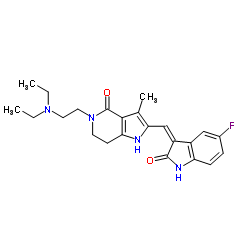
C23H27FN4O2
|
|---|---|
| 分子量 |
410.48
|
| 精确质量 |
410.211
|
| 元素分析 |
C, 67.30; H, 6.63; F, 4.63; N, 13.65; O, 7.80
|
| CAS号 |
1044040-56-3
|
| 相关CAS号 |
Famitinib malate;1256377-67-9
|
| PubChem CID |
16662431
|
| 外观&性状 |
Typically exists as Yellow to orange solids at room temperature
|
| 密度 |
1.3±0.1 g/cm3
|
| 沸点 |
677.1±55.0 °C at 760 mmHg
|
| 闪点 |
363.3±31.5 °C
|
| 蒸汽压 |
0.0±2.1 mmHg at 25°C
|
| 折射率 |
1.628
|
| LogP |
2.61
|
| tPSA |
68.4Ų
|
| 氢键供体(HBD)数目 |
2
|
| 氢键受体(HBA)数目 |
4
|
| 可旋转键数目(RBC) |
6
|
| 重原子数目 |
30
|
| 分子复杂度/Complexity |
695
|
| 定义原子立体中心数目 |
0
|
| SMILES |
C1(=O)N(CCN(CC)CC)CCC2NC(/C=C3/C4=C(NC/3=O)C=CC(F)=C4)=C(C)C1=2
|
| InChi Key |
GKEYKDOLBLYGRB-LGMDPLHJSA-N
|
| InChi Code |
InChI=1S/C23H27FN4O2/c1-4-27(5-2)10-11-28-9-8-19-21(23(28)30)14(3)20(25-19)13-17-16-12-15(24)6-7-18(16)26-22(17)29/h6-7,12-13,25H,4-5,8-11H2,1-3H3,(H,26,29)/b17-13-
|
| 化学名 |
(Z)-5-(2-(diethylamino)ethyl)-2-((5-fluoro-2-oxoindolin-3-ylidene)methyl)-3-methyl-6,7-dihydro-1H-pyrrolo[3,2-c]pyridin-4(5H)-one
|
| 别名 |
SHR-1020; Famitinib; SHR1020; SHR-1020; SHR1020; 945380-27-8; CHEMBL1278146; 768FW21J3L; 5-[2-(diethylamino)ethyl]-2-[(Z)-(5-fluoro-2-oxo-1H-indol-3-ylidene)methyl]-3-methyl-6,7-dihydro-1H-pyrrolo[3,2-c]pyridin-4-one; SHR 1020.
|
| HS Tariff Code |
2934.99.9001
|
| 存储方式 |
Powder -20°C 3 years 4°C 2 years In solvent -80°C 6 months -20°C 1 month |
| 运输条件 |
Room temperature (This product is stable at ambient temperature for a few days during ordinary shipping and time spent in Customs)
|
| 溶解度 (体外实验) |
DMSO : ~4.17 mg/mL (~10.16 mM)
|
|---|---|
| 溶解度 (体内实验) |
注意: 如下所列的是一些常用的体内动物实验溶解配方,主要用于溶解难溶或不溶于水的产品(水溶度<1 mg/mL)。 建议您先取少量样品进行尝试,如该配方可行,再根据实验需求增加样品量。
注射用配方
注射用配方1: DMSO : Tween 80: Saline = 10 : 5 : 85 (如: 100 μL DMSO → 50 μL Tween 80 → 850 μL Saline)(IP/IV/IM/SC等) *生理盐水/Saline的制备:将0.9g氯化钠/NaCl溶解在100 mL ddH ₂ O中,得到澄清溶液。 注射用配方 2: DMSO : PEG300 :Tween 80 : Saline = 10 : 40 : 5 : 45 (如: 100 μL DMSO → 400 μL PEG300 → 50 μL Tween 80 → 450 μL Saline) 注射用配方 3: DMSO : Corn oil = 10 : 90 (如: 100 μL DMSO → 900 μL Corn oil) 示例: 以注射用配方 3 (DMSO : Corn oil = 10 : 90) 为例说明, 如果要配制 1 mL 2.5 mg/mL的工作液, 您可以取 100 μL 25 mg/mL 澄清的 DMSO 储备液,加到 900 μL Corn oil/玉米油中, 混合均匀。 View More
注射用配方 4: DMSO : 20% SBE-β-CD in Saline = 10 : 90 [如:100 μL DMSO → 900 μL (20% SBE-β-CD in Saline)] 口服配方
口服配方 1: 悬浮于0.5% CMC Na (羧甲基纤维素钠) 口服配方 2: 悬浮于0.5% Carboxymethyl cellulose (羧甲基纤维素) 示例: 以口服配方 1 (悬浮于 0.5% CMC Na)为例说明, 如果要配制 100 mL 2.5 mg/mL 的工作液, 您可以先取0.5g CMC Na并将其溶解于100mL ddH2O中,得到0.5%CMC-Na澄清溶液;然后将250 mg待测化合物加到100 mL前述 0.5%CMC Na溶液中,得到悬浮液。 View More
口服配方 3: 溶解于 PEG400 (聚乙二醇400) 请根据您的实验动物和给药方式选择适当的溶解配方/方案: 1、请先配制澄清的储备液(如:用DMSO配置50 或 100 mg/mL母液(储备液)); 2、取适量母液,按从左到右的顺序依次添加助溶剂,澄清后再加入下一助溶剂。以 下列配方为例说明 (注意此配方只用于说明,并不一定代表此产品 的实际溶解配方): 10% DMSO → 40% PEG300 → 5% Tween-80 → 45% ddH2O (或 saline); 假设最终工作液的体积为 1 mL, 浓度为5 mg/mL: 取 100 μL 50 mg/mL 的澄清 DMSO 储备液加到 400 μL PEG300 中,混合均匀/澄清;向上述体系中加入50 μL Tween-80,混合均匀/澄清;然后继续加入450 μL ddH2O (或 saline)定容至 1 mL; 3、溶剂前显示的百分比是指该溶剂在最终溶液/工作液中的体积所占比例; 4、 如产品在配制过程中出现沉淀/析出,可通过加热(≤50℃)或超声的方式助溶; 5、为保证最佳实验结果,工作液请现配现用! 6、如不确定怎么将母液配置成体内动物实验的工作液,请查看说明书或联系我们; 7、 以上所有助溶剂都可在 Invivochem.cn网站购买。 |
| 制备储备液 | 1 mg | 5 mg | 10 mg | |
| 1 mM | 2.4362 mL | 12.1809 mL | 24.3617 mL | |
| 5 mM | 0.4872 mL | 2.4362 mL | 4.8723 mL | |
| 10 mM | 0.2436 mL | 1.2181 mL | 2.4362 mL |
1、根据实验需要选择合适的溶剂配制储备液 (母液):对于大多数产品,InvivoChem推荐用DMSO配置母液 (比如:5、10、20mM或者10、20、50 mg/mL浓度),个别水溶性高的产品可直接溶于水。产品在DMSO 、水或其他溶剂中的具体溶解度详见上”溶解度 (体外)”部分;
2、如果您找不到您想要的溶解度信息,或者很难将产品溶解在溶液中,请联系我们;
3、建议使用下列计算器进行相关计算(摩尔浓度计算器、稀释计算器、分子量计算器、重组计算器等);
4、母液配好之后,将其分装到常规用量,并储存在-20°C或-80°C,尽量减少反复冻融循环。
计算结果:
工作液浓度: mg/mL;
DMSO母液配制方法: mg 药物溶于 μL DMSO溶液(母液浓度 mg/mL)。如该浓度超过该批次药物DMSO溶解度,请首先与我们联系。
体内配方配制方法:取 μL DMSO母液,加入 μL PEG300,混匀澄清后加入μL Tween 80,混匀澄清后加入 μL ddH2O,混匀澄清。
(1) 请确保溶液澄清之后,再加入下一种溶剂 (助溶剂) 。可利用涡旋、超声或水浴加热等方法助溶;
(2) 一定要按顺序加入溶剂 (助溶剂) 。
Link: https://clinicaltrials.gov/ct2/show/NCT07517653
Conditions:MelanomaLink: https://clinicaltrials.gov/ct2/show/NCT06649331
Conditions:Advanced Breast Cancer|Metastatic Breast Cancer|Triple Negative Breast Cancer (TNBC)|HER2-negative Breast Cancer|Breast CancerLink: https://clinicaltrials.gov/ct2/show/NCT07382687
Conditions:Breast Cancer
Title:A Randomized, Open-label, Double-cohort Study of Fluzoparib Combined With Famitinib Malate or SHR-1701 for Neoadjuvant Therapy in Patients With Advanced Ovarian Cancer
Status:Not yet recruiting
updateDate:2026-01-21
Ctid:NCT07355010
Link: https://clinicaltrials.gov/ct2/show/NCT07355010
Conditions:Ovarian CancerLink: https://clinicaltrials.gov/ct2/show/NCT07266350
Conditions:Cervical Cancer Metastatic|Cervical Cancer RecurrentLink: https://clinicaltrials.gov/ct2/show/NCT07143292
Conditions:Cervical Cancer Metastatic|Cervical Cancer RecurrentLink: https://clinicaltrials.gov/ct2/show/NCT07147088
Conditions:Advanced Intrahepatic CholangiocarcinomaLink: https://clinicaltrials.gov/ct2/show/NCT05582499
Conditions:Breast Neoplasm|Breast Cancer|Breast Tumors|Triple-Negative Breast Cancer (TNBC)|HER2-positive Breast Cancer|HER2-negative Breast Cancer|Hormone Receptor Positive Tumor|Hormone Receptor Negative Tumor|Early-stage Breast Cancer|Locally Advanced Breast CancerLink: https://clinicaltrials.gov/ct2/show/NCT05208177
Conditions:Advanced Solid TumorLink: https://clinicaltrials.gov/ct2/show/NCT04680988
Conditions:Recurrent or Metastatic Cervical CancerLink: https://clinicaltrials.gov/ct2/show/NCT05176080
Conditions:Metastatic Breast CancerLink: https://clinicaltrials.gov/ct2/show/NCT06516289
Conditions:BRCA-Mutated Breast Carcinoma|HER2-negative Breast CancerLink: https://clinicaltrials.gov/ct2/show/NCT05594095
Conditions:Breast Neoplasm|Breast Cancer|Hormone Receptor Positive Tumor|HER2-negative Breast Cancer|Advanced Breast CancerLink: https://clinicaltrials.gov/ct2/show/NCT04888429
Conditions:Sarcomatoid Carcinoma of LungLink: https://clinicaltrials.gov/ct2/show/NCT06332300
Conditions:NSCLCLink: https://clinicaltrials.gov/ct2/show/NCT06306560
Conditions:Extensive-stage Small-cell Lung CancerLink: https://clinicaltrials.gov/ct2/show/NCT04409223
Conditions:Gastrointestinal Stromal TumorsLink: https://clinicaltrials.gov/ct2/show/NCT05760378
Conditions:Triple-Negative Breast CancerLink: https://clinicaltrials.gov/ct2/show/NCT04346381
Conditions:Solid TumorLink: https://clinicaltrials.gov/ct2/show/NCT05106335
Conditions:Advanced NSCLCLink: https://clinicaltrials.gov/ct2/show/NCT04733417
Conditions:Advanced Breast Cancer|Metastatic Breast CancerLink: https://clinicaltrials.gov/ct2/show/NCT05042375
Conditions:Non-small Cell Lung CancerLink: https://clinicaltrials.gov/ct2/show/NCT05051865
Conditions:MelanomaLink: https://clinicaltrials.gov/ct2/show/NCT05473468
Conditions:Healthy SubjectsLink: https://clinicaltrials.gov/ct2/show/NCT04355858
Conditions:Breast Cancer|Metastatic CancerLink: https://clinicaltrials.gov/ct2/show/NCT03827837
Conditions:Renal Cell Carcinoma|Urothelial Carcinoma|Cervical Cancer|Ovarian Cancer Recurrent|Endometrial CancerLink: https://clinicaltrials.gov/ct2/show/NCT04679038
Conditions:Solid TumorLink: https://clinicaltrials.gov/ct2/show/NCT05020925
Conditions:Nasopharyngeal CarcinomaLink: https://clinicaltrials.gov/ct2/show/NCT05005468
Conditions:NSCLCLink: https://clinicaltrials.gov/ct2/show/NCT04479904
Conditions:Intrahepatic CholangiocarcinomaLink: https://clinicaltrials.gov/ct2/show/NCT04814485
Conditions:Pancreatic CancerLink: https://clinicaltrials.gov/ct2/show/NCT04866381
Conditions:Esophageal Squamous Cell Carcinoma|Progression to PD-1 AntibodyLink: https://clinicaltrials.gov/ct2/show/NCT02390947
Conditions:Colorectal Cancer Metastatic|Colorectal Cancer RecurrentLink: https://clinicaltrials.gov/ct2/show/NCT04494659
Conditions:Healthy Adult SubjectsLink: https://clinicaltrials.gov/ct2/show/NCT04044378
Conditions:Effect of Drugs|Progression|Pediatric CancerLink: https://clinicaltrials.gov/ct2/show/NCT02356991
Conditions:Non-Small Cell Lung Cancer (NSCLC)Link: https://clinicaltrials.gov/ct2/show/NCT01392235
Conditions:Recurrent Nasopharyngeal Carcinoma|Metastatic Nasopharyngeal CarcinomaLink: https://clinicaltrials.gov/ct2/show/NCT01994213
Conditions:Gastroenteropancreatic Neuroendocrine TumorLink: https://clinicaltrials.gov/ct2/show/NCT01829841
Conditions:Renal Cell Cancer|Metastatic Renal Cell CancerLink: https://clinicaltrials.gov/ct2/show/NCT01462474
Conditions:Locally Advanced Nasopharyngeal CarcinomaLink: https://clinicaltrials.gov/ct2/show/NCT01762293
Conditions:Colorectal Cancer|Colorectal Cancer Metastatic|Colorectal Cancer RecurrentLink: https://clinicaltrials.gov/ct2/show/NCT02336724
Conditions:Gastrointestinal Stromal TumorInvivoChem的所有产品仅用于作科学研究,不面向患者销售
Copyright 2020 InvivoChem LLC | All Rights Reserved 粤ICP备20063088号-1


 粤公网安备 44011102003439号
 463611831
